A STUDY OF MORAL DEVELOPMENT
WITH SPECIAL REFERENCE TO PSYCHOLOGICAL NEEDS, HUMAN RELATIONSHIPS AND STRUCTURES OF JUDGMENT
By
HING-KEUNG MA
A thesis submitted in fulfilment of the requirements for the
degree of Doctor of Philosophy in the University of London.
Institute of Education, 1982.
310L. LOWN.
Too many people have helped me in one way or another in the past few years for all to be mentioned.
I
am particularly touched by their kindness at the moment of writing up this acknowledgement. Without their help, not only would I have been unable to finish this thesis butI
might have lost confidence in my pursuit of academic life.One person that came across my mind frequently at the last stage of my thesis writing is my mother, who unfortunately passed away eight years ago. It is always my deep regret that I had not been able to bring her more happiness when she was alive,
and now no longer have the chance to do so. She was the person who gave me the feeling of infinite love and inspiration.
I
wish to express my sincere gratitude to my friend Dr. T.Y. Lee, who gave me financial support when I was in need, took care of me when I was sick, and encouraged me whenI
felt desperate. His brotherly care and support has been extremely important to me in the past two years.I am greatly indebted to my supervisor Dr. John Versey for his'valuable advice and full support in the course of my study. His continuous encouragement and sympathetic understanding have Pacified most of my worries. I am particularly grateful for his -
effort in helping me to recover my physical and intellectual strength in the last Autumn.
My failure in getting a grant from any public organization has put me in a bad and difficult situation. I would have been forced to give up my study if
I
had not received the finan-cial help from my family and my friends: Dr. T.Y. Lee, Mr. M.F.L. Wong, Dr. C.S. Kwok, Ms. S.M. Fung, and Mr. and Mrs. Y.F. Leung. The Institute's Hardship Fund Committee has also granted me a loan to pay the tuition fees of my last year's study.I
wish to express my sincere thanks to all of them.Nearly all the people that I know have helped me to get sub-
jects for my empirical study. Some of them have also helped to adminis- ter the tests to small groups of subjects in secondary schools.
I must thank the following people for their help in the London Study: Dr. J. Versey, Mrs. A. Brett, Mrs. R. Clayfield, Professor K. Swanwick, Dr. R. Cowan, Dr. J. Rust, Mr. C. Watkins, Mrs. D. Penfold, Miss Barker, Mrs. Pugh, Mr. Higgins, Mr. M. Elson, Ms. S. Hill, Ms. B. Ede, Mr. M. Benge, Mr. G.P. Yeung, Mr.S.K.Leung, Mr. Y.H. Cheng, Mr. R.K.S. Wong, Mrs. M. Kim, Dr. T.Y. Lee, Miss. P.Y. Lai, Miss A.H.F. Tsui, Miss c. Kwan, Mr. M. F.L. Wong and Miss S.S. Yeo. I would also like to thank the following people for their help in the Hong Kong Study: Mr. C.M. Tsui, Ms. SnM. Fung, Ms. M. Wong, Mr. K.S. Lau, Mr. S.C. Fung and his students. Mr. B.A. Sarreal and Mr. M.P. Siu have helped me to bring the
grateful to Mr. Y.H. Cheng for his help in getting me some subjects and in arranging a group of college students to code my Hong Kong data. Mr. C.M. Tsui has kindly helped me to prepare the Chinese
questionnaire in Hong Kong. I also owe many thanks to Mr. Y.F. Leung, Dr. T.Y. Lee and Mr. C.M. Tsui for their help in refining the
Chinese translation of the questionnaire. All my brothers, sisters and first cousins have provided valuable help in the data collection in Hong Kong. I must thank in particular my brother Hing-Bun
who has carried out my research instructions efficiently and correctly. Without his help, it would have been impossible for me to complete the Hong Kong Study in such a short time. I also wish to thank my friend Mr. D. Seling for his help in collecting data in Malaysia.
In addition, I owe many thanks; to the staff of the Institute's Reprographic Department for their efficient copying service; to Ms. L.A. Noble, Mr. J. Anthony, Dr. B. Lienard and Mr. T. Halil of the Institute's Statistics & Computing Department for their computing service; to the staff of the University of London Computer Center for their excellent punching service; to the secretaries of my
depart-ment for their unfailing help and kindness; to Mr. C. Owens for
giving me some computing advice; to Mr. and Mrs. M. Chaudhry for their typing service; and to Mr. Y.H. Cheng and Mr. B.A. Sarreal for
typing part of the appendices.
All my friends and teachers have encouraged and helped me in one way or another when I felt desperate and despaired. I
wish to express my sincere gratitude to the following people, besides • those already mentioned; Dr. F.J. Taylor, Professor H. Francis,
Ms. A. Hobsbaum. Mrs A. Brett, Dr. C.S. Kwok, Dr. T.K. Yeung, Mrs. T.Y. Lee, Ms J. Oliveira and Mrs. O.L. Wong.
The support from my family is always immensely great. The love and affection from every member of my family has been extremely important to me in the past few years.
Finally, I wish to express my sincerest gratitude to all the subjects who participated in my empirical study. Their help and co-operation have touched me deeply.
Nature is not always kind to us. Nevertheless, the warmth and inspiration that I felt deeply when I was being loved, pacified, encouraged, taken care of, and helped in one way or another by so many people from different countries have demonstrated to me the good and beautiful side of Nature. It is only with both love and universal justice that we shall ultimately be free from despair, hostility, jealousy, prejudice, and mental and physical illness; and thus we shall be able to self-actualize ourselves, that is, to be ourselves. It is only at that stage the human species as a whole will be able to comply with Nature in the most harmonious way. This is what I have learned from all of those who have kindly helped me in the past few years.
This study consists of two parts: the first part is
the establishment of a theoretical model of moral
develop-ment and the second part is an empirical study which includes
the construction of a new psychological test called The
Moral Development Test (MDT).
The proposed theory postulates the following three
parameters to explain the fundamental nature of moral
development: Basic Psychological Needs (Parameter N), Human
Relationships (R) and Structures of Judgmeht (J). Different
current theories are applied in the elaboration of the above
three parameters: Humanistic Psychology particularly
Maslow's Theory for N, Sociobiological Theory of Kinship for
R and Cognitive-developmental theory for J. The theory is
a 7-stage model. In addition, an attempt is made to employ
the Chinese Tao Philosophy in the primitive establishment
of a theoretical basis for the Ultimate Stage of Human
Development i.e. Stage 7 in the theory. The derivation of
the theory is mathematically oriented.
The MDT is constructed mainly for validating the
above theoretical model. Each form of the MDT consists of
five or six hypothetical dilemmas.
The questions for
each dilemma are divided into two parts. Part I is used
to test the Parameters N and R and Part II the Parameter J.
It was found that the test-retest and internal
con-sistency reliabilities of the major MDT indices (labelled
as NRRJ and WNRRJ indices) were usually in the 0.80s to
0.90s. The face validity, convergent-divergent validity
and the construct validity have been demonstrated to be
good. In addition, results of cross-cultural analyses
using the English (London) and Chinese (Hong Kong) samples
also support the cultural universal hypothesis of the present
theoretical model. Nevertheless, the MDT only explores
5
TABLE OF CONTENTS
ACKNOWLEDGEMENTS 2
ABSTRACT 4
CHAPTER
1. The Psychology of Moral Development: An Introductory Overview
2. Moral Development: Its Nature and
Measurement (A Literature Review) 14
3. A Theoretical Model of Moral Development 133
4. Fundamental Nature of, Moral Development:
An Objective Measure 166
5. The Present Study 226
6. Results 261
7. Discussion 329
8. Suggestions and Conclusions 374
BIBLIOGRAPHY 377
APPENDIX
1. Current Theories Which Have A Bearing On Moral Development (A Supplement to
Chapter 1) 395
2. Supplementary Materials to Chapter 2 418
3. A Summary of the Notations Used in
Chapter 3 450
4. A Derivation of the NRRJO1 and WNRRJO1 Indices
(i) Form A 453
(ii) Form B
466
(iii) 'Civil War' (Long Version) 478 (B) Differences Between the MDT Forms A(IS) and A
480
(C) MDT Form A(5): Chinese Version
482
(D) Kohlberg's Moral Judgment Instrument (MJI): Form A 496 (E) Rest's Defining Issues Test (DIT) 498 (F) Computer Codes for the MDT Indices and Some Important
Variables 503
6.1 (A) MDT Part II Scoring Program 505
(B) MDT Part II: Rate - Rank Consistency Check 507 6.2 to 6.7 Further Details Regarding the Empirical Results
and Findings 511
MICROFICHES
1. APPENDICES *6.2 (E) TO 6.2 (I) *: London Study 534 2. APPENDIX *6.2 (J)* : MDT - DIT Study
537
1. The Psychology of Moral Development: An Introductory Overview'
The study of morality has long been a most important topic in philosophy. However, the systematic study of moral development in psychology only started in the past few decades, with rapid improvements in the past twenty years or so. In some sense, moral psychology is only in its stage of childhood at the present time.
The main objective of this chapter is to outline some of the common concepts of morality in psychology and to present an introductory overview of the current theories of moral development.
1.1. Some Common Concepts of Morality in Psychology
The concept of morality has been extensively studied by both Eastern and Western philosophers throughout history. Western philosophers such as Plato, Socrates, Aristotle, Kant, Bentham, Mill, etc. and Chinese philosophers such as Confucius, Mencius and many others have dealt with the concept of morality in detail and have given us many insights into the complexities of the problems involved.
*A substantial part of this Chapter is based on Chapters 1 and 2 of the author's M.A. dissertation (Ma, 1980).
This study is predominantly a psychological one, therefore, it will focus more on the interpretation of the concepts of morality given by psychologists, although the work of the sociologist , Durkheim, will be considered because of his influence on cognitive developmental psychologists.
In the following paragraphs, some common concepts of morality will be discussed briefly. They will be
elaborated in further detail in either Appendix 1(A) or Chapter 2.
(1) Psychoanalysts tend to define morality as a force
that is negative to life and love; a force that causes mental illness and death.Gilligan (1976, p.145) defines morality as:
"action and thought motivated by a sense of compulsion or obligation rather than by love (spontaneous
inclination or wish), and by a negative wish to avoid painful feelings (shame or guilt) rather than by a positive wish to express feelings of love".
(2) Behaviourists tend to link morality with social condi-tioning or social conformity. Eysenck (1976) defines conscience as a "conditioned reflex" in his Biological explanation of morality. He argues that:
everything thus labelled." (Eysenck, 1976, p.109)
(3) The concept of morality in the Cognitive Developmental Approach is elaborated in detail by Kohlberg (1981, 1971, 1969). Basically speaking, the concept is
constructed on Kant's moral philosophy and Rawl's (1971) theory of justice. A detailed explanation of this concept is given in Section 2.3.3.
(4) Morality can also be defined in terms of altruism and social norms or moral rules. Wright (1971) writes:
"moral rules are foundational in the sense that they are concerned with the maintenance of, for instance, trust, mutual help and justice in human relationship. .... Moral rules form the yardstick against which we evaluate the rules of any particular activity".
(p.13). It follows that
"moral behaviour consists of all the various things people do in connection with moral rules." (p.15) A more detailed elaboration of the concept of morality
in terms of empathy, altruism and social norms is given in Section 2.2.
self-determination. He elaborates the last element as follows:
"We must have knowledge, as clear and complete as
awareness as possible of the reasons for our conduct. This consciousness confers on our behaviour the
autonomy that the public conscience from now on requires of every genuinely and completely moral being". (Durkheim, 1925, p.120)
In other words, such moral behaviour "must be
freely desired, that is to say, freely accepted (p.120).
1.2. An Overview of Current Theories which have a bearing on Moral Development.
The term 'theory' is used loosely here; any fairly systematic thoughts on moral development is regarded as a 'theory'.
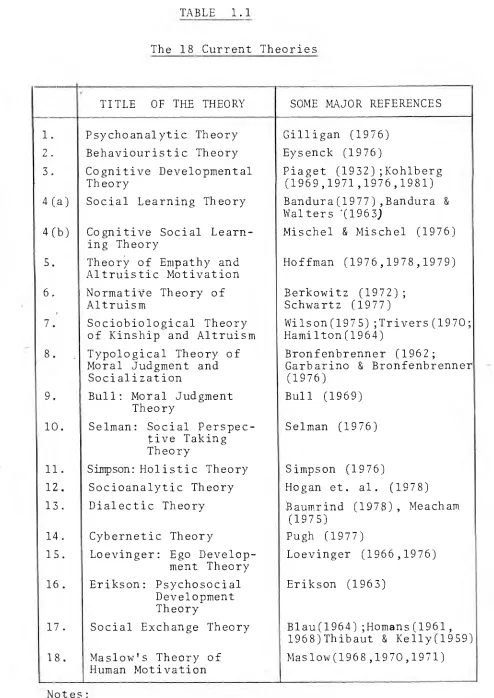
18 current theories which have a bearing on Moral development are discussed in this thesis. Some of them are elaborated in Chapter 2 and some in Appendices 1(A) and 1(B). These theories are grouped in Figure 1.1 in three categories: (1) Feeling or Emotional aspect
(2) Behavioural aspect and (3) Cognitive aspect. It is important to note that:
(i) the list is by no means exhaustive, the criterion for selection is basically a subjective one
(ii)Not all the theories in the list deal with moral development directly and explicitly. Some of them
11
to the study of moral development.
(iii)The categorization of the theories is not entirely rigorous because of the complexity of the topic and the preliminary nature of development of some of the theories.
The following figure is constructed mainly to present a very rough and simple picture of the current theories listed in Table 1.1. The lines indicate the relationships between the various theories and the three'basic aspects of moral development.
The present study seeks to establish relationships between parameters derived for the three fundamental aspects. The parameters are:
(i) Psychological Needs (labelled as Parameter N), (ii) Human Relationships (Parameter R) and
(iii)Structures of Judgment (Parameter J) (See Chapter 3). These parameters are placed within a theoretical model (labelled as *TMD in Figure 1.1) which is tested in the
TABLE 1.1
The 18 Current Theories
TITLE OF THE THEORY SOME MAJOR REFERENCES
1.
Psychoanalytic Theory Gilligan (1976)L.. Behaviouristic Theory Eysenck (1976)
3. Cognitive Developmental Piaget (1932);Kohlberg
Theory (1969,1971,1976,1981)
4 (a) Social Learning Theory Bandura(1977),Bandura & Walters "(1963)
4 (b) Cognitive Social Learn- ing Theory
Mischel & Mischel (1976) 5. Theory of Empathy and Hoffman (1976,1978,1979)
Altruistic Motivation
6. NormatiVe Theory of Berkowitz (1972);
Altruism Schwartz (1977)
7. Sociobiological Theory Wilson(1975) ;Trivers(1970; of Kinship and Altruism Hamilton(1964)
8. Typological Theory of Bronfenbrenner (1962;
Moral Judgment and Garbarino & Bronfenbrenner
Socialization (1976)
9. Bull: Moral Judgment Bull (1969)
Theory
10.
Selman: Social Perspec- tive TakingSelman (1976) Theory
11. Simpson: Holistic Theory Simpson (1976)
12. Socioanalytic Theory Hogan et. al. (1978)
13.
Dialectic Theory Baumrind (1978),. Meacham (1975)14. Cybernetic Theory Pugh (1977)
15, Loevinger: Ego Develop- ment Theory
Loevinger (1966,1976) 16. Erikson: Psychosocial Erikson (1963)
Development Theory
17. Social Exchange Theory Blau(1964);Homans(1961, 1968)Thibaut & Kelly(1959) 18. Maslow's Theory of Maslow(1968,1970,1971)
Human Motivation Notes:
13 5 n Mor a l Dev e lo Pq Cur r en t T heor ies Hav in
a)
cd5
0a) 0 -p Pi 0 0 rl 0 0 0 Soc ia l Exc U) / / / / 2. Be hav iou r is t ic ^-, M OR AL DE V EL OP M EN T AND B EHA VI OUR Soc ia l Le 0) H -P • a> •
1 0
a) a) 4 4 E-1
H rCI
II cd
Moral Development: Its Nature and Measurement.
While the first chapter provides an overview of the major current theories of Moral Development, this chapter gives a more detailed review of the literature directly relevant to this study. The first three sections (2.1 - 2.3) give a background literature review for the theoretical model constructed in the next chapter. Section 2.1.describes the Humanistic Approach in the study of
Psychological Needs, in particular, Maslow's theory
of Human Motivation and the concept of self-actualization will be elaborated in detail . Section 2.2 gives a
brief description of the concepts and origins of altruism and human relationships. Some emphasis is placed
on the Evolutionary and Sociobiological Theories. In Section 2.3, the Cognitive Developmental Theory of Morality is reviewed in detail .
A primitive attempt to introduce Tao Philosophy in the study of the Ultimate Stage of Human Development is carried out in Section 2.4. Finally, Section 2.5 outlines the details of the Moral Judgement and Decision System of Man as a Value-driven system, which has a
15
2.1 Psychological Needs
Psychological studies of instincts, drives and needs have led to the establishment of a large number of theories of motivation (see,eg Weiner, 1980; Bolles, 1975; Madsen, 1974). However, the objective of this section is to provide the background literature review for the theory established in Chapter 3 and therefore the discussion will be limited to Maslow's theory of Human Motivation and his concept of self-actualization.
The existential philosophy and phenomenological approach in sociology influenced a group of psycholo-gists in America in the 1950s. These psycholopsycholo-gists were _highly critical of Freud's negative view of human nature
which was based mainly on his clinical studies of neuro-tic and psychoneuro-tic subjects. On the contrary, they
postulated that human nature is basically good or neutral (Maslow,-1965, p.308-309) and that the study of those mentally ill is limiting. They argued that
there should be an emphasis on the importance of studying mentally healthy people. Maslow, a major proponent
of this approach, did this in his study of those people considered to be extremely mentally healthy and proposed a theory which includes the concepts of self-actualization, B-cognition, Metamotivation and Transcendence (Maslow,
1968, 1970, 1971).
and many others, a "third force" in psychology, which is often called Humanistic Psychology was established. The humanistic psychologists usually take a 'holistic' app-roach in developing their theories and their research interests are probably best described by the statement of purpose of the Journal of Humanistic Psychology, which states that
"topics of special interest are authenticity, encounter,
consciousness, self-actualization, self-transcendence, search
for meaning, creativity, personal growth, humanistic psychotherapy, confluent education, values, identity and love."
2.1.1 Maslow's Theory of Human Motivation
I. Propositions
17
1. Gestalt Postulate of Individual (P1, P12)
In general, the individual is assumed to be an integrated, organized whole. However, Maslow is also aware of the fact that an individual sometimes does not behave as an integrated whole. He writes,
"Apparently the organism is most unified in its
integ-ration when it is successfully facing either a great joy or creative moment or else a major problem or a threat or emergency. But when the threat is overwhelming or when the organism is too weak or helpless to manage it, it tends to disintegrate." (Maslow, 1970, p.30)
2. Universality of Ultimate Needs (P3, P4, P9)
The unconscious ultimate needs or desires of human being are universal, that-is, similar in all people.
These ultimate needs form a sound fundamental base for the classification of motivational life.
3. Fundamental Nature of Motivation (P5, P6, P13)
4. Hierarchy of Needs and Drives (P7, P8)
Human needs are arranged in a hierarchy of prepo-tency. Similarly, drives are arranged in a hierarchy of specificity.
5. Environmental Influences on Motivation (P11, P14, P15)
Human motivation is actualized in behaviour under the influence of environment. For instance, people have been taught by experience to be realistic, that is, to "yearn consciously for that which might conceivably be
actually attained" (Maslow, 1970, p.31). It is also postulated that reality exerts an influence on the unconscious impulses or motivations.
In addition, three of Maslow's propositions (P2, P10, and P16) described below are regarded as scientific
attitudes or arguments rather than as scientific postulates: (i) P2: The choice of hunger as a paradigm for all
other motivational states is regarded as prob-lematic. One main reason is that hunger is "different from other motivations in that it
has a known somatic base, which is unusual for motivational states" (Maslow, 1970, p.20). In other words, the hunger drive is atypical rather than typical in human motivation.
HIGHEST
LOWEST 19
the use of animal data as a base for theorizing human nature is debatable.
(iii) P16:The highest capacities of the healthy and strong people should be studied in parallel with those psychologically abnormal ones.
II. The Theory
1. Maslow's Hierarchy of Basic Needs
Maslow (1970) hypothesizes a hierarchy of Basic Needs as follows:
Degree of Pre otency Physiological Needs
Safety Needs
Belongingness and Love Needs
Esteem Needs
Self-actualization Needs
Lower Needs
Higher Needs
Cognitive and Aesthetic Needs
In addition to the above five basic needs, Maslow (1970) also hypothesizes two other needs, namely,
cogni-tive needs and aesthetic needs, of which he says that little knowledge is known. Cognitive needs refer to the desires "to satisfy curiosity, to know, to explain, and to understand" (p.38). He also argues that cognitive needs are similar to the above basic needs the sense that they are themselves conative. Similarly, the aes-thetic needs refer to the needs for beauty. He further elaborates: "The needs for order, for symmetry, for closure, for completion of the act, for system, and for structure may be indiscriminately assigned to either cognitive, conative, or aesthetic, or even to neurotic needs." (p.51)
2. The Emergence of New Needs
According to Maslow (1970) , if all the basic needs are unsatisfied and the organism is dominated by physio-logical needs, then all the other needs are suppressed. On the other hand, if the lower needs are satisfied,
higher needs will emerge. In other words, the above five basic
needs are arranged in a hierarchy of relative prepotency. However, this does not mean that a need must be "1000
21
of satisfaction in lower needs and a lower percentage of satisfaction in higher needs. He also asserts that the hierarchy of Basic Needs is not necessarily a fixed order for all people. Exceptional cases are possible and
"explainable" by other supplementary arguments. For example, some people may value 'self-esteem' as more important than 'love'. Maslow argues that such people are often strong, powerful, self-confident or aggressive. they "seek high esteem and its behaviour expressions
more as a means to an end than for its own sake; they seek self-assertion for the sake of love rather than for self-esteem itself." (P.52)
3. The origin of Basic Needs
According to Maslow (1970) , all basic needs are supposed to be instinctoid and innately given. That is, they "are in some sense, and to some appreciable degree, constitutional or hereditary in their determination". (P.88).
4. Universality of Basic Needs
Maslow argues that basic needs are "more ultimate, more universal, more basic than the superficial conscious desires, and makes a closer approach to common human
and that the order of the hierarchy of basic needs is the same for all persons. Instead, he argues that the extent of such universalities is probably the highest in the field of motivational studies.
5. Higher and Lower Needs
The basic needs are divided into two categories: Growth Needs and Deficiency Needs. Growth,needs refer to self-actualization needs and deficiency needs to all the others. In addition, Maslow calls those needs with a higher degree of prepotency in the hierarchy as lower needs (e.g. physiological and safety needs) and those with lower degree of prepotency higher needs (e.g. esteem needs and self-actualization needs.) He hypothesizes 16 propositions regarding the differences between higher and lower needs (Maslow, 1970, p.98-100). Only the first
two of them are mentioned here, as they are concerned with the developmental aspects of basic needs. First of all, it is argued that the basic needs form a progressive evolutionary developmental pattern. The lower needs pre-cede the higher needs in phyletic or evolutionary deve-lopment. Maslow (1970) argues that "the higher the need the more specificially human it is" (p.98). Secondly, the basic needs form an ontogenetic developmental pattern
is,
23
2.1.2 The Concept of Self-actualization
The concept of self-actualization is one of the cen-tral themes of Humanistic Psychology. Broadly speaking, self-actualization means one's desire or tendency to
actualize or fulfill one's potential. K. Goldstein (1939) refers one's potential or capacities as one's "nature". He argues that the tendency "to actualize 'itself', is
the basic drive, the only drive by which the life of the organism is determined" (p.196). An example of
self-actualization given by Goldstein (1939) is the need to complete incomplete actions and the urge to perfection. Goldstein uses the terms "perfection" and "imperfection" in a very broad sense. He argues that the driving force underlying self-actualization "is given in the experience of imperfection - be it thirst, hunger or experience of being able to fulfill any performance which seems to be within our capacities - the goal is the fulfillment of the task". (Goldstein, 1939, p.205)
Inspired by Goldstein's work, Maslow develops a theory of self-actualization, which is the focus of dis-cussion in this section.
Characteristics of Self-actualizing People
Maslow (1970, Chapter 11) proposes 15 character-istics of self-actualizing people. After extensive
public and historical figures that can be regarded as self-actualizers. Among the list of self-actualizers,
there are "2 fairly sure historical figures (Lincoln in his last years and Thomas Jefferson)" and "7 highly
probable public and historical figures (Einstein, Eleanor Roosevelt, James Addams, William James, Schweitzer,
Aldous Huxley and Spinoza)" (Maslow, 1970, p.152).
In the following paragraphs, Maslow's 15 charac-teristics of self-actualizing people are summarized-into 6 general features. (See also Appendix 2.1(C))
(Abbreviation used: SAP = Self-actualizing Person)
1. SAP as a social being (S1, S2, S5, S10, S13)
SAPs tend to have superior and efficient perception of reality, they have "an unusual ability to detect the spurious, the fake, and the dishonest in personality,
and in general to judge people correctly and efficiently" (p.153). In addition, they can accept themselves and
others "in the stoic style, with all its shortcomings, with all its discrepancies from the ideal image without feeling real concern." (p.155)
25
tend to have a need for privacy, a need for detachment, a need for being alone and solitary without causing harm or discomfort to others.
2. SAP as a moral and democratic being (Sll, S12)
SAPs are fair, democratic people who always know how to discriminate clearly between means and ends, and between good and evil.
3. SAP as a broad-minded humanistic being (S4, S6, S9,
S15)
SAPs tend to show a deeper identification with human species as a whole. They have some mission
in life; some tasks that "they must do or want to do". Their missions and tasks are largely concerned with the good of mankind in general. They tend to be more inde-pendent of the physical and social environment,. that is, more independent of their cultural influences or show a higher degree of autonomy in thought and behaviour.
4. SAP as a creative being (S14)
5. SAP as a child-hearted being (S3, S7)
SAPs always behave with a high degree of spontan-eity, simplicity and naturalness, which are common in young children's behaviour. They have also "the wonder-ful capacity to appreciate again and again, freshly and naively, the basic goods of life, with awe, pleasure,
wonder and even ecstasy ...." (p.163)
6. SAP as a peak experiencer (S8)
Peak experience - moments of self-actualization, states of being or transcendence of the self, is one of the important concepts in Maslow's theory.
Peak experience can be defined as moments during which most of the characteristics described above are experienced more fully. In other words, one feels more open, more creative, more humorous and more
ego-transcending during such episodes. In Maslow's words, the SAP "becomes in these episodes more truly himself, more perfectly actualizing his potentialities, closer to the core of his being, more fully human." (Maslow, 1968, p.97). In general, SAPs show a much higher fre-quency of peak experience than non-SAPs.
27
FInally, it should be emphasized that SAPs are not entirely perfect people, there are moments during which SAPs are "boring, irritating, petulant, selfish, angry, or depressed." (Maslow, 1970, p.176).
Self-actualization as a Process of Psychological Growth
As mentioned before, the self-actualization need can be regarded as a growth need and the process of self-actualization is a process of psychological growth. But how does growth take place? Maslow (1968) argues.
'"Growth takes place when the net step forward is subjec-tively more delightful, more joyous, more intrinsically satisfying than the previous gratification with which we have become familiar and even bored...." (p.45)
That is to say, growth occurs simply because we subjectively like it to occur or we prefer the next step to the present one. In short, "the new experience vali-dates itself rather than by any outside criterion. It is self-justifying, self-validating." (Maslow, 1968, p.45)
2.13 Empirical Studies of Maslow's Theory
I. Maslow's Hierarchy of Basic Needs.
that is the Physiological and Safety Needs, are clearly supported by empirical evidence (p.684). More recently, in a review of ten factor-analytic and three ranking studies testing Maslow's Hierarchy, Wahba and Bridwell (1976) write,
"This literature review shows that Maslow's Need Hierarchy Theory has received little clear or consistant support from the available research findings. Some of Maslow's propositions are totally re-jected, while other receive mixed and questionable sup- port at best." (p.2.33)
Indeed, there are very few empirical studies which lend support to the whole ofMaslow's Hierarchy. Very often, experimental psychologists find difficulties in operation-alizing Maslow's five basic needs and tend to regroup them into four or less categories. For example, Graham and Balloun (1973) grouped Maslow's five' Basic Needs into 4 categories: Physiological, Security, Social and Self-actualization needs and used three different methods of data collection in their study. They found that data collected by two of the three methods used supported Maslow's theory. Studies by Mathes and Edwards (1978) and Mathes (1981) suggest that Maslow's Hierarchy should be reduced to two or three levels or categories. Mathes (1981) suggests that Maslow's Hierarchy should be re-vised to "contain only three levels - physiological,
29
support for Maslow's Hierarchy, Alderfer (1972) proposes a hierarchy of three needs only: Existence, Relatedness and Growth needs. The theory is called E.R.G. theory. Alderfer (1972) argues that his theory is better than Maslow's theory on empirical grounds (p.53).
More recently, Goebel and Brown (1981) studied
Maslow's Hierarchy of Needs by constructing a test called the Life Motivation Scale, which requires subjects to rank
statements representing Maslow's five needs (Physiolo-gical, Security, Love, Self-esteem and Self-actualization needs). A sample of 111 subjects, aged 9 to 80 years old was used. Dividing the subjects into five age groups (children, adolescents, young adults,.middle-aged adults, old adults) , an analysis of variance (AGE x SEX) was
performed. It was found that there were significant age differences for four needs. On the other hand, the re-sults are said to give limited support to Maslow's
Hierarchy as a developmental sequence because they do not show clear-cut and consistent developmental trends.
II. Maslow's concept of self-actualization
Apart from Maslow's own empirical work (see e.g. Maslow, 1970, Chapter 11; 1968, Chapter 6), the other important empirical study of self-actualization is
value judgements. Items
were
constructed based on the theoretical work of Maslow, Rogers, Fromm, Horney and many others. There are 12 scoring categories or dimen-sions, which include, for example, (i) Self-actualizing value: "Measures affirmation of a primary value of self-actualizing people" (Shostrom, 1964, p.209) (ii) Self-regard: "Measures affirmation of self because of worth or strength" (p.209) (iii) Self-acceptance. (Measuresaffirmation or acceptance of self in spite•of weakness or deficiencies." (p.209) The measure is claimed to discriminate effectively self-actualizing subjects from non-self-actualizing ones. A large number of researches have been done using this test (See Shostrom, 1980).
One major defect of the POI as a measure of
Maslow's concept of self-actualization is that it misses a number of important concepts in Maslow's theory.
31
2.1.4. A Critical Discussion of Maslow's Theory
There are two major defects in Maslow's system: (i) Vague Concepts
Many important concepts in Maslow's theory are vaguely or loosely defined or constructed. For example, the concept of need itself. Wahba and Bridwell (1976) write,
"It is not clear what is
meant by the concept of need. Does need have a
psycholo-gical and/or physiolopsycholo-gical base? Does a need come to existence because of defi-ciency only or does need
always exist even if it is gratified? How can we iden-tify, isolate and measure different needs?"
(p.234)
Another example is the concept of self-actualization. Maslow likes to use lots of adjectives or loosely defined terms to elaborate a point or to describe a situation. This does not help other psychologists to understand or operationalize his concepts. It sometimes misleads them. Therefore, Cofer and Appley (1964) urge that the
pre-requisite for further development of the concept of self-actualization "is the formulation of the important ideas in language that is relatively precise." (p.692)
(ii) Problemetic empirical methodology
empirical system to test or validate his theory. Very often, the data collected by him act as a source of stimulation for constructing theories rather than as a source of empirical facts testing his theory. This practice leads him to ignore occasionally the scientific strictness of empirical methodology. For example, (i) In a study of peak experience, Maslow (1968) writes, "No one subject reported the full syndrome. I have added together all the partial responses to make a 'perfect' composite
syndrome" (p.71). (ii) Maslow's study of self-actualization using a group of historical and public figures as subjects is criticized for selecting a sample of people he admired
and "eliminated people with gross pathology - the Dostoyevskis and Van Gogh" (Smith, 1973, p.24). This implies that Maslow's "empirical definition of psycholo-gical health or self-actualization thus rests, at root, on his own implicit values that underlie this global judgement." (Smith, 1973, p.24). In other words, the systematic biases in the sampling of his self-actualizing subjects in principle damages the universality of his concepts of self-actualization.
Unless the methodology is greatly improved, it is difficult to construct a scientific theory of man based on Humanistic Psychology in general and Maslow's Theory in particular.
33
2.2 Human Relationships and Altrusim.
The objective of this section is limited to the exploration of a base for the construction of a heirarchy of Human Relationships in terms of altruism. In addition,
an overview of different theoretical studies of altruism is also given.
Consider a person A interacting with another person B in a social situation S. It is argued that the moral behaviour of A depends on the relationship between A and B. For example, the probability of carrying out an al-truistic act by A to B is much higher if B is the parent of A than if B is a stranger to A in similar social
situation S. In other words, some people are more import-ant to A than others. The problem is: who are importimport-ant and who are not? Why is this so?
2.2.1 The Biological Basis of Human Relationships and Altruism.
Evolutionary theorists and Sociobiologists attempt to answer the problem in terms of natural selection.*
Sociobiology, as defined by Wilson (1975), is "the systematic study of the biological basis of all
social behaviour."(P.4) Its central theoretical problem is "how can altruism, which by definition reduced personal fitness, possibly evolve by natural selection?" (Wilson, 1975, p.3) The answer provided by sociobiologists is kinship. In general, sociobiologists argue that
"When any behaviour under study reflects some com-ponent of genotype; animals should behave so as to
maximize their inclusive fitness. In most cases this is achieved by maximizing the production of success-ful offspring."
(Barash, 1977, p.63)
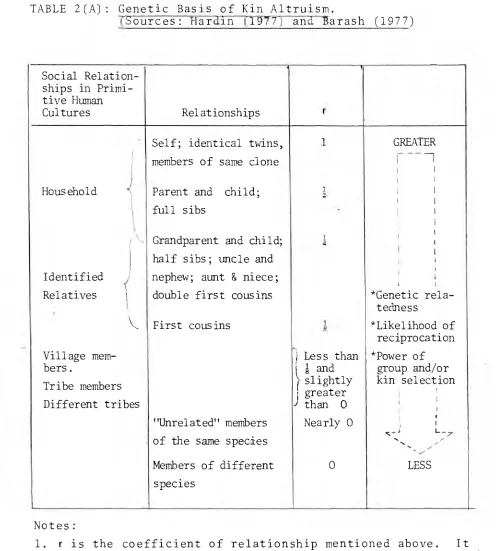
The above quoted statements are tentatively called the . Central Theorem of Sociobiology by Barash. More ex-plicitly, the evolution of altruism is explained in terms of group selection, kin selection, parental manipulation
and the development of reciprocal altruism. (1) Group Selection and Kin Selection
The concepts of group selection and kin selection were originated by Charles Darwin in "The Origin of
35
greater commonality of genetic makeup among close rela-tives" (Staub, 1978, p.27). According to Wilson (1978), "the closer the genetic relationship of the members of a group, the more stable and intricate the social bonds of its members." (p.73) In addition, sociobiologists also argue that the concept of kinship can be applied to all species. (Barash, 1977, p.85)
A central concept of kin selection is established by Hamilton (1964).
Consider a person A carrying out an altruistic act to another person B.
Define
Recipient B's benefit Altruist A's cost
r = Coefficient of relationship between altruist A and recipient B, summed for all recipients
= Proportion of genes in A and B that
are identical because of common descent. (For further explanation of r, see e.g., Wilson (1975)
p.74-75; Barash (1977), p.85-87).
Hamilton argues that the genes for altruistic be- haviour will be selected if k > 1
r.
Suppose B is a brother of A, that is r =
2 ' half of B's genes are identical to A by common descent,
and therefore k >2. Suppose in extreme case the altruis-tic act causes A to leave no offspring but the act "more than doubles the brother's personal representation in the next generation, it will ipso facto increase the one-half of the genes identical to those in the altruist, and the altruist will actually have gained representation in the next generation." (Wilson, 1975, p.118) In other words, the genes of the altruist A is selected at family level. That is, altruistic behaviour in such cases is favoured in terms of natural selection because the inclusive fit-ness is increased rather than decreased.
The following table
2(A)
is constructed based on Hardin (1977, p.13) and Barash (1977, p.316).(2) Parental Manipulation
Consider an example given by Ruse (1979, p.47). A parent has five children; it is impossible for all of them to survive. However, if the parent tries to mani-pulate one of the children to act as an altruist who will eventually be self-sacrificed for the benefit of the other four children, then all the other four will survive.
Sociobiologists claim that genes causing such parental manipulation are strongly favourdd by natural selection. (see e.g., Barash, 1977, p.95; Alexander, 1974).
37
TABLE 2(A): Genetic Basis of Kin Altruism.
(Sources: Hardin (1977) and Barash (1977)
Social Relation-ships in Primi-tive Human
Cultures Relationships
1
r
Household
Identified ?
Relatives
Village mem- bers.
Tribe members
Different tribes
Self; identical twins,
members of same clone
Parent and child;
full sibs
Grandparent and child;
half sibs; uncle and
nephew; aunt & niece;
double first cousins
First cousins
"Unrelated" members
of the same species
Members of different
species 1 1 . i 4 1 A --,
i Less than i l and
slightly i greater
-' than 0 Nearly 0 0 GREATER *Genetic rela-tedness *Likelihood of reciprocation *Power of group and/or kin selection , 1 , , 1 ,s-J L_7
-. -..
LESS
Notes:
1. r is the coefficient of relationship mentioned above. It is also referred as "Genetic kinship" by Hardin (1977,p.13).
2. It is obvious that no two members in the same species "can
be absolutely unrelated", therefore the value of r for
"unrelated" members of the same species is nearly but
not exactly zero. (Barash, 1977, p.85)
Selection, a person A helps another person B because they are related, that is, B will pass on to the next generation the genes identical to those of A. On the other hand, in Parental Manipulation, A helps B because A is manipulated
by his/her parent C to do so.
(3) Reciprocal Altruism
According to Trivers (1971), reciprocal altruism can be selected even when the recipient is not closely related with the altruist. That is, Kin Selection is not
applicable in this case. In addition, sociobiologists
argue that reciprocal altruism can operate between members of different species. Reciprocal altruism is selected if the performance of altruistic behaviour results in "a return of altruistic behaviour towards the original
al-truist such that the ultimate benefit in units of inclusive fitness is greater than the cost." (Barash, 1977, p.94)
Consider a hypothetical example given by Trivers (1971, p.190):
A person X is drowning and another person Y is going to rescue X.
Chance of X being drowned to death = 1/2
Chance of Y being drowned to death if he tries to rescue X = 1/20
39
reciprocal altruism, each of them reduces the chance of being drowned to death from 1/2 to 1/20 x 2 = 1/10.
"A population at large that enters into a series of such moral obligations, that is, reciprocally altruis- tic acts will be a population of individuals with general-ly increased genetic fitness." (Wilson, 1975, p.120)
Similarly, the concept of reciprocal altruism can also be applied to explain one's general tendency to like others and to form friendships with those one likes.
Trivers (1971) also argues, "Selection will favour liking those who are themselves altruistic" (p.213)
Strictly speaking, reciprocal altruism cannot be regarded as a kind of altruism similar to that involved in Kin Selection and Parental Manipulation because it is basically selfish.
The Debate of Sociobiology
As usual, any study of man is controversial
Sociobiology is no exception. There are numerous criticisms of sociobiology by anthropologists, psychologists and philo- sophers of different schools of thought. (see e.g.,
(1978, particularly the debate between Marxists and Wilson, p.259-269 and p.280-303, and Ruse's paper, p. 355-375); Wilson (1975, particularly chapter 27: Man: From Sociobiology to Sociology); Wilson (1978)).
The debate (nature vs nurture or biology vs culture) is complex. In the following paragraphs, the claim of sociobiologists and the objections given by Montagu (1980) and Campbell are discussed briefly.
Sociobiologists claim that human social behaviour is genetically determined. (Wilson, 1978, p.19). Wilson (1978) writes:
"Can the cultural evolution of higher ethical values gain a direction and momentum
of its own and completely replace genetic evolution? I (E.O. Wilson) think not. The genes hold culture on a leash. THe leash is very long, but inevitably values will be constrained in
accordance with their effects on the human gene pool."
(p.167)
Higher ethical values refer to, for example, Kohlberg's Stage 6 thinking. In short, Wilson (1975) argues that
it is the right time to attempt to biologicize ethics now. (p.562)
41
that human social behaviour has a genetic base but this does not mean that such behaviour is genetically deter-mined. He also argues that the behaviour of an organism is developed through the interaction between the organism and environment and not between the genes and environment. "In short, it is the action of the environment upon the organism that influences and makes possible the functional
expression of the genes." (Montagu, 1980, p.11)
In a study of intergroup conflict and altruistic behaviour, psychologist Campbell (1965) argued that an external threat to a society increases its ingroup soli-darity and individuals' "ethnocentric self-sacrificial loyalty" and that the origins of altruism are based on _both biological and sociocultural evolution. Later on,
Campbell (1972, 1975) changed his original argument and proposed that human social behaviour is culturally det-ermined rather than biologically detdet-ermined. He argues that sociobiology explains altruism in humankind at a level which is "below the biosocial optimum, the level functionally adequate for society." (Staub, 1978, p.32) Campbell (1975) writes:
"Social evolution has had to counter individual selfish tendencies which biological evolution has continued to select as a result of the genetic competition among the cooperators."
On the other hand, a number of researchers (see e.g. Durham, 1978; Freedman, 1979) propose that human social
behaviour is both biologically and culturally determined. In other words, they believe that the base of altruism is both biological (or genetic) evolution and social (or cultural or sociocultural) evolution.
2.2.2 The Psychological Study of Altruism and Human Relationships.
The study of altruism in psychology is quite exten-sive (see e.g., Wispe, Rosenhan and Bryan (Ed.), 1972; Macaulay and Berkowitz (Ed.), 1970; Krebs, 1970; Staub, 1978, 1979; Bar-Tal, 1976).
The psychoanalytic theorists attempt to explain altruistic behaviour in terms of attachment. It is argued that man has a strong tendency to form "deep and long-lasting attachments" (Wright, 1971, p.129) which greatly intensify altruistic tendencies. On the other hand, behaviourists argue that altruism is a habit or a product of social conformity, which is learned by condi-tioning process. Social leaning theorists (Aronfreed, 1968, 1969; Rosenhan, 1969; Rosenhan and London, 1968) explain altruistic acts in terms of modelling, positive experience and observational learning.
43
1978, 1979; see also reviews in Deutsch and Madle, 1975; Shantz, 1975). On the other hand, empirical psychologi-cal studies testing part of or the whole of the theory of Human Relationships or kin altruism (see Table 2(A)) as postulated by sociobiologists are not many. In general these studies deal with a small part of the hierarchy
(see e.g., Sawyer, 1966; Ma, 1980; reports in Freedman, 1979).
I. Theoretical Studies of Altruism
Basically, there are four major theoretical approach-es in the study of altruism: (1) The origins of altruism: Biology vs Culture (see Section 2.2.1) (2) Social Exchange Theory. (3) Normative Approach (4) Emotional or Empathic Approach. The following discussion gives an overview of the last three approaches.
Social Exchange Theory
Social exchange is defined by Blau (1964) to be the "voluntary actions of individuals that are motivated by the returns they are expected to bring and typically do in fact bring from others." (p.91) Exchange theorists (Blau, 1964; Homans, 1961, 1968; Thibaut and Kelley,
for future rewards or it is a type of "social investment." On the other hand, Homans (1961) argues that if altruism forms part of one's value, one may gain self-satisfaction by acting altruistically. In this case, the reward is self-satisfaction and the cost is self-sacrifice or loss in the altruistic act. Homans (1961) writes, "so long as men's values are altruistic, they can take a profit in altruism too" (p.79).
It can be argued that the social exchange theory in psychology and Trivers' theory of reciprocal altruism in sociobiology are quite similar in basic concepts; or to put it in another way, Trivers' theory can be said to form a genetic or biological basis for the Social Exchange theory.
Normative Approach
Social norms can be defined as "a set of expecta-tions members of a group hold concerning how one ought to behave". (Bar-Tal, 1976, p.42) Psychologist and sociologists have attempted to explain prosocial and al-truistic behaviour by different social norms. Some of the major ones are briefly described as follows:
(1) Norm of Reciprocity
45
value systems. The norm of reciprocity is generally postulated to be: "(1) people should help those who have helped them, and (2) people should not injure those who
have helped them." (Gouldner, 1960, p.171). In an ex-perimental study, Wilke and Lanzetta (1970) found
that "The amount of reciprocated help is a monotonic increasing function of the amount of prior help", which supports Gouldner (1960) and exchange theorists' models.
(2) Norm of Giving
In contrast with Gouldner's norm of reciprocity, Leeds (1963) proposes a norm of giving which takes into account of those people who may not be able to reciprocate, for example, "the very young, the very old and the
very sick" (p.229). The norm of giving is a norm of al-truism. According to Leeds (1963), it consists of three criteria (See also Appendix 2.2(A)) (i) The giver must treat the act of giving as an end in itself. That is, the giver must not expect rewards in future, (ii) The act is a voluntary one, (iii) The act "is doing good" (p.230-231).
(3) Norm of Social Responsibility
which prescribe people "to aid those who are dependent upon them" (Berkowitz, 1972, p.68) In addition, people help others "not for tangible gains or social approval, but supposedly primarily for approval from themselves". (p.68) In other words, if they do not offer the help„
they would have a feeling of guilty and dissonance because they violate the norms of social responsibility which is supposed to be part of their own moral code.
(4) Personal Norms
Schwartz (1973, 1977) proposes a theory of personal norms. The term "personal norms" refers to "the self-expectations for specific action in particular situations that are constructed by the individual". (Schwartz, 1977, p.227) The personal norms are closely related to the self- concept. If one acts against one's personal norms, one
would feel self-depreciated and of course guilty too. According to Schwartz's theory, whether one would act altruistically in some specific situations would depend on"the intensity of moral (personal) obligation"
(Schwartz, 1977, p.227). The feelings of such moral ob-ligation may be generated "by the activation of the
indi-vidual's cognitive structure of norms and values". Or "may be neutralized prior to overt action by defenses against the relevance or appropriateness of the obligation" (p.227)
47
critique, one major defect of the Normative approach is that it attempts to explain social behaviour by a number of different norms; "this diversity of norms seriously weakens their explanatory usefulness" (Darley and Latane, 1970, p.85) because almost any kind of behaviour can be regarded as normative - if it does not fit norm A, it would fit Norm B or some other norm. Another difficulty is that some norms appear to contradict one another and are often vague. (p.85-87) In addition, empirical
studies do not always support the Normative Theory. In short, it is argued that altruistic or prosocial
be-haviour "is too complexly determined by situational factors to be accounted for by norms." (p.99)
Schwartz theory of personal norms can be said to be an attempt to overcome some of the major difficulties described by Darley and Latane. Further study is re-quired for justification of Schwartz's approach.
Emotional or Empathic Approach
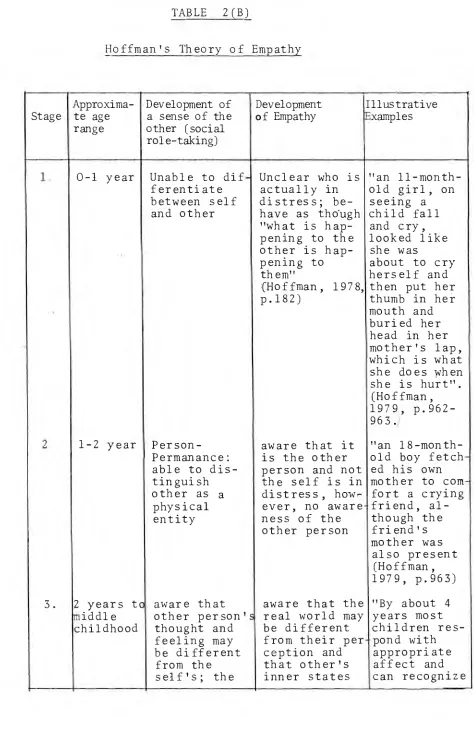
The emotional aspect of altruistic behaviour has generated lots of interests among psychologists (see e.g., review in Deutsch and Madle, 1975; Shantz, 1975; Hoffman, 1976). On the other hand, very few psychologists attempt to present a developmental theory of empathy. M.L.Hoffman (1976, 1978, 1979) is an exception.. Hoffman's
empathic response based on the cognitive development of a sense of the other by the child. According to Hoffman (1976), empathy is defined as "the involuntary, at times forceful, experiencing of another person's emotional
state". (p.126) The following table 2(B) summarizes the essen-tial points of Hoffman's theory. Selman's Social Perspective Stages are included for reference.
Very few empirical researches testing directly Hoffman's theory have been carried out. Thompson and Hoffman (1980) using semiprojective stories in the study of the development of guilt in children report that their results provide modest support for Hoffman's theory. On the other hand, Hoffman is regarded as having taken "a giant stride" in integrating the cognitive and affective aspects of empathy and altruism into a theoretical model. (Lickona, 1976, p.20)
II. Sex and Age Differences in Empathy and Altruism
49
TABLE 2 (B)
Hoffman's Theory of Empathy
Stage
Approxima- to age range
Development of a sense of the other (social role-taking) Development of Empathy Illustrative Examples
0-1 year Unable to dif- Unclear who is "an 11-month- ferentiate actually in old girl, on
between self distress; be- seeing a and other have as tholigh
"what is hap- pening to the other is hap- pening to them" (Hoffman, 1978, p.182) child fall and cry, looked like she was
about to cry herself and then put her thumb in her
. mouth and
buried her head in her mother's lap, which is what she does when she is hurt". (Hoffman, 1979, p.962- 963.
2 1-2 year Person- aware that it "an 18-month- Permanance : is the other old boy fetch- able to dis- person and not ed his own tinguish the self is in mother to com- other as a distress, how- fort a crying
physical ever, no aware-friend, al- entity ness of the
other person though the friend's mother was also present (Hoffman, 1979, p.963) 3. 2 years to aware that aware that the "By about 4
middle other person's real world may years most childhood thought and be different children res-
Stage Approxima- to age range
Development of a sense of the other (social role-taking) Development of Empathy Illustrative Examples
4 Middle- child- hood to Late child- hood
early stage of role-taking (Approximately Selman's stage 0 & 1*)
aware of self and others being differ- ent persons with their own histories and identities (Approximately Selman's Stage 2 & 3)
are indepen- dent of theirs; able to pro- ject their feelings to others or to imagine them- selves -in the other's
position. - able to "res- pond empathi- cally not only to others' transitory, situation- specific dis- tress but also to what they imagine to be other's gen- eral condition" (Hoffman, 1978,
p.184)
signs of hap-piness or sad- ness in others in simple situations" (Hoffman, 1978, p.183) Children at this stage may show more intensified empathic res-ponse to the chronic ra-ther than transitory distress of another person.
51
(1) Sex differences
According to a review by Krebs (1970), most of the studies found no sex differences in altruism. Among the 12 studies which did find sex differences in altruism, as
reviewed by Krebs, 5 of them favoured males and 7 of them favoured females. Similarly, Maccoby and Jacklin (1974) in a review of about 30 studies conclude that their "survey of research on attachment, affiliation, and positive
interactions of all kinds has shown surprisingly little sex differentiation". (p.225) However, Hoffman (1977) in a review of a studies on sex differences in empathy (vicarious affective arousal) found that all of them showed sex differences in favour of females. Hoffman (1977) suggests that this may due to the fact that fe-males show greater tendency to imagine themselves in
other's position while the males tend "to act rather than feel, even in the situations that call for feeling".
(p.720). In addition, Hoffman and Levine (1976) argue that most of the studies reviewed by Maccoby and Jacklin (1974) used measures which are predominantly cognitive, for
example, "judgements of other's feelings in different situations; communicative egocentrism" (p.558) They
6
Age (years) Incidence ofaltruism (%) I 00 -
80
60
4.0
ZO
4
Ugurel-Semin (1952)
Banc:Lion & Gross (1958)
Staub & Feagari (1969)
10
tz
(2) Age Differences
According to Krebs' (1970) review, studies compar-ing the incidence of altruism in children showed age differences. Because different studies used different tasks; explored different dependent variables and did not base their studies on a general school of thought, comparisons of different studies are often difficult and problematic. Nevertheless, most of these studies showed that older children tended to exhibit a larger number of incidences of altruism than the younger one.
Based on Krebs' (1970) review, we attempt to plot the results of three of the studies on the following graph:
Figure 2.1. Age Differences in Altruism
In addition, as mentioned before, Thompson and Hoffman (1980) found some developmental changes in
53
children exhibited more concern for the victim's welfare" (p.156) and more frequent use of internal justice principle whereas younger children paid more attention to
detec-tion and punishment.
III. Empirical Studies of Human Relationships or Kin Altruism.
As mentioned at the beginning of this section, there are very few psychological studies testing sociobiologists' theory of Human Relationships or kin altruism. We propose to call sociobiologists' theory, the theory of Human
Relationships, because with Trivers' theory of reciprocal altruism, sociobiologists' theory can be generalized to deal with all human social interaction and hence involves all human relationships in general, kin altruism in
particular.
In the following paragraphs, three relevant empiri-cal studies of human relationships are described, two of them are unpublished.
(1) Sawyer (1966)
Sawyer (1966) established an altruism scale which "assesses the value one places upon the welfare of another
their preferences for various outcomes for themselves and for the other or to estimate its value on a scale from -1.0 to +1.0 or both.
One hypothetical situation is to ask the subject to imagine that he/she and another student were attending a university course for credit. The assessment of the course is in terms of the grades A, B or C. The subject is asked (i) to indicate his/her preference for each of the combinations of grades for himself/herself and the other student (i.e. both A; self A, other B; self A,
other C etc) and (ii) to estimate a value from -1.0 to +1.0 by tenths (e.g. +1.0: "I am equally interested in how good his grade is and in how good my grade is"; +0.5: "I am half as interested in how good his grade is as I am in how good my grade is" (p.412) etc.). The first measure is called preference Ranking and the second one the
direct Scale Estimation. The Other Person is first sup- posed to be one of the subject's best friends; and then is altered to be a stranger and finally an antagonist.
Using a formula hypothesized by him, Sawyer calcula-ted an index "a", which he called the measure of relative altruism (ranging from -1.0 to +1.0), from the subject's preference rankings. Multiplying "a" by 100 will give the "altruism value" of the subject by preference ranking
SS
college groups (N = 122), Sawyer found that the mean al-truism toward friend, stranger and antagonist is as follows: Friend (45); Stranger (12); and antagonist (-18).
Thus the result provides some support to the Sociobiologists' claim.
(2) Sebastian (1973)
In a study examining Trivers' theory of kin and non kin altruistic behaviour, Sebastian (1973; reported in Freedman, 1979, p.114-115 and p.208) used one of
Kohlberg's story: "Heinz and the drug" with an alternation of the relationship between Heinz and the woman from
Husband-Wife to (i) father-daughter and (ii) friends.
33 eighth grade children were tested. 790 of the subjects justified the stealing for case (i) and only SSo for case (ii). In addition it was found that subjects "felt
stealing a lifesaving drug for a relative was morally justified, whereas a similar theft for a nonrelative was morally wrong" (reported in Freedman, 1979, p.114). It is argued that "with kin, the primary issue was saving a
life; with nonkin, more often the issue was stealing" (In Freedman, 1979, p.208).
It is worthwhile to remark here that Freedman (1979, p.113-115; p.208-210 (Study No.46, 47 and 49) reported
studies provide substantial support for sociobiologists' claim of kin altruism.
(3) Ma (1980)
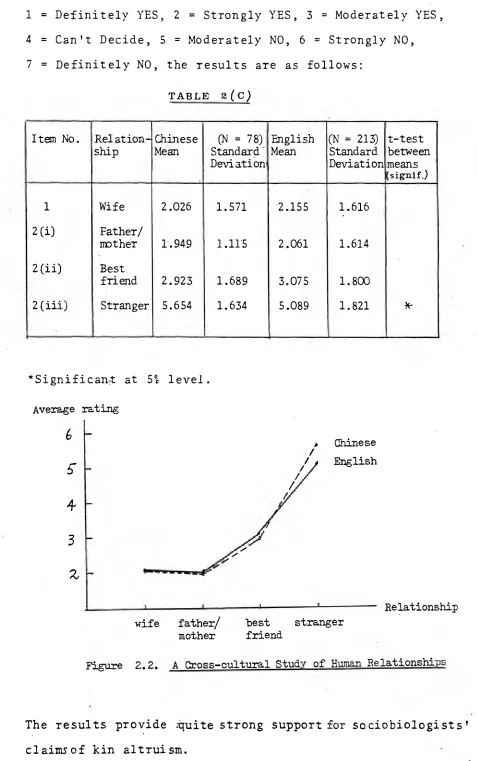
Ma (1980) attempted to study the differences bet-ween the first-person (self) and third-person (other)
views of moral judgment by constructing a Moral Consistency Test based on five of the Kohlberg's Moral .Dilemmas. The test consists of 23 questions, two of them are relevant to our discussion here. The questions are concerned with the story "Heinz (Philip) and the Drug" (For the content of the story, see Appendix 5(D)) (In Ma's study, the name Heinz was changed to Philip for the English Sample) and are as follows:
1. Suppose you were Philip. Would you break into the shop to steal the drug for your wife?
2. Suppose you were Philip and it was not your wife who was dying of cancer but it was someone listed below, would you break into the shop to steal the drug?
(i) Your father/mother (ii) Your best friend (iii) A stranger.
Subjects are asked to rate on a 7-point scale ranging from Difinitely YES to Definitely NO.
78 Chinese students in Hong Kong and 213 English students in London participated in the study. All of
57
1 = Definitely YES, 2 = Strongly YES, 3 = Moderately YES, 4 = Can't Decide, 5 = Moderately NO, 6 = Strongly NO, 7 = Definitely NO, the results are as follows:
TABLE 2 ( C)
Item No. Relation- ship
Chinese Mean
(N = 78) Standard -
Deviation
English Mean
(N = 213) Standard Deviation
t-test between means ' (signif.)
1 Wife 2.026 1.571 2.155 1.616
2(i) Father/
mother 1.949 1.115 2.061 1.614 2(ii) Best
friend 2.923 1.689 3.075 1.800
2(iii) Stranger 5.654 1.634 5.089 1.821 *.
*Significant at 5% level.
Average rating
6
b Chinese
English
4
3
Relationship wife father/ best stranger
mother friend
Figure 2.2. A Cross-cultural Study of Human Relationships
2.3. Structure of Moral Judgment*
The study of moral judgment is probably the most popular research topic in the field of moral development. A
number of theories have been proposed (see e.g., Piaget (1923), Kohlberg (1958, 1969, 1971, 1976, 1980), Bull (1969), Garbarino and Bronfenbrenner (1976)). The study of social cognition is also relevant in this case, see e.g., Damon (ed.) (1978b),Selman (1975, 197'6), Lewis and Brooks-Gunn (1979).
The major objective of this section is to review the Cognitive Developmental Theory of Morality, which forMs a basis of the theory established in the next
_Chapter. Thus, the discussion here is mainly concerned with Piaget, Kohlberg and Rest's work.
Although the major influence on the Cognitive
Developmental Approach has been the early work of Piaget (1932) , this approach has roots in the work of the theorists Durkheim (1925), M. Paul Fauconnet and M. Pierre Bovet
(See Piaget. 1932, Chapter 4). Also, J. Dewey (1930, 1932) with his theory of conduct and experience, G.H. Mead
(1934) with his theory of role-taking, J. Loevinger (1966) with her theory of ego development and J. Rawls (1971)
* This section is an extensively revised version of Chapter 3 of the writer's M.A. dissertation (Ma, 1980). Some long paragraphs which are slightly revised are put in
59
with his theory of justice have influenced more recent theoretical development by Kohlberg (1976, 1980) and Rest (1979b, in press). A forgotten pioneer in this field is Baldwin (1906a, 1906b) whose theory of genetic epistemology is fundamental and significant (see also Russell, 1978).
Other psychologists using the concept of stage in the study of moral development and behaviour are e.g. Hobhouse (1906), McDougall (1908), Peck and
Havighurst (1960) and Kay (1970).
2.3.1 Basic Assumptions.
I. Basic Assumptions of Piaget's Theory
Piaget's theory of cognitive development forms a basic foundation for the Cognitive Developmental Theory of Morality. It is fair to say that the former is the
mother-theory of the latter one. A set of assumptions of Piaget's theory of Cognitive Development is given in
Appendix 2.3(A). Further details of Piaget's assumptions can be found in Brainerd (1978, Chapter 2), Flavell (1963„ Chapter 1 & 2) and Piaget (1953, Chapters 1-3; 1971). A review of some major arguments on Piaget's basic assump-tions is presented in Vuyk (1981, Chapters 12 and 23). A recent elaborated critique of Piaget's theory is
II. The Concept of Stage
The stage concept is one of the core concept in Cognitive Developmental Approach. The characteristics of cognitive stages are summarized in Appendix 2.3(B).
Further details can be found in Piaget (1971, p.16-18), and Kohlberg (1976, p.47).
In addition, there are two other important features of Piaget's concept of stage: (1) Preparation and
achievement periods and (2) Horizontal and Vertical decalages (See e.g. Flavell, 1963, p.21-23; Brainerd, 1978, p.34-37).
Simply speaking, in the preparation period of any stage, the structures and content characteristics defining that stage are in the process of formation and organization and therefore are unstable. In the achievement period, these structures are developed fully and exist as the stable structure d'ensemble.
According to Brainerd (1978),
"in its most basic sense, decalage is simply a name for any invariant sequence between cognitive contents such that one content
always appears earlier than the other" (p.36)