ISSN Online: 1945-3124 ISSN Print: 1945-3116
Specification and Verification of Dynamically
Reconfigurable Systems Using Dynamic Linear
Hybrid Automata
Ryo Yanase
1, Tatsunori Sakai
1, Makoto Sakai
1, Satoshi Yamane
21Graduate School of Natural Science & Technology, Kanazawa University, Kanazawa, Japan 2Institute of Science and Engineering, Kanazawa University, Kanazawa, Japan
Abstract
A dynamically reconfigurable system can change its configuration during operation, and studies of such systems are being carried out in many fields. In particular, medi-cal technology and aerospace engineering must ensure system safety because any de-fect will have serious consequences. Model checking is a method for verifying system safety. In this paper, we propose the Dynamic Linear Hybrid Automaton (DLHA) specification language and show a method to analyze reachability for a system con-sisting of several DLHAs.
Keywords
Formal Method, Model Checking, Hybrid Automata, Embedded Systems, Dynamically Reconfigurable Systems
1. Introduction
Dynamically reconfigurable systems can change their configuration during operation.
Such systems are being used in a number of areas [1]-[4] of an apparatus that involves
human lives or expensive manufactured goods (e.g., in medical or aerospace engineer-ing). Here, it is very important to guarantee safety. The major methods of checking system safety include simulation and testing; however, it is difficult for them to ensure safety precisely, since large systems can have infinite state spaces. In such a case, model checking that performs exhaustive searches is a more effective method.
In this paper, we propose the Dynamic Linear Hybrid Automaton (DLHA)
specifica-tion language for describing dynamically reconfigurable systems and provide a
reacha-How to cite this paper: Yanase, R., Sakai, T., Sakai, M. and Yamane, S. (2016) Speci-fication and VeriSpeci-fication of Dynamically Reconfigurable Systems Using Dynamic Linear Hybrid Automata. Journal of Soft-ware Engineering and Applications, 9, 452- 478.
http://dx.doi.org/10.4236/jsea.2016.99030
Received: July 15, 2016 Accepted: September 27, 2016 Published: September 30, 2016
Copyright © 2016 by authors and Scientific Research Publishing Inc. This work is licensed under the Creative Commons Attribution International License (CC BY 4.0).
bility analysis algorithm for verifying system safety.
1.1. Our Proposal
The target of our research is an embedded system in which a CPU and dynamically re-configurable hardware, e.g., DRP (Dynamically Rere-configurable Processor) or
dynami-cally reconfigurable FPGA (Field-Programmable Gate Array) [5][6] operate
coopera-tively. The DRP is a coarse-grained programmable processor developed by NEC
Cor-poration [4], and it manages both the power conservation and miniaturization. The
DRP is used to accelerate the computations of a general purpose CPU through coopera-tive operations, and it has the following features:
• Dynamic creation/destruction of functions: when a process occurs, the DRP
consti-tutes a private circuit for processing it. The circuit configuration is released after the process finishes.
• Hybrid property: the operation frequency changes whenever a context switch occurs.
• Parallel execution: the DRP executes several processes on the same board at the
same time.
• Queue for communication: the DRP asynchronously receives processing requests
from the CPU.
1.1.1. Specification
We devised the following new specification techniques for dynamically reconfigurable systems consisting of CPUs and DRPs:
• We use linear hybrid automata [7] describing changes in the operating frequency.
• We use linear hybrid automata that have creation/destruction events describing
dy-namic creations and destructions of configuration components.
• We use FIFO queues describing asynchronous communication.
We developed a new specification language (DLHA) based on a linear hybrid auto-maton with both creation/destruction events and unbounded FIFO queues. DLHA is different from existing research in the following points:
• V. Varshavsky and J. Esparza proposed the GALA (Globally Asynchronous - Locally
Arbitrary) modeling approach including timed guards [8]. This approach cannot
describe hybrid systems since it is the specification language based on discrete sys-tems. Thus, GALA cannot represent changes in operating frequency.
• S. Minami and others have specified a dynamically reconfigurable system using
li-near hybrid automata and have verified it by using a model checker, H YT ECH [9].
Since linear hybrid automata cannot describe changes to the configuration and asyn-chronous communications, the system has been specified as a static system. Therefore, the specification presented in their work is unsuitable for representing dynamically reconfigurable systems. Moreover, they verified only the schedulability property of the system, whereas we have verified several other properties in our work.
1.1.2. Verification Method
• Our method targets systems that dynamically change their configurations, which is
something the existing work, such as H YT ECH, has studied. We extend the syntax
and semantics of linear hybrid automata with special actions called creation actions
and destruction actions. We define a state in which an automaton does not exist and transitions for creation and destruction.
• Our method is a comprehensive symbolic verification for hybrid properties, FIFO
queues and creation/destruction of tasks.
1.1.3. Experiments on Verifying Dynamically Reconfigurable Systems
For the experiments, we specified a dynamically reconfigurable embedded system con-sisting of a CPU and DRP, and verified some of its important features. This is the first time that specification and verification of dynamic changes have been tried in a practic-al case.
1.2. Related Work
Here, we describe related work and how it differs from our work.
• P. C. Attie and N. A. Lynch specified systems whose components are dynamically
created/destroyed by using I/O automata [10]. I/O automata cannot describe
changes in variables, for example, changes in the clock and operating frequency.
• H. Yamada and others proposed hierarchical linear hybrid automata for specifying
dynamically reconfigurable systems [11]. They introduced concepts such as class,
object, etc., to the specification language. However, as the scale of the system to be specified increases, the representation and method of analysis in the verification stage tend to be complex.
• B. Boigelot and P. Godefroid specified a communication protocol in terms of
fi-nite-state machines and unbounded FIFO buffers (queues), and they verified it [12].
Since the finite-state machine also cannot describe changes in variables, it is un-suitable in our case.
• A. Bouajjani and others proposed a reachability analysis for pushdown automata
and a symbolic reachability analysis for FIFO-channel systems [13][14]. However,
since their analysis don’t provide for continuous changes in variables, in languages cannot be used for designing hybrid systems.
2. Dynamic Linear Hybrid Automaton
2.1. Preliminaries
Definition 1 (Constraint). Let V be a finite set of variables. A constraint φ on V is
defined as
1 2
:: true x| ~ |e x y~ |e ,
φ = − φ φ∧
where x y, ∈V , e∈, φ1 and
φ
2 are constraints on V, and ~∈ = < > ≤ ≥{ , , , , }.( )
VΦ denotes the set of all constraints on V.
1 1 1
:: n ,
f =x =d ∧∧x =d
where d1,,dn∈. F V
( )
is the set of all flow conditions.For each variable x, we use the dotted variable
x
, to denote the first derivative of x.Definition 3 (Update Expression). Let V be a finite set of variables. An update
ex-pression upd on V is defined as
:: : | : ,
upd = =x c x = +x c
where
x V
∈
and c∈. UPD V( )
is the set of all update expressions can bewrit-ten.
2.2. Syntax
A dynamic linear hybrid automaton (DLHA) is a tuple
(
L V Inv Flow Act T t T, , , , , , ,0 d)
,where
•
L
is a finite set of locations.•
V
is a finite set of (real-valued) variables.• Inv L: → Φ
( )
V is a function that assigns a constraint to each location.• Flow L: →F V
( )
is a function that assigns a flow condition to each location.• Act=Actin∪Actout∪Actτ is a finite set of actions.
- Actin is a finite set of input actions, and each input action has the form
a
?
. Aninput action
m
?
denotes receiving the message m.- Actout is a finite set of output actions, and each output action has the form
a
!
.An output action
m
!
denotes sending the message m to each DLHA.- Actτ is a finite set of internal actions that denote changing a state of a DLHA.
Moreover, we formalize the following special actions:
- A creation action that has the form Crt_′? or Crt_′! denotes a message for
creation of DLHA ′. Crt_′ ∈? Actin is an input action, and it represents that ′
has been created. Crt_′ ∈! Actout is an output action, and represents a request for
creating ′.
- A destruction action that has the form Dst_′? or Crt_′! denotes a message
for a destruction of DLHA ′. Dst_′ ∈? Actin is an input action that indicates ′
has been destroyed.
- An enqueue action that has the form q m! denotes enqueueing of message m into
a queue q. This action is an internal one, that is, q m! ∈Actτ.
- A dequeue action that has the form q m? denotes dequeueing of message m from
the top of q.
• T⊆ × ΦL
( )
V ×Act×2UPD V( )×L is a finite set of transitions. A constraint( )
Vφ ∈ Φ is called a guard condition.
• t0∈ ×L
(
Actin∪Actτ)
×2UPD V( ) is an initial transition.• Td ⊆ × ΦL
( )
V ×Actout is a finite set of destruction-transitions.2.3. Operational Semantics
( )
:: | ,l , σ = ⊥ ν
where l∈L is a location,
ν
:
V
→
is an assignment called evaluation of variables,and
⊥
denotes an undefined value.We define the semantics
of the DLHA by(
Σ ⇒, ,σ0)
, where•
Σ
is a set of states.•
⇒
is a set of time transitions and discrete transitions. • σ0 is the initial state.The following rules define time and discrete transitions:
Definition 4 (Time transition of a DLHA). For any δ∈≥0,
• ⊥ ⇒ ⊥δ
•
( )
l,ν ⇒δ( )
l,ν ′ if ν′ = + ⋅ν δ Flow l( )
∈Inv l( )
where ν ν δ′ = + ⋅Flow l
( )
denotes an evaluation such that( )
( )
( )
.
x Vν′ x ν x δ x Flow l
∀ ∈ = + ⋅ ∧ , and ν ′∈Inv l
( )
denotes that ν ′( )
x satisfiesthe constraint Inv l
( )
for anyx V
∈
.Definition 5 (Discrete transition of a DLHA). For an evaluation ν and update
expressions λ ∈2UPD V( ), ν λ
[ ]
denotes an evaluation updated byλ
, that is, for anyx V
∈
,[ ]
( )
(
)
( )
(
)
( )
(
)
: : , : otherwisec x c
x x c x c x x c
x
λ
ν λ
ν
λ
λ
ν
= ∈ = + = ∈/ = + ∈ • For any transition
(
l, , , ,φ a λ ′ ∈l)
T,( )
l,ν
⇒a(
l,ν λ
[ ]
)
if ν φ∈ and[ ]
Inv l( )
ν λ ∈ ′ .• (Creation of a DLHA) For the initial transition t0 =
(
l a0, 0,λ0)
, ⊥ ⇒a0(
l0, 0[ ]
λ0)
, where 0 is an evaluation such that
∀ ∈
x V
.0
( )
x
=
0
.• (Destruction of a DLHA) For any destruction-transition
(
l, ,φ
a)
∈Td,( )
l,ν ⇒ ⊥aif ν φ∈
For the initial transition
(
l a0, 0,λ
0)
, the initial state σ0 is defined as(
)
[ ]
(
)
(
)
0 0
0, 0 0 otherwise . in a Act l
σ
λ
⊥ ∈ = 3. Dynamically Reconfigurable Systems
To describe an asynchronous communication among DLHAs in a dynamically
recon-figurable system (DRS), we use a queue (unbounded FIFO buffer) as a model of the
communication channel. We assume that the system performs lossless transmission, so we can let the queue be unbounded.
3.1. Syntax of DRS
A dynamically reconfigurable system (DRS)
is defined by a tuple(
A,)
3.2. Semantics of DRS
A state s of a DRS =
(
A,)
is a tupleσ
,w , where•
σ ∈Σ × ×Σ
1
A is a vector of the states of DLHAs.• w∈M1∗× × M∗ is a vector of the content of the queues, where each Mi is the
set of all messages that can be stored in queue qi.
Definition 6 (Time Transition of a DRS). For an arbitrary δ∈≥0, the time
tran-sition is defined as
,w δ ,w i. i δ i.
σ
→σ
′ ⇐ ∀σ
⇒σ
Definition 7 (Discrete Transition of a DRS). Let σ σ ′ , ,w and w′ be
(
1, , A)
σ= σ σ , σ′=
(
σ1′, ,σ′A)
,
(
)
1, ,
w = w w , and w′ =
(
w1′,,w′)
.• For any output action
a
!
,σ
,w →aσ
′,w(
)
(
)
(
)
! ? ?
if∃i.σi⇒aσi′∧ ∀ ≠j i.σj⇒a σj∨ ¬∃σ σj′. j⇒a σj′ ∧σj=σj′ .
An output action is broadcasted to all DLHAs, and a DLHA receiving the action moves by synchronization if the guard condition holds in the state.
• For an internal action aτ ,
- in the case of aτ =q wk! ,
σ
,w →q wk!σ
′ ′,w
,
(
!)
if . . ł . ,
k
i q w i j j k k k k
iσ σ′ j iσ σ ′ w′ w w k w w′
∃ ⇒ ∧ ∀ ≠ = ∧ = ∧ ∀ ≠ =
- while in the case of aτ =q wk? ,
σ
,w →q wk?σ
′ ′,w
,
(
?)
if . . . ,
k
i q w i j j k k l l
iσ σ′ j iσ σ′ w ww′ l k w w′
∃ ⇒ ∧ ∀ ≠ = ∧ = ∧ ∀ ≠ =
- otherwise,
σ
,w →aτσ
′,w
if ∃i.σi ⇒aτ σi′∧ ∀ ≠j i.σj =σ′j.
A run (or path)
ρ
of the system
is the following finite (or infinite) sequence of states.0 1 1
0 1 1
0 1
: i i
i i
a a a i a
s δ s δ δ s δ
ρ
−−
→ → → →
where i
i
a
δ
→ between si and si+1 is defined as
1 . 1.
i
i i i
i a i i i i i a i s →δ s+ ⇐ ∃s s′ →δ s′∧ →s′ s+
The initial state s0 of a dynamically reconfigurable system is
(
σ01,,σ0A) (
, w01,,w0)
where each σ0i is the initial state of DLHA i andeach w0j is empty; that is, ∀j w. 0j =ε.
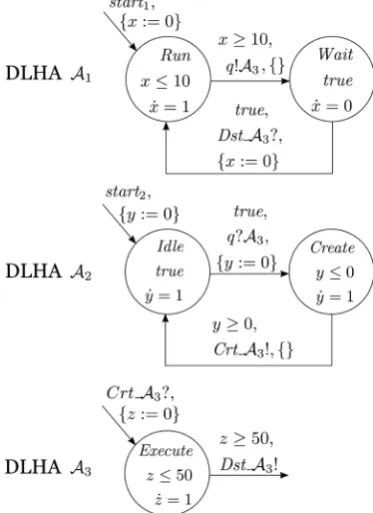
Example 1 (DLHA and DRS). A DLHA is represented by a directed graph, where
each node represents a location and each edge represents a transition. Figure 1 shows a dynamically reconfigurable system
consisting of three DLHAs and one queue.(
)
1= L V Inv Flow Act T t1, 1, 1, 1, 1, ,1 01,Td1 ,
(
)
2= L V Inv Flow Act T t2, 2, 2, 2, 2, 2,02,Td2 ,
(
)
3= L V Inv Flow Act T t3, 3, 3, 3, 3, 3, 03,Td3 ,
{
}
{ }
(
1, 2, 3 , q)
=Figure 1. Example of DRS consisting of three DLHAs and one queue. where
{
}
{ }
{
}
{
}
{
}
{}
(
)
(
{
}
)
{
}
{
}
(
)
{}
{
}
{ }
1 1 1 11 3 1 3
1 3 3
01 1 1 2 2 2 , 10, 1, 0 _ ?, , !
, 10, ! , , , , , _ ?, : 0 ,
, , : 0
,
,
d
L Run Wait
V x
Inv Run x Wait true
Flow Run x Wait x
Act Dst start q
T Run x q Wait Wait true Dst x Run
t Run start x
T
L Idle Create
V y
Inv Idle true Create y
= = = ≤ = = = = = ≥ = = = = = = = ≤
{
}
{
}
{
}
{
}
(
)
(
{}
)
{
}
{
}
(
)
{}
{
}
22 3 2 3
2 3 3
02 2 2 3 0 1, 1 _ !, , ?
, , ? , : 0 , , , 0, _ !, ,
, , : 0
d
Flow Idle y Create y
Act Crt start q
T Idle true q y Create Create y Crt Idle
t Idle start y
{ }
{
}
{
}
{
}
{}
{
}
(
)
(
)
{
}
3 3 33 3 3
3 03 3 3 3 50 1 _ ?, _ !
, _ ?, : 0
, 50, _ !
d
V z
Inv Execute z
Flow Execute z
Act Crt Dst
T
t Execute Crt z
T Execute z Dst
= = ≤ = = = = = = = ≥
This system runs as follows:
1) 1 requires 3 to be created from 2 by enqueueing a message, and it waits
for the message to return from 3.
2) When 2 receives the message, it creates 3.
3) After 3 finishes processing the job, it sends the message to 1 and is destroyed.
4) This system infinitely repeats steps 1) to 3).
For example, (1) shows a run
ρ
of this system is shown.(
) (
)
(
)
( )
(
) (
)
(
)
( )
(
) (
)
(
)
( )
(
) (
) (
)
(
)
( )
(
) (
)
(
)
( )
3 3 3 3 10 ! 3 0 ? 0 _ 50 _: , 0 , , 0 , ,
, 10 , , 0 , ,
, 10 , , 0 , ),
, 10 , , 0 , , 0 ,
, 0 , , 0 , ,
q
q
Crt
Dst
Run x Idle y
Wait x Idle y
Wait x Create y
Wait x Idle y Execute z
Run x Idle y
ρ ε ε ε ε = = ⊥ → = = ⊥ → = = ⊥ → = = = → = = ⊥ →
(1)
4. Reachability Analysis
4.1. Reachability Problem
We define reachability and the reachability problem for a DRS as follows:
Definition 8 (Reachability). For a DRS =
(
A,)
and a location lt,
reachest
l if there exists a path such that
0 1
0 1
0 a att t s δ δ− s
− → →
(
1, ,)
, , .( )
,t A k t
s σ σ w k loc σ l
∧ = ∃ = where
( )
(
( )
)
(
) (
)
, undefined l lloc σ σ ν
σ = = ⊥ = ⊥
Definition 9 (Reachability Problem). Given a DRS =
(
A,)
and a location lt, we output “yes” if
can reach lt, and “no” otherwise.4.2. Reachability Analysis
4.2.1. Convex Polyhedra
with [15].
A polyhedron is convex if it can be defined by a formula which is a conjunction of linear formulae. For a set V =
{
x1,,xn}
of variables, a convex polyhedron ζ on Vis a n-dimensional real space. In particular, we define true and false as n
true= and
false= ∅.
Example 2 (Convex Polyhedron). The formula ∃x x1. 1≥ ∧5 x2≤ ∧ −1 x1 x2= ∧1 true is a convex polyhedron. From linear formula, the existential quantifier can be elimi-nated effectively. Therefore, we obtain
1 1 2 1 2
1 1 2 1 2
2 2
. 5 1 1
. 5 1 1
1 4
.
x x x x x true
x x x x x
x x
false
∃ ≥ ∧ ≤ ∧ − = ∧ = ∃ ≥ ∧ ≤ ∧ − = = ≤ ∧ ≥
=
4.2.2. Algorithm of Reachability Analysis
We define a state s in the reachability analysis as
(
L, ,ζ
w)
, where•
L
is a finite set of locations.• ζ is a convex polyhedron.
• w is a vector of the content of the queues.
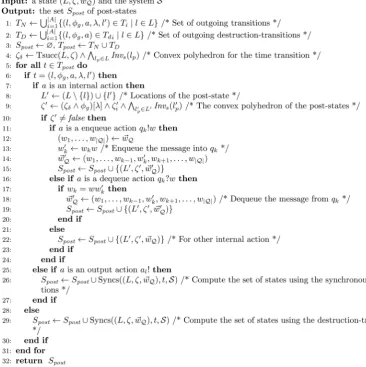
Figure 2, Figure 3 and Figure 4 show the algorithm of the reachability analysis.
Figure 2 is an overview of the reachability analysis, and this algorithm is performed
using the expanded method of [16] with a set of queues. The analysis is performed
as follows:
1. Compute an initial state s0 of the system
(ll.1-3).2. Initialize a traversed set
Visit
and a untraversed setWait
of states by∅
and{ }
s0 (line 4).3. While
Wait
is not empty, repeat the following process (ll.5-16).(a) Take a state
(
L, ,ζ
w)
fromWait
and remove the state fromWait
(ll.6-7).Figure 3. Subroutine Succ.
(b) If the set
L
of locations contains the target location, return “yes” and terminate(ll.8-10).
(c) If the state has not been traversed yet (
(
L, ,ζ
w)
∈/Visit) (line 11),i. add the state into
Visit
(line 12),ii. compute the set Spost of successors by using the subroutine
Succ
(line 13), and iii. add all components of Spost toWait
(line 14).Subroutine Succ Figure 3 shows the subroutine
Succ
to compute the successors ofa state. In this algorithm, we make the following assumptions.
(
A,)
(
{
1, , A} {
, q1, ,q}
)
,= =
1
,
A
s k
k
Inv Inv
=
=
where
(
, , , , , , 0,)
is a DLHA, i= L V Inv Flow Act T ti i i i i i i Td i
(
)
Figure 4. Subroutine Syncs.
Let the initial state of
be(
σ01, ,σ0A)
w 0 ; s0 is
(
L0,ζ
0,w 0)
, where
( )
(
( )
)
(
)
, zone
,
l true
ν σ ν
σ
σ
=
=
= ⊥
( )
{
}
{
}
0 loc 0i | 0i , 1, , ,
L = σ σ ≠ ⊥ ∈i A
( )
0 0
0
zone .
A
i i
ζ σ
= =
∧
Here, zone
( )
σ is a function that assigns a convex polyhedron to each state.(
)
Tsucc L,ζ is a function that returns a convex polyhedron after performing a time
transition on a given set L of locations and a convex polyhedron ζ (line 4). We define this function in accordance with [15] as follows:
Let the set of all variables in the system and their derivatives be
{
1}
1
, ,
A
s k n
k
V V x x
=
=
= and Vs ={
x1,,xn}
.(
)
1 0 1( )
and rename as ,s
x V
Flow L x x x x x
ζ
δ
∈ ′ ′ ∧ ∧∧
= + where 1 , A s k k Flow Flow = =
( )
. s l L Flow Flow l∈
=
∧
For a convex polyhedron ζ and a set
λ
of update expressions, ζ λ[ ]
denotesthe convex polyhedron updated by
λ
for ζ. Let the set of reset variables and set ofshifted variables be Vr =
{
x x| := ∈c λ} {
= xr1,,xr m}
and{
| :} {
1, ,}
a a a n
V = x x = + ∈x c λ = x x . ζ λ
[ ]
can be computed as[ ] (
1, , .)
( )
,r
r r m r a r x V
x x V x m x
ζ λ
ζ
∈
= ∃ ∈ ∧
∧
=where
{
| :}
,r
m = xc x = ∈c λ
{
| :}
,a
m = xc x = + ∈x c λ
( )
1, , .
and rename variables as .
a
a a a n a x V a
x x V x
x m x x x
ζ
ζ
∈ ′ = ∃ ∈ ∧ ′ = +∧
Given a state
(
L, ,ζ
w)
and a system, the successors are computed using thepro-cedure described below.
1. For each transition
(
l, , , ,φ a λ ′l)
(or destruction-transition(
l, , !φ
al)
) outgoingfrom a location l∈L, the set Spost of post states is computed as follows (ll.5-31):
(a) Compute the convex polyhedron for the time transition (line 4).
(
)
( )
Tsucc , .
p
s p l L
L Inv l
δ
ζ
ζ
∈
= ∧
∧
(b) If a is an internal action, Spost is computed as follows: i. Compute the set of locations (line 8)
{ }
(
\)
{ }
.L′= L l ∪ l′
ii. Compute the convex polyhedron for the discrete transition (line 9)
(
)
[ ]
( )
.p
s p l L
Inv l
ζ
ζ φ λ
′∈′
′= ∧ ∧
∧
′iii. If a is an enqueue action q wk! (ll.11-15),
(
)
{
}
(
)
(
)
, , otherwise , postL w false
S
ζ
ζ
′ ′ ′ ′ ≠ = ∅ where
(
1, , k1, k , k 1, ,)
.w′ = w w− w ⋅w w+ w
(
)
{
} (
)
(
)
, , , , .
otherwise .
k k j j
post
L w false w w w j k w w
S
ζ
ζ
′ ′ ′ ′=/ = ⋅ ′ ∀ =/ = ′ = ∅
v. If a is another internal action (line 22),
(
)
{
}
(
)
(
)
, , otherwise . postL w false
S = ′ ′
ζ
ζ
′ ≠∅
(c) If a is an output action al!, Spost is computed with the subroutine Syncs (line 26 and 29).
(d) If a is an input action, Spost = ∅.
Subroutine Syncs Figure 4 shows the subroutine Syncs of Succ to compute
succes-sors by using the transition that has an output action. Given a state
(
L, ,ζ
w)
, atran-sition (or destruction-trantran-sition) ts=
(
l,φ
g, !, ,alλ
l′)
, and a system =(
A,)
, a setpost
S of successors is computed as follows:
1. Initialize Spost as
∅
(line 1).2. Compute a convex polyhedron ζδ for the time transition (line 2).
(
)
( )
Tsucc , .
p
s p l L
L Inv l
δ
ζ
ζ
∈
= ∧
∧
3. For each i in the system
, compute the set Tsi of transitions that areout-going from the state by using an input action al? (ll.3-5),
(
)
(
{ }
)
{
, , ?, , | \}
.si i i l i i i i
T = l φ a λ l′ ∈T l ∈ L l
4. Compute the set
∆
of combinations of Tsi (line 6).{
}
{
Tsi|Tsi ,i 1, , A}
.∆ =
∏
≠ ∅ ∈ 5. For each combination T =
(
t1,,tn)
∈ ∆, the successor(
LT′ ′,ζ
T,w)
is
com-puted as follows (ll.7-29):
(a) Compute the set Tsync of transitions (line 9).
{
1}
max , ,
sync n
T t t
′ ∆ ′
= ∆ ⊆
(
)
{
1 2}
s.t.ζδ ∧ ∧φ
∧
φs| l,φs, ?,al λs,l ∈ ∆ ≠′ false.(b) Compute the set LT′ of locations (ll.9-14, line 21).
(
\)
,T pre post L′ = L L ∪L
where
(
)
{
1| 1, , ?, ,2}
,sync s l s sync L = l l
φ
aλ
l ∈T(
)
{
2| 2, , ?, , 2}
,sync s l s sync L′ = l l
φ
aλ
l ∈T{ }
pre sync L = l ∪L{ }
(
)
(
)
{ }
(
)
0 , _ , _ otherwise .j sync l j j post sync l j
sync
l l L a Crt L L
L L a Dst
(c) Compute the update expression λsync (ll.9-14).
(
)
(
)
(
)
0 _ ,
_
otherwise ,
j in l j j
sync in l j
in
a Crt L L
a Dst
λ λ λ
λ λ λ λ ∪ ∪ = ∩ = ∅ = = ∪ where
(
)
{
| 1, , ?, ,2}
.in s l s al s l Tsync
λ
=
λ
φ
λ
∈(d) Compute the conjunction of guard conditions (ll.9-14).
(
)
{
| 1, , ?, , 2}
.sync s l s al s l Tsync
φ
= ∧φ
∧
φ
φ
λ
∈(e) Compute the convex polyhedron ζ ′T (ll.22-24).
(
)
(
)
1, , . _
otherwise ,
j
j jV j l j
T
x x V
ζ
a Dstζ
ζ
∃ ∈ ′ = ′ = ′ where(
)
( )
. psync sync s p l L
Inv l
δ
ζ ζ φ λ
′∈ ′
′= ∧ ∧
∧
′(f) If ζ ′ ≠T false, the successor is added to Spost (ll.26-27).
The correctness of this algorithm is implied by Lemma 1 and Lemma 2.
Lemma 1. If the algorithm terminates and returns “lt is not reachable”, the system has the safety property.
Lemma 2. If this algorithm terminates and returns “lt is reachable”, the system does not hold the safety property.
By definition, all linear hybrid automata are DLHAs. Our system dynamically changes its structure by sending and receiving messages. However, the messages stati-cally determine the structure, and the system is a linear hybrid automaton with a set of queues. It is basically equivalent to the reachability analysis of a linear hybrid automa-ton. Therefore, the reachability problem of DRSs is undecidable, and this algorithm might not terminate [16].
Moreover, in some cases, a system will run into an abnormal state in which the length of a queue becomes infinitely long, and the verification procedure does not terminate.
5. Practical Experiment
5.1. Model Checker
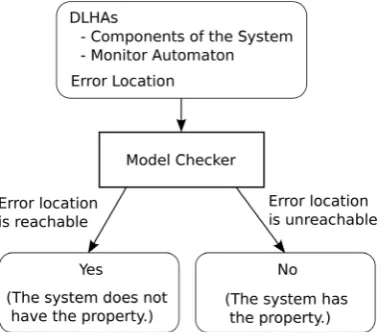
We implemented a model checker of DRSs consisting of DLHAs in Java (about 1600 lines of code) by using the LAS, PPL, and QDD external libraries [12] [17]-[19]. For the
verification, we input the DLHAs of the system, a monitor automaton, and the error
location to the model checker, and it output “yes (reachable)” or “no (unreachable)” (Figure 5). The monitor automaton had a special location (we call it the error location),
and checked the system without changing the system’s behavior [15]. The monitor
properties.
For the specification of the input model, we extended the syntax and semantics of DLHA as follows:
• A transition between locations can have a label asap (that means “as soon as
possi-ble”). For a transition labeled asap, a time transition does not occur just before the discrete transition.
• Each DLHA can have constraints and update expressions for the variables of
anoth-er DLHA in the same system. That is, for each DLHA, invariants, guard conditions, update expressions and flow conditions can be used by all DLHAs.
For example, Figure 6 shows the input file for checking whether the system in
[image:15.595.279.472.247.415.2]Fig-ure 1 reaches the location Execute.
[image:15.595.278.471.303.678.2]Figure 5. Model checker for DRSs.
5.2. Specification of Dynamically Reconfigurable Embedded System
5.2.1. A Cooperative System Including CPU and DRP
We have specified a dynamically reconfigurable embedded system consisting of a CPU
and DRP for the model described in our previous research [9]. A DRP is a processor
that can execute exclusive processes at the same time by dynamically changing the cir-cuit configuration, and it is used to accelerate CPU computations, for example, in
im-age processing and cipher processing. A DRP has computation resources called tiles (or
[image:16.595.251.496.427.591.2]processing elements), and it dynamically sets the context of a process if there are enough free tiles. In addition, a DRP can change the operating frequency in accordance with running processes. In this paper, we assume that the number of tiles and the oper-ating frequency for each process have been set in advance and that the operoper-ating fre-quency of the DRP is always the minimum frefre-quency of the running co-tasks.
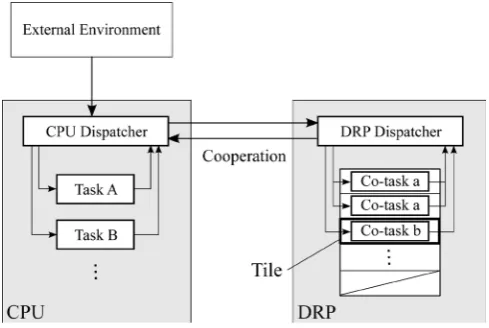
Figure 7 shows an overview of the system. This system processes jobs submitted from the external environment through the cooperative operation of the CPU and DRP. The CPU Dispatcher creates a task when it receives a call message of the task from the external environment. When a task on the CPU uses the DRP, The CPU Dis-patcher sends a message to the DRP DisDis-patcher. The DRP DisDis-patcher receives the mes-sage asynchronously and creates a co-task (it means “cooperative task”) in a first-come, first-served manner if there are enough free tiles. Here, we will assume that this system has two tasks and two co-tasks that have the parameters shown in Table 1 & Table 2.
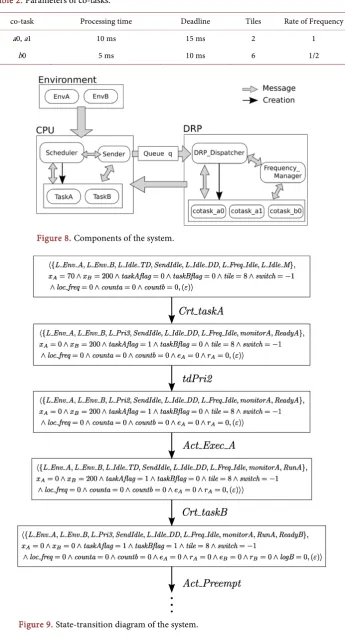
The system, whose components are illustrated in Figure 8, consists of 11 DLHAs and
1 queue. We show part of the state-transition diagram in Figure 9. The external
envi-ronment consists of EnvA (Figure 10) and EnvB (Figure 11) that periodically create
[image:16.595.195.555.635.705.2]Figure 7. Overview of the CPU-DRP embedded system.
Table 1. Parameters of tasks.
Task Period Deadline Priority Process
A 70 ms 70 ms high 20 ms, co-task a0,
10 ms, co-task b0
Table 2. Parameters of co-tasks.
co-task Processing time Deadline Tiles Rate of Frequency
a0, a1 10 ms 15 ms 2 1
b0 5 ms 10 ms 6 1/2
Figure 8. Components of the system.
Figure 10. External environment: EnvA.
Figure 11. External environment: EnvB.
Figure 12. Task: TaskA.
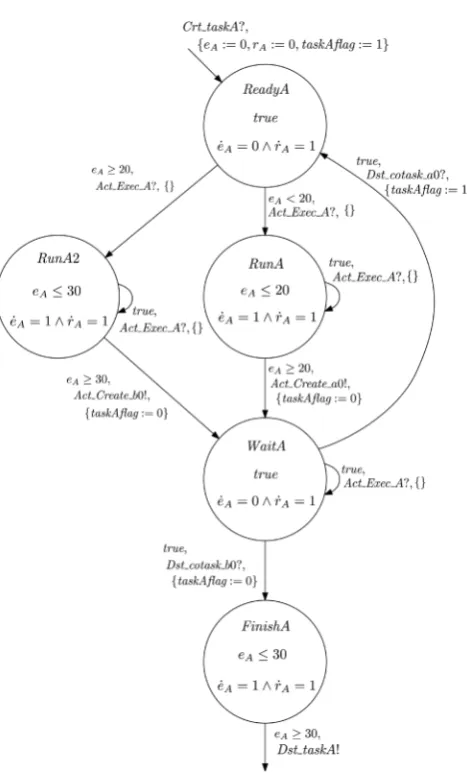
TaskA (Figure 12) and TaskB (Figure 13). That is, EnvA uses Crt_taskA! to create
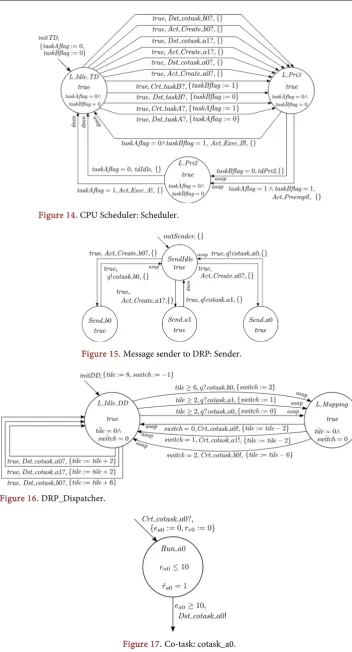
milliseconds. The Scheduler (Figure 14) performs scheduling in accordance with the priority and actions for creation and destruction of DLHAs. For example, when TaskA
is created by EnvA with Crt_taskA! and TaskB is already running, The Scheduler
rece-ives Crt_taskA? from EnvA and sends Act_Preempt! to TaskA and TaskB. Then,
Act_Preempt! causes TaskA to move to RunA and TaskB to move to WaitB.
TaskA and TaskB send a message to The Sender if they need a co-task. The Sender (Figure 15) enqueues the message to create a co-task to q when it receives a message
from tasks. When TaskA sends Act_Create_a0! and moves to RunA from WaitA, The
Sender receives Act_Create_a0? and enqueues cotask_a0 in q with q! cotask_a0.
The DRP_Dispatcher (Figure 16) dequeues a message and creates cotask_a0 (Figure
17), cotask_a1 (Figure 18), and cotask_b0 (Figure 19) if there are enough free tiles.
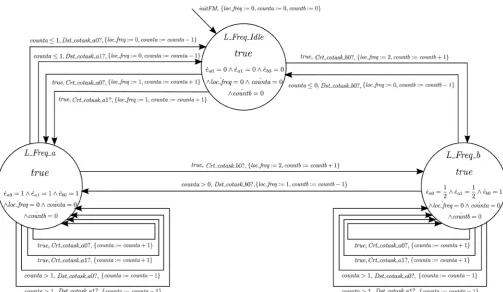
The Frequency_Manager (Figure 20) is a module that manages the operating frequency
of the DRP. When a DLHA of a co-task is created, The Frequency_Manager moves to the location that sets the frequency to the minimum value.
5.2.2. Other Cases
We have the parameters of the model in subsection 5.2.1 and conducted experiments with it.
• Modified Tasks: We modified the parameters of the tasks on the CPU as shown in
Table 3. Here, the parameters of the co-tasks are the same as those in Table 2.
• Modified co-tasks: We modified the parameters of the co-tasks on the DRP, as
shown in Table 4. The parameters of the tasks are the same as those in Table 1.
Figure 14. CPU Scheduler: Scheduler.
Figure 15. Message sender to DRP: Sender.
Figure 16. DRP_Dispatcher.
[image:20.595.233.510.66.264.2]Figure 18. Co-task: cotask_a1.
Figure 19. Co-task: cotask_b0.
[image:21.595.47.551.394.686.2]Table 3. Modified parameters of tasks.
Task Period Deadline Priority Process
A 90 ms 80 ms high 20 ms, co-task b0,
20 ms, co-task a0
B 200 ms 150 ms low co-task a1, 70 ms
Table 4. Modified parameters of co-tasks.
co-task Processing time Deadline Tiles Rate of Frequency
a0, a1 5 ms 10 ms 4 1
b0 10 ms 20 ms 5 1/3
5.3. Verification Experiment
We verified that the embedded systems described in subsection 5.2 provide the
follow-ing properties by usfollow-ing monitor automata (Figures 21-25). The verification experiment
was performed on a machine with an Intel (R) Core (TM) i7-3770 (3.40 GHz) CPU and 16 GB RAM running Gentoo Linux (3.10.25-gentoo).
The experimental results shown in Table 5 indicate that the modified tasks cases and
the modified co-tasks cases were verified with less computation resources (memory and time) than were used by the original model. This reduction is likely due to the following reasons:
• Regarding the schedulability of the modified tasks model, the processing time is
shorter than that of the original model since the verification terminates if a counte-rexample is found.
• In the cases of the modified co-tasks, the most obvious explanation is that the state-
space is smaller than that of the original model since the number of branches in the search tree (i.e. nondeterministic transitions in this system) is reduced by changing the start timings of the tasks and co-tasks with the parameters.
• In cases other than those of the modified tasks, it is considered that the state-space
is smaller than that of the original model because this system is designed to stop processing when a task exceeds its deadline.
5.3.1. Schedulability
Here, schedulability is a property in which each task of the system finishes before its deadline. Let EA be the total processing time and DA be the deadline in task A (Figure 13); the remaining processing time is represented as EA−eA, and the remaining time till
the deadline is represented as DA−rA. Therefore, the monitor automaton moves the error
location if the task A is created and it satisfies the condition EA−eA >DA−rA (Figure 21). In the case of Table 1, EA−eA >DA−rA ⇔30−eA >70−rA⇔rA−eA >40 since
30
A
E = and DA=70. Similarly, the condition for task B is rB−eB>103.
5.3.2. Creation of Co-Tasks
[image:22.595.194.556.189.237.2]task calling it reaches its deadline. When the message
create a
_ 0
is received from taskA, the monitor automaton starts counting time for co-task a0. If the waiting time
ex-ceeds the deadline of task A before it receives the message Crt cotask a_ _ 0, the monitor
moves to error location. Figure 22 shows The monitor automaton for the case of Table
[image:23.595.273.475.159.449.2]1 for co-task a0. Monitor automata for co-tasks a1 and b0 can be similarly described.
Figure 21. Monitor automaton for checking schedulability.
[image:23.595.270.476.474.686.2]Figure 23. Monitor automaton for checking destruction of co-task a0.
Figure 24. Monitor automaton for checking frequency management.
Figure 25. Monitor automaton for checking tile management.
5.3.3. Destruction of Co-Tasks
Each co-task must be destroyed before the waiting time reaches its deadline. For the
co-task a0, when the message Crt cotask a_ _ 0 is received from the dispatcher DRP_
Dispatcher, the monitor automaton checks the message Dst cotask a_ _ 0. Figure 23
shows the monitor automaton for the case of Table 2.
5.3.4. Frequency Management
Creating or destroying a co-task, the DRP changes the operating frequency corres-ponding to the co-tasks being processed. Since this system requires that the frequency is always at the minimum value, the monitor checks whether the frequency manager (Frequency_Manager) moves to the correct location when it receives a message for
creating a co-task. For example, when co-task a0 and co-task b0 are running on the
DRP, Frequency_Manager must be at location L Freq b_ _ . Figure 24 show the
[image:24.595.283.467.406.476.2]Table 5. Experimental results.
Model Property Satisfiability Memory [MB] Time [sec] The number of states
Original: Schedulability yes 168 180 1220
Creation of co-tasks yes 92 315 1220
Destruction of co-tasks yes 154 233 1220
Frequency Management yes 173 265 1220
Tile Management yes 167 234 1220
Modified tasks: Schedulability no 105 10.2 91
Creation of co-tasks yes 117 145 771 Destruction of co-tasks yes 82 151 771
Frequency Management yes 197 115 771
Tile Management yes 135 107 771
Modified co-tasks: Schedulability yes 83 141 768
Creation of co-tasks yes 85 183 768
Destruction of co-tasks yes 86 191 768
Frequency Management yes 104 141 768
Tile Management yes 119 134 768
5.3.5. Tile Management
When the DRP receives a message for creating of a co-task and the number of free tiles is enough to process it, the dispatcher creates the co-task. The dispatcher then updates
the number of used tiles. The monitor automaton checks whether the number tiles in
DRP_Dispatcher is always between 0 and the maximum number, 8 in this case (Figure
25).
6. Conclusion and Future Work
We proposed a dynamic linear hybrid automaton (DLHA) as a specification language for dynamically reconfigurable systems. We also devised an algorithm for reachability analysis and developed a model checker for verifying the system. Our future research will focus on a more effective method of verification, for example, model checking with CEGAR (Counterexample-guided abstraction refinement) and bounded model check-ing based on SMT (Satisfiability modulo theories) [20][21].
References
[1] Agirre, A., Parra, J., Armentia, A., Estévez, E. and Marcos, M. (2016) QoS Aware Middle-ware Support for Dynamically Reconfigurable Component Based IoT Applications. Inter-national Journal of Distributed Sensor Networks, 2016, Article ID: 2702789.
http://dx.doi.org/10.1155/2016/2702789
Article ID: 056320. http://dx.doi.org/10.1186/1687-3963-2006-056320
[3] Lockwood, J.W., Moscola, J., Kulig, M., Reddick, D. and Brooks, T. (2003) Internet Worm and Virus Protection in Dynamically Reconfigurable Hardware. International Conferences
on Military and Aerospace Programmable Logic Device (MAPLD), Washington DC, 9-11
September 2003, E10.
[4] Motomura, M., Fujii, T., Furuta, K., Anjo, K., Yabe, Y., Togawa, K., Yamada, J., Izawa, Y. and Sasaki, R. (2005) New Generation Microprocessor Architecture (2) Dynamically Re-configurable Processor (DRP). IPSJ Magazine, 46, 1259-1265.
[5] Amano, H., Adachi, Y., Tsutsumi, S., Ishikawa, K., et al. (2006) A Context Dependent Clock Control Mechanism for Dynamically Reconfigurable Processors. International Conference on Field Programmable Logic and Applications, 104, 575-580.
http://dx.doi.org/10.1109/fpl.2006.311269
[6] Vatankhahghadim, A., Song, W. and Sheikholeslami, A. (2015) A Variation-Tolerant MRAM-Backed-SRAM Cell for a Nonvolatile Dynamically Reconfigurable FPGA. IEEE Transactions on Circuits and Systems II: Express Briefs, 62, 573-577.
http://dx.doi.org/10.1109/TCSII.2015.2407711
[7] Alur, R., Courcoubetis, C., Henzinger, T.A. and Ho, P. (1993) Hybrid Automata: An Algo-rithmic Approach to the Specification and Verification of Hybrid Systems. Lecture Notes in Computer Science, 736, 209-229. http://dx.doi.org/10.1007/3-540-57318-6_30
[8] Varshavsky, V. and Marakhovsky, V. (2002) GALA (Globally Asynchronous-Locally Arbi-trary) Design. Lecture Notes in Computer Science, 2549, 61-107.
http://dx.doi.org/10.1007/3-540-36190-1_3
[9] Minami, S., Takinai, S., Sekoguchi, S., Nakai, Y. and Yamane, S. (2011) Modeling, Specifi-cation and Model Checking of Dynamically Reconfigurable Processors. Computer Software, 28, 190-216.
[10] Attie, P.C. and Lynch, N.A. (2001) Dynamic Input/Output Automata, a Formal Model for Dynamic Systems. Proceedings of the 20th Annual ACM Symposium on Principles of Dis-tributed Computing (PODC), 2154, 314-316. http://dx.doi.org/10.1145/383962.384051 [11] Yamada, H., Nakai, Y. and Yamane, S. (2013) Proposal of Specification Language and
Veri-fication Experiment for Dynamically Reconfigurable System. Information Processing So-ciety of Japan, 6, 1-19.
[12] Boigelot, B. and Godefroid, P. (1999) Symbolic Verification of Communication Protocols with Infinite State Spaces Using QDDs. Formal Methods in System Design, 14, 237-255. http://dx.doi.org/10.1023/A:1008719024240
[13] Bouajjani, A., Esparza, J. and Maler, O. (1997) Reachability Analysis of Pushdown Auto-mata: Application to Model Checking. Lecture Notes in Computer Science, 1243, 135-150. http://dx.doi.org/10.1007/3-540-63141-0_10
[14] Bouajjani, A. and Habermehl, P. (1997) Symbolic Reachability Analysis of FIFO-Channel Systems with Nonregular Sets of Configurations. Lecture Notes in Computer Science, 1256, 560-570. http://dx.doi.org/10.1007/3-540-63165-8_211
[15] Henzinger, T.A., Ho, P. and Wong-Toi, H. (1997) HyTech: A Model Checker for Hybrid Systems.9th International Conference on Computer Aided Verification,Haifa, 22–25 June 1997, 460-463. http://dx.doi.org/10.1007/3-540-63166-6_48
[16] Alur, R., Courcoubetis, C., Halbwachs, N., Henzinger, T.A., Ho, P., Nicollin, X., Olivero, A., Sifakis, J. and Yovine, S. (1995) The Algorithmic Analysis of Hybrid Systems. Theoretical Computer Science, 138, 3-34. http://dx.doi.org/10.1016/0304-3975(94)00202-T
Inequli-ties of First Order Predicate Logic. Ieice Technical Report Theoretical Foundations of Computing, 111, 55-59.
[18] Bagnara, R., Hill, P.M. and Zaffanella, E. (2008) The Parma Polyhedra Library: Toward a Complete set of Numerical Abstractions for the Analysis and Verification of Hardware and Software Systems. Science of Computer Programming, 72, 3-21.
http://dx.doi.org/10.1016/j.scico.2007.08.001
[19] Boigelot, B., Godefroid, P., Willems, B. and Wolper, P. (1997) The Power of QDDs (Ex-tended Abstract). Proceedings of the 4th International Symposium on Static Analysis, Paris, 8-10 September 1997, 172-186.
[20] Clarke, E.M., Grumberg, O., Jha, S., Lu, Y. and Veith, H. (2000) Counterexample-Guided Abstraction Refinement. Proceedings of the 12th International Conference on Computer Aided Verification, 1855, 154-169. http://dx.doi.org/10.1007/10722167_15
[21] Nieuwenhuis, R., Oliveras, A. and Tinelli, C. (2005) Abstract DPLL and Abstract DPLL Modulo Theories. International Conferences on Logic for Programming, Artificial Intelli-gence and Reasoning, 3452, 36-50. http://dx.doi.org/10.1007/978-3-540-32275-7_3
Submit or recommend next manuscript to SCIRP and we will provide best service for you:
Accepting pre-submission inquiries through Email, Facebook, LinkedIn, Twitter, etc. A wide selection of journals (inclusive of 9 subjects, more than 200 journals)
Providing 24-hour high-quality service User-friendly online submission system Fair and swift peer-review system
Efficient typesetting and proofreading procedure
Display of the result of downloads and visits, as well as the number of cited articles Maximum dissemination of your research work
Submit your manuscript at: http://papersubmission.scirp.org/