Improved Self-management of DataCenter Systems
Applying Machine Learning
by
Josep Llu´ıs Berral Garc´ıa
Advisors:
Prof. Jordi Torres Vi˜
nals
Prof. Ricard Gavald`
a Mestre
A dissertation submitted in partial fulfilment of the requirements for
the degree of
Doctor per la Universitat Polit`
ecnica de Catalunya
Universitat Polit`
ecnica de Catalunya PhD program
Departament d’Arquitectura de Computadors
Abstract
Autonomic Computing is a Computer Science and Technologies research area, originated dur-ing mid 2000’s. It focuses on optimization and improvement of complex distributed computdur-ing systems through self-control and self-management. As distributed computing systems grow in complexity, like multi-datacenter systems in cloud computing, the system operators and archi-tects need more help to understand, design and optimize manually these systems, even more when these systems are distributed along the world and belong to different entities and authori-ties. Self-management lets these distributed computing systems improve their resource and energy management, a very important issue when resources have a cost, by obtaining, running or main-taining them. In this Ph.D.Thesis we propose to improve Autonomic Computing techniques for resource management by applying modeling and prediction methods from Machine Learning and Artificial Intelligence. Machine Learning methods can find accurate models from system behaviors and often intelligible explanations to them, also predict and infer system states and values. These models obtained from automatic learning have the advantage of being easily updated to workload or configuration changes by re-taking examples and re-training the predictors. So employing automatic modeling and predictive abilities, we can find new methods for making ”intelligent” decisions and discovering new information and knowledge from systems. Summarizing, we try to improve multi-datacenter systems using machine learning by 1) finding automatic learned de-cision makers, easier to build and update than hand-made ones, and not much worse or even better; 2) being more energy efficient, optimizing resource usage without compromising the quality of service offered by the system; and 3) managing them autonomously enough to free operators from supervising the system constantly.
Agra¨ıments
Permeteu-me en un primer moment, abans de comen¸car amb la chicha que pertoca a aquesta tesi, de fer una relaci´o de totes aquelles persones que, durant aquests darrers 5 anys, m’han ajudat o m’han hagut de suportar. Persones de qui no nom´es he obtingut ajut i suport, si no tamb´e de qui he apr`es gaireb´e tot el que he vist i fet durant aquesta tesi, i que m’han servit d’exemple a seguir com a acad`emic, com a professional i com a persona.
Primer de tot agra¨ır tota la feina i esfor¸c dels meus dos directors, en Jordi Torres i en Ricard Gavald`a. Em van oferir la oportunitat de coneixer el m´on de la recerca i d’obtenir nous coneixements de dues arees de coneixement tan ortogonals per`o tan complement`aries com son l’Autonomic Computing i el Machine Learning. Sense la seva dedicaci´o i recolzament no hagu´es estat possible aquest treball.
Cal fer menci´o especial a dues persones que m’han ajudat en extrem durant tot aquest temps, que son l’´I˜nigo Goiri, un gran professional de la ciencia i de la vida, i en Javier Alonso, gran investigador i encara millor persona. Tamb´e fer un reconeixement especial a la gent del grup abans conegut com “eDragon”, com en Ramon Nou, en Ferran Juli`a, en Nico Poggi, en Jordi Guitart i en David Carrera, amb qui treballar o compartir coneixements ´es sempre un plaer.
Indicar tamb´e un reconeixement a la gent del grup LARCA de qui tamb´e he apr`es molt, com en Borja Valle, en Dani Alonso, en Miquel Camprodon i en Ramon Xuriguera; aix´ı com els companys del LSI, en Sergi Oliva, en Jorge Mu˜noz, en Javier De San Pedro, en Nikita Nikitin, l’Adri`a Gasc´on i l’Alessandra Tosi, l’Albert Vilamala, l’Eva Garc´ıa i en Carles Creus. Ha estat un plaer servir aqui amb vosaltres.
Important recordar a la gent que ha estat la meva segona familia durant els darrers dotze anys en aquesta arc`adia anomenada Campus Nord, la gent de l’Oasi i Distorsi´o, a qui dedico aquesta obra. Tant els anticsOasieroscom en Modesto, Juan Pedro, David, ´Alvaro i Sergio, i els Distorsionats Rom`a, Guille, Carlos, Miguel, Arnau, Guillem, David, Christian, Ramon, Nicol´as, Pedro, Judit, Dani, Jordi i Alex; aix´ı com els nous (antics nous i nous de trinca) Alberto (F), Alberto (K), Hector, Eric, Elisabeth, Nat`alia (que s’ha currat aquesta fant`astica portada), David, Arnau, Agust´ın, Lino, Mag´ı, Sergi, Ignacio, Marc, Quimi, Alejandro L., Alejandro N. i Imanol. Nom´es dir que ens veiem al bar, ara baixo.
Un agra¨ıment especial tamb´e a la gent del GCO-DAC, companys de dinars i caf`es, i tamb´e de feines presents i futures, en Luis Velasco, en Marc Ramirez, l’Alberto Castro i Llu´ıs Gifr´e. Espero que poguem seguir fent ci`encia plegats i potser fer-nos rics algun dia.
No voldria oblidar-me d’aquella gent que van abandonar els seus paisos per trobar-se a Nou Brunswick, Nova Jersey, amb qui vaig compartir uns mesos molt valuosos a Rutgers: en Cheng Li, en Quingyuan Deng, en Guilherme Cox i el professor Ricardo Bianchini. Espero de veritat que els vagi molt b´e la vida i que cadasc´u trobi el seu cam´ı per ser feli¸c.
In Memoriamal Ministeri d’Innovaci´o i Ci`encia d’Espanya, sense el qual aix`o no hagu´es estat possible, i que fou una de les primeres v´ıctimes de la involuci´o en cultura i coneixement soferta en aquest pais recentment.
Finalment, dedicar aquesta feina a la meva fam´ılia, per haver-me suportat tot aquest temps i haver tingut paci`encia amb mi.
This work has been supported by the Spanish Ministry of Science and the Spanish Secretariat for Research (nowadays part of the Ministry of Finances and Competition), under contract TIN2011-27479-C04-03 and under FPI grant BES-2009-011987 (TIN2008-06582-C03-01), by EU PASCAL2 Network of Excellence, and by the Generalitat de Catalunya (SGR-2009-1428).
Contents
1 Introduction 17
1.1 Introduction . . . 17
1.2 Motivation . . . 19
1.3 Goals of this thesis . . . 19
1.4 About this thesis . . . 21
1.5 Document Outline . . . 22
2 Background 23 2.1 Relevant Concepts on Autonomic and Cloud Computing . . . 23
2.1.1 About Autonomic Computing . . . 23
2.1.2 About Cloud Computing . . . 25
2.1.3 Related Concepts: the Grid and Virtualization . . . 26
2.1.4 Cloud Resource Business . . . 27
2.2 Relevant Concepts on Green Computing . . . 28
2.2.1 Green Computing Techniques . . . 29
2.2.2 Green DataCenters . . . 31
2.3 Relevant Concepts on Artificial Intelligence . . . 31
2.3.1 AI and Intelligent Management . . . 31
2.3.2 Machine Learning Techniques . . . 32
2.3.3 Relevant Machine Learning Algorithms . . . 33
3 Previous Experiences with ML and Web-Services 35 3.1 Our Previous Works on User Modeling . . . 35
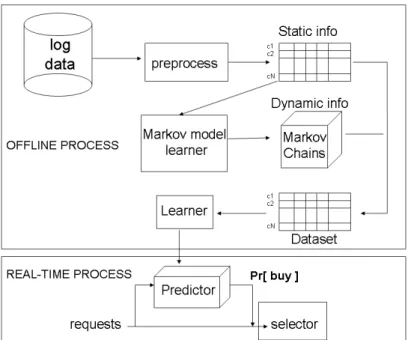
3.1.1 The AUGURES Prototype . . . 36
3.1.2 Experimental results . . . 39
3.1.3 Conclusions for User Modeling . . . 40
3.2 Our Previous Works on Self-Protection . . . 40
3.2.1 Distributed Data Collection . . . 41
3.2.2 Reaction and Feedback . . . 42
3.2.3 Summary of the Node and Network Algorithm . . . 42
3.2.4 Conclusions for Self-Protection . . . 44
3.3 Collaboration Work on Self-Healing . . . 44
3.3.1 Software Aging Scenario . . . 45
3.3.2 Prediction Experiments . . . 46
3.3.3 Conclusions on Learning Towards Self-Healing . . . 48
4 Tailoring Jobs and Resources 51 4.1 Introducing the Resource Modeling Approach . . . 51
4.2 Ad-Hoc Modeling of Virtualized DataCenter . . . 52
4.2.1 Time References . . . 52
4.2.2 Revenue and SLA Factors . . . 53
4.2.3 Performance Factors . . . 54
4.2.4 Power and Energy Factors . . . 54
4.2.5 Other Factors and Important Issues . . . 55
4.3 Modeling the Costs-Benefit . . . 55 7
4.4 Scheduling following the Model . . . 58
4.4.1 Solving Scheduling . . . 58
4.5 Conclusions on Tailoring Jobs and Resources . . . 59
4.6 Note on Experimental Environments . . . 60
4.6.1 Energy-Efficient Simulator . . . 60
4.6.2 Experimental Real Environments . . . 61
4.6.3 The LiBCN’10 Workload . . . 61
4.6.4 Experimental Methodology . . . 61
5 Predictions on Decision Making 63 5.1 Introducing Energy-aware Prediction and Scheduling . . . 63
5.2 Energy-aware management . . . 64
5.2.1 Machine Learning approach . . . 65
5.2.2 Relevant factors and basic assumptions . . . 65
5.2.3 Data sets and prediction algorithms . . . 66
5.3 Simulation and Metrics . . . 67
5.3.1 Simulation and power models . . . 67
5.3.2 Metrics . . . 69
5.4 Evaluation of the Energy-aware Schedule . . . 70
5.4.1 Experimental environment . . . 70
5.4.2 Power vs. SLA fulfillment trade-off . . . 70
5.4.3 Validation of ML models . . . 71
5.4.4 Scheduling policies . . . 72
5.5 Conclusions for energy-aware scheduling . . . 74
6 DC Mathematical Modeling 77 6.1 Introducing the Modeling Approach for DataCenters . . . 77
6.2 A MILP Representation for DataCenters . . . 78
6.2.1 Scheduling Approach . . . 78
6.2.2 Minimizing the power cost . . . 79
6.2.3 Maximizing the profit . . . 80
6.2.4 Quality of Service as a factor . . . 81
6.3 Studying the Behavior of the Model . . . 82
6.3.1 Programming and Simulation Environment . . . 82
6.3.2 Experiments . . . 84
6.3.3 Impact of Policies and Trade-offs . . . 87
6.4 Discussion on MILP Modeling of DataCenters . . . 88
6.5 Introducing Machine Learning into the Model . . . 89
6.5.1 Web-Services and Prediction . . . 89
6.5.2 Adapting the Mathematical Model . . . 90
6.5.3 Experiments . . . 91
6.6 Conclusions on Introducing Machine Learning on Data-Center Modeling . . . 94
7 Modeling Resources With Machine Learning 95 7.1 Introducing the DataCenter Scenario . . . 95
7.2 Infrastructure and Monitoring . . . 96
7.2.1 Service DataCenter Architecture . . . 96
7.2.2 Service Level Agreements . . . 96
7.2.3 Information Monitoring . . . 97
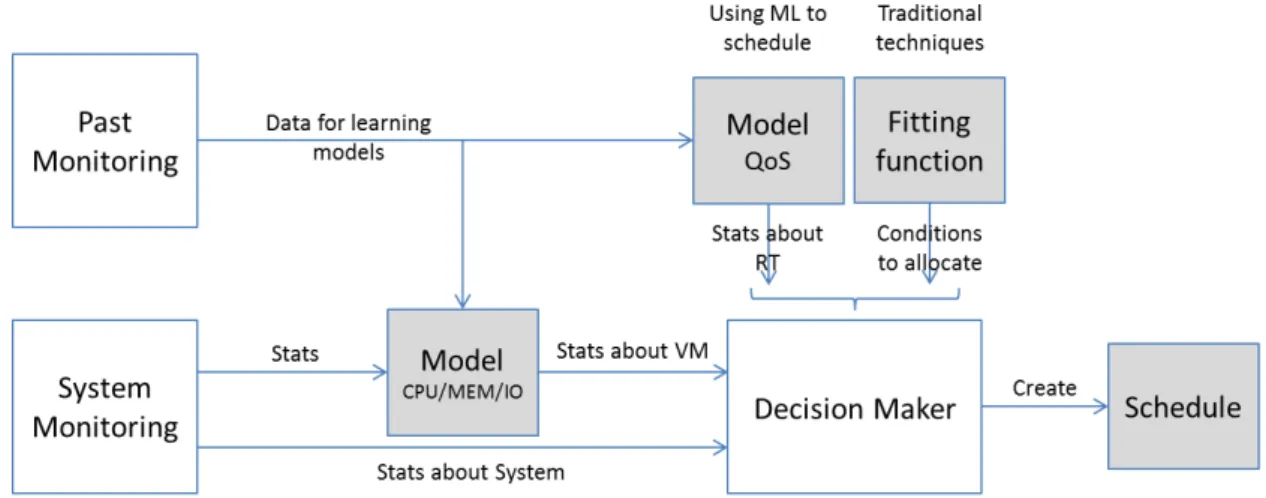
7.2.4 Modeling and Prediction . . . 97
7.2.5 Framework Schema . . . 98
7.3 Resource Modeling and Learning . . . 98
7.3.1 CPU Prediction . . . 99
7.3.2 Memory Modeling . . . 99
7.3.3 Bandwidth Prediction . . . 101
CONTENTS 9
7.4 Managing and Scheduling DataCenters . . . 104
7.4.1 Scheduling Algorithms . . . 104
7.4.2 Environment Description . . . 104
7.4.3 ML-augmented scheduling algorithms . . . 105
7.4.4 Validation on Real Machines . . . 105
7.5 Conclusions on Modeling DataCenter Resources using Machine Learning . . . 107
8 Extending to Multi-DataCenters 109 8.1 Introducing the Multi-DataCenter Management using Machine Learning . . . 109
8.2 The Multi-DataCenter Scenario . . . 110
8.3 Mathematical Approach and Models . . . 111
8.3.1 Adaptive Models . . . 113
8.3.2 Scheduling Algorithms . . . 113
8.4 Experiments and Studies over the Multi-DC . . . 114
8.4.1 Environment Description . . . 114
8.4.2 Intra-DC Comparatives . . . 115
8.4.3 Inter-DC Comparatives . . . 116
8.5 Conclusions for Multi-DC Modeling and Managing . . . 120
9 A Green Approach for Placing DataCenters 123 9.1 Introducing Green DataCenter Placement . . . 123
9.2 Green Energy DataCenter Placement . . . 124
9.3 Green datacenter placement tradeoffs . . . 129
9.4 Scheduling VMs Among Green Energy Availability . . . 132
9.5 Conclusions for Green Placement of DataCenters . . . 135
10 Conclusions 137 10.1 Main Contributions . . . 137
10.2 Topics for Further Research . . . 139
List of Figures
2.1 Commercial hosting infrastructure . . . 28
2.2 Virtualization middleware schema . . . 29
2.3 Consolidation Strategy . . . 29
2.4 Inductive Learning Schema . . . 33
3.1 AUGURES architecture . . . 36
3.2 %admitted vs. recall and %admitted vs. precision . . . 40
3.3 Detection and Reaction Mechanism . . . 43
3.4 Confusion Matrix on Attack Ratios and Thresholds . . . 44
4.1 Examples of SLA fulfillment kinds . . . 53
4.2 Information flow schema using models . . . 62
5.1 Simulator Diagrams . . . 68
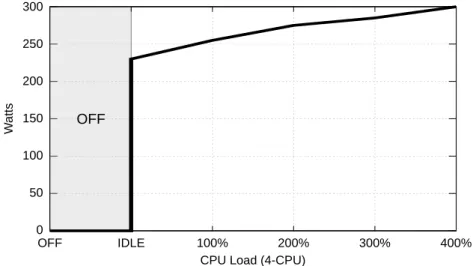
5.2 Power behavior of the target PC . . . 69
5.3 SLA and Power using different turn on/off thresholds [Source: eEnergy’10 [30]] . 71 5.4 Power consumption of different schedulers with a Grid workload . . . 74
5.5 CPU usage and SLA fulfillment with heterogeneous workload; Most significant policies: Dynamic Backfilling, Machine Learning and Random . . . 75
6.1 Power consumption in for each model . . . 84
6.2 Benefit obtained from each model . . . 85
6.3 Number of migrations for each model . . . 86
6.4 Power versus migrations and migration restriction policy . . . 87
6.5 Power versus QoS (health) and QoS Loss restriction policy . . . 88
6.6 Power and SLA Comparative on the Schedulers . . . 93
7.1 Prediction of VM CPU demand for Xeon-4Core . . . 100
7.2 Typical VM Memory Behavior, with memory Flushing and Garbage Collection . 100 7.3 Prediction of MEM VM demand(TR: ∆T ∈[10s,10min,1h]; TS: ∆T= 5min). . . 101
7.4 Prediction of PM Bandwidth demand . . . 102
7.5 Prediction of Response Time, in a non-stress and stress situation. Stress begins around instance 1400, where RT begins to increase . . . 103
7.6 BF-noML against BF+ML SLA (based on response time) and machines used . . 106
8.1 Results and Factors for Intra-DC Scheduling . . . 115
8.2 VM placement following the Load for Inter-DC Scheduling . . . 117
8.3 Results and Factors for Inter-DC Scheduling . . . 118
8.4 Comparative Static vs Dynamic Inter-DC for 5 VMs . . . 119
8.5 Relation of the SLA vs Energy vs Load . . . 120
9.1 Optimization function and constraints . . . 128 9.2 Cost of building a 50% green network of DCs with a computation capacity of 50MW129 9.3 Cost of building a network of DCs depending on green % required using net metering129 9.4 Cost of building a network of DCs depending on confidence using net metering . 130
9.5 Cost of building a network of datacenters depending on confidences with no energy storage . . . 130 9.6 Cost of building a network of datacenters depending on the confidence using batteries131 9.7 Cost of building a 100% green network of datacenters depending on the migration
requirements with no energy storage . . . 131 9.8 Constraints for the load placement problem . . . 132 9.9 Load distribution to achieve 50% confidence of having 100% green energy using
net metering . . . 134 9.10 Load distribution to achieve 100% green energy without energy storage . . . 134
List of Tables
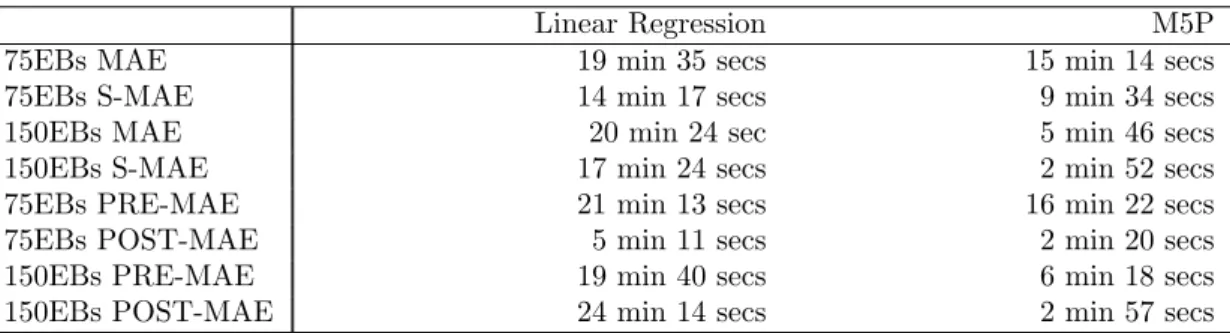
3.1 MAEs obtained predicting time until failure on deterministic software aging . . . 47
3.2 MAEs obtained predicting time until failure on software aging hidden within pe-riodic pattern . . . 48
4.1 Summary of symbols and functions . . . 53
4.2 Summary of Costs . . . 55
5.1 Summary of symbols and functions . . . 67
5.2 Scheduling results . . . 72
6.1 Properties of the simulated datacenter . . . 83
6.2 Workload details . . . 83
6.3 Comparative between models . . . 86
6.4 Statistical analysis for each algorithm and metric. . . 92
6.5 Scheduling Comparative between techniques applying Migration Penalties . . . . 93
6.6 Scheduling MILP Solver with different electric costs and migration penalty . . . 93
7.1 Attributes obtained from the monitoring agents . . . 97
7.2 Learning Load vs CPU function . . . 99
7.3 Learning Load vs MEM function . . . 101
7.4 Learning Load vs IO function . . . 102
7.5 Learning Load,Resources vs RT function . . . 103
7.6 Comparative of algorithms from the relevant business model values . . . 105
8.1 Learning details for each predicted element and selected method. All training processes are done using random split of instances (66/34) . . . 114
8.2 Prices and Latencies table (Latencies in ms [10Gbps line]) . . . 116
8.3 Comparative of results for the multi-DC per 5 VMs . . . 119
9.1 Parameters and Variables for the Placement Mathematical Problem . . . 125
9.2 Summary of parameters and variables for the load placement problem . . . 132
9.3 Datacenter network details for 50% confidence of having 100% green energy using net metering . . . 133
9.4 Datacenter network details for 100% green energy without energy storage . . . . 133
Acronyms
AI Artificial Intelligence
BWD Bandwidth
CAPEX Capital Expenditures
DC DataCenter
DDoS Distributed Denial of Service
DVFS Dynamic Voltage/Frequency Scaling
EEFSIM Energy-Efficient Simulator
HPC High Performance Computing
IO Input/Output
ISP Internet Service Provider
IT Information Technologies
MAE Mean Absolute Error
MAPE Monitor/Analize/Plan/Execute
MSE Mean Squared Error
MILP Mixed Integer Linear Program
ML Machine Learning
OPEX Operational Expenditures
PM Physical Machine
PUE Power Usage Efficiency
QoS Quality of Services
RL Reinforcement Learning
RR Round-Robin
RT Response Time
SLA Service Level Agreement
SLO Service Level Object
VM Virtual Machine
WS Web-Service
Chapter 1
Introduction
“Intelligence”: The art of good guessing. - H.B.Barlow
“Artificial Intelligence”: Artifact able to guess good, given limited resources, time or space.
1.1
Introduction
The Web 2.0 and the computing/storage web service business have contributed to democratize the Internet, allowing everybody to share information, services and Information Technologies (IT) resources around the network. With the arrival of social networks and the introduction of new IT infrastructures into the business world, the Internet population has grown enough to make the need for computing resources an important matter to be treated. While few years ago enterprises had all their IT infrastructures in privately owned DataCenters (DC), nowadays the big IT corporations have started aDataCenter-race, offering computing and storage resources at low prices, looking for outside companies to trust their data or IT needs on them.
These offered resources are also referred as “the Cloud”, a place in the Internet where you can access from anywhere, upload and download all your information, send your data to compute, without the need of knowing where and how the physical infrastructure is. For the user, every-thing is reduced to a user-friendly web service, so companies can delegate their e-mail boxes, web applications, and the computing jobs topay-as-you-goIT resources companies like Amazon, Google, etc, instead of spending money on private datacenters, with all the extra infrastructure it requires. And this makes not only enterprises to work into the Cloud, but also casual users start using it. Most of the existing social networks and popular web-services began from user initiatives, and as these services grow popular, more IT resources are required to run them. Only a few extremely large companies such as Facebook need their own Cloud for handling all the users and data stored into.
Handling these requirements to give good Quality of Service (QoS) requires not only a pow-erful enough single datacenter. A single web application or piece of data can be easily used by people around the world, so often it mush be available from everywhere, keeping in mind things like quality of service and service level agreements between users and service providers. For example, Google and Youtube receive queries from around the world at the same time, and must keep replicas of their web-services near each client, and move each piece of data as close to its final user as possible. For a service that can be replicated, it requires moving just data, otherwise copies of unique set of services must be placed wisely among the datacenter farms among the planet, to ensure QoS and reduce costs. This means coordinating all jobs, services and applications in the Cloud system with all its resources, and given the amount of jobs running nowadays on it, this becomes a hard optimization problem.
Before the Cloud and the Web 2.0, technological improvement sufficed to cover the increasing IT demand, bringing faster processors, larger storage devices, and faster connections between re-sources. But now the demand is growing faster than technological improvement, so every day we require larger datacenters and more computational power, with a larger energetic demand, and the requirement of strategic placement of resources and distribution of load around the world. Further more, in most situations more computational power or larger DCs do not mean better
QoS and more availability, and reaching a (near) optimal performance of Cloud services and re-source management passes through anIntelligent Management, aware of the state and capability of each resource used and the needs of each user. This Intelligent Management complements the technological improvement, allowing better resource use, borrowing and lending resources when it is convenient to do so, and improving the quality of service without scaling the DataCenters unnecessarily.
In order to proceed with decision making, knowing in detail the structure and environment of every element involved in the system is crucial. Not having this information prevents us of having experts (automatic or human), advising about what to do in each situation, giving us hints for best solutions and best practices, and having reactive elements keeping an eye over the system constantly to cover any incident or change.
Unfortunately, in the Cloud all of this is not possible, as 1) it becomes an abstract set of resources, each one with abstract set of properties. Each domain of resources has its own resource broker and interface for dealing with resource borrowers and lenders, so a part of the Cloud can not manage or get all the information to other parts of it. 2) Systems running on the Cloud are hard to model explicitly by hand and hard to predict due its internal complexity and also complex dependence on external input including human input. For most of the applications and services running in the Cloud there are no experts, and most variables indicating the system status are hidden to the naked eye, making it difficult to predict the behavior of the hole (or even a part of) the system. 3) Given the amount of elements to control and monitor, also the amount of data generated by each element to be checked, keeping a human operator watching over each warning, change or information, reacting in front of each, becomes practically impossible. In front of these problems, automation and novel techniques for understanding the system become part of the solution, “understanding” what is happening in the system and handling all the decisions to be made in the most autonomous way as possible.
Current datacenters and large-scale distributed computing systems (the underlying structure of the Cloud) are recently implementing techniques of autonomic computing, a field on science focusing on the automation of computation systems (from single computers to multi-DC systems). The need for managing large-scale systems has made this automation a hot topic on research, opening sub-topics focusing on different areas of improvement: self-healing, as the automation of detecting and solving system failures; self-protection, as the automation of enforcing security over systems and data; self-configuration, as the automation of deploying services and applications on systems; and self-optimization, as the automation of improving performance of services and systems. By default, the research on these topics is been done taking advantage of ad-hoc hand-crafted expert systems, statistic models and rules. We put forward the central hypothesis of this thesis: that these solutions can be improved if the system is able to generate models and rules from what it can observe, adapting each model to the given states and environment, “learning by itself” how the system behaves.
Machine learning (viewed as part of a larger field, data mining) brings a methodology to, given a set of observations from a given system, discover knowledge from its behavior, and predict elements of it. The advantage of using machine learning instead of systems built from explicit modeling is that 1) we do not always we have an expert, 2) we have too much information to treat, 3) this information may be incomplete, missing, or uncertain, 4) the system may change over time. Machine learning methods focuses on these issues, some of them being robust against sparse scenarios (scenarios with states sharing low similarity among them), some robust against changes (scenarios changing constantly) or easy to update, and ready to handle high dimensionality (scenarios with too much data and features for each piece of information to be treated).
The usual methodology for creating models using inductive learning require 1) a period of observation of the system to be learned from, 2) a learning process to create a model describing the system behavior, and 3) a testing period.
The ability of using this learned knowledge to improve performance of large-scale systems like Cloud systems opens a new wide research area combining all the capabilities of Autonomic Computing and the capabilities of learning and discovering knowledge from these systems.
1.2. MOTIVATION 19
1.2
Motivation
Currently, intense research is done related to learning and artificial intelligence application into networks and systems. Many existing works focus on specific details of a given system, like a specific component or studying a specific policy. This thesis and research goes beyond this kind of solutions requiring fixed models created by experts or specific ad-hoc details over components or single policies. Often, in large-scale computing systems, we do not know about the whole system; often it is too complex to understand each piece or detail; often the system is in constant change, enough to invalidate all fixed models or established policies.
This thesis is about making management of large-scale systems to be as automatic but ac-curate as possible. We want management to be adaptive, able to get and adjust the models describing web-services and infrastructures, in order to
• let administrators and operators to make their work easier
• make decisions (scheduling, allocate resources and switch on and off resources) automati-cally, including energy management
• offer good quality of service to the users of the infrastructure also to the users of the web-services relying on the infrastructure
• obtain knowledge from the system learning from the generated models
This thesis researches and develops a set of techniques, methods and strategies, letting the system learn about its own behaviors and responses given expected and unexpected scenarios, model these, and find the adequate policies to improve the system management using the result-ing models. We focus on a particular scenario, very common in datacenter infrastructures and services (like e.g. web-service hosting at Amazon), the virtualized environments. The methods and strategies can be studied by observing how machine learning improve management in au-tonomic scenarios, or how if made decisions make the system perform as well as ad-hoc made expert systems, all of this obtaining adaptively by itself this expert knowledge.
1.3
Goals of this thesis
The main goal of this thesis is to demonstrate that, with the use of machine learning techniques, management of virtualized web-services on a multi-datacenter system can be improved in quality of service terms and energy consumption.
In order to achieve this main goal, this thesis takes a walk from the state of the art where the management of virtualized web-services is based on administrators expertise, well known data, ad-hoc studied algorithms and models, and elements to be studied to be from computing machine point of view; to reach a novel state of the art where the management is driven by models learned from the same system, providing useful feedback, making up for incomplete, missing or uncertain data, from a global network of datacenters point of view.
The steps in this walk can be seen as a movement between scaling the scenario, from com-puting machines to multi-datacenters, and the required level of knowledge and prediction, from having a given explicit model to having no a-priori knowledge of the system potential environ-ment and behavior. We start by automatically modeling a single machine, pass by the level of a computing cluster, and reach the level of a multi-datacenter infrastructure. In between we model each system mathematically, identify the relevant information required to manage it and find methods to predict that information and apply it.
Stage 1 - Tailoring Jobs and Resources: We depart from a point where, having a datacen-ter or a set of machines hosting virtualized jobs (be High Performance Computing (HPC) or Transactional jobs like Web-Services (WS)), everything must be arranged and scheduled so as to maintain these jobs accomplishing their deadlines and respecting their quotas of resources (CPU or Memory). This first stage covers the scenario where the decision maker works knowing all pieces of information from the system: how much will each job consume, how is and will be the
desired quality of service, what are the deadlines for the workload, etc. All of this focusing on each component and policy of each element involved in executing these jobs. The work included in this stage coincides in part with the PhD thesis of ´I˜nigo Goiri, working on modeling in detail virtualized environments towards economic profit, where we had an active involvement as a col-laboration on the experimental part. Here we only present the modeling work corresponding to this thesis.
Stage 2-Predictions on Decision Making: When controlling components in a real environment, and also when making decisions that affect the future, we need to predict what the future may look like including the effect of our decisions and actions. Usually estimators are built by experts who know the system, but the experts may not be available when the system becomes large, or the situation to be handled is complex enough to design an ad-hoc decision maker worth it. In this stage the work contemplates the scenario where instead of fixed oracles that provide us information from an expert formula or set of conditions, machine learning is used to create these oracles. Here we stand in a point where we look at components and specific details while some part of the information is not known and must be learned and predicted.
Stage 3 - Mathematical Modeling of DCs: When energy becomes an important factor, the function optimizing costs and benefits must take care of consumption, and reduce the usage of resources while maintaining performance. It should not only be limited to CPUs in a machine, but extended to a whole datacenter by reducing the on-line machines to the minimal required. So the optimization can be expanded by looking to the global datacenter environment. This stage begins reducing the problem of optimizing the resource allocations and requirements for virtualized web-services to a mathematical problem, indicating each factor, variable and element involved, also all the constraints the scheduling process must attend to. Our scheduling problem can be modeled as a Mixed Integer Linear Program (MILP). Here we are in a point where we face an scenario of a full datacenter, further we introduce some information prediction (for only CPU resources at this step) using the methodologies from the previous step.
Stage 4-Learning in DataCenters: Our mathematical problem can be guided also by learned modules providing predictions for each placement so a solver will require less expert ad-hoc speculations, also less information from noisy monitors. Each element can be modeled so the scheduler can use a predictor for each piece of data coming from monitors, speculate with ten-tative schedules, and choose the predicted best situation. We complement the previous stage by expanding the predicted elements, studying the main resources, this is CPU, Memory and IO, that can suffer from noise, inaccuracy or unavailability. Once learning predictors for certain components let the decision making improve, the system can become more “expert-knowledge independent” and research can focus on an scenario where all the elements provide noisy, uncer-tainty or private information.
Stage 5-Extending to Multi-DCs: What can be achieved by managing efficiently a datacenter can be exported to a model where this datacenter is spread along the world, or what is the same, several datacenters distributed along the world are united as a federation. New factors are involved in the optimization, as for each datacenter, costs may change as energy has different prices in different locations. Also each datacenter may provide different times of service due to proximity to the client.
Stage 6-Green Multi-DataCenters: A final approach, once we have a system relying on a dat-acenter network, is to optimize the energy costs by powering them using green energy (energy from renewable sources). Unlike other chapters, in this one we do not address the management of an existing computing structure, but its design and placement before it is built. Planning and building the datacenters near renewable sources and take advantage of solar and wind energy availability results cheaper and more affordable than the usually expected. We finish this thesis with a view of the cost of placing datacenters depending on green energy sources, and distribute the load according to green energy availability.
1.4. ABOUT THIS THESIS 21 At the end of the journey we have moved from a stage where every policy is calculated ad-hoc for each job and component, to a stage where the scenario is a full system of datacenters. All important information that can become inaccurate or missing is predicted, driving the decision manager to grant quality of service to datacenter customers and web-service clients, having into account very important factors like energy consumption.
Note that all the steps above are orientative: they may overlap and often are anticipated elements of the next.
1.4
About this thesis
This thesis is a multidisciplinary work joining two different research areas, autonomic computing and machine learning. While Autonomic Computing cares about self-management techniques like self-healing, self-protection, self-configuration and self-optimization, machine learning brings a set of methods for modeling systems, predicting system values, making ”intelligent” decisions, and adapting these models and predictions when the system changes. Further, this thesis is being developed as a research project inside two research groups:
• The LARCA research Group (Laboratori of Relational Algorithmics, Complexity and Learnability) is a research group composed by members of LSIDepartament de Llenguatges i Sistemesand mostly of the UPC, working on data mining, complexity and computational learning, and its applications; directed by professor Ricard Gavald`a.
• The Autonomic-HPC (Autonomic Computing, at the High Performance Computing re-search Group) is a rere-search group composed by members of the DAC Departament d Arquitectura de Computadors of the UPC and the BSC-CNS Barcelona Supercomputing Center - Centro Nacional de Supercomputaci´on, working on Autonomic Computing and new methods for self-management in distributed systems; directed by professor Jordi Tor-res.
Also, this work is or has been financially supported by:
• The Spanish Ministry of Science FPI grant BES-2009-011987
• The Spanish Ministry of Science MOISES-BAR project (Individualized Modeling of Sym-bolic Sequences) TIN2005-08832-C03-03, coordinated by Ricard Gavald`a.
• The Spanish Ministry of Science SESAAME project (SEcuencias Simb´olicas: An´alisis, Aprendizaje, Modelado y Evoluci´on) TIN2008-06582-C03, coordinated by Ricard Gavald`a.
• The Spanish Ministry of Science BASMATI project (Biological and Social Mining: Al-gorithms, Theory, and Implementation) TIN2011-27479-C04-03, coordinated by Ricard Gavald`a.
• The Spanish Ministry of Science CAP-VI project (Computaci´on de Altas Prestaciones VI) TIN2012-34557.
• The Generalitat de Catalunya (2009-SGR-1428).
• The EMOTIVE-Cloud BSC Project directed by Jordi Torres.
• The EU COST Action IC0804, Energy Efficiency In Large Scale Distributed Systems, coordinated by Jean-Marc Pierson.
• The EU PASCAL2 Network of Excellence. Pattern Analysis, Statistical Modelling and Computational Learning.
• The EU CoreGRID Network of Excellence. European Research Network on Foundations, Software Infrastructures and Applications for large scale distributed, GRID and Peer-to-Peer Technologies.
1.5
Document Outline
The remainder of this document is structured as follows:
Chapter 2 provides some Background Concepts and the State of the Art in the relevant areas: autonomic computing, data mining and machine learning concepts, and the current applications of machine learning to Autonomic Computing. Given that the project is multidisciplinary, a broad survey becomes necessarily.
Chapter 3 visits works done previous to targeting the current goal and stages, in order to explore and perform some experiences toward the possibility of applying machine learning modeling to direct applications in distributed systems and autonomic computing, related to web-service self-optimization, self-defense and self-healing. This chapter is based on already published material (GDN07 [109], UM07 [131], TR-DAC07 [135], ComNet09 [133]), also (DSN10 [3], DPDNS10 [4]), also material presented as Master Thesis (AISec08 [32]).
Chapter 4 presents work on analytical and theoretic ad-hoc modeling on HPC and transactional virtualized jobs from a computing machine/datacenter (Stage 1). This chapter is based on al-ready published material (ICAC08 [156], GRID10 [67], Cluster10 [70], FGCS12 [66]).
Chapter 5 presents work on machine learning applied to predicting components and variables to drive decision managers concerning to autonomic computing issues like self-optimization for a computing machine/datacenter (Stage 2). This chapter is based on already published material (EEnergy10 [30], GreenBook12 [31]).
Chapter 6 presents work on modeling a full datacenter reducing it to a mathematical program, optimizing the costs for running it taking into account quality of service for datacenter cus-tomers and web-service clients, and applying the machine learning techniques developed in pre-vious stages (Stage 3). This chapter is based on already published material (TR-LSI10 [24], GRID11 [25],TR-LSI11 [26]).
Chapter 7 presents work on the study of learning and prediction of datacenter and comput-ing machine component performance towards web-service load and different resource allocation scenarios (Stage 4). This chapter is based on already published material (SAC13 [27], TR-LSI13 [28]).
Chapter 8 presents work on managing world-wide datacenter systems, focusing on distribution of jobs according on energy obtaining, energy consumption, service placement and proximity to the web-service clients (Stage 5). This chapter is based on material being published (PASA13 [29]). Chapter 9 presents work on building a world-wide datacenter system, oriented towards the avail-ability of green energy sources, like solar and wind capacity (Stage 6). Material in this chapter is subject of a paper to be submitted to a main conference.
Chapter 10 draws the main conclusions of the thesis and proposes new issues to continue the research field and proposes some lines to continue the research in this thesis.
Chapter 2
Background
Nowadays data mining techniques and other stochastic models are being introduced into the field of autonomic computing, improving on modeling and prediction for decision making. This section explains some background concepts and provides some examples of applications to Autonomic Computing, Cloud Computing and self-management topics. Mostly, works provided in this section are focused on the direction of this thesis, by applying autonomic strategies, artificial intelligence or statistical learning in some way. Further, each chapter will include its ownrelated work section pointing on their specific relevant concepts and important related works..
2.1
Relevant Concepts on Autonomic and Cloud
Comput-ing
2.1.1
About Autonomic Computing
Autonomic Computing definition can be found in the manifesto and challenge visions written by J.Kephart [91, 90] from IBM Watson Research Center:
As systems become more interconnected and diverse, architects are less able to anticipate and design interactions among components, leaving such issues to be dealt with at runtime. Becoming too massive and complex for even the most skilled system integrators to install... the only option remaining is computing systems that can manage themselves given high-level objectives from ad-ministrators.
So, the more complex and large systems become, operators and architects are less able to manage and create components that will fit accurately into these systems. For this, autonomic computing is responsible of giving self-management abilities to such complex systems, allow-ing degrees of autonomy for makallow-ing decisions, like followallow-ing healallow-ing, optimizallow-ing, self-configuring and self-protecting policies.
• Self-Healing: Self-Healing techniques are in charge of automatically detecting, diagnosing and repairing localized software and hardware problems. There is a lot of work done on recovering systems from a failure, but predicting these failures before they happen can help us to prepare the system for these recovery processes. If we are able to anticipate a failure, we can take some actions to prevent it or to attenuate its consequences. Some works are done on self-healing considering that recovering systems can be more efficient than prevent systems from failures, like Patterson et al. [38]. Anticipating the kind of failure, the moment of failure and as most details as possible, we can set up the recovery mechanism ready minimizing the impact of the process. E.g. works presented by Alonso, Silva et al. [6, 5, 143] are about these system rejuvenation methods, by predicting crashes
for web-service components and enabling replicas before crash. Prediction and anticipation require some modeling. Works like Cherkasova [181], Cohen [48] or Barham et al. [20] try to discover if a system is going to crash or not from its behavior by modeling it. While Cherkasova [181] relates a methodology obtaining linear regressions for system exhaustion, Cohen and Barham [48, 20] are about the system instrumentation in order to find a good model for diagnosis purposes.
• Self-Configuration: Self-Configuration techniques are in charge of configuring components and software of an autonomous system following high-level policies, often being these com-ponents from different vendors and providers. This makes installing and configuring them in a proper way a consumption of time and effort for operators, also finding the best inte-grated configuration is hard enough. There are some examples of works on self-configuring, like the ones from Wildstrom et al. [175, 174, 173], where reinforcement learning techniques are used to change configuration of software components, looking for improving execution of these components.
• Self-Optimization: Self-Optimization techniques are in charge of automatically improving the system goals, usually performance or economic values where performance is heavily implied. The decisions to be made are usually deciding the best values for parameters, selecting the best strategies to be followed, enabling the best policies to reach the system goals, or finding solutions to General Allocation Problems like scheduling tasks. As having a lots of manually set parameters, variables and decisions to be made over a given system, as it becomes complex these decisions become harder; another reason to automate the self-optimization tasks and proceed through “intelligent management”. Self-Optimization is a challenging area where several works have been done. Examples are in Parashar, Chandra et al. [183, 42], where frameworks for self-managing like PRAGMA are extended by using predictive behavior models for applications and system status, adapting the policies on runtime. The challenge here is on perform this optimization over heterogeneous workloads and heterogeneous resources. While in systems where the owner is always the same (e.g. a grid system), optimization could be easier to perform as it was possible to know the dimensions of the whole domain and have most of the information of it available, but now in Cloud systems the optimization becomes harder as management systems may not know its full shape, or parts of the information required to manage the system is not available; another reason to proceed with data mining and machine learning techniques, exploring the data finding information and knowledge.
• Self-Protection: Self-Protection techniques are in charge of detecting attacks towards the system or cascade failures, letting management to react, warn or anticipate them, prevent-ing a system-wide failure or data and information compromise. They are also in charge of preventing intrusions, malicious behaviors, exploitation of errors or any kind of happening that may harm the system or the users of such system. Recent advances have helped to take some of the burden of security maintenance of overloaded system administrators, such increasing of usage of automatic intrusion detection systems, secure embedded processors, proactive security measures, and automated virus response mechanisms, but there is much more to do. In the work of Chess et al. [46] some keys to be researched in the field of self-protection are summarized: ways to represent the security and privacy policies, rep-resent the security states and trust relationships, resistant algorithms against fraud and persuasion, taxonomies for communication the privacy states and policies, methods for dif-ferentiating normal status and attacks and ways to construct autonomic elements so that their collective behavior is both trustworthy and trusted. Currently most of works on au-tomated security are focused on Intrusion Detection Systems and Anti-Spam and Flooding Avoidance. E.g. works presented by Lee et al. [95] exposing IDS frameworks being updated using Data Mining techniques, incorporating new policies and patterns when needed. Or works presented by Y.M.Wang et al. [172] exposing frameworks to avoid spammers to pro-mote their spam links into top search results using reinforced statistic techniques. Further works presented by Parashar, Berral et al. [178, 32] with methods for enhancing Intru-sion Prevention Systems to avoid network and web-services flooding attacks automatically
2.1. RELEVANT CONCEPTS ON AUTONOMIC AND CLOUD COMPUTING 25 from collecting and sharing information between agents in the network, learning patterns of attacks, predicting them and reacting.
Most of the current advances on Autonomic Computing are converging on the usage of more sophisticated techniques than simple statistical models and heuristics, introducing techniques from approximate algorithms, artificial intelligence, modeling and prediction, and data mining. Approaches with more capabilities by understanding better the system and making automatically decisions, and with better adaption to changes and noise.
2.1.2
About Cloud Computing
Nowadays the concept of Cloud has become one dominating paradigm in the externalization of information and IT resources for people and enterprises. In the “Cloud” business, the concept of “Cloud” can be defined as a “resource pool with on-demand resource allocation”, a pay-as-you-go everything-as-a-service system, spread on an abstract infrastructure as seen by the common user (also more details for its definitions are found on [106]). The fact is that the Cloud is actually a name for the abstract concept of having data, web-services and computing resources available through the Internet, with no need of knowing details of the supporting infrastructure, but just a user-friendly interface to manage them. The infrastructure maintaining these systems, given their complexity and operational costs must be organized and managed in the most optimal, secure, robust and adaptable way. Again, the main focuses of Autonomic Computing.
The possibility of offering “everything as a service” (platform, infrastructure and services) has allowed companies to move their IT, previously in private, owned data-centers, to external hosting. Resource renting and Cloud resource offering has become an important business for IT companies, who have started, in the late 2000’s, the business of offering infrastructures, platforms and services as a service. For companies that have IT needs, it is cheaper and more comfortable to rent resources (computational, storage or back-end and front-end services) than own IT equipment, paying just what the client company requires. As a consequence, the Cloud led to the creation of computing-resource provider companies, starting adatacenter race offering computing and storage resources at low prices. E.g. companies like Amazon with its EC2 and S3 [8], Google with its AppEngine and Cloud services [1], and IBM with the Blue Cloud [84], offer these resources with costs lower than a company buying and maintaining new IT that will be used temporarily [56].
The datacenter administration will essentially try to maximize its revenue by executing as many hosted services as possible, but is constrained by the its infrastructure: If too many services are accepted, quality of service will degrade, leading to immediate penalties as per Service-Level-Agreements (SLA), and eventually to prestige and customer satisfaction losses. Additionally, power consumption costs are becoming a growing portion of the operationg costs, besides increasing societal and environmental concerns. Naturally, high job throughput and user-satisfaction can be obtained by deploying a large amount of resources, but this incurs in high resource usage costs.
So, research is also on Cloud management, as it actually relies on (multi) datacenter infras-tructures to be managed, optimizing processes and operations, always helping the operators and always transparent to its users. Works on self-management of these multi datacenter infrastruc-tures are generally oriented to manage workloads, broker resources, and provide high quality of service to the resource customers. A large part of this work is focused on the middlewares managing the different Cloud layers (E.g. [118] for media file storage, [117, 122] for job and virtualization management), and different Cloud kind of works and workloads [40].
Resource Brokers
In the driving middlewares is where the autonomic computing techniques are applied. Resource brokering is in charge of manage resources to be given/obtained for each job or virtualized service. High-level brokers manage resources according to SLA policies, while low-level brokers attend to CPU/Memory/IO costs, distribution of the systems, system overheads for migration, virtualization, and running resources costs. All in all, the goal for resource brokers are to optimize the resource usage and assignation. This is why one commonly kind of resource broker
used is the economy-driven resource managers [37, 35, 171], where resources are driven, shared or allocated following market-oriented policies. Several works developed frameworks or methods for this economic resource management, e.g. projects Grace, Sorma, Spawn, Tycoon, etc.
The Sorma project [113, 120] presented an economic approach for efficient resource alloca-tion in a Cloud, using market mechanisms. Their ”Decentralized Local Greedy Mechanism” satisfies desirable economic properties for each supplier and requester promising to enable an efficient allocation of resources. With this mechanism, the participants in a network (companies, research institutes, etc.) try to selfishly maximize their individual benefit from participating in the network, and setting the right incentives for suppliers and requesters, for an efficient usage of the limited available resources, motivating the participants to cooperate and provide their idle resources. The Grace project (Grid Architecture for Computational Economy) [36] also pre-sented another economy-based architecture for efficient resource allocation, where both resource owners and users maximize their objective functions, defining their charging and access policies, interacting with the resource pool by defining their requirements through high-level tools.
There are more frameworks (like [93], etc.) apart of these two, all of them with the purpose of allocating resources in a fair way, where clients and providers specify their conditions in service level agreements, and the brokers try to satisfy all the agreements as most as possible, considering the profit for each exceeded or violated agreements and other cost-benefit variables. Further, apart of market-based metrics, also other works treated the resource provisioning based on other ones, not only on the cost of the resources, like the waiting time for the resource or the runtime execution time of the workload [137].
2.1.3
Related Concepts: the Grid and Virtualization
Some concepts should be explained or visited to understand the fundamentals of Cloud Com-puting research area: “the Grid” and Virtualization techniques.
The Grid
Before the idea of “Cloud” developed, the research on managing distributed systems was focused on Clusters and “Grid” systems. I. Foster and C. Kesselman defined Grid systems as ahardware and software infrastructure that provides dependable, consistent, pervasive and expensive access to high-end computational capabilities[63, 64]. They also designed a list of requirements or goals for what a Grid system should be able to do:
• Coordinate resources that are not subject to centralized control, integrating and coordi-nating resources and users within different control domains.
• Do it using standard and general-purpose protocols and interfaces, built from multi-purpose protocols and interfaces that address such fundamental issues as authentication, authoriza-tion, resource discovery, and resource access.
• And deliver non-trivial qualities of service to be used in a coordinated fashion to deliver var-ious qualities of service meeting complex user demands so that the utility of the combined system is significantly greater than that of the sum of its parts.
The concepts and implementations of the Cloud have inherited many of the properties, concepts and problems from the Grid systems.
Virtualization
Virtualization is a technique (or set of techniques) to run processes, jobs, guest OS and also “machines” inside one or several Physical Machines (PM). The main capabilities of virtualization are to provide a confined environment where applications can be run, limit hardware resource access and usage or expand it transparently for the applications, adapt the runtime environment to the application, use dedicated or optimized OS mechanisms for each application, manage the whole applications and processes running within Virtual Machines (VM). These virtualized elements can be migrated among physical machines with different relying infrastructures or OSes,
2.1. RELEVANT CONCEPTS ON AUTONOMIC AND CLOUD COMPUTING 27 dimensioned dynamically defining the size of the virtual machine (resources that will demand to the physical environment), also treated as a process for the host operating system. For more information about the architecture of VMs see [144], among other works on that area. Here we summarize the basic aspects of current products and solutions, obtained from [168]:
• Operating system-level approaches: these approaches allow to virtualize a physical server enabling multiple isolated and secure virtualized servers to run on a single physical server. No guest OS are used and applications run in a specific view of the only one OS as if they were alone running on the operating system. Some of these approaches are VServer [101], a kernel patch based on partitioning, using a ”security context” inside a UNIX OS, FreeBSD Jail [136], and also Solaris Containors, OpenVZ, etc.
• Emulators: Virtual machines simulate the complete hardware used by a guest OS. VMware [169] is a virtualization software for machines based on x86 architecture, where virtualiza-tion works at the processor level, the virtual machine privileged instrucvirtualiza-tions are trapped and virtualized by the VMware process and other instructions are directly executed by the host processor. All hardware resources of the machine are also virtualized. Other solutions are Microsoft VirtualPC, Oracle VirtualBox, QEMU [23], etc.
• Operating system in user space: These approaches provide virtualization through the exe-cution of guest operating systems directly in user space. Some approaches are User Mode Linux [82], that allows launching Linux OS as applications of a host machine running Linux, and also coLinux, Adeos, L4Ka based projects, etc.
• Paravirtualization: the paravirtualization technique does not necessarily simulate the hard-ware, but instead offers a special API requiring modifications to the guest OS. The hardware resources are abstract resources not necessarily similar to the actual hardware resources of the host machine. Xen [21] is a virtual machine monitor for x86 architecture, allowing the concurrent executions of multiple OS while providing resource isolation and execution con-finement between them. Other projects using this paravirtualization approach are Denali and Trango.
• Hardware-assisted virtualization: this virtualization allows to run unmodified guest OS giving to the VM its own hardware. This is possible thanks to an increase set of processor instructions provided by Intel VT (IVT [86]), AMD (AMD Pacifica x86 virtualization [9]), IBM (IBM Advanced POWER virtualization [83]) and Sun (Sun UltraSPARC T1 hyper-visor [107]).
The design of Cloud systems take advantage of the possibility of virtualizing services, jobs and processes, as one physical machine can hold several of them. Further, services and HPC jobs running in the Cloud can be easily run in isolation, tailoring their resources and consumptions, moving them across the network of multi-DCs for placing them in the most proper location, and stopping and resuming the virtual machines conveniently. Encapsulating these jobs in virtual machines, the system manager can migrate the job across the network of datacenter looking for proximity of services toward clients (improving the quality of experience), scheduling the job with the required resources (speeding up job deadline or enforcing resource agreements, and thus improving quality of service), or placing the job in a place where operational costs can be reduced (e.g. energy availability, looking for cheap available energy or green energy, further applying consolidation techniques to reduce resource consumption).
Virtualization has to pay usually overheads, as it implements a software layer in the OS software stack; also VM operations like VM migration requires time to get accomplished, where the service or job is not running or providing service. Although that, as we see in works using virtualization, if well used it becomes an affordable cost in front of all the capabilities this technology provides.
2.1.4
Cloud Resource Business
• Thedatacenter manager, or cloud service provider, wants to maximize its final revenue by optimally using the physical and virtual resources she has provisioned. To this end he/she has a certain freedom to allocate his customer’s tasks to physical and virtual resources over time.
• The Cloud customers want to run their services on the cloud. In order to do this, they negotiate with the the cloud provider a certain amount of quality of service or service level agreements that they deem sufficient for their desired level of client satisfaction.
• The serviceclients want to accede to the services on the Cloud, paying the service owners for it. Client satisfaction affects whether the service will produce revenue or not.
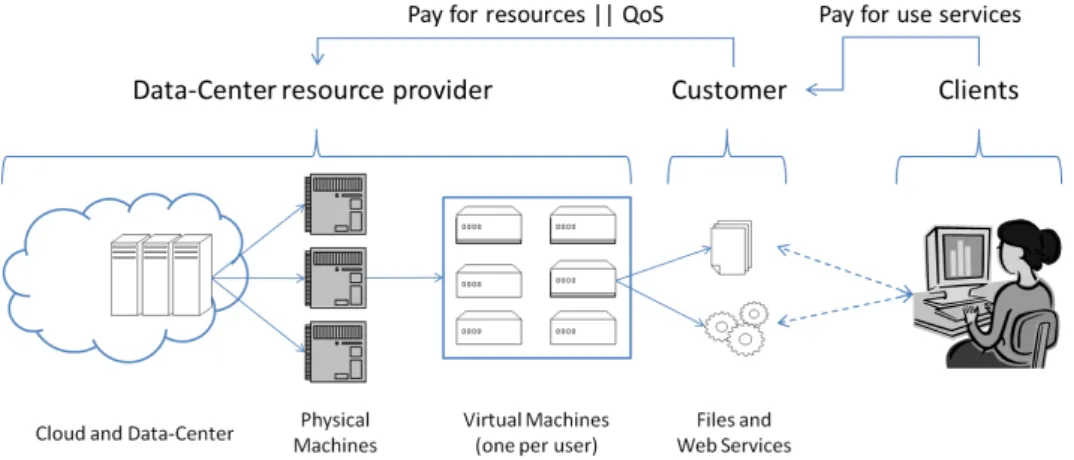
Typical commercial datacenters are designed so that customers can run web-services running without knowing details of the infrastructure. Customers pay the providers on a usage-basis, and providers ensure that the web-services will be running according the service level agreements, negotiated by customers to accommodate their clients requests at sufficient satisfaction level. The datacenter contains physical machines, and each one holds virtual machines containing data and services from different customers. Virtualization is used to ensure isolation of customer and client contents, privacy of sensitive data, and allow for VM and service migration among PMs. The provider enables a VM for each customer, adjusts the granted resources for the web-service given the QoS, and set it into a PM with these available resources. His/her goal is to maximize the profit of each VM fulfilling the QoS and reduce the cost of running resources. Figure 2.1 shows the business infrastructure.
Figure 2.1: Commercial hosting infrastructure
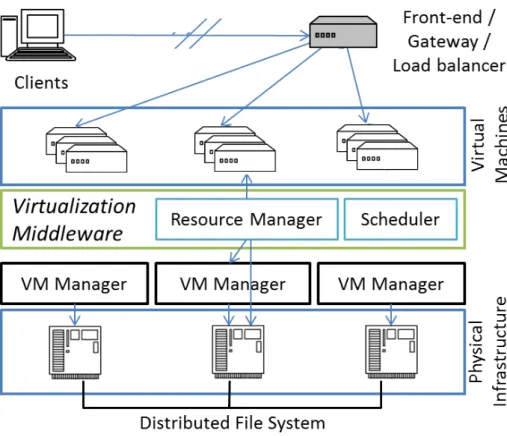
A middleware software such as OpenNebula [147], Eucaliptus [122] or EmotiveCloud [162] is typically used in cloud-like architectures in order to manage PMs, VMs, network elements and traffic. Figure 2.2 shows the typical cloud middleware infrastructure. An agent on each PM controls VMs and monitors PM resources and VM requirements; the decision maker, on the machine hosting the resource manager and scheduler, reads all monitored lectures and makes decisions on a “Monitor/Analize/Plan/Execute” (MAPE) control loop [43]; also an agents on the network gateways redirect and also monitor traffic.
2.2
Relevant Concepts on Green Computing
Energy-related costs have become a major economical factor for IT infrastructures and datacen-ters because of the power’s price escalation. Companies are now focusing more than ever on the need to improve energy efficiency. A new challenge has appeared besides the energy cost, the re-duction of the carbon footprint, due to many EU regulations and campaigns demanding greener businesses. Commercial electricity consumption is a major contributor to the rising atmospheric CO2levels and datacenters are one of the foremost parts of the problem. Energy costs are rising,
2.2. RELEVANT CONCEPTS ON GREEN COMPUTING 29
Figure 2.2: Virtualization middleware schema
the current amount of datacenter emissions but the fact that these emissions are increasing faster than any other carbon emission. For this reason nowadays there is a growing interest in “Green” datacenters and supercomputer centers [72].
In this area, the research community is being challenged to redesign datacenters, adding en-ergy efficiency to a list of critical operating parameters that already includes service availability, reliability, and performance. A large variety of power-saving methods has been presented in re-cent literature. Two of the most representative ones, namely workload consolidation and turning off spare servers, have been shown as an effective way to save energy. Server consolidation implies combining workloads from separate machines and different applications into a smaller number of systems (e.g. Figure 2.3). This approach solves some interesting challenges: less hardware is required, less electrical consumption is needed for server power and cooling and less physical space is required. Intelligently turning off of spare servers that are not being used is an obvious way to reduce both power and cooling costs while maintaining good performance levels.
Figure 2.3: Consolidation Strategy
2.2.1
Green Computing Techniques
Power management in cluster-based systems is an emerging topic in the resource management area. As explained in previous chapters, there are several works proposing energy management for
servers that focus on applying energy optimization techniques in multiprocessor environments, such as Lefurgy et al. [97] and Bianchini et al. [33]. Another proposal for load balancing for power and performance optimization in this kind of environment can be found in Pinheiro et al. [129]. Economical approaches are also used for managing shared server resources in e.g. Chase et al. [44], where authors use a greedy resource allocation distributing a web workload among different servers assigned to each service. This technique demonstrates to reduce server energy usage by 29% or more for a typical Web workload. B.G.Chun et al. [47] proposes a hybrid datacenter architecture that mixes low power systems and high performance ones.
Dynamic Voltage/Frequency Scaling (DVFS) is one of the techniques that can be used to reduce the consumption of a server and minimize the total energy expenditure, as seen in Lee et al. [96] and Horvath et al. [81]. Other works such as the presented by Elnozahy et al. [59] propose adding other power management mechanisms to DVFS, as the dynamic turning off of idle machines when the workload is low.
Khargharia et al. [92] introduce a theoretical methodology for autonomic power and perfor-mance management in e-business data centers. They optimize the perforperfor-mance/watt at each level of the hierarchy while maintaining scalability. The authors opt for a mathematically-rigorous op-timization approach that minimizes wasted power while meeting performance constraints. Their experimental results show near 72% savings in power as compared to static power management techniques and 69.8% additional savings with the global and local optimizations. Petrucci et al. [125] developed a mixed integer linear programming formulation to dynamically configure the consolidation of multiple services/applications in a virtualized server cluster. The approach is power efficiency centered and takes into account the cost of turning on/off the servers. This turning on-off technique is also applied in by Kamitsos et al. [88], which sets unused hosts to a low consumption state in order to save energy; also in energy concerned frameworks like GREEN-NET [51], where hardware components are set-up/shut-down, driven by the schedule of jobs to be run.
The advantages of consolidation using virtualization were pointed out, e.g., Vogels et al. [170], while e.g. Nathuji et al. [112] widely explored its advantages from a power efficiency point of view. This idea is also shown in Petrucci et al. [125], which proposes a dynamic configura-tion approach for power optimizaconfigura-tion in virtualized server clusters and outlines an algorithm to dynamically manage the virtualized server cluster. Following the same idea, Liu et al. [102] aims to reduce virtualized data center power consumption by supporting VM migration and VM placement optimization while reducing the human intervention. Based on these works, Goiri et al. [69, 70] introduce the SLA-factor into the self-managing virtualized resource policies. Other works presented by Verma [166, 167] also propose a virtualization aware adaptive consolidation approach, measuring energy costs executing a given set of applications, also dealing with uncer-tainty, where statistic methods based on correlation are used to predict usage and so consolidate works. They measure SLA but do not take it directly into account when consolidating tasks.
Using heterogeneous workloads leads to SLA’s where some of the applications in the sys-tem can have stringent conditions to be met. There have been several proposals into resource capacity planning and dynamic provisioning issues for QoS control (e.g. [15, 138, 141]). Chen et al. [45] states that new power saving policies, such as DVFS, or turning off idle servers can increase hardware problems as well as the problem to meet SLAs in this reduced environment. Also, Fit´o et al. [62] show that decreasing the number of on-line machines obviously decreases power consumption, but impacts the ability to service workloads appropriately, so a compromise between the number of on-line machines and energy saving must be found.
Filani et al. [61] offer a solution that includes a platform resident Policy Manager which monitors power and thermal sensors and enforces platform power and thermal policies. They explain and propose how the PM can be used as the basis of a data center power management solution.
We want to indicate that other works focusing on green computing and related techniques will be introduced at the proper time in next chapters, comparing their approaches to the ones presented in each work of this thesis.
2.3. RELEVANT CONCEPTS ON ARTIFICIAL INTELLIGENCE 31
2.2.2
Green DataCenters
Despite the optimization techniques for reduce energy consumption on datacenters, another way to reduce the impact of computing on environment is to reduce the “brown energy” consump-tion (energy generated from non-renewable sources). Focusing on the availability of “green energy” (energy obtained from renewable sources) when building datacenter networks, is a way to contribute on green computing, building the datacenters as independent of “brown-energy” as possible. As a result of increasing societal awareness of climate change, governmental agen-cies, non-profits, and the public at large are starting to demand cleaner datacenters. Multiple companies have announced plans to build “green” datacenters (DCs at least partially powered by renewable energy that they themselves generate). I.e. Apple is building a 20MW solar array for its North Carolina datacenter [54], whereas McGraw-Hill has just completed a 14MW solar array for its datacenter in New Jersey [55]. However, the rate of adoption of these sources of energy in datacenters has been limited by their perceived high cost.
As far as we know, at this time no other works have considered the placement of exclusively green powered datacenters at global scale. The closest related work is Goiri et al. [115], which presents a framework to place Internet services oriented datacenters, characterizing different US regions including costs of building, costs of utilities and distances to the end-user cities, looking for placing the datacenters in an intelligent way saving in costs. Other works considered datacenter placement by ranking potential locations based on operating costs, but without considering all the relevant costs involved on datacenter deployment [2, 123, 149].
Works like Stewart et al. [150] focuses on how energy policies can manage the usage of renewables (wind energy in their case) fitting datacenter workloads to wind energy production. In that work they put emphasis in wind energy intermittent behaviour and the need of policies to hold or move load according to the green energy production.
Considering load management depending on green energy availability, some works presented approaches to schedule properly the deployment of load depending on the predicted amount of available solar energy, like GreenHadoop [71] and Liu et al. [103]. The workload schedule also considers the energy consumed by the cooling systems and the quality of service offered by datacenters.
After datacenter placement, strategies must be applied to reduce the impact of brown or maximize the usage of green energy. To that effort works like Le et al. [94] study policies from exploiting datacenter with different variable electricity prices to the usage of datacenters near green energy sources. Further, focusing explicitly on green energy, the strategy of “following the renewals” has become a relevant topic on energy and computer science, and works like Lin et al., Liu et al., Zhang et al. [99, 104, 182] present studies of algorithms to solve geographical load optimizing the usage of renewable energy depending on availability, constrained by budgeting, latencies and switching cost.
Finally, in the works presented by J.M.Pierson [127, 128] we see a detailed relation of elements to be taken into account for green task allocation, as counting on all energy-consuming elements, the sources of energy and the fluctuation of energy availability on time.
2.3
Relevant Concepts on Artificial Intelligence
2.3.1
AI and Intelligent Management
Even though adaptive and updatable mechanisms have been developed to optimize Cloud man-agement, knowledge-based and data mining techniques are being applied to improve the resource usage and improve quality of service. As the multi-DC systems are becoming more complex and application requirements are increasing, Artificial Intelligence (AI) and also Machine Learning (ML) can be applied to deal with problems difficult to solve, predictions and information retrieval, letting the system to make these decisions with more autonomy in a treatable time.
To help with thisintelligent management, several techniques and science fields are available. The first ones are standard AI-based applications, using prediction and heuristic algorithms in order to anticipate the system performance and act in consequence. Using generally expert knowledge to tune the heuristics, it includes fuzzy logic, genetic algorithms and other AI
space-search methods. The second ones are the Machine Learning-based applications, using observed behaviors to create models that fit best to key behaviors, letting the system to create its predictors and decision makers without so much expert knowledge.
This thesis is

![Figure 5.3: SLA and Power using different turn on/off thresholds [Source: eEnergy’10 [30]]](https://thumb-us.123doks.com/thumbv2/123dok_us/356602.2539247/71.892.117.727.129.323/figure-sla-power-using-different-thresholds-source-eenergy.webp)