Technology (IJRASET)
Improved Scalability and Security on Data
Retrieval for Decentralized DTN’S Using CP-ABE
Algorithm
G.Gayathri1, A.K.Puneeth Kumar2
1M.Tech CSE Student, 2Asso.Prof, ResearchScholar Dept of CSE, SEAGI, Tirupati,
Abstract: Mobile Nodes in some challenging network scenarios suffer from intermittent connectivity and frequent divisions, for example in battleground if the network failure occurs then there is a chance to lose the data. Many of the networks are failed to recover the data that was lost. The DTN technology is the famous technology which is used in the military network. It permits devices which are wireless and supports by peoples in a military to interact with each other. In this technology the data will be transferred from sender to receiver through intermediate nodes. So, as we are using intermediate nodes there are issues related to data security. Some of the challenging issues in this scenario are the enforcement of authorization policies and the policies update for secure data retrieval. In this paper, we suggest a secure data retrieval scheme based on the Cipher text Policy Attributed-Based Encryption (CP-ABE) algorithm. In Cipher text Policy Attribute-Based Encryption (CP-ABE), a user secret key is merged with a set of attributes, and the cipher text is related with an access policy over attributes. In decentralized DTNs multiple key authorities manage their attributes without depending on others. We illustrate how to apply the proposed mechanism to safely and proficiently deal with the classified information dispersed in the Interruption or disruption tolerant network.
Keywords: Access-control, Attribute-based encryption (ABE), Disruption-tolerant Network (DTN), Multi authority, Secure Data Retrieval.
I. INTRODUCTION
Technology (IJRASET)
thing. In the Attribute based encryption the key authority generates private keys of users by applying the authority’s master secret keys to users’ associated set of attributes. So that’s why, the key authority can decrypt any cipher text forwarded to specific users by generating their attribute keys. The final challenge is the coordination of attributes issued from multiple authorities. It is very difficult to define good access schemes over attributes issued from several authorities, when several authorities manage and issue attributes and keys to users independently with their own master keys. For example, suppose that attributes “role 1” and “region2” are managed by the authority B, and “role 2” and “region 1” are managed by the authority A. In this situation it is not possible to produce an access policy ((“role 1” OR “role 2”) AND (“region 1” or “region 2”)) in the previous strategies because the OR logic between attributes issued from different authorities cannot be implemented. Why, because the fact that the dissimilar authorities generate their own attribute keys using their own master secret keys that are autonomous and individual. So that’s why, general access policies cannot be articulated in the existing schemes, which is a extremely practical and usually required access policy logic.
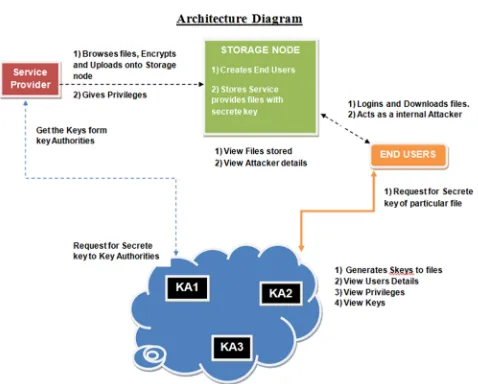
[image:3.612.185.424.240.432.2]II. NETWORK ARCHITECHTURE
Fig 1: Disruption tolerance network architecture diagram
A. Key Authorities
They are the key generation centers that generate public or secret parameters for CP-ABE. The key authorities consist of central authority and multiple local authorities. There are secure and reliable communication channels between a central authority and each local authority. Each local authority manages different attributes and issues corresponding attribute keys to users.
B. Storage Node
This entity stores data from senders and provide corresponding access to users. It may be mobile or fixed.
C. Sender
This entity owns confidential data and wishes to store them into the external data storage node. A sender is responsible for defining access policy and encrypts the data under the policy before storing it to the storage node.
D. Receiver
This is a mobile node that wants to access the data stored at the storage node. If a user owns a set of attributes satisfying the access policy of the encrypted data then he will be able to decrypt the ciphertext and obtain the data.
III. EXISTING FRAMEWORK
Technology (IJRASET)
policy chosen by an encryptor, but a key is purely created with respect to an attributes set. CP-ABE is more suitable to DTNs than KP-ABE because it enables encryptors such as a commander to choose access guidelines on attributes and to encrypt confidential data under the access structure via encrypting with the corresponding public keys or attributes.
A. Disadvantages Of Existing Framework
The trouble of applying the ABE to DTNs introduces numerous security and privacy challenges. Because some users may change their associated attributes at some point (for example, moving their province), or a number of private keys might be compromised, key revocation (or update) for each attribute is necessary in order to make systems secure. However, this issue is even more hard, particularly in ABE systems, since each attribute is conceivably shared by multiple users (henceforth, we refer to such a collection of users as an attribute group)
Another challenge is the key escrow problem. In CP-ABE, the key power generates private keys of users by applying the authority’s master secret keys to users’ associated set of attributes.
The last challenge is the coordination of attributes issued from different authorities. When several authorities manage and issue attributes keys to users independently with their own master secrets, it is extremely hard to describe fine-grained access policies over attributes issued from different authorities.
IV. PROPOSED SYSTEM
In this section, we provide a multi authority CP-ABE scheme for secure data retrieval in decentralized DTNs. Each local power issues partial personalized and attribute key components to a user by performing secure 2PC protocol with the central power. Each attribute key of a user can be updated individually and immediately. Therefore, the scalability and security can be enhanced in the proposed scheme. Since the first CP-ABE scheme proposed by Bethencourt et al, dozens of CP-ABE strategies have been proposed. The successive CP-ABE schemes are mostly motivated by more rigorous security proof in the usual model. However, most of the schemes failed to achieve the expressiveness of the Bethencourt et al.’s scheme, which reports an competent system that was expressive in that it allowed an encryptor to express an access predicate in terms of any monotonic formula over attributes. Hence, in this segment, we develop a variation of the CP-ABE algorithm partially based on (but not limited to) Bethencourt et al.’s construction in order to improve the expressiveness of the access control policy instead of building a new CP-ABE scheme from scratch.
A. Advantages Of Proposed System
1) Data Confidentiality: The users who are nor authorized do not have enough credentials satisfying the access policy should be deterred from accessing the plain data in the storage node. In addition, illegal access from the capacity node or key authorities should be also prevented.
2) Collusion-Resistance: If multiple users get together, they may be able to decrypt a cipher text by combining their attributes even if each of the users cannot decrypt the cipher text alone.
3) Backward And Forward Secrecy: In the context of ABE, backward secrecy tells that any user who comes to hold an attribute (that satisfies the access policy) should be prevented from accessing the plaintext of the previous data exchanged before he holds the attribute. On the other hand, forward secrecy tells that any user who drops an attribute should be prevented from accessing the plaintext of the subsequent data exchanged after he drops the attribute, except the other valid attributes that he is holding satisfy the access policy.
Technology (IJRASET)
[image:5.612.161.454.292.456.2]Fig 2: DTN ROUTER
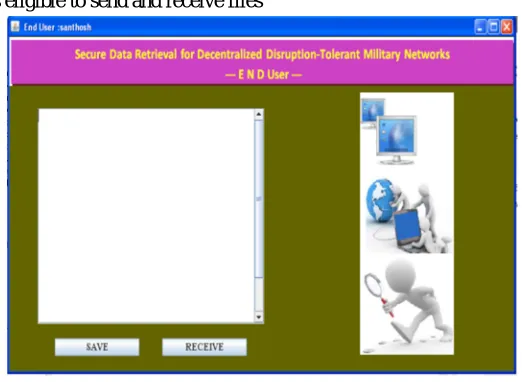
Fig 3 shows the authentication of the user is with respect to their ID and Passwords.
Fig 3: USER LOGIN After successful Login the user is eligible to send and receive files
[image:5.612.175.436.488.679.2]Technology (IJRASET)
Fig 5 : KEY AUTHORITY
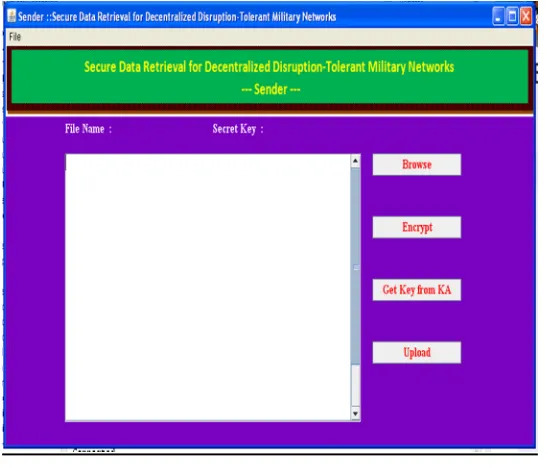
The Fig 6 shows sender who wants to send the files to the users
Fig 6: SENDER PAGE
VI. CONCLUSIONS
[image:6.612.171.445.314.548.2]Technology (IJRASET)
manage the confidential data distributed in the disruption- tolerant military network.
REFERENCES
[1] Junbeom Hur and Kyungtae Kang,, “Secure Data Retrieval for Decentralized Disruption-Tolerant Military Networks,” in Proc. IEEE ACM, 2014, pp. 16–26. [2] M. Chuah and P. Yang, “Node density-based adaptive routing scheme for disruption tolerant networks,” in Proc. IEEE MILCOM, 2006, pp. 1–6.
[3] M. M. B. Tariq, M. Ammar, and E. Zequra, “Mesage ferry route design for sparse ad hoc networks with mobile nodes,” in Proc. ACM MobiHoc, 2006, pp. 37– 48.
[4] S. Roy andM. Chuah, “Secure data retrieval based on ciphertext policy attribute-based encryption (CP-ABE) system for the DTNs,” Lehigh CSE Tech. Rep., 2009.
[5] M. Chuah and P. Yang, “Performance evaluation of content-based information retrieval schemes for DTNs,” in Proc. IEEE MILCOM, 2007, pp. 1–7.
[6] M. Kallahalla, E. Riedel, R. Swaminathan, Q. Wang, and K. Fu, “Plutus: Scalable secure file sharing on untrusted storage,” in Proc. Conf. File Storage Technol., 2003, pp. 29–42.
[7] L. Ibraimi, M. Petkovic, S. Nikova, P. Hartel, and W. Jonker, “Mediated ciphertext-policy attribute-based encryption and its application,” in Proc. WISA, 2009, LNCS 5932, pp. 309–323.
[8] N. Chen, M. Gerla, D. Huang, and X. Hong, “Secure, selective group broadcast in vehicular networks using dynamic attribute based encryption,” in Proc. Ad Hoc Netw. Workshop, 2010, pp. 1–8.