http://dx.doi.org/10.4236/cs.2016.78156
Wireless Transmission Based Image Quality
Analysis Using Uni-Level Haar Wavelet
Transform
K. Senthamilselvan
1, Lakshmi Dhevi
21Department of Electronics and Communication Engineering, Dhanalakshmi College of Engineering, Chennai,
India
2Research Scholar, Anna University, Chennai, India
Received 22 March 2016; accepted 20 April 2016; published 22 June 2016 Copyright © 2016 by author and Scientific Research Publishing Inc.
This work is licensed under the Creative Commons Attribution International License (CC BY).
http://creativecommons.org/licenses/by/4.0/
Abstract
This article deals with picture excellence examination by different parameters utilizing uni-level Haar wavelet transmission in excess of remote channel. The quality is analyzed based on power. The goal is towards reducing absolute power assigned in favour of picture compression and com-munication, while power in favour of every bit is reserved at prearranged value. Two Power Algo-rithms were presented. The greatest iterative power control calculation and Minimum Power Ad-aptation Algorithm (MPAA) are proposed. Those algorithms methodology was utilized for improv-ing the aggregate power dispensed for multimedia such as picture because of input compression and transmission focus towards a settled bit source mutilation. Simulations were performed util-izing Haar wavelet than Additive White Gaussian Ration (AWGN) channel. Different picture excel-lence parameters, for example, Peak Signal to Noise Ratio (PSNR), M-Normalized Cross-Correla- tion, Average Difference; Structural Content parameters, for example, Maximum Difference, Nor-malized Absolute Error, Elapsed Time, CPU time, demonstrate a improved presentation with MPAA, Maximum Power Adaptation Algorithms (MAPAA) instead of Conventional Power Adaptation Algo-rithm (CPAA).
Keywords
1. Introduction
The multimedia communications and data superhighway have offered ascending towards a colossal interest on elite correspondence frameworks. Sight and sound transmission of signs over remote connections was measured since first prime uses of potential portable radio communication systems. Be that as it may, such applications need utilization of generally high information rate (in Mbps range) contrasted with voice functions. Among these prerequisite, these are extremely testing to give satisfactory nature of administrations as calculated by Bit Error Rate (BER) because of confinements forced by remote correspondence channels, for example, blurring and multipath engendering. Moreover, client portability makes such an assignment more troublesome on ac-count of time changing nature of channel. The principle assets accessible to interchanges frameworks planners were force and transmission capacity and additionally framework many-sided quality. Accordingly, it is basic to utilize systems that are both force and data transmission productive for corrects operation of communication re-sources [1]-[4].
Power control had been a compelling methodology into lessening deformation and enhancing nature of pic-ture broadcast over wireless channels. The power control framework includes a system of allocating so as to control the power by adjusting the bits most extreme force. The primary contemplations for these frameworks are the requirement for an input connects quickly to path time variety of path and won’t use message formation of video or picture sign will be transmitted by force portion.
The rest of article is sorted out as follows. In Section 2, a survey of fundamental foundation required to ade-quately execute our calculation is displayed. Proposed calculation is depicted in Section 3. Then, utilization of future calculation is talked about in Section 4, and we make our inference in last area.
2. Background
Productive utilization of mixed media restricted battery power is most significant difficulties during data devices. The administration of force turns out to be much critical by gadgets incorporating complex video signal proc-essing procedures among interchanges. A percentage of key advances that influence force in the admiration are input signal pressure, channel-error-control coding, and radio communication. Power utilization of baseband preparing ought to additionally be considered. Then again, the work on enhancing the force has concentrated on discrete parts, for example, calculations and equipment plan for particular video and channel coders and low power transmitter outline [3]-[5].
Joint improvement of source pressure, channel coding, and transmission to adjust the nature of administration and force necessities of the interactive media has just as of late pulled in hobby. The work by Appadwedula et al. [6], considers minimization of the aggregate vitality of a wireless image transmission framework. By picking the coded source bit rate for the picture coder, excess for the Reed-Solomon (RS) coder, transmission power for the force speaker and the quantity of fingers in the RAKE recipient, the aggregate vitality because of channel codec, transmission, and the RAKE collector is enhanced subject to end-to-end execution of the framework. The proposed framework is reproduced for an indoor office environment subject to way misfortune and multipath. Critical vitality sparing is accounted for.
In [7] and [8], by changing the precision of movement estimation distinctive force and contortion levels for H.263 encoder are given [8]. The coded bits are packetized and unequally ensured utilizing RS codes and are transmitted over a code-division multiple access system working over a flat fading channel. The creators con-sider the handling power for source coding and channel coding and also transmission power for a given video quality and propose a force minimized bit-allocation plan. Assume the source is compressed using transform coding, with which one can without much of a stretch conform the trade off between varying so as to code pro-ficiency and force utilization the change vector measurement.
fantas-tic execution and completely distributed property make our proposed calculation a decent decision for sight and sound frameworks.
3. Proposed Algorithm
At the point, N no. of pictures and M no. of bits in a multimedia framework, thus power transmitted via bits
[
1, , ,2 M]
P= P P P and t individual RMSEs at bits be. Let RMSET be objective RMSE.
3.1. Minimum Power Adaptation Algorithm (MPAA)
MPAA is the best Power Adaptation calculations; it accomplishes great execution in Multimedia. As the name itself is simple, it is least in light of the fact that the calculation utilizes just least power and doesn’t rely on upon extensive data for maintaining force.
Power updating move of MPAA be specified as
1
n n n
i i i
R + =R X P⋅ ⋅ where
(
)
min n T
i n i n i RMSE RMSE R RMSE ⋅ = Thus n i
RMSE =Root mean square error of ith bit in nth iteration.
T
RMSE =Target Root Mean Square error.
The new power level is estimated by multiplication of earlier power level and ratio of RMSEs. The MPAA contains:
1) Assign power values to every bit.
2) For 1 to No. of iterations and No. of bits, estimate RMSE and update power to every bit using Equation (1) 3) Compute minimum power for every bit.
3.2. Maximum Power Adaptation Algorithm (MAPAA)
MAPAA is an enhanced rendition of past MPAA calculation. The present calculation contrasts from its thought of the greatest estimation of same. All property of MPPA is additionally fulfilled with MAPAA. The power overhauling venture of Minimum Power Adaptation is specified by comparison (1), thus
(
)
max n, T
i n i i RMSE RMSE R RMSE =
Here new power level is planned with produce of earlier power level and ratio of RMSEs.
[
1, 2, , M]
RMSE= RMSE RMSE RMSE The MAPPA contains:
MACPA an enhanced form of past MCPA calculation planned in [8]. The past Calculation considers base es-timation of CIRs. The present eses-timation varies from its thought of maximum eses-timation of same.
Each property of MCPA is additionally fulfilled by MACPA. The power redesigning is done by taking after mathematical statements:
The power overhauling venture of MPAA is specified by
1
n n n
i i i
P+ =R XP where
max n T
Here new power level is considered by multiplication of earlier power level and ratio of RMSEs MAPPA: 1) Assign power values to every bit.
2) For 1 to No. of iterations and No. of bits, analyse RMSE and update power to every bit using
1
n n n
i i i
P+ =R XP 3) Compute minimum power for each bit.
4. Wavelet
Wavelets are numerical capacities to reduce information keen on various recurrence parts, and after that concen-trate every segment with a determination coordinated to its scale. The wavelet transform can de-correlate a pic-ture together in space and recurrence thus circulating vitality minimally keen on a couple low and high fre-quency coefficients. The effectiveness of wavelet based picture pressure plan determines both on wavelet chan-nels picked and in addition on the coefficient quantization plan.
A picture sign may be examined by going it through an investigation channel bank took after by annihilation operation. The examination channel bank comprises of a low and high pass filter at every deterioration step. When signal pass into channels it parts into two groups. The low pass filter relates to the averaging operation, extricates the coarse data of the sign. The high pass filter compares to differencing action that concentrates point of interest data of sign. The yield of sifting process is then compressed into two.
Two-dimensional transform is proficient with achieving two separate one dimensional changes. To begin with the picture is separated along row and obliterated into two. It was trailed by separating sub picture along section and devastated by two. This operation parts the picture into four groups, to be specific LL, LH, HL and HH in-dividually. The LL band was transmitted along path by allotting power designation and first stage of disintegra-tion was contemplated. The four groups were transmitted over remote channel and coefficients are reproduced utilizing converse change. The estimation coefficients are reproduced utilizing opposite discrete change procedure and different limits are contemplated in MACPA and EPAA techniques for first stage of sub band disintegration.
Haar Wavelet Transform
The strategy for averaging and differencing may be communicated as the filtering information. Averaging com-pares to the low pass sifting. It evacuates high frequencies of information. As subtle elements (sharp changes in information) compare to high frequencies, averaging methodology leans to smooth information. The low pass channel will be communicated in Haar case.
The differencing compares to high pass separating. It evacuates low frequencies and reacts to points of inter-est of a picture since subtle elements compare to high frequencies. It additionally reacts to commotion in a pic-ture, since noise as a rule is situated in high frequencies. The high pass filter may be communicated into Haar case and while we contrast information, basically shift the filter with information. The low and high pass filters make behind what in sign preparing dialect is eluded into a filter bank. The strategy for averaging and differ-encing is alluded to as investigation. The wise versa is called synthesis.
Henceforth, wavelet change isolates low and high frequencies, generally as Fourier change. Subsequent to various elements of a sign (foundation, points of interest, commotion, edges, and so on.) compare to various frequencies, that is a key to utilize wavelets in sign preparing. The main point is that wavelets are limited as it just lives on interim of information, instead of trigonometric capacities utilized because a part of Fourier exami-nation which live on whole interim of the information.
5. Numerical Results
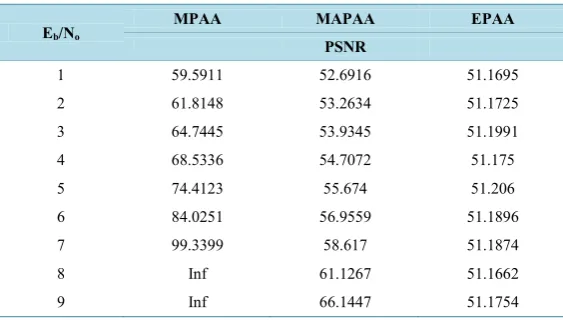
The RMSE assumes an essential part in minimizing force. The estimations of RMSE, PSNR are arranged and appeared in Table 1.
Table 2 demonstrates estimations of Image quality execution limits utilizing MACPA & EPAA by Haar
wavelet at level 1. Though, Eb/No expansions, both techniques show an unexpected execution. Different limits like PSNR, Normalized Correlation (NC), Normalized Absolute Error (NAE) and Structural Content (SC).
6. Conclusions
Table 1. RMSE values using MPAA, MACPA and EPAA with Haar Wavelet at level 1.
Eb/No
level 1-Haar Wavelet
MPAA MAPAA EPAA
RMSE
1 0.2683 0.5938 0.7076
2 0.2077 0.556 0.7073
3 0.1483 0.5147 0.7052
4 0.0958 0.4708 0.7071
5 0.0487 0.4213 0.7046
6 0.0161 0.3634 0.7059
7 0.0028 0.3002 0.7061
8 0 0.2249 0.7078
9 0 0.1262 0.7071
Table 2. PSNR values using MPAA, MACPA and EPAA with Haar Wavelet at level 1.
Eb/No MPAA MAPAA EPAA
PSNR
1 59.5911 52.6916 51.1695
2 61.8148 53.2634 51.1725
3 64.7445 53.9345 51.1991
4 68.5336 54.7072 51.175
5 74.4123 55.674 51.206
6 84.0251 56.9559 51.1896
7 99.3399 58.617 51.1874
8 Inf 61.1267 51.1662
9 Inf 66.1447 51.1754
first picture is partitioned into subband utilizing HAAR wavelet and the picture is reproduced utilizing back-wards handle. The obtained picture is then passed over remote AWGN channel by distributing the greatest en-ergy towards every one of the pixels. The most extreme force is rearranged to every piece considerably to every one of the bits. Assignment is finished to aim greatest force and bits were transmitted and received.
At Eb/No = 7 dB, three techniques MPAA, MAPAA and ECPA demonstrate a progressive transform in exe-cution of RMSE and PSNR. The ideal force distribution shall focalize to routine plan with equivalent force as-signment for each bit, for high Eb/No.
Thus, the power adjustment is completed utilizing one level of disintegration of wavelets improved with force vector and transmitted over remote channel. The outcomes got with the plan demonstrate a noteworthy execu-tion over ordinary force adjustment calculaexecu-tion. The passed time contrasted and the two strategies demonstrate that MAPAA technique devours preferable time over the CPAA and MPAA indicates preferred execution over MAPAA, when the force is viewed as least. On the off chance that the force is greatest, then it demonstrates that MAPAA performs superior to anything CPAA concerning different parameters.
References
[1] Zhang, R., Regunathan, S.L. and Rose, K. (2000) Video Coding with Optimal Inter/Intra-Mode Switching for Packet Loss Resilience. IEEE Journal on Selected Areas in Communications, 18, 966-976.
http://dx.doi.org/10.1109/49.848250
[image:5.595.176.458.319.479.2]Journal on Selected Areas in Communications, 18, 1012-1032. http://dx.doi.org/10.1109/49.848253
[3] Varatharajan, R. (2015) Evolutionary Algorithmical Approach for Placement Problem Using Signal Processing. Jour-nal of Pure and Applied Microbiology, 9, 71-77.
[4] Abidi, A. (1995) Low-Power Radio-Frequency IC’s for Portable Communications. Proceedings of the IEEE, 83, 544-569.
[5] Appadwedula, S., Goel, M., Shanbhag, N.R., Jones, D.L. and Ram-Chandran, K. (2001) Total System Energy Minimi-zation for Wireless Image Transmission. Journal of Signal Processing Systems, 27, 99-117.
http://dx.doi.org/10.1023/A:1008127715523
[6] Zhang, Q., Ji, Z., Zhu, W. and Zhang, Y.Q. (2002) Power-Minimized Bit Allocation for Video Communication over Wireless Channels. IEEE Transactions on Circuits and Systems for Video Technology, 6, 398-410.
http://dx.doi.org/10.1109/TCSVT.2002.800322
[7] Ji, Z., Zhang, Q., Zhu, W. and Zhang, Y.Q. (2001) Joint Power Control and Source-Channel Coding for Video Com-munication over Wireless Networks. Proceedings of IEEE Vehicular Technology Conference, October, 1658-1666. [8] (2001) Physical Layer Standard for Cdma2000 Spread Spectrum System 3GPP2 C. S0002 Version 3.0, June 15.
www.3gpp2.org