Technology (IJRASET)
Design and Verification of Adaptive Router
for NOC Using Buffer Resizing Technique
Snehalata Patil 1, T.C Thanuja2
PG Student1, Professor2
1,2
Department of VLSI Design andEmbedded systems, Department of PG studies, Visvesvaraya Technological University, Belagavi, Karnataka, India
Abstract— This paper focuses on design of adaptive router with buffer resizing technique for network on chip(NOC)by run time
reconfiguration of resources and verification of design using system verilog. Complex system on chip(SOC)designs requires high
bandwidth interconnects, NOC provides solution with a relative area and delay overhead. Run time usage of resources improves performance and reduces area of NOC. Functional verification ensures the quality of silicon, 60% of design time is spent on verification. To overcome this verification delay the proposed design adopts latest verification methodologies. The design is verified using a reusable test bench written in system verilog. The design of adaptive router is developed in Verilog, synthesized and simulated in Xilinx ISE Design Suite 12.4 tool. The design is verified using system verilog using Questa SIM tool.
Keywords— NOC, SOC, FIFO, FSM, Verification.
I. INTRODUCTION
Network on chip is a on chip interconnection and communication concept that provides higher bandwidth, which is the basic requirement in complex designs. NOC provides a high level of parallelism by allowing simultaneous data transmission over all the links of NOC. This increases performance and reduces the latency. NOC is an attractive replacement for traditional bus based communication architecture or point to point dedicated links. NOC provides higher bandwidth and improved performance compared to traditional approaches but results in higher area and delay overhead.
NOC structure consists of processing elements, network interface cards and routers. Router includes switch, control logic and buffers. Buffers in routers consume most of the router area. NOC Router architecture optimization shows improvement in the overall performance of system. Buffers in the router influence the overall power consumption, area and performance of the NOC. Resources such as buffers are used in different manner for different applications on the NOC. Some resources are necessary and sufficient for one application and they may be idle for other applications. In this way resources are under or over utilized depending on the application being executed on NOC. Proper utilization of these resources cannot be ensured at design time, hence runtime changes are needed. Considering the run time changes is the best way for efficient utilization of resources and improvement in overall efficiency of the interconnection network. Run time reconfiguration of network topology and routers leads to improvement in performance and overcomes the area and delay overhead. Dynamically changing the buffer size according to data traffic, routing algorithm and changes in switching technique are the possible runtime changes which can be implemented in adaptive NOC architectures.
As the system complexity increases, verification of these complex designs becomes a challenging task. Functional verification gives the quality of silicon hence 60% of the total design time is being spent on verification of designs which requires two times more verification engineers than design engineers. Direct test bench based verification is inefficient in complex designs and is time consuming. Most of ASIC re-spins are due to bugs in RTL design. There is a need for reusable, efficient methodologies which makes the functional verification easy and speedy, which can be achieved by adopting latest verification methodologies so that the verification phase can be accelerated.
In this paper, we introduce the router design for NOC and SOC applications, analyze the buffer resizing technique and importance of verification methodologies in section I. Section II, analyze the previous buffer resize techniques. Section III, the proposed adaptive router design, specification of the router and buffer resizing technique. Section IV, working of router with respect to input and output protocols. Section V, discussion on verification methodology and components developed for verification. Section VI, simulation results are discussed. Section VII, concludes the paper.
II. RELATEDWORK
Technology (IJRASET)
channel sharing routers. This shows good improvement in the system performance but area overhead is increased up to 40% due to double crossbar and control logic design for bidirectional channels. We overcome the problem by using only one routing switch and simple arbiter logic to assign the buffers for ports. M. A. Al Faruque has proposed dynamic allocation of buffer blocks on traffic demand. This technique improves the latency and performance but area overhead reduces the overall efficiency of the system[1]. Concatto C proposed two techniques. First includes resource utilization at run time. In this approach a channel may borrow buffer units from its neighbour channels. This requires extra multiplexer logic for assigning buffers to one of the neighbouring channels. 6% area improvement can be observed with buffer size 4. Second technique, in which router adapts itself by providing proper size of buffer in terms of depth depending on the traffic requirement to maintain the performance with reduced power dissipation. This router consumes 30% less power but the extra resources needed increases up to 55%. But extra logic increases more than linearly with increase in size and hence solution is not scalable [2].
III.THEPROPOSEDADAPTIVEROUTER
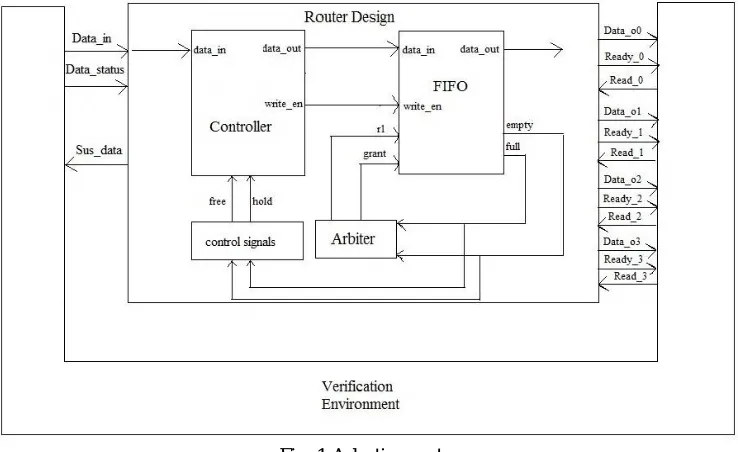
[image:3.612.129.498.325.551.2]Router is a basic building block of NOC which routes the incoming data from input port to the destination port depending on the address. In this design router operates on packet based protocol in which data is transmitted in the form of packets. Packet contains 3 fields: Header part, which contains 8 bit wide destination address, source address and length of data being transmitted. Length of data can be from 1 to 63 bytes. Data payload part contains the actual data that needs to be transmitted. Tail part contains the parity byte of 8bits calculated over header and data payload to ensure correct transmission and reception of data. The router has 5 ports out of which one is input port from where data enters the router and other 4 output ports, with unique port address to, which data is driven to and from where the data is received by actual device.
Fig. 1 Adaptive router
A. Buffer Resizing Technique
When traffic congestion increases there exists blocking of data at destination ports due to lack of storage space. If two packets with same destination address enter the router and first packet is blocked due to lack of space then the second packet will also be blocked and it cannot be processed. This increases the latency of system and reduces the performance. Increasing the size of buffers can overcome the problem of packets being blocked. This change in size of buffer according to traffic demand is called buffer resizing technique. Resizing the buffer at run time that is, dynamically changing the size of buffer is called adaptive buffer resizing technique. In this approach we are using 4 static buffers and one floating buffer of same structure as static buffers. A buffer assigned to a particular port becomes full, then floating buffer is assigned to that port to store the further incoming data. This task of assigning floating buffers to ports is performed by arbiter as shown in the Fig. 1.
IV.INPUTANDOUTPUTPROTOCOLSOFTHEROUTER
Technology (IJRASET)
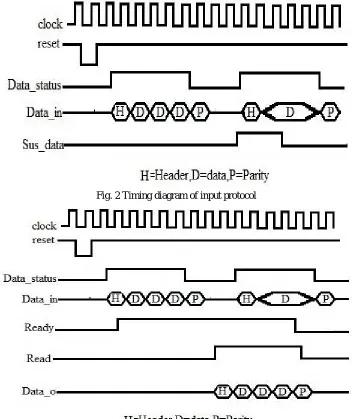
[image:4.612.135.487.159.578.2]three signals Data_out, Ready and Read. When valid data is available on the router then Ready signal is asserted, which is input to receiver. Read signal is asserted by receiver to receive the data from router this action performs read operation on FIFO. The read data is sent out to receiver through Data_out signal as shown in the figure3. When static FIFO becomes full, floating FIFO is assigned to port depending on FIFO full condition and address of the port. FIFO full and empty conditions are requests to arbiter it grants the write or read signals depending on the input or output operation respectively. When static FIFO and floating FIFO both are full and still there is data coming into router then it asserts Sus_data signal to suspend incoming packets.
[image:4.612.143.482.159.346.2]Fig. 2 Timing diagram of input protocol
Fig. 3 Timing diagram of output protocol
V. VERIFICATION
Technology (IJRASET)
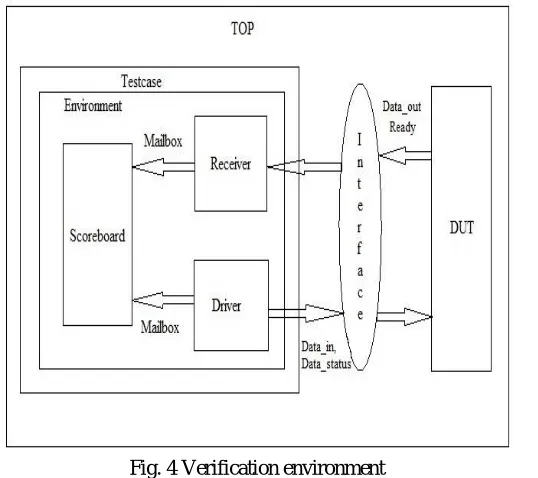
Fig. 4 Verification environment
For this router design we have developed the verification environment as shown in the above block diagram. Verification components used are: Driver to generate and drive input sequences to input the router that is Design Under Test (DUT) and the same sequences are sent to scoreboard through mailbox. Receiver collects the data on output ports and this data sent to scoreboard through mailbox. Scoreboard compares the incoming data from driver and receiver and displays the result in the form of packets matching. This ensures proper receiving of data at the receiver. Testcase is start point of testbench to verify the design and simulation is initiated at this point. Verification block and DUT communicate through the interface.
VI.RESULTS
We have developed the design in verilog HDL using Xilinx ISE design tool. The same design is verified using the Questa SIM simulator using system verilog.
A. RTL Schematic
Fig. 5 RTL schematic of design
B. Simulation Result
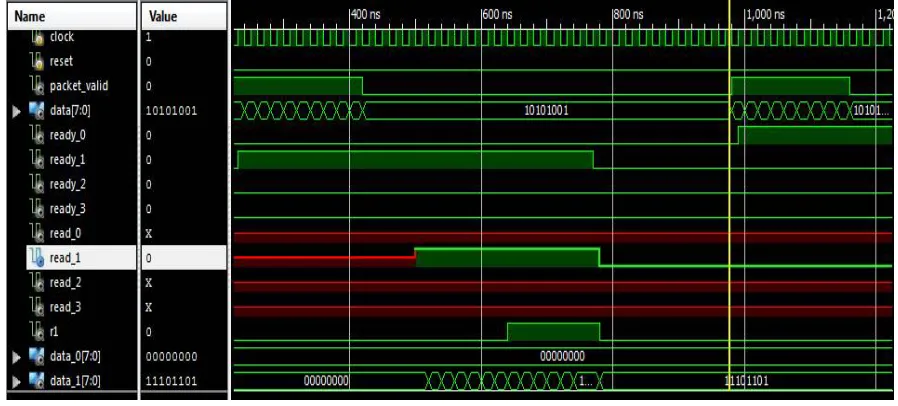
[image:5.612.204.423.479.636.2]Technology (IJRASET)
router, this leads to under utilization of resource in the case of second packet. Hence by employing buffer resizing technique under utilization of resource is over come.
Fig 6: Simulation waveform
C. Checker Output
[image:6.612.85.534.104.307.2]The router is verified by developing a verification environment. The input packets generated by driver are sent to DUT and checker. The output packets received from the DUT are sent to checker. Checker compares the individual bytes of the packets as shown in the below figure 5 and outputs the packets matched or not. If all the packets are matched then the test is passed. From the below figure 5 it is observed that driver is driving packet consisting of bytes 81,01,07,76,3d,ed,8c,f9,c6,c5, a9 and the same bytes are received at the receiver end. The checker block compares all the bytes, since all the bytes match it outputs test passed.
Fig. 7 Checker output
VII. CONCLUSIONS
[image:6.612.122.567.349.603.2]Technology (IJRASET)
REFERENCES
[1] M. A. Al Faruque,- “Adaptive route allocation algorithm and Adaptive buffer assignment technique”, solution for static NOCs in IEEE Transactions on Very
Large Scale Integration (VLSI) Systems,Volume 20 Issue 2, Pages 257-269 – Feb 2012.
[2] Concatto, C., Matos, D., Carro, L., Kastensmidt, F., Susin, A., and Kreutz.M., ”NoC Power Optimization Using Reconfigurable Router”. In the IEEE
Symposium on VLSI, 2009.
[3] Wang, L., Zhang, J., Yang, X., and Wen, D., ”Router with Centralized Buffer for Network-on-Chip”. GLSVLSI, 2009.
[4] Syed Minhaj Hassan- “ Micro architecture of router with centralized buffer using elastic buffered links” .
[5] Deepa S Dev “Design and Implementation of Buffer Loan Algorithm for BiNoC Router” in IJETT,Volume 14 Number 2 – Aug 2014.
[6] Salman Onsori, Farshad Safaei “Performance Enhancement of Routers in Networks-on-Chip Using Dynamic Virtual Channels Allocation”. In CAIJ ,
Volume.1, No.2, November 2014.
[7] Seyyed Amir Asghari, Hossein Pedram, Mohammad Khademi, and Pooria Yaghini “Designing and Implementation of a Network on Chip Router Based on
Handshaking Communication Mechanism”, in world applied science journal, 2009
[8] Khalid Latif, Tiberiu Seceleanu, Hannu Tenhunen “Power and Area Efficient Design of Network-on-Chip Router Through Utilization of Idle Buffers” in IEEE
international conference, 2010.
[9] K. Vital Chand Naik, G. Mangarao “Verification of Five Port Network Router using Advanced EDA tools” in IJSHRE, 2013.
[10] Tom van den Broek and Julien Schmaltz “A Generic Implementation Model for the Formal Verification of Networks-on-Chips” Formal Aspects of Computing,