Technology (IJRASET)
Sensor Based Human Gait Recognition for Drunk
State
Amol S Patwardhan
Senior Researcher, VIT, University of Mumbai, 400037, India
Abstract— Many research studies have examined human activity recognition and body posture and gait detection. Relatively
fewer studies have investigated specifically into shaky, abnormal gait or how drunken person move in a low lit, uncontrolled
setting. This research paper uses markers for tracking the body joints and legs, hands and face and used the position and
movement of tracked features to train an SVM classifier for recognizing various abnormal actions while walking such as
tripping, falling, shaking, walking side-ways, falling, dragging and walking with helps from others vs normal gait and standing
posture. 5 subjects participated in script based simulated drunk actions, expressions and behaviour from a list of actions that
represented an abnormal gait and drunk state of mind. The classification results showed 72.8% accuracy under controlled
lighting. The accuracy was lower by 3.1% in dim indoor lighting and natural outdoor setup similar to those outside a bar or a
low lit street at night.
Keywords— Drunken, Abnormal, Human Activity, Gait, Sensor, SVM, 3D tracking, Emotion, Hand, Body, Face, Legs.
I.
INTRODUCTION
The study by Holien [1] examined how the manner in which people walk affect authentication. The study used accelerometer sensor
to find patterns in walking and recommended possible application in security. The study only tracked gait, using sensor on the left
hip. Hayfron-Acquah [2], [3] evaluated generalized symmetry operator instead of relying on shapes and borders. The study used
discrete Fourier transforms and nearest neighbour approach to find similarities in gaits of same person. In a study on human gait
recognition Huang et. al [4] used spatio-temporal templates to identify human gait. The study used reference templates to compare
the temporal changes in features and detect gait. Wang [5] used statistical shape dynamics to recognize human gait. The study
discussed focussing on gait from the front making it view-dependent and only analysing static shapes leaving an opportunity for
exploring impact of dynamic information. Researchers Zeng and Wang [6] used time-invariant representation of time-varying
dynamical pattern to detect gait. The study used angular velocities and joint angles as features. Research by Wang et. al [7]
examined gait recognition in non-frontal position and used features such as distance between legs and height. Results in study by
Ismail [8] indicated left and right thigh features were significant in improving detection rate. The study focused on abnormal gait
patterns like dragging and drunken walk. Studies [9], [10], [11], [12], [13], [14], [15] have used 3D data for real time detection using
probabilistic approaches such as hidden markov model (HMM) and view invariant techniques. Researcher in [16] through [36] have
analysed emotions in detail using multiple modalities and temporal and pose based techniques. The studies also discuss efficient
software implementation methods for real time image processing and human activity detection. Research done in [37] through [54]
contain surveys and comparisons of state of the art human activity recognition mechanisms.
II.
METHOD
A total of 5 participants were used to enact from a list of 10 actions and 1 normal walking activity. Markers were applied to
participants tracking points on the face, hand, body and legs. The data was annotated using 1 class labels associated with each of the
6 actions. The data was split into 80% for training and 20% for test. The SVM classifiers for each action was trained using 10-fold
cross validation. A total of 20 markers on the body and 20 on the face were used to track the drunken human gait. The feature vector
consisted of movement of each tracked point for 3 second window measured in terms of velocity, the x,y,z co-ordinates of each
point and the distance of each point from the reference point on the back. The participants were shown the 10 actions as reference
and spontaneously moved as if they were drunk.
Technology (IJRASET)
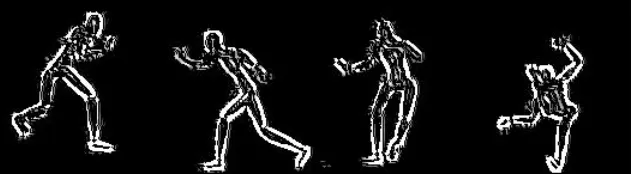
Fig. 2. The four actions involving drunken walking.
III.
RESULTS
0.697
0.022
0.02
0.066
0.068
0.078
0.048 Drunk action 1
0.126
0.775
0.004
0.034
0.032
0
0.03 Drunk action 2
0.166
0.025
0.69
0.031
0.046
0.028
0.014 Drunk action 3
0.026
0.043
0.247
0.562
0.047
0.047
0.029 Drunk action 4
0.02
0.039
0.046
0.085
0.735
0.032
0.043 Drunk action 5
0.056
0.015
0.048
0.02
0
0.672
0.189 Drunk action 6
0.088
0.044
0.07
0.027
0.019
0.025
0.728 Normal walk
Fig.1. Confusion matrix for controlled lighting.
The overall accuracy for the drunken and abnormal gait detection was 69.4%. Action 6 had a relatively higher rate of
misclassification with normal walk compared to other actions. Normal walk was classified incorrectly mostly as drunken action 1
(8.8%).
0.644
0.021
0.054
0.064
0.08
0.076
0.061
0.129
0.77
0.004
0.035
0.033
0
0.031
0.174
0.026
0.677
0.032
0.048
0.029
0.014
0.023
0.038
0.216
0.547
0.065
0.054
0.057
0.035
0.035
0.127
0.077
0.66
0.028
0.038
0.054
0.015
0.046
0.019
0.034
0.649
0.182
0.084
0.042
0.067
0.025
0.063
0.024
0.695
The overall accuracy for the abnormal human gait detection decreased under dim indoor lighting and natural outdoor settings. The
accuracy dropped from 72.8% to 69.5% in terms of recall rate for normal gait. The overall accuracy of drunk action recognition
recall rates dropped by 3.1%.
IV.
CONCLUSIONS
The system performed at a higher accuracy level under controlled lighting compared to accuracy levels in indoor dim lighting or
outdoor naturalistic settings. This showed that more features need to be explored and the classifier needs to be trained with more
data before the results can be generalized. The number of participants 5 was less and as a future scope higher number of participants
in more natural lighting would need to be used for training the recognition system.
REFERENCES
[1] Kjetil Holien, “Gait recognition under non-standard circumstances”, Thesis, Gjøvik University College, 2008.
[2] James B. Hayfron-Acquah, Mark S. Nixon, John N. Carter, “Automatic gait recognition by symmetry analysis”, Pattern Recognition Letters, 2003.
[3] Hayfron-Acquah, J., Nixon, M., Carter, J., 2001. Automatic gait recognition by symmetry analysis. In: 3rd Internat. Conf. on Audio-and-Video-Based Biometric Person Authenticat., pp. 272–277.
[4] Huang, P., Harris, C., Nixon, M., 1999. Human gait recognition in canonical space using spatio-temporal templates. IEE Proc. Vision, Image Signal Process., 93–100.
[5] Liang Wang, Tieniu Tan, Weiming Hu, Huazhong Ning, "Automatic Gait Recognition Based on Statistical Shape Analysis", IEEE Transactions on Image Processing, Vol 12, No 9, September, 2003.
[6] W. Zeng, C. Wang "Human gait recognition via deterministic learning.", Neural Network, vol 35, pp 92-102, November, 2012.
[7] Lin, Kuo-Wei and Wang, Shu-Ting and Chung, Pau-Choo and Yang, Ching-Fang, "A New View-Calibrated Approach for Abnormal Gait Detection", Advances in Intelligent Systems and Applications - Volume 2, Proceedings of the International Computer Symposium ICS 2012 Held at Hualien, Taiwan, December 12--14, 2012.
Technology (IJRASET)
V. P. Veiko, Laser Assisted Microtechnology, 2nd ed., R. M. Osgood, Jr., Ed. Berlin, Germany: Springer-Verlag, 1998.
[9] F. Niu and M. Abdel-Mottaleb, “View-Invariant Human Activity Recognition Based on Shape and Motion Features,” in Proceedings of the IEEE Sixth International Symposium on Multimedia Software Engineering, pp. 546-556, 2004.
[10] M. Z. Uddin, J. J. Lee and T.-S. Kim, “Human Activity Recognition Using Independent Component Features from Depth Images,” in Proceedings of the 5th International Conference on Ubiquitous Healthcare, pp. 181-183, 2008.
[11] N. D. Thang, Y.-K Lee, S.-Y. Lee, and T.-S. Kim, “Estimation of 3-D Human Body Posture via Co-Registration of 3-D Human Model and Sequential Stereo Information,” Applied Intelligence, DOI: 10.1007/s10489-009-0209-4, 2010.
[12] R. Cucchiara, C. Grana, A. Prati, and R. Vezzani, “Probabilistic posture classification for human-behavior analysis,” IEEE Trans. Syst. Man, and Cybern. A, vol. 35, no. 1, pp. 42–54, 2005.
[13] I. Haritaoglu, D. Harwood, and L. S. Davis, “W4: Real-time surveillance of people and their activities,” IEEE Trans. Pattern Anal. Machine Intell., vol. 22, no. 8, pp. 809–830, August 2000.
[14] P. S. Huang, C. J. Harris, and M. S. Nixon, “Canonical space representation for recognizing humans by gait or face,” in Proc. IEEE Southwest Symp. Image Anal. Interpretation, pp. 180–185, 1998.
[15] J. Yamato, J. Ohya, and K. Ishii, “Recognizing human action in time-sequential images using hidden Markov model,” in Proc. IEEE CVPR, pp. 379–385, 1992.
[16] L. X. Wang and J. M. Mendel, “Generating fuzzy rules by learning from examples,” IEEE Trans. Syst., Man Cybern., vol. 22, no. 6, pp. 1414–1427, 1992. [17] K. Etemad and R. Chellappa, “Discriminant analysis for recognition of human face images,” J. Opt. Soc. Am. A, Vol. 14, pp. 1724–1733, 1997.
[18] A. S. Patwardhan, 2016. “Structured Unit Testable Templated Code for Efficient Code Review Process”, PeerJ Computer Science (in review), 2016.
[19] A. S. Patwardhan, and R. S. Patwardhan, “XML Entity Architecture for Efficient Software Integration”, International Journal for Research in Applied Science and Engineering Technology (IJRASET), vol. 4, no. 6, June 2016.
[20] A. S. Patwardhan and G. M. Knapp, “Affect Intensity Estimation Using Multiple Modalities,” Florida Artificial Intelligence Research Society Conference, May. 2014.
[21] A. S. Patwardhan, R. S. Patwardhan, and S. S. Vartak, “Self-Contained Cross-Cutting Pipeline Software Architecture,” International Research Journal of Engineering and Technology (IRJET), vol. 3, no. 5, May. 2016.
[22] A. S. Patwardhan, “An Architecture for Adaptive Real Time Communication with Embedded Devices,” LSU, 2006.
[23] A. S. Patwardhan and G. M. Knapp, “Multimodal Affect Analysis for Product Feedback Assessment,” IIE Annual Conference. Proceedings. Institute of Industrial Engineers-Publisher, 2013.
[24] A. S. Patwardhan and G. M. Knapp, “Aggressive Action and Anger Detection from Multiple Modalities using Kinect”, submitted to ACM Transactions on Intelligent Systems and Technology (ACM TIST) (in review).
[25] A. S. Patwardhan and G. M. Knapp, “EmoFit: Affect Monitoring System for Sedentary Jobs,” preprint, arXiv.org, 2016.
[26] A. S. Patwardhan, J. Kidd, T. Urena and A. Rajagopalan, “Embracing Agile methodology during DevOps Developer Internship Program”, IEEE Software (in review), 2016.
[27] A. S. Patwardhan, “Analysis of Software Delivery Process Shortcomings and Architectural Pitfalls”, PeerJ Computer Science (in review), 2016. [28] A. S. Patwardhan, “Multimodal Affect Recognition using Kinect”, ACM TIST (in review), 2016.
[29] A. S. Patwardhan, “Augmenting Supervised Emotion Recognition with Rule-Based Decision Model”, IEEE TAC (in review), 2016. [30] A. S. Patwardhan, Jacob Badeaux, Siavash, G. M. Knapp, “Automated Prediction of Temporal Relations”, Technical Report. 2014.
[31] S. D’Mello and A. Graesser, “Multimodal Semi-Automated Affect Detection from Conversational Cues, Gross Body Language, and Facial Features,” User Modeling and User-Adapted Interaction, vol. 10, pp. 147-187, 2010.
[32] T. Baenziger, D. Grandjean, and K.R. Scherer, “Emotion Recognition from Expressions in Face, Voice, and Body. The Multimodal Emotion Recognition Test (MERT),” Emotion, vol. 9, pp. 691-704, 2009.
[33] C. Busso et al., “Analysis of Emotion Recognition Using Facial Expressions, Speech and Multimodal Information,” Proc. Int’l Conf. Multimodal Interfaces, T.D.R. Sharma, M.P. Harper,G. Lazzari, and M. Turk, eds., pp. 205-211, 2004.
[34] N. Sebe, I. Cohen, and T.S. Huang, “Multimodal Emotion Recognition,” Handbook of Pattern Recognition and Computer Vision, World Scientific, 2005. [35] R. Cowie, E. Douglas-Cowie, N. Tsapatsoulis, G. Votsis, S. Kollias, W. Fellenz, and J. Taylor, “Emotion Recognition in Human-Computer Interaction,” IEEE
Signal Processing Magazine, vol. 18, no. 1, pp. 32-80, 2001.
[36] S. Carlsson and J. Sullivan, “Action recognition by shape matching to key frames,”in Proc. IEEE Comput. Soc. Workshop Models versus Exemplars in Comput. Vision, pp. 263–270, Miami, Florida, 2002.
[37] A. Kapoor and R.W. Picard, “Multimodal Affect Recognition in Learning Environments,” Proc. 13th Ann. ACM Int’l Conf. Multimedia, pp. 677-682, 2005. [38] O. Oreifej and Z. Liu. HON4D: Histogram of oriented 4D normals for activity recognition from depth sequences. In IEEE Conference on Computer Vision
and Pattern Recognition, pp 716–723, 2013
[39] L. Xia, C.-C. Chen, and J. K. Aggarwal. View invariant human action recognition using histograms of 3D joints. 2012 IEEE Computer Vision and Pattern Recognition Workshops, pp 20–27.
[40] J. Wang, Z. Liu, Y. Wu, and J. Yuan. Mining actionlet ensemble for action recognition with depth cameras. In CVPR, pp 1290-97, 2012.
[41] Sijin Li, Weichen Zhang, and Antoni B. Chan. Maximum-Margin Structured Learning with Deep Networks for 3D Human Pose Estimation. Intl. Conf. on Computer Vision (ICCV), Santiago, 2015.
[42] S. Ji, W. Xu, M. Yang, and K. Yu. 3d convolutional neural networks for human action recognition. IEEE Transactions on Pattern Analysis and Machine Intelligence, 35(1):221-231, 2013.
[43] P. Luo, X. Wang, and X. Tang. Pedestrian parsing via deep decompositional neural network. In ICCV, pages 2648-55, 2013. [44] J. K. Aggarwal and M. S. Ryoo. Human activity analysis: A review. ACM Computing Survey, 43(3):16, 2011.
Technology (IJRASET)
[46] L. Chen, H. Wei, J. M. Ferryman. A survey of human motion analysis using depth imagery. Pattern Recognition Letters, 34:1995, 2013.
[47] W. Li, Z. Zhang, and Z. Liu. Action recognition based on a bag of 3D points. IEEE Computer Society Conference on Computer Vision and Pattern Recognition Workshops, pp 9-14, 2010.
[48] J. Shotton, T. Sharp, A. Kipman, A. W. Fitzgibbon, M. Finocchio, A. Blake, M. Cook, and R. Moore. Real-time human pose recognition in parts from single depth images. Communications of the ACM, 56(1):116–124, 2013.
[49] J. Sung, C. Ponce, B. Selman, and A. Saxena. Unstructured human activity detection from RGBD images. In IEEE Intl Conference on Robotics and Automation, pp 842–849, 2012.
[50] C. Zhang, Y. Tian. RGB-D based daily living activity recognition. Journal of Computer Vision and Image Processing, 2(4), Dec. 2012.
[51] D. Gurkaynak and H. Yalcin, Recognition and Classification of Human Activity from RGB-D Videos. IEEE Conference on Signal Processing and Communication Applications (SIU 2015), pp 1642-1646, 2015.
[52] Y. Bengio, P. Lamblin D. Popovici, and H. Larochelle. Greedy LayerWise Training of Deep Networks. Advances in Neural Information Processing Systems 19 (NIPS‘06), pp 153-160, MIT Press 2007.
[53] R. Poppe, “Vision-based human motion analysis: an overview,” Comput. Vision and Image Understan., vol. 108, pp. 4–18, 2007.
[54] A. F. Bobick and J. W. Davis, “The recognition of human movement using temporal templates,” IEEE Trans. Pattern Anal. Machine Intell., vol. 23, no. 3, 2001.
[55] R. Hamid, Y. Huang, and I. Essa, “ARGMode–Activity recognition using graphical models”, in Proc. Conf. Comput. Vision Pattern Recog., vol. 4, pp. 38–45, Madison, Wisconsin, 2003.
[56] Anne Veenendaal, Elliot Daly, Eddie Jones, Zhao Gang, Sumalini Vartak, Rahul S Patwardhan, Drunken Abnormal Human Gait Detection using Sensors, Computer Science and Emerging Research Journal, vol 1, 2013.
[57] Anne Veenendaal, Elliot Daly, Eddie Jones, Zhao Gang, Sumalini Vartak, Rahul S Patwardhan, Fear Detection with Background Subtraction from RGB-D data, Computer Science and Emerging Research Journal, vol 1, 2013.
[58] Anne Veenendaal, Elliot Daly, Eddie Jones, Zhao Gang, Sumalini Vartak, Rahul S Patwardhan, Code Definition Analysis for Call Graph Generation, Computer Science and Emerging Research Journal, vol 1, 2013.
[59] Anne Veenendaal, Elliot Daly, Eddie Jones, Zhao Gang, Sumalini Vartak, Rahul S Patwardhan, Multi-View Point Drowsiness and Fatigue Detection, Computer Science and Emerging Research Journal, vol 2, 2014.
[60] Anne Veenendaal, Elliot Daly, Eddie Jones, Zhao Gang, Sumalini Vartak, Rahul S Patwardhan, Group Emotion Detection using Edge Detecttion Mesh Analysis, Computer Science and Emerging Research Journal, vol 2, 2014.
[61] Anne Veenendaal, Elliot Daly, Eddie Jones, Zhao Gang, Sumalini Vartak, Rahul S Patwardhan, Polarity Analysis of Restaurant Review Comment Board, Computer Science and Emerging Research Journal, vol 2, 2014.
[62] Anne Veenendaal, Elliot Daly, Eddie Jones, Zhao Gang, Sumalini Vartak, Rahul S Patwardhan, Sentiment Analysis in Code Review Comments, Computer Science and Emerging Research Journal, vol 3, 2015.
[63] Anne Veenendaal, Elliot Daly, Eddie Jones, Zhao Gang, Sumalini Vartak, Rahul S Patwardhan, Temporal Analysis of News Feed Using Phrase Position, Computer Science and Emerging Research Journal, vol 3, 2015.
[64] Anne Veenendaal, Elliot Daly, Eddie Jones, Zhao Gang, Sumalini Vartak, Rahul S Patwardhan, Decision Rule Driven Human Activity Recognition, Computer Science and Emerging Research Journal, vol 3, 2015.
[65] Anne Veenendaal, Elliot Daly, Eddie Jones, Zhao Gang, Sumalini Vartak, Rahul S Patwardhan, Depression and Sadness Recognition in Closed Spaces, Computer Science and Emerging Research Journal, vol 4, 2016.
[66] Anne Veenendaal, Elliot Daly, Eddie Jones, Zhao Gang, Sumalini Vartak, Rahul S Patwardhan, Dynamic Probabilistic Network Based Human Action Recognition, Computer Science and Emerging Research Journal, vol 4, 2016.
[67] Anne Veenendaal, Elliot Daly, Eddie Jones, Zhao Gang, Sumalini Vartak, Rahul S Patwardhan, Fight and Aggression Recognition using Depth and Motion Data, Computer Science and Emerging Research Journal, vol 4, 2016.
[68] Anne Veenendaal, Elliot Daly, Eddie Jones, Zhao Gang, Sumalini Vartak, Rahul S Patwardhan, Sensor Tracked Points and HMM Based Classifier for Human Action Recognition, Computer Science and Emerging Research Journal, vol 5, 2016.
[69] A. S. Patwardhan, “Edge Based Grid Super-Imposition for Crowd Emotion Recognition”, International Research Journal of Engineering and Technology (IRJET), May. 2010.
[70] A. S. Patwardhan, “Human Activity Recognition Using Temporal Frame Decision Rule Extraction”, International Research Journal of Engineering and Technology (IRJET), May. 2010.
[71] A. S. Patwardhan, “Low Morale, Depressed and Sad State Recognition in Confined Spaces”, International Research Journal of Engineering and Technology (IRJET), May. 2011.
[72] A. S. Patwardhan, “View Independent Drowsy Behavior and Tiredness Detection”, International Journal for Research in Applied Science and Engineering Technology (IJRASET), May. 2011.
[73] A. S. Patwardhan, “Sensor Based Human Gait Recognition for Drunk State”, International Journal for Research in Applied Science and Engineering Technology (IJRASET), May. 2012.
[74] A. S. Patwardhan, “Background Removal Using RGB-D data for Fright Recognition”, International Journal for Research in Applied Science and Engineering Technology (IJRASET), May. 2012.
[75] A. S. Patwardhan, “Depth and Movement Data Analysis for Fight Detection”, International Research Journal of Engineering and Technology (IRJET), May. 2013.
[76] A. S. Patwardhan, “Human Action Recognition Classification using HMM and Movement Tracking”, International Research Journal of Engineering and Technology (IRJET), May. 2013.
Technology (IJRASET)
[78] A. S. Patwardhan, “Call Tree Detection Using Source Code Syntax Analysis”, International Journal for Research in Applied Science and Engineering Technology (IJRASET), May. 2014.
[79] A. S. Patwardhan, “Walking, Lifting, Standing Activity Recognition using Probabilistic Networks”, International Research Journal of Engineering and Technology (IRJET), May. 2015.
[80] A. S. Patwardhan, “Online News Article Temporal Phrase Extraction for Causal Linking”, International Journal for Research in Applied Science and Engineering Technology (IJRASET), May. 2015.