A Technique COFDM For Improving Efficiency
To Transmitted An Images Through Modulation
Technique For Wireless Communication
Problem
Ms. Deepti Agrawal #1, Dr. J.S.Yadav*2
#1
PhD Research Scholar,(Electronics and Comm Deptt) ,Mewar University ,Chittorgarh (Rajasthan),
*2 Prof. J.S.Yadav Associate Professor,(Electronics and Comm Deptt),MANIT, Bhopal,(M.P.) India
Abstract- The GSM & CDMA technologies has been widely used in wireless 3G system, But today 4G system wireless
transmitter and receiver are used in communication. In this paper we presents novel method for used maximum spectral efficiency from Coded Orthogonal Frequency Division Multiplexing (COFDM) system, and simulate for the transmission of an image of the size of 11,878 bytes in 120*90. Where COFDM show the effect of band pass filtering, for use of a raised cosine guard period, modulation BER rate, clipping distortion, frequency offset errors, and time synchronization error. These techniques utilize the knowledge of the radio channel response, to optimize the frequency, and subcarrier modulation. Modulation independently optimizes the modulation scheme, applied to each subcarrier so that the spectral efficiency is maximum, while maintain a target Bit Error Rate (BER). Also study OFDM technology with multipath current status of COFDM research appears a suitable, technique to modulation technique for high performance wireless telecommunications. And here one possible crucial problem in receiver side where receiver may require a very large memory range in order to handle the large signal strength variation between Tx and Rx.
Keywords- Orthogonal Frequency Division Multiplexing (OFDM) systems, Subcarrier, Bit Error Rate (BER), Additive White Gaussian Noise (AWGN), frequency.
I. INTRODUCTION
In this paper try to investigates the effectiveness of Orthogonal Frequency Division Multiplexing (OFDM) as a modulation technique for wireless radio applications. The main aim is to access suitability of t h e OFDM as a modulation technique for a fixed wireless phone system for t h e rural areas of t h e Asia [1]. The mobile technology is becoming an integral part as it is accessible almost everywhere in globe. Mobile computing has been in the past few years forming a new computing environment. The main fact is that mobile computing is constrained by poor resources, highly dynamic variable connectivity and restricted the energy sources, The design of stable and efficient mobile information systems has been complicated but improve its efficiency.
Orthogonal Frequency Division Multiplexing (OFDM) is a multicarrier transmission technique, it divide spectrum with many carriers, each one being modulated by a low rate data stream. OFDM is similar to FDMA in that the multiple user access is achieved by subdividing the bandwidth into multiple channels, that are allocated to users. However, OFDM spectrum much more efficiently by spacing the channels much closer together [2]. This is achieved by the making all carriers orthogonal to the one another, preventing interference between the closely spaced carriers.
Coded Orthogonal Frequency Division Multiplexing (COFDM) is similar to the OFDM except that forward error correction is applied to the signal before the transmission. This is to overcome errors in the transmission due to lost carriers from frequency selective fading, channel noise and other propagation effects [3]. For this discussion the terms OFDM and COFDM are used interchangeably, as the main focus of this paper is on OFDM, but it is assumed that any practical system will use forward error correction, thus would be COFDM.
In FDMA each user is typically allocated a single channel, which is used to the transmit all user information. The bandwidth of the each channel is typically 10kHz-30kHz for
II. RELATEDWORK
Eonpyo Hong et. al, research paper proposes [4] a new spectrum sensing method for orthogonal frequency division multiplexing (OFDM) systems with pilot tones for equalization convenience. The time domain signal cross-correlation method exploits the periodic feature of pilot signals embed in time domain OFDM signals, while random data signals deteriorate the detection performance. The new spectrum sensing method employs parallel pairs of cross correlators and comb filters, reducing the effect of random data signals by comb filters.
New TDSC-MRC method employing parallel pairs of cross correlator and comb filter is proposed for sensing OFDM signals. Due to significant reduction of random data signals by the filter bank, substantial SNR gain is achieved prior to employing the TDSC-MRC method. The SNR improvement is obtained at the cost of increased computational complexity due to comb filtering.
However, considering 5dB SNR gain of the MRC method over the Neyman-Pearson (NP) method at the cost of 20 times computational complexity [5]. There Simulation results show that the proposed method provides improvement of the sensing performance by about 1.2 dB in SNR over the TDSC-MRC method. Since SNR gain by comb filtering does not depend on the type of TDSC method, the SNR gain is sustained when the NP method is adopted instead of the MRC method.
Gangxiang Shen et. al, show in their paper [6], Traditional ITU-T fixed frequency grid-based optical transport networks suffer several drawbacks such as low fiber spectral efficiency, difficulty in supporting large bandwidth super-channels, and inflexibility in network bandwidth reconfiguration and modification.
To overcome these drawbacks, a new-generation optical transport network based on the concepts of agile spectrum operation and elastic bandwidth allocation has been recently proposed and is receiving increasing attention. This new generation network is called coherent optical orthogonal frequency-division multiplexing (CO-OFDM) optical transport network. It employs the promising CO-OFDM transmission technique and the new-generation bandwidth-variable ROADMs that use the coherent detection capability of the CO-OFDM transmission for optical channel filtering.
The CO-OFDM optical transport network is characterized by arbitrarily assigning center frequency and bandwidth of an optical channel, thereby providing flexibility in network design and operation and achieving efficient fiber spectrum utilization. Despite the increasing attention and considerable progress, there are still many outstanding issues regarding the implementation of CO-OFDM optical transport networks.
In their article they reviews the literature on the architectures of the CO-OFDM optical transport network and discusses key issues, particularly involving network control plane, light path routing and spectrum assignment, impact of channel modulation format and optical reach, sub wavelength traffic grooming, network survivability, and network reconfiguration.
Tushar Kanti Roy write in their paper, [7] Orthogonal frequency division multiplexing (OFDM) is becoming the chosen modulation technique for wireless communications. It can provide large data rates and is sufficiently robust in the face of radio channel impairments. Digital modulation techniques contribute to the evolution of our mobile wireless communications by increasing the capacity, speed and quality of wireless networks. In their paper, they concentrate on digital modulation schemes, such as M-PSK (M-ary Phase Shift keying) and M-QAM (M-ary Quadrature Amplitude Modulation) over an additive white Gaussian Noise (AWGN) channel to analyse the performance of an OFDM system in terms of bit error rate (BER). This is evaluated through a computer simulation, and it is clear that, for high-capacity data rate transmission, the M-QAM modulation is better than the M-PSK modulation.
In their paper, author say the evaluated BER performance of an OFDM system with two digital modulation schemes, namely M-ary PSK and M-M-ary QAM, over an AWGN channel. OFDM is a powerful modulation technique to achieve high data rate and is able to eliminate ISI. It is computationally efficient due to its use of FFT techniques for implementing modulation and demodulation functions. It is observed from the M-ary PSK BER plots that the BER is less in the case of 4-PSK for a low Eb/N0 than in the 8- PSK and 16-PSK cases. Hence, as a higher value of M-ary PSK increases spectrum efficiency, but is easily affected by noise, the OFDM system with the higher M-PSK scheme is used for large-capacity, long-distance application at the cost of slight increase in Eb/N0 while that with the QPSK scheme is suitable for low-capacity, short-distance application. The comparison of M-ary PSK and M-ary QAM schemes indicate that, the BER is large in M-PSK as compared to M-QAM and it is generally depending on its applications. For a higher value of M, such as M > 16, the QAM modulation scheme is suitable for OFDM. In both cases, author obtain good performances but of these two modulation schemes author conclude that for a high capacity data rate transmission M-ary QAM modulation is better than the M-ary PSK modulation.
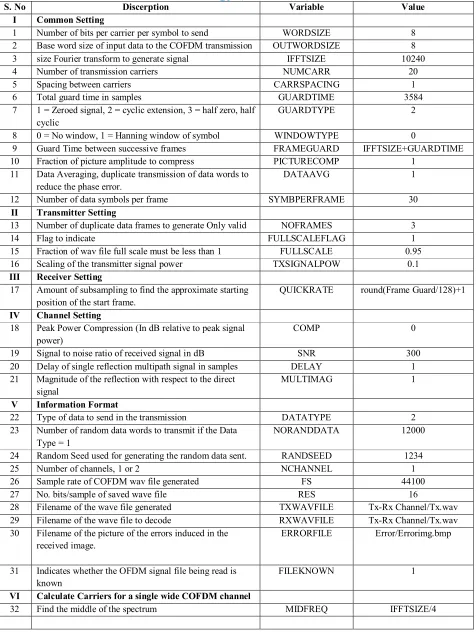
S. No Discerption Variable Value
I Common Setting
1 Number of bits per carrier per symbol to send WORDSIZE 8 2 Base word size of input data to the COFDM transmission OUTWORDSIZE 8 3 size Fourier transform to generate signal IFFTSIZE 10240
4 Number of transmission carriers NUMCARR 20
5 Spacing between carriers CARRSPACING 1
6 Total guard time in samples GUARDTIME 3584
7 1 = Zeroed signal, 2 = cyclic extension, 3 = half zero, half cyclic
GUARDTYPE 2
8 0 = No window, 1 = Hanning window of symbol WINDOWTYPE 0
9 Guard Time between successive frames FRAMEGUARD IFFTSIZE+GUARDTIME 10 Fraction of picture amplitude to compress PICTURECOMP 1
11 Data Averaging, duplicate transmission of data words to reduce the phase error.
DATAAVG 1
12 Number of data symbols per frame SYMBPERFRAME 30
II Transmitter Setting
13 Number of duplicate data frames to generate Only valid NOFRAMES 3
14 Flag to indicate FULLSCALEFLAG 1
15 Fraction of wav file full scale must be less than 1 FULLSCALE 0.95 16 Scaling of the transmitter signal power TXSIGNALPOW 0.1
III Receiver Setting
17 Amount of subsampling to find the approximate starting position of the start frame.
QUICKRATE round(Frame Guard/128)+1
IV Channel Setting
18 Peak Power Compression (In dB relative to peak signal power)
COMP 0
19 Signal to noise ratio of received signal in dB SNR 300
20 Delay of single reflection multipath signal in samples DELAY 1 21 Magnitude of the reflection with respect to the direct
signal
MULTIMAG 1
V Information Format
22 Type of data to send in the transmission DATATYPE 2
23 Number of random data words to transmit if the Data Type = 1
NORANDDATA 12000
24 Random Seed used for generating the random data sent. RANDSEED 1234
25 Number of channels, 1 or 2 NCHANNEL 1
26 Sample rate of COFDM wav file generated FS 44100
27 No. bits/sample of saved wave file RES 16
28 Filename of the wave file generated TXWAVFILE Tx-Rx Channel/Tx.wav 29 Filename of the wave file to decode RXWAVFILE Tx-Rx Channel/Tx.wav 30 Filename of the picture of the errors induced in the
received image.
ERRORFILE Error/Errorimg.bmp
31 Indicates whether the OFDM signal file being read is known
FILEKNOWN 1
VI Calculate Carriers for a single wide COFDM channel
[image:4.612.70.546.71.703.2]32 Find the middle of the spectrum MIDFREQ IFFTSIZE/4
In this given configuration some of the setting and its value change error rate when fully debugged. If the receiver is giving to the very high error rates, then it is clear that there is a synchronisation error. For fix the error used the different value in given variable ifft_size, guardtime and NumCarr.
IV. GENERATIONOFCOFDM
For successfully generate of COFDM with the relationship between all the carriers must be carefully controlled to maintain the orthogonality of the carriers. For this reason, COFDM is generated by choosing spectrum required, on the base of input data, and modulation scheme used. Each carrier to be produced and is assigned to the some data to be the transmit. The required amplitude and phase of the carrier is calculated with the based on the modulation scheme (typically differential BPSK, QPSK, or QAM). The required spectrum is converted back to it’s the time domain signal using an Inverse Fourier Transform. In mostly applications, an Inverse Fast Fourier Transform (IFFT) is used. The performances of IFFT transformation is very efficiently, and its provides a simple way of ensuring that the the carrier signals produced are orthogonal.
The Fast Fourier Transform (FFT) transforms a cyclic time domain signal into the equivalent frequency spectrum. This is done by the finding equivalent waveform, generated by a sum of the orthogonal sinusoidal components. The amplitude and phase of the sinusoidal components represent the frequency spectrum of time domain signal. The IFFT performs are reverse process, to transform a spectrum (amplitude and phase of the each component) into a time domain signal. An IFFT converts a number of the complex data points, of length which is a power of the 2, into the time domain signal of same number of points. Each data point in frequency spectrum used for an FFT or IFFT is called a bin. The orthogonal carriers required for COFDM signal and its can be easily generated by the setting of amplitude and phase of each bin, then an IFFT performing. Since each bin of an IFFT corresponds to amplitude and the phase of a set of the orthogonal sinusoidal, and reverse process of its can guarantees that the carriers generated are fully orthogonal.
V. EXPERIMENTSANDRESULTS
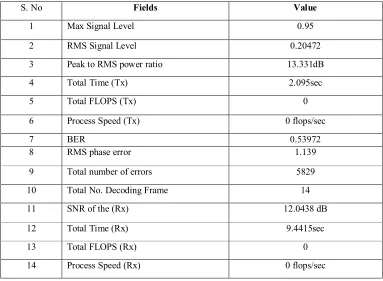
In this paper used given above parameter table 1 to transmitted an image which size of 11,878 bytes in 120*90. In the table 2 our results are available in those parameters with error of 5829 px. but we identify that our transmitter signal size goes high up to 15 MB.
S. No Fields Value
1 Max Signal Level 0.95
2 RMS Signal Level 0.20472
3 Peak to RMS power ratio 13.331dB
4 Total Time (Tx) 2.095sec
5 Total FLOPS (Tx) 0
6 Process Speed (Tx) 0 flops/sec
7 BER 0.53972
8 RMS phase error 1.139
9 Total number of errors 5829
10 Total No. Decoding Frame 14
11 SNR of the (Rx) 12.0438 dB
12 Total Time (Rx) 9.4415sec
13 Total FLOPS (Rx) 0
[image:5.612.114.497.385.666.2]14 Process Speed (Rx) 0 flops/sec
Table 2. Show results from simulation of transmitting an image of 11,878 bytes in 120*90.
Fig1. Original Image send by given Parameter to transmitted by COFDM
Fig2. Received Image trough receiver by given Parameter
Fig3. Received Error when transmitted and received data by given Parameter
VI. CONCLUSION
In this paper show the simulation result of the transmitted an image of size of 11,878 bytes in 120*90, and the result of whole experiment is given in table 2. from this given parameter of table 1 we received best result with error of 5829 but we identify that our transmitter signal size goes high up to 15mb. From this the current status of COFDM research appears a suitable technique of modulation for high performance wireless telecommunications.
between users. In Some research papers practical tests performed on a low bandwidth baseband signal. But in this paper we try an high signal range so our transmitted (Tx) file become more heavy. So far only some main performance criteria have been tested, those are COFDM’s tolerance to multipath delay spread, peak power clipping and channel noise. These includes effect of frequency stability errors on impulse noise effects and COFDM.
This research paper concentrated on COFDM, however most practical system would use forward error correction to improve the system performance. Here in future more work needs to done on studying forward error correction to improved performance, that would be suitable for different applications, like data transmission. Some modulation techniques for COFDM is investigated in 256PSK, 16PSK, QPSK and BPSK. From this system performance gains may be possible by dynamically choosing the modulation technique based on the type of data being transmitted.
REFERENCES
[1] A. Al-Dweik, A. Hazmi, S. Younis, B. Sharif, and C. Tsimenidis, “Carrier frequency offset estimation for OFDM systems over mobile radio channels,” IEEE Trans. Veh. Technol., vol. 59, no. 2, pp. 974 – 979, Feb. 2010.
[2] Jiakuo Zuo, Van Phuong Dao, Yongqiang Bao, Shiliang Fang, Li Zhao, and Cairong Zou, “Robust Energy Efficiency Power Allocation for Uplink OFDM–Based Cognitive Radio Networks”, ETRI Journal, Volume 36, Number 3, June 2014.
[3] Farhan Farhan, “Study of Timing Synchronization in MIMOOFDM Systems Using DVB-T”, International Journal on Information Theory (IJIT), Vol.3, No.2, April 2014.
[4] Eonpyo Hong, Kiseon Kim, Dongsoo Har, “Spectrum Sensing by Parallel Pairs of Cross-Correlators and Comb Filters for OFDM Systems With Pilot Tones”, IEEE SENSORS JOURNAL, VOL. 12, NO. 7, JULY 2012
[5] H. S. Chen, W. Gao, and D. G. Daut, “Spectrum sensing for OFDM systems employing pilot tones,” IEEE Trans. Wireless Commun., vol. 8, no. 12, pp. 5862–5870, Dec. 2009.
[6] Gangxiang Shen, Moshe Zukerman, “Spectrum-Efficient and Agile CO-OFDM Optical Transport Networks: Architecture, Design, and Operation, IEEE Communications Magazine • May 2012.