ISSN 2250-3153
Students, Peer Pressure and their Academic
Performance in School
Vangie M. Moldes1 Cherry Lyn L. Biton2 Divine Jean Gonzaga3
Jerald C. Moneva4
Students, Jagobiao National High School – Senior High Department1 2 3 Adviser, Teacher, Jagobiao National High School 4
DOI: 10.29322/IJSRP.9.01.2019.p8541
http://dx.doi.org/10.29322/IJSRP.9.01.2019.p8541
ABSTRACT
Adolescent have higher tendency to experience peer pressure in school. Peer pressure is clustered in four categories such as social belongingness, curiosity, cultural-parenting orientation of parents and education, this research design used is descriptive correlation. The researchers conducted the survey among the students in the Senior High School. With 96 respondents who completed the survey. Quantitative data were processed by using chi-square. The result would show the correlation between the perceived level of peer pressure in terms of social belongingness, curiosity, cultural-parenting orientation of parents and education. Generally, students are expected to face the effects of peer pressure optimistically to cope up the negative impact of peer pressure in their studies. Students may use positive or negative approach towards peer pressure. Teacher may guide and help them in facing the problems. Keywords: Cultural-Parenting Orientation, Curiosity, Peer Pressure, Social Belongingness
I. Rationale / Introduction
Peer pressure is often seen during the adolescence stage of a teenagers because they often seek comfort among their peers and intend to do what their peers does without knowing if it is good or bad for them. Adolescence is a period of an individual that is transitory when a child reaches the point in changing its childhood to adulthood (Adeniyi & Kolawole, 2015). Thus individuals are prone temptations in the social contextualization concepts, for example, socializing with others tend to do some activities such as napping and drinking during classes or work day ( Bonein & Denont- Boemont, 2013).
Adolescence social environment could affect teenagers in their adolescence, because mostly in this period teenagers tend to communicate more by their peers. As children grow and reach adolescence, teenagers become more dependent with their peers than their family especially in making choices and enhancing their moral values in life (Uslu, 2013).
Human development is affected by its socialization with other people in the environment. Specifically the academic achievements of students are conjectured to be correlational by the support given by the parents, the teachers and the peer of teenagers that affect their level of academic performance (Chen, 2008). In general teenagers spend more time with peers. Peer pressure is described to have a positive and negative impact among individuals and even without effect to a person because peer pressure is a continuous learning (Gulati, 2017).
Peer pressure often seems to have various effects toward the student academic performance in school. It is how their peers affect them whether in a positive or negative way. Teenagers need to seek comfort from others that they found in the presence of their peers, and they are not even aware on how their peers influence them academically.
Eventually this study aimed to know the relationship of peer pressure the Senior High School Students and their academic performance.
ISSN 2250-3153
Studies show that the influence of peer groups among student can boost their anxiety especially pertaining to their education (Kadir, Atmowasdoyo & Salija 2018). The relationship within the group with its peers are co-related with each other, hence the direction of this particular relationship should be monitored were these relationships should go considering all possible factors correlated within the groups outcome (Wilson, 2016). Peer pressure faced by many teenagers of the society, professionals understood the concept of peer influence that could affect teenagers in a negative way which can be prevented by educating and preparing teenagers to face the negative aspects caused by peer pressure (Temitope & Og0nsakin, 2015). Similarly peer influence among teenagers does not directly affect them in a negative way but it varies in how much and how the students receive the climate of the peers coming from the group (Mosha, 2017). When a student is influenced and motivated by peers he will perform excellent at school and got good grades in mathematics (Boechnke, 2018). Getting the support needed coming from the peer group, student tend to excel and exceed its capability and concentrate more pertaining to his studies and do good in the academic tasks in school (Olalekan, 2016). Adolescence gaining social support from its peers is an important factor to cope with different problems and illnesses by letting go of emotions by talking someone. Social support plays an important role for teenagers to lessen the effects of stressful situations and stressors through the support of the peers in the group (Esen & Gundogdu 2010). Despite the various studies conducted for understanding the effects of peer group in student’s academic performance, no one has yet understood the nature of peer effects among students (Zhang, 2010). Knowing how the teenagers interact with their peers and how they interact with each other and how presence of peer group affect student’s academic achievement in school plays an important role for various categories and even the whole educational system (Leka, 2015). Peer pressure is commonly described as peers encouraging other teenagers to do things (Santor, Messervey & Kusumakar, 2000). Peer pressure is also caused by parent’s lack of supervision towards their children during adolescence, children tend to enjoy their peers company and spend with their peers more during the adolescence period (Puligni, 1993). There are different factors that could affects student’s academic performance in school whether it’s their family is giving proper guidance and motivation to their children with the healthy and harmonies interaction with their surroundings (Ezzarrooki, 2016). Students interactions with its peers could help enhance their capability and increase their academic performance in school because they could seek help from their peers that could serve as a motivation than working alone (Sotinis, Mirco & Michael, 2013). Student peer group in school plays as an in socializing teenager with the peers to socialize with each other that help should the child adolescents (Uzezi & Deya, 2017). Interaction of students between its peer are likely to influence the students and can be crucial for the student to determine their choice and could affect student performance ( De Giorgi ,n.d.).
Understanding peer influence towards teenagers is important for developing and understanding how to improve socioeconomic policies (Carman & Zhang, 2011). Peer among youth plays a vital role during the adolescence of a teenager. This is the time when teenagers develop deep friendship among their peers and become permanent during their adolescence (Guzman, 2017). Peer pressure towards persons behavior is said to be a social phenomenon where the members of a particular society or may not be influence negatively but majority are affected by the undesirable behavior of those people who resist what others do (Gulati, 2017). Looking to the different group of factors that influence adolescence in their completion of their academic excellence it is further hindered by developmental challenges (Chen, 2008). An individual seek emotional support towards communicating publicly and showing his private objectives or goals. Indeed through showing your emotions to others individual can get emotional benefits from it because it could help them to overcome temptation and could give them emotional benefits. (Borein & Boemont, 2013). Also, peer groups answer questions from teenager different concern from adolescence stage including physical appearance or changing bodies (Ademiyi & Kolawole, 2015).
Peer pressure could easily affect the self-esteem of students that an important factor adolescence. Individual adapt attitudes towards a certain aspect that they encountered or they are aware of (Uslu, 2013). In many events student fantasizing and visualizing what they dreamed to became through with their colleagues atmosphere. Eventually, they pursue their choices through with the influence of peer pressure (Owoyele & Toyobo, 2008). The pressure among peer group among its member may engage to do undesired things or negative behavior with the presence of a particular peer group leader who engage its member to do deviant acts or promote undesirable things to the group (Dumas, Ellis, & Wolfe, 2012).
ISSN 2250-3153
II. Research Elaborations
This contains the researcher design, research environment, respondents, instruments and data gathering. Design
This research study used the descriptive correlation design of the variables covering social belongingness, curiosity, cultural-parenting orientation and education. This design used survey guide as a tool to gathered data.
Environment
This study will be conducted in Jagobiao, Mandaue City in the school of Jagobiao National High School known before as Mabini National High School which was built in 1984. By 2015, this institution recommended the k to 12 Curriculum program that recommended by Department of Education. The School consist of three Academic Tracks namely ABM (Accountancy and Business Management), HUMSS (Humanities and Social Sciences) and GAS (General Academic Strand). The student’s in Jagobiao National High School suits as the respondents for this research in order to collect data.
Respondents
This survey focuses on the Grade 12 Senior High School Students in Jagobiao National High School. Consisting three sections namely ABM (Accountancy and Business Management), HUMSS (Humanities and Social Sciences) and GAS (General Academic Strand). The respondents we’re chosen because they are the appropriate respondents to answer the specific questions.
Instruments
In this study, the researcher use the survey questionnaire in gathering of data, this survey design provides a quantitative description of some fraction of the population that is sample through the data collection process. Questionnaire is being use in data collection instrument for the study. In the sampling stratified sampling in being applied in this study, under the weighted mean statistics.
Data Gathering
The researchers used the survey method to find out the Effects of Peer Pressure in the Academic Performance of Students. In gathering of data, researcher will ask permission to the Administer teacher for that section and also for the students who chosen to be as respondents for the study.
In collecting data, the questionnaire given by the researcher personally and a clean sheet of paper to the respondents for the students would put their answers. The answer of the respondents were collected and it was used in order to tabulate data interpret. Treatment of Data
The data will be treated using a chi-square. It is a testing of the relationship between the categorical variables and its null hypothesis (Ho) represents on relationship at all with the independents such as categorical variables in the population.
III. RESULTS OR FINDINGS
[image:3.612.41.469.625.731.2]This chapter presents the findings, analysis, discussion and interpretation of data gathered wherein the objective is to know the Students, Peer Pressure and their Academic Performance in School.
Table 1. Level of Students Social Belongingness
Indicators
Weighted
Mean Interpretation
1. I spend much time with my peer group 3.41 Agree
2. My friends and I share problems with each other 3.79 Agree
3. My friends give me advice in my problems. 3.81 Agree
4. My friend and I do school activities. 3.57 Agree
ISSN 2250-3153 bond.
Overall Weighted Mean 3.68 Agree
Legend: Strongly Agree(4.01-5.00), Agree(3.26-4.00), Neutral (2.51-3.25), Disagree(1.76-2.50), Strongly Disagree(1.00-
The table above shows the weighted mean of the perceived level of peer pressure in terms of social belongingness of grade 12 students. Students perceived that they agree with the term that they are accompanied by their peers in school. The table shows that student is likely to socialize among others and seeks attention with their peers. Students agree that they should belong to a particular group in school whom they could associate and share their thoughts and opinion regarding school. Overall, students agree that they need their peers and belong to a peer group, thus it could help them share their own perspective and capacity as individuals. Table 2. Level of Students Curiosity
Indicators Weighted Mean Interpretation
1. I like to do something new 4.08 Agree
2. I want to explore my capabilities to do things 4.18 Agree
3. I am curious about having vices 3.14 Neutral
4. I want to explore my teenage years 4.16 Agree
5. I want to experience relationship 3.19 Neutral
6. I like starting a new activity 3.92 Agree
Overall Weighted Mean 3.78 Agree
[image:4.612.37.495.483.630.2]Legend: Strongly Agree(4.01-5.00), Agree(3.26-4.00), Neutral (2.51-3.25), Disagree(1.76-2.50), Strongly Disagree(1.00-1.75) The table above shows the weighted mean of the perceived level of peer pressure in terms of curiosity of grade 12 students. In terms of the content, the statement “I want to explore my capabilities to do things” has the highest weighted mean of 4.18, interpreted as agree. This indicates that adolescents like to explore their capabilities to do things and enjoy their life as a teenager. For the statement “I want to explore my teenage year”, “I like to do something new” and “I like starting new activity” has the weighted mean of 4.16,4.08 and 3.92 respectively and interpreted as agree. This implies that student want to explore, like to do something new things and want to engage in starting new activity. On the other side, the statements “I want to experience relationship” and “I am curious about having vices” has the weighted mean of 3.19 and 3.14 respectively interpreted which is neutral and as adolescents are likely want experience relationship and are curious in having vices. The overall weighted mean of the perceived level of peer pressure in terms of curiosity is 3.78 which signify that adolescents agree to explore their teenage year.
Table 3. Level of Students Cultural-Parenting Orientation
Indicators
Weighted
Mean Interpretation 1. I have to ask my parent permission to do most things 3.97 Agree 2. My parent worry that I am up to something they won't like 3.79 Agree 3. My parent want me to follow their directions even if I disagree with
their reasons 3.44 Agree
4. My parent encourage me to give my ideas and opinions even if I
might disagree 3.30 Neutral
5. My parent warn me not to go out along with my friends at night 3.80 Agree
Overall Weighted Mean 3.67 Agree
ISSN 2250-3153
[image:5.612.37.493.151.289.2]opinions even if I might disagree” has the lowest weighted mean of 3.30 interpreted as neutral which means that children whether like or disagree the reasons of their parents to give their ideas and opinion to their parents. The overall weighted mean for the perceived level of peer pressure in terms of cultural-parenting orientation is 3.67 which mean that adolescents agree to the reasons their parents signifies.
Table 4. Level of Students in Education
Indicators
Weighted
Mean Interpretation 1. My friends help me on what to do in my academic performance in
school 3.73 Agree
2. My friends inspire me to work hard in my studies 3.76 Agree 3. We always help each other with academic difficulties 3.49 Agree
4. I am always focused in class with my peers 3.49 Agree
5. My friends assistance in group assisted to improve my grades 3.61 Agree
Overall Weighted Mean 3.60 Agree
Legend: Strongly Agree(4.01-5.00), Agree(3.26-4.00), Neutral (2.51-3.25), Disagree(1.76-2.50), Strongly Disagree(1.00-1.75) Students perceived that they agreed with the term that in education they need their friends in school in order succeed and accomplish certain school works and activities. The table shows that student’s education, they need the presence of their peers to help them do their school works and inspire them to work hard pertaining in their studies. And students agree and contented by the presence they get from their peers, thus it help them achieved their goals and excel academically. Overall, students agree with presence and support given by their peers toward in school and their studies. Thus, it helped them as individuals.
TABLE 6.
Summary of Results
Factors X2 Df X2
(0.05) Discussion Interpretation
Social Belongingness 10.12 3 7.81 Reject Significant
Curiosity 7.24 6 12.6 Failed to Reject Not Significant
Cultural Parenting Orientation 16.30 6 12.6 Reject Significant
Education 7.48 6 12.6 Failed to Reject Not Significant
The table above shows the value of computed chi-square x2 (10.12) in terms of social belongingness is less than the computed critical value (7.81) which reject the null hypothesis- thus, significant. This implies that social belongingness can influence the student’s level of performance in school. Social belongingness can affect students’ academic excellence pertaining in their studies. Individual displays interest in communicating to public about his personal concern and objectives. Likely, displaying emotions to others can give emotional benefits to a person thus it helps him to overcome temptation in life (Bonein & Denant-Boemont, 2013). Positive outcomes in relation to students peer association likely to occur when student environment drives the students to engage their desired activities that is motivated by their peers to continue to strive to reach possible outcome (Korir & Kipkemboi, 2014).
The value of computed chi-square in terms of curiosity x2 (7.24) is less than the computed critical value (12.6), which failed to reject the null hypothesis, there is a significant difference. It state that there is no correlation between student’s curiosity and their level of academic performance in school relatively and it could affect their grades and academic performance. It contradicts to the statement that student’s curiosity could lead toacademic failure and could have a negative impact in their studies. For instance, adolescents who commit explanation of substance abuse through engaging with their peers likely to make unhealthy decisions in their life that could interfere their life goals and make inconsistent choices (Dumas, Ellis & Wolfe, 2012). And also, peer pressure is the main indicator of teenagers into engaging drugs because they begin to adapt this kind of lifestyle among their acquaintances (Gulati, 2017).
[image:5.612.38.484.404.467.2]ISSN 2250-3153
teenagers parents should realize that children will find their way to fit in a certain group in their age and the world alike (Olalekan, 2016).
The value of computed chi-square x2(7.48) in terms of education is less than the computed critical value (12.6), which fails to reject the null hypothesis. Thus, there is no significant difference. This implies that peer group along with student education cannot affect their studies. Therefore, peer group in student’s level of academic performance in school is not associated with each other. Adolescence is a stage where children particularly seeks socialization with their age group that will exhibit different behavior and attitude which occur through their interaction, thus a child will learn more by engaging and interacting with their peers (Cuzezi & Deya, 2017). Friendship among youth will allow them to develop their necessary social skills towards other for them foster as an individual and reach future success (Guzman, 2007).
IV. Conclusion
Graduating senior high school students have encountered different factors in relation to students peer pressure in school and its association in their studies in terms of social belongingness, curiosity, cultural-parenting orientation of parents and education. The results declared that there are several factors that could affect students’ academic performance in school regarding to peer pressure. This suggests that peer pressure does not give negative impact directly to student toward their peers.
Generally, students peer pressure in school affects the academic performance among students in term of various content. Furthermore, cultural parenting among parents among parents and social belongingness can affect student academic performance in school based on the result of the computation of chi-square. It had been manifested that curiosity and students level of education does not affect student academic performance. Hence, whatever the effects of student peer pressure are based their approach towards their peers.
APPENDIX A
Students Peer Pressure and their Academic Performance in school
Personal Information
Name:
Age: Gender:
Direction: Please answer the following items with all honesty. The information that will be gathered by the researchers shall be held with utmost confidentiality.
How does peer pressure affect students in school?
Social belongingness 5 4 3 2 1
1. I spend much time with my peer group
2. My friends and I share problems with each other 3. My friends give me advice in my problems 4. My friends and I do school activities together
5. I and my friends share thoughts and opinions to strengthen our bond CURIOSITY
1. I like to do something new
2. I want to explore my capabilities to do things 3. I am curious about having vices
4. I want to explore my teenage years 5. I want to experience relationship 6. I like starting a new activity.
Cultural-Parenting Orientation 5 4 3 2 1
1. I have to ask my parents permission to do most things 2. My parents worry that I am up to something they won’t like
3. My parents want me to follow their directions even if I disagree with their reasons 4. My parents encourage me to give my ideas and opinions even if I might disagree 5. My parents warn me not to go out along with my friends at night
2. Educational 5 4 3 2 1
ISSN 2250-3153
2. My friends inspire me to work hard in my studies 3. We always help each other with academic difficulties 4. I am always focused in class with my peers
5. My friends assistance in group discussion assisted to improve my grades
Legend: Strongly Agree(4.01-5.00), Agree(3.26-4.00), Neutral (2.51-3.25), Disagree(1.76-2.50), Strongly Disagree(1.00-1.75)
Republic of the Philippines Department of Education Region VII, Central Visayas
Division of Mandaue City JAGOBIAO NATIONAL HIGH SCHOOL
North Road, Jagobiao, Mandaue City
In the ___ day of August 2018 MRS. ARLINA YAP AMANTE Pricipal IV
Jagobiao National High School North Road Jagobiao, Mandaue City Dear Mrs. Arlina Y. Amante:
The students of Accountancy and Business Management ABM-12 of Senior High School are currently conducting a research as a partial requirement of the subject Practical Research 2 Quantitative Research for the school year 2018-2019.
As a part of completing subject, we need to conduct a quantitative study titled ”Students, Peer Pressure and their Academic Performance in School.” In this instance, we intent to ask your permission to allow us to gather descriptive data from the Senior High School Students of Jagobiao National High School.
We are hoping for your approval. Very truly yours,
VANGIE M.MOLDES __________________________ CHERRY LYN L. BITON __________________________ DIVINE GONZAGA __________________________ Researchers
Noted by: Approved by:
JERALD MONEVA ARLINA YAP AMANTE Principal IV
ISSN 2250-3153
Teachers in Senior High School
APPENDIX C
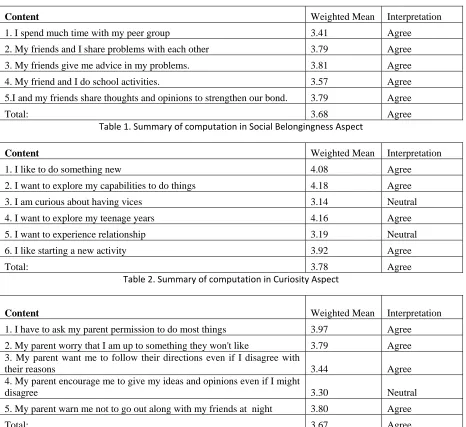
Summary of the computation
Content Weighted Mean Interpretation
1. I spend much time with my peer group 3.41 Agree
2. My friends and I share problems with each other 3.79 Agree
3. My friends give me advice in my problems. 3.81 Agree
4. My friend and I do school activities. 3.57 Agree
5.I and my friends share thoughts and opinions to strengthen our bond. 3.79 Agree
[image:8.612.75.541.242.669.2]Total: 3.68 Agree
Table 1. Summary of computation in Social Belongingness Aspect
Content Weighted Mean Interpretation
1. I like to do something new 4.08 Agree
2. I want to explore my capabilities to do things 4.18 Agree
3. I am curious about having vices 3.14 Neutral
4. I want to explore my teenage years 4.16 Agree
5. I want to experience relationship 3.19 Neutral
6. I like starting a new activity 3.92 Agree
Total: 3.78 Agree
Table 2. Summary of computation in Curiosity Aspect
Content Weighted Mean Interpretation
1. I have to ask my parent permission to do most things 3.97 Agree 2. My parent worry that I am up to something they won't like 3.79 Agree 3. My parent want me to follow their directions even if I disagree with
their reasons 3.44 Agree
4. My parent encourage me to give my ideas and opinions even if I might
disagree 3.30 Neutral
5. My parent warn me not to go out along with my friends at night 3.80 Agree
Total: 3.67 Agree
ISSN 2250-3153
Content Weighted Mean Interpretation
1. My friends help me on what to do in my academic
performance in school 3.73 Agree
2. My friends inspire me to work hard in my studies 3.76 Agree 3. We always help each other with academic difficulties 3.49 Agree
4. I am always focused in class with my peers 3.49 Agree
5. My friends assistance in group assisted to improve my grades 3.61 Agree
[image:9.612.141.471.206.674.2]Total: 3.60 Agree
Table 4. Summary of computation Education Aspect
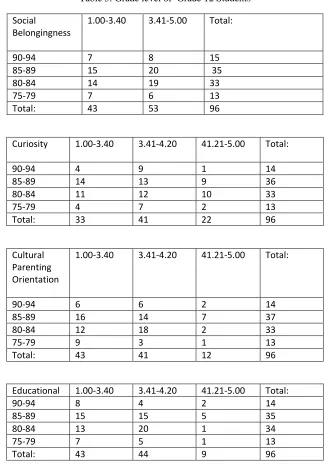
Table 5. Grade level of Grade 12 Students Social
Belongingness 1.00-3.40 3.41-5.00 Total:
90-94 7 8 15
85-89 15 20 35
80-84 14 19 33
75-79 7 6 13
Total: 43 53 96
Curiosity 1.00-3.40 3.41-4.20 41.21-5.00 Total:
90-94 4 9 1 14
85-89 14 13 9 36
80-84 11 12 10 33
75-79 4 7 2 13
Total: 33 41 22 96
Cultural Parenting Orientation
1.00-3.40 3.41-4.20 41.21-5.00 Total:
90-94 6 6 2 14
85-89 16 14 7 37
80-84 12 18 2 33
75-79 9 3 1 13
Total: 43 41 12 96
Educational 1.00-3.40 3.41-4.20 41.21-5.00 Total:
90-94 8 4 2 14
85-89 15 15 5 35
80-84 13 20 1 34
75-79 7 5 1 13
Total: 43 44 9 96
ISSN 2250-3153
Students Social
belongingness
Curiosity Cultural Parenting
Education
Student 1 2 3 3.8 2.2
Student 2 2.8 3.16 3.2 2.2
Student 3 3.8 4.33 3 3.4
Student 4 2.6 4 4 3
Student 5 3.6 3.83 3.8 3.6
Student 6 3.8 3.33 4.2 3.2
Student 7 3.6 2.15 3.4 3
Student 8 3.8 2.83 2 3
Student 9 3 3.33 3.4 3
Student 10 3.2 4.16 4 3.4
Student 11 3.8 3.33 3.4 3.2
Student 12 3.6 3.36 2.8 3.4
Student 13 4.4 3.35 4.2 4.4
Student 14 4.4 4.5 4.6 4.4
Student 15 4.2 4.66 4.2 4
Student 16 3.8 4 3.4 4
Student 17 4 3 2.8 4
Student 18 4 3 2.8 48
Student 19 3.8 3.66 3.4 3.8
Student 20 2.8 2.66 3.6 3.8
Student 21 3.6 4 3 3.8
Student 22 4.2 4 4 4
Student 23 5 4.16 4 5
Student 24 3.8 4.5 4.6 4.6
Student 25 4.4 5 4.6 4.4
Student 26 4.6 3.5 4.8 4.8
Student 27 3.4 3.66 3.6 3.8
Student 28 3 3.83 3.8 1.4
Student 29 3.8 5 2.8 3.4
Student 30 2.8 2.66 4.8 2.4
Student 31 1.4 5 1 2
Student 32 3.4 4.16 5 3.2
Student 33 3.6 3.66 3.6 3.4
Student 34 4 4 4 4
Student 35 4.2 4 3.4 4
Student 36 4 3.5 3.6 4
Student 37 4 4.33 3.2 3.6
Student 38 3.8 3.33 4 2.6
Student 39 4 4.5 3.2 3.6
Student 40 4.2 4.33 3.6 3
Student 41 3.8 4 3.6 4.2
Student 42 4.6 4 4 4.6
Student 43 3.8 3.38 3 3.6
Student 44 4 3.33 3.6 3.6
Student45 3.6 3.16 3.4 3.8
Student 46 3.4 3.5 3.6 3.8
Student 47 3.4 3.33 3.6 3
Student 48 4.6 3.33 4 3.6
Student 49 3.8 3.33 4 3.6
Student 50 4 4 4.4 5
Student 51 4.2 3.16 3.6 4
Student 52 4.8 4 3.2 4
Student 53 4 3.66 5 4.6
ISSN 2250-3153
ACKNOWLEDGEMENT
We thank all who in one way or another contributed in the completion of this research. First , we give thanks to our God for protection and ability to do work.
Specially and heartily thank to our subject teacher, Dr. Jerald C. Moneva who encouraged and directed us. His challenges brought this work to a completion. It is with his supervision that this work came into existence. For any faults we take full responsibility.
Student 55 3.4 4 3 3.2
Student 56 3.4 3.66 3.6 3.6
Student 57 3.4 4.33 2.8 4
Student 58 4 3.5 4 3
Student 59 3.2 4 4 4.2
Student 60 4 4.83 4.4 4
Student 61 2.2 3.83 2.83 2.8
Student 62 3.4 3.33 4.2 3.4
Student 63 4 3.83 4.8 3
Student 64 3.6 4.33 3.6 3.6
Student 65 4 4.16 3.6 4
Student 66 3.8 3.33 3 1.9
Student 67 2.8 5 1.4 1.6
Student 68 4.4 4.17 3.6 3.6
Student 69 3.6 3.83 3 3
Student 70 3.8 4.33 4.2 2.6
Student 71 4.8 3.83 4.2 4.4
Student 72 2.4 3.67 3.4 3.6
Student 73 4.6 4.83 4.8 4.2
Student 74 3.6 3.5 3.2 4.2
Student 75 3.8 4.33 4.2 4
Student 76 4.4 4.33 4.4 4.4
Student 77 4 4.33 3.6 4
Student 78 2.8 2.33 3.4 2.6
Student 79 3.6 3.33 3.6 3.8
Student 80 3 2.5 2.5 3
Student 81 3.6 3.70 3.6 4
Student 82 4.6 4.83 3.4 4
Student 83 3.4 4 5 3.8
Student 84 2.6 2.17 3.2 3.6
Student 85 2.8 4.83 3 2.6
Student 86 3.8 3.33 4.4 4
Student 87 3.8 3.33 3 4
Student 88 3.8 4.5 4.2 4.4
Student 89 3 3.67 2.8 4
Student 90 3.2 4 3.8 3.8
Student 91 3 3.83 4 3.4
Student 92 3.6 3.5 4 3.8
Student 93 3.8 3.17 4.8 4
Student 94 3.4 3.17 4 3
Student 95 3.4 3.17 4 4.2
Student 96 3.6 4 4 3
ISSN 2250-3153
We are also deeply thankful to our respondents. With their names withhold, but we want to acknowledge and appreciate their cooperation during our data gathering. Their information helped us complete this research.
We also thank our family who encouraged us and prayed for us throughout the time of our research. We are heartily thankful to our parents who support us financially for the completion of this research.
May the Almighty God richly bless all of you.
REFFERNCES
Adeniyi, M A and Kolawole, V A. (2015). The influence of peer pressure adolescents’social behaviour. UNIVERSITY OF MAURITUS RESEARCH JOURNAL,21. Retrieved from:
https://www.ajol.info/index.php/umrj/article/view/122065
Boehnke, K.(2008). Peer pressure: a cause of scholastic underachievement? a cross-cultural study of mathematical achievement among german, canadian, and israeli middle school students. Soc Psychol Educ 11, 149-160. DOI: 10.1007/s11218-007-9041-z Bonein, A. and Denant-Boement ,L. (2013). Self-control, commitment and peer pressure: a laboratory experiment. Center for
Research in Economics and Management. Retrieved from: https://link.springer.com/article/10.1007/s10683 014-9419-7
Carman, K. and Zhang, L. (2012). Classroom peer effects and academic achievement: evidence from a chinese middle school.
China Economic Review 23 223-237. Doi: 10.1016/j.chieco.2011.10.004
Chen, J.(2008). Grade-level differences: relations of parental, teacher, and peer support to academic engagement and achievement among hong Kong students. School Psychology International. Retrieved from:
https://www.researchgate.net/publication/247718714
Chen, X. and Chang, L. (2003). Effects of the peer group on the development of social functioning and academic achievement: a longitudinal study in chinese children. Child Development, 79(2), 235-251. Retrieved from:
https://www.researchgate.net/publication/5486862
De Giorgi, G., Pellizzari, M. and Redaelli, S. (n.d.) Identification of social interactions through partially overlapping peer groups. AMERICAN ECONOMIC JOURNAL. Retrieved from:
https://www.aeaweb.org/articles?id=10.1257/app.2.2.241
Dumas, T., Ellis, W. and Wolfe, D. (2012). Identity development as a buffer of adolescent risk behavior in the context of peer group pressure and control. Journal of Adolescence (35) 917-927 Doi: 10.1016/j.adolescene.2011.12.012
Esen, B. and Gundogdu, M. (2010).The relationship between internet addiction, peer pressure and perceived social support among adolescents. The International Journal of Researchers 2 (1), 29- 36. Retrieved from: http://ijer.eab.org.tr/1/2/4_esen.b.k.pdf Ezzarrouki, A. (2016). Peer influence on academic performance in a collectivistic culture. educational & social psychology. Retrieved from: http://www.enews.ma/en/wp content/uploads/2016/11/Paper-Ezzarrouki-Peer- Influence-Final Draft.pdf Fuligni, A. and Eccles, J. (2008). Perceived parent-child relationships and early adolescents’ orientation toward peers.
Development in Psychology,29(4), 622-632. Retrieved from: https://www.researchgate.net/publication/232572886
Georganas, S., Tonin, M. and Vlassopoulos, M. (2013). Peer pressure and productivity: the role of observing and being observed. IZA Discussion Paper, (7523), Institute for the Study of Labor
Gulati, S.(2017). Impact of peer pressure on buying behaviour. INTERNATIONAL JOURNAL OF RESEARCH-GRANTHAALAYAH, 5 (6), DOI: https://doi.org/10.5281/zenodo.820988
ISSN 2250-3153
Kadir, H., Atmowardoyo, H. and Salija, K. (2018). The influence of peer groups on students’ anxiety in efl Learning. ELT
Worldwide, 5(1) 78. Retrieved from: http://eprints.unm.ac.id/8893/1/ARTICLE.pdf
Kinderman, T. (2016). Peer group influences on students’ academic motivation. Handbook of Social Influences in School Contexts, Doi:10.4324/9781315769929.ch3
Kremer, M. and Levy, D. (2008). Peer effects and alcohol use among college students. Journal of Economic Perspectives,22(3),189-206. Retrieved from: https://www.aeaweb.org/articles?id=10.1257/jep.22.3.189
Korir, D. and Kipkemboi, F. (2014). The impact of school environment and peer influences on students’ academic performance in vihiga county, kenya. Journal of Education and Practice,5(11),1.Retrieved from:
https://www.iiste.org/Journals/index.php/JEP/article/view/12362
Leka, I.(2015). The impact of peer relations in the academic process among adolescents. Mediterranean Journal of Social Sciences,6(1),125 S1 Doi:10.5901/mjss.2015.v6n1s1p127
Mosha, M.(2017). The influence of peer group on academic performance of adolescent students in secondary schools in Tanzania. Research Journal of Educational Studies and Review3 (1), 18-26. Retrieved from:
http://pearlresearchjournals.org/journals/rjesr/index.html
Olalekan, A. (2016). Influence of peer group relationship on the academic performance of students in secondary school (a case study of selected secondary school in atiba local government area of oyo state). GLOBAL JOURNAL OF HUMAN SOCIAL
SCIENCE: A ARTS & HUMANITIES PSYCHOLOGY, 16(4),35 Version 1.0. Retrieved from:
https://socialscienceresearch.org/index.php/GJHSS/article/view/1826
Owoyele, J. W. and Toyobo, O.M. (2008). Parental will, peer pressure, academic ability and school subjects selection by students in senior secondary schools. The Social Sciences 3 (8): 583-586. Retrieved from:
http://docsdrive.com/pdfs/medwelljournals/sscience/2008/583-586.pdf
Porter, S. and Umbach, P. (2006). College major choice : an analysis of person environment fit. Research in Higher Education, 47(4), Doi: 10.1007/s11162-005-9002-3
Santor, D., Messervey, D. and Kusumakar, V. (2000). Measuring peer pressure, popularity, and conformity in adolescent boys and girls: predicting school performance, sexual attitudes, and substance abuse. Journal of Youth and Adolescence,29(2), 165. Retrieved from: https://link.springer.com/article/10.1023/A:1005152515264
Temitope, B. and Ogunsakin, F. (2015). Influence of peer group on academic performance of secondary school students in ekiti state. International Journal of Innovative Research & Development, 4(1),324. Retrieved from:
http://www.ijird.com/index.php/ijird/article/view/59780
Uslu, M. (2013). Relationship between degrees of self-esteem and peer pressure in high school adolescents. International
Journal of Academic Research Part B; 117122.Retrieved from: https://www.researchgate.net/publication/314524207
Uzezi, J. and Deya, G. (2017). Relationship between peer group influence and students’ academic achievement in chemistry at secondary school level. American Journal of Educational Research, 5(4), 350-356. Doi: 10.12691/education-5-4,2
Yunus, A., Mushtaq, S. and Qaiser, S. (n.d.). Peer pressure and adaptive behavior learning: a study of adolescents in gujrat city.
International Journal of Asian Social Science 2(10):18321841. Retrieved from: http://pakacademicsearch.com/pdf-
files/art/1/ijass%20pp.1832-1841.pdf
Zhang, H.(2010).Peer effects on student achievement: an instrumental variable approach Using School transition data. Department of Economics The Chinese University of Hong Kong. Retrieved from: