FACE RECOGNITION USING COMPLETE GABOR FILTER
WITH RANDOM FOREST
Yuen Chark See
1and Norliza Mohd Noor
21
University Tunku Abdul Rahman, Sungai Long Campus, Bandar Sungai Long, Cheras, Kajang, Selangor, Malaysia
2UTM Razak School, Universiti Teknologi Malaysia, Kuala Lumpur Campus, Jalan Sultan Yahya Petra, Kuala Lumpur, Malaysia
E-Mail: [email protected]
ABSTRACT
This paper proposes a hybrid face recognition technique called Complete Gabor Classifier with Random Forest (CGC-RF) in biometrics technologies. CGC-RF uses Gabor Filter and Oriented Gabor Phase Congruency Image (OGPCI) with Random Forest as the learning framework. The Gabor Filter provides the magnitude information of Gabor responses, where the OGPCI contains the phase information of Gabor response. Random Forest is used as the learning framework to classify images based on the features extracted from both Gabor Filter and OGPCI. We tested the proposed technique by assessing the face verification and identification on two face databases namely, the Georgia Tech Face and Faces94. These databases consisted of face image with varied characteristics such as head positions, head orientations, occlusion and light illumination. The results of the assessment suggest the proposed CGC-RF produced high recognition rates of face images on all two databases. It is of our view that GGC-RF outperformed existing face recognition techniques such as PCA, LDA and Gabor-PCA.
Keywords: complete gabor classifier, random forest, face recognition.
INTRODUCTION
Face recognition is one of the critical features to be considered in biometrics technologies. The first automated face recognition system was developed by T. Kanade [1]. Since then it has gone through series of evolution leading to implementation of commercial systems such as biometric identification [2-4].
The findings by Hua et al. [5] on real world face recognition have shown recent face recognition systems produce promising results over large databases in a controlled environment. Although different algorithms were proposed in face recognition system, the performances of face recognition were unstable in an uncontrolled environment.
This paper proposes a hybrid face recognition technique called Complete Gabor Classifier with Random Forest (CGC-RF). The technique uses both Gabor Filter and Oriented Gabor Phase Congruency Image (OGPCI) with Random Forest as the learning framework. Random Forest is used to classify the images based on features extracted from Gabor Filter and OGPCI.
The rest of the paper is organized as follows. Section 2 provides an overview of different approaches and studies conducted in face recognition. Section 3 discusses the hybrid face recognition technique, CGC-RF. We have conducted experiments on CGC-RF on two different face databases and the results are presented and discussed in Section 4.
We conclude the paper in Section 5 by summarizing the capabilities of CGC-RF as a face recognition technique.
Overview of approaches to face recognition
There are three approaches to face recognition; appearance-based, feature-based and learning-based.
Appearance-based
Appearance-based approach uses statistical methods to derive image (high-dimensional) into a feature space (low-dimensional). Examples of these methods are Principal Component Analysis (PCA) and Linear Discriminant Analysis (LDA). PCA is one of the earlier approaches in face recognition using eigenfaces.
Turk and Pentland [6] applied Euclidean distance to measure and classify the input face images using PCA. However, PCA performs well in frontal images, but not when the images are subjected to pose and illumination variations. To alleviate these issues, Belhumeur et al. [7] apply Linear Discriminant Analysis (LDA) in face recognition. LDA models the complete set of face training in scatter matrix. However, LDA requires a large training sample for good classification which is not suitable for face recognition. A combination of PCA and LDA is adopted because of its ability to reduce the training size [8]. In this method, PCA is applied to reduce feature dimension before LDA projection. Bartlett et al. [9] introduced Independent Component Analysis (ICA) to reduce the high computational power of PCA. Xiao Luan et al. [10] extracted parse error of robust PCA for frontal view face recognition with varying illumination and occlusion.
Feature-based
is a challenge to extract stable and difference features from the phase response of the Gabor Filter. Therefore, the phase information of Gabor Filter is disregarded by researchers [14]. Baochang et al. [15] developed the histogram to represent the phase information of face and Struc et al. [16] used phase based classifier to extract phase information. Vitomir and Nikola [17] use both Gabor magnitude and phase information with LDA as feature selection to develop a complete Gabor Fisher classifier for face recognition.
Learning-based
Learning-based approach to face recognition applies machine learning algorithms in classifying faces. Neural network was first demonstrated by Kohonen [18] to recognize aligned and normalized faces. For example, combining Gabor Filter with neural network [19]. Besides the neural network method, ensemble learning also emerged as a prominent candidate in the classification technique by combining all the classifiers to produce a final output [20]. Breiman [21] proposed Random Forest which is one of the ensemble learning methods. Kousani and Mostafa have pointed the benefits of Random Forest towards image classification. Kouzani et al. [22] use Random Forest to classify images by using image pixel value. Mostafa et al. [23] use Random Forest and support vector machine as classifier.
MATERIAL AND METHODS
The proposed hybrid face recognition technique called, Complete Gabor Classifier with Random Forest (CGC-RF) uses Gabor Filter and Oriented Gabor Phase Congruency Image (OGPCI) with Random Forest as learning framework.Gabor Filter also known as Gabor wavelets have proven to be a powerful tool for facial feature extraction. It allows an efficient space-frequency analysis to code facial feature vector. Researchers often use only the magnitude information to construct the facial feature vector. This is due to Gabor phase could take different values even if it is sampled at image close proximate location such as a few pixels apart. This makes extraction of reliable and discriminative features from phase responses difficult. In the proposed CGC-RF technique, Gabor Filter is used to provide the magnitude information.
To overcome the problem in Gabor phase, we propose to employ the Phase Congruency Model introduced by Kovesi [24]. The Phase Congruency Model can be applied together with Gabor Filter to uncover the salient features of the face. It has the advantage of insensitivity towards image illumination variations and contrast.
Random Forest algorithm which originated from the Learning- based approach is used to classify the images. Built on the ensemble learning framework which combines the results of many classifiers to give a final output, Random Forest is used to grow many classification of tress.
CGC-RF comprised of the three stages: pre-processing stage; feature extraction stage and classifier
stage. The stages are depicted on a flow chart as shown in Figure-1. With reference to Figure-1, an individual face image is pre-processed (Section 3.1) before extracting the critical features such as eyes, nose and mouth of the individual. Two face recognition techniques are used to extract the features-Gabor Filter (Section 3.2.1) and Oriented Gabor Phase Congruency Image (OGPCI) (Section 3.2.2). The extracted features from each of the techniques are classified using Random Forest (Section 3.3) to produce the final output. The matching scores from Gabor and OGPCI are combined with a fusion parameter to form the final matching score for Complete Gabor Classifier with Random Forest (CGC-RF) (Section 3.5). The class which has the highest matching score will be selected as the final class output.
Figure-1. Flowchart of CGC-RF.
Pre-processing
Pre-processing is a process of optimizing the image quality; Red Green Blue (RGB) colour image is converted to grayscale image followed by dimension reduction to 64 × 64 pixels.
Features extraction
Gabor Filter and Oriented Gabor Phase Congruency Image (OGPCI) [15, 17, 24-29] are used in the feature extraction process.
Gabor filter
A Gabor wavelet, u v, is given as [17]:
(1)
cos v sin v
xx y , (2)
sin v cos v
y x y , (3)
u
f Gaussian center frequencyfmax/ 2 u/ 2 , (4)
v
Gaussian orientationv/ 8, (5)
and
are ratio between center frequency and size of Gaussian envelop and fmax is the maximum frequency of the filter. Here, the parameters and are
defined as 2 and fmaxdefined as 0.2.The filter bank featuring eight orientations and five scales, where
{0,..., 7}
and u{0,..., 4}are constructed to extract the facial features. The filtering operation is given as
, , , * ,( , )
u v u v
G x y I x y x y
(6)
where I x y
,
¡ axb is a grayscale face image with the size of a b pixels, u v, ( , )x y at the center frequency, fu, as aGabor Filter at the orientation,v and at the center frequency, fu.
, ( , )
u v
G x y consists of real and imaginary parts:
, , , ,
u v u v
E x y Re G x y (7)
, , , ,
u v u v
O x y Im G x y
(8)
Based on the equation 7 and equation 8, the magnitude information of the filtering output can be determined as follows:
(9)
The image features generated are large, as 40 Gabor Filters are applied on a single image, resulting in increases of dimension size by 40 times. After the filtering process, an image of 64 × 64 pixels will become 163840 (64 × 64 × 40) dimensional size, which is highly computational. To resolve this, down-sampling using rectangular grid method is implemented [17]. In this technique only the pixels within the rectangular grid are retained, while the remaining pixels are removed, similar to the resizing concept. In the Gabor Filter technique, down-sampling factor is set to 128.
Oriented GaborPhase Image (OGPCI)
The Gabor Phase Congruency Image (OGPCI) is given as follows [17]:
(10)
where Au v, ( , )x y is set to 0.0001 to avoid divisions with
zero. u v, ( , )x y is the phase deviation defined as follows:
, , ,
Φu v x y, cosu v x y, v x y, sinu v x y, v x y,
(11)
( , )
v x y
is the mean phase angle atv-th orientation and u v, ( , )x y is the phase angle of Gabor Filter
defined as:
(12)
OGPCI calculates the phase congruency by summing of p filter scale for each orientation, v. The generated features are smaller compared to Gabor magnitude response. For example, by selecting an input image size of 64 × 64 pixels, using filter bank of 8 orientations × 5 scales, the total features generated are 32768 (64 × 64 × 8) dimensional size. The filter scales, pare added together for each orientation, v. The numbers of features generated are considered too large for computation, so a down-sampling process is required to reduce the dimensional size. In Gabor magnitude filter, a down-sampled image with a factor of 128 could generate 1000 features. The dimensional size for OGPCI is 5 times lesser than Gabor magnitude. Thus, the feature size generated for OGPCI is only 200.
Random forest
The features extracted from both Gabor Filter and OGPCI techniques undergo a filtering process to remove redundant features and to select critical features. Random Forest is used to evaluate these critical features. Each node in Random Forest is split using randomly selected features instead of best features. The selection of a random subset of features resolved the over fitting data problem as proposed by Tim Ho [30]. Figure-2 depicts a Random Forest Framework. Random Forest is constructed by T classification trees, where T is the total number of tree. In order to classify a test sample, the input vectors of test image are evaluated on each tree in the forest. Each tree gives a classification result which is represented as a
Figure-2. Random forest framework.
In our experiments, the parameters used to grow each tree are as follows:
a) Let the number of training sample be N, and the number of features be M.
b) Choose n times with replacement from N training cases (two-thirds), in-bag sample and the remaining (one-third), out-of-bag (OOB) sample to estimate the error of tree.
c) At each tree decision node, a number m of features is chosen randomly from M and calculate the best split decision among the m variables. The number of m should be less than M.
d) Each tree is grown without pruning, to largest possible size.
The tree is grown using two-thirds of training sample (n), while the remaining one-third (N-n)is left out. These remaining samples are known as OOB samples which are used to obtain the value of m. The forest error rate depends on two situations [21]:
a) The correlation between any two trees in the forest. Increasing the correlation will increase the forest error rate.
b) The strength of each tree. Increasing the strength will decrease the forest error rate.
Increasing the value of potential predictors (m) increases the correlation and strength and vice versa. Hence, it is important to find the optimum value of m to balance these opposing effects. To do this, OOB error rate is used to tune m to achieve optimum value. The OOB sample is run through the finished tree to get the classification output. The OOB error is calculated by using the number of misclassified samples, averaged over all cases. The value of m can be adjusted (increasing or decreasing) to minimize the OOB error. It is recommended to begin the m value with square root of the total numbers
of predictors (m M ) and search for optimal value with respect to OOB error.
Feature importance selection
After the trees in the forest are grown, the most discriminant features subset will remove the redundant features.The selected features are used to regrow the trees. The following are the procedures to estimate the importance of m-th features [31]:
a) For each grown tree, take the OOB cases and go through the tree. Count the number of votes for correct class.
b) Randomly permutes the values of m-th features in OOB cases.
c) Apply the tree again to the OOB cases with the permuted values and count the number of correct class.
d) Subtract the number of correct class votes for permuted OOB cases from the correctly classified class of unaltered OOB cases.
The feature importance is defined as the average of this subtracted value over all the trees in the forest.
Complete Gabor Classifier with Random Forest (CGC-RF)
The matching score for Gabor magnitude and Gabor phase is obtained after the forests are grown. By combining the matching score of Gabor Filter, and Oriented Gabor Phase Congruency Image, OGPCI, a final matching score,CGCis calculated as follows:
1
CGC GFC OGPCI
(13)
where[0,1] is the fusion parameter that controls the relative importance of the two-matching score. The Random Forest will predict the class of test image based on the input features set.
Program framework
Experiement Setup
The proposed hybrid technique is evaluated by piloting face recognition experiments on two popular face databases namely, Faces94 [32], and Georgia Tech Face [33]. Table-1 shows the characteristics of the individual databases. The characteristics which produce large variations were selected as test variables.
The selection criteria of the samples are driven by time and accuracy. We have used a range of 40 to 50 samples to train the Random Forest.
In Georgia Tech Face database, all the 50 subjects are selected to train under the Random Forest. There are 15 images for each individual, 10 images are chosen as the training set and the remaining 5 images are selected as test set. Experiments are conducted to evaluate the performance of the Gabor Filter, OGPCI and Complete Gabor Classifier on face images with different face expression, orientation and lighting illumination.
In Faces94 database, 40 subjects are chosen randomly for growing Random Forest. 15 out of 20 images per individual are chosen as the training set, while the remaining 5 images as the testing set. Faces94 is used for occlusion test. We tested the effectiveness of face recognition algorithm on occluded images. Figure-3 shows the samples of the occluded testing image set. With regards to testing set, the images are modified by adding different size of black box as occlusion. The details of each occlusion box used on Faces94 are shown in Table-2. We also carried out comparison of our experimental results against Principal Component Analysis (PCA) [34], Linear Discriminant Analysis (LDA) [35] and Gabor-PCA [36]. This is discussed in the Section4.2 of the paper.
EXPERIMENTS AND RESULTS
In this section, we performed experiments by assessing the recognition rates of Gabor Filter and OGPCI on two face databases, Georgia Tech Face and Faces94. The following explains the details of the experiments conducted and the results.
Data sets and Evaluations
The following experiments were performed:
Sample images from the databases were down-sized by the factor of 128 to generate 1000 features for Gabor Filter and 200 features were generated for Oriented Gabor Phase Congruency Image (OGPCI). The output features generated from these images were
used to grow trees for the random forest at different ranges as per below:
1. Georgia Tech, the number of trees to be grown is in the range of 100 to 500 with interval of 100 and 2. Faces94, the number of trees to be grown is within the
range of 60 to 100 with interval of 10.
The recognition rate which represents the matching score of the output features against the number of trees grown is measured for each of the databases. The results are presented in Table-3 (Georgia Tech) and Table-4 (Faces94) respectively.
In our next experiment, the random forest was rebuilt using the best features. This is to test the capability of
the new forest to replicate the performance of random forest that uses all features in the earlier experiment. The recognition rate which represents the matching
score of the number of best features against the number of trees grown is measured for each of the databases. The results are presented in Table-5 (Georgia Tech - Gabor filter); Table-6 (Georgia Tech - OGPCI); 8 (Faces94 - Gabor filter) and Table-9 (FacesTable-94 - OGPCI).
Georgia tech database evaluation
The results tabulated in Table-3 indicated that when 500 trees were grown, the recognition rates for Gabor filter was 86.8% and 71.6% for OGPCI. Thereafter, the variances in recognition rate were minimal beyond 500 trees for both extraction methods. The recognition rate is also affected by number of features in each of the methods. Gabor filter which consisted of 1000 features produced better recognition rate than OCPCI which has only 200 features.
In the second experiment, Random forest was rebuilt using best features. A range of 50 to 250 best features with increment of 50 features were selected for Gabor filter. A range of 10 to 50 best features with increment of 10 features were selected for OGPCI. The results of the new classification performance for Gabor filter and OGPCI features are shown in Table-5 and Table 6 respectively.
The results indicated Random forest computed using the best features have slightly lower performance compared to full features in Georgia Tech. In Gabor filter, the best classification result was 86.4%. This was achieved by growing 500 trees with 250 features compared to 86.8% (500 trees with 1000 features - Table-3). As with OGPCI, the best recognition rate was 70.4% (Table-6) computed using 500 trees with 50 features, slightly lower than 71.6% (500 trees with 200 features-Table-3). This suggested random forest that built with best features have similar performance as full features with minimal discrepancy in recognition rate and only utilised 25% of full features.
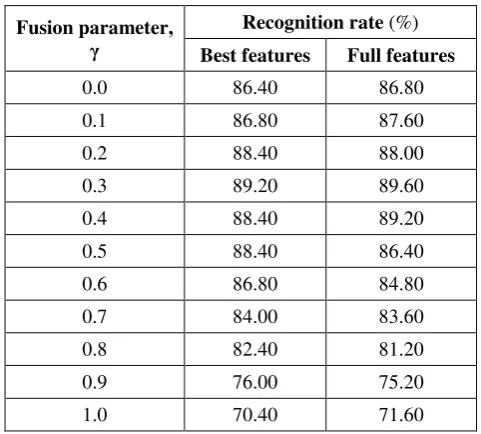
In our next experiment, we combined the best matching score obtained from both Gabor filter and OGPCI with a fusion parameter, γ to form Complete Gabor Classifier with Random Forest (CGC-RF). We performed test on CGC-RF using best features and full features. The results are tabulated in Table-7.
Table-1. Georgia Tech Face and Faces94Database.
Characteristics Georgia Tech
Face Faces94
Number of
Individuals 50 153
Image per Individual 15 20
Resolution (pixels) 150 × 150 180 × 200
Background Clutter Plain Green
Head Scale None None
Head Turn, Tilt and Slant
Major Variation
Minor Variation
Position of Face Some Translation
Minor Translation Image Lighting
Variation
Significant
Change None
Expression Variation Some Minor changes
Format 24bit colour JPEG
24bit colour JPEG
Figure-3. Sample Testing Set for Faces94 Database Image (Occluded).
Table-2. Details of occlusion boxes on Faces94.
Properties Occluded Box No.
1 2 3 4 5
Size (w × h), pixels
100 × 30
100 × 50
100 × 30
100 × 70
40 × 100 Occlusion
Percentage (%)
8.33 13.89 8.33 19.44 11.11
Occluded
Region Eyes Nose
+ Mouth
Mouth Forehead Half face
Table-3. Gabor (1000 Features) and OGPCI (200 Features) on Georgia Tech Face.
Number of trees
Recognition rate (%)
Gabor OGPCI
100 80.8 63.6
200 86.8 67.2
300 84.8 70.4
400 86.4 70.4
500 86.8 71.6
1000 87.2 72.0
Table-4. Gabor (1000 Features) and OGPCI (200 Features) on Faces94.
Number of trees
Recognition rate (%)
Gabor OGPCI
60 96.50 84.00
70 96.00 86.50
80 96.50 88.50
90 96.50 87.50
100 95.00 87.50
500 97.00 89.00
For Random Forest grown using full features, the best recognition rate of Gabor Filter (500 trees with 1000 features -Table-3) and OGPCI (500 trees with 200 features - Table-3) with fusion parameter γ = 0.3 produced best recognition rate of 89.60%.
CGC-RF exploits the information of Gabor magnitude and phase information by combining the Gabor Filter and OGPCI matching score, resulting increased recognition rate. This suggested the hybrid of Gabor and OGPCI techniques produced better performance than individual method.
Table-5. Recognition rate (%) for Gabor features on Georgia Tech Face.
Number of trees
Number of features
50 100 150 200 250
100 75.6 76.4 80.0 81.6 84.0
200 77.6 79.2 82.4 82.4 84.8
300 78.8 82.0 82.8 84.4 85.2
400 79.2 83.6 83.6 84.4 84.8
Table-6. Recognition rate (%) for OGPCI features on Georgia Tech Face.
Number of trees
Number of Features
10 20 30 40 50
100 59.6 56.4 61.6 61.2 61.2
200 65.6 63.6 68.4 66.4 66.0
300 64.8 66.0 70.0 67.2 68.4
400 66.8 68.4 68.0 68.4 70.0
[image:7.595.48.289.276.493.2]500 66.8 68.4 67.6 69.6 70.4
Table-7. Complete Gabor Classifier on Georgia Tech Face.
Fusion parameter,
γ
Recognition rate (%)
Best features Full features
0.0 86.40 86.80
0.1 86.80 87.60
0.2 88.40 88.00
0.3 89.20 89.60
0.4 88.40 89.20
0.5 88.40 86.40
0.6 86.80 84.80
0.7 84.00 83.60
0.8 82.40 81.20
0.9 76.00 75.20
1.0 70.40 71.60
Faces94 database (with occlusion) evaluation
In our experiment on Faces94, we adopted the same approaches as with Georgia Tech Face database. As shown in Table-4, the best recognition rate for Gabor Filter was 97.00% and 89.00% for OGPCI when 500 trees were grown. However, when comparing with 80 trees, the recognition rates only deviates 0.50% in both Gabor Filter and OGPCI making it a more favourable option in terms of memory consumption.
In the second experiment, the Random Forest was regrow using the best features. The results are tabulated in Table 8 and Table-9. The best recognition rates produced for Gabor Filter and OGPCI were lower than full features as per Table 4 (Gabor Filter - 500 trees with 1000 features) and OGPCI - 500 trees with 200 features. The best recognition rate for Gabor Filter was 93.50% using 100 trees with 250 features, whilst 75.50% for OGPCI using 100 trees with 50 features. This was due to features such as the eyes, nose or mouth region being occluded, have caused degradation in feature information. Hence, features which are of lower importance are required to be filtered out in order to classify the face image accurately.
A Random Forest built using best features will always produce lower recognition rate when compared to
the ones built using full features. In our next experiment, we combined the best matching score obtained from both Gabor Filter and OGPCI with a fusion parameter, γ to form Complete Gabor Classifier with Random Forest (CGC-RF). We performed test on CGC-RF using best features and full features. The results are tabulated in Table-10.
For Random Forest grown using best features, Gabor Filter (100 trees with 250 features - Table-8) and OGPCI (100 trees with 50 features - Table-9) with fusion parameter, γ = 0.3 produced best recognition rate of 94.50%.
Table-8. Recognition rate for Gabor on Faces94 (with occlusion).
Number of trees
Number of features
50 100 150 200 250
60 78.5 82.5 87.0 91.0 93.5 70 77.5 83.0 88.0 91.0 93.0 80 79.5 83.0 89.0 90.5 92.5 90 79.5 83.0 89.0 91.5 93.0 100 80.5 84.0 88.5 91.0 93.5
Table-9. Recognition rate for OGPCI on Faces94 (with occlusion).
Number of trees
Number of features
10 20 30 40 50
60 56.0 67.0 65.5 66.0 72.5 70 56.0 68.0 67.0 66.0 74.0 80 56.5 67.5 67.5 67.0 74.0 90 56.5 67.5 69.0 68.5 74.0 100 55.0 66.5 68.0 69.0 75.5
Table-10. Complete Gabor Classifier on Faces94 (with occlusion).
Fusion parameter, γ
Recognition rate (%)
Best features Full features
0.0 93.5 96.5
0.1 94.0 96.5
0.2 94.5 97.0
0.3 94.5 98.5
0.4 94.0 98.5
0.5 92.5 97.5
0.6 88.5 97.5
0.7 86.5 95.5
0.8 81.0 93.0
0.9 78.0 90.5
1.0 75.5 88.5
features Table4) and OGPCI (80 trees with 200 features -Table-4) with fusion parameter γ = 0.3 produced best recognition rate of 98.50%.
OUTPUT RECOGNITION RESULTS AND DISCUSSION
Figure-4(a) shows the classification results of using Gabor Filter, OGPCI and CGC-RF on Georgia Tech Face database. The Gabor Filter failed to classify the result accurately. On the other hand, OGPCI produced correct class output. However, with the hybrid CGC-RF, it classified the test image accurately. CGC-RF exploits OGPCI phase information to produce correct classification of results. This technique combined both Gabor and OGPCI elements to improve the face recognition rate. It also exploits Gabor magnitude to correct OGPCI misclassification. This is shown in Figure-4(b).
Figure-5 shows classification results using the proposed CGC-RF. This technique has the following capabilities:
recognising face image with different illumination and face orientation (shown in the first column from the left in Figure-5).
produces reliable results in test subjects with additional features such as wearing caps and glasses (as shown in the second column and fourth column form the left in Figure-5).
CGC-RF achieved 89.60% recognition rate when using 500 trees with 1000 feature for Gabor Filter and 200 features in OGPCI. The result could be improved by increasing the number of features used in the Random Forest. Figure6 shows the matching results of applying CGC-RF on Faces94 database. The results suggested the hybrid technique could recognize face images which are partially occluded.
Comparisons with State-of-the-art Algorithms
In this section, the proposed technique, Complete Gabor Classifier with Random Forest (CGC-RF) is compared with the existing state-of-the-art algorithms such as Principle Component Analysis (PCA), Linear Discriminant Analysis (LDA) and Gabor-PCA. A comparison of Random Forest computed using full features and best features are made between these algorithms. Table-11 shows the results of recognition rates for each algorithm on different databases. CGC-RF for both full and best features produces the following results in various databases:
Georgia Tech Face Database, CGC-RF for full features produced recognition rates of 89.60%; Faces94 (with occlusion), CGC-RF for full features
produces recognition rates of 98.50%.
In summary, both CGC-RF full and best features produce higher recognition rates in different databases, thus, outperformed other algorithm such as PCA, LDA and Gabor- PCA. However, CGC-RF performance is affected by the number of trees grown.
Table-11. Comparison of Recognition Rate for different algorithm on different database.
Method Georgia
Tech Face Faces94 (occlusion)
CGC-RF (full)* 89.60 98.50 CGC-RF
(best)** 89.20 94.50
PCA[34] 50.40 81.50
LDA[35] 65.60 95.00
Gabor-PCA[36] 55.60 98.50
* CGC-RF (full) is Complete Gabor Classifier with Random Forest using full features
(a) (b)
Figure-4. The classification results from Gabor, OGPCI and CGC-RF on Georgia Tech Face (a) Gabor Misclassify (b) OGPCI Misclassify.
Figure-5. Complete Gabor Classifier on Georgia Tech Face (Correct Classification).
Figure-6. Complete Gabor Classifier on Faces94 (Correct Classification).
CONCLUSIONS
In this paper we have examined the capabilities of a hybrid face recognition system called Complete Gabor Classifier with Random Forest (CGC-RF) in biometrics technologies. The features of the Gabor Filter and Gabor Phase Congruency Image (OGPCI) were discussed. CGC-RF exploits the features from magnitude and phase response of Gabor Filter. Random Forest is used as the learning framework. The performance of CGC-RF was evaluated on two face databases, namely Georgia Tech Face and Faces94, face databases. The results, suggested CGC-RF has the capabilities of producing reliable, stable and consistent performance on the databases. The paper also evaluated CGC-RF in an uncontrolled environment where face images are affected by the individual head scales and positions, facial expressions, illumination and partially occluded areas. The results indicated CGC-RF outperformed other face recognition methods such as PCA, LDA and Gabor-PCA.
ACKNOWLEDGEMENTS
This research is partially funded by the Ministry of Higher Education Malaysia (MyBrain15 program - MyPhD), Universiti Teknologi Malaysia and Universiti Tunku Abdul Rahman, Malaysia.
REFERENCES
[2] Sebastian S. 2013. Literature survey on automated person identification techniques. International Journal of Computer Science and Mobile Computing. 2: 232-237.
[3] Zeng Z, Pantic M, Roisman GI and Huang TS. 2009. A survey of affect recognition methods: Audio, visual, and spontaneous expressions. IEEE Transactions on Pattern Analysis and Machine Intelligence. 31: 39-58.
[4] Delac K., and M. Grgic, M. 2004. A survey of biometric recognition methods. Proceedings on 46th International Symposium Electronics in Marine. pp. 184-193.
[5] Hua G, Yang MH, Learned-Miller E, Ma Y, Turk M, Kriegman D.J. et al. 2001. Introduction to the special section on real-world face recognition. IEEE Transactions on Pattern Analysis and Machine Intelligence. 33: 1921-1924.
[6] Turk M and Pentland A. 1991. Eigenfaces for recognition. Journal of Cognitive Neuroscience. 3: 71-86.
[7] Belhumeur PN, HespanhaJP and Kriegman D. 1997. Eigenfaces vs. fisherfaces: Recognition using class specific linear projection. IEEE Transactions on Pattern Analysis and Machine Intelligence. 19: 711-720.
[8] Zhao W, Chellappa R. and Krishnaswamy A. 1998. Discriminant analysis of principal components for face recognition. Proceedings on Third IEEE International Conference on Automatic Face and Gesture Recognition. pp. 336-341.
[9] Bartlett MS, Movellan JR, and Sejnowski TJ. 2002. Face recognition by independent component analysis. IEEE Transactions on Neural Networks. 13: 1450-1464.
[10]Luan X, FangB, LiuL, Yang W and Qian J. 2014. Extracting sparse error of robust PCA for face recognition in the presence of varying illumination and occlusion. Pattern Recognition. 47: 495-508.
[11]Brunelli R and PoggioT. 1993. Face recognition: Features versus templates. IEEE Transactions on Pattern Analysis and Machine Intelligence. 15: 1042-1052.
[12]Sharif M, Khalid A, Raza M. and Mohsin S.2011. Face Recognition using Gabor Filters. Journal of Applied Computer Science & Mathematics. 11(5): 53-57.
[13]Cho H, Roberts R, Jung, Choi O and Moon S. 2014. An Efficient Hybrid Face Recognition Algorithm Using PCA and GABOR Wavelets. International Journal of Advanced Robotic Systems. 11: 1-8.
[14]Zhang B, Shan S, Chen X and Gao W. 2007. Histogram of gabor phase patterns: A novel object representation approach for face recognition. IEEE Transactions on Image Processing. 16: 57-68.
[15]Zhang B, Wang Z and Zhong B. 2008. Kernel learning of histogram of local Gabor phase patterns for face recognition. EURASIP Journal on Advances in Signal Processing. 2008:469109.
[16]Struc V, Vesnicer B and Pavesic N. 2008. The phase-based gabor fisher classifier and its application to face recognition under varying illumination conditions.2nd International Conference on Signal Processing and Communication Systems (ICSPCS 2008). pp. 1-6.
[17]Vitomir Š and Nikola P. 2010. The complete gabor-fisher classifier for robust face recognition. EURASIP Journal on Advances in Signal Processing. Vol. 2010.
[18]Kohonen T. 1988. Self-organization and associative memory. Self-Organization and Associative Memory. Springer-Verlag Berlin Heidelberg New York. Also Springer Series in Information Sciences.
[19]Bhuiya AA and Liu CH. 2007. On face recognition using Gabor Filters. Proceedings of World Academy of Science, Engineering and Technology. pp. 51-56.
[20]Bauer E. and Kohavi R. 1999. An empirical comparison of voting classification algorithms: Bagging, boosting, and variants. Machine learning. 36:105-139.
[21]Breiman L. 2001. Random Forests. Machine Learning. 45: 5-32.
[22]Kouzani A, Nahavandi S and Khoshmanesh K. 2007. Face classification by a Random Forest. 2007 IEEE Region 10 Conference: TENCON 2007. pp. 1-4.
classifiers. IEEE Trans on Affective Computing. 5(2): 141-154.
[24]Kovesi P. 1999. Image features from phase congruency. Videre: Journal of Computer Vision Research. 1(3): 1-26.
[25] Liu C and Wechsler H. 2002. Gabor feature based classification using the enhanced fisher linear discriminant model for face recognition. IEEE Trans on Image processing. 11: 467-476.
[26]Qing L, Shan S, Chen X and Gao W. 2006. Face recognition under varying lighting based on the probabilistic model of gabor phase. 18th International Conference on Pattern Recognition (ICPR 2006). pp. 1139-1142.
[27]Xie S, Shan S, Chen X and Chen J. 2010. Fusing local patterns of gabor magnitude and phase for face recognition. IEEE Trans on Image Processing. 19: 1349-1361.
[28]Liu C and Wechsler H. 2003. Independent component analysis of Gabor features for face recognition. IEEE Trans on Neural Networks. 14: 919-928.
[29]Štruc V and Pavešić N. 2010. The complete gabor -fisher classifier for robust face recognition. EURASIP Journal on Advances in Signal Processing. 2010: 31.
[30]Ho TK. 1998. The random subspace method for constructing decision forests. IEEE Transactions on Pattern Analysis and Machine Intelligence. 20: 832-844.
[31]Liaw A and Wiener M.2002. Classification and regression by Random Forest. R news. 2: 18-22.
[32]Spacek L. 2007. Collection of facial images: Faces94. Computer Vision Science and Research Projects. University of Essex United Kingdom, http://cswww.essex.ac.uk/mv/allfaces/faces94.html.
[33]Nefian A and Nefian A. 2013. Georgia Tech Face database. Ed. 2013.
[34] Turk M and Pentland AP. 1991. Face recognition using eigen faces. Proceedings IEEE Computer Society Conference on Computer Vision and Pattern Recognition (CVPR'91). pp. 586-591.
[35]Zhao W, Krishnaswamy A, Chellappa R, Swets DL, Weng J. 1998. Discriminant analysis of principal
components for face recognition. Face Recognition, Ed: Springer, 1998. pp. 73-85.