A STUDY ON CHARACTERISTICS OF PARAMETERS INFLUENCING
INTERNAL GRINDING PROCESS WITH MRR
S. Jeevanantham
1, N. M. Sivaram
1, D. S. Robinson Smart
2P. Shanmughasundaram
1and N. Manikanda Prabu
31
Department of Mechanical Engineering, Karpagam Academy of Higher Education, Karpagam University, Coimbatore, Tamil Nadu, India
2
School of Mechanical Sciences, Karunya University, Coimbatore, Tamil Nadu, India
3
Department of Mechanical Engineering, Nehru Institute of Engineering and Technology, Coimbatore, Tamil Nadu, India E-Mail: [email protected]
ABSTRACT
Objective: To generate the information about the process of internal grinding applied to envisage the grinding performance and accomplish the optimal operating procedure characteristics. In recent engineering and technology surface finishing and precision were playing a major role in the manufacturing organizations. Method/Analysis: Different methods such as burnishing, honing, lapping and grinding are exercised for accomplishing good quality of surface finish. Grinding is the appropriate method for improving the surface finish and precision concurrently between all of those constraints. Recently lot of researches has been carried out on surface grinding process, but only few articles were elaborately described about the internal grinding procedure. In view of the fact the internal grinding processes was chosen as a main tool to characterize throughout this study. Findings: Similar to surface grinding various process parameters are used to get high surface finish and it could be achieved for the various components. This article relating the possibilities to get greater surface finish in internal grinding process and also it demonstrates the machining parameters involved in this process. Application/Improvements: The machining parameters involved in these abrasive machining technologies were speed, feed, depth of cut and material removal rate and also these constraints were considered throughout the theoretical investigation.
Keywords: internal grinding, MRR, process constraints, surface roughness, surface finish.
INTRODUCTION
Grinding is an operation of material removal process used to produce the required shape and get the finished products which was prepared by metals or any other formed materials. Grinding process is a metal cutting operation which is generally carried out through abrasive particles where rigidly mounted on a rotating wheel of the machine. The pattern of the grinding wheel is mostly in the shape of disk and it balanced precisely for high speed movements [1]. Each grain of the abrasive in the grinding wheel used serves as a microscopic single point cutting edge, which shears a tiny chip and helps in giving better surface finish and essential quality that shows the real value of the product. The precision and surface finish through the grinding operations is usually ten times better than turning or milling operations performed in the similar machines. In the production process surface finish considered as the most significant productivity reaction and it also depends on the quality of the work piece material. The process of grinding is the most proficient and accepted finishing operation because it takes out the unwanted material in the size of 0.25 to 0.50mm chips and the precision in an array of 0.000025 mm has been offered by this operation. The internal grinding operation provides good quality of surface finish and expected accuracy on the specimen material during machining [2]. During the internal grinding procedure the main constraints such as speed, feed and depth of cut were taken into account for making augmentation and through the roughness tester the accuracy of surface roughness for the specimen was measured [3].The final obtained values with different parameters stated that the diminishing of material surface
provide minimum surface roughness.EN24, EN31and die steel were the chosen work piece materials for grinding operations using the above technique. The universal grinding tool, cutter grinding machine and Al2O3 white
grinding wheel are used for the investigation of various grinding parameters. The different process constraints such as work speed of the grinding, wheel grades and hardness of the material were considered for the study [8]. An experimental investigation was carried out as per the dimensions of orthogonal array and the surface roughness of different constraints put together was measured by DA5 tester and resulted that the surface roughness diminishing during the enhancement of material hardness [9]. The characters of friction stir welded joints for primed composite were examined in weld region and the welding quality characteristics were found in two different circumstances. The above process was assured that the feature and quality of friction stir welded joints of the prepared composite in the weld region both in theoretical and experimental aspects [10]. In 304-stainless steel we can get a good quality of surface finish with most favorable grinding circumstances under the cylindrical grinding operations. To minimize the quality problem in surface finish, the best possible procedures may be adopted during cylindrical grinding operations for getting close tolerance [11]. Many problems were occurred like the vibration of the grinding machine, grinding wheel, more MRR and excessive temperature on the work piece which leads to poor quality of surface finish. When experimental study was done on the persuade through EDM parameters on surface quality the material removal rate, electrode wear rate, and micro hardness of AISIO2,primarily MRR has been increased after reaching the maximum value and found decrease with increase in gap voltage [12]. Initially the tool wear rate was increased by means of the increase in pulse-on-time but after a certain value it decreases [13]. A study on the effects of mechanical properties, heat treatment on the microstructure and quality of casting of LM25 alloy was carried out. Alloying, mould vibration, chemical modification during solidification and heat treatment were found to be effective in modifying the microstructure. It was found that the influence of all such techniques modifies microstructure which enhances the mechanical properties and quality of casting [14]. For attaining final conclusion liable surface methodology was adopted for best possible machining parameters which guided to maximum MRR and least surface roughness in surface grinding process [15]. EN24 steel was selected as work material and the EN24 material was available in round bar, flat bar and plate. The various applications of EN24 material are crankshaft, gear shaft and propeller shaft. For an experimental investigation the process parameters such as speed of the wheel, table speed and depth of cut were considered for estimating the grain size properties on work piece material surface roughness [16] and also grinding forces. A steel of AISI-1050 was preferred as material and to determine and also record the forces created throughout the grinding process the dynamometer was employed [17]. The experimental results revealed that the grain particle
size affected the grinding surface roughness values and grinding forces when the selected grinding wheels were considered for the grinding process [18]. Similarly an analysis was carried out with MRR on H-13 die tool steel through electro discharge machining by using the application of Taguchi technique. The investigation was carried out to study the consequence of the various constraints on MRR with peak current, pulse on time and feed rate [19]. The conventional internal grinding confirms that for higher hardness grinding wheels the higher grinding speeds to be considered. The evaluations have proved that various criteria for the review of procedures the grinding ratio ‘G’ may be an added advantage for enhancement to the rigidity of grinding wheel and also its velocity [20]. The real efficiency of the process were evaluated and analyzed on the basis of one standardized index for various criteria assessment. One of the advanced manufacture technologies is high efficiency abrasive machining. The fatigue life of the product along with camber angle influence with radial fatigue testing machine was done and the same was pointed out through amalgamate finite element analysis, which is one of the best method for forecasting the fatigue life of different alloy materials [21]. Large scale manufacturing industries are always increasing the efficiency, finished quality and manufacturing cost [22]. Nowadays, developments in abrasive technology particularly high efficiency grinding machining such as high efficiency deep cutting grinding, super high speed grinding, abrasive belt grinding, creep feed deep grinding and heavy duty machining are remarkable [23]. The thermal scratch is one among a significant control of grinding process which may be avoid using appropriate cooling on the surface of the work piece. Cooling and lubrication plays an important role to ensure work piece quality in grinding [24-25]. Due to high heat it causes the thermal deformation, residual stresses, micro crack etc were generated on ground surfaces and it affects the productivity of the process. Proper cooling and lubrication system to be developed to overcome these kinds of defects. Lean and green production is use to develop industrial compliances through the effluent regulations. Green products and services are the requirements of country which are possible only by eco friendly, energy conserving processes and optimum resource utilization [26-27]. Based on the above literature the comparative study was carried out and the necessary conclusions were made.
INTERNAL GRINDING PROCESS
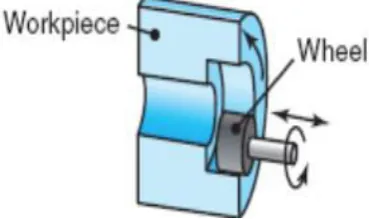
tapered, grooved or profiled. Different internal contours formed within the work piece by means of internal bore
diameter grinding are shown in Figure-1.
[image:3.595.139.466.136.260.2](A) Rotation of grinding wheel (B) Work piece rotation (C) Reciprocation of work table (D) In feed
Figure-1. Internal grinding operations.
RESULTS AND DISCUSSIONS
In this section, we have presented the results elaborately by comparing two different material like EN24 and EN353 in different input and output parameters. Different Parameters: The parameters affecting the internal grinding process are cutting speed, depth of cut, material removal rate, cutting fluid, work piece, surface roughness, Table speed, material hardness, grinding wheel grades, grain size and grinding forces [28]. The Figures 2 and 3 indicates the pictorial representation of general internal grinding was done.
Table speed: Figures 4 and 5 shows the various table speed with respect to surface roughness and material removal rate. When the table speed increases, surface roughness and the material removal rate also increases for both of the materials EN24 and EN 353.Due to the fact that MRR was obtained at higher speed because there are two ways of grinding processes occur at the equal time, one in rotational and another in linear direction.
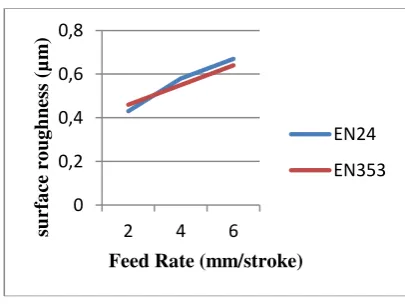
Feed rate: The various feed rate related to MRR and surface roughness were calculated with an experimental investigation and the same was illustrated in Figure-6 and Figure-7 clearly. For two different materials (EN 24 and EN353) the investigation was carried out and found that there is an enhancement of surface roughness and MRR by means of feed rate enhancement [28]. The elevated feed rate progression of grinding tool is more against to the specimen and leads to remove a larger amount of materials on the specimen surface. Resulted the specimen surface roughness was increased since extra cutting forces were produced due to the fast advancement of tool and vibrations occurred during the process and it deteriorates the quality of surface finish improvement. From Figure-6, it was clearly observed that, there was a very poor quality of surface finish during feed rate and surface roughness rate enhancement. The table speed and the depth of cut were clearly identified as constant parameters for the above process. Similarly the Figure-7 identified that there was an enhancement of MRR
occurred during feed rate enhancement for the EN24 and EN353 [29].
[image:3.595.328.513.631.740.2]Depth of cut: During an investigation there has been difference between depth of cut and surface roughness for the selected steel and the same was calculated and the values were given in Figure-8. From the calculated values we came to know that there was an augmentation in depth of cut and in the surface roughness also [29]. Similarly the difference between the constraints of depth of cut and MRR for the same selected materials was evaluated and the calculated values were given in Figure-9. From the calculated values, we concluded that MRR augmentation was occurred during the depth of cut improvement due to the quantity of material eradicated from the material surface through a single stroke of selected tool displacement [29]. More over the enhancement of surface roughness may be in the same order due to the enhancement of dissemination of grinding tool abrasives on the specimen surface. Consequently, if there is a bigger chips exclusion of material takes place during the grinding operation which may causes scratching the surface of work piece. There is a minimum percentage of development in quality of surface roughness during a constant feed rate and table speed was taken [30]. More the depth of cut more will be the MRR and more material removed along with the particular depth of cut.
Figure-3.Plunge grinding.
[image:4.595.95.527.67.640.2]Figure-4. Table speed vs. surface roughness.
Figure-5. Table speed vs. material removal rate.
[image:4.595.307.529.82.616.2]Figure-6. Feed rate vs. surface roughness.
Figure-7. Feed rate vs. material removal rate.
[image:4.595.66.269.602.755.2]Figure-8. Depth of cut vs. surface roughness.
Figure-9. Depth of cut vs. material removal rate.
SUMMARY AND CONCLUSIONS
a) The survey on internal grinding process with different tool materials was thoroughly studied and comparative study on EN24 and EN353 materials and influencing parameters on various factors was also carried out.
b) The major parameters affecting the inner grinding process were identified and the influence of those parameters on dissimilar work pieces and tool materials has been monitored.
0 0,2 0,4 0,6 0,8
2 6 10 14
Su
rf
a
ce
ro
ug
hn
ess
(
µ
m
)
Table Speed (m/min)
EN24
EN353
0,85 0,9 0,95 1 1,05 1,1 1,15 1,2
2 6 10 14
M
RR
Table Speed (m/min)
EN24
EN353
0 0,2 0,4 0,6 0,8
2 4 6
surf
a
ce
ro
ug
hn
ess
(
µ
m
)
Feed Rate (mm/stroke)
EN24
EN353
0,95 1 1,05 1,1 1,15
2 4 6
M
RR
Feed rate (mm/stroke) EN24
EN353
0 0,1 0,2 0,3 0,4 0,5 0,6 0,7
0,1 0,15 0,2
surf
a
ce
ro
ug
hn
ess
(
µ
m
)
Depth of cut (microns) EN24
EN353
0,95 1 1,05 1,1 1,15
0,1 0,15 0,2
M
RR
Depth of cut (microns) EN24
c) The grinding of EN353 provides better MRR when compared to EN24 material and also in the case of feed rate.
d) Surface quality is an essential output of machining which is higher in case of EN24 material when compared to EN353 material.
e) Internal grinding process which provides excellent quality of surface finish to the component and imparts high quality of accuracy of shape and dimension as per the requirements.
f) Also found that the internal grinding is maintaining the tool geometry of cutting tools, flattening and forming of surfaces.
REFERENCES
[1] Jagtap KR, Ubale K. 2011. Optimization of cylindrical grinding process parameters for AISI-5120 steel using taguchi method. International Journal of Design and Manufacturing Technology. 2(1): 47-56.
[2] Himanshu. 2015. Optimization of cylindrical grinding process parameters on C40E steel using Taguchi technique. International Journal of Engineering Research and Applications. 5(1): 100-04.
[3] Patel S. 2014. An experimental investigation on cylindrical grinding process parameters for EN8 using regression analysis. International Journal of Engineering Development and Research. 2(2): 2486-91.
[4] Nallusamy S, Babu M, Prabu M. 2015. Investigation on carbonnanotubes over review on other heat transfer nano fluids. International Journal of Applied Engineering Research. 10(62): 112-17.
[5] Sohal N, Sandhu CS, Panda BK. 2014. Analyzing the effect of grinding parameters on MRR and surface roughness of EN24 and EN353 steel. Mechanica Confab. 3(5): 1-6.
[6] Nallusamy S. Analysis of MRR and TWR on OHNS diesteel with different electrodes using electrical discharge machining. International Journal of Engineering Research in Africa. 2016; 22:112–20.
[7] George LP, Job V, Chandran. 2013. Study on surface roughness and its prediction in cylindrical grinding process based on taguchi method of optimization. International Journal of Scientific and Research Publications. 3(5): 1-5.
[8] Krishna K, Ramakrishna S. 2015. Prediction of material removal rate using artificial neural network in CNC turning process on aluminum. International Journal of Engineering Technology. Management and Applied Sciences. 3(2): 12-26.
[9] Deepak. 2012. Optimization of grinding parameters for minimum surface roundness by tag chi parametric optimization technique. International Journal of Mechanical and Industrial Engineering. International Journal of Management in Education. 1(3): 74-8.
[10]Nallusamy S. 2015. Analysis of welding properties in FSW aluminium 6351 alloy plates added with silicon carbide particles. International Journal of Engineering Research in Africa. 21: 110-17.
[11]Karthikeyan GS, Karthikeyan N. 2014. Prediction and optimization of cylindrical grinding parameters for surface roughness using taguchi method. IOSR Journal of Mechanical and Civil Engineering. 39-46.
[12] Iqbal A, Khan AA. 2010. Modeling and analysis of MRR, EWR and surface roughness in EDM milling through response surface methodology. American Journal of Engineering and Applied Sciences. 3(4): 611-19.
[13]Anand. 2014. Analysis of the influence of EDM parameters on surface quality, MRR, EWR and micro hardness of AISIO2 (1.2842). International Journal of Scientific and Engineering Research. 5(3): 850-57.
[14]Nallusamy S. 2016. A review on the effects of casting quality, microstructure and mechanical properties of castAl-Si-0.3Mg alloy. International Journal of Perform ability Engineering. 12(2): 143-54.
[15]Kumar. 2013. Optimization of process parameters in surface grinding using response surface methodology. International Journal of Research in Mechanical Engineering and Technology. 3(2): 245-52.
[16]Pratyusha J, Ashok kumar U, Laxminarayana. 2013. Optimization of process parameters for milling using taguchi methods. International Journal of Advanced Trends in Computer Science and Engineering. 2(6): 129-35.
[18]Nallusamy S, Ganesan M, Balakannan K, Shankar C. 2015. Environmental sustainability evaluation for an automobile manufacturing industry using multi-grade fuzzy approach. International Journal of Engineering Research in Africa. 19: 123-29.
[19]Kumar S, Kundu S, Chaudhary R. 2014. Optimization of process parameter and experimental investigation of MRR on H-13 die tool steel using EDM with application of taguchi technique. International Journal of Engineering and Management Research. 4(1): 162-67.
[20] Markul J. 2006. Efficiency improvement in internal grinding. Archives of Civil and Mechanical Engineering. 6(2): 77-82.
[21]Nallusamy S, Prabu M, Balakannan, Majumdar G. 2015. Analysis of static stress in an alloy wheel of the passenger car. International Journal of Engineering Research in Africa. 16: 17-25.
[22] Wang L. 2012. Application and development of high efficiency abrasive process. International Journal of Advanced Science and Technology. 47: 51-64.
[23]Nallusamy S. 2016. A proposed model for sustaining quality assurance using TQM practices in small and medium scale industries. International Journal of Engineering Research in Africa. 22: 184-90.
[24]Kinalkar H. 2014. A review on various cooling system employed in grinding. International Journal of Innovative Technology and Exploring Engineering. 4(1): 28-35.
[25]Nallusamy S, Dinagaraj, Balakannan, Satheesh. 2015. Sustainable green lean manufacturing practices in small scale industries-A case study. International Journal of Applied Engineering Research. 10(62): 143-46.
[26]Kumar G. 2013. Green manufacturing in foundry. International Journal of Engineering Research and Technology. 2(1): 1203-07.
[27]Nallusamy S. 2016. Frequency analysis of lean manufacturing system by different critical issues in Indian automotive industries. International Journal of Engineering Research in Africa. 23: 181-87.
[28]Thakor SP. 2014. An experimental investigation on cylindrical grinding process parameters for En 8 using regression analysis. International Journal of
Engineering Development and Research. 2(2): 2486-91.
[29]Raoa CJ, Raob DN, Srihari P. 2013. Influence of cutting parameters on cutting force and surface finish in turning operation. International Conference on Design and Manufacturing, Procedia Engineering. 64: 1405-15.