Link to Leeds Beckett Repository record:
http://eprints.leedsbeckett.ac.uk/5352/
Document Version: Article
c
The Author(s) 2018
The aim of the Leeds Beckett Repository is to provide open access to our research, as required by funder policies and permitted by publishers and copyright law.
The Leeds Beckett repository holds a wide range of publications, each of which has been checked for copyright and the relevant embargo period has been applied by the Research Services team.
We operate on a standard take-down policy. If you are the author or publisher of an output and you would like it removed from the repository, please contact us and we will investigate on a case-by-case basis.
For Peer Review
DESTINATION CLIMATE ADAPTATIONJournal: Journal of Hospitality & Tourism Research Manuscript ID JHTR-17-11-418.R1
Manuscript Type: Research Note (3500 words)
Keywords: Climate change, destination adaptation, climate index for tourism, climate scenarios
Abstract:
For Peer Review
ABSTRACT
Climate is an important element in the tourism products of a destination and a critical part of a
destination’s economic base. Any change in climate attributes will trigger human responses
and may pose a threat to a destination’s competitiveness, sustainability and economic
viability. This research note focuses on destination adaptation to climate change that is
anticipatory rather than reactive and is based upon projecting future climate scenarios for a
destination and then assessing the tourism products that the future climate will support. It
outlines an original approach to adaptation which is generalizable to other destinations. The
research note describes an exploratory research collaboration between tourism and climate
scientists that allows firstly: the modelling of a destination’s projected climate conditions and
secondly, the products and activities that can be supported by these climate scenarios using
climate indices for tourism. The exploratory research was carried out in Croatia.
INTRODUCTION
This Century has seen the tourism sector accept that it is a climate sensitive activity and in
particular begin to acknowledge the sustainability challenge of destination adaptation to
climate change. Climate is an important element in the tourism products of a destination and a
critical part of a destination’s economic base. Any change in climate attributes will trigger
human responses and may pose a threat to a destination’s competitiveness, sustainability and
economic viability. This is because it will influence demand through seasonality, the activities
and products that can be supported and thus destination choices made by tourists. A
destination’s vulnerability therefore depends upon exposure to climate change; the sensitivity
of the tourism system; and the adaptive capacity of the destination to cope with change. As a
result of this realisation, research into climate change adaptation has grown, resulting in a
growing number of methods, tools and processes, designed to integrate and mainstream
climate change into destination strategies and policies (Simpson et al., 2008). Destination
adaptation to climate change involves adjustments in practices, processes or structures to take
account of changing climate conditions in order to moderate potential damages, or to benefit
from the opportunities associated with climate change (McCarthy et al., 2001). Kajan and
Saarinen (2013) have classified this research into approaches to adaptation made by business,
For Peer Review
This research note focuses on destination adaptation to climate change that is anticipatory
rather than reactive and is based upon projecting future climate scenarios for a destination and
then assessing the tourism products that the future climate will support. It illustrates the
pivotal importance of climate information for the formulation of destination adaptation plans
and outlines an original approach to adaptation which is generalizable to other destinations.
The research note describes an exploratory research collaboration between tourism and
climate scientists that allows firstly: the modelling of a destination’s projected climate
conditions and secondly, the products and activities that can be supported by these climate
scenarios using climate indices for tourism (CIT) (de Freitas et al., 2008). The collaboration
will facilitate a toolkit that can be used for destinations to develop their product portfolios in
the future, giving guidance both on where to invest and disinvest as a result of changing
climate resources, and also on potentially shifting patterns of seasonality. The exploratory
research was carried out on the Croatian Island of Lošinj in the Northern Adriatic.
METHOD
The overall aim of the project was to develop and communicate replicable research
methodologies to underpin a toolkit suitable for use in delivering sustainable product planning
for tourism destination climate adaptation plans. The research involved international
collaboration across tourism and climate specialists from the UK and Croatia, climate
scientists from the Meteorological and Hydrological Service of Republic of Croatia, and the
local government of the Croatian Island of Lošinj. The research was overtly mixed method in
approach and comprised of four key stages. The first was a stakeholder consultation on the
Island of Lošinj to gauge the level of awareness of climate change across the tourism sector. It
also elicited stakeholder’s thoughts on the Island’s vulnerability and the tourism sector’s
social response to climate change. Secondly, a climate scenario was developed for Lošinj up
to 2030 using the regional climate model to allow the research team to understand the future
climate of the Island as a key resource for tourism. Thirdly, the team then applied tourism
climate indices to both the present climate and the future climate till 2030 to assess which of
the Island’s products would be viable in the near future and in particular how climate change
may impact upon seasonality. In other words the future climate scenario was transformed into
the Island’s future tourism climate resource base. Finally, a seminar was held in Croatia’s
For Peer Review
1 STAKEHOLDER CONSULTATION
The Island of Lošinj is one of Croatia’s most award-wining sustainable destinations,
worldwide known as a “climatic spa”. The destination is reliant upon a Mediterranean climate
to support health, beach, sports and heritage tourism. Thus, the engagement of destination
stakeholders in the research was seen as an essential research step, recognising the fact that
the implementation of the complex public policy decisions which are demanded by adaptation
will require their support and understanding of the issues (Harman et al, 2016; Michailidou,
2016).
A workshop on climate change adaptation was held for Island stakeholders in October 2015.
The workshop facilitated stakeholder identification of potential climate risks and
vulnerabilities to tourism in Lošinj and sought their commitment to an adaptation plan. Over
60 representatives of the tourism industry, biologists, Government and conservation agencies
attended the workshop which was facilitated by the tourism board director of the town of Mali
Lošinj and the University of Zagreb. All sessions were held in Croatian and yielded rich,
knowledgeable and insightful discussion on the Island’s vulnerability to climate change.
Particular risks identified included air temperature and sunshine hours; quality of air and
aerosols; seawater quality and temperature; fresh water quality; and resilience to extreme
climate events.
2 CLIMATE SCENARIO METHOD
The adaptation challenge for destinations is to demonstrate how a global mean temperature
change may manifest itself at the local scale. Uncertainties arise due to gaps in our knowledge
of interactions between the oceans, biosphere, cryosphere and climate systems, as well as the
unpredictability of future emissions levels (Eriksen et al., 2003). The Intergovernmental Panel
on Climate Change (IPCC) has produced global circulation models (GCMs) to simulate the
geographical and seasonal distribution of global warming. These models can be ‘downscaled’
further to provide information at the destination level.
The research collaboration allowed the Croatian Meteorological and Hydrological Service to
For Peer Review
period between 2011 and 2030. Climate modelling over Croatia was performed using the
Regional Climate Model of the third generation, RegCM3 (Pal et al., 2007). The integration
domain was across almost the whole of Europe centred at 45°N, 8.5°E with 35 kilometre grid
spacing. More about using RegCM3 settings in modelling can be found in Branković et al.
(2012). To take into account the uncertainties mentioned above, the model was forced by two
randomly chosen simulations from the GCM model ECHAM5-MPIOM (Rockner et al.,
2003). Downscaling was performed for the reference climate (P0) of 1961-1990, as well as
for the future period (P1) of 2011-2030. In the P0 climate, concentrations of greenhouse gases
in the GCM were specified at observed values, whilst in the P1 climate the IPCC SRES A2
emission scenario was applied. The applied scenario is the so-called strong scenario and it
represents the upper limit of anthropogenic impact to the atmosphere and climate in the 21st
century. In this study, daily data at 6 and 12 Coordinated Universal Time (UTC) were used.
Near surface temperature, wind at 10 metres, specific humidity and cloudiness were selected
for the model grid cells that coincide with the locations of meteorological stations. The
orography in the model is an approximation of the real one. Therefore to take it into account
the difference between the climate station altitude and the model grid height, the temperature
is corrected by a vertical rate of 0.65°C/100 metres. Since the centre of gravity of the human
body is assumed to be at 1.1 metres, the model wind speed was reduced to this height. Daily
precipitation was also used. The abovementioned meteorological data were used for
calculation of the touristic index for the present as well as for the future period and for both
runs. Mean annual or monthly values in two time spans 2011-2030 and 1961-1990 were
subtracted in order to get climate change.
In analysing the results, it has to be kept in mind that climate models are not perfect. One way
to assess the model uncertainties is to compare model results for the observed period with the
measured data for the same period. Only with this information will the interpretation of
expected future climate conditions be complete. However, when discussing climate change in
terms of the difference between future and present simulated climate conditions, it can be
assumed that model bias is neglected.
3 CLIMATE INDEX FOR TOURISM (CIT)
Climate is a key part of the resource base for destinations, yet the relationship is complex,
For Peer Review
different weather requirements, particularly in relation to human comfort levels. Researchers
have created climate indices specific to tourism activities, allowing the assessment of climate
attractiveness for different types of tourism activity. To achieve this, de Freitas et al., 2008
defined the climate index for tourism (CIT) that integrates the thermal, aesthetic and physical
facets of the atmospheric environment important for tourism. They also estimated the set of
weather thresholds by surveying groups of tourists spending mainly sedentary activities on the
beach (sun, sea and sand (3S) and picnicking). Later Bafaluy et al. (2014), based on
consultation with experts and practitioners, established a set of thermal, aesthetic and physical
thresholds for several other tourist activities including cycling, hiking, golf, nautical sports
(motor boating and sailing), football and cultural tourism.
The CIT comprises three components. Firstly, the thermal component is a measure of the
body-atmosphere energy balance expressed by a biometeorological index that integrates
physiological thermal and environmental variables comprising temperature, relative humidity,
wind speed and radiation. Secondly, the aesthetic component includes the condition of the
sky, whilst thirdly, physical components include wind and rain, which can have an overriding
effect when certain values are exceeded. These thermal, aesthetic and physical states are
combined in a weather typology matrix to produce a rating class for the CIT ranging from
unacceptable conditions, through acceptable, to ideal conditions for each tourism activity (de
Freitas et al., 2008).
The Island’s climate data at 06 UTC (7 a.m. local time) and 12 UTC (1 p.m. local time) in the
climate period 1961-1990 as well as for the future scenario in the 2011-2030 period were run
through the CIT in order to determine the types of tourism activities in the present climate and
those that would be supported by the Island’s climate resources by the end of 2030.
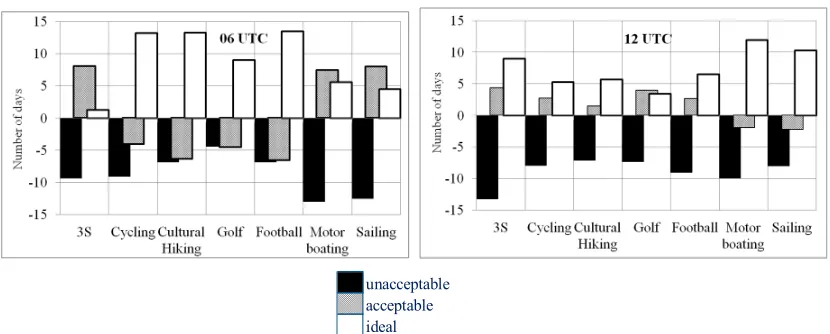
Comparing climate conditions for tourism in the present (1961-1990) and future climate
(2011-2030), there is a decrease of unacceptable conditions and an increase of acceptable and
ideal conditions. Examining annual data, the mornings show an improvement of climate
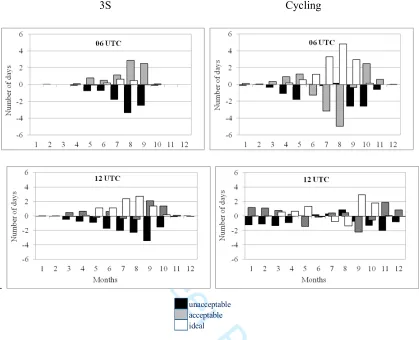
conditions for all activities in the morning (see Figure 1). However, analyzing on a monthly
scale, there are differences between activities. For typical marine activities (3S, motor boating
and sailing) more favourable climate conditions are visible for all months during the warm
period of the year in the morning as well as in the afternoon. On the other hand, for all other
activities (cycling, cultural tourism, hiking, golf and football) in the morning there is an
For Peer Review
conditions for spring and autumn, but a decrease or very small change during the summer (in
Figure 2 activities are shown for 3S and cycling).
Table 1 shows the changes (trends) of ideal and acceptable days for a range of activities by
season in the period 2011-2030. Changes at 06 UTC and 12 UTC (7 a.m. and 1 p.m.) are
calculated in order to judge the possible shift of activities during the day in the future. It is
clear from the table that the activities and products currently offered by the Island will have
even better conditions and possibilities at the end of the analyzed future period. On an annual
scale an increase in acceptable and ideal conditions for most activities in the morning can be
expected (except cycling and golf) and for all activities in the afternoon. However, more
significantly, the seasonality of activities shifts markedly. In the morning the changes are
smallest in winter, while for afternoons the changes are smallest in the autumn and for marine
activities in winter. For both morning and afternoon the conditions for beach tourism are
expected to improve from spring to autumn. The greatest increase in the number of acceptable
and ideal days for sport activities and cultural tourism occurs mainly in the spring season.
These results point to a clear opportunity for the Island to extend its tourism season. However,
whilst extending the season will boost the profitability of the tourism sector and spread the
tourist load away from the highly peaked summer season, utilising the climate information
provided by this study will prove challenging. Successful adaptation will depend upon the
ability of the Island’s many stakeholders to collectively deliver an extended season, a
consideration that was not identified in the workshops. This finding reinforces the imperative
of involving all the Island’s tourism stakeholders throughout the research project.
4 FUTURE APPROACHES
The final stage of the research drew together the research team and representatives of the local
government tourism board of Lošinj to focus on the next stage of the project. The group
agreed on a two-stage approach. Firstly, communicating the toolkit approach to tourism
industry and government stakeholders is critical, but also complex. The group therefore felt
that the effective ‘practitioner-facing’ communication of the toolkit was a priority and so for
the next stage of the research, the team will expand to include television and print media
For Peer Review
in the other major destinations and climate zones of Croatia, particularly coastal zones,
mountains and rural destinations.
CONCLUSION
This research note has shown the utility of international collaboration between physical and
social scientists by importing techniques from climate science to underpin destination
adaptation plans. Not only does this approach provide an incontestable climate information
base upon which to plan adaptation in the future, but it also offers a strong platform from
which to develop an adaptation toolkit applicable to any destination. This approach to climate
adaption for destinations is therefore highly original, albeit based upon existing research
techniques. It represents a considerable advance in the field of climate change adaptation for
tourism which can be applied to destinations, businesses and as an underpinning platform for
adaptation policy.
REFERENCES
Bafaluy, D., Amengual, A., Romeo, R. & Homar, V. (2014). Present and future climate
ressources for various types of tourism in the Bay of Palma, Spain. Regional Environmental
Change, 14, 1995-2006.
Branković, Č, Patarčić, M, Güttler, I, Srnec, L, 2012: Near-future climate change over Europe
with focus on Croatia in an ensamble of regional climate, Climate Research, Vol. 52, 227-251
de Freitas, C.R., Scott, D. & McBoyle, G. (2008). A second generation climate index for
tourism (CIT): specification and verification. International Journal of Biometeorology, 52,
399–407.
De Freitas, C. R (2005) The Climate Tourism Relationship pp 29-43 in Hall, C M and
Higham J (eds) Tourism, Recreation and Climate Change, Channel View Clevedon
Eriksen, S. & Naess, L. O. (2003). Pro-poor climate adaptation: Norwegian development
cooperation and climate change adaptation: An assessment of issues, strategies and potential
For Peer Review
Harman, B.P, Rylance, K., Brown, P.R, Cunningham, R., Jacobs B. and Measham, T. (2016),
Engaging local communities in climate adaptation: a social network perspective from Orange
Valley, New South Wales, Australia, CSIRO, Australia.
Kajan, E and Saarinen, J (2013) Tourism, climate change and adaptation: a review, Current
Issues in Tourism, 16, 2, 167–195.
McCarthy, J.J., Canziani, O.F., Leary, N.A., Dokken, D.J. & White, K.S. (2001). Climate
change 2001: Impacts, adaptation, and vulnerability. Third assessment report,
Intergovernmental Panel on Climate Change (IPCC) Working Group II. Cambridge
University Press: Cambridge.
Michailidou, A. V. Vlachokostas, C., Moussiopoulos, N (2016) Interactions between climate
change and the tourism sector: Multiple-criteria decision analysis to assess mitigation and
adaptation options in tourism areas Tourism Management 55 1-12
Pal, J. & 19 coauthors (2007). Regional climate modeling for the developing world. The ICTP
RegCM3 and RegCNET. Bulletin of the American Meteorological Society, 88, 1395-1409.
Roeckner, E., Bäuml, G., Bonaventura, L., Brokopf, R., Esch, M., Giorgetta, M., Hagemann
S., Kirchner, I., Kornblueh, L., Manzini, E., Rhodin, A., Schlese, U., Schulzweida, U.,
Tompkins, A. (2003). The atmospheric general circulation model ECHAM5. Part I: model
description. Hamburg: Max-Planck Institute for Meteorology Report 349.
Simpson, M. C., Gossling, S., Scott, D., Hall, C. M. & Gladin, E. (2008). Climate change
adaptation and mitigation in the tourism sector: Frameworks, tools and practices. Paris:
For Peer Review
Table 1
Change in the Number of Ideal and Acceptable Days by Activity in the Period 2011-2030
at 06 UTC (grey) and 12 UTC (white)
Activity Year Winter Spring Summer Autumn
Beach 8.4 8.0 0.0 0.2 1.8 3.2 5.4 4.2 1.4 0.4
Cycling -1.6 15.0 0.0 2.8 3.6 8.4 0.0 1.2 -5.2 -2.0
Sightseeing 13.0 12.6 0.8 4.2 10.2 7.2 1.4 -1.2 0.8 0.0
Golf -1.8 9.4 0.0 2.2 3.2 6.2 -1.6 2.2 -3.6 -1.0
Football 10.2 10.2 1.2 5.6 9.0 4.0 -0.2 0.8 0.4 -0.6
Motor boating 10.2 7.8 0.0 0.6 3.8 9.2 5.4 2.0 1.0 -4.2
For Peer Review
Fig. 1. Annual differences between the number of days with unacceptable, acceptable and
ideal climate conditions for various tourism activities between future (2011-2030) and present
climate (1961-1990).
For Peer Review
3S Cycling
[image:13.612.93.512.68.408.2].
Figure 2. Differences between the number of days with unacceptable, acceptable and ideal
climate conditions by months for 3S and cycling between future (2011-2030) and present
climate (1961-1990).