"Industrial Demography"
Sormas Asterios
Department of Business Administration, Technological Educational Institute of Western Macedonia, Greece
Copyright©2016 by authors, all rights reserved. Authors agree that this article remains permanently open access under the terms of the Creative Commons Attribution License 4.0 International License
Abstract
Market turnover includes two interrelating procedures, playing a very important role in the industrial organization: firm entry and exit of the market. The question what favors and what prohibits a firm to enter the market place and the relationship between its entry and exit, are in the scope of industrial dynamics. An approach of firms’ entries and exits in an industrial market, can be seen under the prism of the life cycle of a product. The innovations and the technical changes are very important factors, driving a firm to make the decision either to enter or exit the market .In this paper we will examine the theories involving the market entries and exits of the firms. Also, we will analyze the nature and the components of the entry and exit barriers. The market looks like a football pitch surrounded by complex and different size gates. Firms intending to enter or exit the market have to leap over these gates. In a way, the gates can act as a barrier, increasing or decreasing in height, not for the firms in on the pitch, but for those outside intending to enter. According to the theory, the factor influencing the entry is the market structure, while the exit is influenced by the industrial development. Firms’ entries and exits are characterized by asymmetry and interrelation, creating in a way the revolving door phenomenon, where someone enters and somebody else exits, because every entry includes an exit in a future moment. The existence of barriers is leading firms to develop entry or exit strategies. There are models based on game theory, on the technological situation in the market and on the fact the firm has one or more plants.Keywords
Firm Objectives, Business Objectives of the Firm, Industrial Policy, Sectoral Planning Methods1. Introduction
Market turnover includes two interrelating procedures, playing a very important role in the industrial organization: firm entry and exit of the market.
The question what favors and what prohibits a firm to enter the market place and the relationship between its entry and exit, are in the scope of industrial dynamics.
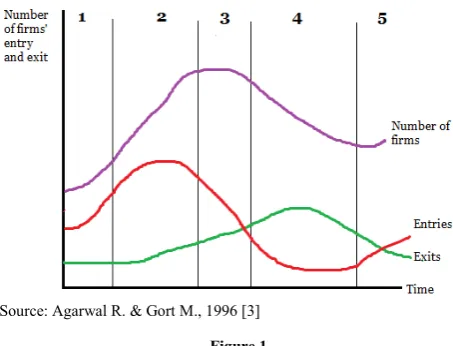
An approach of firms’ entries and exits in an industrial market, can be seen under the prism of the life cycle of a
product. The innovations and the technical changes are very important factors, driving a firm to make the decision either to enter or exit the market.
The actions could be undertaken are:
Introduction of a new technology
Imitation of an established firm and
Remove an obsolete technology
Firms can be compared to the new products entering the market. When an innovative businessman enters the market, he does not know which is going to be the final product design that will conquer the market. The production and sales uncertainty influences the characteristics and the optimal structure of the firm in the early stages. There are many emerging problems, like information, skill intensity, production characteristics and nature of the market.
Source: Agarwal R. & Gort M., 1996 [3]
Figure 1.
There are many empirical studies about industrial demography contributing to better understanding the determinants of entries and exits in the market. Considered, over the times, the entries and exits appeared to be very unstable and interrelating (Cables & Schwalbach, 1991[13]; Geroski, 1991[23]). Entries are influencing exits since they increase the competition pressure in the market setting aside the least effective firms. Companies which decide to leave the market leave behind them niches of unsatisfied consumers that encourage newcomers. A determining factor in market entry is its structure and exit, which is the development of the industry (Shapiro – Khemani, 1987) [46].
Here rises the question, if there is interdependence and symmetry in entries and exits in a given part of the market.
The answer is that on one hand the entry of newcomers may be the cause to leave established firms. This is called displacement or it is the revolving door effect. On the other hand, the gap left those fled, releases useful resources and improves the chances of those entering. The interdependence hypothesis, if the exits affect the entries, is more controversial than the case of symmetry which seems to be generally accepted. Actually, the decision of a firm to enter the market always includes an exit at some time in the future (Harrigan) [28] [29] [30], but the disappearance of a firm does not necessarily mean the appearance of another.
Empirical studies confirm these doubts. For example, Fotopoulos and Spencer raise doubts about the nature and extent of the relationship between the entries and exits. They conclude that most changes in the identity of active firms occur in the short term and in the perimeter of larger companies. In a similar study for the British manufacturing industry (Love, 1996) [39] is concluded that the interaction between the entry and exit is derived from the revolving door effect. Finally, Arauzo, Martin and Segara [5], in a study for the Spanish manufacturing industry, consider that the only entry barrier is the average capital demand, while the exit barriers are the firm size and the research and development expenditures. Yet, exits have little dependence on the ex ante profits and are more sensitive in the economic cycle of the region.
Geroski (1991) [23] approaches the exit pattern effectively, putting series of standard events and series of standard results, about what drives the entry of a business in an industry. But on the other hand, what forces drive the firm to the exit is a fact that is complicated and obscured. Studies about the exit pattern have specific characteristics that make them distinguished. Some restrict themselves to consider that the reduction in capacity of the business is only a means to the firm to return to profitability and others that the profitability supervenes with their differentiation. For example, a cast metal industry, differentiates its production by cutlery making (Baden-Fuller, 1989) [9].
2. Entry and Exit Barriers
The idea that there are barriers making the entry of firms in the market difficult and barriers prohibiting them to exit, allows the analogy of the market as a stadium surrounded by gates of different sizes and complexity. The gates will remain to be overcome by firms wishing to enter or exit. Somehow the gate can be raised or lowered, certainly not for those who are on the pitch but for those who are outside and want to enter. Classical barriers include patents, licenses, agreements and exclusive access to natural resources. For example, a drug patent provides its holder exclusive rights for a specific period (usually a maximum of seven years) to produce and sell the drug in a particular market. The economies of scale obtained by growth and establishment in a market segment, can act as a barrier to entry. If newcomers project that they will sell huge quantities even before being competitive to the existing businesses, the economies of scale can react on the deterrence of their ambitions. Let us try to remember when, was the last time someone tried to enter the automotive industry.
Entry barriers may be elevated, even by governments. The regulations surrounding the banking sector are designed to act as barriers against rogues and villains. But inevitably discourage some honest businesses to enter.
Established market businesses may be tempted to raise barriers when appears someone who wants to enter in the sector. They do this, for example, lowering prices, making in this way the products of rivals less competitive. Moreover, the reduction in prices can be an easy selection of established businesses, since their prices may be higher than the level of the free market due to the barriers.
Monopolies exist where there are irresistibly entry barriers. If there were not, other firms would enter such markets to participate in the profits of the monopolies.
The exit barriers make it more difficult for a company to come out of an industry than would otherwise be the case. They include issues such as staff redundancy costs, and contractual obligations such as rent payments.
[image:2.595.57.284.78.251.2]in this market and that they will not abandon it.
With the growth of electronic commerce, classic entry barriers do not apply. By using the internet, businesses can sometimes overcome obstacles that were previously insurmountable. For instance, economies of scale are not applicable in this way.
In 1980’s and 1990’s governments oriented in free market, had passed regulations to lower the entry barriers into industry sectors such as aviation and brokerage services. But these regulations have had limited success. Nevertheless, in recent years a number of low cost carriers developed, managing, to some extent, to overcome the barriers using regional airports and selling tickets online.
Bain (1956) [10] attempted to define or measure the level of entry barriers as “a barrier to entry is an advantage of established sellers in an industry over potential entrant sellers, which is reflected in the extent to which established sellers can persistently raise their prices above competitive levels without attracting new firms to enter the industry”. In contrast, Stigler (1968) wrote that " a barrier to entry is a cost of producing (at some or every rate of output) that must be borne by firms seeking to enter an industry but is not borne by firms already in the industry”, while J. Ferguson, 1979 states that “a barrier to entry is a factor that makes entry unprofitable while permitting established firms to set prices above marginal cost, and to persistently earn monopoly return”, also, F. Fisher, 1979, defines entry barriers as “anything that prevents entry when entry is socially beneficial” and D. Carlton & J. Perloff, 1994 as “a barrier to entry is anything that prevents an entrepreneur from instantaneously creating a new firm in a market. A long-run barrier to entry is a cost necessarily incurred by a new entrant that incumbents do not (or have not had to) bear”.
The exit barriers from a declining industry can be divided into two categories. In the first are the exit barriers related to industrial structure - economic exit barriers - and in the second are exit barriers relating to business strategies. Because the environments in declining industries differ, many different strategies might be appropriate to deal with a declining demand. A company in a declining industry should take into account all the characteristics of demand and consumers, the exit barriers, the characteristics of products and competitors and the behavior of suppliers. Strategic alternatives include, the early exit, the selective downsizing, the retention of position and increased investment. Some of them, if they are to succeed, should be adopted early.
In a declining industry, a company should be well aware whether the general environment offers even a slim chance of survival by taking an advantageous position, as well as exiting the market, if the prospects of the industry are not favorable. An industry is favorable if somehow the demand is not sensitive to price, also, if the required productive replacement units are known for a foreseeable future and if there were loyal consumer unions ready to make sacrifices. The industry would be less favorable, if demand would be very sensitive to prices and at the same time there was a history of price volatility. Also, if the demand for a declining
product suddenly falls sharply, it would create heavy losses to companies, which would be forced to exit the market. Even if there were substantive requirements to reinvest (for example, anti-pollution mechanisms) and if there is great uncertainty about the duration of demand, which will push some companies to invest, the effect of exit barriers will deteriorate.
Competition in a declining industry would likely be unstable and business exit process would likely be made with an order, if it was relatively certain which demand niches will declined first, how quickly declining demand would prevail in various parts of the market and if the demand was likely to be renewed. But if there is substantial uncertainty about the renewal of demand and when and who should exit the market, then what would follow would be chaos. If the duration of demand is uncertain, then firms may increase or maintain their asset levels. This, according to Porter (1976) [45], would create exit barriers that would make the output difficult if suddenly reduced demand. The owners of assets which are not fully employed and are costly even if withdrawn, may push other companies to make price cuts and to increase their promotional activities, reflating in this way competition in the industrial sector. If competitors believe that they should remain in the industry and expect to revive demand, without being sure of when this will happen, it is likely they will continue to do so operating the plants in low productivity for many years, instead of selling them or allowing being idle.
Industrial organization theory is concerned with the maximization of long-term efficiency and weighing tradeoffs. Generally, efficiency is the ratio of output to the input and over the long-time horizon is the impact of numerator (the returns) on the investment (denominator).
The entry in a market as a long-term strategic decision has to emphasize in choosing the option offering the highest returns on investment in a feasible set. It is critical for an entrant, especially in a foreign market, the degree of control offered by each entry mode. Control is the ability to influence systems and as the most important determinant of both risk and return, has impact on the future of the company. Without control, a firm finds it more difficult to coordinate actions and carry out or revise strategies, when two parties to a contract pursuit their own interests (Davidson W. H. 1982) [16]. High control modes increase return and risk, while, low control modes minimize risk (resource commitment) but often at the expense of returns.
All this tradeoff between high and low control can be described by a classification of modes of entry:
In high-control modes, a firm expresses dominant equity interests as a wholly-owned subsidiary or as a dominant shareholder.
relationship can “lend a special feeling of partnership to the two parties” adding “the risk of deadlock itself acts as a powerful incentive to the partners, encouraging them to find solutions to disagreements by discussion and compromise (W. G. Friedman and Jean-Pierre Beguin, 1971) [21]. Franchising, is a typical agreement offering medium control since there are incentives to adhere to system’s rules, allowing at the same time high degree of monitoring of the franchisee’s activities. Also, the contracts which are exclusive but nonrestrictive or nonexclusive but restrictive, give the entrant a moderate control.
In low-control modes the entrant has diffused interests in the form of minority equity positions or nonexclusive/nonrestrictive contracts.
This classification from governance structure to control, looks like a progression from more integrated to less integrated. This progression is the transference of authority from a contract to the entities. Control and integration are related, since integration gives to a firm legitimate authority to operate. At this point of discussion economics, law and organization are involved and consequently the notion of transaction cost cannot be ignored.
A transaction occurs when one stage activity terminates and another begins. When interface is well working, like a pair of well lubricated mechanical parts, the transfer goes smoothly. Between two parties the existence of cooperation and harmony is important, or there are misunderstandings and conflicts leading to malfunctions, delays and breakdowns.
The efficiency of an entry mode depends on dimensions that determine the optimal degree of control, following a transaction cost analysis:
1. The condition of asset specificity: is a notion related to the sunk costs of a firm and they can be: (a) the site specificity, (b) physical asset specificity, (c) human assets, (d) dedicated assets and (e) brand name capital. 2. The uncertainty that can be:
a) External: the unpredictability of the entrant’s external environment and
b) Internal: the entrant’s inability to determine its agents’ performance by observing output measures.
In a nutshell, transaction costs for a firm are the communication charges, the legal fees, the contracting and coordinating costs and the search costs. Transaction costs are mainly entry barriers for a firm and not exit causes.
3. Market Selection Process
The most famous event in industrial demography is the asymmetric distribution of sizes of firms, which almost follows the Pareto distribution. There are two remarkable phenomena:
First: the asymmetry of the stable coexistence of firms of different sizes and
Second: the relative stability of the distribution.
There are three the fundamental mechanisms governing changes in business sizes:
Fluctuations in market shares.
Changes in the market size in which businesses operate and
Mergers, acquisitions, vertical integration and horizontal diversification.
The results of the influence of these mechanisms have not yet been studied in depth, but what has been explored is the statistical properties of business development under the Gibrat’s law, or the "law of the proportional effect", which simply states that growth rates are random variables and independent of the firm size. In one of the first studies on the distribution of company sizes, Gibrat (1931) observed that the size of the companies follow very closely the logarithmic normal distribution and concluded that business growth should be a random process. His reasoning was that, the development should not depend on the initial size of the firm, as a process that inevitably produced a log normal distribution.
Indicating firm size at time t as St and proportional development between t and t-1, as εt will be:
1
1 0 2
1
( t t ) (1 ) (1 )(1 )....(1 )
t t t t t t
t
S S S S S
S − ε − ε ε ε ε
−
− = ⇒ = + ⇒ + + +
Taking the logarithms and using the approach that log (1 +εt) ≈ εt leads to
0 1 2
log
S
t=
log
S
+ + + +
ε ε
...
ε
tAs the time approaches infinity, t → ∞, the logarithm of the initial size of the firm, logS0 is becoming insignificant compared to logSt and if ε1 is originated from a normal distribution with a mean μ and variance σ2, then logS
t can be approximated by a normal distribution with a mean μt and variance σt2.
The result that the variation of the distribution of firms’ sizes will certainly grow over time only by chance, is probably responsible for the popularity of Gibrat’s Law in Industrial Organization, provided that it is a good explanation for the observed empirical regularities that industrial concentration increase as the time passes on. However, studies in the 80’s and 90’s have shown that the growth rates of companies and their variations tend to decrease in relation to their size and age.
sectors or countries and decide to diversify. In this case, the entry occurs by acquiring an existing firm. The role of this type of entry is limited in terms of number of companies, but very important in terms of share of industrial production and employment. It should be noted here, that little is known about the degree of churning in the core of the industry, among the large established companies. There are, however, studies supporting the existence of relative stability in the hierarchy of large companies, showing only small decreases in their turnover. However, mortality is very high, so that the net entry rates are much lower than those of general entries and significant turbulence is characterizing the industrial progress. Generally, the probability of survival appears to increase with age and size.
An interpretation of this is that turbulence is typical primarily of the margin of each industry. This seems to be confirmed by the observation that replacement of old by new firms happens in much greater among small start-ups that are very similar to each other. Large and well established firms in the core of industry are rather protected from selective pressures.
In any case, there is not yet a strong theory explaining the birth of new firms. A series of questions are waiting for answers:
Why newcomers continue to enter despite their low probability of survival?
Why there are so many entries even in capital-intensive sectors?
Is motivation the current profitability?
Whatever are the dynamics can be observed within an industry, one that eventually can see is a business group showing persistent differences. These differences, asymmetries according Dosi, 1984 [17], are related to significant differences in production and costs. What is particularly interesting is the persistence of these asymmetries, for example, there are companies that enjoy high (low) earnings and are expected to earn high (low) earnings also in future. One could notice that profits do not seem to converge on a common performance indicator. The existence of diversities raises questions:
Where do they originate?
What are their consequences on the industrial dynamics?
Why don’t competing reactions vanish?
So far the properties of industrial structures and the dynamics are derived from aggregated industry data. But the place of innovation, competition, entries, is located at more detailed levels. For instance, if we do not look in the pharmaceutical industry, but the field of antibiotics, within the micro-domains we can distinguish standard "ways" of development together with the lifecycle of the product group or industry. The "ways" where studied by Klepper (1996) [37] and are as follows: There is an initial period of relatively steady growth in the number of producers, which is followed by a period of sharp decline. The time at which the number of
entrants reaches the maximum number of producers, does not follow a common way for all products. There are instances where the number of new entrants exceeds the maximum and others where is very close to. The number of the most important innovations in the products tends to reach its peak during the period of growth in the number of producers and then falls as the time passes on. Over time, company’s market share changing rate is slowing down.
4. Industrial Dynamics
All these empirical findings are a challenge in themselves, asking for a theory that will be cohesive, but also create a new set of questions. These questions could be:
i. Forces that drive business to develop:
Are they multiple, small and seasonal? Or conversely, one can find deeper and more persistent factors? What is the role of organizational and technological innovation? And what are the degrees of freedom of enterprise in their choice of entry, exit or expansion?
ii. Heterogeneity and lack of variation in some aggregate statistics:
For example, how one can reconcile the observations of persistent asymmetries among enterprises with those relatively stable overall Pareto type distributions? How can one reconcile the tension of the "path" of the life cycle at the level of industry sector with the most stable structures of levels greater generalization of the whole, i.e., industry?
iii. Industrial structure sectors variety and the process of change.
What explains the differences? Are there any variables that follow different development paths? And what is the significance of technological factors of competition mechanisms and demand conditions?
These questions can be approached from several sides and with the following models:
4.1. The Neutral Balance Model
A theory that can interpret some aggregated stabilities - in the sense of lack of variation - in industrial structures, is Gibrat’s law.
biased factors which will not affect the growth opportunities. Finally, all possible conditions between organizations and the market seem to be in neutral equilibrium. All potential distributions of industrial structures, starting from the monopoly and ending to perfect competition, are expected to show the same efficiency properties.
This interpretation presents three main difficulties.
First, there are doubts about a general assumption of "neutrality" (i.e., all forms of industrial structures to be identical in terms of effectiveness). Imagine that the production efficiency of a Boeing can be done under the same conditions, in an industrial area of Greece by thousands of family businesses. Microeconomics state that in any industrial activity there are some "typical ways of" organizing production. It may be more than one, but not too many. That is, there may be some combinations between the organization and the markets to be "neutral" in terms of effectiveness, but the set is small and probably no dense.
Second, in a relatively detailed level, no one often finds, either the structure or a Gibrat type development, while, it can be observed at the aggregate level.
Third, it is concluded from the theory of production that businesses should be almost identical - sorted upwards or downwards it only affects the size - but, on the other hand, it seems difficult to reconcile this hypothesis with the existence of persistence on asymmetries among firms in terms of performance - and most importantly - the possibilities to innovate.
4.2. “Optimal Control” Balance Model
Herbert A. Simon (1916 - 2001), proposed a series of stochastic models that aimed to find applications in a wide range of empirical distributions follow the exponential distribution. That is, modeling the dynamics of a data system with the relevant counters. For example, the words and their occurrence frequency in a text. In the model, the system dynamics is based on steady growth through the addition of new data as well as the increase in cash at a ratio proportional to the current price. On Simon models, the company sizes distributions, accompanied with the procedure of Gibrat’s development, one no need to ask whether the observed structure is optimal. Indeed, indirect and stable continuous output of the theory of neutral balance, implies that the observed structures are some historical statistical results with unknown properties of their distribution. R.E. Lucas Jr (On the size distribution of business firms, 1978), begins with an optimal distribution of problems, given a standard production function of two inputs, in which another factor is added (the administrative talent), with uneven distribution throughout the workforce. All the above, with auxiliary hypotheses of administrative technology and distributions of such talents, gives the optimal size of companies distribution and Gibrat’s law as an empirically controllable restriction for production operation.
4.3. Special Evolutionary Equilibria
In literature, it has been proposed that dynamic models that try to explain the observed patterns of industrial dynamics as a result of the learning process and selection.
Jovanovics, (1982) [32] tries to explain the regularities observed in the size distribution along with the patterns of entries and exits as the result of a stochastic process of convergence, to the optimal techniques on the basis of missing information. New firms continually enter the industry with reasonable technical expectations, but uncertain about their own productive efficiency. During their production procedure, they obtain information about their productivity. Those firms that discover that their effectiveness exceeds their expectations expand the scale of production, while those taking adverse signals react or even exit of the industry. Therefore, the industry evolution is driven by the option which promotes the growth of efficient business and reduces inefficient one. Pakes and Ericson (1987), extended this model by considering that companies can influence their productivity by investing in learning activities (e.g. research and development), the outcome of which is, however, random. Lampson, 1991 examines industrial development and explains some facts mentioned above resulted in changing of external market conditions.
All these models are called "special evolutionary equillibria" because while incorporating some evolutionary conception of imperfect knowledge and selection of the market between heterogeneous agents, they maintain consistency regarding the fundamentals concerning the best practice technologies. As a consequence it is difficult for models mentioned above to accommodate innovative processes, particularly if they are idiosyncratic and are reported at the firm level. Furthermore, it is hard to accept that evolutionary pressures are so strong that each observation (e.g., size distributions, entries, exits, etc.) is in itself almost in equilibrium. Finally, the way the dynamic option operates, Jovanovics (1992), is based largely in challenging assumptions about rationality and predictability of individual factors. Maybe, it is worthwhile to explore the properties of evolutionary models which are not limited to specific equillibria and are taking into account the heterogeneous processes of innovation.
REFERENCES
[1] A. E. Andersson, B. Johansson, “Industrial dynamics, product cycles and employment structure” IIASA 1984.
[2] Acs Z. J. and Audretsch, D. B. (1989) ‘Small-firm entry in US manufacturing’, Economica, 56, 255-265.
[3] Agarwal R (1997), Survival of firms over the product life cycle. South Econ J 3:571–584
[5] Arauzo J. M., Manjon M., Martin M., Segarra A. Entry and Exit in Spain: Tests of the independence, symmetry and simultaneity hypothesis ‘Department of Economics, URV. [6] Audretsch, D. B. and T. Mahmood, 1994a, ‘The Rate of
Hazard Confronting New Firms and Plants in U.S. Manufacturing’, Review of Industrial Organization 9(1), 41– 56.
[7] Audretsch, D. B. and T. Mahmood, 1994b, ‘Firm Selection and Industry Evolution: The Post-entry Performance of New Firms’, Journal of Evolutionary Economics 4(3), 243–260. [8] Austin, J. S. and Rosenbaum, D. I. (1991) ‘The determinants
of entry and exit rates into U.S. manufacturing industries’, Review of Industrial Organization, 5,2 1 l-22 1.
[9] Baden-Fuller C. W. F. (1989), Exit from declining industries and the case of steel castings’ The Economic Journal, 949 – 961.
[10]Bain, J. S., 1956, Barriers to New Competition, Cambridge, MA: Harvard University Press.
[11]Baldwin, J. R., 1995, The Dynamics of Industrial Competition: A North American Perspective, Cambridge University Press. [12]Bernard A. B., Jensen J. B. (2000) who dies? International
trade, market structure and plant closures.
[13]Cable J., Schwalbach J., International comparisons of entry and exit.
[14]Caves, R. E. and M. Porter, 1976, ‘Barriers to Exit’, in R.Masson and D. Qualls (eds.), Essays on Industrial Organization in Honor of Joe S. Bain, Cambridge, MA: Ballinger, pp. 39–69.
[15]Caves, R. E. and M. Porter, 1977, ‘From Entry Barriers to Mobility Barriers: Conjectural Decisions and Contrived Deterrence to New Competition’, Quarterly Journal of Economics 97(1), 241–261.
[16]Davidson W.H. (1982), Global Strategic Management, New York: John Wiley and Sons
[17]Dosi G. (1984), Institutions and Markets in a Dynamic World. [18]Dunne, T., M. J. Roberts and L. Samuelson, 1988, ‘Patterns of Firm Entry and Exit in U.S. Manufacturing Industries’, Rand Journal of Economics 19(4), 495–515.
[19]Evans, L. B. and J. J. Siegfried, 1993, ‘Entry and Exit in United States Manufacturing Industries from 1977 to 1982’, in D. B. Audretsch and J. J. Siegfried (eds.), Empirical Studies in Industrial Organization, Dordrecht: Kluwer Academic, pp. 253–273.
[20]Flynn, J. E., 1991, ‘The Determinants of Exit in an Open Economy’, Small Business Economics 3(3), 225–232. [21]Friedman V. G. and Jean-Pierre Beguin (1971), Join
International Business Venture in Developing Countries, New York: Columbia University Press.
[22]Geroski, P. A. and R. T. Masson (eds.), 1987, ‘Entry, Exit and Market Dynamics’, International Journal of Industrial Organization 5(1) (A Special Issue).
[23]Geroski, P. A., 1991, Market Dynamics and Entry, London: Blackwell.
[24]Geroski, P., R. J. Gilbert and A. Jacquemin, 1990, Barriers to Entry and Strategic Competition, Chur, Switzerland: Harwood.
[25]Ghemawat P., Nalebuff B. Exit ‘Rand Journal of Economics, 1985.
[26]Gilbert, R. J., 1989, ‘Mobility Barriers and the Value of Incumbency’, in R. Schmalensee and R. D. Willig (eds.), Handbook of Industrial Organization, Vol. 1, and Amsterdam: North-Holland, pp. 475–535.
[27]Greenaway D., Gullstrand J., Kneller R. (2009), ‘Live or Let Die? Alternative Routes to Industry Exit.
[28]Harrigan K. R. ‘ Strategy formulation in declining industries ‘ Academy of Management Review 1980, Vol. 5, No 4, 599-604.
[29]Harrigan, K. R., Barriers to entry and competitive strategies. [30]Harrigan, K. R., Entry barriers in mature manufacturing
industries.
[31]Harrigan, K. R., Strategies for declining businesses
[32]Javanovic B. (1982), Selection and the evolution of industry. Econometrica 50:649–670.
[33]Jelili R., Goaied M. ‘Entry, Exit and Productivity in Tunisian Manufacturing Industries.
[34]Karakaya, F. and M. J. Stahl, 1991, Entry Barriers and Market Entry Decisions: A Guide for Marketing Executives, New York: Quorum Books.
[35]Karlsson C. and Nystrom K. ‘Exit and Entry Over the Product Life Cycle: Evidence from Swedish Manufacturing Industry. [36]Kleijweg A., Lever M (1996), Entry and Exit in Dutch
Manufacturing Industries.
[37]Klepper S. (1996), Entry, Exit, Growth and Innovation over the Product Life Cycle.
[38]Lieberman, M. B., 1990, ‘Exit from Declining Industries: “Shakeout” or “stakeout”’, Rand Journal of Economics 21(4), 538–554.
[39]Love J. H. “The Determinants of Variations in Exit Rates” Empirica 23 (1996).
[40]Lucas, R. E. Jr, On the size distribution of business firms. The Bell Journal of Economics, 1978 - JSTOR
[41]Mata, J. and D. B. Audretsch (eds.), 1995, ‘The Post-Entry Performance of Firms’, International Jounal of Industrial Organization 13(4) (Special Issue).
[42]Noriyuki Doi, The Determinants of Firm Exit in Japanese Manufacturing Industries.
[43]Nystrom K. (2007), Patterns and determinants of entry and exit in industrial sectors in Sweden’.
[44]Pamukcu T., Sekkat K., Taymaz E., Entry, Exit and Productivity in Turkish Manufacturing Industries.
[46]Shapiro, D. and P. S. Khemani, 1987, ‘The Determinants of Entry and Exit Reconsidered’, in Geroski and Masson (eds.), pp. 15–26.