A MODEL FOR FEDERATED DATA GRID SYSTEMS BASED ON NETWORK CORE AREA
ZARINA BT MOHAMAD
A thesis submitted in
fulfillment of the requirement for the award of the Doctor of Philosophy
Faculty of Computer Science and Information Technology University Tun Hussein Onn Malaysia
ABSTRACT
ABSTRAK
CONTENTS
TITLE i
DECLARATION ii
DEDICATION iii
ACKNOWLEDGEMENT iv
ABSTRACT v
ABSTRAK vi
CONTENTS viii
LIST OF TABLES xii
LIST OF FIGURES xiii
LIST OF SYMBOLS AND ABBREVIATIONS xvi
LIST OF APPENDICES xviii
CHAPTER 1 INTRODUCTION 1
1.1 Background study 1
1.2 Problem statement 6
1.4 Scope of thesis 7
1.5 Importance of study 8
1.6 Thesis organization 8
CHAPTER 2 LITERATURE REVIEW 10
2.1 Introduction 10
2.2 Data grid 13
2.3 Data grid architecture 13
2.4 Data grid model 15
2.5 Data replication 19
2.6 Job Scheduling for data replication 21
2.7 Data grid research 24
2.7.1 Dynamic data replication and scheduling strategy in hierarchical data grid system
24
2.7.2 Dynamic data replication and scheduling strategy in peer-to-peer and federation topology.
32
2.8 Grid Simulator 39
2.8.1 OptorSim architecture and design 40
2.8.2 Replication strategy and job scheduling algorithm in OptorSim Simulator
42
2.9 Access time 43
CHAPTER 3 METHODOLOGY 46
3.1 Introduction 46
3.2 Sub-Grid-Federation 47
3.3 Terms and definitions of Sub-Grid-Federation 50
3.4 Expected access latency of Sub-Grid-Federation replication strategy
52
3.5 Matching job scheduling for Sub-Grid-Federation Replication Strategy
58
3.6 Summary 61
CHAPTER 4 PERFORMANCE ANALYSIS AND RESULTS 62
4.1 Introduction 62
4.2 Analytical Analysis for Sub-Grid-Federation Replication Strategy
63
4.2.1 System parameters 63
4.2.2 Cumulative hit ratio 64
4.2.3 Access latency 67
4.3 The implementation of Sub-Grid-Federation 68
4.3.1 The grid configuration file 69
4.3.2 The job configuration file 71
4.3.3 The parameter file 72
4.3.4 The implementation of Sub-Grid-Federation Scheduling
4.3.5 System Testing 75
4.3.6 Experiments of Sub-Grid-Federation 76
4.4 Results and discussion 83
4.4.1 Total access time 84
4.4.2 The number of inter-communication 85
4.4.3 Inter-communication bandwidth 86
4.4.4 Comparisons analysis between ODRS and SGFRS
87
4.5 Summary 88
CHAPTER 5 CONCLUSIONS AND FUTURE WORK 89
5.1 Introduction 89
5.2 Contributions 90
5.3 Future work 91
REFERENCES 94
APPENDIX 102
LIST OF TABLES
2.1 Data grid research in hierarchical model 30
2.2 Data grid researches in p2p and federation model 32
3.1 The sites belong in cluster ci 50
3.2 The clusters belong in sub-grid gt 51
4.1 Comparison on replication strategy 63
4.2 System Parameters 64
4.3 Simulation parameters for grid 71
LIST OF FIGURES
1.1 A hierarchical cluster grid architecture 3
1.2 Federation resource sharing system 5
2.1 A high-level view of a data grid 12
2.2 A layered architecture 14
2.3 Centralised or monadic model 16
2.4 Hierarchical model 17
2.5 Federation model 18
2.6 Hybrid model 18
2.7 A replica management architecture 20
2.8 An instance of Optimized Downloading Replication Strategy (ODRS)
39
2.9 Grid architecture used in OptorSim, which is based on European Data Grid (EDG) (2012) data management components.
41
3.1 An instance of grouping in Sub-Grid-Federation 49
3.2 Data access for Sub-Grid-Federation 56
3.3 An algorithm to matching job scheduling for Sub-Grid-Federation Replication Strategy
59
4.1 Cumulative local hit ratio 65
4.2 Cumulative intra cluster hit ratio 65
4.3 Cumulative intra region and inter region hit ratio 67
4.4 Analysis of access latency in SGFRS and ODRS 68
4.5 Topology of the simulated platform 70
4.6 UML diagram of interactions between Users, Sub-Grid-Federation, Resource Broker and Computer Element when simulating job scheduling for Sub-Grid-Federation.
74
4.7 The OptorSim result for system testing 75
4.8 SGFS for case there is a replica of file fj in nk, 77
4.9 ODRS for case there is a replica of file fj in nk, 77
4.10 In SGFS when there is no replica of file fj in nk, but may be available at other sites of cluster o[k/m] .
79
4.11 In ODRS when there is no replica of file fj in nk, but may be available at other sites of cluster o[k/m] .
79
4.12 SGFS for case means there is no replica of file fj in local cluster o[k/m] but file fj can be found in other clusters o-kj of the same sub grid g[l/s] .
81
4.13 ODRS for case means there is no replica of file fj in local cluster o[k/m] but file fj can be found in other clusters o-kj of the same sub grid g[l/s] .
81
4.14 SGFS for case there is no replica of file fj in sub grid g[l/s], therefore, file fj must be hit in other sub grids.
83
4.15 Average job time based on varying number of jobs 84
4.17 Average job time based with varying inter-communication bandwidth for 500 jobs
LIST OF SYMBOLS AND ABBREVIATIONS
M - Number of sites in the system Q - Number of clusters in the system G - Number of sub grids in system N - Number of unique files in the system K - Storage space at each site (GB)
λ - lambda
ρ - rho
tl - costs when accessing a replica file from a site’s local storage space
to - costs when accessing a replica file from a remote site of the same cluster
tg - costs when accessing a replica file from remote site of other cluster but within the same sub grid
tG - costs when accessing a replica file from remote site of other sub grid
NCA - Network Core Area
ODRS - Optimized Downloading Replication Strategy LAN - Local Area Network
WAN - Wide Area Network
SGFRS - Sub-Grid-Federation Replication Strategy SGFS - Sub-Grid-Federation Scheduling
CERN - European Organization for Nuclear Research FTP - File Transfer Protocol
LIST OF APPENDICES
APPENDIX TITLE PAGE
A Example of grid configuration file 102
B Example of job configuration file 109
C Example of parameters file 112
D1 Grid configuration file for Sub-Grid-Federation 116
D2 Job configuration file for Sub-Grid-Federation 120
E1 OptorSimMain 123
E2 SimpleUsers 127
E3 SkelResourseBroker 130
E4 SGFS Resource Broker (RB) 136
CHAPTER 1
INTRODUCTION
This chapter introduces the context of the research to be presented in this thesis. It starts off with an introduction to the general area of grid computing and data grids. This is followed with an explanation of the fundamentals of job scheduling and data replication in data-intensive environments. Then, the objectives and the scope of the research are presented. The chapter ends with a discussion on the organisation of the thesis.
1.1 Background study
organizational domains computational hence will produce a grid computing without a limit in regards to the number of organizations, departments or users and different kinds of applications such as compute intensive applications, data intensive applications and distributed services applications (K. Sashi & A. S. Thanamini, 2010).
A data grid can access and manage a huge sum of sets of data amounting up to terabytes or petabytes that depend on the requirement of the projects. The up and coming trend in scientific applications, like those found in science and engineering, demonstrate that huge amounts of data sets are processed and produced by these applications. Data grids support the required functionality of a large number of data in data grid applications, for instance, security, user management, resource management, resource discovery, job scheduling, data replication, high speed network protocols, and data management (Srikumar V, Rajkumar B., & Kotagiri R., 2006). Thus for more analysis and sharing among collaborating research around the globe among the scientific community the produced data requires to be stored.
Collaboration means “togetherness” that involves several types of data sharing
between organizations in the data grid. Enhanced Science or e-Science (Hey T. & Trefethen, 2002) is a scientific community for the collaborative environment that involves the requirement of interoperability and data sharing respectively (Miles at el., 2007). In other words, e-Science relates to the set of services, techniques, personnel and organizations, which have become a collaborative network (Antunes, G. & PinaHelder, 2011). Grids can be organized in different ways. In particular, grids can be federated with each other. The federated model allows grids to fit into different institutions with independent administration and different locations that are interoperable with each other so that data can be shared. In data grid, collaboration is important for an organization to share their research. Moreover, the concepts of collaborations are rapidly emerging in a cloud that is called cloud federation which shares resources in order to fulfil user demand (I. Goiri et al, 2010 & Xiaoyu Yang et al., 2012).
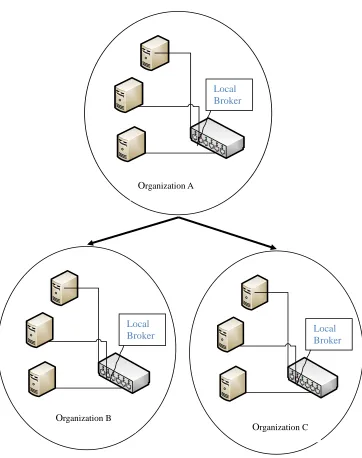
distributed scheduling architecture. A cluster user submits jobs to either its centralised local resource broker or to the cluster broker. As the number of clusters increases, a hierarchical connection between clusters imposes serious performance limitations. As a result, this solution is imperfect and the federation data grid model can be used for collaboration activity.
[image:18.612.142.504.227.685.2].
Figure 1.1: A hierarchical cluster grid architecture
Organization A
Organization B
ization B Organization C
Local Broker
Local
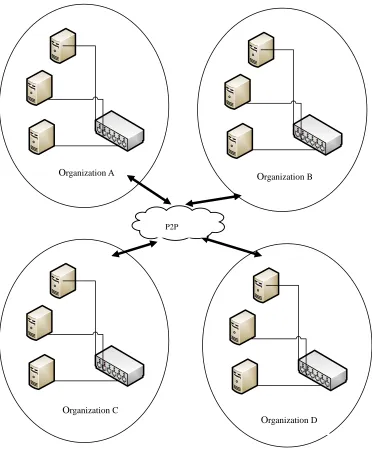
Figure 1.2 shows four clusters in this data grid system. The sites in a cluster connect in a Local Area Network (LAN) and the sites among clusters connect in a Wide Area Network (WAN). These refer to two types of communication between sites in this data grid system. The first type of communication is the intra-communication which refers to the site to site in same cluster communication (LAN connection). The second type of communication is the inter-communication which refers to the communication between sites across clusters (WAN connection). Accessing large datasets from remote sites will affect high access latency. Consequently, the bandwidth of networks between sites across clusters will always be lower than within clusters themself which causes traffic bottlenecks in the network channels and congestion in cluster inter-communicating. It is crucial to decrease the total number of inter-communications for reduction of access latency and prevention of WAN bandwidth congestion.
Figure 1.2: Federation resource sharing system
Organization A
Organization C
Organization D Organization B
Cloud
1.2 Problem statement
As discussed in previous section of this thesis, the benefit on employing the federated data grid environment is apparent when collaboration among peers of grid providers is required. The existences of single or centralized coordinator in hierarchical data grid limit the process of collaboration among grid providers. Therefore, the concept of federated data grid environment is employed where each data grid peers have the same level of authority in sharing and collaborate their resources (i.e., the need for central coordinator is eliminated). However, this advantage comes with a price of complexity in addressing access latency issue, especially when the federated data grid also inherits two main characteristics of general data grid environment i.e., 1) it involved a massive number of machines, and 2) it is dynamic in nature. This issue is generally prominent in the aspect of data replication and job scheduling. In such situation, jobs need to be assigned and processed by the best resource (which holds the respective replica data) before the result can be returned to the user. Job scheduling and data replication are two most important issues that are difficult to resolve when the above mentioned characteristics need to be addressed. From the perspective of data replication, these characteristics will undoubtedly increase the complexity of replication process where the best number and location of replica data need to be chosen carefully to ensure the efficiency of replication scheme is preserved. Furthermore, from the view of job scheduling, the existence of these characteristics in data grid environment will shoot up the difficulty of job scheduling process. In such scenario, an efficient mechanism is required so that the best resource (which holds the respective replica data) can be chosen and jobs can be processed by this resource before the result can be returned to the user to reduce access latency.
1.3 Objectives of thesis
Generally, the main objective of this thesis is to develop a model for a federated data grid that can efficiently minimize access latency. This can be done by integrating the replication strategy and job scheduling algorithm. It reduces WAN bandwidth congestion by decreasing the number of network communications between grid regions. Specifically, the study aims to achieve the following objectives:
(i) To propose a model for federated data grid systems.
(ii) To propose an efficient data replication strategy for the proposed model.
(iii) To simulate the proposed model using data grid simulator.
1.4 Scope of thesis
1.5 Importance of study
In a data grid environment, a set of replica files can be retrieved from various sites. If the required files are replicated on a site where the job has been executed, then this job processing will be completed in this site without delay. On the other hand, if the required files are unavailable within the job execution site, job scheduling process will be triggered and this job will be processed from a remote site. In such situation, a longer time is required in this scheduling process due to a huge replica size, where in some applications, it size may reach to gigabytes in scale. Undoubtedly, the limitation of network bandwidth between grid sites cannot be avoided. As a result, the process of re-scheduling for replicas via the internet connection will introduce unnecessary delay which in turn will cause a longer job execution time. To highlight, the main contribution of this thesis is that it reduces data access time when jobs are processed in federated data grid environment.
1.6 Thesis organization
This thesis consists of five chapters which includes this introductory chapter. The remaining four chapters are organized as follow:
research questions can be addressed efficiently.
Chapter 3 discusses the proposed model of Federation. The Sub-Grid-Federation system is defined as a collaboration and data sharing system for heterogeneous data grid. The replication strategy for this model is presented and proved analytically. The objective of the proposed model is to minimize access latency by allowing data to be accessed from the nearest site in the federated data grid.
Chapter 4 describes the implementation and evaluation of the proposed model based on simulation. The performance of the proposed model is compared against two existing model, i.e. SGFRS and ODRS, by using OptorSim simulator tool. Detail discussions on the simulation result are presented. Finally, this chapter is summed up by discussing the testing which has been done by using this simulation environment.
CHAPTER 2
LITERATURE REVIEW
This chapter provides a general overview of data grids that covers topics such as a layered architecture and data grid model. This chapter presents an analysis of the differences between data grid models such as monadic, hierarchy, P2P and federation. It ends with a discussion on research in data grids into specialised areas and categories in data replication strategy and scheduling algorithm for data-intensive.
2.1 Introduction
and dealing with computational intensive tasks, while data grids are for data sharing and collaboration.
2.2 Data grid
Data grids help users to search large amount of data, modify and transfer them according to their specific needs. Users can also create and manage copies of these data, and store them in distributed repositories (Srikumar V. et al., 2006). There are two basic functionalities of a data grid: 1) a scalable replication discovery and management mechanism 2) a high performance and reliable data transfer mechanism (Chervenak A. et al., 2000). However, the replication discovery and high performance data transfer depend on the requirements of an application as a provision for a range of other services that need to be fulfilled. Replica management consistency, filtering of data and management of data are some instances of services. To ensure requests are authenticated and only authorized operations are conducted, all data grid operations are mediated by a security layer.
Maintaining the huge shared dataset collections in distributed system is an additional facet of a data grid. In a data grid, dataset are freely maintained, without concerning the kind of storage system underneath. The inclusion of a new site is also easily achieved without much effort. More importantly, the establishment of persistent archival storage is compulsory where the data associated with metadata, access controls, and version changes will be well-maintained during the platform change (Moore R., Rajasekar A. & Wan M., 2005).
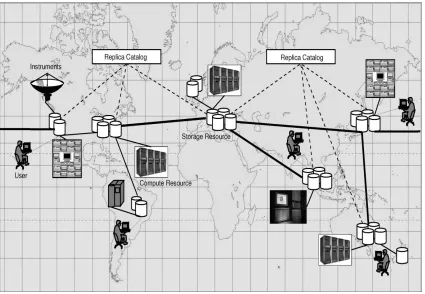
responding to a request, data is conveyed to a storage space of another site around the globe.
[image:27.612.115.540.296.590.2]In the process of locating the required datasets, firstly, users will query a local replication catalogue. Data from local repository will be retrieved to their area whenever the permissions and requisite rights are granted. Otherwise, if the required data is not available in local sites, retrieval of data from a remote repository needs to be performed. Subsequently, for the purpose of processing, data might be sent out to a cluster or a facility of supercomputer, or generally known as a computational site. After being processed, the result might then be transmitted to facilitate visualization, sharing or even to be stored the local workstation.
2.3 Data grid architecture
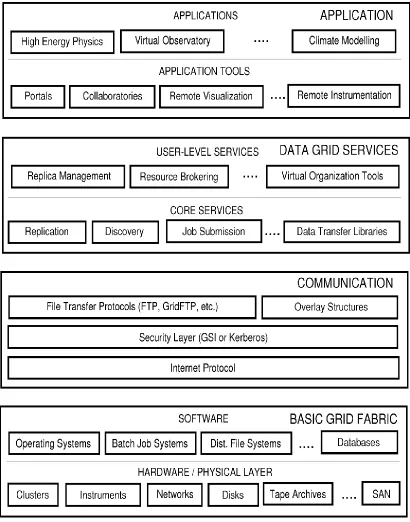
The components of data grids consist of applications, data grid services, communication and basic grid fabric (Srikumar V. et al., 2006). The layered structure is depicted in Figure 2.2. Each layer has its own features and being described as follows:
(i) Application
This layer provides services to users by calling the services provided by the inner layers of the architecture. Then, they are modified to match the target domain such as replica management and resource brokering.
(ii) Data grid services
The core-level in data grid services like data replication, job scheduling and data discovery provide transparent access to dispersed data while replica management and resource brokering involve mechanisms that permit efficient management of resource buried behind smart commands and APIs in user level services.
(iii) Communication
(iv) Basic Grid fabric
This layer is classified into hardware and software layers. The hardware or physical layer contains the dispersed computational resources such as storage resources, supercomputers and clusters linked up together by high bandwidth networks. Every individual resource executes specific applications (software layer) such as Relational Database Management Systems (RDBMS), Job Submission and Management Systems, and Operating System.
2.4 Data grid model
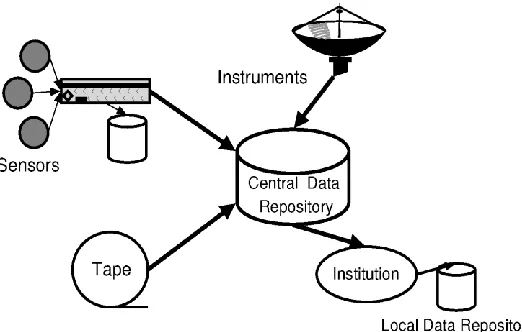
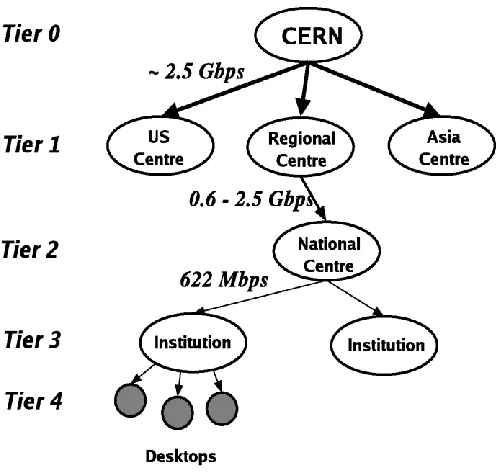
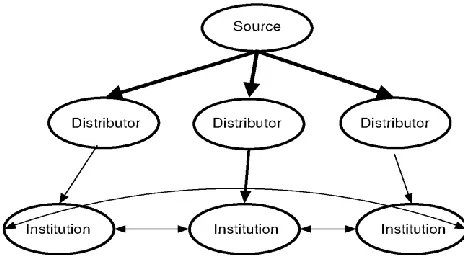
The design of the data grid model is developed according to the structure of data sources in a system. Depending on the data source, distributed or single, data size and sharing mode, numerous models are available for data grid operation. Figure 2.3 – Figure 2.6 show four models which are commonly established in a data grid environment.
(i) The centralised or monadic model
This data grid model represented in Figure 2.3 is a common form that acts as a central repository where all data are resided and all user queries are served from. Sources of data can be from anywhere in the grid for instance from sensor networks and/or distributed instruments. Then, data will be accessible via interfacing mediums such as web portal and system application where authorization and verification of users will be performed.
Figure 2.3: Centralised or monadic model (Srikumar V. et al, 2006)
(ii) Hierarchical model
Figure 2.4 shows the hierarchical model operating in a single source where data has to be dispersed among collaborative organisations in the globe. The source is from root as Tier 0, where the data is created. The sub-tiers are the Tier 1 which is called national centres, the Tier 2 named regional centres, Tier 3 workstation and lastly Tier 4, which involves computers from thousands of end users (Foster I & Kesselman, 1998 & Q. Rasool, J. Li & S. Zhang, 2009).
Figure 2.4: Hierarchical model (Srikumar V. et al, 2006)
(iii) The P2P model and federation model
Figure 2.5: Federation model (Srikumar V. et al, 2006)
(iv) Hybrid model
The hybrid model combines all the centralised, hierarchical, and federated models is beginning to emerge as data grids mature and used in the industries. As a result, there is a requisite for collaboration and sharing of their resources among researchers. One of the examples of hybrid model is shown in Figure 2.6 which represents hierarchical data grid and peer edges linkages.
[image:33.612.177.409.528.658.2]2.5 Data replication
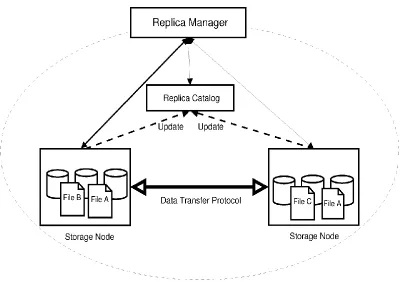
A data grid is a collaboration of a geographically-distributed datasets where each and every collaborative member requires accessing the produced dataset. Datasets replication is a prerequisite for bandwidth preservation, and also a necessity in ensuring collaboration scalability and data access reliability (M. Tang et al., 2005 & Nazanin saadat & Amir M. R, 2011). Moreover, the available storage size and the bandwidth between sites may affect the performance of replication (Figueira & Trieu, 2008). Thus, a management system of replica guarantee requires data assessment, and at the same time performing underlying storage management. Figure 2.7, shows a management system of replica, consists of storage sites or sites connections using high-performance protocols of data transport. Depending on users‟ demands, the creation and management of replicas is performed by the replica manager and the storage availability. Also, a catalogue or a directory keeps track of their replica locations. The applications request for the catalogue to find the availability of replicas for the particular datasets, their number and its location. Sometimes, a merged single entity of the catalogue and the manager are also found in some systems. Generally, software of the client side will include a library which normally incorporates into applications and queries the catalogue that locates datasets and requesting replication for the specific dataset. Strategy of replication and system architecture are the vital elements for the mechanism of replication.
decrease sharply. On the other hand, dynamic replication automatically builds and removes replicas according to the changes of access patterns. This is to ensure the benefits of replication continue although there are the changes of users‟ behaviour to form the popular data (Lamehamedi H, Shentu Z. & Szymanski B., 2003 & Ruay-Shiung C. & Hui-Ping, 2008 & Muhammad Bsoul et al. 2011).
[image:35.612.113.514.319.601.2]Assessment of popular data will always create hotspots. These hotspots were reduced by dynamic replication strategies which also promote load sharing. This benefit however, comes with extra overhead costs. System log efficiency maintenance for handling grid environment dynamicity and network traffic real time assessment generates additional overhead.
Figure 2.7: A replica management architecture (Srikumar V. et al, 2006)
2.6 Job scheduling for data replication
Data intensive jobs scheduling differ from computational jobs. This is due to the large dataset requirements and the existence of these dataset‟s multiple replicas that are scattered and located over a geographically-distributed region. The availability of bandwidth and transfer latency amongst computational sites has to be taken into account by the schedulers to retrieve the required data from the storage resource(s) (Ruay-Shiung C., Jih-Shing C. & Shin-Yi L., 2007 & Yun-Han L., Seiven L. Rauy-Shiung C., 2011). Hence, the scheduler must know the existence of replica near to the computation point. Besides, the scheduler would produce a new replica of data, if the replication is combined with the scheduling. Types of data-intensive applications scheduling is described below:
(i) Application model
Strategies of scheduling can be defined as an application model to retrieve required data from any storage resource. The composition or distribution of an application is done for global grids scheduling, ranging from specific levels such as process to move general levels such as single tasks to groups of tasks like workflows. For the independent computation unit, a task is regarded as the smallest unit. Every level has its own requirement for scheduling.
(ii) Process-oriented
tasks which belongs to a Bag of Tasks (BoT) application must be successfully executed.
(iii) Scope
The description of scope in scheduling context refers to the application‟s extent of a data grid scheduling strategy. If the strategy of scheduling‟s only is concern to meet the objectives from a perspective of the user, the scope is individual. Each scheduler will own an independent view of the desired resources which it intends to utilize in a multi-user atmosphere. A scheduler is aware of fluctuations in resource availability caused by other schedulers submitting their jobs to common resources. Then it strives to schedule jobs on least-loaded resources that can meet its objectives.
(iv) Data replication
and then the job identifies a location of replica, most appropriate and suitable to send a request for the required data. A Study of decoupled strategies by Raganathan K. and Foster I. (2002a) has revealed that decoupled strategies tend to increase performance while the complexity of data grid environments designing algorithms is reduced.
(v) Utility function
An algorithm of job scheduling can decrease some form of a utility function that varies depending on the users‟ requirements and architecture of distributed
system that the algorithm is targeted to. Usually, algorithms of job scheduling aim to reduce the required total computing time to complete all the jobs in a set, which is also known as makes pan. To gain the maximum output from the systems, load is distributed among the machines by the Load-balancing algorithms. Bundled with economic objectives, scheduling algorithms will maximize the economic utility of the users which is normally manifested as a profit function which takes economic costs for jobs executing on the data grid into account. Meeting requirements of Quality-of-Service (QoS) is possibly another objective. QoS requirements include reducing computational cost, complying with a deadline, conforming to a stricter requirement of security and/or complying with particular resource requirements.
(vi) Locality
scheduled to the same site. Spatial locality may be regarded as bringing computation to data; on the other hand temporal locality brings data to computation. It is noticeable that the form of temporal locality for data requests is being exploited by the schedulers that couple replication of data to scheduling of job.
2.7 Data grid research
Studies and analysis on diverse data grid researches have been done for different domains of applications. The goal of data grid research is to involve the development of middleware, management of storage and advanced networking, dynamic strategy of data replication and efficient algorithm of job scheduling. The studies of dynamic data replication and job scheduling strategy in data grid environment are divided into; 1) hierarchical model, and 2) P2P and federation model. Table 2.1 and Table 2.2 provide lists of the researches and a brief summary for each of them.
2.7.1 Dynamic data replication and scheduling strategy in hierarchical data grid system
Most of current research done follows a hierarchal model (Tehmina Amjad et al., 2012). This section discusses the data replication technique without scheduling strategy and the data replication technique with scheduling strategy in a hierarchical data grid system.
(i) Best Client, Cascading, Caching and Fast Spread
REFERENCES
A. Abdullah, M. Othman, H. Ibrahim, M.N. Sulaiman, A.T. Othman (2008). Decentralized replication strategies for P2P based scientific data grid. Information Technology, ITSim 2008, International Symposium on, vol. 3, pp. 1–8.
A. Horri, R. Sepahvand and G. Dastghaibyfard (2008). A hierarchical scheduling and replication strategy. IJCSNS International Journal of Computer Science and Network Security. 8 (2008).
Abawajy J.H. (2004). Placement of File Replicas in Data Grid environments. Springer, Heidelberg, vol. 3038, pp. 66-73.
Antunes, G. and Pina Helder H. (2011). Using Grids Federations for Digital Preservation (2011). In the 8th International Conference on Preservation of Digital Objects (iPRES 2011).
A. Legrand, L. Marchal and H. Casanova (2003). Scheduling distributed applications: the simgrid simulation framework .In Proc. of the 3rd International Symposium on Cluster Computing and the Grid, Tokyo, Japan, May 12–15 2003.
Bell W. H., Cameron D.G., Capozza L., Millar P., Stockinger K. and Zini F. (2002). Design of a Replica Optimisation Framework. Technical Report DataGrid- 02-TED-021215, CERN, Geneva, Switzerland, December 2002. EU DataGrid Project.
Bell W.H., Cameron D.G., Capozza L, Millar P. and Stockinger K, Zini F. (2003). OptorSim—a grid simulator for studying dynamic data replication strategies. Int J High Perform Comput Appl 17(4):403–416
Cameron D.G., Schiaffino R.C., Ferguson J, Millar P, Nicholson C, Stockinger K. and Zini F. (2004). OptorSimv2.0 installation and user guide. http://edg-wp2.web.cern.ch/edg-wp2/optimization/optorsim.html
Chervenak A., Foster I., Kesselman C., Salisbury C., and Tuecke, S. (2000). The Data Grid: Towards an architecture for the distributed management and analysis of large scientific datasets. Journal of Network and Computer Applications, 23(3):187 2000.
Cohen E. and Shenker S. (2002). Replication strategies in unstructured peer-to-peer networks. In: Proceedings of the conference on Applications, technologies, architectures, and protocols for computer communications. ACM Press: New York, 2002, 177−190.
Figueira and Trieu (2008). Data replication and the storage capacity of data grids, Springer-Verlag, Berlin, Heidelberg (2008), pp. 567–75.
Foster, I. and Kesselman, C. (1998). The grid: Blueprint for a new computing infrastructure. Morgan Kaufmann Publishers, USA.
Hey, T. and Trefethen, A. E. (2002). The UK e-Science Core Programme and the Grid. Journal of Future Generation Computer Systems (FGCS), 18(8):1017–1031.
H.J. Song, X. Liu, D. Jakobsen, R. Bhagwan, X. Zhang, K. Taura and A. Chien (2000). The microgrid: a scientific tool for modelling computational grids. In: Proc. of IEEE Supercomputing Conference, Dallas, USA, November 4–10.
Hong L., Q. Xue-dong L., Xia L. Zhen and W. Wen-Xing (2008). Fast cascading replication strategy for data grid. CSSE ‟08: proceedings of the 2008 international conference on computer science and software engineering, IEEE Computer Society, Washington, DC, USA (2008), pp. 186–189.
I. Goiri, Jordin Guitart and Jordi Terres (2010). Characterizing Cloud for Enhancing Providers’ Profit. IEEE 3rd
Internation Coference on Cloud Computing.
Jiang J. and Yang G. (2007). An Optimal Replication Strategy for data grid system. Front Computer. Science China, 1(3): 338-348.
Jin H., Mao F., Chen H., Wu, S. and Zou D. (2006). P2P Based Decentralized Dynamic Replica Placement Strategy in Data Grid Environment. Downloaded on October 2006 (2006) from http://grid.hust.edu.cn/fmao/
K. Sashi. and A. S. Thanamini (2010). Dynamic replication in a data grid using a Modified BHR Region Based Algorithm. Future Generation Computer Systems, Volume 27 (2011), pp. 202-210.
Lamehamedi H., B. Szymanski, Z. Shentu and E. Deelman, (2002). Data replication strategies in grid environments. Proceedings of the fifth international conference on algorithms and architectures for parallel processing, IEEE Computer Society Press (2002), pp. 378–383.
Lamehamedi H, Shentu Z, Szymanski B (2003). Simulation of dynamic data replication strategies in data grids. In: Proceedings of the International Parallel and Distributed Processing Symposium. Washington, DC: IEEE Computer Society,
M. Tang, B.S. Lee, C.K. Yao, X.Y. Tang (2005), Dynamic replication algorithm for Performance Data Grid. In proceedings of the Int'l Grid Computing Workshop, Denver, Colorado, USA, 2001.
M. Tang, Bu-Sung Lee, Xueyan Tang, Chai-Kiat Yeo (2006). The Impact of Data Replication on Job Scheduling Performance in the Data Grid. Future Generation Computer Systems, Volume 22 (2006), pp. 254-268.
Mckinley K. S., Carr S. and Tseng, C.-W. (1996). Improving data locality with loop transformations. In ACM Trans. Program. Lang. Syst. Vol. 18. ACM Press, New York, NY, 424–453.
Miles S., Wong S. C., Fang W., Groth P., Zauner K. P. and Moreau L. (2007). Provenance-based validation of science experiments,” Web Semant.5 (Mar. 2007), 28–38.
Ming Tang, Bu-Sung Lee, Chai-Kiat Yeo and Xueyan Tang (2005). Dynamic replication algorithms for multi-tier data grid. Future Generation Computer System. 21 (2005):775-790.
Ming Tang, Bu-Sung Lee, Xueyan Tang, Chai-Kiat Yeo (2006). The Impact of Data Replication on Job Scheduling Performance in the Data Grid. Future Generation Computer Systems, Volume 22 (2006), pp. 254-268.
Mohammad Bsoul, Ahmad Al-Khasawneh, Emad Eddien Abdallah, Yousef Kilani (2011). Enhanced Fast Spread Replication strategy for Data Grid. Journal of Network and Computer Applications, Volume 34, Issue 2, March 2011, Pages 575-580.
Moore R., Rajasekar A., and Wan, M. (2005). Data Grids, digital libraries and persistent archives: An integrated approach to publishing, sharing and archiving data. Proceedings of the IEEE (Special Issue on Grid Computing) 93( 3).
Nazanin Saadat and Amir Masoud Rahmani (2011). PDDRA: A new pre-fetching based dynamic data replication algorithm in data grids. Future Generation Computer System. 27 (2011):233-244.
N. Mansouri, Gh. Dastghaibyfard and A. Horri (2011). A Novel Job secheduling Algorithm for Improving Data Grid’s performance. 2011 International Conference on P2P, Parallel, Grid, Cloud and Internat computing. Pp. 142-147.
Q. Rasool, J. Li, S. Zhang (2009). Replica placement in multi-tier data grid. Eighth IEEE International Conference on Dependable, Autonomic and Secure Computing, 2009, pp. 103–108.
Qaisar Rasool, Jianzhong L. George S. Oreku, Ehsan U. M. (2007). A Comparative Study of Replica Plecement Strategies in Data Grids. Springer-Verlag Berlin Heidelberg, LNCS 4537, pp. 135–143, 2007.
Ranganathan K. and I. Foster (2002a). Simulation Studies of Computation and Data Scheduling Algorithms for Data Grids. Journal of Grid Computing, Volume 1, Number 1,
Raganathan K., Lamnitchi A. and Foster, I (2002b). Improving Data Availability through Model-Driven Replication for Large Peer-to-Peer Communities. In: proceedings of Global and Peer-to-Peer Computing on Large-Scale Distributed Systems Workshop, Berlin, Germany.
Ranganathan K.and Foster I. (2001a). Design and evaluation of dynamic replication strategies for a high-performance data grid. In: International conference on computing in high energy and nuclear physics. Beijing, China, 2001a.
Ranganathan K. and Foster I. (2001b). Identifying dynamic replication strategies for a high-performance data grid. GRID ‟01: proceedings of the second international workshop on grid computing, Springer-Verlag, London, UK (2001), pp. 75–86.
Ruay-Shiung C., Jih-Sheng Chang and Shin-Yi Lin (2009). Ant algorithm for job scheduling in grid computing, Future Generation Computer Systems, Volume 25 (2009), pp. 254-268.
Ruay-Shiung C., Jih-Sheng Chang and Shin-Yi Lin (2007). Job scheduling and data replication on data grids. Future Generation Computer Systems, Volume 23 (2007) pp. 846–860.
R. Lakshmi and Bin Tang (2011). Integrating Scheduling and Replication in Data Grids with Performance Guarantee. IEEE Globecom 2011 proceedings.
S. Siva Sathya, K. and Syam Babu. (2010). Survey of fault tolerant techniques for grid. Computer Science Review 4 (2010), pp. 101 – 120.
Sang-Min Park, J-H. Kim, Y.-B. Go and W.-S. Yoon (2003). Dynamic grid replication strategy based on internet hierarchy, in: International Workshop on Grid and Cooperative Computing, in: Lecture Note in Computer Science, vol. 1001, 2003, pp. 1324-133.
Srikumar Venugopal, Rajkumar Buyya, and Kotagiri Ramamohanarao (2009). A Taxonomy of Data Grids for Distributed Data Sharing, Management, and Processing. ACM Computing Surveys, Vol. 38, March 2006, Article 3.
Tehmina Amjad, Muhammad Sher, Ali Daud (2012). A survey of dynamic replication strategies for improving data availability in data grids. Future Generation Computer Systems, Volume 28(2012), pp. 337-349.
Xun-yi R., Ru-chuan W., Qiang K. (2010). Using OptorSim to efficiently simulate replica placement strategies. The Journal of China Universities of Posts and Telecommunications. February 2010, 17(1), pp. 111-119.
Xiaoyu Yang, Bassem Nasser, Mike Surridge and Stuart Middleton (2012). A business-oriented Cloud federation model for real-time application. Future Generation Computer Systems, Volume 28 (2012), pp. 1158-1167.