Evaluation of Geometrical Nonlinear Behaviour of FRP Composite Plate
Using Finite Element Method
Ch. jeevitha1, M.Mounika2and p.phani prasanthi3 Mechanical Engineering Department,
P.V.P. Siddhartha Institute of technology, Vijayawada, Andhra Pradesh, India. [email protected]
Abstract
The work presents the prediction of nonlinear behavior of a square plate made of composite material under uniform transvers pressure using 3-D finite element analysis. Transverse deflection, principal stresses and shear stresses are evaluated for different values of load and by varying the number of layers. The effect of loading and stresses in both the analyses for all the values of composite laminated plate with different stacking sequence are determined. The study also includes the effect of the layer thickness for different layup responses of laminate under the clamped boundary conditions. The commercial finite element analysis software ANSYS has been successfully executed for both linear Static analysis and geometric nonlinear static analysis.
Key words: composite, geometric- nonlinearity, FEM, laminate, stacking-sequence.
Introduction
The needs of the high rise building and aerospace industry led to the development and application of composite materials. Advances in the manufacturing process and technology of laminated composites have changed the use of the composites from secondary structural components to the primary ones. Practically laminated composites are commonly used as a part of building like sandwich penal, aeronautical and aerospace industries as the main part of the structure rather than aluminium or other metallic materials. Low weight, high strength and greater rigidity were of paramount interest. A variety of structural elements such as cylinders, beams, plates and shells could be potentially used for the analysis of laminated composites. The high stiffness-to-weight ratio coupled with the flexibility of the selection of the lamination scheme that can be tailored to match the design requirement makes the laminated plate an attractive structural component for many industries. Depending upon their applications, plates can be moderately thick. To use the laminated composite plates efficiently, it is necessary to develop appropriate analysis theories to predict accurately their structural and dynamical behaviour. The increased utilization of composite materials in several engineering applications
has led to intensive research activities in linear and non-linear, static and dynamic analysis of laminated composite plates. The majority of the investigations on laminated plates utilize either the classical lamination theory (CLT), or the first-order shear deformation theory (FSDT). FRP composites are different from traditional constructional materials such as steel or aluminium. FRP composites are orthotropic whereas steel or aluminium is isotropic therefore FRP composite properties are directional, meaning that the best mechanical properties are in direction of fiber placement. Sheikh et al. [1] developed a high precision shear deformable element for the analysis of laminated composite plates of different shapes. M. Ganapathi, B.P. Patel [2] used a C0 eight-noded plate element developed based on an accurate higher-order theory, the nonlinear dynamics analysis of thick composite and sandwich plates are investigated. The formulation is based on a theory that accounts for the realistic variation of in-plane and transverse displacements through the thickness. It also includes the inertia terms pertaining to the higher-order terms involved in the displacement functions. The geometric nonlinearity is introduced in the formulation based on
the relevant Green’s strain vector for the laminate. The
governing equations of motion obtained here are solved through eigenvalue solution for free vibration case whereas the direct integration technique is employed for the transient response analysis. The performance and the applicability of the proposed discrete model for the nonlinear free flexural and forced vibration responses of thick laminates are discussed among alternate models, considering multi-layered cross-ply and angle-ply, and sandwich plates.C.Sasi Rekha[3] Stress Analysis of FRP Composite Cylinder with Closed Ends Composite cylinders made of a polymer matrix such as epoxy reinforced with glass or carbon fibers possess extremely high strength. Proper modeling of FRP composite cylinder is very essential for many applications. FRP composite cylinders are commonly used in the aerospace, automotive, marine and construction industries. The variation of stresses at the top end, middle and bottom end portions of a composite cylinder by varying the diameter to thickness ratio(S) and fiber
composite cylinder is considered for behaviour of each portion (Top end, middle and Bottom end) the increment of stress takes place linearly with respect to D/t ratio due to reduction in thickness of the layer. The critical fiber angle is 45⁰ to 60⁰ as it offers high resistance against axial and circumferential deformation in middle and end portions. Junaid Kameran Ahmed, V.C. Agarwal, P.Pal, Vikas Srivastav [4] used the First Order Shear Deformation Theory on static and dynamic analysis of Graphite /Epoxy composite plates. The behaviour of laminated composite plates under transverse loading using an eight-node disoparametric quadratic element based on First Order Shear Deformation Theory was studied, the element has six degrees of freedom at each node: translations in the nodal x, y, and z directions and rotations about the nodal x, y, and z axes. The static analysis includes the parametric studies on laminated plates to estimate the maximum deflection. The parametric study represented by variation in (aspect ratio, layer orientation, layer number, dimension of the plate and mesh size). The modelling of the plates was done by using ANSYS 12.0, and the results were compared with Finite Element Method code. The minimum deflection was found at an angle of 15 degree for clamped plate, and in case of simply supported plate the minimum deflection was found for angle 45 degree. It is also observed that the deflection for clamped boundary condition is less than in simply supported boundary condition for both isotropic and orthotropic plates. In isotropic plate the deflection in clamped plate is about 50% of simply supported. And for orthotropic plate the deflection for clamped is about (25 to 30) % of simply supported. Liércio André Isoldi [5] studied the geometrically nonlinear static and dynamic behaviour of laminate composite shells are analysed using the Finite Element Method (FEM). Triangular elements with three nodes and six degrees of freedom per node (three displacement and three rotation components) are used. For static analysis the nonlinear equilibrium equations are solved using the Generalized Displacement Control Method (GDCM) while the dynamic solution is performed using the classical New mark Method with an Updated Lagrangean Formulation (ULF). The system of equations is solved using the Gradient Conjugate Method (GCM) and in nonlinear cases with finite rotations and displacements an iterative incremental scheme is employed. Namik Kemal oztorun[6] validate finite element formulation for the static and dynamic analysis of linear elastic space structures composed of plate and beam-type members is presented in this study. In general, finite elements can be used efficiently for the analysis of linear-elastic structures with shear walls built by use of tunnel forms. S.Oller, X. Martinez, F. Rrastellini [7] used computational methodology to present modeling of non-linear mechanical behaviour of composite structures made of FRP (Fiber-reinforced polymers) laminates. A Comprehensive study of the
large amplitude vibration of plates has been presented by Sathyamoorthy [8] Very often thick composite laminates are subjected to severe environmental conditions that necessitate the study of their nonlinear response, i.e. large deflection, post buckling and large amplitude vibrations. The analysis of their vibrational characteristics in the nonlinear domain is of particular interest, as it leads to a better understanding of the behavior of laminated structures and thus enables the full exploitation of their advantages. Both analytical and numerical methods have been applied in the recent past to these aims.
In the present work, the geometric nonlinear effects of a square plate are evaluated using ANSYS software. The description of the problem, the details of finite element modeling, material properties loading and boundary conditions are explained in the following sections.
Problem modeling Geometry
A square plate of dimensions length L=100, breath B=100, thickness H=10 units considered for the present analysis. The thickness H varies according to the no. of layers, and the transverse pressure 100Mpa is applied in five steps.
Finite Element Modeling
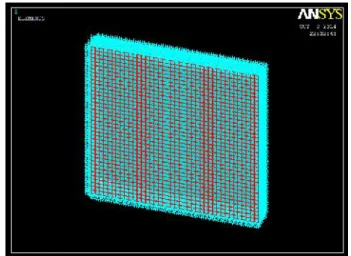
The finite element mesh is generated using SOLID191 is a layered version of the 20-node structural solid designed to model layered thick shells or solids. The element is defined by 20 nodes having three degrees of freedom per node: translations in the nodal x, y, and z directions. SOLID191 has stress stiffening capabilities.
FIGURE 1: FE model for composite plate.
Boundary Conditions and Loading
The analysis is performed by applying the total load in 5 equal number of steps.
Material properties
The following material properties are considered for the present analysis.
i) You
ng’s modulus, E1=175GPa, E2=E3=7GPa.
ii) Poiss
on’s Ratio, ν12= ν13=0.27, ν23= 0.01.
iii) Rigi
dity-Modulus, G12=G13=3.5Gpa, G23=1.4Gpa.
Results and Discussion
Variation of the transvers deflection measured at the center of the plate (w) with different stacking sequence of [0/-15/15/0]s, [0/-45/45/0]s and cross ply of
[0/90/90/0]s (‘s’ means indication of symmetry of
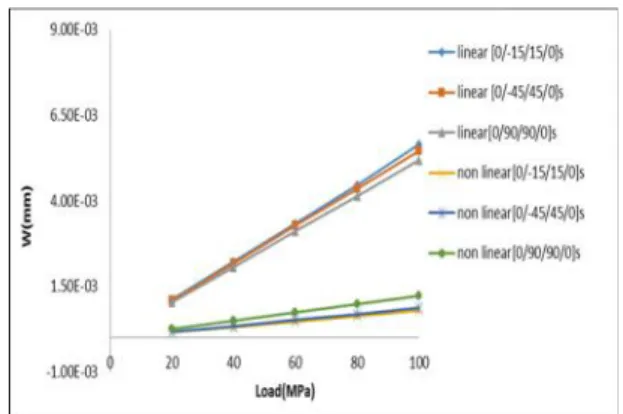
number of layers in the composite structure). From the Figure.2, it can be observed that the variation of center deflection (w) for both the linear and nonlinear analysis are exhibiting Clear deviation with respect to the different stacking sequence.
It is observed that for angle ply of [0/-15/15/0]s, both the analysis i.e linear and nonlinear response gives maximum deviation in displacement of the composite structure. The deflections are maximum in the linear analysis compared to the nonlinear analysis. The same types of analysis are performed for cross ply laminated plate (0/90/90/0). The percentage of variation in displacement between the angle ply [0/-15/15/0]s and the cross ply[0/90/90/0] maximum of 8.47%. No changes in the displacement of the plate is observed at [0/15/15/0] and [0/45/45/0] ply orientation. Variation of
stresses with respect to applied load steps for angle ply’s
[0/15/15/0], [0/45/45/0] cross ply [0/90/90/0] are presented in Figs. 5 to 8. It is observed that for angle
ply’s [0/-15/15/0] s, and [0/-45/45/0]s, cross ply[0/90/90/0] stress obtained from the nonlinear analysis is lower than that of linear response. The maximum response of stress (σx) is observed for the fiber arrangement of 15/15/0], followed by, [0/-45/45/0] and [0/90/90/0] lay-up. No specific deviation is gained in nonlinear response for all considered ply orientations. A different behavior is observed in stress in y direction i.e. (σy). [Fig.4] The maximum stress magnitude is observed for the lay-up of cross ply [0/90/90/0]. The behavior of composite plate showed similar response for all considered lay-up in terms of (σy). The variation of normal stress (σz) shown in Fig. 5.
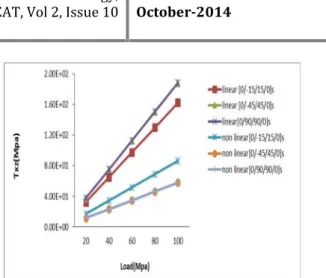
σzis gained peak response for cross ply laminate. So for uniform geometry and uniform loading and boundary conditions same material composite plate response is different with different lay-up. Similarly the variation of shear stress with respect to ply orientation and the variation of shearing stresses with respect to load steps is presented in Figs.6-8.The response of τxy is same as that of σx. The shear stress τyz is exhibiting same
response for all lay ups. But clear deviation between linear and nonlinear analysis is observed. The response ofτxzis same as that ofσz.
FIGURE 2:variation of ‘w’ with respect to load steps
for fiber angles.
FIGURE 3:variation of ‘σx’ with respect to load steps
for fiber angles
FIGURE 5:variation of ‘σz’ with respect to load steps for fiber angles.
FIGURE 6:variation of ‘τxy’ with respect to load steps for fiber angles.
FIGURE 7:variation of ‘τyz’ with respect to load steps for fiber angles.
FIGURE 8:variation of ‘τxz’ with respect to load steps for fiber angles.
Conclusions:
Importance of geometric nonlinear analysis of an angle ply and cross ply FRP square plate subjected to uniform transverse pressure loading has been discussed in this paper. The plate is used analysed using linear and geometric nonlinear analysis options available in finite element software ANSYS. Form the present analysis it is found that the nonlinear analysis is must for the considered plate for all fiber orientations considered for the study.
References:
[1].A H Sheikh, S. Haldar and D. Sengupta, (2002). A high precision shear deformable element for the analysis of laminated composite plates of different shapes. Composite Structures 55 pp.329–336.
[2]. M. Ganapathi, B.P. Patel*, D.P. Makhecha (2002). Nonlinear dynamic analysis of thick composite/sandwich laminates using an accurate higher-order theory www.elsevier Composites, Part B 35 (2004) 345–355.
[3].C.Sasi Rekha, P.Ravi Kumar, K. Venkata Rao (2013). Stress Analysis of FRP Composite Cylinder with Closed Ends, IOSR Journal of Mechanical and Civil Engineering, Volume 9, Issue 6 (Nov. - Dec. 2013), e-ISSN: 2278-1684,p-e-ISSN: 2320-334X
[4].Junaid Kameran Ahmed, V.C. Agarwal, P.Pal, Vikas Srivastav, (2013).A Static and Dynamic Analysis of Composite Laminated Plate. International Journal of Innovative Technology and Exploring Engineering, Volume-3, Issue-6, (November 2013), (IJITEE) ISSN: 2278-3075.
[6]. Namik Kemal oztorun, “ A rectangular finite
element formulation,” Elsevier Science publishers
volume 42, Issue 12 (August 2006),pages:1031-1052, year of publication :2006,ISSN:0168-874X.
[7]. S.Oller, X. Martinez, F. Rrastellini, “Advanced composite Material simulation,” journal of advanced composite Material Simulation Ciencia e-techno –logia dos materials, vol.20, 2008
[8].ANSYS Reference Manuals.2007.