Information and Cosmological Objects
Igor Gurevich
The Institute of Informatics Problems of the Russian Academy of Sciences, Hetnet Consulting Corp., Moscow, Russia *Corresponding Author: [email protected]
Copyright © 2013 Horizon Research Publishing All rights reserved.
Abstract Estimation of the volume of information in
cosmological objects, including stars of the Sun type, neutron stars, white dwarfs, black holes is necessary for generation of restrictions for their formation, development and interconversion. Information is an integral part of the Universe. The basic law of Zeilinger’s quantum mechanics postulates that the elementary physical system (in particular, fundamental particles: quark, electron, photon) bears one bit of information. By its physical essence information is heterogeneity of matter and energy. Therefore information is inseparably connected with matter and energy. An information approach along with a physical one allows to obtain new, sometimes more general data in relation to data obtained on the ground of physical rules only. The author’s works, testify about the practicality of information laws usage simultaneously with physical rules for cognition of the Universe. The results presented in this paper show the effectiveness of informational approach for studying the cosmological objects. In future the proposed models and estimations should undoubtedly be specified and presented in more detailed way. One should point out that informational approach allows formulating restrictions on the valuations of physical systems characteristics and physical processes while the physical methods and models can describe not only the restrictions but also concrete physical “mechanisms” of restriction formation, concrete valuations of physical systems characteristics.Keywords
Cosmological Objects, Sun, Neutron Stars, White Dwarfs, Black Holes, Information, Heterogeneity, Objective Reality, Restrictions, The Universe1. Introduction
Estimation of the volume of information in cosmological objects, including stars of the Sun type, neutron stars, white dwarfs, black holes is necessary for generation of restrictions for their formation, development and interconversion.
Information is an integral part of the Universe. The basic principle of Zeilinger’s quantum mechanics [1] postulates that the elementary physical system (in particular, fundamental particles: quark, electron, photon) bears one bit
of information. By its physical essence information is heterogeneity of matter and energy. Therefore information is inseparably connected with matter and energy. The universal measure of physical heterogeneity of information is the Shannon information entropy [2, 3]. It is important to note that the Neumann entropy cannot be applied as the universal measure of heterogeneity because it is equal to zero for structured pure state. An information approach along with a physical one allows to obtain new, sometimes more general data in relation to data obtained on the ground of physical rules only. The author’s works, for instance the [4, 5] testify about the practicality of information laws usage simultaneously with physical rules for cognition of the Universe. The estimates cited below are based on the foundational principle of Zeilinger quantum mechanics i.e. “an elementary system carries one bit of information” and prove it. The elementary systems are fundamental particles (quarks, leptons, photons). Let us evaluate the volume of information in the system of n q-bits. At first we consider the systems with equiprobable basic states.
2. Non Interacting Q-bits in the System
Suppose that the system contains n non-interacting q-bits. Let the q-bit be described by the wave function
1
( 0 1 ) 2
ψ = +
, where 0 , 1 - are the basic states of the q-bit [6]. While measuring the q-bit we’ll obtain the basic states 0 , 1 with equal probabilities 1 / 2 . Uncertainty (information) of the q-bit in the state
ψ
is equal to 1 bit:1 1 2 2
1 1 1 1
( log log ) 1.
2 2 2 2
N =I = − + =
Hence, the volume of information in the system containing n non-interacting q-bits with equiprobable basic states is proportional to the amount of q-bits and is equal to n bit.
number of particles (elementary systems) in the usual substance (fundamental particles - quarks, leptons, photons).
3. The System Having N Basic States
Let us consider the case when the objects in the system are specified by the wave functions
1
1 (
n i)
i
e
n
ψ
=
=
∑
.Uncertainty (information) of the object i is equal to
n n
n n n
Ni =−(1log1+...+1log1)=log2
. If the system has
n
basic states, then the system uncertainty (information) content is equal to2 1
1
1
1
1
( log
...
log )
log
n
i i
N
N
n
n
n
n
n
n
n
=
=
∑
= −
+ +
=
.This dependence characterizes the neutron stars and white dwarfs [7]. The neutron stars and white dwarfs appear to be degenerate fermionic systems that fill in a zone of n states
i
e .
4. Q-bits Pairwise Interaction in the
System
Suppose that a system contains n pairwise interacting q-bits with equiprobable basic states. The system consisting of n interacting particles (q-bits) can be described with the
following wave function:
1 2 1 2
1
( 0 0 ... 0 1 1 ... 1 )
2 n n
n
ψ+ = + . Each q-bit i
possesses the wave function 1 ( 0 1 ) 2
i i i
ψ = +
( 0 , 1i i - basic states of the i-th q-bit). Information on relationships between each pair of interacting q-bits i j, is equal to one unit (one bit) [8]. Let us demonstrate this. Under the linked (intricate) status of q-bits i j, the status of q-bit
j is absolutely certain if the status of q-bit i is known, and
vice versa the status of q-bit
i
is absolutely certain if the status of q-bit j is known.For the state 1 ( 0 0 1 1 )
2 i j i j
ψ = + the
probabilities of basic states realization are equal to 1
( 0 ) ( 1 2
i i
P =P = , ( 0 )) ( 1 ) 1
2
j j
P =P = ; the
probabilities of pairwise states realization are equal to 1
( 0 0 ) ( 1 1 ) 2
j j
i i
P =P = . Combined probabilities are
defined with matrix 1
0 2 P
1 0
2
=
. Indefiniteness
(information entropy) of q-bits i , j is equal to
1 1 1 1
( log log ) 1
2 2 2 2
j i
N = N = − + = bit. Indefiniteness
(information entropy) of combined distribution of the states of q-bit
i
and q-bitj
is equal to1 1 1 1
( log log ) 1
2 2 2 2
ij
N = − + = (bit). Information on the links
of q-bits
i
andj
is equal to1 1 1 1
j
ij i ij
I =N +N −N = + − = bit.
The volume of information in the link of a system of n
pairwise interacting q-bits with equiprobable basic states described with the wave function
1 2 1 2
1
( 0 0 ... 0 1 1 ... 1 )
2 n n
n
ψ = +
,
is equal to
( 1) 2
n n n
I = ⋅ −
bit.
The volume of information in the system of n pairwise interacting q-bits is formed from n bits of information
available in the q-bits and
( 1) 2
n n⋅ −
bit of information on the link between the q-bits. The total volume of information in the system containing n pairwise interacting q-bits with equiprobable basic states is equal to
( 1) ( 1)
2 2
n n n n n
I = +n ⋅ − = ⋅ +
bit.
This estimate determines the maximum volume of information in the system consisting of n q-bits with equiprobable basic states. In the system containing n pairwise interacting q-bits with equiprobable basic states the volume of information is proportional to squared number of
q-bits and is equal to
( 1) 2
n n n
I = ⋅ +
bit.
The volume of information in a system of
n
pairwise interacting q-bits with equiprobable basic states is n bit more than in a system consisting of n−1 q-bit,1 (2 1) ( 21)
n n n n n n
I I − n
⋅ + − ⋅
− = − =
.
Under n>>1 the volume of information in a system of
n pairwise interacting q-bits is equal to one half of squared
number of interacting q-bits
2
2
n n I ≈
quadratic dependence of the the volume of information upon the black holes mass.
5. Local Q-bit Interaction in the System
Let us consider a case when in the system of n q-bits
there stand out
n
k groups of k q-bits, each of
k
q-bitsinteracting only with the q-bits of each group (suppose that
n is divided by k). Then the volume of information
I
k inthe group of k pairwise interacting q-bits with
equiprobable basic states is equal to
( 1) 2
k k⋅ +
bit. Hence the system under consideration consisting of nq-bits contains
/ (2 1) (2 1)
n k n k k n k
I k
⋅ + ⋅ +
= =
bit. This explains a linear dependence of the volume of information on the mass in the systems composed of compound particles of usual substance (for instance, in the systems composed of elementary particles – mesons, baryons, atoms, molecules, gas, … ).
At k=1 the system contains the minimum information
content: /1
1 (1 1) 2
n
I =n ⋅ + =n
. At k n= the system contains the maximum volume of information:
/ ( 1) ( 1)
2 2
n n n n n n n
I n
⋅ + ⋅ +
= =
.
6. Restrictions on the Volume of
Informationin the System with
Equiprobable and Non-equiprobable
Basic States
In the general case, the volume of information In in the
system of n q-bits with equiprobable basic states is no less
than n bit and no more than
( 1) 2
n n⋅ +
bit: ( 1)
2
n n n
n I≤ ≤ ⋅ +
.
If we consider the systems consisting of n q-bits with arbitrary probabilities realization of basic states 0 , 1 , then a q-bit is described with the wave function
0 1
a b
ψ = + . While making the q-bit measurements we
obtain the basic states 0 , 1 with probabilities a2,
2
b
.Uncertainty (information) of the q-bits in the state
ψ
isequal to N1=I1= −(a2log2 a2+ b2log2 b2).
In the general case, the volume of information In in the
system of n q-bits is larger or equal to zero bits and is not
larger than
( 1) 2
n n⋅ +
bit:
( 1) 0
2
n n n
I ⋅ +
≤ ≤
.
7. The Volume of Information in the
Black Hole. Information Model of the
Black Hole
The information volume of a black hole of mass MBh is
equal to 2 2 Bh Bh G I M c π⋅ ⋅
=
Nat, or
2 2 ln 2 Bh Bh G I M c π⋅ ⋅ ⋅
=
bit [9]. The information volume contained in the black hole is proportional to its squared mass. How to explain it? Let us assume that a black hole contains n pairwise interacting particles (q-bits). Then the quadratic dependence of the volume of information in the black hole on its mass can be explained by the fact that each interaction forms 1 bit of information. The black hole is described with the wave
function 1 2 1 2
1
( 0 0 ... 0 1 1 ... 1 ) 2
n n n
ψ = +
. As mentioned earlier the volume of information in the system described with the present given function is equal to
( 1) 2
n n n
I
=
⋅ +bit. At n>>1 the volume of information in the black hole is proportional to the black hole squared
mass
2
2
n n I ≈
. A black hole consisting of n particles contains the information, which is n bit larger than a black hole consisting of n−1 particles:
n n n n n I
In− n−1= (2+1)−( −21)⋅ =
.
Let us compare the estimates of squared mass of a black
hole:
2 ln 2
2
Bh c Bh
M I G π ⋅ ⋅ = ⋅ ⋅
(from cosmological formula [9]) and
M
Bh2=
n m
2⋅
02 (squared massn
of the particlescomposing the black hole). We have
2 2 2 0
ln 2 2
Bh Bh
c
M n m I
G π ⋅ ⋅ = = ⋅ ⋅
⋅
. As far as
2 2 Bh n I = , then 2 2 2
0 ln 2
2 2 c n n m G π ⋅ ⋅ ⋅ = ⋅ ⋅ , or 2 0
1 ln 2
4 c m G π ⋅ ⋅ = ⋅ . Eventually we obtain the estimate of mass of particles being
part of the black holes: 0
ln 2 2 c m G π ⋅ =
magnitude with Planck mass
5
2,17 10
Pl
c m
G
− ⋅
= ≈ ⋅
g:
6
0 ln 2 0, 23 5, 09 10
2 Pl
c
m m
G π
− ⋅
=
≈
= ⋅g. Therefore, a black hole is the aggregate of particles (let us call them black particles) each having a mass equal to 0.23th of Planck mass) and interacting with all other black particles that form a black hole [5, 10].
8. Emission and Absorption of Usual
Substance by a Black Hole
Suppose that at the initial instant of time a black hole consisting of n black particles has the mass of
0 n
M = ⋅n m
and contains
( 1) 2
n n n
I = ⋅ +
bit of information. The black hole mass changes (increases or decreases) by black particles (quanta) ∆M m= 0. As far as
each black hole has the sub-Planck mass m0, then the
change in energy of a black hole in such a case is equal to
2 0
E m с
∆ = . In the event of the loss of emission of one black
particle the mass of a black hole becomes equal to
0
( 1)
n
M = n− ⋅m
. In this case the volume of information
remaining in the black hole is 1
( 1) 2
n n n
I −
− ⋅ =
bit. Change (loss) of information in the black hole comes to n bit.
For further estimates we implement the law of conservation of uncertainty (information) [4, 5] and energy conservation principle. According to the law of conservation of uncertainty (information) a change in the system “a black hole with the mass Mn = ⋅n m0 – external environment” on
emission of one black particle must be balanced by the occurrence of n particles containing 1 bit each:
1 n n
I −I − =n bit. It can believed that n photons of
frequency
ν
and energy hν
emerged.In virtue of energy conservation principle
n
⋅
h
ν
=
m
0c
2and
2 0 m c
n h ν =
⋅ . Because 0
ln 2 2
c m
G π
⋅
=
, then the frequency of emitted photon must be equal to
5 1 ln 2
4
c
n G
ν
π π
= ⋅⋅
=
42 0,69 10
n
⋅
1/с. Because
-5 5,41 1044 Pl
G t
c ⋅
≈ ⋅
=
с, then
1 ln 2
4 Pl
n t
ν
π π = ⋅
⋅ .
Let us denote
5
42
0 ln 2 1 ln 2 0, 68 10
4 Pl 4
c
t G
ν
π π π π
= = ≈ ⋅
⋅
1/с. Then
0
n
ν ν =
⋅
.
In the case of a black hole containing one black particle the radiation frequency is maximal and in inverse proportion to Planck time unit. Similar dependences are true for absorption of photons by black holes.
Note 1. In the general case, there must appear
k
particles with aggregated information equal to n bit and aggregated energy m0c2.Note 2. In the general case, there must be absorbed n photons having the frequencies νi and the aggregated
energy
2 0 1 n
i i
h ν m c
=
=
∑
equal to n bit.
Note 3. In the general case, there must be absorbed
k
particles with aggregated information equal to n bit and aggregated energy m0c2.Identical dependencies are true for cases when photons are absorbed by black holes. In virtue of the law of conservation of uncertainty (information), the changes in the system “a black hole with the mass Mn−1=(n− ⋅1) m0 – external
environment”, when the mass of a black hole is increased by the mass of one black particle, must be determined by absorption of
n
particles containing 1 bit each:1 n n
I −I − =n bit. Suppose that there had been absorbed n
photons of frequency ν and energy h
ν
. By virtue of energy conservation principle n h⋅ ν =m c0 2. The frequencyof each absorbed photon must be equal to
5
1 ln 2 4
c
n G
ν
π π
= ⋅
⋅
=
42
0,69 10
n ⋅
1/sec. At the formation of a black hole consisting one black particle the absorption frequency is maximal and inversely proportional to Planck time unit.
Having the estimates of black holes distribution by mass one can calculate the intensity of aggregated distribution of black holes radiation by frequencies and compare them with the experiment results. From the obtained radiation frequency expression one can draw the estimate of black hole radiation temperature.
3 3
2
1 ln 2 ln 2
2.7 2, 7 8 M G 4 2, 7 M G
h h c c
T
k k n k
υ
π π
⋅ ⋅
= = ⋅ =
⋅ ⋅ ⋅ ⋅ ⋅
9. Formation and Development
(Changing) of Black Holes
Let us assume that a black hole of mass Mn = ⋅n m0 is
formed from the usual substance (radiation). As mentioned
earlier, such a black hole contains
( 1) 2
n n
I = +
bit of information. Therefore, for its formation are needed
( 1) 2
n n+
particles of usual substance (radiation quanta), each of them containing 1 bit. For formation of a black hole
of the mass equal to M kg it is necessary to form 0
M n
m =
sub Planck particles and use
2 0 0
2 0
1 ( 1)
2 2 2
M M
m m
n n M
m +
+
= ≈
radiation quanta. Thus,
for formation of a black hole with the mass of the Sun equal to ≈ ⋅2 1030 kg, it is necessary to form
33
38 6
0
2 10
4 10 5 10
sun M n
m −
⋅
= = ⋅
⋅
=
sub Planck particles
and use
76
( 1) 8 10 2
n n+ ≈ ⋅
radiation quanta.
It is known that during supernova explosion the radiation energy is on the order of 10 erg, the maximum 50 10 erg 54 [11]. Whereas the average radiation frequency is 10 Hz, 18 then the supernova explosion generates
50 54
59 63 27 18
10 10
10 10 10 10
(
)
(
)
N = −
=
radiation quanta. Assuming that
≈
100% radiation quanta is used for black hole formation, then the mass of a black hole would be equal to about M ≈ 2N m0 ≈2,3 10⋅ 24 g. [image:5.595.72.519.397.750.2]The table 1 presents information characteristics of black holes of different masses.
Table 1. Information characteristics of black holes of different masse The number of absorbed radiation quanta
(the volume of absorbed information) The number of sub Planck particles in the newly formed black hole
1 2
1 1
1E+10 141421
1E+20 14142135623
1E+30 1,41421E+15
3,76E+38 1,78326E+19
1E+40 1,41421E+20
1E+50 1,41421E+25
1E+59 1,47214E+29
1E+60 1,41421E+30
1,26E+62 1,58745E+31
1E+63 4,47214E+31
1E+70 1,41421E+35
7,72E+76 3,92927E+38
1E+80 1,41421E+40
1E+90 1,41421E+45
7,72E+94 3,92927E+47
1E+100 1,41421E+50
7,72E+100 3,92927E+50
1E+110 1,41421E+55
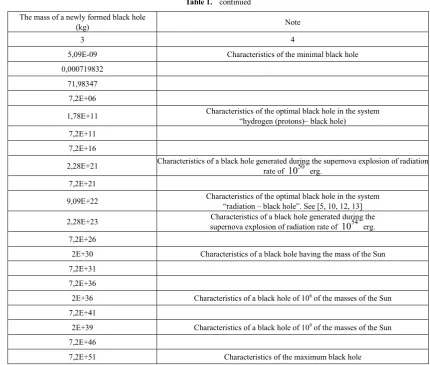
Table 1. continued The mass of a newly formed black hole
(kg) Note
3 4
5,09E-09 Characteristics of the minimal black hole
0,000719832 71,98347
7,2E+06
1,78E+11 Characteristics of the optimal black hole in the system “hydrogen (protons)– black hole)
7,2E+11 7,2E+16
2,28E+21 Characteristics of a black hole generated during the supernova explosion of radiation rate of 1050
erg. 7,2E+21
9,09E+22 Characteristics of the optimal black hole in the system “radiation – black hole”. See [5, 10, 12, 13]
2,28E+23 supernova explosion of radiation rate of Characteristics of a black hole generated during the 1054
erg. 7,2E+26
2E+30 Characteristics of a black hole having the mass of the Sun
7,2E+31 7,2E+36
2E+36 Characteristics of a black hole of 106 of the masses of the Sun
7,2E+41
2E+39 Characteristics of a black hole of 109 of the masses of the Sun
7,2E+46
7,2E+51 Characteristics of the maximum black hole
From the above chart it follows that:
1. The mass of a black hole formed during the supernova explosion is close to the mass of an optimal black hole in the system “a black hole – radiation”. One can expect that during the supernova explosions the black holes be formed having the masses under which the information volume in the adjacent space is close to minimum.
2. For formation of the black holes with the mass equal to million masses of the Sun the volume of information exceeding the volume of information of the Universe (1090 bit) is required [4, 5, 9, 14]. Significant volumes of information are needed for formation of the black holes with the same mass as of the Sun’s. In such case the volume of information of about 1076 is required. It means that locally (in the zone of black hole formation) there must take place the intensive physical processes of radiation formation. For instance, the supernova explosions and accelerated motion of relativistic particles.
10. The Volume of information in the
Neutron Stars and White Dwarfs.
The Information Model of a Neutron
Star and White Dwarf
When evaluating the volume of information in the neutron star we must take into account the volume of information in the structure of the star and in the neutrons. In the neutron fermi-gas during its complete degeneration all the low energy levels are filled in up to the Fermi level while all the subsequent ones remain empty. Temperature rise can change distribution of neutrons in the levels to only a small extent: a small fraction of neutrons sitting in the levels close to the Fermi level pass to the empty levels possessing bigger energy and clear the levels from which the migration took place.
approx. 9,422*(M/m) +(M/m)*log2(M/m) bit. The volume of information in the neutron star is proportional to the mass multiplied by the logarithm of dyadic mass. In a similar way one can evaluate the volume of information in the white dwarfs. Recall for the sake of comparison that the volume of information in the usual substance (non-interacting particles, gas) is proportional to mass, the volume of information in the black hole is proportional to squared mass.
The neutron mass is m=1, 67 10⋅ −27 kg. A number of neutrons in the star with the mass of 1,0 (1,4) of the mass of the Sun is equal to ≈1,18 10⋅ 57 (≈1, 68 10⋅ 57). Therefore, the neutron star with the mass of 1,0 (1,4) of the mass of the Sun contains ≈2,32⋅1059 (≈3,2⋅1059) bit. The neutron star structure contains the amount of information, which is about two orders of magnitude more ≈2,25⋅1059 ( ≈3,16⋅1059 ), than in the neutrons ≈6,93⋅1057 (≈9,7⋅1057).
The most commonly encountered are the white dwarfs consisting of carbon and oxygen with helium-hydrogen shell [7, 15]. Under the masses of white dwarfs 0.6 Мsun - 1.44Msun, with the radiuses equal to the Earth’s the surface temperature can be relatively high (from 100,000 K to 200,000 K). The main feature of their construction is a nucleus, its gravity equilibrium being supported by degenerate electron gas whose properties do not allow any further modifications of its structure. The degenerate gas pressure puts into equilibrium the gravitation (under prescribed mass) and the loss of heat resulting from non-degenerate component of the substance does not change this pressure and the losses alone are relatively insignificant. The fate of the supergiant star remnants depends on the mass of remaining nucleus. When hydrostatic equilibrium breaks down there occurs gravitation collapse (lasting for seconds of fractions of seconds) and if Мkern<1.4Мsun, then the nucleus will shrink up to the Earth dimensions and a white dwarf is produced. If 1.4Мsun<Мkern<3Мsun, then the pressure of incumbent layers will be so strong that the electrons are “forced into” protons thus generating neutrons and emitting neutrino p++e−→ +n νe. The so-called a
degenerate neutron gas is generated. The pressure of degenerate neutron gas halts the subsequent shrinkage of the star. However, it appears that part of the neutron stars are formed during supernova outbursts and appear to be the remnants of massive stars that had exploded as the Supernova of the second type.
For evaluating the volume of information available in the white dwarf of the mass of the Sun we assume that the white dwarf contains more or less equal number of atoms of carbon and oxygen. Then the total number of atoms in the white dwarf of the mass of the Sun is equal to
30
55 27
2 10
8, 55 10
( O) / 2 13 1, 67 10
C O C
M n
m m
c
+ −
⋅
≈ ≈ ⋅
+ ⋅ ⋅
=
.
The number of electrons in the white dwarf of the mass of the Sun is equal to nE ≈5, 99 10⋅ 56. Thus the structure of the white dwarf of the mass of the Sun contains
59
1,13 10
≈ ⋅ bit. The carbon and oxygen atoms of the
white dwarf of the mass of the Sun contain ≈1,11 10⋅ 58 bit. Therefore, the white dwarf of the mass of the Sun contains only ≈1, 24 10⋅ 59 bit.
Emission and absorption of usual substance by the neutron star. The logic of derivation of estimates in the present section is identical to the logic of derivation of estimates for the black hole. Suppose that at the initial instant of time the neutron star consists of n neutrons, possesses the mass of
n n
M = ⋅n m
and contains In =nlog2n+9, 422⋅n bit of
information. The mass of neutron star changes (increases or decreases) by neutrons (quanta) ∆M =mn. Because each
neutron has the mass mn, then the neutron star energy
change in this case is equal to ∆E=mnс2. At the loss of
emission of one neutron the mass of neutron star becomes equal to Mn−1=(n−1)⋅mn . In this case the volume of
information remaining in the neutron star is equal to )
1 ( 422 , 9 ) 1 ( log ) 1
( − 2 − + ⋅ −
= n n n
In bit. Information
change (loss) in the neutron star comes to
= − ⋅ − − −
− ⋅ + =
− =
∆In In In−1 nlog2n ,9422 n (n )1log2(n )1 ,9422 (n )1
= + − −
− +
=log2n (n 1)(log2n log2(n 1)) 9,422
2 2 2
log n n( 1)(log 1 1/ ( 1)) 9, 422 log
(
n n 9, 422= + − + − + ≈ +
bit. For further estimates we use the law of conservation of uncertainty (information) and energy conservation principle. According to the law of conservation of uncertainty (information) any change in the system “neutron star of the mass Mn =n⋅mn– external environment” at the emission
of one neutron of a particle must be compensated by occurrence of log2n+6,8 particles containing 1 bit each:
422 , 9 log2 1= +
−I − n
In n bit. Let us consider that there
have emerged log2n+6,8 photons of frequency ν and
energy h
ν
. By virtue of the energy conservation principle2 2
(log n+9, 422)⋅hν =m cn
and
2
2
(log 9, 422)
n m c
n h
ν =
+ ⋅
. Let us calculate the radiation temperature
2 2
2 2
(log 9, 422) (log 9, 422)
.
n n
m c m c
h h
T
k k n h n k
υ
= = =
+ ⋅ + ⋅
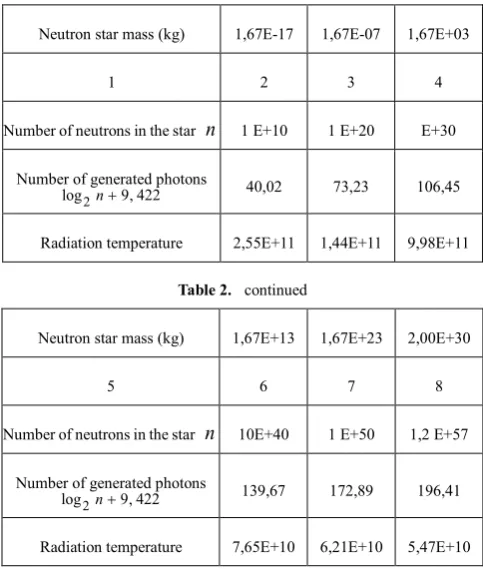
Table 2. Estimate of dependence of the temperature of neutron star radiation on its mass
Neutron star mass (kg) 1,67E-17 1,67E-07 1,67E+03
1 2 3 4
Number of neutrons in the star n 1 Е+10 1 Е+20 Е+30
Number of generated photons
2
log n+9, 422 40,02 73,23 106,45
Radiation temperature 2,55E+11 1,44E+11 9,98E+11
Table 2. continued
Neutron star mass (kg) 1,67E+13 1,67E+23 2,00E+30
5 6 7 8
Number of neutrons in the star n 10Е+40 1 Е+50 1,2 Е+57
Number of generated photons
2
log n+9, 422 139,67 172,89 196,41
Radiation temperature 7,65E+10 6,21E+10 5,47E+10
Note that the given estimate does not take into account the availability of other elements in the neutron stars that decrease the radiation temperature.
Note 4. In the general case there must be generated 422
, 9
log2n+ photons having the frequencies of νi and
aggregated energy 2
log 9,422
2 0 1
n
i i
h ν m c
+
=
=
∑
.Similar dependencies are true for the cases when the neutrons are absorbed by neutron stars. The estimate of radiation temperature of the white dwarf of the mass of the Sun was derived by using information method, which is similar to estimations of black hole and neutron star radiation temperature and is equal to about 3E+07K.
According to the law of conservation of uncertainty (information) the change in the system “neutron star of the mass Mn−1=(n−1)⋅mn – external environment” at the
black hole mass increase by the mass of one black particle must be conditioned by the absorption of log2n+9,422
particles containing 1 bit each: In+1−In =log2n+9,422
bit. Let us assume that there was absorbed log2n+9,422
photons of frequency ν and energy h
ν
. By virtue of the energy conservation principle (log2n+6,8)⋅hν =m cn 2 .The frequency of each absorbed photon must be equal to
2
2
(log 9, 422)
n m c
n h
ν =
+ ⋅ 1/s.
Similar dependencies are also true for the white dwarfs.
11. The Information Volume of the Sun.
Information Model of a Star of the
Sun Type
The Sun consists for the most part from hydrogen (~74% of its mass) and helium (~25% of its mass). The number of hydrogen atoms nH in the Sun amounts to
30
57 27
2 0, 74 10
1, 66 10 0,9 10
H H
Sun M n
m −
⋅ ⋅
⋅
= = ≈ ⋅
. The hydrogen atom contains 11,422 bit. The volume of information in the system consisting of nв hydrogen atoms is 11,422 nH bit. Therefore, hydrogen in the Sun contains
57 58
11, 422 0, 9 10 10
H
I
≈
⋅ ⋅ ≈bit. The helium atom (two protons, two neutrons, two electrones) contains approx. 40 bit of information. The volume of information available in the system consisting of
n
He atoms of helium is equal to 40He
n
bit. Thus, helium in the Sun contains30
57 27
0, 25 5 10
40 40 3 10
1, 66 10 H
He Sun
M m
n
⋅ ⋅ − ≈ ⋅⋅
=
⋅
=
bit. All in all the Sun contains ≈1,3⋅1058 bit of information.
Note 5. Our Galaxy contains over 10 stars, the 11 Universe contains 10 galaxies. Consequently, our Galaxy 11 and the stars contain about 10 bit while the Universe and 69 the stars contain about 10 bit of information. 80
12. Formation of Black Holes from the
Stars
Table 3 presents the masses of black holes. Estimations were based on the assumption that the black holes had been formed from the neutron star, white dwarf of the Sun type. Suppose that the original neutron star possesses a mass equal to the mass of the Sun M
n
=2,00E+30kg, consists of 1,20E+57 neutrons and contains the volume of information equal to In =n(log2n+9, 422)=2,38E+59 bit. Following the transformation a black hole and usual substance are formed. The black hole mass is equal to MBh =km0 while the volume of information in the newly formed black hole isequal to
( 1) 2
k k
I = +
. The number of usual substance particles formed as a result of the merging is equal to x. The volume of information in the usual substance is equal to
I x
equal to m.
From the law of conservation of uncertainty (information) it follows:
( 1)
(log 9, 422)
2 2
n n
I n n x I I
n Bh Us
+
= + = + = +
. Suppose that the main energy of the black holes and usual substance is concentrated in the mass. Then from the energy conservation principle it follows:
0
M nm km xm M M n = n = + = Bh+ Us.
This we have a system consisting of the two equations
0
nm km xm n = + ,
( 1)
(log 9, 422)
2 2
k k
n n+ = + +x in three
unknowns n , x , m . x≥0 . Therefore,
2 ( 1)
(log 9, 422)
2 2 2
k k k
n n+ ≥ + ≈ , k≤ 2 (logn 2n+9,422)
and 2 (log2 9,422)
0 0
M km m n n
Bh = ≤ + (restriction on the
mass of a black hole formed from the neutron star). At n
=1,20E+57 (log 9, 422) 2
I n n
n = + =2,38E+59 bit
59 58 29
2 2,38 10 47,6 10 7 10
k≤ ⋅ ⋅ = ⋅ ≈ ⋅ . As far as m0
=5,09E-09kg, then 7 1029 3, 5 1021 0
M m
Bh ≤ ⋅ ≈ ⋅ kg.
Let us consider the following example. Suppose that the neutron star consists of 1,20E+57 neutrons, possesses the mass equal to the mass of the Sun
M
n
=2,00E+30kg and contains the volume of information equal to(log2 9, 422)
I n n
n = + =2,38E+59 bit. The resulting black
hole consists of k=3E+29 particles (it has the mass of 1,5 E+21kg and contains 4,5E+58 bit). The resulting number of usual substance particles (radiation quanta) is equal to 1,9E+59. The total mass of usual substance is equal to (2,00E+30 – 1,5E+21) kg. The average mass of particles (radiation quanta) is about E-29kg. Radiation frequency is equal to approx. 2 10 299 1016 1021
34 6,6 10
mc h
ν
− ⋅ ⋅
= = ≈
− ⋅
1/s. This is the bottom boundary of hard gamma radiation [16]. Thus the volume of information in the neutron star of the mass of the
Sun (~2,38E+59 bit) is sufficient for the formation of a black hole of the mass of ~3E+24g.
Suppose that the original white dwarf possesses the mass equal to the mass of the Sun MSun=2,00E+30kg and contains the information volume equal to 1,24E+59 bit.
Because log 129, 5 ( 1)
2 2 2
2
k k k n n n
C O
e e
+
+ ⋅ ≥ ≈
+ ,
2 log2 129,5)
k ≤ ne ne+nC O+ ⋅ and
2 log2 129,5)
0 0
MBh =km ≤m ne n ne C O+ + ⋅
(restriction on the mass of a black hole formed from the white dwarf). When the volume of information in the white dwarf is equal to 1,14E+59 bit. k≤4, 8 10⋅ 29. Because m0
=5,09E-09kg, then 5 1029 2, 4 1021 0
M m
Bh ≤ ⋅ ≈ ⋅ kg.
Suppose that the original star is the star of the Sun type having the mass equal to the mass of the Sun
Mn =2,00E+30kg and contains the volume of information equal to ≈1,3⋅1058 bit. The mass of the newly
formed black hole is equal to
0
M km
Bh = , the volume of
information in the newly formed black hole is equal to
2 ( 1)
2 2
k k k
I = + ≈ . Because the star of the Sun type contains
only the usual substance, then the mass of the black hole under formation is equal to 2
0 0
M m k m IUs
Bh = = In the
case under study
9 58 9 58
2 5, 09 10 2 1,3 10 5, 09 10 2,6 10
0
M m I Us Bh
− −
= ≈ ⋅ ⋅ ⋅ = ⋅ ⋅ ≈
9 29 20
5, 09 10− 1, 6 10 8 10
≈ ⋅ ⋅ ⋅ ≈ ⋅ kg.
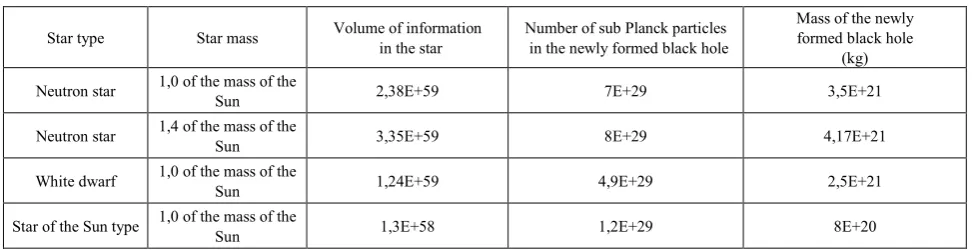
[image:9.595.62.551.630.755.2]One can see from the table 3 that the mases of the black holes that can be generated during formation of black holes from neutron star, white dwarf, star of the Sun type are close to the mass of the optimal black hole (in the system “black hole – radiation”) - 8,08E+22kg.
Table 3. Mass of the newly formed black hole
Star type Star mass Volume of information in the star in the newly formed black hole Number of sub Planck particles Mass of the newly formed black hole
(kg)
Neutron star 1,0 of the mass of the Sun 2,38E+59 7E+29 3,5E+21
Neutron star 1,4 of the mass of the Sun 3,35E+59 8E+29 4,17E+21
White dwarf 1,0 of the mass of the Sun 1,24E+59 4,9E+29 2,5E+21
13. Black Hole Merger
Let us consider a system consisting of the two black holes. Suppose that the black holes have the mass of M1=n m1 0,
2 2 0
M =n m ( m0 - the minimal black hole mass,
1, 2 1, 2,..
.
n n = ) and contain the volume of information equal to 1 1
1
( 1)
2
n n
I = + and 2 2
2
( 1)
2
n n
I = + . The mass of the system is equal to M1 2+ =(n n m1+ 2) 0 , the volume of information in the system is 1 1 2 2
1 2
( 1) ( 1)
2 2
n n n n
I+ = + + + . Is it possible that a black hole is formed as a result of the two given black holes merger and only two given black holes? The mass of a new black hole must be equal to the sum of the masses of the original black holes
M M
=
1 2+=
(
n n m
1+
2)
0.The volume of information in the new black hole must be equal to ( 1 2)( 1 2 1)
2
n n n n
I = + + + . It is obvious that under no masses of the original black holes the volume of information in the newly formed black hole would coincide with the total volume of information in the original black holes
2 2
1 2 1 2 1 1 2 1 1 2 2 2
( )( 1)
2 2
n n n n n n n n n n n n I= + + + = + + + + + ≠
2 2
1 1 2 2 1 1 2 2
1 2
( 1) ( 1)
2 2 2
n n n n n n n n
I I
+ + + + +
+ +
≠ = = .
Let us consider the following example. Suppose that the mass of the black holes is M1=M2 =m0 and they contain
the volume of information equal to I1=I2 =1. The mass of the system is M1 2+ =2m0, the volume of information in the system is I1 2+ =1 1+ =2.
Is it possible that a black hole is formed as a result of merging the two black holes of the minimal mass and only the two given black holes of the minimal mass? The mass of a new black hole must be equal to the sum of masses of the original black holes M =M1 2+ =2m0 . The volume of information in a new black hole must be equal to
(1 1)(1 1 1) 3 2
I = + + + = . Apparently the volume of information in a new black hole does not coincide with the aggregated volume of information in the original black holes.
We give a system of equations for estimation of the mass of a black hole under formation when the two black holes are merged.
Let us suppose that the black holes before merging possess the mass of M1 =n m1 0, M2 =n m2 0 (m0=5,09E-09kg - is the
minimum mass of the black hole n n1, 2=1, 2,..
.
) andcontains the volume of information equal to 1 1 1
( 1)
2
n n I = +
and 2 2 2
( 1)
2
n n
I = + . As a result of the original black holes a black hole and usual substance are created. The mass of the black hole after the merger is equal to
1 2 0
M =nm
+ , the mass of information in the newly formed black hole is equal to
( 1)
1 2 2
n n I = +
+ . A number of particles of usual substance that have been formed after the merger is equal to
x
. The volume of information in the usual substance is equal toI x
Us = . The average mass of a particle of usual substance is
equal to m.
From the law of conservation of uncertainty (information) it follows:
( 1) ( 1) ( 1)
1 1 2 2
1 2 2 2 2 1 2
n n n n n n
I I x I I
Us
+ + +
+ + + +
+
= = = .
We believe that the main energy of black holes and usual substance is concentrated in the mass. Then from the energy conservation principle it follows:
( )
1 2 1 2 0 0
M +M = n +n m =nm +xm. Thus we have a two-equations system
( 1) ( 1) ( 1)
1 1 2 2
2 2 2
n n n n n n
x
+ + +
+ = + ,
(n1+n m2 0) =nm0+xm, with three unknowns n, x,
m . x≥0 . Hence,
( 1) ( 1) ( 1)
1 1 2 2
2 2 2
n n + n n + n n+
+ ≥
, or at
1
n>>
2 2 2
1 2
n ≤n +n
(restriction on the mass of the black hole after merging).
Next we have
2 2 2 2
1 1 2 2
n +n +n +n −n −n = x
, ( )
1 2 0 0
n +n m =nm +xm.
And
2 2 2
1 1 2 2
2
n n n n n n x= + + + − − ,
(1 2 ) 0 2(1 2 )
0
2 2 2
1 1 2 2
n n n m n n n
m m
x n n n n n n
+ − + −
= =
+ + + − − .
At n>>1
2m0 m
n ≈
.
The following assertions are valid.
Assertion 1. A black hole cannot be created by means of merging the two black holes and only two black holes. Merging of black holes can occur only with the absorption and emission of usual substance.
merging k black holes and only k black holes. Merging of black holes can occur only with extra absorption and emission of usual substance.
Assertion 3. A black hole can reduce its mass through emission of usual substance and only it into space. A black hole can increase its mass through absorption of usual substance and only it from space. During the two black holes merger one of them should emit usual substance into space while another one should absorb usual substance from space.
Assertion 4. During the merger of two black holes having the masses M1=n m1 0, M2 =n m2 0, without using any additional usual substance, the mass of a newly formed black
hole is less than
2 2 2 2
1 2 1( 1 1) 2( 2 1) 0 1 2 0 1 2
M+ = n n + +n n + m ≈ n +n m = M +M .
During the merger of two black holes having the same masses M1=M2 =nm0, the mass of a newly formed black hole is less than
2
1 2 2 0 0 2 2 1 2 2
M + = n m
=
nm = M = M . The massof a black hole that was formed as a result of the merger of 2 black holes of the same masses without using any additional usual substances is 2 times less than the sum of masses of merging black holes. The remaining mass is dissipated in the space.
Assertion 5. During the merger of kblack holes having the mass of Mi =n mi 0 without using any additional usual substance, the mass of a newly formed black hole is less than
2 2
1 2 ... 0 0
1 1 1
( 1)
k k k
k i i i i
i i i
M + + + m n n m n M
= = =
+ ≈
=
∑
∑
=
∑
.During the merger of k black holes of the same masses
0 i
M =nm =M without using any additional usual substance, the mass of a newly formed black hole is les than
M k k nm m kn
M + + +k = 2 0 = 0 = ...
2
1 . The mass of a
black hole that was formed as a result of the merger of k black holes having the same masses is k times less than the sum of masses of merging black holes. The remaining mass is dissipated in the space.
A system consisting of the two black holes and usual substance. Let us consider a system consisting of the two black holes and usual substance. The black holes possess the same mass M1,0 =nm0, M2,0 =nm0 and contain the same volume of information 1,0 ( 1)
2
n n
I = + and 2,0 ( 1) 2
n n
I = + .
The usual substance is represented by the photons having different frequencies (energy) E h=
ν
, each of them according to the foundational principle of Zeilinger quantum mechanics contains one bit of information.Assertion 6. During the merger of k black holes having the same masses M1=nm0 and M2 =nm0 and
containing the same volumes of information 1 ( 1) 2
n n
I = +
and 2 ( 1)
2
n n
I = + , the absorbing black hole must absorb by
2
n bit information more than contained in the absorbed black hole 2 ( 1)
2
n n
I = + - the absorbing black hole must absorb additionally n2 particles of usual substance, each of them containing one bit of information.
Assertion 7. The merger of the two black holes having the masses of M1=n m1 0 and M2 =n m2 0 and containing the
volumes of information 1 1
1 ( 1)
2
n n
I = + and
2 2 2 ( 1)
2
n n
I = + resulting in one black hole formation, requires the usage of extra nf
=
n n1 2 radiation quanta –2 1
n
n
particles of usual substance each of them containingone bit of information.
14. Estimation of the Volume of
Information in the Planck Particle
Energy necesary for formation of one bit is not less than
ln 2
kT [6, 17]. Energy necessary for formation of one Nat is not less than kT.
Mass necessary for formation of one bit is not les than
2
ln 2
kT
c . Mass necessary for formation of one Nat is not less
than
2 kT
c . At Planck temperature
1, 41696 10
5
32
1
Pl K
c T
k G ⋅
= = [18] the mass necessary for
formation of one Nat is not less than Planck mass
5 2
2, 17671 10
Pl
Pl
kT c
m m
G c
g
− ⋅
= = = = , the mass
necessary for formation of one bit is not less than ln 2 0, 69
Pl Pl
m ≈ m =1,5 10⋅ −5g..
«Fourteen billion years ago at birth of the Universe it was enclosed in the point with the radius of 10-33cm, which is incommensurably smaller then the proton
radius - 10-13cm. In that volume all the information about the
future of the Universe had already been built-in. The Big Bang occurred» (A.Cherepashuk [19]). 10-33 cm – is the size
information (≈ 1,45 bit) while the information about the Universe contains not less than ≈ 1014 bit of classical
information. Hence, all the information about the future of the Universe was enclosed in the Universe segment of the radius larger than 10-33cm. It is not impossible that similar
informational considerations would allow to prove either independent development of the Universe determined by the information (heterogeneity) contained in it, or the presence of additional external control executed from outside of the Universe.
15. Conclusion
The results presented in this paper show the effectiveness of informational approach for studying the cosmological objects.
1. We consider the following system of q-bits: non interacting q-bits in the system, the system having n basic states, q-bits pairwise interaction in the system, local q-bit interaction in the system.
2. It is shown that in the general case, the volume of information In in the system of n q-bits is larger or equal to
zero bits and is not larger than n(n+1)/2 bit.
3. It is shown that the information volume contained in the black hole is proportional to its squared mass. A black hole is the aggregate of particles (black particles) each having a mass equal to 0.23th of Planck mass and interacting with all other black particles that form a black hole. The estimates of black holes distribution by mass one can calculate the intensity of aggregated distribution of black holes radiation by frequencies and compare them with the experiment results. From the obtained radiation frequency expression one can draw the estimate of black hole radiation temperature. Are given information characteristics of black holes of different masses.
4. The neutron star with the mass of the Sun contains
59
10 32 ,
2 ⋅
≈ bit.
5. The white dwarf with the mass of the Sun contains
59
1, 24 10
≈ ⋅ bit.
Estimate of dependence of the temperature of neutron star radiation on its mass (number of neutrons in the star).
6. The Sun contains ≈1,3⋅1058 bit of information.
7. The mases of the black holes that can be generated during formation of black holes from neutron star, white dwarf, star of the Sun type are close to the mass of the optimal black hole (in the system “black hole – radiation”).
8. A black hole cannot be created by means of merging some black holes and only some black holes. Merging of black holes can occur only with the absorption and emission of usual substance. The mass of a black hole that was formed as a result of the merger of 2 black holes of the same masses without using any additional usual substances is 2 times less than the sum of masses of merging black holes. The remaining mass is dissipated in the space.
9. All the information about the future of the Universe was
enclosed in the Universe segment of the radius larger than 10-33cm.
10. In future the proposed models and estimations should undoubtedly be specified and presented in more detailed way.
REFERENCES
[1] Zeilinger A. A Foundational Principle for Quantum Mechanics", Foundations of Physics 29 (4): 631-43. (1999), [2] Shannon C. A Mathematical Theory of Communication //
Bell System Technical Journal. (1948) Т. 27. p. 379-423, 623–656.
[3] Stratonovich R.L. Information Theory. (In Russian). Moscow: Soviet Radio, 1975.
[4] Gurevich I.M. Law of informatics - a basis of researches and designing of complex communication and management systems. (In Russian) «Ecos». Moscow (1989) 60 p.
[5] Gurevich I.M. «Informatics Laws - a basis of a structure and cognitive of complex systems». (In Russian) The second edition. Moscow. «Torus Press». (2007).
[6] Valiev K.A. Kokin A.A. Quantum computers: Hope and reality. (In Russian) Scientific and publishing center "Regular and chaotic dynamics". Moscow-Izhevsk (2004) p. 320.
[7] Shapiro S., Teukolsky S. Black Holes, White Dwarfs and neutron Stars. Cornell University, Ithasa, New York. (1983). [8] Gurevich I.M. Information characteristics of the
entanglement states. (In Russian). Magazine Information technologies. № 5. Moscow. 2006.
[9] Penrose R. The Emperor's New Mind. Oxford University Press. (1989) 466 p.
[10] Gurevich I.M. Information model of a black hole. (In Russian). Works of the conference ВАК-2007. 2007. Kazan. [11] June gamma-ray burst did not fit into the theory.
http://elementy.ru/news/430418.
[12] Gurevich I.M. On information models in cosmology. (In Russian). Systems and Means of Informatics. Issue 17. IPI RAN. Moscow. 2007. pp. 164-183.
[13] Gurevich I. About restrictions on volume of the information in the Universe. 58 th International Astronautical Congress – 2007 (IAC 2007).
[14] Lloyd S. Computational capacity of the Universe. arXiv:quant-ph/0110141 v1 24 Oct 2001.
[15] http://crydee.sai.msu.ru/~mir/Star_Life.site/Structure/Star_m odels/Dwarfs/wdmod.htm
[16] http://elementy.ru/posters/spectrum/gamma.
[17] Brillouin L. Science and information theory. (In Russian) Fizmatgiz. Moscow (1960), 392 p.
theory. History. Physics. Philosophy. (In Russian) Works of the international conference, NIA-Nature. Moscow. 2002. pp.105-113.