Transactions
COMMUNICATION
Cite this:Dalton Trans., 2016,45, 1349
Received 9th December 2015, Accepted 21st December 2015
DOI: 10.1039/c5dt04820f
www.rsc.org/dalton
Structural variation in cation-assisted assembly of
high-nuclearity Mn arsonate and phosphonate
wheels
†
Theresa O. Chimamkpam,
aRodolphe Clérac,
b,cDmitri Mitcov,
b,cBrendan Twamley,
aMunuswamy Venkatesan
dand Wolfgang Schmitt*
aComproportionation reactions between MnCl2and KMnO4in the
presence of arsonate or phosphonate ligands promote the cation-assisted assembly of high-nuclearity, wheel-shaped or toroidal {Mn8} (1) and {Mn24} (2) complexes; the closely corresponding
reaction systems provide insights into the complexation behaviour of homologous phosphonate/arsonate ligand species.
Organophosphonate-stabilised transition metal complexes have received significant attention mainly due to their interest-ing structures, their hydrolytic stabilities and potential appli-cations in different areas such as catalysis, ion exchange technologies, corrosion inhibitor materials, proton conduc-tors, photochemistry, molecular magnetism etc.1 Their
strong coordination ability towards transition metal ions enabled the synthesis of extended networks and oxo-clusters incorporating various transition metal systems.2Of particular
interest in the area of molecular magnetism are 0-D Mn phos-phonate species in which competing ferromagnetic and anti-ferromagnetic interactions in combination with magnetic anisotropy can give rise to slow relaxation of the magnetisation and quantum effects,i.e.Single-Molecule Magnet (SMM) pro-perties.3 Applied synthetic approaches to nanoscopic
mole-cular species include self-assembly approaches, hydrolysis or condensation reactions in the presence of suitable ligands, redox-mediated aggregate formations or reactions of phospho-nate ligands with preformed Mn complexes in the presence of different bases.2c,4 Although the structural chemistry of
orga-noarsonates and phosphonates is generally expected to be similar, the coordination chemistry of the former is less inves-tigated and their capacity as complexing agents has not yet
been fully explored.5To date, Mn/organoarsonate-based SMMs
or larger complexes6have not yet been reported, thus, studies
are required to understand the chemistry of this ligand system. We previously developed supramolecular approaches to mixed-valent Mn/phosphonate oxo-clusters whereby halide ions allowed us to direct the assembly of distinct building units that form upon comproportionation between MnCl2and
KMnO4.7 These assembly processes using Cl− ions as
struc-ture-influencing agents are comparable to template effects observed in polyoxometalate chemistry, i.e. processes that result in nanoscopic polyoxovanadate Keplerates in which Archimedean VIV/Vpolyhedra incorporate Platonic halide
tem-plates.8 This interest in template syntheses, prompted us to
explore the possibility of developing cation-assisted syntheses of large polynuclear species. The motivation was provided by studies, which demonstrate that cation-induced wheel struc-tures can be used for the synthesis of rotaxanes that allow the investigation of tunnelling effects or point towards appli-cations as qubits for quantum information processing devices (QIP).9
To pursue these objectives we modified previously develo-ped synthetic approaches and increased in comproportiona-tion reaccomproportiona-tions between KMnO4 and MnCl2 the oxidant/Cl−
ratio. Furthermore, we introduced dipicolinic acid as a poten-tial co-ligand. The latter is a good chelating ligand whose donor atoms preferentially occupy meridional binding sites in octahedral complexes; this binding behaviour was expected to limit 3D hydrolytic growth reactions or the formation of extended 2D/3D phosphonate/arsonate precipitates thus increasing the propensity to obtain 0D oxo/hydroxo species.10
The approach resulted in two toroidal, high-nuclearity coordination complexes: the {Mn8} complex in
[K(H2O)2⊂MnIII8(μ-OH)2(CH3OH)2(PhAsO3)4(PhAsO3H)6 (dipic)4
]-Cl·18H2O·4CH3OH (1) and the {Mn24} species in
(H3O)4[K2(H2O)2⊂Mn24(μ3-O)4(μ-OH)4(μ-CH3O)4(H2O)8(PhPO3)20
(dipic)12][Mn(H2O)6]·solv (2) which both assemble around
stabilising K+ ions. The latter represents one of the largest
wheel-shaped Mn-oxo complexes; {Mn8} is a rare example of a
polynuclear arsonate-stabilised Mn species. The closely related
†Electronic supplementary information (ESI) available: Additional crystallo-graphic data, syntheses, magnetic data, TGA and FTIR. CCDC 1428584 and 1428585. For ESI and crystallographic data in CIF or other electronic format see DOI: 10.1039/C5DT04820F
a
School of Chemistry & CRANN, University of Dublin, Trinity College, Dublin 2, Ireland. E-mail: [email protected]; Tel: +353-1-896-3495
bCNRS, CRPP, UPR 8641, F-33600 Pessac, France c
Univ. Bordeaux, CRPP, UPR 8641, F-33600 Pessac, France
dSchool of Physics & CRANN, University of Dublin, Trinity College, Dublin 2, Ireland
Published on 21 December 2015. Downloaded by Trinity College Dublin on 13/12/2016 12:26:15.
View Article Online
reaction conditions of both systems provide comparative insights into the coordination behaviour of homologous organoarsonate and phosphonate ligands.
1crystallises in the monoclinic space groupC2/c and con-tains an octanuclear MnIIIcomplex that assembles around a central, hydrated K+ ion (Fig. 1). The {Mn8} complex in 1 is
stabilised by ten partially deprotonated organoarsonate ligands, four dipicolinate ligands, twoμ-OH−ligands and two coordinating methanol molecules. The core consists of two symmetry-related bent tetranuclear units with a C2 symmetry
axis coinciding with the atom positions of the central K+ion. Each symmetry-independent tetranuclear unit consists of four Mn ions connected through five organoarsonate and two dipi-colinate ligands (ESI†). All the Mn ions in 1 adopt distorted octahedral coordination geometries and each ion resides in the oxidation state +III as confirmed by bond valence sum (BVS) analyses and consistent with their Jahn–Teller distorted geometries.11The distorted nature of the coordination geome-tries of the Mn ions mainly arises from the geometrical restric-tions of the binding dipicolinate ligands. Within the bent, tetranuclear subunits, the Mn coordination polyhedra share
common vertices whereby the common O donors are provided by a μ-OH− and two dipicolinate ligands. Each tetranuclear unit consists of three outer bridging PhAsO3H−and two inner
bridging PhAsO32−ligands which adopt bidentateμ–η1:η1:η0
bridging modes. In the solid state, the {Mn8} complexes are
linked by weak H-bonds involving the constitutional solvent molecules and the O atoms of the arsonate and dipicolinate ligands. In the direction of the crystallographicb-axis, the ring structures stack on top of each other to form 1D tubular chan-nels (ESI†). It should be noted that in1, a K+ion stabilises the ring structure whereas in the previously reported {Mn13}
derivatives, Cl− ions act as structure directing agents.7 The reason for this modified reaction behaviour can be attributed to the increased relative quantities of the KMnO4. Contrarily,
in the absence of the oxidant, no isolable product was obtained. The {Mn8} complex in 1 joins the small class of
molecular Mn arsonates and is to the best of our knowledge the highest nuclearity Mn-arsonate complex reported to date.
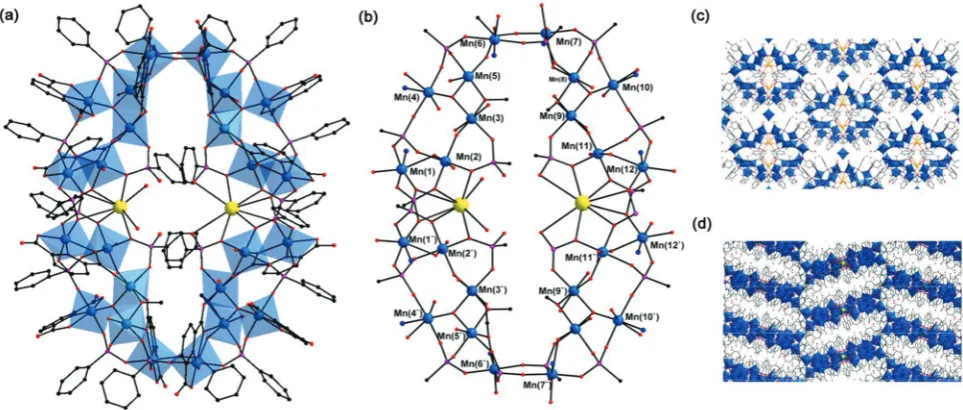
2 forms when phenyl arsonic acid, that afforded the for-mation of1, is substituted by the corresponding phenyl phos-phonic acid in the reaction mixture.2crystallises in the space groupPnn2. The tetraicosanuclear complex in 2 (Fig. 2) con-sists of two bent symmetry-equivalent {Mn12} units which are
linked to each other through donor atoms of four phosphonate functionalities. The {Mn12} units can formally be sub-divided
into two {Mn6} units that are linked through O atoms of two
phosphonate functionalities, which double-bridge the two sub-units to form the {Mn12} moiety (ESI†). Within each {Mn6}
subunit, the six Mn ions are connected through five fully deprotonated PhPO32−, three dipicolinate ligands, oneμ-OH−,
one μ3-O2− and one μ-CH3O− ligands. The PhPO32− ligands
adopt eitherμ3–η1:η1:η1orμ–η1:η1:η0bridging modes. The coordination cluster in 2 can be considered as a wheel/cage with two crystallographically independent K+ ions located at the centre. One K+ ion is coordinated to six phosphonate O atoms and two H2O molecules, whilst the second K+ion, is
exclusively coordinated to phosphonate O donor atoms. It is noteworthy that with the exception of two phosphonate ligands, all the O-donor atoms of the remaining 18 phos-phonate ligands are involved in bonding to Mn or K+ centres (Fig. 2). The oxidation states of the Mn centres in 2 were assessed by BVS analysis (ESI†) and structural analysis consid-ering the degree of protonation of the O-donor ligands and the coordination geometries of the Mn centres. Whilst the BVS values are slightly high, the magnetic susceptibility data suggests that all 24 Mn centres in the cluster core of2adopt the oxidation state +III (see below).
The packing arrangement in 2 is stabilised by H-bonding interactions involving the O atoms of the ligands and consti-tutional solvent molecules. This arrangement creates cavities occupied by large quantities of lattice solvent molecules, and isolated [MnII(H2O)6]2+ complexes. The large cavities may
contain further charge-balancing hydronium ions, which have previously been observed to form in similar protic reaction systems.12 In the direction of the crystallographic c-axis, the {Mn24} complexes pack to form an assembly in which the Fig. 1 Structure of the octanuclear Mn complex in1; (a)
symmetry-independent unit; (b) polyhedral representation of the complex; colour code: Mn blue, As orange, K yellow, N blue, C black. All H atoms have been omitted for clarity.
[image:2.595.81.249.49.372.2]{Mn24} cores are separated by the organic ligands and
consti-tutional water molecules, Fig. 2. To account for the diffuse electron density due to the large quantity of solvent molecules, we applied the Platon routine SQUEEZE during the crystallographic refinement (accounted for 1441 electrons per unit cell; void volume 4941.5 e Å−3). The significant solvent content is further reflected in the thermogravimetric analysis (ESI†).
The {Mn24} complex in2joins the family of molecular Mn
phosphonate species,2c,4,13 and may also be discussed in the context of other larger wheel-shaped complexes.14 It further relates to the largest previously reported Mn phosphonate species, {Mn18},15 {Mn19},16 {Mn20},17 {Mn22}18 or other
recently or previously phosphonate species.2c,4The distinctive differences of the here reported {Mn24} complex arise from the
influencing role of themer-coordinating dipicolinates and the K+ions. The latter direct the subunits into a wheel structure. This cation-effect further distinguishes the present reaction system from previously investigated Mn/phosphonate systems in which lower relative KMnO4: MnCl2mole ratios give rise to
Cl− influenced assembly processes. In these systems, the halide ions act as {Mn4} capping ligands located in Jahn–Teller
sites at the periphery of the final complex.7 It is noteworthy that related polyoxovanadate/phosphonate systems incorporate {V4}-stabilising halide templates in their cavities (see
sche-matic in ESI†).8
To our knowledge, there has not been any report that describes the reactivity of organoarsonates and phosphonates in identical Mn-based systems. Thus, the comparable con-ditions that led to the formation of 1 and 2 provide some insights into the reactivity of the homologous ligands. Although their binding behaviour is generally expected to be
closely comparable, the larger ionic radius of AsVcompared to PVcan lead to structural differences.5Moreover, their reactiv-ities in protic solvents are significantly influenced by their varying acid strengths, whereby the pKa values of PhAsO3H2
(3.39 and 8.25) are significantly higher than those of PhPO3H2
(1.86 and 7.51).19Indeed the structural differences observed in
1and2can be attributed to the degree of protonation of the arsonate and phosphonate ligands. The 20 fully deprotonated phosphonates in2increase the connectivities between the Mn centres and facilitate μ3–η1:η1:η1 bridging modes. A larger relative number of arsonate moieties in1remain partially pro-tonated and their coordination mode is restricted to bidentate μ–η1:η1:η0 binding. Similar structural effects can also be
observed in other transition metal arsonate systems where the lower pKavalues of the phosphonic acids result in 3D MOFs20
whilst protonated arsonates give rise to lower-dimensional 1D polymers or 2D structures.5
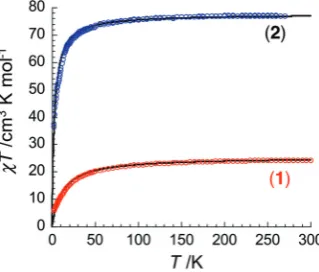
Magnetic properties of 1 and 2 were studied at 1000 Oe between 1.8 and 300 K (Fig. 3). At room temperature, theχT
product of 1 reaches ca. 24.3 cm3 K mol−1, which is in good agreement with the presence of 8 high-spin MnIII sites (S= 2,C= 3 cm3K mol−1,g= 2). On decreasing the tempera-ture, theχTproduct decreases slowly to 22.6 cm3 K mol−1at 100 K and then sharply to 5.9 cm3 K mol−1 at 1.85 K. This thermal dependence reveals the presence of dominating anti-ferromagnetic interactions, between the Mn centres in 1 (Curie–Weiss fit of the data shown in Fig. 3 leads to C = 25.3 cm3K mol−1 andθ =−12 K). Moreover, the field depen-dences of the magnetisation below 8 K (Fig. S3†) show that the magnetisation of 1 does not saturate even at 1.9 K and 7 T reaching a low value of 14.5μB. In agreement with theχT vs. T
data, this behaviour is the direct consequence of the
intra-Fig. 2 (a) and (b) Polyhedral and ball-stick representation of the {Mn24} complex in2; in (b) only the cluster core structure is shown; (c) and (d) Packing arrangement of2viewed in the direction of the crystallographicb- andc-axes, respectively. Colour code: Mn blue, N dark blue. C black, P pink, K yellow, O red (all H-atoms have been omitted for clarity).
[image:3.595.56.538.51.256.2]molecular antiferromagnetic interactions, which induces low lying excited states that may be populated under an applied dc field. Moreover, it is likely that the observedM vs. Hbehaviour is also influenced by a substantial intrinsic magnetic an-isotropy of the MnIIIions.
Preliminary studies of the magnetic properties of2shown in Fig. 3 reveal a room temperature χT product of ca. 77.3 cm3 K mol−1 in agreement with the calculated value of 76.4 cm3K mol−1for 24S= 2 MnIIIand oneS= 5/2 MnII mag-netic centers. With decreasing the temperature, theχTproduct decreases to 70.2 cm3 K mol−1 at 30 K and then to 36.5 cm3K mol−1at 1.9 K indicating the presence of dominat-ing antiferromagnetic interactions in2(Curie–Weiss fit leads toC= 77.6 cm3K mol−1andθ=−2.8 K). As for1, the magneti-sation of2does not saturate in the investigated regime (reach-ing 75.6 μB at 1.9 K and 7 T) as expected in presence of
intramolecular antiferromagnetic interactions/low lying excited states and significant magnetic anisotropy (ESI†).
In summary, we have conducted a comparative study using phenylarsonate and phosphonate ligands to stabilize high-nuclearity {Mn8} (1) and {Mn24} (2) complexes. Their assembly
is influenced by the binding mode of dipicolinate co-ligands and central K+ions to produce toroidal structures. The struc-tural differences between 1 and 2 reflect the different pKa
values of the organoarsonate and phosphonate ligands, whereby fully deprotonated phosphonates have a high propen-sity to bridge between Mn centres and resulting in a higher nuclearity species. The results can be viewed in the context of other Mn and V phosphonate systems and provide insights into the underlying assembly-processes. The reported synthesis may provide a new approach to the cation-assisted synthesis of polynuclear Mn-based complexes which may assemble around various different inorganic or organic cations.
This work was supported by Science Foundation Ireland (SFI, 13/IA/1896 & 08/IN.1/I2047), the European Research Council (ERC CoG 2014 - 647719), by the CNRS, the University of Bordeaux and the Conseil Régional d’Aquitaine.
Notes and references
1 (a) Z.-Y. Du, A. V. Prosvirin and J.-G. Mao, Inorg. Chem., 2007, 46, 9884; (b) J.-G. Mao, Z. Wang and A. Clearfield,
Inorg. Chem., 2002,41, 2334; (c) A. Clearfield,Curr. Opin. Solid State Mater. Sci., 1996,1, 268.
2 (a) G. K. H. Shimizu, R. Vaidhyanathan and J. M. Taylor,
Chem. Soc. Rev., 2009,38, 1430; (b) K. J. Gagnon, H. P. Perry and A. Clearfield,Chem. Rev., 2012,112, 1034; (c) J. Goura and V. Chandrasekhar, Chem. Rev., 2015, 115, 6854 (and refs. therein).
3 (a) R. Sessoli, H.-L. Tsai, A. R. Schake, S. Wang, J. B. Vincent, K. Folting, D. Gatteschi, G. Christou and D. N. Hendrickson, J. Am. Chem. Soc., 1993, 115, 1804; (b) G. Christou, D. Gatteschi, D. N. Hendrickson and R. Sessoli, MRS Bull., 2000, 25, 66; (c) S. M. J. Aubin, M. W. Wemple, D. M. Adams, H.-L. Tsai, G. Christou and D. N. Hendrickson, J. Am. Chem. Soc., 1996, 118, 7746; (d) A. Caneschi, D. Gatteschi, R. Sessoli, A.-L. Barra, L. C. Brunel and M. Guillot, J. Am. Chem. Soc., 1991,113, 5873; (e) R. Sessoli, D. Gatteschi, A. Caneschi and M. A. Novak, Nature, 1993, 365, 2; (f) D. Gatteschi and R. Sessoli, Angew. Chem., Int. Ed., 2003, 42, 268; (g) L. F. Jones, A. Batsanov, E. K. Brechin, D. Collison, M. Helliwell, T. Mallah, E. J. L. McInnes and S. Piligkos,
Angew. Chem., Int. Ed., 2002, 41, 4318; (h) W. Wernsdorfer and R. Sessoli, Science, 1999, 284, 133; (i) E. K. Brechin, R. A. Coxall, A. Parkin, S. Parsons, P. A. Tasker and R. E. P. Winpenny,Angew. Chem., Int. Ed., 2001,40, 2700. 4 G. E. Kostakis, A. M. Ako and A. K. Powell,Chem. Soc. Rev.,
2010,39, 2238 (and refs. therein).
5 J.-D. Lin, R. Clérac, M. Rouzières, M. Venkatesan, T. O. Chimamkpam and W. Schmitt,CrystEngComm, 2014,
16, 7894.
6 F.-Y. Yi, Q.-P. Lin, T.-H. Zhou and J.-G. Mao,Inorg. Chem., 2010,49, 3489.
7 L. Zhang, R. Clérac, P. Heijboer and W. Schmitt, Angew. Chem., Int. Ed., 2012,51, 3007.
8 L. Zhang and W. Schmitt, J. Am. Chem. Soc., 2011, 133, 11240.
9 (a) C.-F. Lee, D. A. Leigh, R. G. Pritchard, D. Schultz, S. J. Teat, G. A. Timco and R. E. P. Winpenny,Nature, 2009,
458, 314; (b) M. Affronte, F. Troiani, A. Ghirri, S. Carretta, P. Santini, V. Corradini, R. Schuecker, C. Muryn, G. Timco and R. E. Winpenny, Dalton Trans., 2006, 2810; (c) G. A. Timco, S. Carretta, F. Troiani, F. Tuna, R. J. Pritchard, C. A. Muryn, E. J. L. McInnes, A. Ghirri, A. Candini, P. Santini, G. Amoretti, M. Affronte and R. E. P. Winpenny,Nat. Nanotechnol., 2009,4, 173.
10 (a) R. Uhrecký, J. Moncol, M. Koman, J. Titišand R. Boča,
Dalton Trans., 2013,42, 9490; (b) B. Das and J. B. Baruah,
Polyhedron, 2012,31, 361.
11 W. Liu and H. H. Thorp, Inorg. Chem., 1993, 32, 4102.
12 (a) S. Bhattacharya, M. Gnanavel, A. J. Bhattacharyya and S. Natarajan,Cryst. Growth Des., 2014,14, 310; (b) Y. Kim,
Fig. 3 Temperature-dependence of theχTproduct for the coordination compound containing the polynuclear complexes1(red symbols) and2 (blue symbols) at 1000 Oe (χis defined as molar magnetic susceptibility equal toM/H). The black lines are thefits discussed in the text.
[image:4.595.87.247.51.187.2]S. Das, S. Bhattacharya, S. Hong, M. G. Kim, M. Yoon, S. Natarajan and K. Kim,Chem.–Eur. J., 2012,18, 16642. 13 (a) L. Zhang, C. I. Onet, R. Clérac, M. Rouzières, B. Marzec,
M. Boese, M. Venkatesan and W. Schmitt,Chem. Commun., 2013, 49, 7400; (b) L. Zhang, R. Clérac, C. I. Onet, M. Venkatesan, P. Heijboer and W. Schmitt,Chem.–Eur. J., 2012,18, 13984; (c) J.-T. Li, Y.-S. Ma, S.-G. Li, D.-K. Cao, Y.-Z. Li, Y. Song and L.-M. Zheng, Dalton Trans., 2009, 5029; (d) M. Wang, C. Ma and C. Chen,Dalton Trans., 2008, 4612; (e) H.-C. Yao, Y.-Z. Li, Y. Song, Y.-S. Ma, L.-M. Zheng and X. Quan,Inorg. Chem., 2006,45, 59; (f) C. Dendrinou-Samara, C. A. Muryn, F. Tuna and R. E. P. Winpenny,
Eur. J. Inorg. Chem., 2010, 3097; (g) Z.-Y. Du, H.-B. Xu and J.-G. Mao, Inorg. Chem., 2006, 45, 6424; (h) Y.-Z. Zheng, E. M. Pineda, M. Helliwell and R. E. P. Winpenny,Chem.– Eur. J., 2012, 18, 4161; (i) M. Shanmugam, G. Chastanet, R. Sessoli, T. Mallah, W. Wernsdorfer and R. E. P. Winpenny, J. Mater. Chem., 2006, 16, 2576; (j) M. Wang, C. Ma, D. Yuan, M. Hu, C. Chen and Q. Liu,
New J. Chem., 2007, 31, 2103; (k) L. Zhang, B. Marzec, R. Clérac, Y. Chen, H. Zhang and W. Schmitt, Chem. Commun., 2013, 49, 66; (l) Y.-S. Ma, H.-C. Yao, W.-J. Hua, S.-H. Li, Y.-Z. Li and L.-M. Zheng,Inorg. Chim. Acta, 2007,
360, 1645.
14 (a) A. J. Tasiopoulos, A. Vinslava, W. Wernsdorfer, K. A. Abboud and G. Christou,Angew. Chem., Int. Ed., 2004,
43, 2117; (b) F. Xu, H. N. Miras, R. A. Scullion, J. Thiel and
L. Cronin,Proc. Natl. Acad. Sci. U. S. A., 2012,109, 11609; (c) R. A. Scullion, A. J. Surman, F. Xu, J. S. Mathieson, D.-L. Long, F. Haso, T. Liu and L. Cronin,Angew. Chem., Int. Ed., 2014,53, 10032; (d) G. A. Timco, A. S. Batsanov, F. K. Larsen, C. A. Muryn, J. Overgaard, S. J. Teat and R. E. P. Winpenny, Chem. Commun., 2005, 3649; (e) K. L. Taft and S. J. Lippard,J. Am. Chem. Soc., 1990,112, 9629.
15 M. Shanmugam, G. Chastanet, T. Mallah, R. Sessoli, S. J. Teat, G. A. Timco and R. E. P. Winpenny,Chem.–Eur. J., 2006,12, 8777.
16 S. Konar and A. Clearfield,Inorg. Chem., 2008,47, 3489. 17 (a) M. Wang, C. Ma, H. Wen and C. Chen, Dalton Trans.,
2009, 994; (b) N. Burkovskaya, G. Aleksandrov, E. Ugolkova, N. Efimov, I. Evstifeev, M. Kiskin, Z. Dobrokhotova, V. Minin and I. Eremenko,New J. Chem., 2014, 38, 1587; (c) S. Maheswaran, G. Chastanet, S. J. Teat, T. Mallah, R. Sessoli, W. Wernsdorfer and R. E. P. Winpenny,Angew. Chem., Int. Ed., 2005,44, 5044.
18 (a) J. T. Brockman, T. C. Stamatatos, W. Wernsdorfer, K. A. Abboud and G. Christou,Inorg. Chem., 2007,46, 9160; (b) Y.-S. Ma, Y. Song, Y.-Z. Li and L.-M. Zheng,Inorg. Chem., 2007,46, 5459.
19 T. Tian, W. Yang, Q.-J. Pan and Z.-M. Sun, Inorg. Chem., 2012,51, 11150.
20 J.-W. Zhang, C.-C. Zhao, Y.-P. Zhao, H.-Q. Xu, Z.-Y. Du and H.-L. Jiang,CrystEngComm, 2014,16, 6635.