S T U D Y P R O T O C O L
Open Access
Pre-consultation educational group intervention
to improve shared decision-making in
postmastectomy breast reconstruction: study
protocol for a pilot randomized controlled trial
Jennica Platt, Nancy Baxter, Jennifer Jones, Kelly Metcalfe, Natalie Causarano, Stefan OP Hofer, Anne O
’
Neill,
Terry Cheng, Elizabeth Starenkyj and Toni Zhong
*Abstract
Background:The Pre-Consultation Educational Group Intervention pilot study seeks to assess the feasibility and inform the optimal design for a definitive randomized controlled trial that aims to improve the quality of decision-making in postmastectomy breast reconstruction patients.
Methods/design:This is a mixed-methods pilot feasibility randomized controlled trial that will follow a single-center, 1:1 allocation, two-arm parallel group superiority design.
Setting: The University Health Network, a tertiary care cancer center in Toronto, Canada.
Participants: Adult women referred to one of three plastic and reconstructive surgeons for delayed breast reconstruction or prophylactic mastectomy with immediate breast reconstruction.
Intervention: We designed a multi-disciplinary educational group workshop that incorporates the key components of shared decision-making, decision-support, and psychosocial support for cancer survivors prior to the initial surgical consult. The intervention consists of didactic lectures by a plastic surgeon and nurse specialist on breast reconstruction choices, pre- and postoperative care; a value-clarification exercise led by a social worker; and discussions with a breast reconstruction patient.
Control: Usual care includes access to an informational booklet, website, and patient volunteer if desired. Outcomes: Expected pilot outcomes include feasibility, recruitment, and retention targets. Acceptability of intervention and full trial outcomes will be established through qualitative interviews. Trial outcomes will include decision-quality measures, patient-reported outcomes, and service outcomes, and the treatment effect estimate and variability will be used to inform the sample size calculation for a full trial.
Discussion:Our pilot study seeks to identify the (1) feasibility, acceptability, and design of a definitive RCT and (2) the optimal content and delivery of our proposed educational group intervention. Thirty patients have been recruited to date (8 April 2013), of whom 15 have been randomized to one of three decision support workshops. The trial will close as planned in May 2013.
Trial registration:NCT01857882
* Correspondence:[email protected]
UHN Breast Restoration Program, Division of Plastic and Reconstructive Surgery, 8N 871, 200 Elizabeth Street, Toronto, ON M5G 2C4, Canada
Background
Women with a history of breast cancer now constitute the largest group of cancer survivors [1], with over 85% surviving for greater than 5 years after diagnosis [2]. Mastectomy remains a common form of breast cancer treatment, with 37% of American women undergoing mastectomy as their definitive cancer treatment in 2006 [3]. The goal of breast reconstruction is to reconstruct a mastectomy defect without affecting cancer outcomes [4]. The opportunity to restore the breast mound through reconstructive surgery has been shown to en-hance a woman’s self-image and femininity [5-7], as well as provide psychosocial benefit [8].
The majority of women who undergo breast recon-struction are satisfied with the outcome and the aes-thetic result [5,9-11]. However, one fourth of women report being dissatisfied with some component of their cancer or reconstructive care [12]. Failure of the phys-ician to provide adequate information about treatment options is the most frequent source of cancer patient dissatisfaction [13], and breast reconstruction patients have expressed a need for further information regarding the complex decision to pursue breast reconstruction [14-16]. Information dissatisfaction and a mismatch be-tween a patients’ preferred and actual role in decision-making may contribute to decision regret in breast oncology patients [12,17-19]. Implementation of strat-egies to incorporate shared decision-making can improve the quality of treatment decisions [20]. Developing the self-confidence to make and express a treatment decision (defined as decision self-efficacy [21]) is a necessary com-ponent of shared-decision making, and this attribute can be enhanced through decision support interventions [22].
Given the financial and time constraints that exist in our current health-care system, it is not feasible to relay detailed information regarding every aspect of breast re-construction during a single patient consultation. In addition, the breast reconstruction discussions can be highly complex, as there are many different techniques (implant vs. autologous tissue, one-stage vs. two-stage), timing (delayed vs. immediate), and complications that are unique to each procedure [4,23]. In such scenarios of complex medical decision-making, decision support techniques may be an effective solution to information provision [13] and shared decision-making [14,24]. As a result, we developed a pre-consultation educational group intervention delivered in a group setting for women considering breast reconstruction, with the aims to fill an existing information-gap, promote high-quality decision-making, and enhance decision self-efficacy. This pilot study will be the first step in the evaluation of our educational group intervention, and the results will be used to determine the feasibility and inform the opti-mal design for a definitive randomized controlled trial.
Figure 1 shows a pre- and postoperative photo of a pa-tient who underwent delayed breast reconstruction using autologous tissue reconstruction.
Hypothesis
Patients seeking consultation for breast reconstruction allocated to the pre-consultation educational group intervention plus usual care will have greater decision self-efficacy, satisfaction with information, decision pref-erence, and decision choice, perceived involvement in care, breast reconstruction knowledge, and less deci-sional conflict as measured approximately 1 week after intervention and surgical consultation compared with patients allocated to receive usual care alone.
Pilot study objectives
1. To determine feasibility and acceptability of
randomization, intervention uptake, and data collection 2. To assess implementation and fidelity of the
outcome measures and intervention
3. To pilot trial procedures including recruitment (giving information and obtaining preliminary consent via telephone recruitment), randomization, intervention delivery (workshop scheduled same day as initial surgical consult), and outcome
measurement (mailed questionnaires)
4. To use qualitative research methods to assess the content and acceptability of the intervention and learn from patient interviews how to improve the delivery of the intervention for the full trial 5. To obtain estimates of variance and a preliminary
estimate of the effect of the intervention on preliminary trial outcomes (decision self-efficacy, satisfaction with information, decision preference and decision choice, decisional conflict) and service outcomes such as duration of consultation.
Methods/design
This is a mixed-methods pilot feasibility randomized controlled trial that will follow a single-center, 1:1 alloca-tion, two-arm parallel group superiority design. The study setting will be the University Health Network (UHN), a tertiary care cancer center in Toronto, Canada, with three plastic and reconstructive surgeons who specialize in breast reconstruction. Research ethics board approval was obtained from the University Health Network (11-1027-CE).
Participants
Adult women referred to one of the plastic surgeons for consideration of breast reconstruction will be eligible to participate. The study coordinator is responsible for identification and recruitment of potentially eligible
Plattet al. Trials2013,14:199 Page 2 of 9
participants. Because the intervention (educational workshop) will occur before the initial surgical consult-ation, it is necessary to identify subjects from faxed re-ferrals and determine their eligibility via telephone confirmation at the time of recruitment and prior to the initial surgical consultation. Participants will be excluded if they are referred for reconstruction after atypical breast malignancy (e.g., angiosarcoma) or metastatic breast cancer, secondary breast reconstruction, have cog-nitive impairment or uncontrolled psychiatric diagnosis, or cannot read or write in English. Once eligibility has been confirmed with the study coordinator, subjects who indicate an interest in participation will be enrolled after
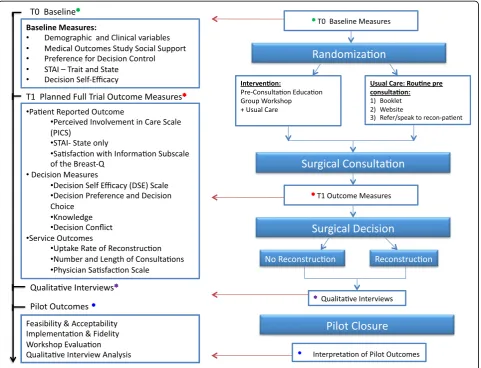
providing informed consent over the telephone, and study packages will subsequently be mailed. Participants will be officially registered upon receipt of signed con-sent through return mail. Baseline measures (T0) will be assessed prior to randomization and returned in postage-paid envelopes. Participants in the study and control groups will complete T1 measures approximately 1 week after the initial surgical consultation. The partici-pant timeline is outlined in Figure 2.
Randomization and allocation of interventions
[image:3.595.58.544.89.530.2]Once informed consent has been obtained from each participant and the baseline questionnaire returned by
mail, the next opaque, sealed envelope in sequence will be opened by the study coordinator to determine the partici-pant’s randomized treatment allocation. A computer-generated random allocation sequence will be created and sealed in opaque envelopes by the program biostatistician independent form the study coordinator with 1:1 alloca-tion to the educaalloca-tional group intervenalloca-tion or usual care and balanced in blocks of ten.
Intervention
Patients in the experimental group will participate in a pre-consultation educational group intervention in addition to receiving usual care. The intervention will be 2 h in duration on the morning of the consultation and will be facilitated by a dedicated social worker from psycho-oncology. Concerning the workshop develop-ment and structure, the intervention will incorporate the key components of shared decision-making (patient-physician involvement, shared information, expression of preferences) [13] and decision support (information
provision, values clarification and patient involvement) [25-27] with the philosophy of delivering supportive care to cancer patients [28-30].
Surgeon–30 min: treatment options for breast reconstruction with indications/contraindications, advantages/disadvantages, expected postoperative course, aesthetic result (realistic photos), and complications with probabilities
Registered nurse–30 min: preparing for surgery, postoperative recovery, and how to navigate the health-care system
Social worker (SW)–30 min: values clarification exercise (Figure3)
Breast reconstruction patient volunteer: 30 min: questions and answers about her personal experience
[image:4.595.59.541.89.457.2]Patients in the experimental and control group will re-ceive usual care. At the UHN, all patients are asked to
Figure 2Study design flowchart and participant timeline.
Plattet al. Trials2013,14:199 Page 4 of 9
read a breast reconstruction information booklet and visit the website developed by the group prior to their consultation with the plastic surgeons. They are then booked for a 45-min consultation with a consultant plas-tic surgeon and a surgical resident or fellow. A thorough history and physical exam are performed, and specific information regarding reconstruction options, advan-tages, and complications is provided, followed by a dis-cussion about patient preferences. In addition, all patients are referred to speak with a volunteer patient at a later date if desired. Appointments will be scheduled in batches to prevent contamination between those ran-domized to the experimental and control groups.
Outcome measures
Pilot and feasibility outcome measures
Feasibility and acceptability of randomization, treatment allocation, and data-collection procedures: Recruitment and attrition rates will be recorded. We will measure the
[image:5.595.59.541.87.431.2]proportion of participants that submitscompleteprimary and secondary outcome measures and baseline question-naires. Treatment Implementation and fidelity: We will record the proportion of participants who received their randomly allocated treatment assignment to monitor participant adherence to treatment allocation. Accept-ability of interventions, assessment of primary outcome, and refinement of the educational group intervention content and delivery: A subgroup of participants allo-cated to both the experimental and usual care groups will be asked to participate in a brief qualitative tele-phone interview. Purposeful sampling will be used to re-cruit five patients from each group to achieve data saturation and variability [31]. Telephone interviews will be conducted by a social worker trained in qualitative methods after the decision regarding breast reconstruc-tion has been made, which we consider to be when a pa-tient signs the surgical consent. All participants randomized to the workshop will additionally be asked
to complete a written survey for evaluation of the inter-vention immediately after participation in the workshop.
Trial outcome measures will be divided into three broad categories
Decision measureswill include decision self-efficacy [21], decision conflict score [32], decision preference, and de-cision choice [33]. These three instruments will be given at T0 (baseline) and T1, after the surgical consultation with the plastic surgeon.
1) The decision self-efficacy (DSE) scale is a prospectively designed instrument to evaluate patient self-confidence in decision-making, including shared decision-making [21]. It has been validated among women facing treatment decisions for osteoporosis [21] and used in cancer patients [22]. Psychometric evaluation has shown high levels of internal consistency (Cronbach’s alpha 0.90). Decision self-efficacy is correlated with decision conflict subscales of feeling informed (r= 0.47) and supported (r= 0.45) [21]. This instrument has never been tested in the breast cancer or breast
reconstruction population.
2) The decision conflict scale measures personal perceptions of uncertainty in choosing options and has been demonstrated to be valid and responsive to change [32]. The decisional conflict scale is a 16-item 5-response instrument that reports a score from 0–100 with higher scores indicating more conflict (items are summed, divided by 16 and multiplied by 25) [26,34].
3) Decision Preference and Decision Choice has been used as a primary and secondary outcome in studies of decision support interventions in cancer patients. It demonstrates good test-retest reliability (test-retest coefficient > 0.90) and is sensitive to change when measured before and after an intervention [33].
Patient reported outcomes (PRO)will be measured using the perceived involvement in care scale [35] (PICS) and sat-isfaction with information subscale of BREAST-Q [36-39].
1) PICS is a measure of patient perception of involvement with her care, and has seven 5-point Likert scale items that assess the extent to which the patient asked questions, offered opinions, and expressed concerns when meeting with the surgeon [35].
2) The BREAST-Q is a procedure-specific and validated PRO that measures Hr-QOL and patient satisfaction with PMBR [36-39]. The“Satisfaction with Information”Subscale specifically measures patient satisfaction with the preoperative information and care provided by the plastic
surgeon and other members of the medical team. There are 15 items that use a four-level Likert scale response format; the score is transformed on a scale of 0 to 100 with higher scores indicating greater satisfaction [36-39].
Service outcomes will be measured using the uptake rate of breast reconstruction, consultation length, num-ber of consultations until a decision is made (consent signed), the physician satisfaction scale [40], and a breast reconstruction knowledge test [41].
Baseline measures
Patient demographic and clinical characteristics, baseline psychosocial measures such as the Spielberger State-Trait Anxiety Inventory (STAI) [42], a social support survey [43], and preference for decision control [44] will be captured on our routine two-page patient intake form after consent but prior to randomization and allocation (T0, Figure 1). Baseline covariates that will be docu-mented include demographic variables, including age, marital status, ethnicity, household annual income, highest level of education, urban vs. nonurban place of residence, and employment status, and clinical covari-ates, including study site, timing of the reconstruction (immediate vs. delayed), previous stage of breast cancer, prior receipt of radiation, prior receipt of chemotherapy, and presence of chronic illness.
STAI is a 20-item measure of anxiety, and its scores range from 20–80, with a higher score indicating greater anxiety [42]. The STAI trait subscale will be measured at baseline, and the state subscale will be measured at base-line and T1. The state subscale is a sensitive indicator of changes in transitory anxiety in behavior modification programs or with experimental procedures.
The Medical Outcomes Study Social Support Survey has a series of 18 questions that measure four domains of social support (emotional, tangible, affectionate, and social interactions). Responses range from 1 (none of the time) to 5 (all the time). The items in each domain were summed and then transformed to yield scores ranging from 0 to 100. Higher scores indicate more support [43]. Preference for Decision Control is assessed using a val-idated question from previous studies in cancer patients where patients indicate whether they want to play an ac-tive, passive, or collaborative role with their physician when making a treatment decision [35].
Analysis
Analysis of primary and secondary outcomes from the main trial will be summarized using measures of central tendency and dispersion. This pilot study will provide important information regarding the treatment effect es-timate and variability (standard deviation) to supplement
Plattet al. Trials2013,14:199 Page 6 of 9
what has been reported in observational studies and will be used to guide the design and sample size calculation for the main trial. Because this is a pilot study, we do not propose to undertake formal hypothesis tests of the primary or secondary endpoints for the definitive trial.
Qualitative analysis
Thematic analysis [45] will be used to extract emerging themes and variations. Concurrent data collection and analysis will be undertaken using multi-layered reading and constant comparison [46]. N-vivo 10.0 software will be used for data management. An audit trail, detailed field notes, and memos will be maintained throughout the research process.
Sample size and power
Sample size for the pilot study is determined based on the recommended sample size of approximately 40 par-ticipants for a pilot study [47]. Approximately 20 pa-tients are referred for breast reconstruction per surgeon per month. Workshops and clinics have the capacity for five and ten patients per session, respectively. A conser-vative estimate of 50-70% recruitment would allow us to recruit our pilot sample size over 6 months across four clinics.
Interpretation of pilot results
Feasibility targets include≥60% recruitment, ≥ 80% re-tention after randomized treatment assignment, and ≥ 80% completion of primary outcome measure. Suc-cess will also be measured based on high treatment fidelity measured through observation of the interven-tion and participant qualitative report. To inform our de-cision for the primary outcome for a definitive RCT, the most important outcome measure for patients will be solicited and ascertained through qualitative methods.
Discussion
To reduce unnecessary variation in treatment and im-prove quality of cancer care among breast cancer pa-tients, there has been a growing interest in engaging patients through the decision-making process [48,49]. Particularly for breast reconstruction there is a paucity of studies designed to address patients’unique informa-tional and supportive-care needs, and there has been a call to action to develop and implement interventions that enhance patient empowerment [50]. Only one RCT has designed and implemented a decision support inter-vention for patients considering breast reconstruction [51]. While patients assigned to the pre-consultation computer-based decision support intervention demon-strated greater knowledge scores, outcomes related to shared decision-making or decision quality were not assessed using validated instruments [51]. Retrospective
observational studies from single institutions suggest that well-informed patients already participate in the de-cision whether or not to undergo breast reconstruction [12,41], but interventions can improve involvement and satisfaction for the decision regarding the type of struction (implant-based or autologous tissue recon-struction) among women who decided to have breast reconstruction [52]. However, inferences regarding the utility of decision-support interventions for breast re-construction patients from non-randomized and particu-larly retrospective studies must be made with caution. Furthermore, no study has examined the potential of group workshops to enhance patient engagement and decision quality; educational interventions delivered in a group setting have been demonstrated to be an effective tool to address informational and psychosocial needs for breast cancer survivors [30]. Therefore, we designed a novel intervention to address identified gaps in care to promote shared decision-making and improve the quality of patient decisions surrounding breast reconstruction.
Because the intervention occursbeforethe initial surgi-cal consultation (necessitating telephone recruitment) and is delivered using anovel formatin a group setting, we felt it would be most appropriate to first undertake a pilot study prior to a definitive trial. Our pilot study seeks to identify (1) the feasibility, acceptability, and de-sign of a definitive RCT and (2) the optimal content and delivery of our proposed educational group intervention. Results from our pilot study will be used in the following two ways: (1) to validate the design of the intervention and revise content and delivery to meet the needs of the end-users; (2) to inform the final design and sample size estimation for a definitive RCT.
Trial status
The pre-consultation educational group intervention pilot trial began recruitment in January 2013. Thirty pa-tients have been recruited to date (18 May 2013), of whom 15 have been randomized to one of three decision support workshops. Once all participants have been recruited and enrolled, we will complete qualitative in-terviews among a purposeful sample of voluntary partic-ipants. Recruitment is ongoing, and the trial is scheduled to be completed by the end of this academic year (June 2013).
Competing interests
The authors declare they have no competing interests.
Authors’contributions
Acknowledgements
Contributing surgeons include (in alphabetical order): Dr. Stefan OP Hofer, Dr. Anne O’Neill, and Dr. Toni Zhong. Contribution to data collection and study management: Catherine Butler and Natalie Causarano at the UHN. Contribution to delivery of Educational Workshops: Natalie Causarano, Terry Cheng, Jennica Platt, Elizabeth Starenkyj, Scott Secord, and the staff at the Electronic Living Lab for Interdisciplinary Cancer Survivorship Research. The investigators would like to thank all patients who participated in the study.
Funding
Dr. Platt is supported by research fellowships from the Canadian Breast Cancer Foundation-GlaxoSmithKline Physician Fellowship Program and the Canadian Institutes of Health Research. Dr. Zhong is supported by the Conquer Cancer Foundation Career Development Award from the American Society of Clinical Oncology. Dr. Baxter holds the Cancer Care Ontario Health Services Research Chair. Dr. Hofer is supported by the Wharton Chair in Plastic and Reconstructive Surgery from the University Health Network. Drs. Zhong, Hofer, and Metcalfe received grant funding from the Canadian Breast Cancer Foundation and the Canadian Institutes of Health Research.
Research support
This research was supported by the Physician Services Incorporated Foundation-Resident Grant awarded to Dr. Jennica Platt under the supervision of Dr. Toni Zhong. The opinions reported in this article are those of the authors and are independent from the funding source.
Received: 18 May 2013 Accepted: 26 June 2013 Published: 6 July 2013
References
1. Rowland JH, Aziz N, Tesauro G, Feuer EJ:The changing face of cancer survivorship.Semin Oncol Nurs2001,17(4):236–240.
2. Canadian Cancer Society’s Steering Committee on Cancer Statistics. Canadian Cancer Statistics:Canadian Cancer Society.2011. Available at: http://www.cancer.ca/Canada-wide/About-cancer/~/media/CCS/ Canadawide/Files-List/English-files-heading/PDF - Policy - Canadian Cancer Statistics - English/Canadian Cancer Statistics 2011 - English.ashx. Accessed Oct. 29, 2011.
3. Habermann EB, Abbott A, Parsons HM, Virnig BA, Al-Refaie WB, Tuttle TM: Are mastectomy rates really increasing in the United States?J Clin Oncol
2010,28(21):3437–3441.
4. Cordeiro PG:Breast reconstruction after surgery for breast cancer.N Engl J Med2008,359(15):1590–1601.
5. Zhong TC M, Min S,et al:Satisfaction and health-related quality of life following autologous tissue breast reconstruction: a prospective analysis of early postoperative outcomes.Cancer.
6. Potter S, Winters ZE:Does breast reconstruction improve quality of life for women facing mastectomy? A systematic review.Eur J Surg Oncol
2008,34:1181. Abstract P1163.
7. Elder EE, Brandberg Y, Bjorklund T,et al:Quality of life and patient satisfaction in breast cancer patients after immediate breast reconstruction: a prospective study.Breast2005,14(3):201–208. 8. Wilkins EG, Cederna PS, Lowery JC,et al:Prospective analysis of
psychosocial outcomes in breast reconstruction: one-year postoperative results from the Michigan Breast Reconstruction Outcome Study. Plast Reconstr Surg2000,106(5):1014–1025. discussion 1026–1017. 9. Yueh JH, Slavin SA, Adesiyun T,et al:Patient satisfaction in
postmastectomy breast reconstruction: a comparative evaluation of DIEP, TRAM, latissimus flap, and implant techniques.Plast Reconstr Surg
2010,125(6):1585–1595.
10. Cordeiro PG, McCarthy CM:A single surgeon’s 12-year experience with tissue expander/implant breast reconstruction: part II. An analysis of long-term complications, aesthetic outcomes, and patient satisfaction. Plast Reconstr Surg2006,118(4):832–839.
11. Hu ES, Pusic AL, Waljee JF,et al:Patient-reported aesthetic satisfaction with breast reconstruction during the long-term survivorship period. Plast Reconstr Surg2009,124(1):1–8.
12. Lantz PM, Janz NK, Fagerlin A,et al:Satisfaction with surgery outcomes and the decision process in a population-based sample of women with breast cancer.Health Serv Res2005,40(3):745–767.
13. Coulter A:Patient information and shared decision-making in cancer care.Br J Cancer2003,89(Suppl 1):S15–S16.
14. Lee CN, Hultman CS, Sepucha K:Do patients and providers agree about the most important facts and goals for breast reconstruction decisions? Ann Plast Surg2010,64(5):563–566.
15. Spector D, Mayer DK, Knafl K, Pusic A:Not what I expected: informational needs of women undergoing breast surgery.Plast Sur Nurs2010, 30(2):70–74. quiz 75–76.
16. Nissen MJ, Swenson KK, Kind EA:Quality of life after postmastectomy breast reconstruction.Oncol Nurs Forum2002,29(3):547–553.
17. Fernandes-Taylor S, Bloom JR:Post-treatment regret among young breast cancer survivors.Psychooncology2011,20(5):506–516.
18. Hack TF, Degner LF, Watson P, Sinha L:Do patients benefit from participating in medical decision making? Longitudinal follow-up of women with breast cancer.Psychooncology2006,15(1):9–19. 19. Sheehan J, Sherman KA, Lam T, Boyages J:Association of information
satisfaction, psychological distress and monitoring coping style with post-decision regret following breast reconstruction.Psychooncology
2007,16(4):342–351.
20. Wennberg JE, Fisher ES, Skinner JS:Geography and the debate over medicare reform.Health Aff2002.
21. O’Connor Annette M:User manual - decision self-efficacy scale [document on the internet]. 1995 [modified 2002].Ottawa Hospital Research Institute. Available at: http://decisionaid.ohri.ca/docs/develop/user_manuals/ UM_decision_selfefficacy.pdf. Accessed Jan 21, 2012.
22. Hacking B, Wallace L, Scott S, Kosmala-Anderson J, Belkora J, McNeill A: Testing the feasibility, acceptability and effectiveness of a‘decision navigation’intervention for early stage prostate cancer patients in Scotland–a randomised controlled trial.Psychooncology2012. May 9. 23. Platt J, Baxter N, Zhong T:Breast reconstruction after mastectomy for breast cancer.CMAJ Canadian Med Assoc J2011,183(18):2109–2116. 24. Charles C, Gafni A, Whelan T:Decision-making in the physician-patient
encounter: revisiting the shared treatment decision-making model. Soc Sci Med1999,49(5):651–661.
25. O’Connor Annette M:Ottawa Decision Support Framework to address decisional conflict.2006. http://www.ohri.ca/decisionaid. Accessed Oct. 29, 2011. 26. Stacey D, Bennett Carol L, Barry Michael J,et al:Decision aids for people
facing health treatment or screening decisions.Cochrane Database Syst Rev2011(10). http://www.mrw.interscience.wiley.com/cochrane/clsysrev/ articles/CD001431/frame.html.
27. O’Connor Annette M, Llewellyn-Thomas H, Stacey DH:International Patient Decision Aid Standards Collaboration: Background Document.2005. http://ipdas.ohri.ca/IPDAS_Background.pdf.
28. Fitch M:Supportive care for cancer patients.Hosp Q2000,3(4):39–46. 29. Adamsen L, Rasmussen JM:Sociological perspectives on self-help groups:
reflections on conceptualization and social processes.J Adv Nurs2001, 35(6):909–917.
30. Jones JM, Cheng T, Jackman M,et al:Getting back on track: evaluation of a brief group psychoeducation intervention for women completing primary treatment for breast cancer.Psychooncology2011. Sep 9. 31. Guest G, Bunce A, Johnson L:How many interviews are enough? An
experiment with data saturation and variability.Field Methods2006, 18(1):59–82.
32. O’Connor Annette M:User Manual - Decision Conflict Scale (16 item statement format) [document on the Internet].Ottawa Hospital Research Institute; 1993. Available at: http://decisionaid.ohri.ca/docs/develop/ User_Manuals/UM_Decisional_Conflict.pdf. Accessed; cited 2011.11.10. 33. O’Connor Annette M:User Manual - Measures of Decision/Choice
Predisposition [document on the Internet].Ottawa Hospital Research Insitute; 1996. Available at: http://decisionaid.ohri.ca/docs/develop/User_Manuals/ UM_ChoicePredisposition_Decision.pdf. Accessed 03 OCTOBER, 2012. 34. McCaffery K, Irwig L, Bossuyt P:Patient decision aids to support clinical
decision making: evaluating the decision or the outcomes of the decision.Med Decis Making2007,27(5):619–625.
35. Lerman CE, Brody DS, Caputo GC, Smith DG, Lazaro CG, Wolfson HG: Patients’perceived involvement in care scale: relationship to attitudes about illness and medical care.J Gen Intern Med1990, 5:29–33.
36. Klassen AF, Pusic AL, Scott A, Klok J, Cano SJ:Satisfaction and quality of life in women who undergo breast surgery: a qualitative study.BMC Womens Health2009,9:11.
Plattet al. Trials2013,14:199 Page 8 of 9
37. Pusic AL, Klassen AF, Scott AM, Klok JA, Cordeiro PG, Cano SJ:Development of a new patient-reported outcome measure for breast surgery: the BREAST-Q.Plast Reconstr Surg2009,124(2):345–353.
38. Scientific Advisory Committee of the Medical Outcomes Trust:Assessing health status and quality of life instruments: attributes and review criteria.Qual Life Res2002,11:193–205.
39. U.S. Food and Drug Administration:Patient reported outcome measures: Use in medical product development to support labelling claims.2006. 40. Sepucha K, Belkora J, Mutchnick S, Esserman L:Consultation planning to
help breast cancer patients prepare for medical consultations: effect on communication and satisfaction for patients and physicians.J Clin Oncol
2002,20(11):2695–2700.
41. Lee CN, Belkora J, Chang Y, Moy B, Partridge A, Sepucha K:Are patients making high-quality decisions about breast reconstruction after mastectomy? [outcomes article].Plast Reconstr Surg2011,127(1):18–26. 42. Spielberger CD, Gorsuch RL, Lushene R, Vagg PR, Jacobs GA:Manual for the
State-Trait Anxiety Inventory.Palo Alto, CA: Consulting Psychologists Press; 1983. 43. Sherbourne CD, Stewart AL:The MOS social support survey.Soc Sci Med
1991,32(6):705–714.
44. Degner LF, Kristjanson LJ, Bowman D,et al:Information needs and decisional preferences in women with breast cancer.JAMA1997, 277(18):1485–1492.
45. Creswell JW:Qualitative Inquiry and Research Design.Thousand Oaks, CA: Sage Publications; 1998.
46. Straus A, Corbin J:Basics of Qualitative Research.2nd edition. Thousand Oaks, CA: Sage Publications; 1998.
47. Hertzog MA:Considerations in determining sample size for pilot studies. Res Nurs Health2008,31(2):180–191.
48. Waljee JF, Rogers MA, Alderman AK:Decision aids and breast cancer: do they influence choice for surgery and knowledge of treatment options? J Clin Oncol2007,25(9):1067–1073.
49. Sepucha KR, Fowler FJ Jr, Mulley AG Jr:Policy support for patient-centered care: the need for measurable improvements in decision quality. Health Aff (Millwood)2004. Suppl Variation: VAR54-62.
50. Preminger BA, Lemaine V, Sulimanoff I, Pusic AL, McCarthy CM: Preoperative patient education for breast reconstruction: a systematic review of the literature.J Cancer Educ2011,26(2):270–276.
51. Heller L, Parker PA, Youssef A, Miller MJ:Interactive digital education aid in breast reconstruction.Plast Reconstr Surg2008,122(3):717–724.
52. Lee BT, Chen C, Yueh JH, Nguyen M-D, Lin SJ, Tobias AM:Computer-based learning module increases shared decision making in breast
reconstruction.Ann Surg Oncol2009,17(3):738–743.
doi:10.1186/1745-6215-14-199
Cite this article as:Plattet al.:Pre-consultation educational group
intervention to improve shared decision-making in postmastectomy breast reconstruction: study protocol for a pilot randomized controlled trial.Trials201314:199.
Submit your next manuscript to BioMed Central and take full advantage of:
• Convenient online submission
• Thorough peer review
• No space constraints or color figure charges
• Immediate publication on acceptance
• Inclusion in PubMed, CAS, Scopus and Google Scholar
• Research which is freely available for redistribution