A LOW POWER AND FAST CMOS ARITHMETIC LOGIC UNIT
NUR UMAIRA BINTI ZULKIFLI
A project report submitted in partial
fulfillment of the requirement for the award of the Degree of Master of Electrical Engineering
ABSTRACT
vi
ABSTRAK
Tesis ini membentangkan reka bentuk Unit Aritmetik Logik (ALU) CMOS yang
rendah kuasa dan pantas. ALU adalah salah satu bahagian yang penting dalam
komputer digital yang direka untuk melakukan aritmetik dan logik operasi, termasuk
operasi anjakan unit yang perlu dilakukan untuk hampir semua data yang sedang
diproses oleh unit pemprosesan pusat (CPU). Bagi kebanyakan aplikasi litar digital,
terdapat dua ciri-ciri penting iaitu memaksimumkan kelajuan dan mengurangkan
penggunaan kuasa. Prestasi keseluruhan sistem akan bergantung kepada kelajuan
modul yang berbeza yang digunakan dalam reka bentuk. Untuk mencapai hasil yang
dikehendaki, ALU yang direka menggunakan pemultipleks berasaskan pass
transistor logic (PTL) dan penambah penuh lapan transistor. Tanner EDA V13
dengan menggunakan teknologi CMOS 0.25µm digunakan untuk mereka bentuk dan menganalisis litar ini. Jumlah transistor yang sedikit yang digunakan akan menghasilkan ruang reka bentuk yang kecil dan seterusnya mengurangkan
penggunaan kuasa. Keputusan dianalisis dari nilai bekalan voltan yang berbeza yang
TABLE OF CONTENT
TITLE i
DECLARATION ii
DEDICATION iii
ACKNOWLEGMENT iv
ABSTRACT v
ABSTRAK vi
CONTENT vii
LIST OF TABLES x
LIST OF FIGURES xi
LIST OF SYMBOL AND ABBREVIATION xiv
CHAPTER 1 INTRODUCTION 1
1.1 Project Background 1
1.2 Problem Statement 2
1.3 Objective 2
1.4 Scope of Project 2
CHAPTER 2 LITERATURE REVIEW 3
2.1 Introduction 3
viii
2.3 Technology Development 4
2.3.1 Design of Low Power ALU using 8T FA and PTL Based Mux
Circuits 4
2.3.2 A Review Paper on 3T XOR Cells and 8T Adder Design in
Cadence 5
2.3.3 Design of Low Power High Speed ALU Using Feedback Switch
Logic 5
2.3.4 Low Power Sub-Threshold Asynchronous QDI Static Logic
Transistor-Level Implementation (SLTI) 32-bit ALU 6 2.3.5 Design of a Low Power, Sub-Threshold, Asynchronous ALU
Using a Bidirectional Adder 6
2.3.6 Energy – Efficient, High Performance Circuits for Arithmetic
Units 7
2.3.7 A Low Power 10T Full Adder Cell for Embedded Architecture 7 2.3.8 An Implementation of 1-bit Low Power Full Adder Based on
Multiplexer and Pass Transistor Logic 8
2.3.9 A Fast ALU Design in CMOS for Low Voltage Operation 8
2.4 Software Development 8
2.4.1 T-Spice: Analog Simulation 9
2.4.2 S-Edit: Schematic Capture 9
2.4.3 W-Edit: Waveform Viewing & Analysis 10
CHAPTER 3 METHODOLOGY 12
3.1 Introduction 12
3.2 Flowchart 12
3.2.2 Flowchart of Circuit Design Process 13
3.3 Proposed Architecture 15
3.3.1 Design of FA 15
3.3.2 Design of Multiplexer 16
3.3.3 Design of ALU 19
3.3.3.1 Operation 19
CHAPTER 4 RESULT AND ANALYSIS 21
4.1 Introduction 21
4.2 Performance Analysis of the Proposed ALU by Different Parameters 21
4.3 Results for All Circuits 22
4.3.1 Result of 2:1 Mux 22
4.3.2 Result of 4:1 Mux 23
4.3.3 Result of 8T Full Adder 24
4.3.4 Result of ALU 26
4.3.4.1 Power Consumption 39
4.3.4.2 Propagation Delay 40
CHAPTER 5 CONCLUSION AND RECOMMENDATION 41
5.1 Conclusion 41
5.2 Recommendation 41
REFERENCES 42
APPENDICES 44
x
LIST OF TABLE
Table 3.1 XOR truth table 16
Table 3.2 FA truth table 16
Table 3.3 2:1 mux truth table 17
Table 3.4 4:1 mux truth table 18
Table 3.5 ALU truth table 20
Table 4.1 Transistor sizing for the 8T FA 24
LIST OF FIGURE
Figure 2.1 S-Edit 10
Figure 2.2 W-Edit 11
Figure 3.1 Flowchart of the overall project activities 13
Figure 3.2 Flowchart of circuit design process 14
Figure 3.3 Circuit level diagram of proposed 8T ALU 15
Figure 3.4 Schematic view of proposed 2:1 mux 17
Figure 3.5 Schematic view of proposed 4:1 mux 18
Figure 3.6 Block diagram of proposed ALU 20
Figure 4.1 2:1 mux using pass transistor logic 22
Figure 4.2 Waveforms of 2:1 mux 23
Figure 4.3 4:1 mux using pass transistor logic 23
Figure 4.4 Waveforms of 4:1 mux 24
Figure 4.5 8T FA circuit level 25
Figure 4.6 Waveforms of 8T FA 25
Figure 4.7 Block diagram of the 1-bit proposed ALU 26 Figure 4.8 Waveforms of 1-bit proposed ALU for AND operation,
S2S1S0=000, Vdd =5V 27
Figure 4.9 Waveforms of 1-bit proposed ALU for XOR operation,
S2S1S0=001, Vdd =5V 27
Figure 4.10 Waveforms of 1-bit proposed ALU for XNOR operation,
S2S1S0=010, Vdd =5V 28
Figure 4.11 Waveforms of 1-bit proposed ALU for OR operation,
xii
Figure 4.12 Waveforms of 1-bit proposed ALU for ADDITION
operation, S2S1S0=100, Vdd =5V 29
Figure 4.13 Waveforms of 1-bit proposed ALU for SUBTRACTION
operation, S2S1S0=101, Vdd =5V 29
Figure 4.14 Waveforms of 1-bit proposed ALU for INCREMENT
operation, S2S1S0=110, Vdd =5V 30
Figure 4.15 Waveforms of 1-bit proposed ALU for DECREMENT
operation, S2S1S0=111, Vdd =5V 30
Figure 4.16 Waveforms of 1-bit proposed ALU for AND operation,
S2S1S0=000, Vdd =3V 31
Figure 4.17 Waveforms of 1-bit proposed ALU for XOR operation,
S2S1S0=001, Vdd =3V 31
Figure 4.18 Waveforms of 1-bit proposed ALU for XNOR operation,
S2S1S0=010, Vdd =3V 32
Figure 4.19 Waveforms of 1-bit proposed ALU for OR operation,
S2S1S0=011, Vdd =3V 32
Figure 4.20 Waveforms of 1-bit proposed ALU for ADDITION
operation, S2S1S0=100, Vdd =3V 33
Figure 4.21 Waveforms of 1-bit proposed ALU for SUBTRACTION
operation, S2S1S0=101, Vdd =3V 33
Figure 4.22 Waveforms of 1-bit proposed ALU for INCREMENT
operation, S2S1S0=110, Vdd =3V 34
Figure 4.23 Waveforms of 1-bit proposed ALU for DECREMENT
operation, S2S1S0=111, Vdd =3V 34
Figure 4.24 Waveforms of 1-bit proposed ALU for AND operation,
S2S1S0=000, Vdd =1V 35
Figure 4.25 Waveforms of 1-bit proposed ALU for XOR operation,
S2S1S0=001, Vdd =1V 35
Figure 4.26 Waveforms of 1-bit proposed ALU for XNOR operation,
S2S1S0=010, Vdd =1V 36
Figure 4.27 Waveforms of 1-bit proposed ALU for OR operation,
S2S1S0=011, Vdd =1V 36
Figure 4.28 Waveforms of 1-bit proposed ALU for ADDITION
Figure 4.29 Waveforms of 1-bit proposed ALU for SUBTRACTION
operation, S2S1S0=101, Vdd=1V 37
Figure 4.30 Waveforms of 1-bit proposed ALU for INCREMENT
operation, S2S1S0=110, Vdd=1V 38
Figure 4.31 Waveforms of 1-bit proposed ALU for DECREMENT
operation, S2S1S0=111, Vdd=1V 38
Figure 4.32 Power consumption for Vdd=1V 39
xiv
LIST OF SYMBOL AND ABBREVIATION
ALU - Arithmetic Logic Unit CPU - Central Processing Unit
CMOS - Complimentary Metal-Oxide-Semiconductor Vdd - Supply voltage
FA - Full Adder Mux - Multiplexer T - Transistor
GPU - Graphics Processing Unit FPU - Floating-Point Unit
VLSI - Very Large Scale Integration Vth - Threshold Voltage
PDP - Power Delay Product Pavg - Average power W/L - Width/Length
FSL - Feedback-Switch Logic DSP - Digital Signal Processor QDI - Quasi-Delay-Insensitive
SLTI - Static Logic Transistor-level Implementation PCHB - Pre-Charged Half-Buffer
Cout - Carry Out
CPL - Complementary Pass Transistor Logic BGFSB - Back-gate Forward Substrate Bias tpd - Propagation delay
CHAPTER 1
A LOW POWER AND FAST CMOS ARITHMETIC LOGIC UNIT
1.1 Project Background
One of the important parts of a digital computer is an arithmetic logic unit (ALU). ALU is designed to do the arithmetic and logic operations, including bit shifting operations which are the basic processes that need to be done for almost any data that is being processed by central processing unit (CPU). For most applications of all digital circuits, the two important attributes are maximizing speed and minimizing power consumption. The overall performance of the system will depend on the speed of the different modules used in the design.
CPU can be more powerful, but it also can consume more energy and creates more heat depending on how the ALU is designed. Therefore, it is important to balance between how powerful and complex the ALU is and how expensive the whole unit becomes. Faster CPUs are normally more expensive, consume more power and dissipate more heat.
1.2 Problem Statement
As a fundamental part of the microprocessors, ALU performs computing operations and it is typically on the critical path. Therefore, the achievable operating frequency of the whole microprocessor is determined by the operating speed of ALU. At the same time, ALU is also one of the most active components in microprocessor, raising the power and thermal issues. Therefore, the lowest voltage supply to the circuit is needed to reduce power and reducing the propagation delay is required to enhance the speed of the ALU.
1.3 Objectives
For this project, the objectives are: i. To design a low power ALU ii. To design a fast ALU
1.4 Scope of Project
CHAPTER 2
LITERATURE REVIEW
2.1 Introduction
This chapter describes the necessary study to design a low power and fast ALU circuit. The first part of this chapter explained about the function of ALU, the operations that it performs, and the types of structure to implement FA in ALU. The second part of this chapter reviewed the technology developments that associated to the proposed design. The last part of this chapter described about the software development used to design and simulate the proposed circuit which is Tanner EDA tool.
2.2 Arithmetic Logic Unit (ALU)
An ALU is an integrated circuit within a CPU or graphics processing unit (GPU) that performs arithmetic and logic operations. Arithmetic operations include addition, subtraction, and shifting operations, while logic operations include Boolean comparisons, such as AND, OR, XOR, and NOT operations. All these operations are in the final processing performed by the processor. After the information has been processed by the ALU, it is sent to the computer memory.
operations, since the result may be a fraction, or a "floating point" number. Instead, division operations are usually handled by the floating-point unit (FPU), which also performs other non-integer calculations.
While the ALU is a fundamental component of all processors, the design and function of an ALU may vary between different processor models. For example, some ALUs only perform integer calculations, while others are designed to handle floating point operations as well. Some processors contain a single ALU, while others include several ALUs that work together to perform calculations. Regardless of the way an ALU is designed, its primary job is to handle integer operations. Therefore, a computer's integer performance is tied directly to the processing speed of the ALU.
Most of the digital systems used for very large scale integration (VLSI) applications, extensively use arithmetic operations. Thus, addition has become a fundamental arithmetic operation performed by any ALU, the design and implementation of a 1-bit FA circuit has become the most crucial issue [3]. There are two types of logic structures to implement the FA cell, namely static style and dynamic style. The static FAs are normally simpler, more reliable, and lower power compared to dynamic. However, dynamic FAs are faster and sometimes more compact than static FAs but the drawback of dynamic is it suffers from charge sharing high power due to high switching activity, clock load and complexity [4].
2.3 Technology Development
Study on the technology development is important to ensure a continuous improvement can be made in the specific area. Based on previous studies, [4] can be used to propose a low power and fast ALU. The study from [5], it can be used as a reference in term of ratios of the transistors size used in the FA.
2.3.1 Design of Low Power ALU using 8T FA and PTL Based Mux Circuits [4]
5
processors (DSP), microprocessors, etc. In existing method, FA and multiplexers were designed using transmission gate logic. To reduce the number of transistors, multiplexers were designed using pass transistor logic while FA is designed using 8 transistors logic in the implementation of ALU. The power and the area were greatly reduces to more than 70% compared to the existing method.
2.3.2 A Review Paper on 3T XOR cells and 8T Adder Design in Cadence 180nm [5]
This paper gives a review of already existing 3T XOR cells and provides an optimized value of width/length (W/L) on the basis simulation results obtained which helped to improve the driving capability as to improve the threshold loss problems present in the existing designs of 3T XOR cells. However, the driving capability obtained is not sufficient for large circuits like multipliers. From their best improved version of 3T XOR cell obtained, they designed a FA circuit. They implement all the basic circuits and their improved versions in Cadence Virtuoso for 180nm technology and 1.8V source.
2.3.3 Design of Low Power High Speed ALU Using Feedback Switch Logic [6]
2.3.4 Low Power Sub-Threshold Asynchronous QDI Static Logic Transistor-Level Implementation (SLTI) 32-bit ALU [7]
In [7], they proposed an asynchronous-logic Quasi-Delay-Insensitive (QDI) static logic transistor-level implementation (SLTI) approach for low power sub-threshold operation. The approach is implemented to design 32-bit pipelined ALUs, the primary computation core for microprocessors, and benchmarked against the reported Pre-Charged Half-Buffer (PCHB). There are two key attributes in this proposed design. First, the proposed SLTI ALU design can perform dynamic voltage scaling seamless by only changing the Vdd from nominal (1V) to sub threshold (~0.2V) regions for high speed/low power operation. Second, the ALU achieves ultra-low power dissipation (3.5μW) at the lowest Vdd point (~0.15V). For fair of comparison, both implemented ALUs have identical functionality and functional blocks, are implemented using the same 65nm CMOS process. Based on the simulations, the minimum energy point occurs at Vdd of 0.2V for SLTI-based ALU and at Vdd of 0.3V for PCHB based ALU. The SLTI-based ALU have ~93% and ~89% lower energy on the arithmetic and logic operations respectively from Vdd of 1V to Vdd of 0.2V. At Vdd of 0.2V, with 9 MHz input switching rate, the asynchronous ALU based on their proposed SLTI approach dissipates ~51% and ~44% lower power than the reported PCHB counterpart on the arithmetic and logic operations respectively.
2.3.5 Design of a Low Power, Sub-Threshold, Asynchronous ALU Using a Bidirectional Adder [8]
7
the proposed design around 30 % in area. Power reduction of 9 - 26% was achieved for the addition operation and 19.5 - 75.1% for the logical operation on the proposed 32 bit ALU, compared to the conventional dynamic logic based ALU operated over the voltage range 0.2-0.3V.
2.3.6 Energy – Efficient, High Performance Circuits for Arithmetic Units [9]
This paper present a new full adder structure based on complementary pass transistor logic (CPL) which is faster and more energy efficient than the existing structures. They also proposed a new technique of implementing multiplier circuit using decomposition logic which improves speed and reduces power consumption by reducing the spurious transition on international nodes. There is substantial improvement in the performance of the multiplier structure with the combination of the new adder structure and the decomposition logic. The proposed circuits were implemented using TSPICE for simulation in TSMC 180nm technology.
2.3.7 A Low Power 10-transistor Full Adder Cell for Embedded Architecture [10]
2.3.8 An Implementation of 1-bit Low Power Full Adder Based on Multiplexer and Pass Transistor Logic [11]
This paper presents the design of low power full adder based on XOR pass transistor logic and transmission gate for carry. They have not connected power supply rail directly, instead of that inputs are given directly to reduce the transition activity and charge recycling capability and this result in great amount of reduction in power consumption. The proposed 14T full adder has been developed using Tanner SPICE simulation. Based on their result, there is saving of power supply by the factor of 30% as compared to 10T full adder and a reduction in power by 26% as compared to the conventional 28T CMOS adder.
2.3.9 A Fast ALU Design in CMOS for Low Voltage Operation [12]
In this paper, a high-speed 4-bit ALU has been designed for 1V operation to demonstrate the usefulness of the back-gate forward substrate bias (BGFSB) method in 1.2μm n-well CMOS technology. The 4-bit ALU employs a ripple carry adder and is capable of performing eight operations which are four arithmetic and four logical operations. The BGFSB has been limited to |0.4|V. The delay time measurements are taken for all operations from the SPICE simulations with and without the back-gate forward substrate bias.
2.4 Software Development
9
2.4.1 T-Spice: Analog Simulation
T-Spice is a complete design capture and simulation solution that provides accuracy and convergence with market-proven reliability. It transforms designer’s idea into design and able to quickly simulate large circuit and with a high degree of accuracy. It also offers integration with other design tools and is compatible with industry standard.
2.4.2 S-Edit: Schematic Capture
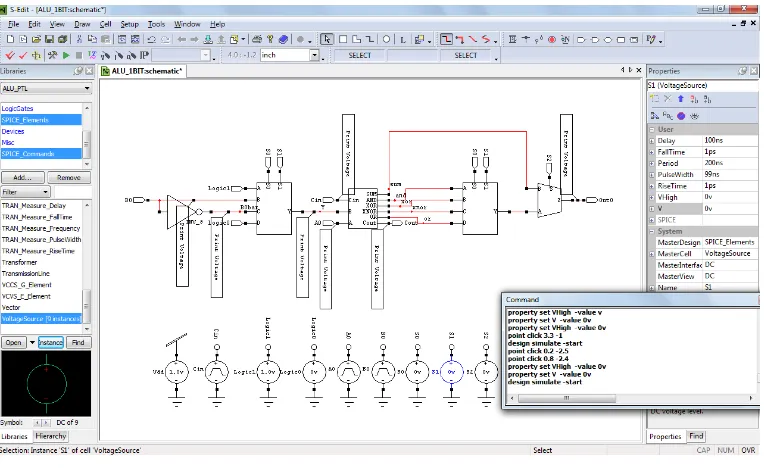
S-Edit gives the power to handle most complex full custom IC design capture with its tightly integrated with Tanner EDA’s T-Spice simulation, L-Edit layout editor, and HiPer verification tools. S-Edit integrates easily with third-party tools and legacy data with its efficient design capture process. S-Edit allows designer to explore design choices and provides an easy-to-use view into the consequences of those choices.
Operating point result can be viewed directly on the schematic with the S-Edit’s tight integration with SPICE simulation which it also allows performing waveform cross-probing to view node voltages and device terminal currents or charges.
S-Edit imports schematics via Open Access and via EDIF from Cadence, ORCAD and ViewDraw with automatic conversion of schematics and properties for seamless integration of legacy data.
Figure 2.1: S-Edit
2.4.3 W-Edit: Waveform Viewing & Analysis
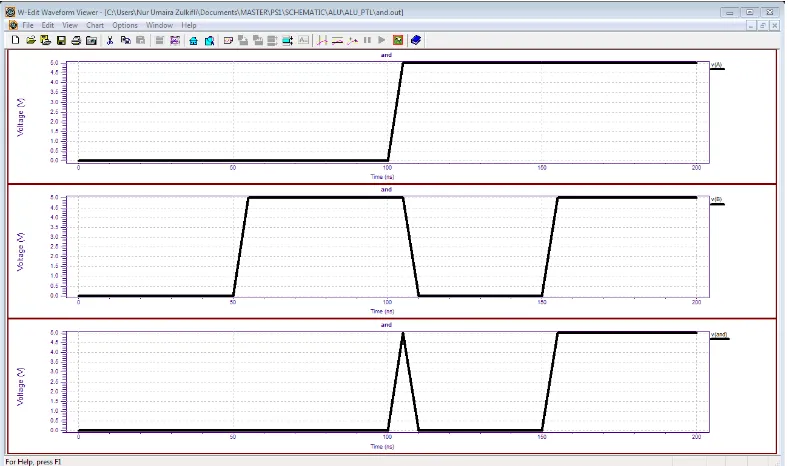
The W-Edit waveform analysis tool is a comprehensive viewer for displaying, comparing, and analyzing simulation results. W-Edit provides an intuitive multiple-window, multiple-chart interface for easy viewing of waveforms and data in highly configurable formats
W-Edit is dynamically associated to T-Spice and S-Edit with a run-time update feature which displays simulation results as they are being generated and it also allows waveform cross-probing directly in the schematic editor for faster design cycles.
W-Edit offers advanced features such as automatically calculating and displaying Fast Fourier Transform (FFT) results in a variety of formats, including dB or linear magnitude, wrapped or unwrapped phase, and real or imaginary parts.
11
CHAPTER 3
METHODOLOGY
3.1 Introduction
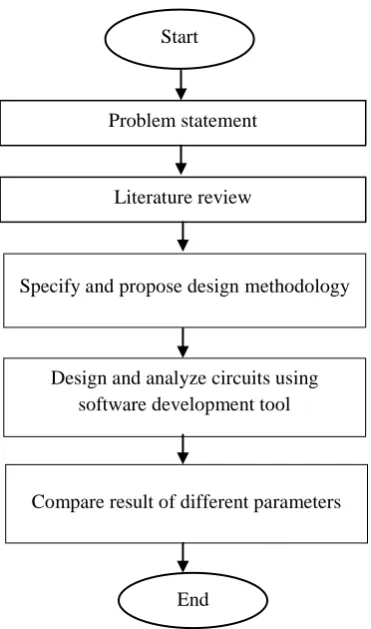
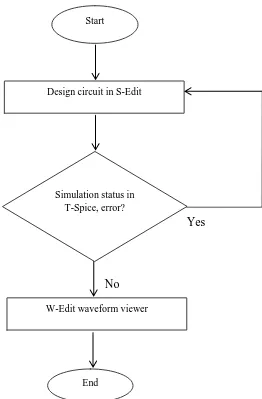
This chapter will discuss about the proposed design methodology in order to achieve the desired target of this project which is to design a fast and low power ALU. The summarization of the overall project activities and the software flowchart were shown in Figure 3.1 and Figure 3.2.
3.2 Flowchart
In this part, the flowcharts of the project development are discussed.
3.2.1 Flowchart of Project Activities
13
[image:25.595.226.412.94.409.2]
Figure 3.1: Flowchart of the overall project activities
3.2.2 Flowchart of Circuit Design Process
Figure 3.2 shows the proposed flowchart used to design the ALU by using Tanner EDA tool. The work started with designing all circuits in S-Edit. The circuits are then simulated and the analysis data is displayed on the T-Spice. If there is no error on the circuit design, the desired outputs are displayed on the W-Edit waveform viewer.
Start
Problem statement
Literature review
Specify and propose design methodology
Design and analyze circuits using software development tool
Compare result of different parameters
Yes
No
[image:26.595.231.493.83.482.2]
Figure 3.2: Flowchart of circuit design process
Design circuit in S-Edit
Simulation status in T-Spice, error?
W-Edit waveform viewer Start
15
3.3 Proposed Architecture
The proposed architecture of the ALU consisted of 4:1 mux and 2:1 mux, and FAs. The details of the proposed design are as mentioned in the following sections.
3.3.1 Design of FA
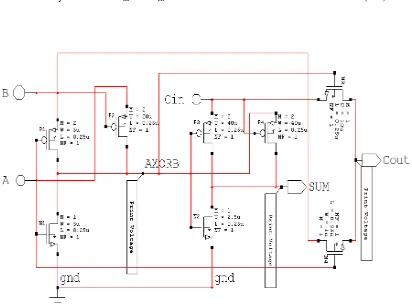
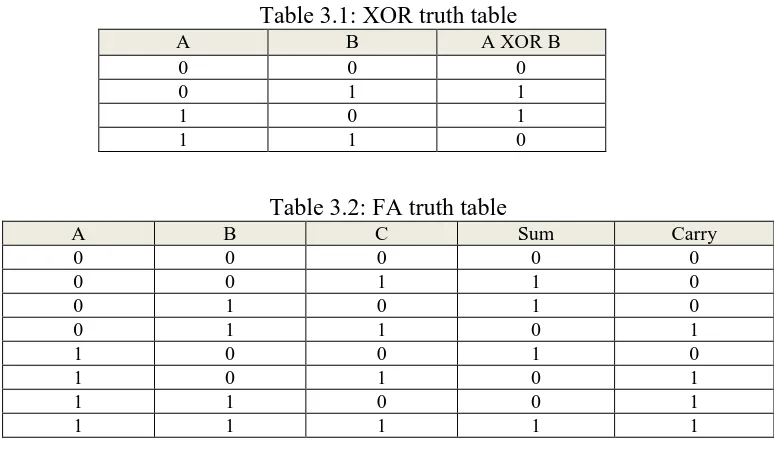
The proposed design of FA consisted of three inputs (A, B, Cin) and two outputs (Sum, Cout). The FA circuit consisted of two XOR circuits which had eight transistors in the whole circuit as shown in Figure 3.3. Less number of the transistors used will reduce the power consumption. The equations for Sum and Carry are as shown in 3.1 and 3.2. Table 3.1 and 3.2 show the truth tables of XOR and FA.
Sum = AB’Cin’ + A’BCin’ + A’B’Cin + ABCin (3.1)
[image:27.595.113.525.390.697.2]Carry = AB + ACin + BCin (3.2)
Table 3.1: XOR truth table
A B A XOR B
0 0 0
0 1 1
1 0 1
1 1 0
Table 3.2: FA truth table
A B C Sum Carry
0 0 0 0 0
0 0 1 1 0
0 1 0 1 0
0 1 1 0 1
1 0 0 1 0
1 0 1 0 1
1 1 0 0 1
1 1 1 1 1
3.3.2 Design of Multiplexer
17
Figure 3.4: Schematic view of proposed 2:1 mux
Table 3.3: 2:1 mux truth table
S A B Z
0 0 X 0
1 X 1
1 X 0 0
[image:29.595.140.533.524.590.2]Figure 3.5: Schematic view of proposed 4:1 mux
Table 3.4: 4:1 mux truth table
S1 S0 A B C D Y
0 0 X X X 0 0
0 0 X X X 1 1
0 1 X X 0 X 0
0 1 X X 1 X 1
1 0 X 0 X X 0
1 0 X 1 X X 1
1 1 0 X X X 0
[image:30.595.145.529.526.644.2]19
3.3.3 Design of ALU
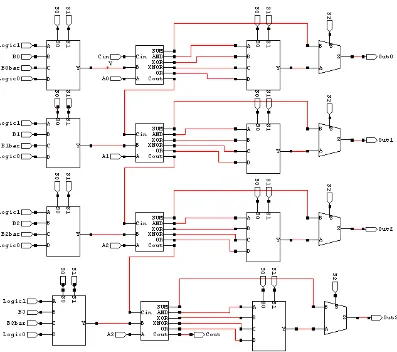
The proposed ALU design was consisted of eight 4:1 multiplexers, four 8T full adders and four 2:1 multiplexers. Figure 3.6 shows the schematic view of 4-bit proposed ALU design with CARRY bit cascading from the first stage to forth stage. The 4-bit proposed ALU is designed in 0.25um, n-well CMOS technology.
3.3.3.1Operation
For the SUBTRACTION operation, complement of B is used. The full adder performs this operation by two’s complement method.
For the DECREMENT and INCREMENT operations, logic ‘0’ and logic ‘1’ are used as inputs respectively. The DECREMENT operation is seen as subtraction operation and the INCREMENT operation is analyzed as adding ‘1’ to the addend [4].
Figure 3.6: Block diagram of 4-bit proposed ALU
Table 3.5: ALU truth table
S2 S1 S0 Operation
0 0 0 AND
0 0 1 EXOR
0 1 0 EXNOR
0 1 1 OR
1 0 0 ADDITION
1 0 1 SUBTRACTION
1 1 0 INCREMENT
[image:32.595.120.520.489.626.2]CHAPTER 4
RESULTS AND ANALYSIS
4.1 Introduction
This section demonstrates and analyses the results obtained from each of the circuits involved in developing the proposed ALU. These circuits are including 8T FA, 2:1 mux, 4:1 mux and ALU which consisted of that three types of circuits mentioned earlier.
The results are then analyzed from the waveforms viewed on the W-edit and data obtained from the T-Spice. The propagation delay of the ALU is measured from the waveforms obtained, while the value of power consumption in the ALU can be obtained from the T-Spice.
At the end of this analysis, the optimal parameters that give relatively good performance for the ALU in different parameters will be concluded.
4.2 Performance Analysis of the Proposed ALU by Different Parameters
4.3 Results for All Circuits
This part will demonstrates the simulation results of all circuit designs involved in the development of the proposed ALU.
4.3.1 Result for 2:1 Mux
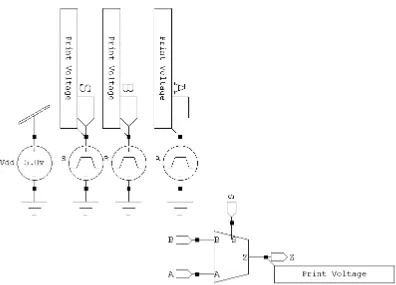
[image:34.595.122.518.297.582.2]The schematic circuit of 2:1 mux is shown in Figure 4.1. When S=0, the ouput Z=A and when S=1, the output Z=B. Based on the waveforms shown in Figure 4.2, the output result of Z is correct and comply to the 2:1 mux truth table in Table 3.3.
23
Figure 4.2: Waveforms of 2:1 mux
4.3.2 Result for 4:1 Mux
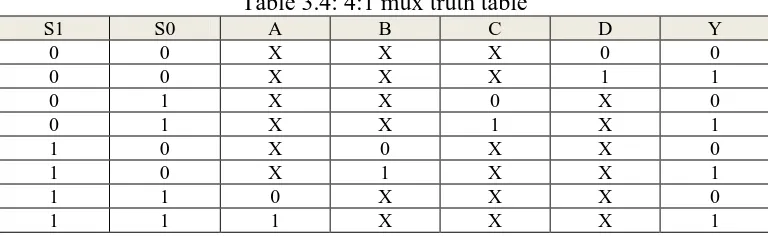
[image:35.595.116.524.500.721.2]Figure 4.3 shows the 4:1 mux simulation circuit. When S1=0 and S0=0, output Y=D. When S1=0 and S0=1, the output Y=B. When S1=1 and S0=0, the output Y=C. When S1=1 and S0=1, the output Y=A. Figure 4.4 shows the correct output of Y obtained from the simulation circuit which is according to the theory as stated in Table 3.4.
Figure 4.4: Waveforms of 4:1 mux
4.3.3 Result of 8T Full Adder
The simulated circuit of the FA is shown in Figure 4.5 and the output result is shown in Figure 4.6. The sizing of the transistors play a major role to obtained the correct and best output. Table 4.1 shows the size of the transistors used for the 8T FA circuit by referring to Figure 3.3. The output waveforms as in Figure 4.6 shows the output SUM and Cout of the FA are correct and according to the theory as stated in Table 3.2.
Table 4.1 Transistor sizing for the 8T FA
Name of transistor Width (μm) Length (μm)
P1 5 0.25
P2 20 0.25
P3 40 0.25
P4 40 0.25
N1 5 0.25
N2 2.5 0.25
N3 10 0.25
[image:36.595.115.532.538.651.2]42
REFERENCES
[1] A. Srivastava and D. Govindarajan. (2002). A Fast ALU Design in CMOS for Low Voltage Operation, VLSI Design, pp. 315-327
[2] Yang, Y., Chandrakasan, A.P., Sheng, S. and Brodersen, R.W. (1992). Low-Lower CMOS Digital Design, IEEE Journal of Solid-State Circuits 27(4), pp. 822-839
[3] Basak, S., Saha, D., Mukherjee, S., Chatterjee, S. and Sarkar, C.K. (2012). Design and Analysis of a Robust, High Speed, Energy Efficient 18 Transistor 1-bit Full Adder Cell, Modified with the concept of MVT Scheme, International Symposium on Electronic System Design, pp. 130-134
[4] Nehru, K., Shanmugam, A. and Darmila Thenmozhi, G. (2012). Design of Low Power ALU Using 8T FA and PTL Based MUX Circuits, IEEE-International Conference on Advances in Engineering, Science and Management, pp. 145-149 [5] Khan, A.A., Pandey, S. and Pathak, J. (2014). A Review Paper on 3-T Xor Cells and 8-T Adder Design in Cadence 180nm, International Conference for Convergence of Technology, pp. 1-6
[6] Prakash, P. and Saxena, A.K. (2009). Design of Low Power High Speed ALU Using Feedback Switch Logic, International Conference on Advances in Recent Technologies in Communication and Computing, pp. 899-902
[8] Jiaoyan Chen, Vasudevan, D., Popovici, E. and Schellekens, M. (2011). Design of a Low Power, Sub-Threshold, Asynchronous Arithmetic Logic Unit using a Bidirectional Adder, 14th Euromicro Conference on Digital System Design, pp. 301-308
[9] Agarwal, S., Pavankumar, V.K. and Yokesh, R. (2008). Energy – Efficient, High Performance Circuits for Arithmetic Units, 21st International Conference on VLSI Design, pp. 371-376
[10] Fayed, A.A. and Bayoumi, M.A. (2001). A Low Power 10-transistor Full Adder Cell for Embedded Architecture, The 2001 IEEE International Symposium on Circuits and Systems, pp. 226-229
[11] Parihar, R., Tiwari, N., Mandloi, A. and Kumar, B. (2014). An Implementation of 1-bit Low Power Full Adder based on Multiplexer and Pass Transistor Logic, 2014 International Conference on Information Communication and Embedded Systems (ICICES), pp. 1-3
[12] Srivastava, A. and Govindarajan, D. (2002). A Fast ALU Design in CMOS for Low Voltage Operation, VLSI Design, pp. 315-327
[13] Zimmermann, Reto and Fichtner, Wolfgang. (1997). Low-Power Logic Styles: CMOS versus Pass-Transistor Logic, IEEE Journal Of Solid-State Circuits, pp. 1079-1090