Journal of Theoretical and Applied Information Technology 31st July 2013. Vol. 53 No.3
© 2005 - 2013 JATIT & LLS. All rights reserved.
ISSN: 1992-8645 www.jatit.org E-ISSN: 1817-3195
ELECTRONIC RECORDS MANAGEMENT IN
INSTITUTIONS OF HIGHER LEARNING IN LIBYA:
ADOPTION OF DIRKS MODEL
1YOUSEF I. ABUZAWAYDA, 2ZAWIYAH MOHD YUSOF, 3MOHD AB AZIZ
1
Faculty of Information Science and Technology, University Kebangsaan Malaysia/ Misurata University
2Faculty of Information Science and Technology, University Kebangsaan Malaysia
3Faculty of Information Science and Technology, University Kebangsaan Malaysia
E-mail: [email protected], [email protected], [email protected]
ABSTRACT
Institutions of Higher Learning (IHL) have now produced and created most of their documents and records electronically. These records need to be managed efficiently and effectively according to the widely accepted standards. Well-managed records could give untold benefits to organization, hence, help organizations remain competitive. The management of electronic records ought to be guided by a policy, which serve as a roadmap in implementing the initiative. A study is conducted in order to determine whether Institutions of Higher Learning in Libya have guideline to manage electronic records. It is also to identify whether there are problems in managing electronic records, and to identify what problems are encountered. This study adopts survey as its method employing a questionnaire as the technique to collect data.
Keywords: Electronic Records, Records Management, Libyan Institutions Of Higher Learning,
Information Policy.
1.
INTRODUCTIONRecord is an important asset of every organisation and should always be handled with care regardless of their formats. The importance of maintaining records efficiently is to ensure that they support the organisation in for better decision making and can be used to enhance accountability and transparency [1].
Records Management is not a new concept but instead have evolved from the ancient world to modern times. The prologue of computers in the actual mid-twentieth century impacted the factor of documentation in sustaining supervision and business operations while companies have been beguiled by an amazing benefits of digital skills, particularly in the organization storage and recovery of data together with reputable security features [2]. Apart from that the development in the field of e-government and other e-business systems across the globe has led to the development of electronic format of management in every area of business. The contribution of information
communication technology (ICT) has been remarkable behind the development of records management [3].
The emergence of records management in Libya is largely attributed to the development of ICT within the country recently and is largely used by the service delivery organisations and has resulted in the use of electronic records for various public services being offered by the public sector organisations. The public sector organisations should ensure that they manage their records properly and effectively for legal purposes [4].
2.
PROBLEM STATEMENTvital information related to various functions of the government and also acts for the welfare and interests of the citizens [5].
Apart from the government sector even the academic institutions face the challenges related to record management as these public institutions have to manage numerous records in paper format [4]. Many universities in Libya have the basic ICT infrastructure required but still the use of paper format is highly preferred. Regardless of this, the development in electronic records management in the public sector in Libya has been facing several challenges. The main reason behind this is the lack of efficient infrastructure to support the proper management and also the lack of technical support related to ICT among the institutions [6]. Currently it looks as though the institutions are practicing electronic records management without proper policies and frameworks.
3.
RESEARCH OBJECTIVEi. To propose a model for electronic records management in institutions of higher learning in Libya.
ii. To identify the various factors which influence the effective records management practices in higher education institutions in Libya.
4.
ELECTRONIC RECORDSMANAGEMENT
Records are classified into both paper and electronic but due to the development of ICT the role of electronic records has become more prominent. This has resulted in the creation and use of electronic records in the public sector. The increased usage of ICTs to conduct business and transmit information contributes to a need to manage the resultant records. Electronic records need to be well-managed as part of the transition to the electronic environment [4].
Records management deals with the recognition, storage, access and exploitation of records that are necessary for an organization in order to blossom [7]. Records management should comprise of policies, processes, guidance, instruments and methods, means and training instructed to design and hold on to efficient and trusted records systems [8]. The goal of an effective records management is to distinguish and keep records, define characteristics, policies, methods, judgements and necessary trades of tasks and research [9].
Having a record management system ensures that the records are present, which can be accessed at any given point of time, which can be interpreted and can be maintained for a particular period of time. Later these records can be disposed off once its role is completed with the help of record disposal schedules and only retain the records which are required for a long period of time in order to save storage space and improve the record retrieval process [10].
According to ISO 15489:2001 [11] “records management involves setting policies, guidelines and benchmarks, assigning responsibilities and authorities, establishing and promulgating procedures and guidelines and giving a series of benefits attached to the institution” [12].
Electronic records management (ERM) is a set of computer programme which helps in keeping track and storage of electronic records [12]. With the help of an ERM, management of record is easier where there are controls to manage the electronic records which have a life cycle from creation to destruction. The records life cycle is a crucial process of ERM process [13].
ERM has numerous goals. First, it integrates e-records management ideas and routines together with thorough information management policies, functions and is designed in a string so that the reliability of electronic records and information to handle interoperability, well-timed and successful decision-making and improved services to customers. Apart from that, ERM also provides various tools for the use of agencies to access the electronic records for so long as essential and transfer the records to the archives which may be required for the future [14]. ERM needs to be equipped with assorted range of statutory regulations, always be accommodating enough to adjust to completely new rules and regulations, take care of the continuing huge growth in electronic records and be accepted by anyone that has to actually use it.
4.1 Electronic Records Management Policy
In accordance with ISO 15489:2001 [11];
certain that the policy is communicated and fully implemented at all levels in the institution. The policy should be implemented and endorsed at the highest decision-making level and transmitted through the institution. Responsibility for compliance should be appointed”. A good electronic records management policy is detailed, comprehensive and up-to-date. It defines responsibilities for records management and can easily be understood [15]. In order to achieve a successful ERM programme, an organization needs to establish a sustainable records management infrastructure which includes developing policies for the management of records and information in all forms, including electronic and paper [19].
4.2 Electronic Records Management Policy In
Middle Eastern Countries
Due to the advent in technology the quest of development between developing and developed nations has decreased sustainably and ICT is largely responsible behind this [16]. The Middle Eastern countries have a very similar nature with regard to cultural and social aspects and in common they have a common issue related with the implementation of the electronic formats within their systems [17]. The development in ICT has lead to the increased use of electronic equipments such as computers in the Arabic Nations and the citizens are keen to get access to the Electronic format rather than the Paper format [18]. But the main challenge with the nations in the Middle East is the lack of policies with regard to Record management practices is acting as a negative force. Therefore, Libyan institutions of higher learning need to address these problems in order to manage their electronic records effectively.
4.3 Model Of Electronic Records Management
A model can be described as a phenomenon which is abstracted from the details of realism [20]. Developing a model has a great scope for various purposes and the main objective of this study is to suggest a model for the higher learning institutions in Tripoli, Libya. The following sections describe about various models related to electronic records management which have been developed by the national archives and other record management institutions.
As mentioned earlier, the objective of this study is to develop a policy model for the IHL in Libya related to the management of electronic records. By deploying such a model will benefit the IHL in Libya to effectively manage their records and also follow policies and framework so that they can be accountable and always be seen as transparent.
There are several models which can be used by the IHL in Libya. Some of the models well known models are:
a. The Records Continuum MODEL
According to Australian Standard 4390, a record continuum is "a consistent and rational system of management procedures from the time of the creation of records throughout the maintenance and use of records as archives." As noted by one scholar, “profitable management of electronic records could only be achieved if electronic records are handled and managed as a continuous process” [21]. The records continuum as a model concept was created and formulated in the 1990s by Upward (1996) based on four assumptions.
Followed by the records continuum model is the International Council on Archive (ICA) Model which was developed in the year 2005 by the ICA committee for electronic records and was designed to help archival institutions reposition themselves to address the management of archival electronic records. This model also addresses several records management issues such as records and archives in the electronic environment. In particular, it explores records in a database, strategies for managing and preserving of electronic archives, policies and legal implications for electronic archives [22]. Followed by this model is the DIRKS model which has been considered for the IHL in Libya.
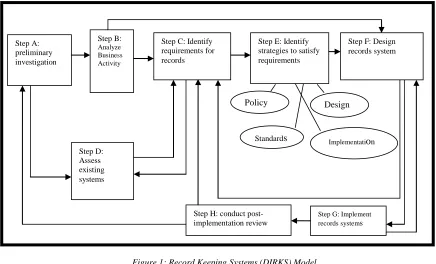
The DIRKS Model which was introduced by the National Archives of Australia along with the state records Authority of New South Wales can be used by IHL in Libya as this model could be widely used to review the existing record keeping system or can also be used for the development of new systems and this model is largely used for the improvement of the existing record management system [15;23]. Figure 1 illustrates the DIRKS Model.
5.
METHODThis study uses a quantitative approach to gather the information required for the study. For the purpose of gathering data, this study used a survey method employing by using questionnaires. The respondents for this study are the staff members of the IHL in Tripoli where a total of 300 questionnaires were distributed and out of these 270 questionnaires were received back indicating a response rate of 90%.
6.
DATA ANALYSIS AND FINDINGSBased on the demographic findings it was revealed that most of the participants are male in comparison and are in the age group between 25 and 40 with most of the respondents possessing Diploma. Most of the respondents are qualified with some IT experience which is a positive sign for the making use of electronic records management system effectively.
The next section of the research questionnaire was related to the challenges which connected to records management in IHL in Tripoli, Libya.
G
ENDER
% IT
EXP ERI ENC E
% AGE % QUALIFIC ATIONS
%
M
F 59
41 YES
NO
78
22
Under 25
25-40
41-50
51-60
Over 60
8
61
27
4
-
High-School-
Diploma
Bachelor
Master
Doctorate
15
46
25
14
Job Type
Management 36.4
Admin 39.7
Financial 23.9
Table 1: Demographics Profile
Figure 2 illustrates the findings about the importance of technology in managing records electronically among the staff which are indicated as below:
Step A: preliminary investigation
Step B: Analyze Business Activity
Step C: Identify requirements for records
Step D: Assess existing systems
Step E: Identify strategies to satisfy requirements
Step F: Design records system
Step H: conduct post-implementation review
Step G: Implement
records systems
Policy Design
[image:4.612.103.539.99.363.2]Standards Implementation
Figure 2: Importance Of Technology In Managing Records Electronically
The findings suggest that 78% of the respondents have agreed that it is highly important to manage records electronically through integrating advanced technology in the existing system because the modern environment demands speed and accuracy in utilising university data for making fast decisions and this can be attained through electronically recording university’s data. However, 22 % of the respondents did not agree with the importance of technology in managing records electronically.
Followed by the importance of technology the next question was related to the current environment among the education institutions in Tripoli and the results have been portrayed in the table below.
[image:5.612.89.299.89.262.2]a. Do you consider the lack of infrastructure as a Problem in managing electronic records?
Table 2: Lack Of Infrastructure
Question Variables %
Do you consider the lack of
infrastructure as a problem
in managing ER ?
YES
NO
90
10
According to the results portrayed in table 2 it is clearly that the lack of good IT infrastructure is largely responsible behind the acceptance of electronic records management system (ERMS) which is obvious. Followed by the discussion on
infrastructure the respondents were asked about the importance of training individuals can enhance the process of deploying ERMS.
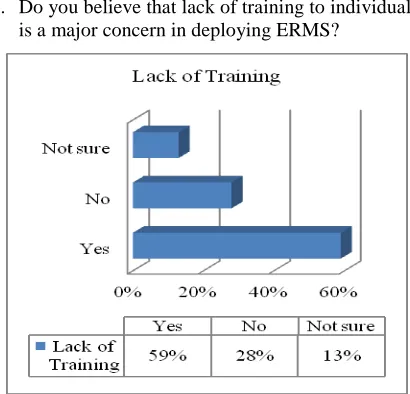
b. Do you believe that lack of training to individuals is a major concern in deploying ERMS?
Figure 3: Lack Of Training In IHL For Records Management
The above figure clearly depicts that the staff also believes that the lack of training among the staff related in record management is a major challenges which can be largely attributed the available resources within the country. Whereas 28% of the records respondents believed that there is no need for
any specialized knowledge of the records
management officers to perform electronic records of data. However, 13% of the respondents did not either agreed or disagreed about the need for specialized knowledge in managing records.
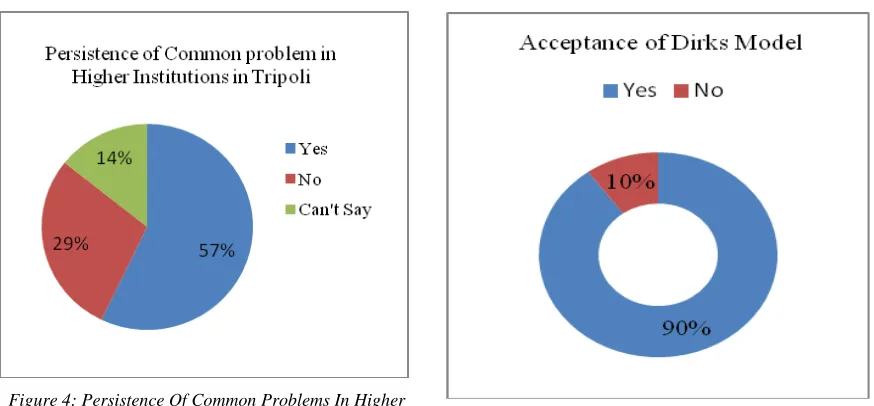
[image:5.612.318.523.154.351.2]Figure 4: Persistence Of Common Problems In Higher Institutions In Tripoli
Based on the findings of the study it was evident that the respondents had their own views with respect to the policies and procedures in the higher education institutions in Libya especially in relation to the ICT department and the record managers. Based on the findings it was also found that the main sources based on which the institutions currently used to frame their policies were based on the US National Archives, Australian National Archives and UK National Archives.
Finally, the respondents were asked about any specific issues that they encounter while making the recording of data electronically and the response of the majority of the respondents suggested that the major problem faced by them in recording data electronically is the classification problem. Since, there are various departments within the institution and at the same time, each department offers various kinds of programs, it leads to confusion in appropriately classifying the records of different students enrolled within a particular course. In addition to this, another major problem as specified by the respondents as interviewed was that most of the institutions in Tripoli were are new and they have relatively lower experience. This also poses difficulties in successfully operating over the newer system, as the development of appropriate programs and policies is also lacking to perform the task of electronic recording of data.
c. Do you believe that the DIRKS Model would be suitable for IHL in Libya
Figure 5: Acceptance Of DIRKS Model
Based on the results derived in figure five it is clear that most of the respondents have agreed with the DIRKS Model as the results indicate that 90 % of the respondents agreed with the DIRKS model and just 10% apposing it which clearly depicts that the suggested model is welcomed well among the IHL in Libya for electronic record management practices.
7.
CONCLUSIONTo conclude the major challenges as encountered by them are inappropriate infrastructure to perform the electronic recording of data, lack of appropriate training programs and knowledge by record keepers, increasing numbers of courses leading to increasing pressure among the record keepers, inappropriate programs and policies etc. Based on the findings of the study it was evident that most of the higher education institutions in Libya lack effective records management policies and some institutions have policies but are not framed in the right manner which can act as a guide to implement better record management practices within the nation.
REFERENCES:
[2] R.J. Cox, “Ethics, accountability and recordkeeping in a dangerous world”, London: Facet Publishing,2006.
[3] A. Meijer, “Accountability in An Information Age: Opportunities and Risks for Records Management”, Archival Science, Vol 1, No:4, 2001, pp.361-72.
[4] S.B. Hanan, “Virtuality and Future of
Electronic Management in Libya”,2007. http://www.journal.cybrarians.info/index.php? option=com_content&view=article&id=95-52-47&Itemid=55[ 23August 2012].
[5] Florida Department Of State, Electronic
Records and Records Management Practices . Division Of Library And Information Services , 2010. Http://Dlis.Dos.State.Fl.Us/Barm/Hand books /Electronic.Pdf [Accessed on 04 May 2012].
[6] R. Amal, and I. Miliszewska, “Towards E-learning in higher education in Libya”, Thesis Ph.D. School of Engineering and Science, University of Victoria, 2010.
[7] J.E. Rowley, “Organizing knowledge: an introduction to managing access to information”, Ashgate Publishing, Ltd, 2008. [8] International Atomic Energy Agency (IAEA),
“Long term preservation of information for docommissioning projects”, 2008. http://www-pub.iaea.org/MTCD/publications/PDF/trs467_ web.pdf [ 25 August 2012].
[9] Fermi National Accelerator, “Employee
records management handbook”, 2010. http://bss.fnal.gov/records/RM_Handbook_201 0.pdf [11 July 2012].
[10]ACARM, ”What is records management?”,
2007. http://www.acarm.org/pub/ blications /Leaflets/ACARM%20RM%20leaflet-What is records management. pdf [23 August 2012]. [11]International Standards Organization (ISO),
“ISO 15489-1, Information and
Documentation – Records Management Part 1: General”, Geneva: International Standards Organization, 2001. http://www.records.nsw.gov .au/ publicsector/ standards /introint1.htm [20 September 2012]. [12]N.B. Dubey, “Office management developing
skills for smooth functioning”, New Delhi: Global India Publications Pvt Ltd, 2009. [13]F.S. Robert, “Taming the email tiger: Email
management for compliance, governance and litigation readiness: A management guide”, New Orleans: BB Publishing, 2008.
[14]NRCNA (National Research Council of the National Academies), “Health risks from exposure to low levels of ionizing rdiation: BEIR VII Phase 2”, Washington, DC: 2005.
[15]National Archives of Australia, “DIRKS
Manual: Strategies for Documenting Government Business”, 2007.
http://www.records.nsw. gov.au/
recordkeeping /dirks-manual [17 August 2012]. [16]H.Z. Abdol Nasser, A.K. Faraj, and H.R. Wael,
“Assessing e-readiness in the Arab countries: perceptions towards ICT environment in public organizations in the stat of Kuwait”, 2007. http://issuu.com/academic-conferences.org [15 August 2012].
[17]S. Fadi, “Exploring E-Government Barriers In The Arab States”, 2006. http://belfercenter.ksg.harvard.edu/files/DSGe GOVBRIEF_egov_fadi.pdf [ 21 August 2012]. [18]RAB, “Transparency and Accountability in the
Public Sector in the Arab Region”, 2006. http://unpan1.un.org/intradoc/groups/public/do cuments/ unpan003617.pdf [ 12September 2012].
[19]A. Mohsin, and R. Othman, “Implementation of Electronic Government in Malaysia: The Status and Potential for Better Service to the Public”, Public Sector ICT Management Review, Vol 1, No 1, 2006. Malaysian Centre for Geospatila Data Infrastructure (MacGDI). [20]H.N. Kemoni, "Management of electronic
records: Review of empirical studies from the Eastern, Southern Africa Regional Branch of the International Council on Archives (ESARBICA) region." Records Management Journal 19, no. 3 (2009): 190-203.
[21]E. Shepherd, “Why are Records in Public Sector Organizational Assets?”, Records Management Journal, Vol. 16, No:1, 2006. International Council on Archives (2004), “Welcome to ICA”, International Council on Archives, Paris. www.ica.org [Accessed on September 2011].
[22]State Records New South Wales, “Strategies for Documenting Government Business: Doing DIRKS Project”, Records Access and Security,
2006. http://www.records.nsw.gov.au/ publicsector/DIRKS/ final /accesssecurity.htm