Knowledge management research within
the built environment: Research
methodological perspectives
Pathirage, CP, Amaratunga, RDG and Haigh, RP
Title Knowledge management research within the built environment: Research methodological perspectives
Authors Pathirage, CP, Amaratunga, RDG and Haigh, RP
Type Conference or Workshop Item
URL This version is available at: http://usir.salford.ac.uk/9940/
Published Date 2005
USIR is a digital collection of the research output of the University of Salford. Where copyright permits, full text material held in the repository is made freely available online and can be read, downloaded and copied for noncommercial private study or research purposes. Please check the manuscript for any further copyright restrictions.
KNOWLEDGE MANAGEMENT RESEARCH WITHIN THE BUILT
ENVIRONMENT: RESEARCH METHODOLOGICAL PERSPECTIVES
C.P. Pathirage, R.D.G. Amaratunga and R. Haigh
The Research Institute for the Built and Human Environment, University of Salford
Salford M7 1NU
E- mail: [email protected]
ABSTRACT: As built environment is of major importance to all societies and economies, it is essential that the discipline advances as rapidly and rigorously as possible. Only by use of appropriate methodologies and methods of research, the body of knowledge for construction can be established and advanced with confidence. Research is always executed in context and it is vital to give careful consideration to the research methodolo gy at the outset of the research. This paper discusses available research philosophies and methodologies, while highlighting the main facets of the arguments on their relative characteristics. Issues that need to be considered when selecting the most appropriate approach and research methods when undertaking research in built environment context are outlined. In highlighting above, the paper e xplains and justifies the selected research strategy for a performance oriented knowledge management research in built environment context. Social constructionism stance in terms of epistemological undertakings and idealistic approach under the ontological assumptions with value laden purposes are suggested together with the deployment of multiple exploratory case studies approach and triangulation techniques.
Keywords – Built Environment, Knowledge Management, Research Methodology
1. BACKGROUND
Almost all disciplines and professions seek out new knowledge and answers to critical issues through research. Yet, there is hardly any agreement in literature in defining the term research, despite its importance, due to the fact research means different things to different people from different disciplines. Most commonly research refers to, a systematic careful search; a contribution to knowledge; or as a learning process. As the Oxford English Dictionary (1995) provides, more extensive definition of research is “a systematic investigation and study of materials, sources etc. in order to establish facts and reach new conclusions, hence new knowledge”. Nevertheless, research is always executed in a context and it is vital to give careful consideration to the research methodology at the outset of the research in order to adopt most appropriate approaches and research methods.
As Built Environment (BE) is of major importance to all societies and economies, co-operating as an active partner with various scientific disciplines such as management, social science, natural science and psychology, it is essential that the discipline advances as rapidly and rigorously as possible. A discipline or a profession is established by developing a body of knowledge, which is unique, through research. Only by use of appropriate methodologies and methods of research, applied with rigour, can the body of knowledge for any discipline be established and advanced with confidence (Fellows and Liu, 2003). In the context of built environment, this highlights the importance of careful selection of appropriate research methodologies, which have often been criticised for their anecdotal approach (Amaratunga et al, 2002) when interpreting real world phenomena.
portrays existing research philosophies and methodologies, while highlighting the main facets of the arguments on their relative characteristics. The second section describes the development of research objectives from the identified gaps in the literature through a brief review of related concepts, whereas in the final section, issues that need to be considered when selecting the most appropriate approach and research methods are outlined, while justifying the selected research strategy for a knowledge management research in BE context.
2. RESEARCH METHODOLOGY- PHILOSOPHIES AND APPROACHES
Research methodology, the methods by which research can be carried out, lies at the heart of any research. It is vital to give careful consideration to the research methodology at the outset of the research in order to adopt most appropriate approaches and research methods. Thereby, it is unwise to conduct research without an awareness of the philosophical, methodological and political issues that lie in the background of any research. Yet, many research methodology texts fail to explain the distinction between research method and methodology (Travers, 2001). Methods are the techniques used in collecting data, whereas methodology refers to the assumptions a researcher possess, which can be epistemological or political in character. By highlighting the same issue Tuchman (1994) asserts, methodology means not only the application of a specific data collection method such as survey or interviews but also, the study and understanding of the epistemological and ontological assumptions implicit in specific methods. In this context, following sections outlines major aspects of research methodology, which will examine the existing philosophical paradigms and approaches of research. Research techniques are not discussed under this section due to high dependency on the research approach selected.
2.1Research Philosophy
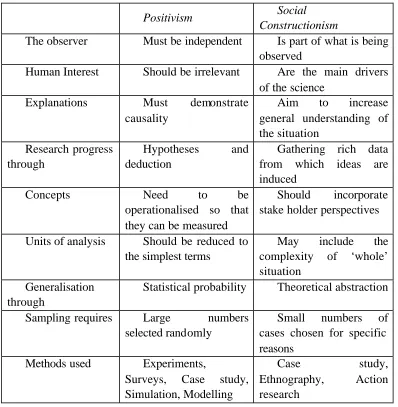
The research philosophy refers to epistemological, ontological and axiological assumptions and undertakings that guide an inquiry in a research study, implicitly or explicitly. Failure to think through philosophical issues, while not necessarily fatal, can seriously affect the quality of a research, which is central to the notion of research design (Easterby-Smith et al, 2003). In terms of epistemological undertakings, two fundamentally different and competing schools of thought are positivism and social constructionism which can be place in two extreme ends of a continuum. As Easterby-Smith et al (2003) asserts in their review of research philosophies, “in the red corner is constructionism; in the blue corner is positivism”, which stresses the two extreme ends of the epistemological undertakings. The contrasting key features of these two epistemological research paradigms are detailed in Table 1.
In summary, positivism believes that the social world exists externally and that its properties should be measured through objective measures, where observer must be independent from what is being observed, which originates from the thinking of Comte (1853). In contrast, social constructionism stem from the view that reality is not objective and exterior, but is socially constructed and given meaning by people (Easterby-Smith et al, 2003), who are conscious, purposive actors with ideas about their world and attach meaning to what is going on around them (Robson, 2002).
2004) whereas, idealists assumes that different observers may have different viewpoints and that, “what counts for the truth can vary from place to place and from time to time” (Collins, 1983). Axiology, the third component of the research philosophy, is classified based on whether the reality is value free or value driven. In value neutral research, the choice of what to study and how to study, can be determined by objective criteria, whilst in value laden research choice is determined by human beliefs and experience (Easterby-Smith et al, 2003), which marks the two extreme ends of a continuum.
Table 1: Contrasting implications of positivism and social constructionism (Easterby-Smith et al, 2003)
Positivism Social Constructionism
The observer Must be independent Is part of what is being
observed
Human Interest Should be irrelevant Are the main drivers
of the science
Explanations Must demonstrate
causality
Aim to increase general understanding of the situation
Research progress through
Hypotheses and deduction
Gathering rich data from which ideas are induced
Concepts Need to be
operationalised so that they can be measured
Should incorporate stake holder perspectives
Units of analysis Should be reduced to
the simplest terms
May include the complexity of ‘whole’ situation
Generalisation through
Statistical probability Theoretical abstraction
Sampling requires Large numbers
selected randomly
Small numbers of cases chosen for specific reasons
Methods used Experiments,
Surveys, Case study, Simulation, Modelling
Case study, Ethnography, Action research
2.1. Research Approach
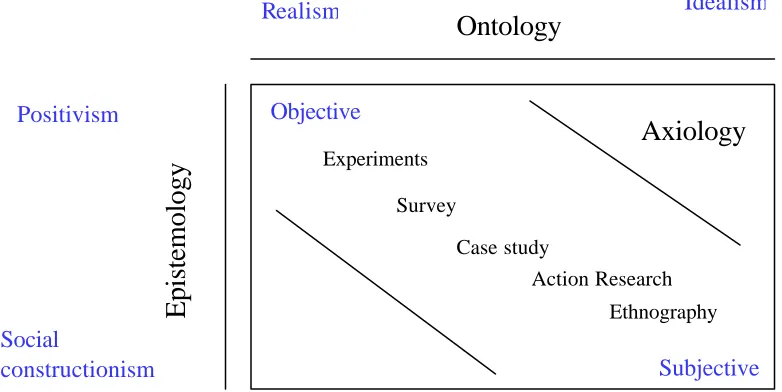
[image:5.596.104.495.214.410.2]Research approach is being guided by the epistemological undertakings, ontological assumptions and by axiological purposes. Figure 1 (adopted from Sexton, 2004) illustrates research approaches governed by different research philosophies. Experiments and survey approaches have been positioned towards the positivist epistemological undertakings and an ontological assumption titled towards realism with value neutral research. In contrast, ethnography, action research and often case studies are governed by social constructionist epistemological undertakings and idealist ontological positioning with value laden research.
Figure 1 Dimensions of Research Philosophy (Sexton, 2004)
By considering the underpinning paradigmatic distinctions between the aforementioned philosophical schools, another two broadly differing approaches to describe the collection and analysis of data are usua lly referred to as the qualitative and the quantitative approaches. As Gill and Johnson (1991) proposed, research approaches can be positioned by taking nomothetic (realist) and ideographic (idealist) ontologies into account. Nomothetic is defined as the research approach which utilises quantified methods for data analysis, whereas ideographic approaches deal with analysis of subjective accounts generated through inside situations and involving one self in the everyday flow of life (Gill and Johnson, 1991). This highlights the quantitative and qualitative approaches and according to Gill and Johnson (1991), experiments and survey approaches are associated with nomothetic type, whilst ethnography, action research and case study under ideographic type.
Experimental style of research is carried out, usually in laboratory setting, when an investigator can manipulate behaviour directly, precisely and systematically (Yin, 2003). In surveys, samples are examined through questionnaires or interviews, which can vary from highly structured questionnaires to unstructured interviews (Fellows and Liu, 2003). As Argyris and Schon (1989) state, action research builds descriptions and theories within the practice context itself and tests them there through intervention experiments. Ethnography is a research method well suited to providing researchers with rich insights into the beliefs and values of human, social and organisational aspects of a socio-cultural phenomenon (Harvey and Myers 1995). It requires long periods of field work study conducted in a reasonably unstructured manner (Van Maanen, 1982).
Case studies constitute a distinct style of research. Yin (2003) defines case studies as an empirical enquiry that investigates a contemporary occurrence within real life context,
Ontology
Realism Idealism
Epistemology
Positivism
Social
constructionism
Objective
Subjective
Survey
Case study
Action Research
Ethnography Experiments
especially when boundaries between phenomenon and context are not clearly evident. Generally, only a few cases are studied and due to this the case researcher will typically try to uncover more variables of interest. The research approach adopted should reflect and be appropriate to the research purpose and the type of research question being addressed (Yin, 2003). Accordingly, following section outlines the development of research objectives from the identified gaps through a thorough literature review by way of a brief review of related concepts.
3. THE NATURE OF THE RESEARCH: LITERATURE AND OBJECTIVES
Importance of literature review can be of two sorts. Firstly it may assist the researcher to understand and identify a problematic area of research through gaining a sound knowledge in the field being studied. Later to unearth the relevant work in terms of theories and models developed by previous researchers in the field. This will ensure the researcher, to define the objectives and the research problems more clearly and precisely, to refrain from ‘reinventing the wheel’ and finally to make a contribution to the body of knowledge.
The research is aimed at establishing the importance and impact of managing tacit knowledge towards company performance in BE. Although the concept of K nowledge Management (KM) has emerged extensively during last few decades, link to the company performance is inadequately researched. The conceptual arguments from the literature centred around three themes: knowledge and its link to performance, performance evolution and KM and company performance.
3.1. Knowledge and its link to Performance
3.2. Performance Evolution
For many years, frameworks have been used by companies to assess their performance in order to communicate it to the wider market which can be placed on four distinct generations. The first generation performance frameworks mainly relied on financial measures. The subsequent revolution in performance measurement promoted companies to implement non-financial measures that appropriately reflect their objectives. Thereby, second generation measurement systems were based on the assumption that financially biased measurement systems should be supplemented with non-financial indicators, including intangibles. Third generation measurement approaches made a significant step forward by using strategy and/or success maps (Neely et al, 2003) incorporating the dynamic nature of performance. Presently the concern is heading towards the fourth generation of performance measurement, which requires companies to seek greater clarity about the linkages between the non- financial and intangible dimensions of company performance.
Despite the importance of business performance measurement in BE, it has received “scant attention” (Love & Holt, 2000) within mainstream construction management literature, particularly concerning its role in “offering real-aid” (ibid, p409) to improved construction performance. The issue of the critical role that employees play in fostering an effective construction business has often been overlooked (Nesan & Holt, 1999). Hence it is argued (Love and Holt, 2000; Dainty et al, 2003) that there is a necessity in BE to define more appropriate performance criteria for both project and company level by redefining traditional success parameters to consider the knowledge, skills and behaviour inputs which contribute to superior performance.
3.3. Knowledge Management and Company Performance
Review of current literature reveals numerous definitions and techniques of KM due to wide range of interest, perspectives and issues represented by different authors. In general, KM is used to refer to all efforts, to enhance and increase the value of the generation, sharing and application of knowledge. Many companies are embracing KM but few of them are able to implement it successfully to see the benefits (Arora, 2002). Even if companies become successful, the determination and the establishment of the impact on the company performance is important for a business to justify the implementation of KM initiatives. Yet, authors such as Kalling (2003), Steele et al (2003), Ahn and Chang (2002) and Marr and Spender (2004) who have researched on combining KM and performance measurement, have expressly admitted the difficulty of measuring the contribution of knowledge on business performance, which has resulted in paucity of KM literature (Marr et al, 2003; Ahn and Chang, 2002; Kululanga and McCaffer, 2001) that make explicit connection between KM and company performance. The paucity of literature in this area is more pronounced in the construction industry, which marked the gap in literature.
research was developed to address this prevailing gap in construction industry, which is detailed in succeeding section.
3.4. Research Objectives
Drawing from the conclusions of the literature review together with the identified gap in built environment literature, research aim and objectives are devised around the themes of tacit knowledge management and company performance. An appropriate research strategy is developed by taking the tacit knowledge intensive nature of BE and ind uctive theory building process into account. Research aimed at establishing the impact of managing tacit knowledge on business performance in companies operating within BE. In the process of determining the link between these two constructs, emphasis is placed on the importance of tacit knowledge, human capital involvement and on fourth generation measurement frameworks. Thereby, the following section outlines the research methodology applied for this research in order to fulfil the aforementioned aim of the study.
4. Research Methodology Applied
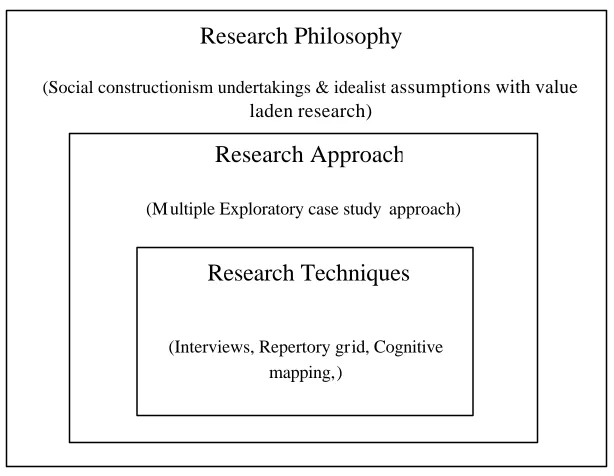
[image:8.596.149.456.395.633.2]This study uses the ‘nested approach’ (Kagioglou et al, 1998) which nests the philosophy, approach and techniques of the research. Figure 2 depicts the intended deployment of each of these elements in this study and succeeding sections will explore the application of these philosophical paradigms, approaches and techniques for this research.
Figure 2 Nested Approach (Kagioglou et al, 1998)
4.1. Research Philosophy
Justification will be done in this section in terms of epistemological undertakings, ontological assumptions and axiological purposes. By considering the key features of epistemological extremes, the social constructionism approach deemed to be more appropriate to this research than the traditional positivism philosophy due to several reasons. As set out in the aim of this
Research Philosophy
Research Approach
Research Techniques
(Interviews, Repertory grid, Cognitive mapping,)
(M ultiple Exploratory case study approach)
study, research requires an in-depth context specific investigation of real life, complex, human cognitive and behavioural aspects in view of theory building. It renders the descriptive channel of research, focusing on a small sample by relying on inductive research approach than deductive, which is mainly deployed for theory testing through examining a large sample through extensive cases. As such, this disqualifies itself from embracing an entire positivist approach, which begins with a theoretical position and moves towards concrete empirical evidence through rigorous process of testing hypotheses with va lue free facts to identify universal laws.
[image:9.596.110.511.388.579.2]In particular, as this study attempts to explore the unarticulated knowledge mainly grounded in the intellectuals, which gains its orientation from the management research paradigm, it again disproves the likeliness of comfortably fitting to the positivist paradigm. Hence, based on the capability of a socially constructed reality in building up the understanding of the phenomena, social constructionism stance is preferred as the underpinning epistemological undertaking in this research. In addition, as the nature of the problem being investigated in this study is of explorative type and due to the unstructured character of the subject being examined, this research closely resembles with the idealist assumption in terms of ontological positioning which perceives external world as not having a pre-determined nature and a structure. As contended by Collins (1983), truth may vary from place to place and from time to time, determined by human beliefs and experience. As such, from this kind of research, it is expected that different observers to come up different view points, due to the subjective, value laden nature of the researcher, which highlights the axiological purposes.
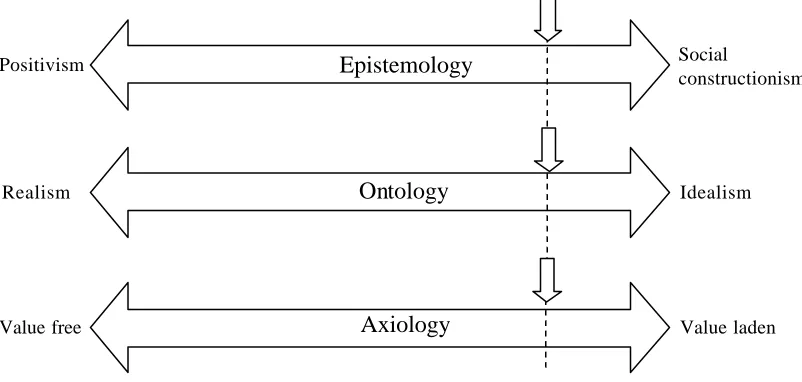
Figure 3 Epistemological, Ontological and Axiological stances Applied
By taking the aforementioned characteristics of the study into account, as given in Figure 3, it can be concluded that this research is mainly driven towards social constructionism stance in terms of epistemological undertakings whilst taking an idealistic stance in positioning under the ontological assumptions with value laden purposes in terms of axiological endeavours. In this context, the succeeding section outlines the available research approaches for these philosophical stances.
4.2. Research Approaches
Positivism Social
constructionism
Realism Idealism
Value free Value laden
Epistemology
Ontology
Ethnography, action research and case studies are the research approaches governed by social costructionist epistemological undertakings and idealist ontological positioning with value laden research. Thereby, this disqualifies itself adhering experiments or surveys as a research approach for this study, since they are governed by positivism and realism in terms of research philosophy. Gill and Johnson (1991) further justifies usage of ethnography, action research and case studies from ideographic (idealist) ontological stance with qualitative approach. Yet, applying an appropriate research method(s) for a particular research is governed by the problem being solved or the questions being answered. What method to use also depends on the nature of the investigation and the type of information that is available or required (Naoum, 1998).
As the aim of this research is more of exploratory with ‘What’, ‘How’ questions and descriptive in nature, an approach suited to exploration and description is required. Yet all ethnography, action research and case studies facilitate opportunity for exploration as well as for descriptive analyses. Therefore no distinction can be done within these research approaches in terms of exploration and description. In addition, since this study attempts to explore the role of managing tacit knowledge for better performance in BE, it requires to examine contextual, contemporary and complex human interactions both psychological and sociological levels without controlling variables i.e. intervention. Although, all these approaches offer examination of context specific and contemporary set of events, choices of both action research and ethnography were rejected as they disqualify the intervention criteria which require the researcher to be a participant observer and to interact with the problem environment. Accordingly, the case study approach appears to be the most suitable method for this study, which cater ‘What’ and ‘How’ type research questions about contemporary set of events, without differentiating between phenomena and context, where the researcher tends not to interfere with what is being studied. Hence, the necessity for a descriptive, context specific research without the researcher’s intervention together with the exploratory type research questions defined, justifies the case study approach for this research. Thereby, following section further examines into case study approach by considering its design to the current study.
4.3. Case Study Design
Case study approach governs by the social constructio nist epistemological undertakings and an ontological position titled towards idealist with value laden purposes. The nature of the research preferred intensive research methods, where case studies being selected as the main research strategy. This facilitates the researcher to investigate the link between management of tacit knowledge and performance in a ‘real life’ BE context. In this sense, case studies have an important function in building theory in BE research.
study. But, due to the inherent risk involved and lack of replication and confidence in the robustness of the theory development in single case study, more than one case study was preferred. Due to the project based nature of the BE research, the recognition was given for the existence of construction projects as a subunit within the main unit of analysis of construction firm. Thereby in summary these justify selection of exploratory, multiple, embedded case study design. Although case study is a distinct form of empirical inquiry, there are also criticisms offered to this approach due to lack of rigour and biased views of the investigator, which can render constructs invalid. Therefore, next section describes the tactics used within case study design to overcome such criticisms.
4.3.1. Case Study Design Acceptability
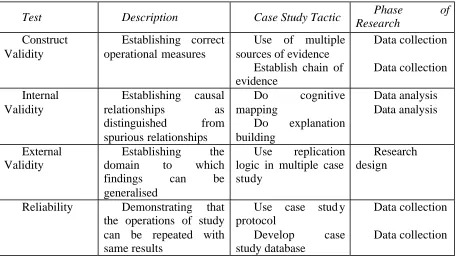
[image:11.596.71.527.317.573.2]According to Yin (2003), the quality and validity of any case study design can be judged by four design tests, which can overcome much criticism. Those are construct validity, internal validity, external validity and reliability. The intended deployment of these principles to this research is illustrated in the Table 2.
Table 2 Validity and Reliability of Case Study Research (Yin, 2003)
Test Description Case Study Tactic Phase of Research
Construct Validity
Establishing correct operational measures
Use of multiple sources of evidence
Establish chain of evidence Data collection Data collection Internal Validity Establishing causal relationships as distinguished from spurious relationships
Do cognitive
mapping Do explanation building Data analysis Data analysis External Validity Establishing the domain to which findings can be generalised
Use replication logic in multiple case study
Research design
Reliability Demonstrating that
the operations of study can be repeated with same results
Use case stud y protocol
Develop case study database
Data collection
Data collection
The other common concern about the case studies is that they provide little basis for generalisation. It is true that case study approach provides a limited basis for the traditional scientific generalisation, but case studies, like experiments, can be generalised to theoretical propositions and not to population or to universe (Yin, 2003). In the context of this research, the goal would be to expand and generalise theories (analytic generalisation) by comparing conceptual arguments developed from literature with empirical results of case study relating to tacit knowledge and performance in BE and not to enumerate frequencies (statistical generalisation).
reasons, by selecting less and more tacit knowledge intensive cases within BE. According to Eisenhardt (1989), multiple cases, apart from permitting replication logic, also permit extension among individual cases to develop more elaborated theory, whereas Yin (2003) further argues that the development of “rich theoretical framework” as an important step in replication procedures. By developing such a rich theoretical framework it is intended to use it as a vehicle for generalisation in BE context. In addition, purposive or theoretical sampling, in which the cases are selected to serve the real purpose and objectives of the study to gain insight and understanding into the chosen phenomenon, is preferred in this research over statistical sampling. In this context, the following section outlines the proposed usage of research techniques that will be utilised within this research.
4.4. Research Techniques
Methods of data collection and the analysis are considered under the research techniques. In this regard, case study approach presents a “full- fledged” method for conducting research. One important aspect of case study data collection is the ability to use multiple sources of evidence, converging on the same set of issues, which can be of quantitative or qualitative nature (Yin, 2003). As asserted by Eisenhardt (1989), theory building researchers typically combine multiple data collection methods. Thereby being parallel to Eisenhardt’s assertion, this research intends to deploy triangulation technique combining more than one source of data collection and collecting techniques, yet with a high emphasis on qualitative analyses. In view of addressing aim and objectives of this research, the study will seek to collect data from companies within BE covering entire supply chain of the construction process, with the view of exploring the role of tacit knowledge towards company performance. Data will be mainly gathered via interviews, direct observations and through document reviews. Interviews will be carried out at three different levels of staff in construction companies’ i.e. senior manager, middle manager and worker level. Open ended key informant interviews will be carried out with senior managers, which are often critical for case studies (Yin, 2003). As Yin (2003) asserts, key informants not only provide insights into matter, but can also suggest sources corroboratory or contrary. Semi-structured focused interviews are preferred with middle managers, whereas structured survey will be carried out with construction workers. The survey results produce quantitative data for the case study, whic h can be used for corroborating with the rest of the evidence collected. This can be considered as part of triangulating the sources of data collection. As this study deals with the tacit knowledge of the intellectuals, analysis of documentation will be of very limited use. Yet, direct observations and review of documentation will be done in view of gaining a clear understanding of the context and the phenomenon of the case being studied.
5.
CONCLUSION
Clear definition and design of a research strategy is a fundamental and necessary requirement for a sound empirical study not only in BE but in any field. This paper has set out an appropriate research strategy for a performance oriented management of tacit knowledge research in BE. It is not the purpose of this paper to suggest aforementioned research methodology as the only suitable design for similar research in BE and as discussed within the paper, suitability will depend on the aim, objectives and questions of the research study, but to emphasis that, for the success of any research, understanding the fundamental issues relating to different philosophies, approaches and techniques are of immense importance to design the most suitable research strategy.
6.
REFERENCES
Ackermann, F., Eden, C. and Cropper, (1992), Getting started with cognitive mapping, proceedings of 7th Young operational research conference, University of Warwick, April 1992, pp. 65-82
Amaratunga, D., Baldry, D., Sarshar, M and Newton, R., (2002), Quantitative and qualitative research in the built environment: application of mixed research approach, Work study, Vol 51(1), pp 17-31
Adams, G.L. and Lamont, B.T., (2003), Knowledge management systems and developing sustainable competitive advantage, Journal of knowledge management, Vol 7(2), pp 142-154.
Ahn, J.H. and Chang, S.G., (2002), Performance oriented knowledge management
methodology, Invited paper for journal of management information systems.
Argyris, C. and Sch¨on, D., (1989), Participatory Action Research and Action Science Compared, American Behavioural Scientist, Vol 32 (5), pp.612–23
Arora, R., (2002), Implementing KM- A Balance Scorecard approach, The Journal of
Knowledge Management, Vol.6 (3), pp.240-249.
Bollinger, S. and Smith, D., (2001), Managing organizational knowledge as a strategic asset,
The Journal of Knowledge Management, Vol.5 (1), pp8-18
Carrillo, P. M, Anumba, C.J. and Kamara, J. M. (2000) “Knowledge management for
construction: key IT and contextual issues,” in Gudnason, G. (ed.), Proceedings of the Inter. Conf. on Construction IT, 28-30 June, Reykjavik, Iceland, Icelandic Building Research Institute, pp. 155-165
Civi, E., (2000), Knowledge management as a competitive asset: a review, Marketing intelligence and planning, Vol 18(4), pp.166-174
Collins, H.M., (1983), An empirical relativist programme in the sociology of power and symbolism, Routledge and Kegan Paul, London
Dainty, A.R.J., Cheng, M. and Moore, D.R., (2003), Redefining performance for construction project managers: an empirical evaluation, Construction Management and Economics, Vol 21, pp.209-218
Drucker, P. (1992), Managing for the Future: The 1990s and beyond, Truman Talley Books, New York, NY
Easterby-Smith, M., Thorpe, R. and Lowe, A., (2003), Management Research: An
Introduction, 2nd, SAGE publications, London
Egbu, C, Kurul, E, Quintas, P, Hutchinson, V., Anumba, C. and Ruikar, K., (2003),
Knowledge production, resources and capabilities in the construction industry, Work package 1- final report, Knowledge management for sustainable construction competitiveness project, Available from: www.knowledgemanagement.uk.net
Eisenhardt, K.M. (1989), Building theories from case study research, Academy of
Management Review, Vol. 14 (4), pp. 532-55
Fellows, R and Liu, A., (2003), Research methods for construction, 2nd, Blackwell Science, Oxford, UK
Gill, J. and Johnson, P., (1991), Research Methods for Managers, Paul Chapman Publishing, London
Gummesson, E., (1991), Qualitative Methods in Management Research, revised edition Sage publications, London
Harvey, L. and Myers, M. (1995), Scholarship and practice: the contribution of ethnographic research methods to bridging the gap, Information Technology and People, Vol. 8 No. 3, pp. 13-27
Herrgard, T.H., (2000), Difficulties in the diffusion of tacit knowledge in organizations,
Journal of Intellectual Capital, Vol 1(4), pp.357-365
Herriott, R.E and Firestone, W.A., (1983), Multisite qualitative policy research: Optimising description and generalisability, Education Researcher, Vol 12, pp 14-19
Johnson, P. and Duberly, J. (2000), Understanding Management Research, Sage
publications, London
Kagioglou, M., Cooper, R and Aouad, G., Hinks, J., Sexton, M.G. and Sheath, D.M., (1998),
A generic guide to the design and construction process protocol, University of Salford, Salford
Kalling, T., (2003), Knowledge management and the occasional links with performance, The journal of Knowledge Management, Vol.7(3), pp.67-81
Love, P.E.D. and Holt, G.D., (2000), Construction business performance measurement: the SPM alternative, Business process management journal, Vol. 6 (5), pp. 408-416
Marr, B. Carlucci, D and Schiuma, G., (2003), Linking knowledge management initiatives & business performance: The knowledge asset value creation map, Proceedings of 4th European conference on knowledge management, MCIL, 18-19 September 2003
Marr, B. and Spender, J.C., (2004), Measuring knowledge assets- implications of the knowledge economy for performance, Measuring business excellence, Vol 8(1), pp 18-27.
Naoum, S.G., (1998), Dissertation research and writing – For construction students, Butterworth-Heinemann, Oxford, U.K
Neely, A., Marr, B., Roos, G., Pike, S and Gupta, O., (2003), Towards the third generation of performance measurement, Controlling, Heft 3/4, Marz/ April 2003, pp.129-135
Nesan, L.J. and Holt, G.D., (1999), Empowerment in Construction Organisations: The Way Forward for Performance Improvement, Research Studies Press, Somerset
Nonaka, I. and Takeuchi, H., (1995), The knowledge creating company: How Japanese
companies create the dynamics of innovation, Oxford university press, New York.
Robson, C., (2002), Real world research, 2nd, Blackwell publications, Oxford, UK
Sexton, M., (2004), PhD Workshop: Axiological purposes, ontological cages and
epistemological keys, Postgraduate research workshop, November 2004, University of Salford, UK
Sharkie, R., (2003), Knowledge creation and its place in the development of sustainable competitive advantage, The Journal of Knowledge Management, Vol.7 (1), pp20-31
Steele, A et al., (2003), A framework to create key performance indicators for knowledge management solutions, The journal of Knowledge Management, Vol.7(2), pp.46-62
Teece, D.J., (2000), Managing intellectual capital, Oxford University press, Oxford
The concise Oxford Dictionary of current English, (1995), 9th, Clarendon press, Oxford
Travers, M., (2001), Qualitative research through case studies, SAGE publications, London, UK
Tuchman, G., (1994), Historical Social Science: Methodologies, Methods and Meanings, in N. Denzin and Y. Lincoln (eds.), Handbook of Qualitative Research, Thousand Oaks: Sage
Van Maanen, M. (1982), Linking ways of knowing with ways of being practical, Curriculum Inquiry, Vol. 6 (3), pp. 205-228