IS THERE A CORRELATION BETWEEN ERP
IMPLEMENTATION, ADHERENCE TO COSO AND GCG
IMPLEMENTATION?
1JULISAR, 2HARJANTO PRABOWO, 3JAP TJI BENG, 4 SUKRISNO AGOES
1 Senior Faculty Member, School of Information System, Bina Nusantara University, Indonesia
2 Professor, School of Business Management, Bina Nusantara University, Indonesia
3 Associate Professor, School of Information System, Tarumanagara University, Indonesia
4 Professor, Faculty of Economics, Accounting Department, Tarumanagara University, Indonesia
E-mail: 1 [email protected] 2 [email protected] 3 [email protected] 4 [email protected]
ABSTRACT
The objective of this study is to make a conceptual framework the correlation of ERP implementation, adherence to COSO, and GCG implementation. Based on literature review, that it needs a paradigm the application of ERP is a business project. Business project requires the attention of stakeholders, such as management, information systems professionals, line workers, consultants, and trading partners. In the development phase of the ERP system is a project, there must be control. Control is done so that the system is made to achieve the goals and objectives that have been set previously. Control is done by implementing an internal control guided by COSO. This research is still a literature study, so that the concept written here is still a conceptual framework which has to be tested empirically.
Key Words: ERP Implementation, Adherence To COSO, GCG Implementation
1. INTRODUCTION
There are departments in every company. They are also called functional areas that are the lowest level of the company's management structure. The types of functional areas in the company are the accounting, finance, marketing, human resources, and production and operations. Each functional area supported by the information system so that each functional area referred to as the accounting information systems, financial information systems, marketing, information systems, human resource information systems and information systems of production and operation. Every information system has been developed independently, thus resulting in information silos [1]. Information silos of communication occurs between the functional areas to be inefficient. Therefore, we need an information system that can bridge the silos of this information. They are able to integrate the functional areas of the company.
[2] State ERP is a software that integrates the planning, management, and use of all available resources within the company. It contains a series of applications to automate the routine work in the category of back-end (such as finance, inventory
management, and scheduling) which helps
companies to handle jobs that exist in the departments of the company. Thus, ERP is a great system to implement that function as "the backbone" for industrial and services companies. This system is designed to solve problems in information such as the term "islands of information" in the company. [1] Wrote "island of information" as "information silos".
The main objective of this ERP implementation is to integrate the across all of functional areas in the company as well as allowing information to flow seamlessly across all functional areas [1].
For companies that are in the modern era, a company whose operations using information technology, the application of internal control should be the primary focus for all processes in the company, particularly in the financial reporting
process is done automatically. Processing
automatically as initiates, authorize, record, and report the effect of financial transactions [3].
on the effectiveness and efficiency of the operations, reliability of financial reporting and compliance with laws and regulations in force in any State; have focused on all the entities that exist in the company; and who is responsible is the management, so in this study will be used as a measurement of the COSO. COSO is in accordance with the principles of administration issued by [4] and there is a responsibility and control to management centered.
In ERP implementation, the primary audience is management because management have a fairly important and the success and failure of ERP implementation is dependent on the full support of management. Since management exercise control over the implementation of ERP which includes planning, organizing, leading, and controlling [5].
2. LITERATURE REVIEW
2.1. Implementation of ERP
It needs a paradigm that ERP implementation is a business project compared to the installation of a new software technology [6] [6a]. In this ERP implementation, as it is a business project, it will require the attention of stakeholders, such as management, information systems professionals, line workers, consultants, and trading partner [7].
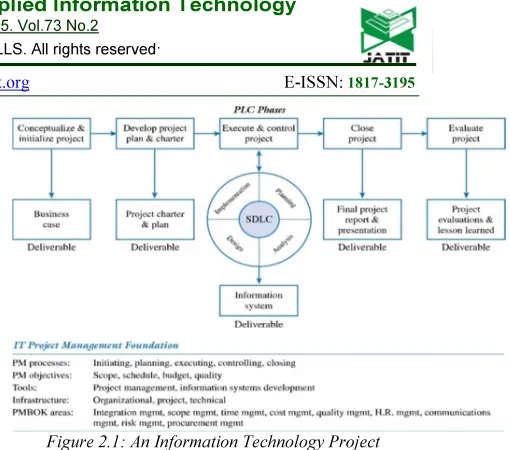
[8] Provides a methodology to create a project in Information Technology (Information Technology Project Methodology, ITPM) as in figure 2.1 below.
A methodology provides a strategic-level plan for managing and controlling IT project. Think of a methodology as a template for initiating, planning, and developing an information system [8].
[image:2.595.300.555.74.299.2]In the methodology contained in Figure 2.1 is the methodology recommends the phases, deliverables, processes, tools, and knowledge areas for supporting an IT project. The key word here is recommended because it given the different types of each project such as ERP, CRM (Customer Relationship Management) or data warehousing applications, which might require different tools and approaches in the manufacture of these systems [8].
Figure 2.1: An Information Technology Project Methodology Source: [8]
From the picture above, there is a relationship PLC
(Project Life Cycle) and SDLC (System
Development Life Cycle). At the current stage of the SDLC in the PLC is Execute and Control Project can be seen that in the development phase of ERP systems is a project, there must be control. Control is done so that the system is made to achieve the goals and objectives that have been set previously.
Enterprise resource planning (ERP) systems can be
regarded as one of the most innovative
developments in the information technology (IT) of the 1990s. With the growing interest of many organizations in moving from functional to process-based IT infrastructure, ERP systems have become one of today’s most widespread IT solutions. [9].
[10] Enterprise Resource Planning (ERP) systems are widely implemented as the backbone of many manufacturing and service firm. They are designed
to address the problem of information
fragmentation or “island of information” in business organization.
Enterprise Resource Planning by [11] consists of the word:
Enterprise, enterprise is any organization that has a set of common goals.
Planning, for effective utilization of resources, an enterprise needs to plan and undertake a variety of
planning activities like demand planning,
distribution planning, production planning, capacity planning, material planning, maintenance planning, financial planning and budgeting, quality planning, new product planning, etc.
[1] Writes ERP systems take a business process view of the overall organization to integrate the planning, management, and use of all of an organization’s resources, employing a common software platform and database.
Business process according to [1] a business process is a collection of related activities that produce a product or a service of value to the organization, its business partners, and/or its customers. A process has inputs and outputs, and its activities can be measured.
The business process is the same direction that described by [9] is to adopt ERP, so companies require more effort focused on technology and business process to implement ERP. In addition to focusing on technology and business process, when it will make ERP implementation, companies also need to take control at the time of application and organizational changes, because without control, ERP implementation will be difficult and risky, [12], [13]. In connection with the need to implement internal control, a company must also have a complementary relationship between the factors related to operational activities, such as
flexible manufacturing systems, marketing
strategies, control systems, information systems, relationships with customers and suppliers. All the factors mentioned above have referred to as complementary factors required for these factors in order to "fit" with each other to form a coherent operating system and to maximize profitability. Then to obtain success in the implementation of ERP, the company should also understand the risks that have to control the risks associated with it. [13].The risks referred to above is at risk due to a lack of fit between organizational strategy, organizational structure and processes and the selection of the ERP application.
[13] A risk that is repeatedly identified in the literature is the lack of alignment between the organization strategy, structure, and processes and the chosen ERP application [12] (Davenport, 1998, 2000). An ERP implementation project must be a business initiative. Microsoft succeeded in
implementing an ERP system when the project was led by the corporate controller rather than by the IT group. The requirement of having the ERP implementation be viewed as a business initiative requires the organization to gain strategic clarity (i.e., know the business, how it delivers value, etc.) as well as attain a constancy of purposes.
2.2. Adherence to COSO
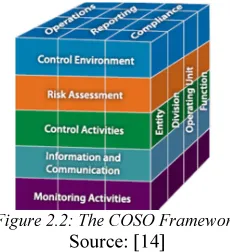
[14] Issued a framework that shows the relationship between the destination (target), the components of internal control, and the structure of the organization. 2.6 In the picture below there are three (3) categories of the target application of internal controls in the form of a column; Five (5) components of internal controls in the form of a line; and the shape of the overall organizational structure which includes entities, divisions, subsidiaries, operating units or functions included in its business process is, such as sales, purchasing, production and marketing in which the application of internal control is absolutely necessary, is presented in three dimensions in cube.
[image:3.595.348.463.495.621.2]Research has been carried out for the successful implementation of information system project [15] [16] [17] [18] [19], but the research conducted is still at risk of failure in the implementation of. Therefore, to be able to support the implementation of ERP success, must understand the risks, so that by knowing the risk it will be the control.
Figure 2.2: The COSO Framework
Source: [14]
Internal control as a process, definition written by [20]
“Internal control is a process, effected by an entity’s board of directors, management, and other personnel, designed to provide reasonable assurance regarding the achievement of objectives relating to operations, reporting, and compliance. The objectives are:
operations, including operational and financial performance goals, and safeguarding assets against loss
- Reporting objectives – these pertain to internal and external financial and non-financial reporting and may encompass reliability, timeliness, transparency, or other terms as set forth by regulators, recognized standard setters, or the entity’s policies.
- Compliance objectives – these pertain to adherence to laws and regulations to which the entity is subject.
A process consisting of ongoing tasks and activities. It is a means to an end, not an end in itself [20].
Business process, which are conducted within or across operating units or functional areas, are managed through the fundamental management activities of planning, executing, and checking. Internal control is integrated with these processes. Internal control is most effective when it is embedded in the entity’s infrastructure and its ongoing activities [21].
Application of internal control is in accordance with the development of management theory issued by Henry Fayol (1841-1925) which includes Flow Management for Organizational Theory Classical (1900-1940), who argued on Administrative Theory (Theory of Administration), which consists of
planning, organizing, giving commands,
coordination, and supervision. The Administration Theory was developed by [4] to 10 (ten) principles, namely:
Table 2.1: Principle of Administration
Fayol’s Administrative Theory Developed to be 10 Principles by Wren
1. Unity of Command
2. Hierarchical transmission of orders (“chain-of-command”)
3. Separation of Powers – authority, subordination, responsibility and control
4. Centralization
5. Order
6. Discipline
7. Planning
8. Organization Chart 9. Meetings and reports 10. Accounting
Source: [4]
To implement compliance with laws and
regulations in force in a State as required by COSO in terms of internal control so in this study will be guided by the GCG Indonesia.
Based on [22] by the Decree of the Coordinating
Minister for Economic Affairs Number:
KEP/49/M.EKON/11/2004 has approved the
establishment of the NCG (National Committee on Governance), which consists of the Subcommittee and Subcommittee of Public Corporations. GCG NCG provides guidance to all companies in Indonesia, including companies that operate on the basis of Sariah, the company whose shares have been listed on the stock exchanges, state enterprises, regional companies, companies that raise and manage public funds, and companies whose products or services are used by the public, as well as companies that have a broad impact on the environment.
In the implementation of the internal control implementation with ties to corporate governance and the implementation of ERP systems, using agency theory, [23] writes with the implementation of ERP systems can facilitate monitoring and auditing activities to obtain information that can be used by the principal about the agent's behavior, according to the second proposition is written by [24], namely “when the principal has information to verify agent behavior, the agent is more likely to behave in the interest of the principal”.
The argument for this proposition is that if the information system to provide information to the principal (shareholders) of the behavior of the agent (management), so that the agent cannot commit fraud or deceive the principal.
2.3. Implementation of GCG
Corporate governance or governance is a term used in the formulation of corporate governance. Basically governance in the company are the rules, principles or practices that define the direction of the company.
[22] provides a definition of good corporate governance through the remarks of Dr. Boediono (Coordinating Minister for Economic Affairs of the Republic of Indonesia) is
Corporate governance is sometimes viewed as a business culture fostering economic growth by building up confidence of investors [25].
The aimed of management from the company is to maximize corporate value and shareholder wealth. Value and wealth in principle are the hope of the future performance of the company with two variables at the center of the formation of values and expectations of wealth is increasing cash flow and reducing the level of risk [26].
Risks that may occur related directly or indirectly with the performance of the company. Because of this risk affects corporate policies and regulations. A paper written by Poletti-Hughes advises that corporate governance provides value to the company. This risk can be managed by giving better attention to the implementation of internal control and corporate governance structure (governance structure) to give a value for the company [27].
3. DISCUSSION
ERP is software that integrated the planning, management, and use of all available resources within the company. It contains a series of applications that automate routine work that the company is in the category of back-end (such as finance, inventory management, and scheduling as well as the activities of the other back-end), which helps companies to handle jobs that exist in the functional area [2].
The main purpose of the implementation of ERP is integrated across all functional areas in the company as well as allowing information to flow seamlessly across all functional areas [1]. However, in its implementation, there are companies that succeed and fail in the implementation of ERP and there is a presumption if already implemented ERP, then there is no problem in the company.
In Structuration Theory [28] argues that each individual is a member of the social structure and
the structure supporting the sustainable
performance at all times. Therefore, success and failure in ERP implementation also depend on the individual that is in the structure. Therefore, there
needs to be control in accordance with
Complementary Control Procedures [13] which is adherence to the complementary control procedures is to perform internal control in the ERP implementation. In addition to adherence to
complementary control procedures, to the success of ERP implementation must consider the critical success factors in ERP implementation is a strategic initiative, commitment executive, human resources, project management, information technology, business process, training, project support and communications, and software selection and support [29].
In line with the Structuration Theory [28] and the Complementary Control Procedures [13], [21] requires the existence of internal control.
To implement the objectives outlined by the COSO, then every company must implement laws and regulations. In this case the [22] issued a policy that every company in Indonesia, including companies that operate on the basis of sharia, the company whose shares have been listed on the stock exchanges, state enterprises, regional companies, companies that raise and manage public funds, and companies whose products or services used by the general public, as well as companies that have a broad impact on the environment shall implement GCG.
4. CLOSING
Based on literature review, it needs a paradigm the application of ERP is a business project. Business project requires the attention of stakeholders, such as management, information systems professionals, line workers, consultants, and trading partners. In the development phase of the ERP system is a project, there must be control. Control is done so that the system is made to achieve the goals and objectives that have been set previously. Control is done by implementing an internal control guided by COSO.
[14] Issued a framework that shows the relationship between the destination (target), the components of internal control, and the structure of the organization. To implement compliance with laws and regulations in force in a State as required by COSO in terms of internal control, so in this study will be guided by the [22].
economy. It is closely related to trust companies that execute them or to the business climate in the country ".
To prove the above literature review, it is necessary to study further supported by the data. Further research is expected to contribute to prove whether
there is a correlation between the ERP
Implementation, Adherence to COSO, and GCG implementation.
REFERENCES
[1] Rainer, R.K; Cegielski, CG. (2011).
Introduction to Information Systems, Enabling and Transforming Business. Third Edition. International Student Version. John Wiley & Sons, Inc. ISBN: 978-0-470-55310-7.
[2] Turban, E and Linda Volonino. (2010).
Information Technology for Management: Transforming Organization in the Digital Economy. 7th Edition. John Wiley & Sons, Inc. ISBN 978-0-470-40032-6.
[3] Hall, JA. (2008). “Accounting Information System”. Sixth edition. International Student Edition. South Western. Cengage Learning. ISBN – 13: 978-0-324-56093-0; ISBN – 10: 0-324-56093-1.
[4] Wren, Daniel, A; Bedelan, A.G; Breeze, J.D. (2002). “The Foundation of Henry Fayol’s
Administrative Theory”. Management
Decision. 40(9). 906-918.
[5] Vijayakumar, U. (2009). “Top Management Control Functions for Information Systems in Small and Medium Enterprise”. Informatica Economică. 13(4). 109-113.
[6] Parr, A; Shanks, G. (2000).”A model of ERP project implementation”. Journal of Information Technology. 15(4). 301-320.
[6a] Presley, A. (2006). “ERP investment analysis
using the strategic alignment model”.
Management Research News. 29(5). 17-49. [7] Sambamurthy. V; Kirsch L.J. (2000). “An
integrative framework of the information systems development process”. Decis Sci. 31(2). 391-411.
[8] Marchewka, JT. (2013). “Information
Technology for Project Management”. Fourth edition. International Student Version. John Wiley & Sons, Inc. ISBN 978-1-118-09794-6 [9] Al-Mashari, M. (2002). “Enterprise resource
planning (ERP) systems: a research agenda”.
Industrial Management and Data Systems. 102(3). 165-170
[10] Muscatello, JR; Small, MH; Chen, IJ. (2003). “Implementing enterprise resource planning (ERP) systems in small and midsized manufacturing firms”. International Journals of Operations and Production Management.
23(8). 850-871.
[11] Ray, R. (2012). “Enterprise Resource Planning, Text & Cases”. Tata McGraw Hill Education Private Limited. New Delhi. [12] Davenport, T.H. (2000). “Transforming the
Practice of Management with Enterprise Systems. In Mission Critical”. Harvard Business School Press. Boston MA. 203-235.
[13] Grabski, SV; Leech, SA. (2007).
“Complementary controls and ERP
implementation success”. International
Journal of Accounting Information Systems. 8. 17-39.
[14] COSO (Committee of Sponsoring
Organizations of the Treadway Commision). (2013, a). An overview of COSO’s 2013 Internal Control-Integrated Framework. [15] Cafasso, R. (1984). “How to control risk and
effectively reduce the chance of failure”.
Management Review. 73(6). 50-4.
[16] Ives, B; Olson, MH. (1984). “User involvement and MIS success: a review of research”. Management Science. 30(5). 19-29. [17] Jiang, JJ; Klein, G; Balloun, J. (1996). “Ranking of system implementation success factors”. Project Management Journal. 27(4). 50-55.
[18] Jiang, JJ; Klein, G. (1999). “Risks to different aspects of system success”. Information & Management. 36(5). 263-272.
[19] McFarlan. (1981). “Portfolio approach to
information systems”. Harvard Business
Review. 59(5). 142-150.
[20] COSO (Committee of Sponsoring
Organizations of the Treadway Commision).
(2013, b).
http://www.coso.org/documents/990025P_Exe cutive_Summary_final_may20_e.pdf
[21] COSO (Committee of Sponsoring
Organizations of the Treadway Commision).
(2011). Internal Control – Integrated
Framework. www.ic.coso.org
[23] Morris, John. J. (2011). “The Impact of Enterprise Resource Planning (ERP Systems on the Effectiveness of Internal Controls over Financial Reporting”. Journal of Information Systems. 25(1). 129-157.
[24] Eisenhardt, K, M. (1989). “Agency Theory: An Assessment and review”, TheAcademy of Management Review. 14(1). 57-74.
[25] The HIH Royal Commision. (2003). “The Failure of HIH Insurance”. Vol. 1, A
corporate collapse and its lessons,
Commonwealth of Australia.
[26] Djohanputro, B. (2008, b). Manajemen Resiko Korporat. Penerbit PPM. Jakarta.
[27] Bhimani, A. (2009). “Risk Management,
corporate governance and management
accounting: Emerging interdependencies”.
Management Accounting Research. 20. 2-5. [28] Giddens, A. (1976). New rules of sociological
method: A positive critique of interpretative sociologies. London: Hutchinson.