1, 2
R2
S D
R1 ,
, 2
1,
2,
PERFORMANCE OF TWO-PATH SUCCESSIVE RELAYING
IN THE PRESENCE OF INTER-RELAY INTERFERENCE
1
QIAN YU LIAU, 2CHEE YEN LEOW
Wireless Communication Centre, Faculty of Electrical Engineering, Universiti Teknologi Malaysia, 81310 Skudai, Johor, MALAYSIA.
E-mail: [email protected], [email protected]
ABSTRACT
Half-duplex constraint refers to the inability of a radio to transmit and receive signals simultaneously due to the hardware limitation. In cooperative communication, half duplex constraint requires orthogonal time or frequency channel use between source transmission phase and relay transmission phase. This limits the spectral efficiency of conventional relaying to half of the performance of direct transmission without relay. Two-path successive relaying has been proposed to relax this half-duplex constraint by allowing non-orthogonal transmission, where the source transmits new message continuously in every time slot. In two-path successive relaying, two relays are scheduled to assist the transmission alternately. However, the inter-relay interference degrades the performance significantly since the two inter-relays are not operating in orthogonal channel. Majority of the existing literature neglects the inter-relay interference and over estimates the performance of two-path successive relaying. The main objective of this paper is to investigate the actual interference limited performance of two-path successive relaying compared to conventional half-duplex relaying in terms of ergodic capacity. We consider several channel and system conditions to identify the optimal scheme in respective conditions. The results show that the two-path successive relaying is not always optimal if compared to the conventional half-duplex relaying in interference limited scenario.
Keywords: Wireless Communication, Cooperative Communication, Two-Path Successive Relaying,
Decode and Forward, Inter-Relay Interference
1. INTRODUCTION
Wireless communication is one of the most active topics in the telecommunication field today. Since each transmitter-receiver pair communicates over the air, therefore channel fading and interference are the two main challenges in wireless communication. Channel fading between the transmitter and receiver is due to the small-scale effect of multipath fading and also large-scale effects such as path loss and shadowing. Interference happens when more than one transceiver pair access the same channel at the same time.
Cooperative communication is introduced to improve the wireless communication using spatial diversity to overcome highly shadowed or deeply faded links [1-2]. In cooperative communication, additional relay node assists in the transmission to offer alternative and independent transmission
[image:1.595.331.459.565.655.2]paths. However, a conventional half-duplex relay is subject to half-duplex constraint (HDC), i.e. it cannot transmit and receive signal simultaneously
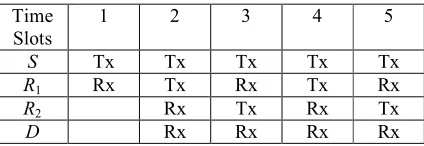
Table 1: The Transmission Protocol of Two-Path Successive Relaying
Time Slots
1 2 3 4 5
S Tx Tx Tx Tx Tx
R1 Rx Tx Rx Tx Rx
R2 Rx Tx Rx Tx
D Rx Rx Rx Rx
in the same frequency channel, due to the hardware limitation [3, 4]. The conventional half-duplex relay is unable to isolate the received signal and the transmitted signal, since the power of self-transmitted signal is much higher than received signal from a remote transmitter. Therefore, the source transmitter has to keep silent and stop transmission of new message during the relay transmission phase. As a result, the conventional half-duplex relay needs double amount of channel resources (requires orthogonal channel use) and the maximum multiplexing gain is only half of the direct transmission without relay.
A full-duplex relay receives and transmits at the same time on the same channel utilises the spectrum resources more efficiency [5-7]. However, the full-duplex relay is subject to loop interference (LI) due to signal leakage from the relay’s transmission to its own reception. The latest literature shows that the LI can be mitigated sufficiently and the residual interference may be regarded as mere additional noise [6, 7]. However, these advanced signal isolation techniques require sophisticated hardware and/or advanced signal processing which significantly increases the cost and complexity of relay nodes.
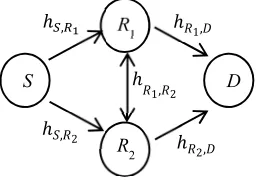
Successive relaying protocols are introduced to recover the loss of spectral efficiency without incurring the LI [8-10]. Two-path successive relaying (SR) is one of the popular successive relaying protocols [10]. The SR schedules a pair of half-duplex relays to assist the transmission between source and destination pair alternately. In the SR, a message is transmitted in two time slots. In the first time slot, the source, S transmits the message to relay R1 or R2. In the second time slot,
the message is forwarded to the destination, D, as shown in Figure 1 and Table 1. The SR recovers the loss of spectral efficiency due to the HDC by allowing the source continues transmitting new messages. This is also known as non-orthogonal transmission.
In the early literature, the relays in SR are assumed to be orthogonal to each other [11]. However, in practice the relays in SR do not necessary operate in orthogonal channels. When they operate in co-channel, the concurrent transmission of the source and relay (interferer) transmitters causes the co-channel interference to another relay receiver (victim). This co-channel interference is known as the inter-relay interference and degrades the performance of the SR significantly.
Successive interference cancellation (IC) technique is proposed to mitigate the inter-relay interference in [10, 12]. The IC is performed at the relay when the inter-relay interference is stronger than the channel gain of the source-to-relay. The relay decodes the inter-relay interference first and treats the desired message from the source as noise. After that, the relay subtracts the decoded inter-relay interference from the received signal and proceeds to decode the desired message from the
interference-free signal. To further improve the
performance of SR, relay selection has been proposed in [13]. This opportunistic two-path successive relaying (OSR) considers the instantaneous signal to interference plus noise ratio (SINR) of source-to-relay channels and the instantaneous signal to noise ratio (SNR) of relay-to-destination channels respectively during the relay selection to optimise the capacity performance of SR [13]. Successive interference cancellation is performed in [13] when the instantaneous rate of the inter-relay channel is greater than the target rate to mitigate the inter-relay interference. However, the interference cancellation technique is only 3effective when the inter-relay interference is strong. In fact, the ergodic capacity of OSR performs worse than the conventional opportunistic half-duplex relaying (OHR) under some channel and system conditions [14].
2. SYSTEM MODEL
In this paper, we assume all nodes are equipped with single antenna and subject to half-duplex constraint. The half-duplex constraint is realised using time division duplexing and the individual transmit power of the source and relays are subject to unit power constraint. We consider the channels are independent and identically distributed (i.i.d.) with quasi-static Rayleigh fading distribution and reciprocal unless stated otherwise. We assume each node can obtain perfect channel state information (CSI) for local channels and each receiver is corrupted by complex circularly symmetric additive white Gaussian noise with distribution ∼ (0, σ2). The signal-to-noise ratio (SNR) is defined as P/ σ2 where P=1. The target rate of the transmission, is fixed to 1bits/s/Hz.
In this paper, a scenario of one source, S, and one destination, D with N potential decode-and-forward half-duplex relays is considered. It is assumed that the direct channel between S and D does not exist due to severe shadowing or extreme path loss.
3. TWO-PATH SUCCESSIVE RELAYING
(SR)
In this paper, we consider the two-path successive relaying without relays selection (SR) [10], opportunistic two-path successive relay with interference cancellation (OSR-IC) [13] and opportunistic two-path successive relay without interference cancellation (OSR).
The achievable sum-rate of relay R1 and R2 for
the SR can be expressed as follows [10],
min !,
, !" ,
,# "$ ,
(1)
where %&' log %1 + &' and p ϵ {1, 2}.
For the OSR-IC that has been proposed in [13], the first relay, R1 is chosen from the N potential
relays according to the following criterion:
max min . / , 0, / 0,12, (2)
where k ϵ {1, …, N}. The second relay, R2 is chosen
from the rest / 3 1 potential relays according to the following criterion:
max min . 4/ , 0, / 0,12, (3)
where R1≠R2. In this case, the rate constraint of the
inter-relay channel is greater than the target rate, TR
as follows,
log5 1 + , 0
, 0 " 6 ,
(4)
the successive interference cancellation (IC) is performed. Therefore, the achievable sum-rate of relay R1 and R2 for the OSR-IC can be expressed as
follows [13],
If (4) is satisfied and the IC is performed at the relay R1 and R2:
7 89:
min ! , !
, " ,
! , ! " , ,# "$,
(5) Else if (4) is not satisfied:
7
min ,
! , !" ,
,# "$ .
(6)
In order to justify the effectiveness of the IC in optimising the performance of the SR, we compare the OSR-IC [13] to the OSR which does not performing the IC and the achievable sum-rate of relay R1 and R2 for the OSR is as stated as (6).
4. CONVENTIONAL HALF-DUPLEX
RELAYING (HR)
The conventional half-duplex relaying (HR) [1] and opportunistic half-duplex relaying (OHR) [15] are served as the comparison schemes in this paper.
The achievable of the HR can be expressed as follows [1],
< =5min > ! , ! ? , > ! ,#! ?" . (7)
For the OHR, the relay, RBis chosen from the N
potential relays according to the following criterion [15]:
max min . / , 0, / 0,12, (8)
where k ϵ {1, …, N}. Therefore, the achievable rate of OHR can be expressed as follows [15],
7< =5min , @ " , @,# "$ . (9)
This section shows the ergodic capacity of the SR varies with the signal-to-noise ratio (SNR) which is defined as P/ σ2 and P=1.
Figure 2 shows the ergodic capacity of various schemes versus SNR. We observe that the SR-IC outperforms the SR and same goes to the OSR-IC and OSR. This shows that the successive interference cancellation (IC) is able to improve the ergodic capacity of the SR in the presence of inter-relay interference. However, the SR and SR-IC still perform worse than the HR and same goes to the OSR and OSR-IC toward the OHR when SNR ≥ 20dB. This is because the inter-relay interference, i.e. ! , !5, limits the performance of the SR at high SNR regime, i.e. σ5→ 0.
6. INTER-RELAY INTERFERENCE
This section discusses the effect of inter-relay interference toward the performance of the SR when the channels gains are not identically distributed. The V is the ratio of the fading variance of inter-relay channel to the fading variance of source-to-relay channel, i.e. D E , /E, , where E , E ,1 1.
Figure 3 shows the ergodic capacity of various schemes with strong inter-relay interference, i.e. D 10GH, and when the number of potential relays, / 10, 20. We observe that the OSR-IC outperforms the OHR when the strength of the inter-relay interference is strong. This is because the advantage of the IC in strong inter-relay interference. On the other hand, without IC the SR performs worse than the OHR.
Figure 4 show the ergodic capacity of various schemes with weak inter-relay interference, i.e.
D 310GH and when the number of potential relays, / 10, 20. We observe that the OSR and OSR-IC achieved similar ergodic capacity when the inter-relay interference is weak. Due to the weak inter-relay interference, the OSR and OSR-IC outperform the OHR significantly in terms of ergodic capacity. This is because the higher multiplexing gain due to pre-log factor in the SR compared to the HR.
7. NUMBER OF POTENTIAL RELAYS
This section shows the effect of the number of potential relays, N towards the ergodic capacity of various schemes at high SNR and low SNR.
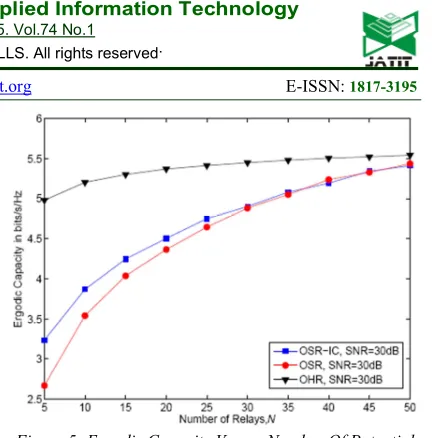
[image:4.595.299.515.72.291.2]Figure 5 shows the ergodic capacity of various
Figure 5: Ergodic Capacity Versus SNR Of Various Schemes With Strong Inter-Relay Interference. Figure 2: Ergodic capacity versus SNR of various
[image:4.595.87.290.321.507.2]schemes.
Figure 4: Ergodic Capacity Versus SNR Of Various Schemes With Weak Inter-Relay Interference.
[image:4.595.305.508.555.722.2]schemes vary with the number of potential relays, N
at high SNR, i.e. SNR = 30dB. We observe that the OSR and OSR-IC underperform the OHR significantly at high SNR when N is small. However, the ergodic capacity increases and the gap between the OHR towards the OSR and OSR-IC decreases when N increases. This thanks to the advantage of relay selection in the OSR and OSR-IC. As the N increasing, the probability of choosing relay pair with weak inter-relay interference and/or strong inter-relay interference is increasing as well. We also observe that the ergodic capacity of the OSR and OSR-IC converge when N is large. This is because when the SNR is high, i.e. σ5→ 0, the inter-relay interference limits the performance of the SR even when the N is large.
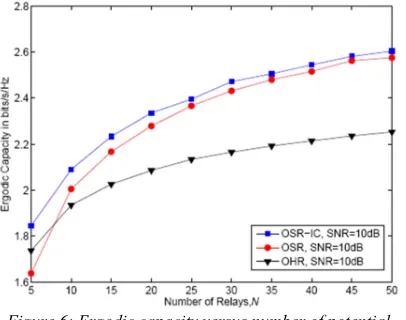
Figure 6 shows the ergodic capacity of various schemes vary with the number of potential relays, N
at low SNR, i.e. SNR = 10dB. The figure shows that the OSR-IC and OSR outperform the OHR significantly when the N increases. This is because of the pre-log factor gain of the SR compared to the HR. We also observe that the OSR-IC performs better than the OSR. This is because the adaptive gain of the OSR-IC that performing the IC when the rate constraint of the inter-relay channel is greater than the target rate, TR.
8. SUMMARY
Table 2: Performance Comparison of Various Schemes in Different Channel and System Conditions.
Channel or system conditions
OHR OSR OSR-IC
Low SNR Worst Good Optimal High SNR Optimal Worst Good
Weak inter-relay interference
Worst Good Optimal
Strong inter-relay interference
Good Worst Optimal
Small N Optimal Worst Good Large N Worst Good Optimal
Table 2 shows the performance comparison of OHR, OSR and OSR-IC in different channel and system conditions based on the discussions in the earlier section. From Table 1, we observe that the performance of the OHR, OSR and OSR-IC varies with the channel and system conditions. The results also reveal that the performance of OSR-IC is not always better than the OHR.
9. CONCLUSION
This paper compares the interference limited performance of the two-path successive relaying and half-duplex relaying in terms of ergodic capacity in several channel and system conditions. From fair comparison and detailed investigation, the optimal schemes in respective channel or system conditions are identified. The results also reveal that the two-path successive relaying is not always performing better than the conventional half-duplex relaying in the presence of inter-relay interference.
ACKNOWLEDGEMENT:
This research is supported by the Ministry of Science, Technology and Innovation Malaysia (MOSTI), the Ministry of Education Malaysia (MOE) and University Teknologi Malaysia under Project Vote No. 4S079, 4F261 and 05H39.
REFRENCES:
[1] J. Laneman, D. Tse, and G. W. Wornell, “Cooperative diversity in wireless networks: Efficient protocols and outage behavior,”
Information Theory, IEEE Transactions on, vol. 50, pp. 3062 3080, Dec 2004.
[2] J. Lee, H. Wang, W. Seo, and D. Hong, “Qos-guaranteed transmission mode selection for efficient resource utilization in multi-hop cellular networks,” Wireless Communications, IEEE Transactions on, vol. 7, pp. 3697–3701, October 2008.
[image:5.595.84.287.309.469.2][3] Z. Ding, I. Krikidis, B. Rong, J. S. Thompson, C. Wang, and S. Yang, “On combating the half-duplex constraint in modern cooperative networks: protocols and techniques,” Wireless Figure 6: Ergodic capacity versus number of potential
Communications, IEEE Transactions on, vol. 19, pp. 20–27, Dec. 2012.
[4] G. Kramer, M. Gastpar, and P. Gupta, “Cooperative strategies and capacity theorems for relay networks,” Information Theory, IEEE Transactions on, vol. 51, pp. 3037–3063, Sept 2005.
[5] D. Bliss, T. Hancock, and P. Schniter, “Hardware phenomenological effects on cochannel full-duplex mimo relay performance,” in Signals, Systems and Computers (ASILOMAR), 2012 Conference Record of the Forty Sixth Asilomar Conference on, pp. 34–39, Nov 2012.
[6] T. Riihonen, S. Werner, and R. Wichman, “Mitigation of loopback self-interference in full-duplex mimo relays,” Signal Processing, IEEE Transactions on, vol. 59, pp. 5983–5993, Dec 2011.
[7] O. Taghizadeh and R. Mathar, “Full-duplex decode-and-forward relaying with limited self-interference cancellation,” in Smart Antennas (WSA), 2014 18th International ITG Workshop on, pp. 1–7, March 2014.
[8] S. Yang and J.-C. Belfiore, “Towards the optimal amplify-and-forward cooperative diversity scheme,” Information Theory, IEEE Transactions on, vol. 53, pp. 3114–3126, Sept 2007.
[9] R. Tannious and A. Nosratinia, “Spectrally-efficient relay selection with limited feedback,”
Selected Areas in Communications, IEEE Journal on, vol. 26, pp. 1419–1428, October 2008.
[10]B. Rankov and A. Wittneben, “Spectral efficient protocols for half-duplex fading relay channels,” Selected Areas in Communications, IEEE Journal on, vol. 25, pp. 379–389, February 2007.
[11]F. Xue and S. Sandhu, “Cooperation in a half-duplex gaussian diamond relay channel,”
Information Theory, IEEE Transactions on, vol. 53, pp. 3806–3814,Oct 2007.
[12]N. Nomikos, D. N. Skoutas, and D. Vouyioukas, C. Verikoukis, and C. Skianis, “Capacity maximization through energy-aware multi-mode relaying,” Springer Wireless Pers. Commun. DOI 10.1007/s11277-012-0899-5, 2012.
[13]N. Nomikos and D. Vouyioukas, “A successive opportunistic relaying protocol with inter-relay interference mitigation,” in Wireless Communications and Mobile Computing Conference (IWCMC), 2012 8th International, pp. 228–233, Aug 2012.
[14]Q. Y. Liau and C. Y. Leow, “Study of relay position in two-path successive relaying with interference cancellation,” in Wireless and Mobile, 2014 IEEE Asia Pacific Conference on, pp. 254–259, Aug 2014.
[15]A. Bletsas, A. Khisti, D. Reed, and A. Lippman, "A simple cooperative diversity method based on network path selection," in