ISSN: 1992-8645 www.jatit.org E-ISSN: 1817-3195
A DYNAMIC APPROACH TO TASK SCHEDULING IN
CLOUD COMPUTING USING GENETIC ALGORITHM
R. DURGA LAKSHMI 1, N SRINIVASU2*
R.Durga Lakshmi1, Research Scholar, Department of Computer Science . K L University, Vijayawada,
India
N Srinivasu2, Professor, Department of Computer Science and Engineering, K L University, Vijayawada,
India
E-Mail:[email protected]
ABSTRACT
Cloud computing is one of device technology trends in the future since it combines the advantages of both device computing and cloud, Recent years have seen the massive migration of enterprise applications to the cloud. Cloud computing used in business organizations and educational institutions. One of the challenges posed by cloud applications is Quality-of-Service (QoS) management, which is the problem of allocating resources to the application to guarantee a service level along dimensions such as performance, availability and reliability. To improve the QoS in a system one must need to reduce the waiting time of the system. Genetic Algorithm (GA) is a heuristic search technique which produces the optimal solution of the tasks. This work produces one scheduling algorithm based on GA to optimize the waiting time of overall system. The cloud environment is divided into two parts mainly, one is Cloud User (CU) and another is Cloud Service Provider (CSP). CU sends service requests to the CSP and all the requests are stored in a Request Queue (RQ) inside CSP which directly communicates with GA Module Queue Sequencer (GAQS). GAQS perform background operation, like daemon, with extreme dedication and selects the best sequence of jobs to be executed which minimize the Waiting time (WT) of the tasks using Round Robin (RR) scheduling Algorithm and store them into Buffer Queue (BQ). Then the jobs must be scheduled by the Job Scheduler (JS) and select the particular resource from resource pool (RP) which it needs for execution.
Keywords: Genetic Algorithm, Cloud computing, Quality of Service, Cloud User, Cloud Service Provider,
Request Queue, GA Module Queue Sequencer, Buffer Queue, Waiting Time, Round Robin Scheduling Algorithm, , Resource Pool.
1. INTRODUCTION
Cloud computing, often referred to as simply “the cloud,” is the delivery of on-demand
computing resources, everything from
applications to data centers, over the Internet on
a pay-for-use basis. Cloud computing
environment is highly dynamic; the system load and computing resource utilization exhibit a rapidly changing characteristic over time. Therefore Cloud service provider normally over-position computing resources to accommodate the peak load and computing resources are typically left under-utilize in nonpeak time. Cloud environment allows users to use applications without installation and access their personal files at any computer with Internet
access. End users access cloud based
applications through a web browser or a light weight desktop
*Corresponding author: Professor N. Srinivasu or mobile app while the business software and
ISSN: 1992-8645 www.jatit.org E-ISSN: 1817-3195 requirement to the resources. But the main
problem here is that to find out the best sequence of the tasks from all possible sequences of tasks and JS schedules those tasks and optimize total Waiting time of those jobs.
The jobs assignment task is done by JS. So JS must need to assign the task such a way that assignments of the jobs to the resources must be fruitful as per as CU requests and the total execution time must be optimal of the whole operations. In next two sections discuss about our proposed model of CSP and one Genetic based scheduling an algorithm which assigns the task to the resource as per the CU’s demand and also to optimize the total waiting time of those tasks.
1.1 Scheduling Algorithms
There has been various types of scheduling algorithm exist in distributed computing system. Most of them can be applied in the cloud environment with suitable verifications. The main advantage of job scheduling algorithm is to achieve a high performance computing and the
best system throughput. Traditional job
scheduling algorithms are not able to provide scheduling in the cloud environments. According to a simple classification, job scheduling
algorithms in cloud computing can be
categorized into two main groups; Batch mode heuristic scheduling algorithms (BMHA) and online mode heuristic algorithms. In BMHA, Jobs are queued and collected into a set when they arrive in the system. The scheduling algorithm will start after a fixed period of time. The main examples of BMHA based algorithms are; First Come First Served scheduling algorithm (FCFS), Round Robin scheduling algorithm (RR), Min–Min algorithm and Max– Min algorithm.
By On-line mode heuristic scheduling algorithm, Jobs are scheduled when they arrive in the system. Since the cloud
environment is a heterogeneous system and the speed of each processor varies quickly, the on-line mode heuristic scheduling algorithms are more appropriate for a cloud environment. Most fit task scheduling algorithm (MFTF) is
suitable example of On-line mode heuristic scheduling
algorithm.
a. First Come First Serve Algorithm:
Job in the queue which come first is served. This algorithm is simple and fast.
b. Round Robin algorithm:
In the round robin scheduling, processes are dispatched in a
FIFO manner but are given a limited amount of CPU time
called a time-slice or a quantum. If a process does not complete before its CPU-time expires, the CPU is pre-empted and given to the next process waiting in a queue. The preempted process is then placed at the back of the ready list.
c. Min–Min algorithm:
This algorithm chooses small tasks to be executed firstly,
which in turn large task delays for long time.
d. Max – Min algorithm:
This algorithm chooses large tasks to be executed firstly,
which in turn small task delays for long time.
e. Most fit task scheduling algorithm:
In this algorithm task which fit best in queue are executed
first. This algorithm has high failure ratio.
f. Priority scheduling algorithm:
The basic idea is straightforward: each process is assigned a
priority, and priority is allowed to run. Equal-Priority processes are scheduled in FCFS order. The shortest-Job-First (SJF) algorithm is a special case of general priority scheduling algorithm. An SJF algorithm is simply a priority algorithm where the priority is the inverse of the (predicted) next CPU burst. That is, the longer the CPU burst, the lower the priority and vice versa. Priority can be defined either internally or externally. Internally defined priorities use some measurable quantities or qualities to compute priority of a process.
1.2 Cloud Computing
ISSN: 1992-8645 www.jatit.org E-ISSN: 1817-3195
Cloud computing service models
Cloud computing promises several attractive benefits for businesses and end users. Three of the main benefits of cloud computing include:
a. Infrastructure As A Service (IaaS) In the most basic cloudservice model, providers of IaaS offer core IT services, for example,
computer (physical or virtual machines)
networks, compute, security, operating systems, middleware devices, load balancers and block and file or object storage. IaaS clouds regularly provide extra resources such as a virtualmachine disk image library, IP addresses, firewalls, virtual local area networks (VLANs) and other software bundles. IaaScloud providers provide these resources ondemand from their big pools installed in data centres. For widearea network connectivity, businesses can use either the Internet or carrier clouds (dedicated virtual private networks) that IaaS clouds offer. For the deployment of their applications, users install operatingsystem instances and their application software on the cloud infrastructure. The cloud user also patches and maintains the operating systems and the application software. Cloud providers normally invoice IaaS services on a usagebased computing where the cost reflects the size of resources allocated and
consumed.
b. Platform As A Service (PaaS)
In the PaaS models, cloud providers provide a computing platform, usually including operating
systems, programming language running
environment, database and web servers.
Application developers can develop and run their software solutions on a cloud platform minus the cost and complexity of purchasing and managing the underlying hardware and software layers.As per some PaaS offers like Microsoft Azure and Google App Engine, the core computer and storage resources scale by design to meet application demand so that the cloud user does not need to allot resources manually. This has also been planned by an architecture targeting to facilitate realtime in cloud environments. Media encoding as an application can also be provided via PaaS.
PaaS platforms are not very common because
service providers often cannot offer customers the control and variety that they need for their applications. Furthermore, vendor lockin is another concern. Once the application starts to use any proprietary tools or interfaces that a PaaS provider makes accessible, migration to another provider may become challenging.
c. Software As A Service (SaaS)
In the business model using software as a service (SaaS), users are provided access to application software and databases. Cloud service providers manage the infrastructure and platforms that run the applications. SaaS is on occasions cited to as “ondemand software” and is typically rated on payperuse or on a subscription fee basis. In the SaaS model, cloud providers manage the
applicationsoftware in the cloud and cloud users
access the software via cloud clients. The cloud infrastructure and platform where the
application runs is transparent to the cloud users. The need to install and run the application on the cloud user’s own computers is not needed, which simplifies maintenance and support. Cloudbased applications are unlike other applications in their scalability, which is achieved by duplicating tasks onto several virtual machines at runtime to meet varying demand with load balancers distributing the work. The user sees only a single access point. Cloud applications can be multitenanted to accommodate a huge number of cloud users having any machine serving more than one cloud user organisation.The pricing model for SaaS applications is usually a monthly or yearly flat fee per user, consequently price is scalable and flexible if users are added or removed at any point.Supporters claim SaaS lets a business the potential to lessen IT operational costs by subcontracting hardware and software maintenance and support to the cloud provider. This facilitates the business to reapportion
IT operations expenses away from
ISSN: 1992-8645 www.jatit.org E-ISSN: 1817-3195 applications are hosted centrally, updates can be
done without the need for users’ intervention. One shortcoming of SaaS is that the users’ data are stored on the cloud provider’s server which could be subject to unauthorised access to the
data. Hence, users are progressively
implementing intelligent thirdparty key
management systems to protect their data.
2. LITERATURE REVIEW
Various modifications to task scheduling in cloud computing and genetic lgorithm have been
proposed by several authors. These
modifications can be classified as follows
In 2003,H.xiaoshan et al [3] suggested a QoS Guided Min-Min heuristic [Batch mode heuristic algorithm] was introduced in that some task require higher network bandwidth to exchange a large amount of data among processors, whereas some can be satisfied with the lower network bandwidth. In this algorithm the matching of the QoS request and services between the tasks and hosts based on conventional Min-Min. Firstly each task with the high QoS request in the Meta task, the algorithm finds the earliest completion time and the host that obtains it, in the entire QoS Qualified host. Secondly find the task with the minimum earliest completion time and assigns the task to the host that give the earliest completion time to task. In this algorithm they have addressed only one-dimension QoS issue, because they worked only bandwidth constraint
In 2006 F.Dong et al.. [4] proposed a QoS priority grouping
algorithm which considers deadline and
acceptation rate of the task and the makespan as main factor of task scheduling in whole system. It achieves better acceptance rate and
completion time for the submitted task then Min-Min and QoS Guided Min-Min-Min-Min.
In 2008, C.Hsu et al [5] carried out two
optimization schemes MOR (Makespan
Optimization Rescheduling) and ROR (Resource Optimization Rescheduling). MOR focus on improving the makespan to pull off the better performance and in ROR focus on the redispatch tasks from the machine with the minimum number of tasks to other machine, which is helpful to reduce the resource need. Both this technique achieves low complexity, high effectiveness, good performance than QoS Guided scheduling algorithm and Min-Min algorithm.
In 2008, M.Singh et al [6] proposed a QoS based predictive Max-Min, Min-Min switcher algorithm. In this algorithm, scheduling of the next job is based on appropriate selection among QoS based min-min or QoS max-min algorithm. The effect on the execution time grid jobs has been reduced due to non-dedicated resources. It normally uses the history information about the execution jobs to predict the performance of non-dedicated resources. This algorithm
merges the efficiency of max-min along with min-min and also considers both QoS and non-dedicated property of grid
resources.
In 2009, S.Parsa et al [7] introduced a new task scheduling algorithm called RASA which has the advantage of both Min-Min and Max-Min algorithm. In this first estimate the completion time of the tasks on each resource and then applied both the algorithm. RASA use the Min-Min strategy to execute the small task first then long task and then applied Max-Min to avoid the delays in the execution of large task and support concurrency in the execution of the large and small tasks. It achieves the lower Makespan with good QoS
In2010, Mrs.S.Selvarani et al [8] introduced an
improved costbased costbased scheduling
algorithm for making efficient mapping of tasks
to available resources in cloud. The
improvisation of traditional activity based costing is proposed by new task scheduling strategy for cloud environment where there may be no relation between the overhead application base and the way that different tasks cause overhead cost of resources in cloud. This scheduling algorithm divides all user tasks depending on priority of each task into three different lists. This scheduling algorithm measures both resource cost and computation
performance, it also Improves the
computation/communication ratio.
In 2011, C.Zhao et al [9] proposed a Berger Model in Cloud computing in that algorithm scheduling process establish dual fairness constraint. First constraint is to classify user task by QoS preferences, and establish the general expectation function in accordance with the classification of tasks to restrain the fairness of the resources in the selection process. Second constraint is to define resource fairness justice function to judge the fairness of the resources
allocation. According to constraint, the
ISSN: 1992-8645 www.jatit.org E-ISSN: 1817-3195 of user and it avoid to consider a long task for
execution. Experiment result of this algorithm shows effective execution of the user tasks and manifest better performance.
In 2013, X.Wu et al [10] introduce a task scheduling algorithm based on QoS-driven in cloud computing (TS-QoS). In this TS-QoS algorithm compute the priority of the task according to the special attributes of the tasks, and then sort tasks based on priority. Then the algorithm calculate the completion time of each task on different services, and schedule each task onto a service which can complete the task as soon as possible according to the sorted task queue. But in this process priority can change dynamically an increase continuously this can help to solve the ―starvationǁ problem and follow FCFS principle. Experimental result achieves well performance and load balancing by QoS driving form both priority and completion time.
In 1995 Kennedy and Eberhart [11] Particle
Swarm introduced The PSO algorithm
Optimization (PSO) as a meta-heuristics method
is a self-adaptive global search based
optimization technique it is alike to other
population-based algorithms like Genetic
algorithms (GA) but, there is no direct recombination of individuals of the population The PSO algorithm focuses on minimizing the total cost of computation of an application workflow. As a measure of performance, Authors used cost for complete execution of application as a metric. The objective is to minimize the total cost of execution of application workflows on Cloud computing environments. Results show that PSO based task-resource mapping can achieve at least three times cost savings as compared to Best Resource Selection (BRS) based mapping for our application workflow. In addition, PSO balances the load on compute resources by distributing tasks to available resources.
In 2013, Dr. M. Dakshayini, Dr. H. S. Guruprasad [33] introduced this algorithm. The main idea of the Min-Min algorithm is as quickly as possible to dispatch each task to virtual machines as resources which can complete the task in the shortest possible time. Min-Min algorithm will execute short jobs in parallel and the long jobs will follow the short jobs. The shortcoming of this algorithm is the short jobs scheduled first, until the machines are leisure to schedule and execute long jobs. Min-min can cause both the whole batch jobs executed time
get longer and unbalanced load. Even long jobs cannot be executed. Compared with the
traditional Minmin algorithm, improved
algorithm adds the three constraints (quality of service, the dynamic priority model and the cost of service) strategy which can change this condition. The experimental results of improved Min-Min algorithm show it can increase resource utilization rate, long tasks can execute at reasonable time and meet users’ requirements.
3. PROPOSED MODEL
Before starting to discuss about Cloud queueing model first we discuss about the Genetic algorithm and then site our proposed scheduling algorithm based on Genetic algorithm.
Genetic algorithms (GA) were first proposed by the John Holland in the 1960s The GA is a heuristic search technique that simulates the processes of natural selection and evolution. Genetic algorithm (GA) is a promising global optimization technique.
It works by emulating the natural process of evolution as a means of progressing towards the optimal solution. A genetic algorithm has the capability to find out the optimal job sequence which is to be allocated to the processor.
General Algorithm perform its general operations using the following steps-
A. Select the fixed size chromosomes
from the from the population set.
B. Perform any one type encoding
operation on the chromosomes of the chromosome sets.
C. Select the best two chromosomes
from the chromosome set using their fitness value.
D. Perform the crossover between two
chromosomes and get two different offspring.
E. Perform the mutation operation on
those offspring just interchanging the bit positions.
F. Continue the steps A to B until get
the best solution of the population.
G. Finally perform the elitism
operation of the chromosomes means store the best chromosomes in to the system for future use. Now we discuss our algorithm based on Genetic Algorithm step by step-.
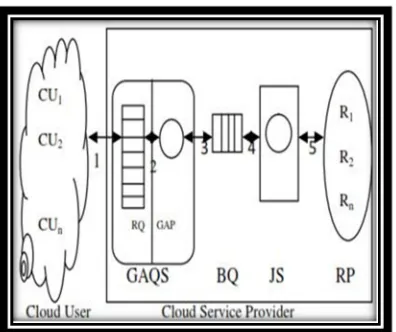
a) Cloud users send the request to the
ISSN: 1992-8645 www.jatit.org E-ISSN: 1817-3195 or resources.
b) CSP stores the request initially into
request queue of GAQS.
c) GAQS processor then select set of tasks
from the RQ and rearrange them until it gets the best arrangement of the tasks.
d) GAQS store the final task set into the
buffer queue.
e) Then job scheduler execute the tasks
[image:6.612.324.515.262.397.2]one by one using round robin scheduling algorithm and select the resource or resources to the cloud users.
Figure 1 describes the architecture of the GA guided scheduling mechanism and the execution
[image:6.612.91.289.284.450.2]steps also shown by the numbering.
Figure 1: Architecture of Cloud queuing model using Genetic Algorithm
Now we discuss the details of GAQS operation step by step-
1)Request initially comes from the CU for the resources andstore into the resource pool.
2) Now GA processor execute the following steps untilthebest sequence of tasks are produced-
a)Select the suitable number of tasks from the request pool using their fitness value (means the tasks those who are ready to execute has the higher fitness value compare to the no ready tasks) and create one chromosome.
b)Now perform the mutation operation on the tasks, just to interchange the positions of them and find out the waiting time of that sequence
using round robin scheduling algorithm
individually.
c)Choose the best sequence of tasks from the task sets whichhave least waiting time, this step is known as elitism.
3)Finally the tasks that produced by the GAQS must be stored in the buffer queue and latter the JS execute the operation using those tasks.
In Figure 2 diagrammatically shown the basic architecture of GAQS which is already discuss in previous part
Figure 2: Diagram of GA Module Queue Sequencer
In the next section we discuss our propose algorithm using one example.
4. PERFORMANCE ANALYSIS
In this section we elaborately discuss our propose algorithm using one example. Suppose Cloud users sends n number request for the resources and those resources initially store into the request queue in GAQS like
P1, P2... Pn as the request come from CU. Now GA processor of GAQS select the tasks from the RP those are ready to execute. Suppose first time tasks P1, P2, P3 are ready to execute and their burst times are 20, 26 and 12
ISSN: 1992-8645 www.jatit.org E-ISSN: 1817-3195
Table 1. Process table case i
The table 1 is depicting here a sample snapshot of three processes whose CPU burst are as follows 20, 26 and 12. Here we have mentioned the burst table according to the present scenario of system state.
P1 P2 P3 P1 P2 P3 P2
0 10 20 30 40 50 52
58
Table 1.1. Burst table for the above processes
The estimated waiting time of the several processes and the average waiting time of the cloud service provider system will be as follows
Table 1.2. Waiting time of several processes
Here the average Waiting time = (20+30+40)/3 = 90/3 = 30 The second option is being explained in the next table of process pool. Here a slight variation can be seen using different notion of process shuffling inside CSP.
Process Burst time
P2 26
P1 20
P3 12
[image:7.612.347.498.195.318.2]
Table 2. Process table case ii
Table 2 in the above is defining the process pool with several Burst Time 26, 20 and 12. Here we have mentioned the burst table according to the present scenario of system state.
P2 P1 P3 P2 P1 P3 P2
0 10 20 30 40 50 52
58
Table 2.1. Burst table for the above processes
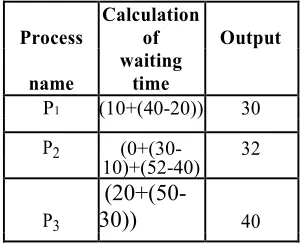
The estimated waiting time of the several processes and the average waiting time of the cloud service provider system will be as follows
Process
Calculation
of Output
name
waiting time
P1 (10+(40-20)) 30
P2 (0+(30- 32
10)+(52-40)
P3
(20+(50-30))
40
Table 2.2. Waiting time of several processes
Here the average Waiting time = (30+32+40)/3 = 102/3 = 34. The third option is being explained in the next table of process pool. Here a slight variation can be seen using different notion of process shuffling inside CSP.
[image:7.612.107.284.332.423.2]Table 3. Process table case iii
Table 3 in the above is defining the process pool with several Burst Time 20, 12 and 26. Here we have mentioned the burst table according to the present scenario of system state.
P1 P3 P2 P1 P3 P2 P2
0 10 20 30 40 42 52
58
Table 3.1 Burst table for the above processes
Process Burst Time
P1 20
P2 26
P3 12
Process Calculation Output
name of waiting
time
P1 (0+(30-10)) 20
P2 (10+(40-20)) 30
P3
(20+50-30))
40Process Burst Time
P1 20
P3 12
[image:7.612.320.529.585.697.2]ISSN: 1992-8645 www.jatit.org E-ISSN: 1817-3195 The estimated waiting time of the several
[image:8.612.89.270.160.264.2]processes and the average waiting time of the cloud service provider system will be as follows
Table 3.2 Waiting time for several processes
Here the average Waiting time = (20+42+30)/3 = 92/3 = 30.6
The fourth option is being explained in the next table of process pool. Here a slight variation can be seen using different notion of process shuffling inside CSP.
Process Burst Time
P2 26
P3 12
P1 20
Table 4. Process table case iv
Table 4 in the above is defining the process pool with several Burst Time 26, 12 and 20. Here we have mentioned the burst table according to the present scenario of system state.
P2 P3 P1 P2 P3 P1 P2
0 10 20 30 40 42 52
58
Table 4.1 Burst Table for the above processes
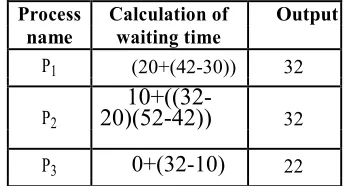
The estimated waiting time of the several processes and the average waiting time of the cloud service provider system will be as follows
Table 4.2 Waiting time for several processes
Here the average Waiting time = (32+32+30)/3 = 94/3 = 31.3.
The fifth option is being explained in the next table of process pool. Here a slight variation can be seen using different notion of process shuffling inside CSP
Process Burst Time
P3 12
P2 26
[image:8.612.368.492.309.371.2]P1 20
[image:8.612.112.227.391.455.2]Table 5. Process table case v
Table 5 in the above is defining the process pool with several Burst Time 12, 26 and 20. Here we have mentioned the burst table according to the present scenario of system state.
Table 5.1 Burst table for the above processes
[image:8.612.331.505.444.537.2]The estimated waiting time of the several processes and the average waiting time of the cloud service provider system will be as follows
Table 5.2 Waiting time for several processes
Here the average Waiting time = (32+32+22)/3 = 86/3 = 28.6.
Process Calculation of Output
name waiting time
P1 (20+(42-30)) 32
P2 (0+(30- 32
10)+(52-40))
P3
10+(40-20)
30
Process Calculation Output
name of waiting
time
P1 (0+(30-10)) 20
P2
(20+(42-30)+(52-42) 42
P3
10+(40-20)
30Process Calculation of Output
name waiting time
P1 (20+(42-30)) 32
P2
10+((32-20)(52-42))
32P3
0+(32-10)
22P3 P2 P1 P3 P2 P1 P2
0 10 20 30 32 42 52
[image:8.612.84.280.536.574.2] [image:8.612.335.526.607.655.2]ISSN: 1992-8645 www.jatit.org E-ISSN: 1817-3195 The sixth option is being explained in the next
table of process pool. Here a slight variation can be seen using different notion of process shuffling inside CSP
Table 6. Process table case vi
Table 6 in the above is defining the process pool with several Burst Time 12, 20 and 26. Here we have mentioned the burst table according to the present scenario of system state.
P3 P1 P2 P3 P1 P2 P2
0 10 20 30 32 42 52
58
Table 6.1 Burst Table for the above processes
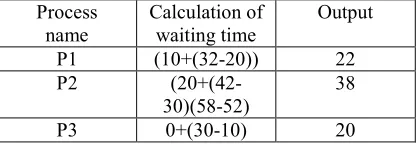
The estimated waiting time of the several processes and the average waiting time of the cloud service provider system will be as follows
Process name
Calculation of waiting time
Output
P1 (10+(32-20)) 22
P2
(20+(42-30)(58-52)
38
[image:9.612.86.295.413.485.2]P3 0+(30-10) 20
Table 6.2 Waiting time for several processes
Here the average Waiting time = (22+38+20)/3 =
80/3 = 26.6
Here the average waiting time of all possible arrangement of three processes those are ready to execute. From that we see that if we arrange the processes using sixth table and then execute them the average waiting time of the tasks must be optimal. So this particular sequence must be initially store into the buffer queue and JS execute the tasks using the sequence which is stored into BQ and select the resources as CUs demands. So, using GA we reduce the waiting time of the overall system.
Graph 1 Compression of Average Waiting Time in different cases.
5. COMPARISION OF AVERAGE WAITING TIME BETWEEN ADDR ALGORITHM
AND NEW PRAPOSED GACQM
ALGORITHM
i. ADRR ALGORITHM
An Augmented Dynamic Round Robin (ADRR) CPU scheduling algorithm works similar to Round Robin (RR) with an improvement. ADRR picks the first process from the ready queue and allocate the CPU to it for a time interval of up to 1 time quantum. After completion of process’s time quantum, it checks the remaining CPU burst time of the currently running process. If the remaining CPU burst time of the currently running process is less than equal half of the time quantum, the CPU again allocated to the currently running process for remaining CPU burst time. In this case this process will finish execution and it will be removed from the ready queue. The scheduler then proceeds to the next process in the ready queue. Otherwise, if the remaining CPU burst time of the currently running process is longer than 1/2 time quantum, the process will be put at the tail of the ready queue. The CPU scheduler will then select the next process in the ready queue.
If the above processprs example is applied to this ADRR algorithm then take
Process Burst Time
P3 12
P1 20
ISSN: 1992-8645 www.jatit.org E-ISSN: 1817-3195
Table 7. Process table
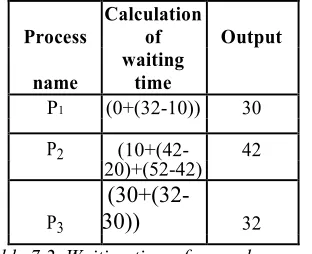
[image:10.612.111.267.379.506.2]The table 1 is depicting here a sample snapshot of three processes whose CPU burst are as follows 20, 26 and 12. Here we have mentioned the burst table according to the present scenario of system state.
Table 7.1. Burst table for the above processes
The estimated waiting time of the several processes and the average waiting time of the cloud service provider system will be as follows
Process
Calculation
of Output
name
waiting time
P1 (0+(32-10)) 30
P2 (10+(42- 42
20)+(52-42)
P3
(30+(32-30))
32 [image:10.612.83.295.554.698.2]
Table 7.2. Waiting time of several processes
Here the average Waiting time = (22+42+32)/3 = 96/3 = 32
Graph 2 Compression of Average Waiting Time
Between ADRR and GACQM Algorithms.
By the above chart we observed that the GACQM algorithm is giving less average waiting time than ADDR algorithm.so the new proposed algorithm is better than ADDR algorithm.
6. ADVANTAGES, DISADVANTAGES,
ISSUES ASSUMPTIONS, ARISING
RELATED TO GACQM ALGORITHM
i. The algorithm must operate on
multi-resource based CSP system. It must not operate on accessory system because it creates an overhead of the whole system.
ii. The GA processor must operate on the
tasks those are ready in RQ to execute. The tasks those are recently come to RQ or the tasks those are come after the execution start by the GA processor must not execute at that time.
iii. The algorithm must be executed in
background. So it must not hamper the execution of the selected tasks on the other processors.
iv. First time it requires some time to find out the sequence of the tasks those are executed in other processors. But from next step it must not take any extra time because GAP find out the exact sequence of the task in the background and other processor must execute in foreground.
v. This algorithm reduces the overall
average waiting time of the system.
vi. This algorithm increases the throughput
of the system.
vii. The algorithm is not applicable in single
resource based CSP system because the throughput of the system must be degraded a lot.
viii. The algorithm is not applicable in online application, means when any new process arrives at RQ the GAP must not use it in current operation which is already started. So the algorithm works as static mode.
32
26.6
28 30 32 34
A D R R G A C Q M
COMPARISION
BETWEEN ADRR AND
GACQM
Process Burst Time
P1 20
P2 26
P3 12
P1 P2 P3 P3 P1 P2 P2
0 10 20 30 32 42 52
ISSN: 1992-8645 www.jatit.org E-ISSN: 1817-3195 7. CONCLUSION
In this paper GA based scheduling
algorithm is proposed. It gives better
performance than conventional round robin algorithm and augmented dynamic round robin algorithm also, it gives minimum average waiting time. Genetic algorithm is a heuristic search algorithm and it always find out the solution which takes minimum time to execute or find optimal solution from the set of possible solutions. This algorithm must increase the throughput of the system. Here the tasks those are ready to execute are operate in all possible way and find the best sequence of the tasks which average waiting time must be optical one. So the waiting time of the system must be optimum. This algorithm can be implemented to improve the performance in the systems in which RR is a preferable choice.
8. FUTURE WORK
In future we are trying to reduce the problems of that algorithm and try to create another algorithm which also produces an optimal solution. In future we also create a simulator of that algorithm and implement it in our environment.
REFERENCES
[1] Kaiqi Xiong, Harry Perros “Service Performance and Analysis in Cloud Computing” 978-0-7695-3708-5/09 $25.00 © 2009 IEEE page- 693-700
[2] Borja Sotomayor, Rubén S. Montero and Ignacio M. Llorente, “Virtual Infrastructure Management in Private and Hybrid Clouds” Ian Foster 1089-7801/09/$26.00 © 2009 IEEE
[3] XiaoShan He,Xianhe Sun and Gergor von
Laszewski. QoS guided Min-Min
heuristic for grid task schedulingǁ. Journal of Computer Science and Technology, 2003, 18(4), p.442-451.
[4] Dong. F, Luo. J, Gao. L and Ge. L, "A Grid Task Scheduling Algorithm Based on QoS Priority Grouping," In the Proceedings of the Fifth International Conference on Grid and Cooperative Computing (GCC’06), IEEE, 2006.
[5] Ching-Hsien Hsu,Zhan. J.,Wai-Chi Fang, et al. ―Towards improving QoS-guided scheduling in gridǁ Third ChinaGrid
Annual Conference(CHINAGRID).
Dunhuang, Gansu,China, 2008, p.89-95.
[6] M.Singh and P.K.Suri;
―QPSMax-Min<>Min-Min : A QoS Based Predictive Max-Min, Min-Min Switcher Algorithm
for Job Scheduling in a Gridǁ,
―International Technology Journal7(8)ǁ :p.1176-1181,2008
[7] Saeed Parsa and Reza Entezari-Maleki,ǁ RASA: A New Task Scheduling Algorithm in Grid Environmentǁ in World Applied Sciences Journal 7 (Special Issue of
Computer & IT): 152-160, 2009. [8] Mrs.
S.Selvarani1, Dr.G.Sudha Sadhasivam,ǁ improved cost-based algorithm for task scheduling in Cloud computing ―in IEEE 2010.
[9] Baomin Xu,Chunyan Zhao,Enzhao Hua,Bin Hu. ―Job scheduling algorithm based on Berger Model in Cloud Environmentǁ Advance in Engineering Software, 2011, 42(7), p.419-425.
[10] Xiaonian Wu, Mengqing Deng, Runlian Zhang, Bing Zeng, Shengyuan Zhou. ―A task scheduling algorithm based onQoS-driven in Cloud Computingǁ Information
Technology and Quantitative
Management(ITQM2013).2013,p.1162-
1169 [11] J. Kennedy and R. Eberhart,
(1995), Particle swarms optimization In IEEE International Conference on Neural Networks, volume 4, pages 1942–1948. [12] Pai-Chou Wang, W. Korfhage, “Process
Scheduling with Genetic Algorithms”, Proceedings of the 7th IEEE Symposium on Parallel and Distributed Processing, Page: 638, ISBN: 0-8186- 7195-5, October 2005, IEEE Computer Society Washington, DC, USA.
[13] T.Gunasekhar, K Thirupathi Rao,et,at.,”
EBCM: Single Encryption, Multiple
Decryptions” International Journal of Applied Engineering Research,vol .9(19), 2014 [14]T.Gunasekhar, K.Thirupathi Rao, et al. “Mitigation of Insider Attacks through MultiCloud."International Journal of Electrical and Computer Engineering (IJECE) 5.1 (2015). [15] G Siva Nageswara Rao,N. Srinivas, “Comparison of Round Robin CPU Scheduling Algorithm with
Various Dynamic Time Quantum”,
International Journal of Applied
ISSN: 1992-8645 www.jatit.org E-ISSN: 1817-3195 [16] G Siva Nageswara Rao, A New Proposed
Dynamic Dual Processor Based Cpu
Scheduling Algorithm, Journal Of
Theoretical And Applied Information Technology 20th March 2015. Vol.73 No.2.
[18] GAN Guo-ning, HUANG Ting-lei, GAO Shuai, “Genetic Simulated Annealing Algorithm for task scheduling based on Cloud Computing Environment”,
978-1-4244-6837-9/10/$26.00 2010 IEEE.
[19] Kousik Dasgupta, Brototi Mandal,
Paramartha Dutta, Jyotsna Kumar Mondal, Santanu Dam, “ A Genetic Algorithm (GA) based Load Balancing Strategy for Cloud Computing”, Procedia Technology, 10 ( 2013 ) 340 – 347.
[20] Monika Choudhary, Sateesh Kumar
Peddoju, “A Dynamic Optimization
Algorithm for Task Scheduling in Cloud Environment”, IJERA, Vol. 2, Issue 3,
May-Jun 2012, pp.2564-2568. [21] Ji Lia;b, Longhua Fenga;b, Shenglong Fan”
An Greedy-Based Job Scheduling
Algorithm in Cloud Computing”
JOURNAL OF SOFTWARE, VOL. 9, NO.
4, APRIL 2014. [22] Stuti Dav Prashant Maheta “Utilizing
Round Robin Concept for Load Balancing Algorithm at Virtual Machine Level in Cloud Environment” International Journal of Computer Applications (0975 – 8887)
Volume 94 – No 4, May2014. [23] Lizheng Guo1,2 Shuguang Zhao1, Shigen
Shen1, Changyuan Jiang1” Task
Scheduling Optimization in Cloud
Computing Based on Heuristic Algorithm” JOURNAL OF NETWORKS, VOL. 7, NO. 3, MARCH 2012. [24] Jia Yu, Rajkumar Buyya and Chen Khong
Tham, “Cost-based Scheduling of
Scientific Workflow Applications on
Utility Grids”, In 1st IEEE International
Conference on e-Science and Grid
Computing, Melbourne, Australia, Dec. 5-8, 2005
[25] Van den Bossche, R., Vanmechelen, K., Broeckhove, J, “Cost Optimal Scheduling in Hybrid IaaS Clouds for Deadline
Constrained Workloads”, in 3rd
IEEEInternational Conference on Cloud
Computing, Miami (July 2010) [26] Savitha. P, J Geetha Reddy ,”A Review
Work On Task Scheduling In Cloud
Computing Using Genetic
Algorithm”,International Journal of
Sciences & Technology Research, vol 2, Issue 8, August (2013) [27] Ankur Bhardwaj “ Comparative Study of
Scheduling Algorithms in Operating
System”, International Journal of
Computers and Distributed Systems, Vol.
No.3, Issue I, April-May 2013. [28] V. Krishna Reddy, L.S.S.Reddy, “A Survey
of Various task Scheduling Algorithms in
Cloud Environment”, Global Journal
Engineering and Applied Sciences
(GJEAS),Volume 2.No1,January,2012.
[29] Arash Ghorbannia Delavar,Mahdi
Javanmard ,Mehrdad Barzegar Shabestari and Marjan Khosravi Talebi “RSDC
(RELIABLE SCHEDULING
DISTRIBUTED IN CLOUD
COMPUTING)” in International Journal of
Computer Science, Engineering and
Applications (IJCSEA) Vol.2,
No.3,June,2012 [30] Saeed Parsa and Reza Entezari-Maleki,”
RASA: A New Task Scheduling Algorithm in Grid Environment” in World Applied Sciences Journal 7 (Special Issue of Computer & IT): 152-160, 2009.Berry M. W., Dumais S. T., O’Brien G. W. Using linear algebra for intelligent information retrieval, SIAM Review, 1995, 37, pp. 573-595.
[31] Dr. M. Dakshayini, Dr. H. S. Guruprasad “An Optimal Model for Priority based Service Scheduling Policy for Cloud Computing Environment” International Journal of Computer Applications (0975 –
8887) Volume 32–No.9, October 2011 [32] Shamsollah Ghanbari, Mohamed Othman
“A Priority based Job Scheduling
Algorithm in Cloud Computing”