S T U D Y P R O T O C O L
Open Access
Transfer of manualized CBT for social phobia into
clinical practice (SOPHO-PRAX): a study protocol
for a cluster-randomized controlled trial
Stephen Crawcour
1, Eric Leibing
2, Denise Ginzburg
3, Ulrich Stangier
3, Jörg Wiltink
4and Jürgen Hoyer
1*Abstract
Background:Cognitive-behavioral therapy (CBT) is generally known to be efficacious in the treatment of social phobia when applied in RCTs, namely when the treatment manual is based on the Clark-Wells approach. However, little is known about the efficacy of manualized treatments in routine clinical practice (Phase IV of psychotherapy research). The present study (SOPHO-PRAX) is a continuation of a large multicenter randomized clinical trial
(SOPHO-NET) and analyzes the extent to which additional training practitioners in manualized procedures enhances treatment effect.
Methods/design:Thirty-six private practitioners will be included in three treatment centers and randomly designated to either training in manualized CBT or no specific training. The treatment effects of the therapies conducted by both groups of therapists will be compared. A total of 162 patients (n= 116 completers;n= 58 per condition) will be enrolled. Liebowitz Social Anxiety Scale (LSAS) will serve as primary outcome measure. Remission from social phobia is defined as LSAS total≤30 points. Data will be collected at treatment begin, after 8, 15, and 25 sessions (50 min each), at treatment completion, as well at 6 and 12 months post-treatment.
Discussion:The present CBT trial combines elements of randomized controlled trials and naturalistic studies in an innovative way. It will directly inform about the incremental effects of procedures established in a controlled trial into clinical practice. Study results are relevant to healthcare decisions and policy. They may serve to improve quality of treatment, and shorten the time frame between the development and widespread dissemination of effective methods, thereby reducing health cost expenditure.
The results of this study will not only inform about the degree to which the new methods lead to an improvement of treatment course and outcome, but also about whether the effects of routine psychotherapeutic treatment are comparable to those of the controlled, strictly manualized treatments of the SOPHO-NET study.
Trial registration:ClinicalTrials.gov identifier: NCT01388231. This study was funded by the German Federal Ministry of Education and Research (SOPHO-NET: BMBF 01GV0607; SOPHO-PRAX: BMBF 01GV1001).
Keywords:Social phobia, Cognitive behavioral therapy, Remission, Phase-IV research, Training, Dissemination, Treatment, Outcome
* Correspondence:[email protected]
1Clinical Psychology and Psychotherapy, Technische Universität/University of
Technology Dresden, Institutsambulanz und Tagesklinik IAP-TUD GmbH, Hohe Straße 53, 01187, Dresden, Germany
Full list of author information is available at the end of the article
Background
Social phobia (SP), also known as social anxiety disorder (SAD), represents a chronic and debilitating mental dis-order characterized by persistent fears of one or more social situations in which the person is exposed to un-familiar persons and expects to be scrutinized by others. The person affected fears acting (or showing anxiety symptoms) in a way that will cause embarrassment and humiliation [1]. DSM-IV-TR criteria indicate that, though such fears are recognized as unreasonable and excessive, exposure to such feared situations may invari-ably trigger anxiety, which may escalate to a situation-bound or predisposed panic attack. The fears in social phobia can cause clinically significant distress or impair-ment in social, occupational, or other important areas of functioning [1]. Epidemiological studies have also shown co-morbid psychopathology (other anxiety disorder, mood disorders, substance abuse) to be common for this disorder (for example [2]).
Prevalence rates have been found to vary across coun-tries. A recent study by Ruscioet al.[3] found estimates of lifetime and 12-month prevalence at 12.1% and 7.1%, respectively. In Europe, a lifetime prevalence of 6.65%, and a 12-month prevalence estimate of 2.0% were found [4,5]. The age of onset tends to be located between prea-dolescence and early adulthood, for example between 10 and 16.6 years [6]. Onset at an age later than 25 years appears to occur less frequently [3,7].
Epidemiological studies have shown SP to be typically chronic in its course (for example [8]). Full remission from SP symptoms, though infrequent, tends to occur within 8 years when no treatment is provided [9,10]. Probably due to the overlap in the symptoms of shyness and SP (that is, heightened autonomic arousal in social situations (for example increased heart rate, blushing, sweating, [11], social skills deficits, such as low eye con-tact)), avoidance of social interactions, and cognitions reflecting fear of negative evaluation [12-14], those affected by the latter may not be easily detected and thus remain untreated [6].
Development and dissemination of efficacious treat-ments for SP is therefore in clear demand. CBT for so-cial phobia is generally efficacious (for example [15,16]). RCT trials favoring the Clark-Wells approach [17] show the highest effect sizes [18,19], even outperforming standard pharmacological treatment [18] and suggesting specifically this approach to be distributed to routine clinical practice. However, to date a large disconnect be-tween research and practice appears to hinder the devel-opment of psychology, both as a science and as a profession. Access to evidence-based psychological treat-ments has become a growing problem in the last 10 years. In spite of the support by healthcare author-ities, the urgently needed evidence and consensus
regarding the success of implementation of such treat-ments, in addition to the measurement of successful training outcomes, continues to be missing [20]. Specif-ically for social phobia, the quality and effectiveness of CBT in routine practice remains unknown.
To the best of the authors’knowledge, there is also no current research: (1) directly examining the effects of additional training in a manualized and highly effective procedure on outcome in routine CBT for social phobia; and (2) testing the effectiveness of CBT for social phobia (in the control group), usually delivered in the private practices in Germany.
Hence, as a continuation of the Social Phobia Psycho-therapy Research Network (SOPHO-NET, [21]), the present study (SOPHO-PRAX) is designed as a multi-center randomized clinical trial based on a standard protocol and a set of standardized measures for the as-sessment and treatment of SP. The present study proto-col aims at testing the potential of the Clark and Wells CBT approach to the treatment of SP evaluated in the main trial of this research cooperation [21] in order to improve the effects of routine psychotherapies. It there-fore appears important to investigate in detail to what extent such treatment methods can be transferred from controlled trials to the less structured setting of routine clinical care, and whether the healthcare system benefits from such developments. The rationale of this study thus represents Phase IV of psychotherapy research.
Methods/design Study centers
The present study is being conducted by three trial sites, namely the Universities of Dresden (Prof. Dr. Hoyer), Frankfurt (Prof. Dr. Stangier), and Göttingen (Prof. Dr. Leibing), each coordinating at least 12 private practices.
Participants
psychotherapists will be recruited. Informed consent from both the therapist and the patient will be collected. All therapists will have to be certified in CBT. Inclusion criteria for therapists are broad (that is, any age and gen-der, living in the area of the trial center) as a function of the naturalistic aspects of the present trial. However, practitioners having recent training (within the last 5 years) in the Clark and Wells treatment of SP [17] will be excluded from the study. Measures of allegiance to
the treatment condition and professional experience will be collected via self-report of the therapists as well as via expert ratings of video-documented sessions.
Interventions
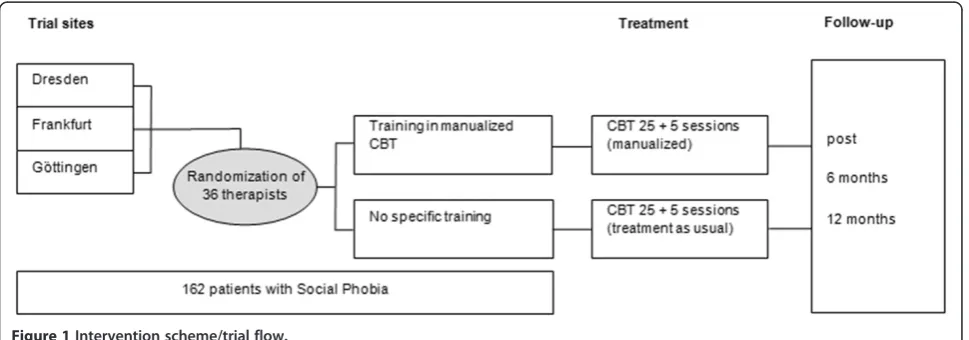
The experimental intervention comprises training in outpatient CBT for private practitioners, following the manual by Stangier, Clark, and Ehlers [22]. The manual follows the model of Clark and Wells [17] and prescribes interventions which are as follows: derivation an idiosyn-cratic version of the Clark and Wells model in cooper-ation with the patient; manipulcooper-ation of self-focused attention and safety behaviors; application of video and audio feedback to modify distorted self-imagery; behav-ioral experiments in and out of the therapy room; atten-tion shifts and interrogaatten-tion of the social environment; identification and modification of anticipatory and post-event processing; identification of the patient’s dysfunc-tional assumptions and modification using cognitive re-structuring. CBT treatment as usual will serve as the control condition. According to psychotherapy manuals (for example [23]), up to 25 + 5 sessions are scheduled. See Figure 1 for trial flow. Practitioners will receive two separate blocks of training based on Stangier et al.’s manual [22], each block with a mean duration of 12 h. Practitioners in both groups will also be offered regular group supervision (with a mean duration of 2 h).
Assessment
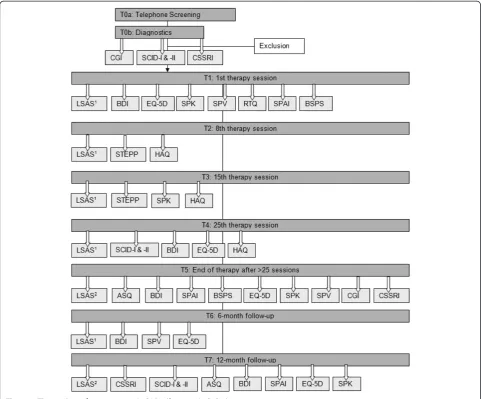
[image:3.595.55.290.103.410.2]The time points of assessment are displayed in Figure 2. Independent and trained SCID interviewers giving pa-tient assessments are blind to the treatment condition. Assessments will be made at baseline, that is, prior to treatment onset (T1), at session 8 (T2), 15 (T3), and 25 (usually post-treatment, T4), at post-treatment (when treatment duration is longer than 25 sessions, T5). Every session is planned to have a 50-min duration. Follow-up Table 1 Inclusion and exclusion criteria
Inclusion criteria Diagnosis of SP (SCID-I)
Liebowitz Social Anxiety Scale>30 (>60 for generalized subtype)
Age 18 to 70 years
SP must be primary diagnosis (most severe disorder according to ADIS-IV)
SP patients with co-morbid disorders will be included, provided that SP is the primary diagnosis, thus ensuring a clinically representative sample as well as analyses of subgroups (for example, type of SP, patients with co-morbid depressive disorder)
Exclusion criteria Psychotic disorder Prominent risk of self-harm
Acute substance-related disorders
Personality disorders except for avoidant
Obsessive-compulsive or dependent personality disorder (SCID-II) organic mental disorder
Severe medical conditions
Concurrent psychotherapeutic or
psychopharmacological treatment, with the following exception: specific psychopharmacological treatments (that is, tranquilizer, hypnotics,
neuroleptics, phytopharmaceuticals, and beta-blockers prescribed as anxiolytics) should be terminated prior to therapy onset
Anti-depressive medication represents no exclusion criterion as long it is reliably and stably consumed
[image:3.595.57.542.556.726.2]assessments will take place 6 (T6) and 12 months (T7) after treatment; assessments at weeks 8 and 15 are per-formed to ensure intent-to-treat analyses. Primary end-point: assessment after 25 sessions; secondary endend-point: post-treatment. Should treatment end at T4, measures for T5 will also be collected.
Objectives and hypotheses
As a study combining the scientific benefits of rando-mized controlled trials (efficacy studies) and naturalistic studies (effectiveness research), its main objective is the analysis of the effects of additional training for private practitioners. Hence, the following question is investi-gated: does training in manualized treatment increase the effectiveness of psychotherapy for social phobia in natural settings?
We expect the effects of CBT on social phobia to be enhanced by training experienced therapists and by
systematic transfer of innovative manualized treatments into practice. Thus, the specific hypotheses are as fol-lows: (1) treatment effects achieved by private practi-tioners trained with the manualized procedures (Group 1) will be superior to those achieved by therapists who continue their standard treatment (Group 2); and (2) treatment duration (in terms of number of sessions be-tween treatment onset and finalization) in Group 1 will be shorter.
Outcomes
[image:4.595.57.539.89.488.2]outcome measures include German versions of other standard scales for social anxiety (SPAI [25], SPK [26], SPV [27], BSPS [28]), depression (BDI [29]), and a scale for quality of life and social functioning (EQ-5D [30]). In addition we will assess emotional regulation (ASQ [31]), helping alliance (HAQ [32]), the subjective evaluation of sessions (STEPP [33]), as well as the reaction to treat-ment (RTQ [34,35]). During diagnostics, a rating on symptoms severity using the Clinical Global Impression scale (CGI [36]) is also given. The majority of these measures will also be used in a related trial of manua-lized short-term psychodynamic therapy allowing for high comparability between both trials [37]. Further-more, patient sociodemographic data and costs of SP treatment are assessed using selected items of the Ger-man adaptation of the client sociodemographic and ser-vice receipt inventory (CSSRI; for example number of treatment sessions, days of work disability [38]). All instruments will be applied in both groups of this trial. Using established cut-off scores for LSAS (≤30 points [24]), the percentages of patients defined as remitted will be assessed and statistically compared between the group treated by specifically trained therapists and the group receiving standard CBT.
Sample size calculation
The only study directly comparing performance of ther-apy delivered under RCT conditions and routine care refers to group CBT for social phobia [18] and showed a small but significant advantage for the RCT therapies. The difference between the Clark trials [17,18] and other controlled trials suggests a much higher difference in the to-be expected between-group effect sizes of our study but only under the improbable assumption that trained private practitioners will be comparably successful as the specialized therapists in the Clark trials. Sholomskas
et al.[39], in a study directly testing the effects of add-itional training, but not in the field of SP, reported an average between group effect size of d = 0.69 when com-paring therapists who were trained in a seminar plus supervision and therapists who used a manual without further training with regard to their performance in standardized role plays. However, this estimation does not directly refer to the expected effect sizes for the therapeutic benefit, which is the main outcome criterion of this trial. Given this inconsistent information, we choose to expect a more conservative effect size of d = 0.50 between Group 1 (trained therapists) and Group 2 (treatment-as-usual), for pragmatic reasons. We aimed at estimating the sample size needed for a dichotomous approach (remission rates according to the above defined criterion, LSAS <30). In order to assure com-parability with the parallel trial for psychodynamic therapy [37] we introduced the same conservative
assumptions: (1) the ICC was set to 15% which is high compared to similar studies [40]; and (2) for the primary analysis (ITT) drop-outs will be analyzed as patients with no remission. When assuming<50% remitters and an equal drop-out rate in both conditions, the absolute difference between remission rates will remain un-changed, but the relative difference will be much greater and will substantially enlarge the difference between treatments.
In contrast to Wiltink et al.’s study protocol [37], the average number of patients in a cluster was assumed to be five, as we choose to collaborate more continuously with the included therapists. Please note that this is the only assumption differing from those made in [37] resulting in a highera priorisample size than in [37].
In order to detect a difference between Groups 1 and 2 atα= 0.05 (one-tailed; see Discussion) with a power of 0.80, n= 58 patients per group are required according to the formula of Campbell et al. [40,41] for cluster-randomization, given that five patients per therapist will be treated (for a more comprehensive account, see [42]):
N¼2 σðzαþzβÞ
E
2
½1þ ðm−1Þρ
¼2 ðzαþzβÞ
ES
2
½1þ ðm−1Þρ
(zα, z-value for probability of error type I alpha; zβ,
z-value for probability of error type II beta;σ, standard de-viation of outcome; E, expected ES of outcome; m, mean observations for each cluster; ρ, Intracluster correlation coefficient (ICC); ES = E/σ, standardized effect size)
Given a conservative drop-out rate estimate of 25% (taking into account slightly elevated drop-outs in a practice study), a total ofn= 162 patients are required to be allocated to the trial. Thus, n= 54 patients will have to be included in each center. According to data of the Stangier et al. [43] study on social phobia, in which patients were recruited in a comparable setting of Ger-man psychotherapeutic care, 61% of 250 patients meet-ing the inclusion criteria can expected to be finally included. We estimate that not more than about 250 patients will have to be assessed for eligibility.
Randomization
not randomized and have no knowledge on whether or not the therapist they have freely chosen has been trained in manualized CBT. Diagnostic procedures are performed by independent, blinded, and specially trained assessors for diagnosis and observer-rated outcome mea-sures. All diagnosticians are trained by one of the co-authors (US), who was responsible for quality assurance of CBT in the SOPHO-NET study and has extensive ex-perience in conducting RCT of SP [43,45]. There will be multimethod assessment of specific and non-specific therapy outcome including both patient and assessor perspective; control for drop-outs, intent-to-treat ana-lyses. Generalizability of results will be established by above defined inclusion and exclusion criteria (Table 1) and by the multicenter approach.
Statistical analysis
Primary analyses
The following hypothesis will be tested: H0: μ manua-lized≤μ standard vs. H1: μ manualized>μ standard-where μ manualized and μ standard are the true remission probabilities in the manualized treatment group and the standard routine care group after the treatment period, respectively.
Remission rates will be compared between specifically trained and standard CBT group via logistic regression using covariates for treatment, sex of the therapist, and experience of the practitioner (as in [37]). For repeated measures, as suggested by Wood et al. [46], random effects models will be fitted of outcomes taking into ac-count potential drop-outs (for further reference, see [42] and [47]). Hypothesis 1 of this trial will be tested by the group*time interaction (with dummy variables coding the time effects at time points T4 to T7 as compared to baseline measurement).
Further analyses will include: comparison of remission rates across treatment groups at time points T4 to T7 using the chi-squared test of independence; cross-sectional analyses at T4 to T7 comparing both patients and therapists in the three study centers; analyses of co-variance of outcomes at T4 to T7 considering patient variables, taking into account potential differences be-tween patients recruited by trainedvs.those recruited by non-trained therapists; and multiple regression analyses to test whether diverse covariates including process vari-ables predict different treatment outcomes. Regression analysis will be applied to each treatment group separ-ately. Should the results be similar, the sample will be pooled.
A descriptive analysis will be made on drop-outs and their covariates. Imputation methods will be considered if necessary following an assessment of the missing value structure [46].
Secondary analyses
Random effects analysis of treatment outcomes as a function of time will also be employed to analyze asso-ciations with questionnaire data and observer ratings (SPAI, SPK, SPV, BSPS, BDI, EQ-5D, ASQ, HAQ, STEPP, reaction to treatment, CGI). Moreover, analyses to be performed will include the following: cross-sectional analyses as above; analyses of subjects’ and therapists’ conditions regarded as subgroup; SP treat-ment costs (CSSRI) [38] will also be considered as
‘process variables’; again, a one-sided level of significance atα= 0.05 will be chosen (see Discussion).
Safety aspects
Trial progress, monitor data management, and patient safety will be reviewed by the control center for clinical studies (KKS), the Ethics Committee (EC) of the Tech-nische Universitaet Dresden (Germany), and the Data Monitoring and Safety Committee (DMSC).
Medical complications
Only psychological conditions according to the Inter-national Classification of Diseases F00-F99 (‘Mental and Behavioral Disorders’) will be recorded and classi-fied as adverse events. Any deterioration that results in discontinuation of therapy (including suicidal risk and hospitalization) will be notified immediately by the pri-vate practitioner. Changes in psychological disorders will also be notified by the therapist and assessed by the diagnostician after session 25 of treatment, as well as 6 and 12 months post-treatment.
Ethical issues
Discussion
In the last decade, several authors have emphasized the large gap between therapeutic treatments validated at uni-versity institutions and the treatments applied in‘everyday practice’(for example [20,48,49]). These researchers argue for an increasingly efficient and effective dissemination of evidence-based treatments in light of empirical data indi-cating that, while such psychological treatments are being developed for a variety of psychopathological conditions (for an overview for depression see [50], for anxiety [51]), their application into routine clinical practice remains impaired. The factors to which the cause of this problem has been attributed to include a lack of knowledge about the effective transmission of CBT skills, the mechanism of action of CBT, and the minimum dose that patients re-quire, in addition to the difficulties in measuring quality of therapy [52].
As a means to bridge this gap, the present study (SOPHO-PRAX) represents a first attempt to test the transferability of new CBT treatment options to the pri-vate clinical practice under controlled conditions. SOPHO-PRAX thus implies a continuation of the multi-center project evaluating the efficacy of cognitive behav-ioral therapy (CBT) and psychodynamic short-term therapy (STPP) (SOPHO-NET [21]). The novelty of the present CBT trial lies in the advantage of combining the elements of randomized controlled trials and naturalistic studies. It will directly inform about the incremental effects of procedures established in a controlled clinical trial into practice. Study results may be of great rele-vance to healthcare policy, health insurance companies, and the statutory boards of psychotherapists. They may serve to improve quality of treatment and shorten the timeframe between the development and widespread use of effective methods, thereby reducing health cost of expenditures [53]. The design of SOPHO-PRAX thus aims to further a faster and more widespread dissemin-ation of effective treatments. As one study center is located in East Germany, study results will be of specific importance for deliverance of evidence-based psycho-therapeutic interventions in this region and its unmet needs for psychotherapy.
The present study will also be the first to include sys-tematic CBT training of private practitioners in the field of psychotherapy in the German healthcare system. It will help clarify whether clinical practitioners will gener-ally regard the new CBT approaches as helpful for their work, and ascertain to what degree they will integrate the new methods into their clinical routine. As we spe-cifically expected the new methods to be superior, it needs to be mentioned that we choose one-sided testing and an alpha of 0.05 as appropriate for a superiority trial [54]. There are two reasons for this decision. Firstly, in the field under investigation there is clear and robust
evidence (not just expectation) that the manualized ap-proach of CBT for social phobia according to Clark and Wells is the most efficacious among other CBT treat-ments (see [15]). It follows that the scientific hypothesis to be tested is one-sided. Secondly, as our study ap-proach is that of a transfer or dissemination trial of an already established manualized procedure, only a clear advantage of this procedure over the reference interven-tion (non-manualized treatment) would have conse-quences for practice. Given these two conditions (that is, one-sidedness of scientific hypothesis and practice rele-vancy for superiority of the to-be implemented treat-ment only), we followed the recommendation of authors, such as Bland and Altmann [55] or Knottnerus and Bouter [56], and calculated the a priorisample size estimation based on one-sided testing. This approach warrants that the sample size is not larger than needed and the study is economic.
However, the clear methodological disadvantage of this decision has to be emphasized: Although it is not our scientific hypothesis, we can certainly not rule out
‘harm’, which in our case would mean superiority of the (non-manualized) reference treatment over the to-be implemented manualized one. Given the logic of the one-sided analysis, no statistical testing whether the standard procedure is superior to the manualized one can be made. Accordingly, a negative result in a super-iority trial (like ours) would not prove that the investi-gated therapies are equivalent [54].
Nevertheless, the results of this study will not only in-form about the degree to which the new methods lead to an improvement of treatment course and outcome, but also about whether the effects of routine psychothera-peutic treatment are comparable to those of the con-trolled, strictly manualized treatments of the SOPHO-NET study [21]. Finally, this study will allow an estimate of the reduction in treatment duration and costs made possible through implementation of treatment manuals into clinical practice. All these questions will be examined in a methodologically rigorous manner, as they seem highly relevant both for the domain of social phobia and the dissemination of psychosocial treatments in general.
Trial status
Patient recruitment for the present trial is ongoing and expected to be completed by September 2013. Therapies are expected to be completed in 2014.
Abbreviations
revision; EC: Ethics Committee; EQ-5D: Quality of life questionnaire; ES: Effect size; HAQ: Helping Alliance Questionnaire; ICC: Intracluster correlation coefficient; ICD-10: International Classification of Diseases; ITT: Intention to treat; KKS: Control center for clinical studies; LOCF: Last observation carried forward; LSAS: Liebowitz Social Anxiety Scale; RCT: Randomized clinical trial; SAD: Social Anxiety Disorder; RTQ: Reaction to treatment questionnaire; SAD: Social anxiety disorder; SAE: Serious Adverse Event; SCID: Structured Clinical Interview for DSM Disorders; SOPHO-NET: Social Phobia Psychotherapy Research Network; SOPHO-PRAX: Study on the transfer of manualized CBT for social phobia into clinical practice; SP: Social Phobia; SPAI: Social Phobia and Anxiety Inventory; SPK: Social Cognitions Questionnaire; STPP: Short-Term Psychodynamic Psychotherapy; SPV: Social Behavior Questionnaire; STEPP: Session evaluation sheet; T1-T7: Time points of assessment.
Competing interests
The authors declare that they have no competing interests. JH received speaking honoraries from Astra-Zeneca for a project unrelated to the present trial.
Authors’contributions
SC and JH completed the first draft of the manuscript. JW, EL, and US added significant content to the first draft and contributed to its critical revision. JH, EL, US, SC, and JW substantially contributed to the conception and the design of the study. All authors read and approved the final manuscript.
Acknowledgement and funding
The study is funded by the German Ministry of Education and Research (BMBF) (01 GV 1001).
Author details
1Clinical Psychology and Psychotherapy, Technische Universität/University of
Technology Dresden, Institutsambulanz und Tagesklinik IAP-TUD GmbH, Hohe Straße 53, 01187, Dresden, Germany.2Abteilung Psychosomatische
Medizin und Psychotherapie Zentrum Psychosoziale Medizin, Georg-August University, von-Siebold-Str, 5, 37075, Göttingen, Germany.3Institut für
Psychologie - Klinische Psychologie und Psychotherapie, Goethe University Frankfurt, Varrentrappstr. 40-42, 60486, Frankfurt am Main, Germany.4Clinic of
Psychosomatic Medicine and Psychotherapy, University Medical Center of the Johannes Gutenberg University of Mainz, Untere Zahlbacher Straße 8, 55131, Mainz, Germany.
Received: 26 January 2012 Accepted: 25 April 2012 Published: 30 May 2012
References
1. American Psychiatric Association:Diagnostic and Statistical Manual of Mental Disorders DSM-IV-TR Fourth Edition (Text Revision). Washington: APA; 2000. 2. Fehm L, Beesdo K, Jacobi F, Fiedler A:Social anxiety disorder above and
below the diagnostic threshold: prevalence, comorbidity and impairment in the general population.Soc Psychiatry Psychiatr Epidemiol
2008,43:257–265.
3. Ruscio AM, Brown TA, Chiu WT, Sareen J, Stein MB, Kessler RC:Social fears and social phobia in the United States: results from the National Comorbidity Survey Replication.Psychol Med2008,38:15–28. 4. Fehm L, Pelissolo A, Furmark T, Wittchen H-U:Size and burden of social
phobia in Europe.Eur Neuropsychopharmacol2005,15:453–462. 5. Wittchen HU, Jacobi F:Die Versorgungssituation psychischer Störungen
in Deutschland. Eine klinisch-epidemiologische Abschätzung anhand des Bundes-Gesundheitssurveys 1998.Bundesgesundheitsbl Gesundheitsforsch Gesundheitsschutz2001,44:993–1000.
6. Wittchen HU, Fehm L:Epidemiology and natural course of social fears and social phobia.Acta Psychiatr Scand2003,108:(Suppl 1)4–18. 7. Beesdo K, Bittner A, Pine DS, Stein MB, Höfler M, Lieb R, Wittchen H-U:
Incidence of social anxiety disorder and the consistent risk for secondary depression in the first three decades of life.Arch Gen Psychiatry2007,
64:903–912.
8. DeWit DJ, Ogborne A, Offord DR, McDonald K:Antecedents of the risk of recovery from DSM-III social phobia.Psychol Med1999,29:569–582.
9. Keller MB:The lifelong course of social anxiety disorder: a clinical perspective.Acta Psychiatr Scand2003,108(Suppl 1):85–94.
10. Yonkers KA, Dyck IR, Keller MB:An eight-year longitudinal comparison of clinical course and characteristics of social phobia among men and women.Psychiatr Serv2001,52:637–643.
11. Beidel DC, Turner SM, Dancu CV:Physiological, cognitive, and behavioral aspects of social anxiety.Behav Res Ther1985,23:109–117.
12. Heimberg RG, Hope DA, Dodge CS, Becker RE:DSM-III-R subtypes of social phobia: comparison of generalized social phobics and public speaking phobics.J Nerv Ment Dis1990,178:172–179.
13. Herbert JD, Hope DA, Bellack AS:Validity of the distinction between generalized social phobia and avoidant personality disorder.J Abnorm Psychol1992,101:332–339.
14. Ludwig R, Lazarus P:Relationship between shyness in children and constricted cognitive control as measured by the Stroop Color-Word Test.J Consult Clin Psych1983,51:386–389.
15. Powers MB, Sigmarsson SR, Emmelkamp PMP:A meta-analytic review of psychological treatments for social anxiety disorder.Int J Cogn Ther2008,
1:94–113.
16. Acarturk C, Cujpers P, van Straten A, de Graaf R:Psychological treatment of social anxiety disorder: a meta-analysis.Psychol Med2009,39:241– 254.
17. Clark D, Wells A:A cognitive model of social phobia. InIn Social phobia: Diagnosis, assessment, and treatment. Edited by Heimberg R, Liebowitz M, Hope D, Schneier F. New York: Guilford; 1995:69–93.
18. Clark DM, Ehlers A, McManus F, Hackmann A, Fennell M, Campbell H, Flower T, Davenport C, Louis B:Cognitive therapy versus Fluoxetine in generalized social phobia: a randomized placebo-controlled trial.J Consult Clin Psych2003,71:1058–1067.
19. Clark DM, Ehlers A, Hackman A, McManus F, Fennell M:Cognitive therapy versus exposure and applied relaxation in Social Phobia: a randomized controlled trial.J Consult Clin Psych2006,74:568–578.
20. Barlow DH:The dissemination and implementation of evidence-based psychological treatments–a review of current efforts.Am Psychol2004,
59:869–878.
21. Leichsenring F, Hoyer J, Beutel M, Herpertz S, Hiller W, Irle E, Joraschky P, König HH, de Liz TM, Nolting B, Pöhlmann K, Salzer S, Schauenburg H, Stangier U, Strauss B, Subic-Wrana C, Vormfelde S, Weniger G, Willutzki U, Wiltink J, Leibing E:The Social Phobia Psychotherapy Research Network. The first multicenter randomized controlled trial of psychotherapy for social phobia: rationale, methods and patient characteristics.Psychother Psychosomat2009,78:35–41.
22. Stangier U:Clark DM, Ehlers A: Soziale Phobie. Göttingen: Hogrefe; 2006. 23. Stangier U, Ehlers A:Clark DM: Soziale Phobie. Fortschritte der
Psychotherapie. Göttingen: Hogrefe; 2006.
24. Stangier U, Heidenreich T, Stangier U, Heidenreich T:Liebowitz Soziale Angst Skala. InInternationale Skalen für Psychiatrie. 5th edition. Edited by Collegium Internationale Psychiatrie Scalarum (CIPS).; 2005.
25. Fydrich T:Soziale Phobie und Angstinventar (SPAI). Deutschsprachige Adaptation des "Social Phobia and Anxiety Inventory" von Turner und Beidel. Göttingen: Hogrefe; 2003.
26. Stangier U, Heidenreich T, Peitz M:Soziale Phobien. Ein kognitiv-verhaltenstherapeutisches Behandlungsmanual. Weinheim: Beltz; 2003. 27. Stangier U, Heidenreich T, Schermelleh-Engel K:Safety behaviors and
social performance in patients with generalized social phobia.J CogPsychother2006,20:417–431.
28. Davidson JR, Potts NL, Richichi EA, Ford SM, Krishnan KR, Smith RD, Wilson W:The brief social phobia scale.J Clin Psychiat1991,52(Suppl 1):48–51. 29. Hautzinger M, Bailer M, Worall H:Keller, F: Das Beck Depressionsinventar. Bern:
Huber; 1995.
30. von der Schulenburg JM Graf, Claes C, Greiner W, Uber A:Die deutsche Version des EuroQol-Fragebogens.Zeitschrift für Gesundheitswissenschaften
1998,6:3–20.
31. Hoffmann SG, Kashdan B:The affective style questionnaire:
development and psychometric properties.J Psychopathol Behav2009,
32:255–263.
32. Bassler M, Potratz B, Krauthauser H:Der "Helping Alliance Questionaire" (HAQ) von Luborsky. Möglichkeiten zur Evaluation des therapeutischen Prozesses von stationärer Psychotherapie.Psychotherapeut1995,40:23–32. 33. Krampen G:Stundenbogen für die Allgemeine und Differentielle
34. Borkovec TD, Nau SD:Credibility of analogue therapy rationales.J Behav Ther Exp Psy1972,3:257–260.
35. Holt CS, Heimberg RG:The reaction to treatment questionnaire: measuring treatment credibility and outcome expectancies.The Behavior Therapist1990,13:213–214.
36. Zaider TI, Heimberg RG, Fresco DM, Schneier FR, Liebowitz MR:Evaluation of the clinical global impression scale among individuals with social anxiety disorder.Psychol Med2003,33:611–622.
37. Wiltink J, Ruckes C, Haselbacher A, Canterino M, Leichsenring F, Joraschky P, Leweke F, Pöhlmann K, Beutel ME:Transfer of manualized Short Term Psychodynamic Psychotherapy (STPP) for social phobia into clinical practice: study protocol for a cluster-randomised controlled trial.Trials2011,12:142. 38. Roick C, Kilian R, Matschinger H, Bernert S, Mory C, Angermeyer MC:
German adaptation of the client sociodemographic and service receipt inventory - an instrument for the cost of mental health care.Psychiatr Prax2001,28(Suppl 2):84–90.
39. Sholomskas DE, Syracuse-Siewert G, Rounsaville BJ, Ball SA, Nuro KF, Carroll KM:We don’t train in vain: A dissemination trial of three strategies of training clinicians in cognitive-behavioral therapy.J Consult Clin Psych
2005,73:106–115.
40. Campbell MJ, Mollison J, Grimshaw JM:Cluster trials in implementation research: estimation of intracluster correlation coefficients and sample size.Stat Med2001,20:391–399.
41. Campbell MJ, Elbourne DR, Altman DG:CONSORT statement: extension to cluster randomised trials.BMJ2004,238:702–708.
42. Donner A, Klar N:Design and Analysis of Cluster Randomization Trials in Health Research. London: Arnold; 2000.
43. Stangier US, Heidenreich T, Peitz M, Lauterbach W, Clark DM:Cognitive therapy for social phobia: individual versus group treatment.Behav Res Ther2003,41:991–1007.
44. Elashoff JD:nQuery Advisor. Version 6.01 User’s Guide. Los Angeles, CA:; 2005. 45. Stangier US, Schramm E, Heidenreich T, Berger M, Clark DM:Cognitive
therapy vs interpersonal psychotherapy in social anxiety disorder - a randomized controlled trial.Arch Gen Psychiatry2011,68:692–700. 46. Wood AM, White IR, Hillson M, Carpenter J:Comparison of imputation and
modelling methods in the analysis of a physical activity trial with missing outcomes.Int J Epidemiol2005,34:89–99.
47. Campbell MK, Mollison J, Steen N, Grimshaw JM, Eccles M:Analysis of cluster randomized trials in primary care: a practical approach.Fam Pract
2000,17:192–196.
48. Gaston JE, Abbott MJ, Rapee RM, Neary SA:Do empirically supported treatments generalize to private practice? A benchmark study of a cognitive-behavioural group treatment programme for social phobia.Br J Clin Psychol2006,45:33–48.
49. Dimeff LA, Koerner K, Woodcock EA, Beadnell B, Brown MZ, Skutch JM, Paves AP, Bazinet A, Harned MS:Which training method works best? A
randomized controlled trial comparing three methods of training clinicians in dialectical behavior therapy skills.Behav Res Ther2009,47:921–930. 50. Thoma NC, McKay D, Gerber AJ, Milrod BL, Edwards AR, Kocsis JH:A
quality-based review of randomized controlled trials of cognitive-behavioral therapy for depression: an assessment and metaregression. Am J Psychiatry2012,169:22–30.
51. Ost LG:Cognitive behavior therapy for anxiety disorders: 40 years of progress.Nord J Psychiatry2008,62(Suppl 1):5–10.
52. Shafran R, Clark DM, Fairburn CG, Arntz A, Barlow DH, Ehlers A, Freeston M, Garety PA, Hollon SD, Ost LG, Salkovskis PM, Williams JMG, Wilson GT:Mind the gap: Improving the dissemination of CBT.BRAT2009,47:902–909. 53. Beutel ME, Rasting M, Stuhr U, Rüger B, Leuzinger-Bohleber M:Assessing
the impact of psychoanalyses and long-term psychoanalytic therapies on health care utilization and costs.Psychother Res2004,14:146–160. 54. Christensen E:Methodology of superiority vs. equivalence trials and
non-inferiority trials.J Hepatol2007,46:947–954.
55. Bland JM, Altman DG:One and two sided tests of significance.BMJ1994,
309:248.
56. Knottnerus JA, Bouter LM:The ethics of sample size: Two-sided testing and one-sided thinking.J ClinEpidemiol2001,54:109–111.
doi:10.1186/1745-6215-13-70
Cite this article as:Crawcouret al.:Transfer of manualized CBT for social phobia into clinical practice (SOPHO-PRAX): a study protocol for a cluster-randomized controlled trial.Trials201213:70.
Submit your next manuscript to BioMed Central and take full advantage of:
• Convenient online submission
• Thorough peer review
• No space constraints or color figure charges
• Immediate publication on acceptance
• Inclusion in PubMed, CAS, Scopus and Google Scholar
• Research which is freely available for redistribution