RESEARCH AND IMPLEMENTATION OF DISTRIBUTED
CALL SYSTEM BASED ON SOFT SWITCH
FENG TIAN
Lecturer & Ph.D Student, College of Communication and Information Engineering, Xi’an University of Science
and Technology, Xi’an 710054, China
E-mail: [email protected]
ABSTRACT
In order to achieve the separation of the service platform and client in the call system, unify the transmission of the voice and data, reduce the communication cost for enterprise, distributed call system model is build, core function module of the distributed call system is designed for the needs of call system status and next generation network’s establishment for enterprise based on the layered architecture of the soft switch. SIP serves as the call control protocol, and layered modularized software development idea and standard opening interface are adopted, distributed call control and development of voice transmission and other core function module is realized by Visual C++ based on the Windows Socket specification. The test platform based on the XE200 voice server of H3C is established, the software function of distributed call system is verified, and voice quality of the call system, signaling process time, compressive resistance of the system is tested by Clear Sight network analyzer. The test results show that the voice quality of the system achieves PSTN effect, signaling process time is in the range of international telecommunication union Tg114 standard, CPU occupancy rate of the system, memory occupancy rate and response time are stable, and possesses good extensibility and maintainability, which achieves the anticipated designing goal.
Keywords: Soft switch; Distributed; SIP; Calling system
1. INTRODUCTION
With the accelerating process of the enterprise information construction, calling center has become the core parts of many large and medium-size enterprises. The feature of facing the customer directly for calling center plays a crucial role in establishing the brand image for enterprise and cultivating customer loyalty. Traditional call center employs the traditional exchange and card technology, which is incapable of separating the service platform and client by combining the call center communication and device control module. When the function is added or the business changes in the call center, the relevant procedure needs to be modified, underlying hardware device needs to be adjusted; the scalability of the system is poor. The voice and data service for traditional call center is based on two separate systems, which result in high cost for enterprise communication. Soft switch technology separates the call and bear, business and control; the layered structure can meet the requirements of distributed call system construction, and solve the defects of the traditional
call system, integrate the voice and data service, achieve the flexible handling of the centralized and distributed process of the system, the scalability, maintainability and testability of the system are effectively improved. With widely application of the next generation network technology, NGN in all trades and professions, the establishment for IP distributed call center has become the developing trends for enterprise call center.
2. SOFT-SWITCH TECHNOLOGY
SYSTEMS
2.1 Soft switch network structure
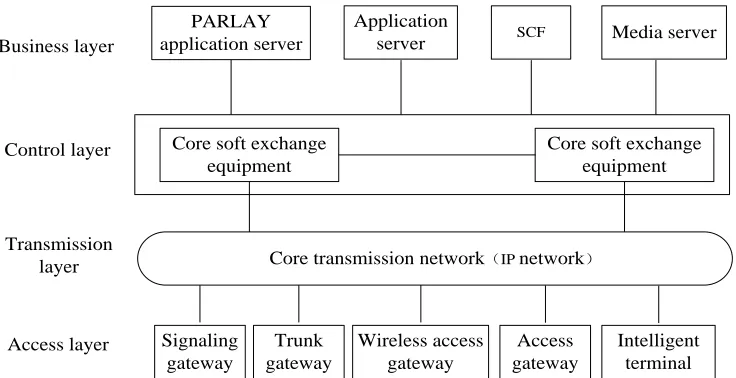
and control through the combination of standard opening service interface and service application layer. Soft switch employs layered structure, which including four layers, access layer, transmission layer, control layer, business layer. The network structure of soft switch is shown in figure 1
(1) Access layer
Access layer access a variety of network and terminal device; mainly put various relevant gateway for existing network or terminal device access into soft switch control system. Access layer
consists of the trunk gateway (TG), signaling gateway (SG), Access gateway (AG), integrated gateway (AG), etc.
(2) Transport layer
Transport layer is the packet switched network which adopts packet switching technology; mainly consist of router and ATM switch, and provide a unified integrated transport platform of high reliability, quality of service assurance, large bandwidth or next generation network.
PARLAY application server
Application
server Media server
Core transmission network(IP network)
Signaling gateway
Trunk gateway
Access gateway
Intelligent terminal Wireless access
gateway Business layer
Control layer
Transmission layer
Access layer
Core soft exchange equipment
SCF
[image:2.612.127.495.242.431.2]Core soft exchange equipment
Figure 1 Soft switch network structure diagram
(1)Control layer
The main functions of control layer including call control function, service provision function, service interaction function, interworking function, SIP agent function, accounting function, network management function, routing function, address resolution function, and authentication function.
(2)Business layer
Business layer refers to the equipment for providing various application and service. It accesses the platform through the application of opening and integrated service, and provides the various value-added service, multimedia service, third-party service, service creation, environment maintenance for next generation network.
2.2 SIP protocol
SIP, (Session Initiation Protocol) is a controlling protocol of application layer, which is used for creating, modifying, terminating the session. Session types include Internet phone call, multimedia conference, and multimedia transmission etc, session participants can be one or more parties. SIP protocol is signaling protocol, not
bearing protocol. SIP support five aspects function based on the construction and maintenance of multimedia conference protocol:
Location terminal: SIP let other terminal know its location, listen port, URI information etc through the registration.
Call terminal: SIP can initiate other SIP phone, PSTN, fixed –line phone by employing the SIP message.
Medium information exchange: exchange the medium information; check the medium and medium parameters before the session.
Session establishment: establish the session parameters between the calling party and called party.
Session management: initiate and terminal the session, modify the session parameters, service invocation etc.
Transport Layer Transaction User Layer
Transaction Layer
[image:3.612.93.279.73.165.2]Syntax and Encoding Layer
Figure 2 SIP protocol layered structure
The bottom of SIP protocol are grammar and encode-decode layer. SIP message is described by ABNF grammar. Transport layer mainly define the details how the client and server side send request and receive response through the network. Transaction layer is the basic component of SIP, one transaction consist of the request that client transaction send to the server (use transport layer) and all the supposed request response that send from the server transaction back to client. Transaction user, every SIP entity is the TU except the stateless proxy.
3. THE ESTABLISHMENT OF
DISTRIBUTED CALL SYSTEM MODEL
In order to implement features of distribution and multimedia of distributed call center, and separate the call center and business platform, distributed call system model based on the four layer network architecture of soft switch is shown in figure 3.
Transmission exchange layer Service management layer
Call control layer
[image:3.612.317.525.317.572.2]Network interface layer
Figure 3 distributed call system model
Network interface put PSTN, Internet and the request of the mobile internet user unified access into the IP network through the SIP protocol and RTP protocol, which implement transformation from PSTN signaling to the SIP signaling, and complete the transformation function of media speech encode. Transmission exchange layer finish the transmission of the VOIP voice package and control signal through the IP network equipment.
Call control layer consists of the network automatic call distribution module and soft switch. Distributed call system provide the network routing function based on soft switch, all the distribute call center that put into access can make a call allocation by employing the same automatic call distribution module system. Soft switch module is the core module of distributed call system, which is
responsible for user’s authentication, authorization and address resolution, and set up, maintain, release and control the call between the users, monitor and dispose the request from the business management layer, and provide the dismantlement and intrusion for multi-call and other functions.
Business management manages the various business needs for distributed call system through the application of software, which includes soft phone call processing, interactive voice respond service and customer relationship management.
4. THE DESIGN AND IMPLEMENTATION
OF DISTRIBUTED CALL SYSTEM
4.1 Function design for distributed call system
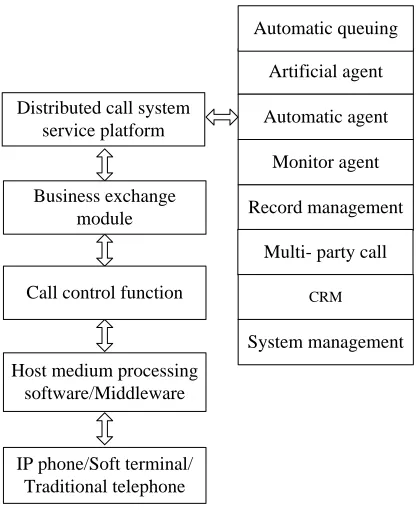
The functional architecture for distributed call system based on the business requirements of call center is shown in figure 4
Distributed call system service platform
Host medium processing software/Middleware
IP phone/Soft terminal/ Traditional telephone
Artificial agent
Automatic agent
Monitor agent
Record management Automatic queuing
Call control function Business exchange
module
Multi- party call
CRM
System management
Figure 4 Distributed call system module function structure chart
All the distributed call service control is operated by the unified platform, basic voice service and customer resource management for enterprise call center are provided on the unified platform of distributed call system. The core function module of distributed call system is shown as follows:
Automatic queuing module, system realizes
[image:3.612.131.264.442.511.2]generated, automatic queue with help of telephone, intelligent distribution function, and support for multiple agents distribution principle and other functions, arrange operators resources reasonably, assign the call to the optimal operator to deal with automatically.
Artificial agent is the umbrella name for
function entity that completes various services through the interaction between the sales representatives and call center. The calling user can request the system provide the artificial service when the calling party is not satisfied with the service that the automatic agent. The basic functions for agent possesses check in /check out, busy/ idle, call pickup, outer calling, call transfer, mute/cancel mute, internal call etc.
Monitor agent module, monitor agent mainly
implement real time monitoring, and statistical analysis for agents in the queue, and monitor, guide and assist the average agent’s work. Monitor agent module possesses the function of monitor, intrusion, dismantlement, controlled call transfer, agent status monitor, intercept calls etc.
Record management module, record
management module record the whole process of work status of various agents and customer call information. The system can automatically record one or some agents or all the agents’ call. Enterprise manager assigns the agent call that requires recording according to the service requirements, which is easy to know the overall operating status of the enterprise, certain period’s record information can be inquired, download to listen, delete according to the calling and called party.
Multi- party call module, multi party-call
realizes the multi-party online voice call through various means. Multi party-call realizes the multi-party, remote real-time communication online, which is mainly used in the business negotiation, the typical implementation way such as telephone conference. Customers can add the original customer who is in a maintainable condition into the call in the distributed call system, so as to realize the multi-party‘s real time conversation, multi- people (one host plus multi answer party) call at the same time.
Customer relationship management module,
Customer relationship management module stores the basic information of all the customers, distributed call system can automatically search the customer information from the database system according to the caller ID, and presents the latest information of the customer to the agents. CRM provide the personalized customer service to the customer through dig and analysis of the customer’s information, give the appropriate guide to the customer and give the customized recommendation of the product and service to the customer.
4.2 Structure design for the system software
Distributed call system software’s development adopts layer structure; according to the function that needs to be implemented the whole system is divided into four layers: application service layer, protocol stack layer, transmission layer, system layer. Each layer plays a different role, and each layer consists of several big modules, which located in different layers, each module’s function is different. The layered structure of the application service layer, protocol stack layer, transmission layer, system layer are elaborated through the following module diagram, and subdivide the different module function of all levels again. The layered structure of distributed call system is shown in figure 5.
Business application layer
System layer Transmission layer Protocol stack layer
Figure 5 The layered structure diagram of distributed call system
4.3 The implementation of core function for
distributed call system
In the design process of call system, we adopt socket: the most common communication mechanism, which can be applied in the communication between the different progress and different machine progress. Socket adopts client/ server communication mode, client and server side realized connection and data exchange on the internet through the Socket port. Socket provide a series of system interface, the user can realize the communication through the convenient use of TCP and UDP and other network protocols.
4.3.1 Call control function
particularly crucial. This design uses finite state machine to design, the ordered state machine’s design of distributed call system mainly include basic call business, group call, intrusion, dismantlement, voice monitoring and record. The status including 3 statuses, basic call service status:
[image:5.612.109.508.156.450.2]S1_idle,S2_calling,S3_ring,S4_pretalk,S5_talking, S6_preidle;exceptional condition status, S7_fail,S8_busy,S9_interrupt,S10_ seton;Monitor agent service status: S11_groupcall, S12_backout, S13_insert.Voice calling FSM diagram is shown in figure 6.
Figure 6 Voice calling FSM diagram
4.3.2 Speech data transmission module
This design socket realize the transmission of SIP signaling message and audio-video media information through the selection of UDP data diagram module of Socket interface .
1) First, create socket sock, and the socket type can be set as UDP data diagram module, SOCK_DGRAM sock= socket (AF_INET, SOCK_DG RAM, IPPROT_UDP);
After the initialization of windows sockets dynamic depot, socket is created. Socket function and WSASocket function will realize the function. Socket function declaration presented as follows:
SOCKET socket (
int af,
int type,
int protocol
2) The allocative socket parameters
laddr.sin_family=AF_INET; //set protocol suite
one_inet_addr=inet_addr(host); //set address
addr.sin_addr.s_addr=one_inet_addr;
laddr.sin_port=htons((short)SENDPORT);//set port (5060)
3) Set the local binding for socket (host
address/port)
Bind function bind the socket to a known address. The function declaration presented as follows:
int bind(
SOCKET s,
const struct sockaddr FAR* name,
int namelen
);
4) send or receive data News legitimacy judgment
INVITE
Route selection
Transmit INVITE S1_idle
Address resolution
S2_calling Start ring time Return to 4xx information
S1_idle
Y N
In the application of UDP socket procedure, it mainly sends the data by sendto function and WSA Send to function, invoke the recvfrom function and WSARevFrom function to receive data. recvfrom function and sendto function are mainly employed in the program design process for this subject. The protypes of two function are shown as follows:
int sendto(SOCKET s, char* buf, int len, int flags, struct sockaddr* to, int tolen);
int recvfrom(SOCKET s, char* buf, int len, int flags, struct sockaddr* from, int* fromlen);
5) Invoke function closesocket(SOCKET s) and
close the socket
During the procedure design process, first loading windows sockets dynamic link library, WSAStartup function implements this function. The function is the first function that socket application procedure must invoke. The function declaration is ahown as follows:
int WSASartup(
WORD wVersionRequested,
LPWSADATA lpWSAData
)
5. SYSTEM TEST
5.1 Test Environment Establishment
[image:6.612.325.519.291.428.2]The hardware platform environment of distributed call system test based on the soft switch is shown in table 1
Table 1 Hardware platform environment
Module Equipment
configuration quantity Central
switching server
Intel 5600,3.60GHz Quad-core CPU,8GB Memory
1
Automatic call distribution module
Intel 600,3.60GHz Quad-core CPU,8GB Memory
1
Soft switch module
Intel 5600,3.60GHz Quad-core CPU,8GB Memory
1
Interactive response module
Intel 5600,3.60GHz Quad-core CPU,8GB Memory
1
Agent soft phone module
Intel i3-2120 processor
3.30GHz, 2G Memory 35
Voice server H3C XE200 1
5.2 Voice Call Control Module Test
ClearSight network analyzer can make a qualitative evaluation of voice quality, and calculate the packet loss and jitter’s impact on the processing speed of voice quality vector, voice delay calculation, call signaling statistical. This test measures the voice quality of the voice call control module and call signaling processing time through the ClearSight network analyzer, voice quality index mainly consists of voice packet delay, loss and jitter[12][13][14].
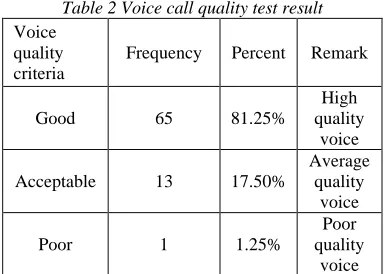
ClearSight network analyzer divides the voice quality into three ranks, Good, Acceptable, Poor. This test completes 80 times voice call quality test, voice quality test result is shown in table 2.
Table 2 Voice call quality test result
Voice quality criteria
Frequency Percent Remark
Good 65 81.25%
High quality
voice
Acceptable 13 17.50%
Average quality
voice
Poor 1 1.25%
Poor quality
voice The test result of table 2 show that the voice quality of the distributed call system reaches the voice quality of PSTN.
ClearSight network analyzer set the weight sum of the three factors that affect the voice quality, packet delay, loss, jitter, encoding as 100, the test result is shown in table 3.
Table 3 weight test result table for voice quality factor
Influence factor Packet delay Packet loss Jitter
Average weight 1.85 55.33 42.82
The test result for table 3 shows the key for improve the voice quality is to reduce the packet loss for network transmission, and improve the technology for processing jitter.
International telecommunication union Tg114 standard set the voice delay’s level 3 standard, level 1 below 150ms, level 2 150-400ms, level 3 400ms above. The test result for packet delay is shown in table 4
Table 4 Test result diagram for Packet delay
Delay time(ms) 0-150ms
[image:6.612.95.302.512.723.2]Frequency 198 2 0
Percentage 99% 1% 0%
The test result for table 4 shows that the voice call delay of the distributed call system is in the range of international telecommunication union Tg114 standard.
[image:7.612.142.517.70.313.2]Call signaling processing speed is embodied by the set up time and releasing time, the test result for processing speed of the call signaling is shown in table 5.
Table 5 Test result diagram for processing speed of the call signaling
Average setting up time for call (second)
Average time for communication releasing
(second)
0.965 0.009
Test result for table 5 shows the average speed processing time for signaling of the distributed call system is below the specified average time for Telecommunication Service regulation.
5.3 The Compressive Resistance for System The compressive resistance for system is the test that mainly aimed at test the system operation, transaction processing, and system response when a large number of concurrent users request for the
system transaction processing. Compressive
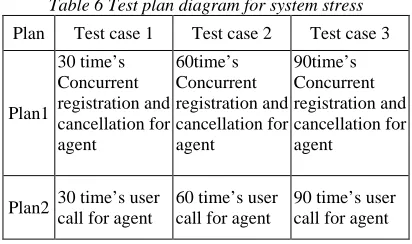
[image:7.612.95.301.515.637.2]resistance is conducted through two sets of test plan, test the large number of registration/cancellation, large numbers of intensive call for agent respectively [13][14]. Test plan is shown in table 6
Table 6 Test plan diagram for system stress
Plan Test case 1 Test case 2 Test case 3
Plan1
30 time’s Concurrent registration and cancellation for agent
60time’s Concurrent registration and cancellation for agent
90time’s Concurrent registration and cancellation for agent
Plan2 30 time’s user call for agent
60 time’s user call for agent
90 time’s user call for agent
Test three indexes, CPU occupancy rate, memory occupancy rate and response time respectively on two sets of test plan. The result of compressive resistance for system is shown in table 7
Table 7 The diagram result of compressive resistance for system
Plan Parameters Test case 1
Test case 2
Test case 3
Plan1
CPU occupancy
rate peak
11.3% 12.7% 13.2%
Memory occupancy
rate peak
5.6% 5.8% 6.5%
Response time peak(
second)
0.8 0.9 1.1
Plan2
CPU occupancy
rate peak
14.6% 15.9% 16.5%
Memory occupancy
rate peak
6.3% 6.7% 7.1%
Response time peak(
second)
1.2 1.6 1.9
Table 7 The result of compressive resistance for system shows CPU occupancy rate, memory occupancy rate, response time of distributed call system are stable under the plan of a large number of concurrent users call and conduct registration/cancellation .
6. CONCLUSION
As the traditional call system can not adapt to the needs of next generation network construction for enterprise, distributed call system module is established based on the soft switch technology system, it adopts the layered modularized software development idea and standard opening interface, the distributed call control and voice transmission and other core function module are developed through the use of Visual C++. Test result show that the voice quality of the system can achieve PSTN effect, signaling process time is the in the range of international telecommunication union Tg114 standard, CPU occupancy rate of the system, memory occupancy rate and response time are stable. It realizes the basic function of distributed call system, and achieves the separation of the call system and business platform, and possesses the good extensibility and maintainability, which is particularly applicable to the call system of multi-service and diversified feature.
REFRENCES:
[1] Li Jia. Design and Implementation of
Embedded Telephony Based on SIP Protocol in
Wireless Local Area Network[D], Xiamen,
[2] Pál, Szabolcs; Šaric, Zoran; Ocovaj, Stanislav; Papp, Istvan, “Hands-free VoIP terminal with gain control based on neural
network”, In Proceedings of 2012 IEEE 19th
International Conference and Workshops on Engineering of Computer-Based Systems, pp.173-181, 2012.
[3] Ye Linhui. Design and Development of the
Driver of NGN Multimedia Terminal and
Voice Gateway[D]. Beijing, Beijing University
of Posts and Telecommunications. 2007 (In China)
[4] Tian Feng. Research and Realization of Coal
Mine Multi-service Voice Scheduling System
Based on Soft Switch[D]. Xi’an,,Xi’an
University of Science and Technology .2009 (In China)
[5] Hui Tian; Ke Zhou; Jing Lu, “A VoIP-based
Covert Communication Scheme Using Compounded Pseudorandom Sequence”, Journal of IJACT, Vol. 4, No. 1, pp. 223 -230, 2012.
[6] Jin Liu; Ke Zhou; Hui Tian; Cunhua Li,
“Efficient Least-significant-bits Steganography
for VoIP”, Journal of IJACT, Vol. 4, No. 10,
pp. 297-305, 2012
[7] Feng Tian. Research of the Coal Mine
Multi-service Model based on Softswitch, In
Proceedings of The 5th International Conference on Computer Science & Education , pp.981-985, 2010.
[8] Zhang, Ruishan;Wang, Xinyuan; Yang,
Xiaohui; Jiang, Xuxian, “On the billing vulnerabilities of SIP-based VoIP systems”, Journal of Computer Networks, vol.54, no.11, pp.1837-1847, 2010.
[9] Jang, Sung-Bong; Kim, Young-Gab, “An
energy-efficient delay reduction technique for supporting WLAN-based VoIP in SmartPhone”, Journal of Systems Architecture, vol.57, no.10, pp.934-944, 2011.
[10] Hassan, Jahan A; Hassan, Mahbub; Das, Sajal
K.; Ramer, “Arthur Managing quality of experience for wireless VOIP using
noncooperative games”, Journal of IEEE
Journal on Selected Areas in Communications, vol.30, no.7, pp.1193-1204, 2012.
[11] Yoon, Eun-Jun ; Yoo, Kee-Young; Kim,
Cheonshik; Hong, You-Sik; Jo, Minho; Chen, Hsiao-Hwa, “A secure and efficient SIP authentication scheme for converged VoIP
networks”, Journal of Computer
Communications, vol.33, no.14, pp.1674-1681, 2010.
[12] Rachidi, T. ;Mourhir, A.; Chaatit, F, “Delivery of unified communications over Thin-IMS”, International Journal of Mobile Computing and Multimedia Communications, vol.4, no.1, pp.43-56, 2012.
[13] Do-Yoon Ha; Chang-Yong Lee; Hyun-Cheol
Jeong; Bong-Nam Noh, “Design and Implementation of SIP-aware DDoS Attack
Detection System”, Journal of AISS, Vol. 2,