Serum Repository for Lyme Disease Diagnostic Test Development and
Evaluation
Claudia R. Molins,aChristopher Sexton,aJohn W. Young,aLaura V. Ashton,bRyan Pappert,aCharles B. Beard,aMartin E. Schriefera Division of Vector-Borne Diseases, Centers for Disease Control and Prevention, Fort Collins, Colorado, USAa
; Department of Microbiology, Immunology, and Pathology, Colorado State University, Fort Collins, Colorado, USAb
Serological assays and a two-tiered test algorithm are recommended for laboratory confirmation of Lyme disease. In the United States, the sensitivity of two-tiered testing using commercially available serology-based assays is dependent on the stage of infec-tion and ranges from 30% in the early localized disease stage to near 100% in late-stage disease. Other variables, including sub-jectivity in reading Western blots, compliance with two-tiered recommendations, use of different first- and second-tier test com-binations, and use of different test samples, all contribute to variation in two-tiered test performance. The availability and use of sample sets from well-characterized Lyme disease patients and controls are needed to better assess the performance of existing tests and for development of improved assays. To address this need, the Centers for Disease Control and Prevention and the Na-tional Institutes of Health prospectively collected sera from patients at all stages of Lyme disease, as well as healthy donors and patients with look-alike diseases. Patients and healthy controls were recruited using strict inclusion and exclusion criteria. Sam-ples from all included patients were retrospectively characterized by two-tiered testing. The results from two-tiered testing cor-roborated the need for novel and improved diagnostics, particularly for laboratory diagnosis of earlier stages of infection. Fur-thermore, the two-tiered results provide a baseline with samples from well-characterized patients that can be used in comparing the sensitivity and specificity of novel diagnostics. Panels of sera and accompanying clinical and laboratory testing results are now available to Lyme disease serological test users and researchers developing novel tests.
L
yme disease is caused by the spirocheteBorrelia burgdorferiandis transmitted to humans by the bite of infectedIxodesticks.
The clinical course of disease can be described as occurring in three stages: early localized, early disseminated, and late dissemi-nated. Each stage of disease may involve multiple tissues and
or-gan systems, including the skin, heart, nerves, and joints (1).
How-ever, beyond the presence of an erythema migrans (EM) in the context of epidemiological risk, individual signs and symptoms of
disease are not sufficiently specific to make a diagnosis (1,2).
In contrast to many bacterial infections, the recovery ofB.
burgdorferiand direct detection of agent-specific markers are not particularly useful for diagnosis. This is due primarily to the
ex-treme sparsity of spirochetes in most infected tissues (3).
Never-theless, a natural antibody response to the pathogen develops over the early weeks of infection and persists. These characteristics of Lyme disease have motivated efforts to identify and charac-terize dozens of agent-specific immune-dominant antigens
and epitopes (1). Consequently, serological assays measuring
an-tibody responses and profiles have been the mainstay of
labora-tory confirmation (1), as well as the basis of all Food and Drug
Administration (FDA)-cleared tests for Lyme disease. In 1995, the Centers for Disease Control and Prevention (CDC) recom-mended a two-tiered serologic testing algorithm that utilizes a first-tier enzyme immunoassay (EIA) followed by second-tier Western immunoblot (WB) assays to standardize laboratory
evi-dence of exposure toB. burgdorferi(4). Despite this
recommen-dation, variability in test performance has led to substantial confusion and uncertainty regarding the appropriate use and
in-terpretation of test results (3,5–7). Many of the reported
perfor-mance variances may be linked to test sample heterogeneity. Ad-ditionally, the comparative evaluation of existing and new tests
suffers from a lack of a well-characterized sample repository. In 2007, the CDC and the National Institutes of Health (NIH) un-dertook an effort to address this shortcoming by collecting sera
from patients at all stages ofB. burgdorferiinfection and negative
controls that included healthy individuals and patients with other diseases known to challenge the specificity of serological tests for Lyme disease. This report describes those efforts, along with the documentation and characterization of the serum samples ac-quired. Furthermore, the availability of samples from the Lyme serum repository (LSR) for research and the development of im-proved serology tests are discussed.
MATERIALS AND METHODS
Serum acquisition and acceptance.Sera from positive (Lyme disease) and negative (non-Lyme disease) controls were obtained prospectively through contracts established between the CDC and external providers. Review of contract proposals assessed the provider’s case definition and proof of disease, inclusion and exclusion criteria, informed consent, clin-ical history questionnaire, recruitment procedures, sample handling and tracking, and budget justification. Additionally, individual provider’s
ex-Received22 May 2014Returned for modification15 June 2014
Accepted8 August 2014
Published ahead of print13 August 2014
Editor:R. Patel
Address correspondence to Martin E. Schriefer, [email protected].
Supplemental material for this article may be found athttp://dx.doi.org/10.1128 /JCM.01409-14.
Copyright © 2014, American Society for Microbiology. All Rights Reserved.
doi:10.1128/JCM.01409-14
on May 16, 2020 by guest
http://jcm.asm.org/
perience based on their peer-reviewed publications and ability to recruit specific donors, collect samples, provide deliverables, and meet calendar milestones were evaluated. Each selected provider was required to obtain local and CDC Institution Review Board (IRB) approval prior to enroll-ment of patients. The final inclusion and exclusion criteria used to identify eligible and ineligible participants for each contract were agreed upon by the contract provider and the CDC. Lyme disease serology or results from two-tiered testing did not play a role in patient enrollment except for inclusion of late-stage Lyme arthritis patients. This was done to minimize reproofing of samples for early disease (i.e., providing samples for the purpose of test evaluation and improvement that had already been shown to be seropositive) and to recruit a potentially broader Lyme disease pa-tient population. Although early Lyme disease papa-tients could be two-tiered negative, they were required to have well-documented clinical and laboratory (PCR and/or culture) evidence of infection.
Collected sera were stored at⫺20°C for up to 2 weeks or at⫺70°C for
longer periods. The sera were transferred on dry ice to the Division of Vector-Borne Diseases at the CDC in Fort Collins, CO, along with sup-porting clinical and laboratory data. Upon arrival, samples were given a CDC identifier number, thawed, heat inactivated at 56°C for 30 min,
aliquoted (100l) into 0.5-ml conical tubes with screw caps, and stored at
⫺70°C. Heat inactivation was performed to minimize exposure risk to
potential pathogens in serum samples by end users of the LSR.
Sample characterization.Sera from all individuals (positive and
neg-ative controls) were tested at the CDC for antibodiesto B. burgdorferi.
Testing was performed in a blinded fashion by assigning a random num-ber to each sample prior to testing. All serologic assays were performed following the manufacturer’s instructions. The CDC-recommended
two-tiered testing algorithm (4) was performed using FDA-cleared
assays for Lyme disease. The assays consisted of a first-tier whole-cell sonicate (WCS) EIA (Vidas Lyme IgM and IgG Polyvalent Assay, bio-Mérieux, Inc., Durham, NC), followed by second-tier IgM and IgG WBs (MarDx Diagnostics, Inc., Carlsbad, CA). The immunoblotting results were interpreted according to the guidelines proposed by the
CDC (4). Samples were considered two-tiered positive if the first-tier
test was equivocal or positive and the second-tier IgM and/or IgG WB was positive. For the IgM blot to be positive, at least 2 of 3 Lyme-specific bands had to be scored as meeting the test intensity threshold, and for IgG blot positivity, at least 5 of 10 Lyme-specific bands had to be scored as meeting the test intensity threshold. IgM WBs were not considered in the final interpretation of two-tiered test results for
serum samples collected from patients with⬎30 days of illness. All
WBs were read by three individuals, and the interpretations were com-pared. If two out of three reads agreed, the read that was in agreement was accepted as final. If the reads of all three individuals disagreed, a consensus read was determined by all three readers.
Culture and PCR of samples from enrolled Lyme patients.Samples from patients with early localized (only an EM) and early disseminated (Lyme carditis or Lyme neuroborreliosis) Lyme disease were tested by culture and PCR when possible. Culture and PCR were performed
ac-cording to published methods (8–11). Additionally, joint fluid from
pa-tients with late disseminated Lyme arthritis was tested by PCR using the
published methods of Li et al. (12). All culture and PCR were performed
by the sample providers.
Panel types/composition.Serum panels representing both Lyme dis-ease patients and non-Lyme disdis-ease patients were formulated to meet anticipated needs of Lyme disease clinical laboratories, investigators, and manufacturers of new tests in the process of FDA clearance.
RESULTS
Contracts and sample acquisition.Eleven contracts were awarded based on the response to a publically advertised funding an-nouncement. The inclusion and exclusion criteria for selecting study participants varied based on the stage of Lyme disease or the look-alike disease for which the serum was sought. These criteria
are outlined in Tables S1 to S3 in the supplemental material for each patient group and healthy controls. All patients were classi-fied in two control categories: positive (Lyme disease patients) and negative (non-Lyme disease patients). Positive controls consisted of physician-diagnosed Lyme disease patients that were well doc-umented, both clinically and epidemiologically. Negative controls were healthy residents of regions to which Lyme disease was en-demic and regions to which it was not and persons with other diseases (infectious mononucleosis, fibromyalgia, multiple sclero-sis, rheumatoid arthritis, syphilis, and severe periodontitis) that had no history of Lyme disease. The latter group of negative con-trols represents diseases that are reported to generate serologic
cross-reactivity in antibody-based tests for Lyme disease (13,14).
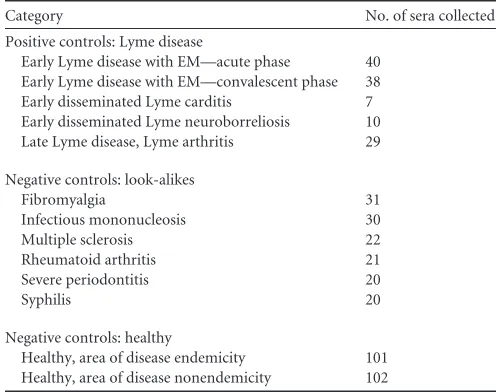
These samples were targeted to enable assessment of Lyme disease serological tests’ specificity. The control groups, subcategories, and numbers of serum samples collected for each are summarized inTable 1. A total of 471 serum samples were collected between 2008 and 2012. The volume of individual serum collected varied depending on the category and ranged from less than 10 ml to greater than 40 ml.
Sample characterization based on medical record data. A medical questionnaire developed by contract providers and ap-proved by the CDC was administered to all serum donors at the time they were enrolled in the study. Information collected through the questionnaire included age, sex, race, past medical history of tick-borne and Lyme disease, history of look-alike dis-ease, and pregnancy, as well as any comorbidities and immuno-compromising conditions. Exclusion criteria for enrollment of early Lyme patients included significant immunocompromising conditions, such as HIV or any disease that required immunosup-pressive medications. Other immunocompromising conditions that were reported by the patient and did not fall into the category described above were recorded as part of their medical history.
Positive controls. (i) Early Lyme disease with EM.Selection of early Lyme disease patients for the LSR was based on the inclusion criteria described in Table S1 in the supplemental material. These criteria included appropriate epidemiological risk, the presence of a skin lesion consistent with EM of at least 5 cm in diameter, and
[image:2.585.296.544.77.273.2]when possible positive culture and/or PCR forB. burgdorferi. A
TABLE 1Categories and numbers of serum samples collected
Category No. of sera collected
Positive controls: Lyme disease
Early Lyme disease with EM—acute phase 40
Early Lyme disease with EM—convalescent phase 38
Early disseminated Lyme carditis 7
Early disseminated Lyme neuroborreliosis 10
Late Lyme disease, Lyme arthritis 29
Negative controls: look-alikes
Fibromyalgia 31
Infectious mononucleosis 30
Multiple sclerosis 22
Rheumatoid arthritis 21
Severe periodontitis 20
Syphilis 20
Negative controls: healthy
Healthy, area of disease endemicity 101
Healthy, area of disease nonendemicity 102
on May 16, 2020 by guest
http://jcm.asm.org/
total of 38 acute- and convalescent-phase serum pairs and 2 addi-tional acute-phase samples were collected, for a total of 78 serum samples from 40 patients. Acute-phase samples were defined as baseline sera collected from patients during their first visit to the clinic and on the day of their Lyme disease diagnosis. The collec-tion of sera from these patients occurred prior to newly prescribed antibiotic treatment. Convalescent-phase sera were collected be-tween 10 to 35 days following the patients’ initial diagnosis and after beginning treatment with antibiotics. The early Lyme disease patients presented with at least one EM rash (the number of EMs ranged from 1 to 27). The time between noticing an EM and col-lection of acute-phase sera ranged from 0 to 28 days, with an average of 7 days. Culture of blood and/or skin biopsy was per-formed by the provider and attempted with 39 of the 40 patients. In total, 17 of the 39 (44%) tested early Lyme disease patients were culture positive. Similarly, PCR was performed by the provider with samples from 39 of the 40 patients. Overall, 24 of the 39 (62%) patients had a positive PCR result. For the 40 enrolled patients, 26 (65%) were culture and/or PCR positive using one or
more samples. Culture and PCR results are summarized inTable
2. At the time of their follow-up visit, 23 patients (58%) were
classified as recovered. The remaining 17 (43%) patients had on-going symptoms that consisted primarily of fatigue, joint pain, and headache.
(ii) Early disseminated Lyme disease with neuroborreliosis or Lyme carditis. Selection of neuroborreliosis (cranial nerve palsy, lymphocytic meningitis, or radiculopathy) and Lyme cardi-tis (various degrees of heart block) patients for the LSR was based
on appropriate epidemiological risk and objective clinical mani-festations (see Table S1 in the supplemental material). Of the 17 patients enrolled, 10 presented with neuroborreliosis and 7 pre-sented with Lyme carditis. Eight of the patients (47%) also had an EM or multiple EMs (up to 25) at the time of enrollment. The number of days between a patient’s initial and follow-up visits ranged from 2 to 28 days.
Culture was performed by the provider with samples from 10 of 17 patients (4 Lyme carditis patients and 6 Lyme neuroborre-liosis patients). Of these, only 2 (20%) of the 10 tested patients with Lyme neuroborreliosis were culture positive from one or more samples. PCR was also performed by the provider on sam-ples from 15 patients (7 Lyme carditis patients and 8 Lyme neu-roborreliosis patients). PCR was positive for 4 (27%) of these 15 patients. Overall, 5 of the 17 patients (29%) with disseminated
infection were culture and/or PCR positive (Table 2). Of the 17
patients, only 2 (12%) were considered to have recovered at the time of their follow-up visits. Other patients had ongoing symp-toms, including dizziness, headache, tingling, and/or ongoing palsy.
(iii) Late disseminated Lyme disease with arthritis.The selec-tion of 29 patients with a diagnosis of Lyme arthritis for the LSR was based on inclusion criteria (see Table S1 in the supplemental material). Additionally, the patients of this group were required to be two-tiered positive, following the guidelines of the CDC and
the State and Territorial Public Health Laboratory Directors (4).
The length of time between a patient reporting joint symptoms and the date of sampling ranged from 1.5 to 547 days. The joint affected for all 29 patients was the knee. One patient also had symptoms in the elbow and wrist joints. The degree of joint swell-ing ranged from mild to severe. For 25 of the 29 patients, the antibiotic treatment occurred 1.5 to 152 days prior to sample col-lection. Four patients were not treated prior to sample colcol-lection. The case definition for late disease required laboratory confirma-tion of infecconfirma-tion. Therefore, all serum samples were tested by IgG EIA and IgG WB by the provider. All samples were positive by IgG
EIA and by IgG WB. VlsE testing (15) was also performed by the
provider and found to be positive for all patients. Joint fluid was collected and tested by PCR from 18 patients, and 7 (39%) of those
tested were found to be positive forB. burgdorferiDNA (Table 2).
Due to the laboratory confirmation required for these samples, selection bias toward reactive samples cannot be discounted.
Negative controls. (i) Healthy residents of regions to which Lyme disease is endemic and regions to which it is not.A total of 101 sera were collected from healthy area-of-endemicity controls (all residing in New York). Sera from 102 healthy persons residing in Texas, an area to which Lyme disease is not endemic, were also collected. Inclusion and exclusion criteria for both groups are out-lined in Table S2 in the supplemental material.
(ii) Fibromyalgia.A total of 31 sera were collected from
pa-tients diagnosed with fibromyalgia based on the 1990 (16) and
2010 (17) criteria for diagnosing fibromyalgia. None of the
pa-tients reported a diagnosis of Lyme disease, although 17 (55%) patients had been previously tested for Lyme disease. Inclusion and exclusion criteria are outlined in Table S3 in the supplemental material.
[image:3.585.40.286.77.358.2](iii) Infectious mononucleosis.A total of 30 sera were col-lected from patients in Colorado that were diagnosed with infectious mononucleosis. All 30 patients had a positive rapid mononucleosis test using the Wampole MonoTest (Alere Inc.,
TABLE 2PCR and culture results for patients with Lyme disease
Sample category and sample
tested (na)
Culture PCR
No. of patients tested
No.
positiveb
No. of patients tested
No.
positiveb
Early Lyme disease with EM— acute phase (40)
39 17 39 24
Blood and skin biopsy 30 15 27 17
Blood 9 2 10 5
Skin biopsy 0 0 2 2
Early disseminated Lyme carditis (7)
4 0 7 2
Blood and skin biospy 1 0 1 0
Blood and heart biopsy 1 0 1 1
Blood 2 0 3 0
Skin biopsy 0 0 0 0
CSFcand blood 0 0 2 1
Early disseminated Lyme neuroborreliosis (10)
6 2 8 2
Blood and skin biospy 1 1 0 0
Blood 5 1 7 1
Skin biopsy 0 0 1 1
Late disseminated Lyme disease with arthritis (29)
18 7
Joint fluid 18 7
a
n, no. of patients.
bWhen two samples were tested from one patient, only one sample had to be positive
to be counted as a positive result.
cCSF, cerebrospinal fluid.
on May 16, 2020 by guest
http://jcm.asm.org/
Waltham, MA) or a Mono-Latex test (Inverness Medical, Scarbor-ough, ME). Only one (3%) patient reported a comorbidity (dia-betes), and three (10%) patients were prescribed antibiotics for
Streptococcusinfection. Inclusion and exclusion criteria are out-lined in Table S3 in the supplemental material.
(iv) Multiple sclerosis.Sera were collected from 22 patients that were diagnosed with multiple sclerosis. A diagnosis of multi-ple sclerosis followed the 2005 revisions of the “McDonald
Crite-ria” (18) (see Table S3 in the supplemental material). Of these
patients, 18 had relapsing-remitting multiple sclerosis and four had secondary-progressive multiple sclerosis. Patients reported anywhere from one to more than six multiple sclerosis episodes. Of these patients, none were in acute exacerbation at the time of sample collection. Patients were asked if they had current or past optic neuritis or myelitis. Five patients reported having optic neu-ritis, and 11 patients reported having myelitis (information was unknown for 2 patients).
Eighteen (82%) patients reported potential exposure to a tick bite. No patient reported a history of an EM rash, one patient reported a history of meningitis, one patient reported a history of facial nerve palsy, and two patients reported a history of radicu-lopathy. All information described above was unknown for one multiple sclerosis patient. Serologic testing, if known, was docu-mented by the provider for antinuclear antibody (ANA), rheuma-toid factor, and neuromyelitis optica antibody. Titers of ANA were found to be weakly positive for two patients and unknown for six patients. Rheumatoid factor was found to be weakly posi-tive for one patient and unknown for seven patients. Neuromyeli-tis optica antibody was negative for 8 patients and unknown for 14 patients.
(v) Rheumatoid arthritis.A total of 21 sera were collected from patients that met the American College of Rheumatology
(ACR) criteria for rheumatoid arthritis diagnosis (19) (see Table
S3 in the supplemental material). Rheumatoid factor (RF) was positive for 17 patients, negative for 3 patients, and unknown for 1 patient. The presence of anti-cyclic citrullinated peptide (CCP)
antibodies (19) was positive for 11 patients, negative for 3 patients,
and unknown for 7 patients. Radiographs to identify erosions or bony decalcification localized in or adjacent to the involved joints were positive for 10 patients and negative for 11 patients. Addi-tionally, ANA tests were positive for four patients.
(vi) Severe periodontitis.Twenty serum samples were col-lected from patients diagnosed with severe periodontitis. Diagno-sis of severe periodontitis was based on the criteria set forth by the
American Academy of Periodontology (20). These criteria are
outlined in Table S3 in the supplemental material.
(vii) Syphilis.Twenty serum samples were collected from pa-tients with active syphilis. All papa-tients were diagnosed following the criteria outlined in Table S3 in the supplemental material. Of the patient samples collected, three (15%) were diagnosed with primary syphilis, four (20%) with secondary syphilis, 10 (50%) with early latent syphilis, and three (15%) with late latent syphilis.
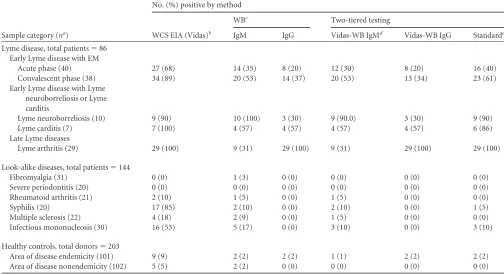
Standard two-tiered testing.Samples received at CDC were given a unique identifier and assayed in a blinded manner using two-tiered serologic testing. The results of this testing are
summa-rized inTable 3. Sera collected at baseline from acute-phase
pa-tients with early Lyme disease (n⫽40) were found to be 68%
positive by EIA, 35% positive by IgM WB, and 20% positive by IgG WB. A relatively small proportion (40%) of acute-phase pa-tient samples was positive by standard two-tiered testing (positive
or equivocal EIA followed by positive IgM and/or IgG WB).
Con-valescent-phase sera collected from these patients (n⫽38) were
89% positive by EIA, 53% positive by IgM WB, 37% positive by IgG WB, and 68% positive by standard two-tiered testing without regard to the duration of illness prior to sample collection. CDC recommendations state that sera from patients collected more than 30 days after the onset of illness should not be tested by IgM
WB to avoid false-positive results (4). Twelve of the 38
convales-cent-phase samples were taken between 31 and 45 days following the onset of illness. Thus, based on the recommended IgM WB restriction, 61% of convalescent patient samples were positive by two-tiered testing.
Patients with early disseminated Lyme disease presenting with
neuroborreliosis (n ⫽10) or Lyme carditis (n ⫽7) were 94%
positive by EIA (9 neuroborreliosis and 7 carditis samples), 82% positive by IgM WB (10 neuroborreliosis and 4 carditis samples), 41% by IgG WB (3 neuroborreliosis and 4 carditis samples), and 88% positive (9 neuroborreliosis and 6 carditis samples) by two-tiered testing (IgM and/or IgG WB) with no 30-day IgM WB cri-teria applied. With the CDC-recommended IgM testing cricri-teria
used, 5 of these 17 patients fell beyond theⱕ30-day criteria for use
of IgM WB. However, these exclusions did not alter the two-tiered testing results for this patient group.
Sera from patients with late disseminated Lyme disease with
arthritis (n⫽29) were 100% positive by EIA, 31% positive by IgM
WB, 100% positive by IgG WB, and 100% positive by two-tiered testing (IgM and/or IgG WB). Twenty patients from this group
had a duration of illness beyond theⱕ30-day criteria for use of
IgM WB. Because all 29 patients were two-tiered positive by IgG WB, the IgM results with or without the 30-day criteria did not change the overall two-tiered results. It should be noted that pos-itive two-tiered serology was a criteria for selection of patients with Lyme arthritis (see Table S1 in the supplemental material); therefore, it was expected that all samples be positive by two-tiered testing.
The Lyme disease-specific serologic reactivity of samples from
negative controls ranged from nonreactive to highly reactive (
Ta-ble 3). Sera from patients with severe periodontitis (n⫽20) were nonreactive for Lyme disease by EIA and WB. Similarly, only 1 serum sample of those collected from patients with fibromyalgia
(n⫽31) was positive by IgM WB. Sera from patients with
rheu-matoid arthritis and multiple sclerosis had a higher cross-reactiv-ity. Positive results were obtained by EIA with 10% and 18% of sera from patients with rheumatoid arthritis and multiple sclero-sis, respectively. Low reactivity (5% positive) was observed for both of these groups in two-tiered testing using IgM WB and no 30-day cutoff. Application of the 30-day illness restriction for the use of IgM WB resulted in no false-positive two-tiered interpreta-tions. The two groups with the highest cross-reactivity were syph-ilis and infectious mononucleosis. Sera from patients diagnosed with syphilis were 85% and 10% positive by the Lyme disease EIA and two-tiered testing using IgM WB, respectively. No syphilis patient samples were positive in IgG WB. However, for one
syph-ilis patient with a disease duration of⬍30 days, the two-tiered test
interpretation was positive. Sera from patients with infectious mononucleosis were 53% positive by EIA and 10% positive by two-tiered testing with or without IgM WB restrictions. Since most infectious mononucleosis patients who seek medical care will do so within 30 days of illness onset, IgM WBs will often be utilized if Lyme disease testing is performed, and this could lead to
on May 16, 2020 by guest
http://jcm.asm.org/
misdiagnosis. For other patient groups (rheumatoid arthritis, fi-bromyalgia, multiple sclerosis, and severe periodontitis), all
pa-tients sought medical care⬎30 days after their initial symptoms
began.
Sera from healthy persons residing in areas to which Lyme
disease is endemic (n⫽101) were 9% positive by EIA, and were
2% positive by two-tiered testing using the IgM WB or IgG WB. Sera from healthy persons residing in areas to which Lyme disease
is not endemic (n⫽102) were 5% positive by EIA, and all were
negative by two-tiered testing (IgM and IgG WBs).
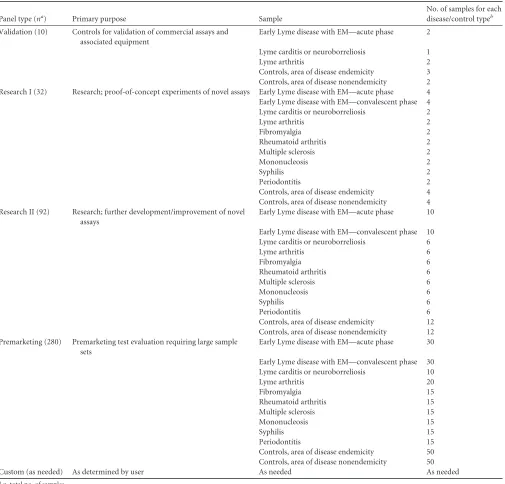
Composition of panels.Based on anticipated use of the sera and our previous experience with distribution of serum panels, we
identified four general panel categories (Table 4). The first panel
category is validation. This panel is composed of five positive Lyme patient samples and five healthy controls and is intended to validate commercial assays and instruments. The second panel category is research. Two panels fall under this category and are identified as Research I and Research II. The Research I panel consists of 32 sera, and Research II consists of 92 sera. For both of these panels, all three stages of Lyme disease, all of the Lyme ease look-alike diseases, and the healthy controls (in areas of dis-ease endemicity and nonendemicity) are represented. The third panel category is premarketing. This panel is composed of 280 sera representing all three stages of Lyme disease, all of the Lyme ease look-alike diseases, and the healthy controls (in areas of dis-ease endemicity and nonendemicity). The fourth panel category is custom. This panel will be assembled in response to more focused needs of individual investigators.
DISCUSSION
Assessment of the antibody response toB. burgdorferiinfection
has been the mainstay of laboratory confirmation of Lyme disease for more than 20 years. In the United States, a two-tiered serology
algorithm was recommended in 1995 (4), and a similar strategy
was established in Europe (21, 22). Although published studies
frequently report serology test data on individual investigations with small patient numbers, fewer report on two-tiered test data obtained with large and well-characterized Lyme borreliosis pa-tient sample sets. Among the later studies with U.S. papa-tients, sig-nificant ranges in sensitivity are reported. Specifically, 29 to 40% sensitivity for the earliest acute-phase samples from EM patients, 29 to 78% sensitivity for convalescent-phase samples from these same patients, and 40 to 87% sensitivity for patients with early disseminated disease (Lyme neuroborreliosis and Lyme carditis)
have been observed (8, 15, 23). In late-stage Lyme arthritis or
Lyme neuroborreliosis, two-tiered sensitivity has been much
higher and more tightly grouped, ranging from 97 to 100% (15,
23–25). Two-tiered variability in sensitivity with early Lyme dis-ease is explained by inappropriate test use and differences in
duration and dissemination of disease in tested patients (3,26).
Variability in sensitivity has also led to confusion and misunder-standing of the value of testing and how to interpret results.
Medical practitioners and the public at risk for Lyme disease, as well as test developers, would benefit from access to large sample sets and the corresponding sample data. Additionally, greater ben-efit would be gleaned from comparative data analyses using a
stan-TABLE 3Two-tiered testing of sera
Sample category (na)
No. (%) positive by method
WCS EIA (Vidas)b
WBc Two-tiered testing
IgM IgG Vidas-WB IgMd Vidas-WB IgG Standarde
Lyme disease, total patients⫽86
Early Lyme disease with EM
Acute phase (40) 27 (68) 14 (35) 8 (20) 12 (30) 8 (20) 16 (40)
Convalescent phase (38) 34 (89) 20 (53) 14 (37) 20 (53) 13 (34) 23 (61)
Early Lyme disease with Lyme neuroborreliosis or Lyme carditis
Lyme neuroborreliosis (10) 9 (90) 10 (100) 3 (30) 9 (90.0) 3 (30) 9 (90)
Lyme carditis (7) 7 (100) 4 (57) 4 (57) 4 (57) 4 (57) 6 (86)
Late Lyme diseases
Lyme arthritis (29) 29 (100) 9 (31) 29 (100) 9 (31) 29 (100) 29 (100)
Look-alike diseases, total patients⫽144
Fibromyalgia (31) 0 (0) 1 (3) 0 (0) 0 (0) 0 (0) 0 (0)
Severe periodontitis (20) 0 (0) 0 (0) 0 (0) 0 (0) 0 (0) 0 (0)
Rheumatoid arthritis (21) 2 (10) 1 (5) 0 (0) 1 (5) 0 (0) 0 (0)
Syphilis (20) 17 (85) 2 (10) 0 (0) 2 (10) 0 (0) 1 (5)
Multiple sclerosis (22) 4 (18) 2 (9) 0 (0) 1 (5) 0 (0) 0 (0)
Infectious mononucleosis (30) 16 (53) 5 (17) 0 (0) 3 (10) 0 (0) 3 (10)
Healthy controls, total donors⫽203
Area of disease endemicity (101) 9 (9) 2 (2) 2 (2) 1 (1) 2 (2) 2 (2)
Area of disease nonendemicity (102) 5 (5) 2 (2) 0 (0) 0 (0) 0 (0) 0 (0)
an, no. of samples. b
WCS, whole-cell sonicate; EIA, enzyme immunoassay; Vidas, a Lyme IgM and IgG polyvalent assay (bioMérieux, Inc., Durham, NC).
cWB, Western blotting; IgM and IgG immunoblotting assays (MarDx Diagnostics, Inc., Carlsbad, CA). d
Positive IgM WB results are recorded regardless of the duration of illness prior to specimen collection.
eIgM WB results are recorded only when the duration of illness is⬍30 days.
on May 16, 2020 by guest
http://jcm.asm.org/
[image:5.585.39.543.80.355.2]dardized sample set that includes healthy and disease controls that are likely to be encountered in normal test use. Such panels are time and cost expensive and require carefully formulated inclu-sion and excluinclu-sion criteria to maximize their utility. The CDC LSR was developed to address these needs and limitations. Specifically, this repository consists of sera from positive controls that include all stages of Lyme disease meeting the CDC surveillance criteria and negative controls that include healthy donors from disease-endemic and non-disease-disease-endemic areas and patients with look-alike diseases. Use of these samples will enable comparative assess-ment among novel diagnostic tests and with those already in use. In addition to improving the sensitivity of diagnostics for Lyme
disease, the specificity of new tests must also be considered. The specificity of two-tiered testing for Lyme disease beyond 30 days of
duration has generally been reported to be 98 to 100% (1,8,15,
23). However, this specificity is dependent on the negative-control
sera used. The panels described here offer sera from patients with look-alike diseases (fibromyalgia, infectious mononucleosis, mul-tiple sclerosis, rheumatoid arthritis, syphilis, and severe periodon-titis) that are documented as causing cross-reactivity in serologic
assays for Lyme disease (27,28) and/or are a differential diagnosis
for at least one of the stages of Lyme disease (2). Syphilis and some
cases of severe periodontitis are caused by the spirochetes
Trepo-nema pallidumandTreponema denticola, respectively, and
anti-TABLE 4Composition of serum panels
Panel type (na) Primary purpose Sample
No. of samples for each
disease/control typeb
Validation (10) Controls for validation of commercial assays and
associated equipment
Early Lyme disease with EM—acute phase 2
Lyme carditis or neuroborreliosis 1
Lyme arthritis 2
Controls, area of disease endemicity 3
Controls, area of disease nonendemicity 2
Research I (32) Research; proof-of-concept experiments of novel assays Early Lyme disease with EM—acute phase 4
Early Lyme disease with EM—convalescent phase 4
Lyme carditis or neuroborreliosis 2
Lyme arthritis 2
Fibromyalgia 2
Rheumatoid arthritis 2
Multiple sclerosis 2
Mononucleosis 2
Syphilis 2
Periodontitis 2
Controls, area of disease endemicity 4
Controls, area of disease nonendemicity 4
Research II (92) Research; further development/improvement of novel
assays
Early Lyme disease with EM—acute phase 10
Early Lyme disease with EM—convalescent phase 10
Lyme carditis or neuroborreliosis 6
Lyme arthritis 6
Fibromyalgia 6
Rheumatoid arthritis 6
Multiple sclerosis 6
Mononucleosis 6
Syphilis 6
Periodontitis 6
Controls, area of disease endemicity 12
Controls, area of disease nonendemicity 12
Premarketing (280) Premarketing test evaluation requiring large sample
sets
Early Lyme disease with EM—acute phase 30
Early Lyme disease with EM—convalescent phase 30
Lyme carditis or neuroborreliosis 10
Lyme arthritis 20
Fibromyalgia 15
Rheumatoid arthritis 15
Multiple sclerosis 15
Mononucleosis 15
Syphilis 15
Periodontitis 15
Controls, area of disease endemicity 50
Controls, area of disease nonendemicity 50
Custom (as needed) As determined by user As needed As needed
an, total no. of samples. b
The total number of serum samples listed is only an example and may change as needed.
on May 16, 2020 by guest
http://jcm.asm.org/
[image:6.585.42.547.76.560.2]bodies to both organisms have been shown to be cross-reactive withBorreliaantigens (29). No cross-reactivity to the Lyme dis-ease EIA and two-tiered test was observed with sera from patients with severe periodontitis. Sera from patients with syphilis, how-ever, had relatively high cross-reactivity (85% of samples) when tested by whole-cell EIA (first tier). When two-tiered testing was performed, the specificity with these patient samples increased to 95%. Infectious mononucleosis was included in the LSR panel because it is an acute infection that generates a clinical picture that may be similar to early Lyme disease and an antibody response that can be cross-reactive in diagnostic assays for Lyme disease
(30). In this study, 53% of sera from patients with infectious
mononucleosis and no history or recent risk of Lyme disease showed cross-reactivity with borrelial antigens by the EIA, and 10% showed cross-reactivity by two-tiered testing. Additionally, 18% of sera from patients with multiple sclerosis, a disease that causes nervous system complications similar to those in Lyme
neuroborreliosis (2), were false positive when tested by first-tier
EIA. However, specificity improved to 100% when two-tiered testing was applied to these patient samples. To account for dif-ferential diagnosis for Lyme arthritis, sera from patients with fi-bromyalgia and rheumatoid arthritis were collected and tested. Limited cross-reactivity with EIA or two-tiered testing was ob-served for patients in these last groups.
Sera from healthy donors in regions to which Lyme disease is endemic and not endemic were collected and included in the LSR. Two-tiered testing of these sera found that healthy con-trols living in areas of endemicity and nonendemicity for Lyme disease yielded specificities of 98% and 100%, respectively. This is in line with previous reports for these two sample
groups (15,23).
The first- and second-tier Lyme disease testing results reported here support the combined sensitivity and specificity rationale of the two-tiered algorithm as opposed to use of just one test. How-ever, alternative and FDA-cleared first- and second-tier tests with
various performance characteristics have been described (23,25,
31). The LSR has been evaluated with additional assays (C6 EIA
and VlsE), and those findings are available to users of the reposi-tory.
While a number of negative-control categories with over-lapping clinical and/or antibody profiles were sought and in-cluded in the LSR, other relevant negative-control disease cat-egories, including summer flu, other tick-borne diseases, and hepatitis, were not obtained. Similarly, samples were not ob-tained from patients who acquired Lyme disease outside the
United States. Thus, infections withBorrelia gariniiandBorrelia
afzeliiwere not represented. Use of the LSR panels, therefore, should be considered partial fulfillment of sample inclusion in the process of new Lyme disease test development, validation, and FDA clearance.
LSR users will have access to a free resource of sera from well-characterized patients. Panels will be supplied to investigators in a progressive manner, with Research Panel I being the first provided and access to additional panels (Research II or custom panels) based on use and data generated from earlier panels. In addition to the availability of sera in the form of research panels, a validation panel will be available to laboratories needing a few positive and negative controls for instrument validation. To obtain a panel, requests should be made to the Division of Vector-Borne Diseases, Bacterial Diseases Branch.
ACKNOWLEDGMENTS
We thank the National Institutes of Health for their support for this proj-ect under interagency title CDC-NIH Lyme Disease Clinical Sample Re-pository and funding number Y1-A1-8362-01.
We thank the sample providers and support staff for their contribu-tions.
REFERENCES
1.Aguero-Rosenfeld ME, Wang G, Schwartz I, Wormser GP.2005.
Diag-nosis of Lyme borreliosis. Clin. Microbiol. Rev.18:484 –509.http://dx.doi
.org/10.1128/CMR.18.3.484-509.2005.
2.Stanek G, Wormser GP, Gray J, Strle F.2012. Lyme borreliosis. Lancet
379:461– 473.http://dx.doi.org/10.1016/S0140-6736(11)60103-7.
3.Aguero-Rosenfeld ME.2008. Lyme disease: laboratory issues. Infect. Dis.
Clin. North Am.22:301–313.http://dx.doi.org/10.1016/j.idc.2007.12.005.
4.Centers for Disease Control and Prevention.1995. Recommendations for test performance and interpretation from the Second National Con-ference on Serologic Diagnosis of Lyme Disease. MMWR Morb. Mortal.
Wkly. Rep.44:590 –591.
5.Feder HM, Johnson BJ, O’Connell S, Shapiro ED, Steere AC, Wormser GP, Agger WA, Artsob H, Auwaerter P, Dumler JS, Bakken JS, Bock-enstedt LK, Green J, Dattwyler RJ, Munoz J, Nadelman RB, Schwartz I, Draper T, Mcsweegan E, Halperin JJ, Klempner MS, Krause PJ, Mead P, Morshed M, Porwancher R, Radolf JD, Smith RP, Jr, Sood S, Weinstein A, Wong SJ, Zemel L.2007. A critical appraisal of “chronic
Lyme disease.” N. Engl. J. Med.357:1422–1430.http://dx.doi.org/10.1056
/NEJMra072023.
6. Weinstein A.2008. Laboratory testing for Lyme disease: time for a
change? Clin. Infect. Dis.47:196 –197.http://dx.doi.org/10.1086/589316.
7.Sivak SL, Aguero-Rosenfeld ME, Nowakowski J, Nadelman RB, Worm-ser GP.1996. Accuracy of IgM immunoblotting to confirm the clinical
diagnosis of early Lyme disease. Arch. Intern. Med.156:2105–2109.http:
//dx.doi.org/10.1001/archinte.1996.00440170121013.
8.Nowakowski J, Schwartz I, Liveris D, Wang G, Aguero-Rosenfeld ME, Girao G, McKenna D, Nadelman RB, Cavaliere LF, Wormser GP, Lyme Disease Study Group.2001. Laboratory diagnostic techniques for pa-tients with early Lyme disease associated with erythema migrans: a
com-parison of different techniques. Clin. Infect. Dis.33:2023–2027.http://dx
.doi.org/10.1086/324490.
9.Liveris D, Schwartz I, Bittker S, Cooper D, Iyer R, Cox ME, Wormser
GP.2011. Improving the yield of blood cultures from patients with early
Lyme disease. J. Clin. Microbiol.49:2166 –2168.http://dx.doi.org/10.1128
/JCM.00350-11.
10. Liveris D, Schwartz I, McKenna D, Nowakowski J, Nadelman RB,
DeMarco J, Iyer R, Cox ME, Holmgren D, Wormser GP.2012. Quan-titation of cell-associated borrelial DNA in the blood of Lyme disease
patients with erythema migrans. Eur. J. Clin. Microbiol. Infect. Dis.31:
791–795.http://dx.doi.org/10.1007/s10096-011-1376-x.
11. Liveris D, Schwartz I, McKenna D, Nowakowski J, Nadelman R, De-marco J, Iyer R, Bittker S, Cooper D, Holmgren D, Wormser GP.2012.
Comparison of five diagnostic modalities for direct detection ofBorrelia
burgdorferiin patients with early Lyme disease. Diagn. Microbiol. Infect.
Dis.73:243–245.http://dx.doi.org/10.1016/j.diagmicrobio.2012.03.026.
12. Li X, McHugh G, Damle ND, Sikand VK, Glickstein L, Steere AC.2011.
Burden and viability ofBorrelia burgdorferiin skin and joints of patients
with erythema migrans. Arthritis Rheum.63:2238 –2247. http://dx.doi
.org/10.1002/art.30384.
13. Fawcett PT, Gibney KM, Rose CD, Dubbs SB, Doughty RA. 1992.
Frequency and specificity of antibodies that crossreact withBorrelia
burg-dorferiantigens. J. Rheum.19:582–597.
14. Bruckbauer HR, Preac-Mursic V, Fuchs R, Wilske B. 1992.
Cross-reactive proteins ofBorrelia burgdorferi. Eur. J. Clin. Microbiol. Infect. Dis.
11:224 –232.http://dx.doi.org/10.1007/BF02098084.
15. Branda JA, Aguero-Rosenfeld ME, Ferraro MJ, Johnson BJ, Wormser GP, Steere AC.2010. 2-tiered antibody testing for early and late Lyme disease using only an immunoglobulin G blot with the addition of a VlsE
band as the second-tier test. Clin. Infect. Dis.50:20 –26.http://dx.doi.org
/10.1086/648674.
16. Wolfe F, Smythe HA, Yunus MB, Bennett RM, Bombardier C, Gold-enberg DL, Tugwell P, Campbell SM, Abeles M, Clark P.1990. The American College of Rheumatology1990 criteria for the classification of
on May 16, 2020 by guest
http://jcm.asm.org/
fibromyalgia: report of the Multicenter Criteria Committee. Arthritis
Rheum.33:160 –172.http://dx.doi.org/10.1002/art.1780330203.
17. Wolfe F, Clauw DJ, Fitzcharles MA, Goldenberg DL, Katz RS, Mease P, Russell AS, Russell IJ, Winfield JB, Yunus MB.2010. The American College of Rheumatology preliminary diagnostic criteria for fibromyalgia and measurement of symptom severity. Arthritis Care Res. (Hoboken)
62:600 – 610.http://dx.doi.org/10.1002/acr.20140.
18. Polman CH, Reingold SC, Edan G, Filippi M, Hartung HP, Kappos L, Lublin FD, Metz LM, McFarland HF, O’Connor PW,
Sandberg-Wollheim M, Thompson AJ, Weinshenker BG, Wolinsky JS.2005.
Diagnostic criteria for multiple sclerosis: 2005 revisions to the
“Mc-Donald Criteria.” Ann. Neurol. 58:840 – 846. http://dx.doi.org/10
.1002/ana.20703.
19. Aletaha D, Neogi T, Silman AJ, Funovits J, Felson DT, Bingham CO, III, Birnbaum NS, Burmester GR, Bykerk VP, Cohen MD, Combe B, Costenbader KH, Dougados M, Emery P, Ferraccioli G, Hazes JMW, Hobbs K, Huizinga TWJ, Kavanaugh A, Kay J, Kvien TK, Laing T, Mease P, Menard HA, Moreland LW, Naden RL, Pincus T, Smolen JS, Stanislawska-Biernat E, Symmons D, Tak PP, Upchurch KS, Vencovský J, Wolfe F, Hawken G.2010. 2010 rheumatoid arthritis classification criteria: an American College of Rheumatology/European League Against
Rheumatism collaborative initiative. Ann. Rheum. Dis.69:1580 –1588.
http://dx.doi.org/10.1136/ard.2010.138461.
20. American Academy of Periodontology.2000. Parameter on aggressive
periodontitis. J. Periodontol.71:867– 869.http://dx.doi.org/10.1902/jop
.2000.71.5-S.867.
21. Brouqui P, Bacellar F, Baranton G, Birtles RJ, Bjoërsdorff A, Blanco JR, Caruso G, Cinco M, Fournier PE, Francavilla E, Jensenius M, Kazar J, Laferl H, Lakos A, Lotric Furlan S, Maurin M, Oteo JA, Parola P, Perez-Eid C, Peter O, Postic D, Raoult D, Tellez A, Tselentis Y, Wilske B, ESCMID Study Group on Coxiella Anaplasma Rickettsia and Bar-tonella, European Network for Surveillance of Tick-Borne Diseases.
2004. Guidelines for the diagnosis of tick-borne bacterial diseases in
Eu-rope. Clin. Microbiol. Infect.10:1108 –1132.http://dx.doi.org/10.1111/j
.1469-0691.2004.01019.x.
22. Wilske B, Fingerle V, Schulte-Spechtel U.2007. Microbiological and
serological diagnosis of Lyme borreliosis. FEMS Immunol. Med.
Micro-biol.49:13–21.http://dx.doi.org/10.1111/j.1574-695X.2006.00139.x.
23. Bacon RM, Biggerstaff BJ, Schriefer ME, Gilmore RD, Philipp MT, Steere AC, Wormser GP, Marques AR, Johnson BJ.2003. Serodiagnosis of Lyme disease by kinetic enzyme-linked immunosorbent assay using
recombinant VlsE1 or peptide antigens ofBorrelia burgdorfericompared
with 2-tiered testing using whole-cell lysates. J. Infect. Dis.187:1187–1199.
http://dx.doi.org/10.1086/374395.
24. Steere AC, McHugh G, Damle N, Sikand VK.2008. Prospective study of
serologic tests for Lyme disease. Clin. Infect. Dis.47:188 –195.http://dx
.doi.org/10.1086/589242.
25. Branda JA, Linskey K, Kim YA, Steere AC, Ferraro MJ.2011. Two-tiered testing for Lyme disease with the use of 2 enzyme immunoassays, a whole-cell sonicate enzyme immunoassay followed by a VlsE C6 peptide
enzyme immunoassay. Clin. Infect. Dis.53:541–547.http://dx.doi.org/10
.1093/cid/cir464.
26. Aguero-Rosenfeld ME, Nowakowski J, Bittker S, Cooper D, Nadelman RB, Wormser GP.1996. Evolution of the serologic response toBorrelia burgdorferiin treated patients with culture-confirmed erythema migrans.
J. Clin. Microbiol.34:1–9.
27. Magnarelli LA, Miller JN, Anderson JF, Riviere GR. 1990. Cross-reactivity of nonspecific treponemal antibody in serologic tests for Lyme
disease. J. Clin. Microbiol.28:1276 –1279.
28. Burkot TR, Schriefer ME, Larsen SA.1997. Cross-reactivity toBorrelia burgdorferiproteins in serum samples from residents of a tropical country
nonendemic for Lyme disease. J. Infect. Dis.175:466 – 469.http://dx.doi
.org/10.1093/infdis/175.2.466.
29. Luft BJ, Dunn JJ, Dattwyler RJ, Gorgone G, Gorevic PD, Schubach WH.
1993. Cross-reactive antigenic domains of the flagellin protein ofBorrelia
burgdorferi. Res. Microbiol.144:251–257.http://dx.doi.org/10.1016/0923 -2508(93)90009-Q.
30. Magnarelli LA.1995. Current status of laboratory diagnosis for Lyme
disease. Am. J. Med.98:10S–14S.http://dx.doi.org/10.1016/S0002-9343
(99)80039-4.
31. Johnson JBJ.2011. Laboratory diagnostic testing forBorrelia burgdorferi
infection, p 73– 88.InHalperin JJ (ed), Lyme disease: an evidence-based
approach. CAB International, Oxfordshire, United Kingdom.