GLOBAL PRACTICES AND LOCAL INTERESTS:
IMPLEMENTING TECHNOLOGY-BASED CHANGE IN A
DEVELOPING COUNTRY CONTEXT
Abiodun O. Bada
Department of Information Systems
London School of Economics and Political Science
Dissertation submitted in partial fulfilment of the requirements
for the award of the degree of Doctor of Philosophy
by the University of London
UMI Number: U150906
All rights reserved
INFORMATION TO ALL USERS
The quality of this reproduction is dependent upon the quality of the copy submitted.
In the unlikely event that the author did not send a complete manuscript and there are missing pages, these will be noted. Also, if material had to be removed,
a note will indicate the deletion.
Dissertation Publishing
UMI U150906
Published by ProQuest LLC 2014. Copyright in the Dissertation held by the Author. Microform Edition © ProQuest LLC.
All rights reserved. This work is protected against unauthorized copying under Title 17, United States Code.
ProQuest LLC
789 East Eisenhower Parkway P.O. Box 1346
vii
, ±
O '
0 0
U -. r
-o
a.
I
Z
S
'i
Z
Abstract
The guiding principle of this research is that the utilisation of information technology
(IT) in any part of the world currently is taking place within the globalisation trends. The
need to take a wider view of IT use has become important due to the ease with which IT
and associated management practices now pervade countries. These practices, developed
in the ‘west’ and applied in countries around the world, are becoming increasingly
universal as a result of the globalisation process. The Nigerian economy was deregulated
towards the end of the 1980s and different sectors of the economy - including banking -
were liberalised with a view to promoting competition and efficiency. In the face of these
environmental changes, organisations in Nigeria have, over the past few years, been
investing extensively in IT and adopting global IT-based practices. Although studies have
discussed the importance of adapting these global practices to suit the context of their
implementation, few have actually focused on revealing the nature of these adaptations
and the factors influencing them. The overall aim of this study, therefore, is to increase
understanding of why and how adaptations take place, and what results are achieved.
This understanding is achieved in the thesis by incorporating ideas from both resource-
based theory and new institutional theory within a contextualist framework, to study the
implementation of planned technology-based change programmes in two Nigerian banks.
It is suggested that local adaptations to global IT-based practices involve an adaptation
process where organisational resources and local institutional rules are employed
rationally, as well as symbolically, to modify the techniques. Rationally, organisational
members redefine the global institutional rules embodied in global practices in order to fit
the organisation’s resource context and the demands of the immediate institutional
environment. Symbolically, global practices are modified when organisational members
ritually sustain organisational traditions and taken-for-granted practices about how to do
things within the organisation or the wider societal context. Thus, such redefinition and
symbolic processes specify the nature of local adaptations to global IT-based practices
Table of Contents
ABSTRACT...2
TABLE OF CONTENTS...3
LIST OF TABLES AND FIGURES...8
ACKNOWLEDGEMENTS...9
CHAPTER 1 - INTRODUCTION...10
1.1 Na t u r e o fr e s e a r c hp r o b l e m...10
1.1.1 From the perspective of globalisation...11
1.1.2 From the perspective of information technology (IT) transfer...16
1.1.3 From the perspective of IT and organisational change...19
1.1.4 Setting the scene: The Nigerian Banking Industry... 25
1.2 Pu r p o s e o ft h er e s e a r c h... 27
1.3 Re s e a r c h q u e s t io n... 28
1.4 Co n t r ib u t io n s oft h e r e s e a r c h... 28
1.5 Re s e a r c h m e t h o d o l o g y... 29
1.5.1 An interpretive research approach... 30
1.5.2 The case study strategy... 32
1.5.3 Research Design... 34
1.5.4 Unit of analysis... 34
1.5.5 Data sources... 35
1.5.6 Data collection and analysis... 35
1.6 St r u c t u r eo ft h et h e s i s...38
CHAPTER 2 - THEORETICAL PERSPECTIVES FOR THE STUDY OF INFORMATION TECHNOLOGY AND ORGANISATIONAL CHANGE... 40
2.1 In t r o d u c t io n: s e l e c t in gt h e o r e t ic a l p e r s p e c t iv e s... 40
2.2 Th e Re s o u r c e-b a s e dv ie w oft h ef ir m... 42
2.2.1 Application of resource-based view in information systems... 45
2.2.2 Assessing the resource-based perspective... 46
2.3.1 The role of the institutional context... 51
2.3.2 The concept of societal sector... 52
2.3.3 Implications for organisational change... 54
2.3.4 The new institutional theory and IS ... 55
2.3.5 Assessing institutional theory... 56
2.4 Co m b in in go r g a n is a t io n a lr e s o u r c e sa n d in s t it u t io n a ln o r m s: t h e PARADOX APPROACH...59
2.5 Su m m a r y...63
CHAPTER 3 - INFORMATION TECHNOLOGY AND ORGANISATIONAL CHANGE: A CONCEPTUAL FRAMEWORK...64
3.1 Co n t e x t u a l is m- In t r o d u c t io n... 64
3.2 Pe t t ig r e w's c o n t e x t u a l is ta p p r o a c h... 65
3.3 Wh a tis t h en a t u r e o fc h a n g e? - Co n c e p t u a l is in gth e c o n t e n to fc h a n g e 66 3.3.1 Organisational change as planned... 66
3.3.2 Organisational change as emergent... 70
3.3.3 Organisational change as improvisations... 72
3.4 Wh yd o e sc h a n g e o c c u r? - Co n c e p t u a l is in gt h ec o n t e x t s o fc h a n g e 75 3.4.1 Inner organisational context... 75
3.4.2 Outer institutional context... 77
3.5 How DOES CHANGE OCCUR? - CONCEPTUALISING THE PROCESS OF CHANGE... 79
3.5.1 The teleological model... 79
3.5.2 The lifecycle model... 80
3.5.3 The dialectical model...81
3.5.4 The evolutionary m odel...82
3.5.5 IT implementation process models... 83
3.6 Su m m a r y...87
CHAPTER 4 - THE WIDER CONTEXT OF CHANGES IN BANKING... 89
4.1 In t r o d u c t i o n...89
4.2 Te c h n o l o g ya n d c h a n g e sinb a n k i n g: a nin t e r n a t io n a l p e r s p e c t iv e... 89
4.2.1 Changes in the environment of banks... 90
4.2.1.1 Regulatory Changes... 90
4.2.1.2 Market structure changes... 92
4.2.1.3 Technological changes... 94
4.2.2 New Inter-organisational patterns... 95
4.2.2.1 New delivery mechanisms: less focus on bank branches... 96
4.2.2.2 Changes in bank-customer relationship... 98
4.2.2.3Changes in bank - retail industry relationship... 99
4.2.2.4 Changes in bank - IT industry relationship...100
4.2.3.1 Increased focus on marketing...101
4.2.3.2 Cultural Changes...102
4.2.3.3 Other Professional Changes... 103
4.2.4 Discussion o f changes in the institutional contexts o f banks... 103
4.3 The Nigerianbankingindustry... 107
4.3.1 Historical evolution o f the Nigerian banking industry... 108
4.3.2 Structure o f the Financial Service Industry...I l l 4.3.3 New Directions: IT and Organisational Change in Nigerian Banks... 112
4.3.3.1 Influence o f regulatory authorities... 112
4.3.3.2 Relationship with IT industry...115
4.3.3.3 Changing Bank - Customer relationship... 115
4.3.3.4 Increased focus on IT and IT-based change programmes...116
4.3.3.5 Introduction o f smart-card products... 117
4.3.3.6 Inter-connectivity and money transfer...118
4.3.3.7 Focus on improving the professionalism o f staff... 119
4.3.4 Discussion: The (Re) Institutionalisation o f the Nigerian banking industry... 120
4.4 Su m m a r y... 125
CHAPTER 5 - EMPIRICAL INVESTIGATION INTO THE IMPLEMENTATION OF INFORM ATION TECHNOLOGY-BASED CHANGE PRO G RAM M ES... 127
5.1 Introduction... 127
5.2 Accesstocasestudysites - aconfessionalta l e...127
5.3 Reorganisationthrough “Reengineering”: WEMA Bank Case St u d y 129 5.3.1 Organisational context... 129
5.3.1.1 Wema Bank Pic: historical context... 130
5.3.1.2 Organisation o f IT function at Wema bank... 132
5.3.1.3 Previous experience with computerisation... 133
5.3.1.4 Structure and culture o f branches at Wema bank... 135
5.3.2 Planned change initiatives at Wema Bank P ic ... 137
5.3.2.1 The First Strategic Plan...137
5.3.2.2 The Second Strategic Plan... 138
5.3.2.3 The BPR initiative... 140
5.3.3 Implementing BPR: Decisions and actions taken to effect change... 142
5.3.4 The results o f reengineering: Changes after B PR ...150
5.4 Reorganisationthrough “Practical Restructuring”: UBA Case Study 155 5.4.1 Organisational Context... 155
5.4.1.1 Historical context o f UBA P ic ...155
5.4.1.2 Previous experience with computerisation... 157
5.4.1.3 Structure and Culture o f bank branches... 160
5.4.2 Restructuring UBA: Launching the change initiative... 163
5.4.3 Implementing change: decisions and actions taken to effect change... 168
5.4.4 Changes after restructuring...174
CHAPTER 6 - ANALYSIS AND DISCUSSIONS... 180
6.1 In t r o d u c t i o n... 180
6 .2 . Lo c a la d a p t a t io n st og l o b a lp r a c t ic e s: a n a n a l y t ic a lf r a m e w o r k... 180
6.3 An o t h e rl o o ka t We m a Ba n k: p l a n n e d, a d a p t e da n d im p l e m e n t e dc h a n g e 186 6.3.1 Management level adaptations: The three-tiered approach to restructuring... 188
6.3.2 Management level adaptations: Rotating staff for reengineering... 190
6.3.3 Management level adaptations: Selecting the implementation team ...191
6.3.4 Branch level adaptations: Accommodating ‘local culture and politics’... 192
6.3.5 Branch level adaptations: Semi-automated authorisation...192
6.4 Su m m a r y...194
6.5 An o t h e rl o o ka tUBA Pl c: p l a n n e d, a d a p t e da n d im p l e m e n t e dc h a n g e.. 195
6.5.1 Management level adaptations: Radical plan; incremental implementation... 197
6.5.2 Management level adaptations: Two-tiered approach to inter-connectivity... 198
6.5.3 Management level adaptations: Drafting OPC manual and redefining BPR.. 199
6.5.4 Branch level adaptations: Standardisation and the use of bullion officers 200 6.5.5 Branch level adaptations: Contract staff and authorisation levels... 200
6.5.6 Branch level adaptations: responding to breakdown in communications... 201
6 .6 Su m m a r y... 2 0 2 6.7 Dis c u s s i o n s: Lo c a l a d a p t a t io n st o g l o b a lp r a c t ic e s... 202
6.7.1 IT and organisational change: Understanding the nature of local adaptations 203 6.7.1.1 The content of adaptation: conceptual and operational adaptation 203 6.7.1.2 The context of adaptation: Influence of resource and institutional factors204 6.7.1.3 The process of adaptation: Interplay of rational and symbolic actions .... 208
6.7.2 IT transfer from within the local-global discourse... 211
6.7.3 Planning and implementing ‘global techniques’: practical considerations... 213
6.8 Su m m a r y...215
CHAPTER 7 - CONCLUSIONS...216
7.1 In t r o d u c t i o n...216
7.2 Ov e r v ie w o ft h er e s e a r c h...216
7.3 Re s e a r c h Co n t r i b u t i o n s...221
7.3.1 Theoretical contributions...222
7.3.2 Methodological contributions...224
7.3.3 Practical contributions...225
APPENDIX I - WEMA BANK PLC: STRUCTURE OF BRANCHES BEFORE
REENGINEERING...230
APPENDIX II - WEMA BANK PLC: STRUCTURE OF BRANCHES AFTER REENGINEERING...231
APPENDIX III - UBA PLC: STRUCTURE OF BRANCHES... 232
APPENDIX IV - ORGANISATIONS INTERVIEWED... 233
APPENDIX V - INTERVIEW GUIDES... 234
\
List of Tables and Figures
Table 1 : Difficulties in applying Socio-Technical Systems in DCs...18
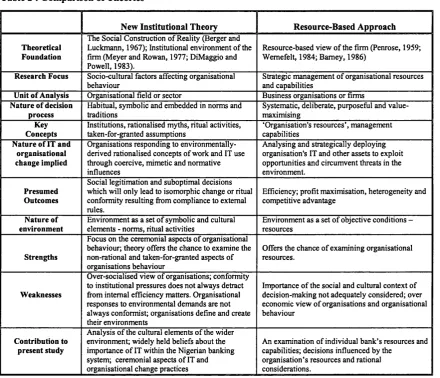
Table 2 : Comparison of Theories... 63
Figure 1: Mintzberg's Strategy Typology... 71
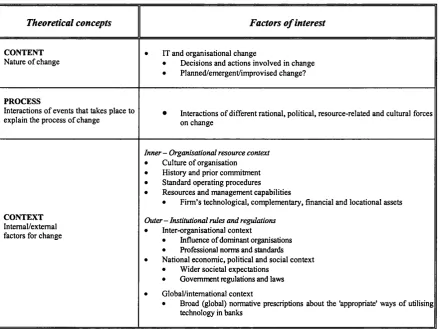
Table 3 : IT and organisational change: a conceptual framework...87
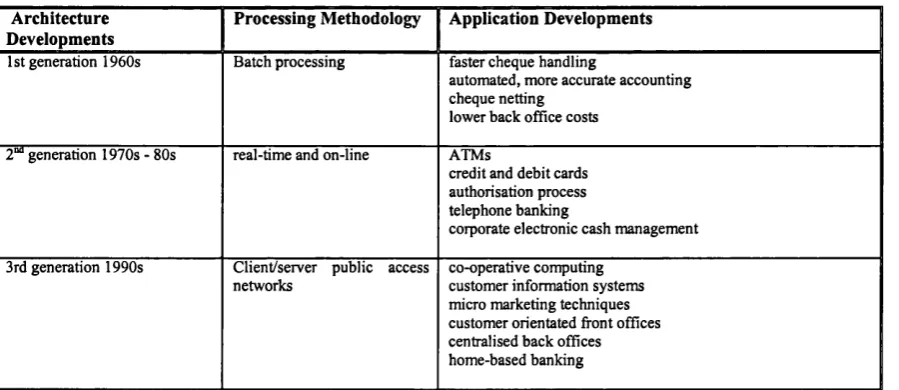
Table 4 : Evolution of banking technology and applications... 96
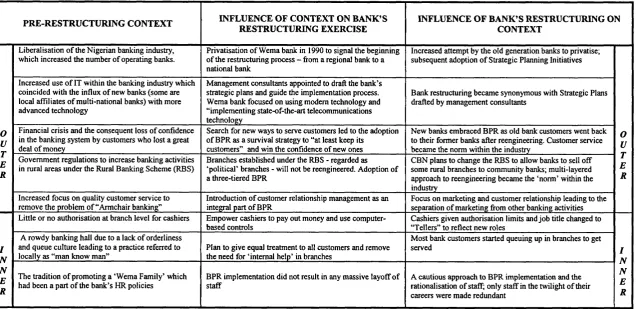
Table 5 : Dynamics of context/process interaction - WEMA Bank Pic... 140
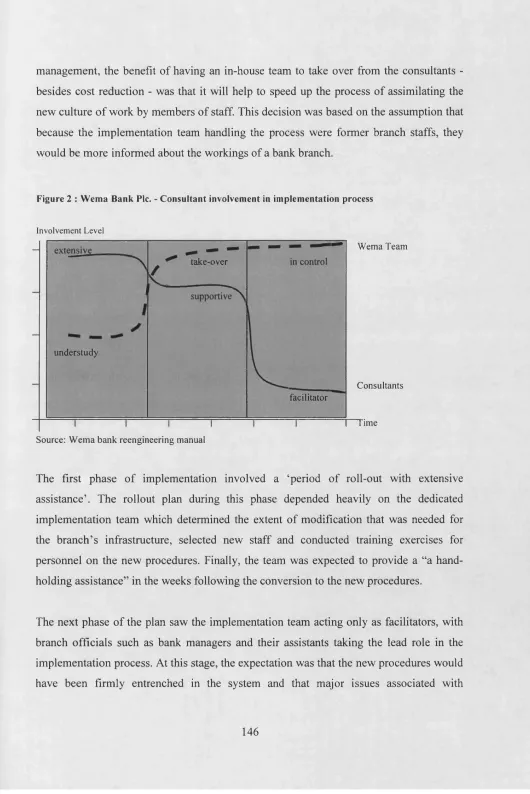
Figure 2 : Wema Bank Pic. - Consultant involvement in implementation process...146
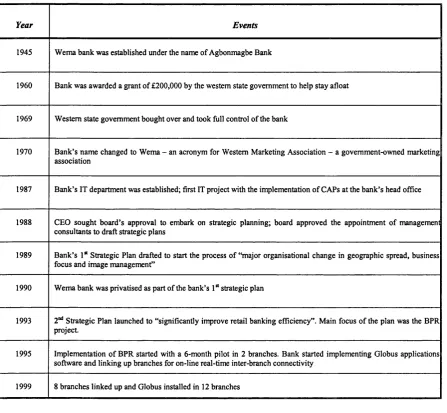
Table 6 : Wema Bank Pic. - Summary of important dates/events...154
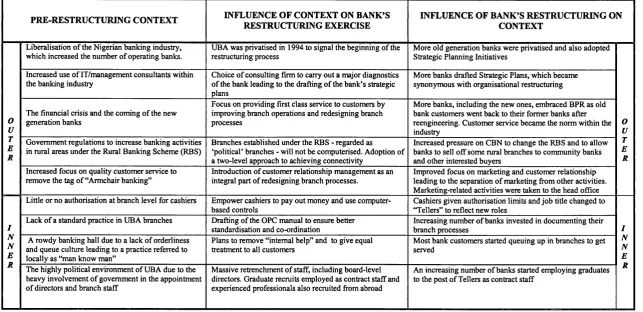
Table 7 : Dynamics of context/process interaction - UBA Pic... 164
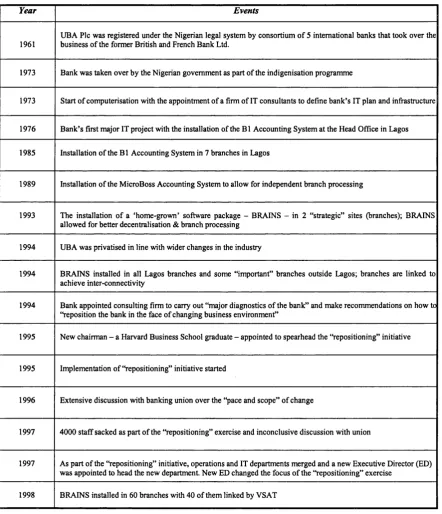
Table 8 : UBA Pic. - Summary of important dates/events...177
Figure 3: Analytical Framework: Context/process interaction...181
Table 9 : Types of adaptations and influential factors - WEMA Bank Pic...194
Acknowledgements
First and foremost, I thank the Almighty Lord for the successful completion of this thesis.
My sincere gratitude goes out to my supervisors Dr. Chrisanthi Avgerou and Dr. Shirin
Madon for being a constant source of inspiration, advice and support. I am also grateful to
Dr. Dade Sadare, Prof. Christine Oliver and Prof. Andrew Van de Ven for their advice and
insightful comments on different aspects of the dissertation and to Dick Hartley for his
critical and valuable comments on previous drafts.
I also wish to acknowledge the banks and other organisations that took part in this research
and devoted considerable time and effort to it. In particular I would like to express my
sincere thanks to the many members of Wema Bank and UBA that participated in the case
studies. Without their kind contributions this research would not have been possible. I would
also like to thank Mr. Wole Oduyemi (Deputy Governor, CBN) whose support at the start of
the fieldwork was extremely invaluable. A special word of thanks goes to Pastor Rotimi
Sogunle and Pastor Ibrahim Abarshi (RCCG) for their efforts in arranging the case studies.
The support I received in the last two years from all my colleagues at the Information and
Communications Department, Manchester Metropolitan University, has been extremely
valuable to the successful completion of this dissertation. Finally, I wish to express my
heartfelt gratitude to my family and friends for their patience, love and unflinching
support throughout this research endeavour. A special thanks goes to Dupe Bada
Chapter 1
Introduction
1.1 Nature of research problem
The theme of this research is the increasing interconnection within the emerging global
economy1 and the implications for developing countries (DCs). According to Castells
(1996), the global economy should lead to greater productivity and efficiency if
organisations invest in a comprehensive programme of both institutional and
organisational change. In recent times, organisations in DCs have been investing quite
extensively in IT and are increasingly adopting management techniques such as Business
Process Re-engineering (BPR) and Total Quality Management (TQM) with a view to
becoming part of the global economy.
In Africa, on the advice of International Financial Institutions (IFIs) such as the World
Bank and the International Monetary Fund (IMF), the majority of countries embarked
upon the task of deregulating and liberalising their economies. In addition, a number of
organisations in different economic sectors have over the past few years been investing
extensively in IT and adopting western management techniques (like BPR and TQM)
with a view to taking part in the globalisation process (Kiggundu, 1992; Saxena, 1996).
Despite these observed trends, there is still a dearth of studies that examine the
experiences of organisations in implementing technologies and associated management
techniques and, in particular, how they are able to accommodate and integrate these
management techniques into their day-to-day operations. Realising the need for such
studies, the International Federation for Information Processing (IFIP) Working Group
9.4, organised a conference towards the end of writing this thesis to examine how
processes of local adaptations are planned and achieved in developing countries and how
local structures mteract with global pressures in contemporary times . This research also
attempts to make a contribution in this respect. The background to the research rests
squarely on three major perspectives: the globalisation discourse, focusing on the global-
local interaction debate; information systems in DCs, especially within the theme of
technology transfer; and planned information technology-based organisational change.
1.1,1 From the perspective o f globalisation
In recent times, the need to study the wider context of IT use in DCs has been recognised
as important due to the effects of the globalisation process. Indeed, the guiding principle
of this research is that the utilisation of IT in any part of the world currently is taking
place within such globalisation trends. A useful definition3 of globalisation given by
Giddens (1990) refers to the concept as ‘the intensification of world-wide social relations
that links distant localities in such a way that local developments become a function of
events occurring many miles away and vice versa’. Similarly, Castells (1996) described the
trend of an increasing interconnection of economic activities and social relations, which he
referred to as a “networked deeply interdependent global economy”. Thus, globalisation
essentially refers to a world in which societies (and culture) have, in one way or another,
come closer together (Kiely, 1998).
It is this coming closer together and its implications that is central to much of the debate
on globalisation. These debates have focused on what happens to local identities within a
globalising world (Hannerz, 1991; Robertson, 1992; Kiely, 1998). Different scenarios
have been painted as to the possible consequences of this interplay between local and
global tendencies. Ranging from the highly deterministic “homogenisation” thesis of the
global institutionalist school (McNeely, 1990) to the interactive ‘mutual influence’
arguments of Robertson (1992), these views posit different implications of the
globalisation trend on local societies.
Within the business literature, Prahalad (1993) sees globalisation as a vigorous
interaction between DCs, the industrialised countries and Multi-National Corporations
(MNCs). For DCs to successfully compete within the global economy, the author
prescribed building a ‘world-scale’ domestic market, developing domestic capabilities
and opening up local markets to foreign competitors (usually MNCs). The view of
increasingly integrated economic activities is further strengthened by Sen’s (1992)
assertion that economic globalisation entails - as a matter of must - that DCs
organisations take the international context or environment into account when taking
decisions in contemporary times. Camoy et al’s view that “national economies now work
as units at the world level in real time” (1993:5) is another similar conceptualisation of an
increased level of integration within the global economy. The authors also agreed that
advances in information and communications technologies have aided such a global
integration.
Baudrillard (1983) takes a rather different view of the globalisation process and argue to the
contrary that the increasing interconnection is based more on the dominance of culture than
on economic factors. The author argued quite strongly that the major impact of the
increasing use of technology in a global world has not led to an informed society but rather
to a state of disintegration (1983:100). Similarly, Waters (1995) stated that economic
motivation is slowly being displaced within the global order by symbolic ones ‘based on
values, preferences and tastes’ (pg. 124).
In discussing the structure of the international system, the institutional school argues that
the organisational forms and practices of nation-states, for example the educational
system, state bureaucracies and, more recently, market enterprise, are the outcome of
world-level directives for 'development’ and 'progress’. These directives are the
rationalised myths which over time become institutionalised in the world system and
which consequently press all countries to adopt common policies, objectives and
While arguing for convergence, the institutionalist school argues that despite the apparent
economic inequalities within the wider system, both rich and poor countries evolve
similar social arrangements and structures. Institutional theorists point to the fact that
poorer countries, despite the disadvantage of being poor still establish massive
government bureaucracies, and educational and military systems similar to those of the
richer nations. As a result, the institutionalist school has focused on convergence not of
functional economic and technical requirements, but on cultural and ideological factors
that exist within the international system. The international system is viewed as an
integrated social system organised around cultural rules that all countries within the
international system subscribe to. It is these cultural rules which press all nations towards
convergence, the institutionalists argue.
Hannerz's (1991) thesis of cultural homogenisation is another such view that examines the
effect of globalisation on local cultures. Hannerz presented a scenario of homogenisation
of the world cultural system, which he called “cultural imperialism”. It involves, in the
author’s views, a 'large-scale transfer of meaning systems and symbolic forms’ along the
dimension of the relationship between the centre and the periphery, with the periphery
being the recipient of culture from the centre. This signifies a discerning note of caution
about the homogenisation - and by extension negative - impact of such globalisation
trends. He went on to state however, that after a certain level of infusion, the periphery
will be able to reshape the culture imbibed from the centre to ‘its own specification’. He
called this the cultural maturation tendency. As global meanings continue to operate
within local settings, some form of ‘mutual influence’ takes place to the extent that the
global culture becomes modified. This process of modification comes about when local
people are able to master the global culture and tinker with them to such extent that a new
form of the global culture, which is an outgrowth of the local culture and which is
responsive to the local culture and needs, arises.
Still within this discussion of global culture is the work of Robertson (1992) who, in
contrast, argues that global culture is not about to be homogenised. For him, the
particularism respectively) is a two-way relationship in which localism is not about to be
lost to a universal process such as globalisation. Instead, what takes place is a kind of
duality of interaction in which the local will be infused with the global and vice versa.
This, he refers to as the interpenetration of the universalisation of particularism and the
particularisation of universalism” (pg. 100). Kiely (1998) also offered a similar
interactive view of the global-local nexus by suggesting that globalisation is best
understood by paying close attention to concrete local events and developments as
opposed to viewing globalisation as a meta-theory.
Other studies have specifically addressed the impact of globalisation on less developed
countries. Focusing on Africa, these studies have analysed the impact of the globalisation
trend and came up with a number of conclusions. Studies from the political-economy
perspective emphasised the declining power of the state as an originator of political actions,
and the increasing role of the international system and international organisations such as the
IMF and the World Bank (Mohan, 1996; Stubbs and Underhill, 1994). Peck and Tickell’s
(1994) description of the 'emerging’ structure as “local responsibility without power and the
supra-national exercise of power without responsibility” best capture this view.
Within the banking industry, the globalisation process is more advanced in wholesale
banking than in the retail sector (O’Brien, 1992:52). Compared to wholesale banking,
retail banking is regarded as more local in nature as it is expected to be much more closer
to customer needs and preferences (O’Brien, 1992; Frazer and Vittas, 1982). Yet, to
completely isolate retail banking from global trends will be misleading. Frazer and Vittas
(1982) identified substantial level of similarities between consumer financial needs and
the ease with which new financial technology can be transferred across many different
countries as reasons why the retail banking sector can be considered global. For Reinicke
(1995), the ease with which foreign banks are now able to penetrate local markets after
deregulation constitutes a major aspect of the globalisation trend within retail banking. In
addition, O’Brien (1992) identified the increasing ownership of local banks by foreigners,
the increasing formation of alliances and mergers between banks of different national
is playing in the area of systems support and the so-called 'back-office’ functions for
banking activities. Here technology is making it easier and cheaper for banks to relocate
these services away from their local base to areas of low cost.
Implicit in these discussions is an increasing integration of activities in the environment
of retail banks. As technology has made it possible for banks to relocate some of their
support services, enter into alliances and increase their presence in foreign territories, the
discussion about the context of retail banks can increasingly be carried out from within
the globalisation discourse. If globalisation entails a unifying of the environment of
banks, then a study of the impact of globalisation on banking institutions in DCs becomes
more important in view of some of the arguments about the possible homogenising effect
such environments portend. According to Aldrich (1979):
“A h om ogen ou s environm ent rewards the d evelopm ent o f standardised w a y s o f relating to the d om ain population, and m a y lead to the d evelopm ent o f an undifferentiated set o f products and se rv ic es” (pg. 66).
Clearly influenced by some of these concerns, studies in IS are beginning to examine
whether the globalisation process portends homogeneity for developing countries’ (DCs)
organisations or whether these organisations can utilise IT and IT-based management
techniques according to the socio-cultural requirements of their contexts (Walsham,
1998). In his contribution to the globalisation debate, Kiely (1998) used the term
‘actually existing globalisation’ to explain the importance of examining globalisation 'as
an agenda for concrete empirical investigation1. The importance of this is that
globalisation is experienced in different ways by different people in different parts of the
world, which therefore means that the local context matters; that global techniques
employed in the ‘west’ cannot be implemented mechanistically in DCs without due
consideration for the local context. Considering the local context may therefore imply
some form of modification or adaptation of ‘western’ technology and techniques when
1.1.2 From the perspective o f information technology (IT) transfer
Information technologies, developed in the industrialised countries of the ‘west’, are said to
have been developed to satisfy the socio-economic needs of that context (Avgerou, 1995).
However, given the increasing interconnection of social and economic activities in
contemporary times, these technologies are rapidly being transferred to DCs. DCs’
organisations, in appreciation of the developmental potentials of the technology, are thus
willing to exploit these potentials to achieve productivity improvement, organisational
effectiveness and business competitiveness (Avgerou, 1995).
IT is increasingly being applied in a number of business sectors in DCs. In Africa, studies
have revealed an increasing investment and adoption of the technology in business sectors
such as banking where, in addition to automating their back office functions, banks are
investing in customer-facing technologies such as ATMs and smart-card technologies
(Dickinson, 1996; Gosling, 1996; Jason, 1998; Woherem, 2000). Other studies include the
application of IT in health institutions in Nigeria and South Africa (Korpela, 1994; Braa and
Hedberg, 2000) and other government offices such as the revenue collection and financial
management information systems in Uganda (Zake, 1995). These various studies examining
the transfer and use of IT in DCs have touched on important organisational, economic,
social, political and cultural factors that influence IT transfer and use in these countries.
The use of IT in DCs has, over the years, been suggested as not living up to the
expectations of their implementation (Madon, 1994; Waema, 1995). These difficulties
have, at various times, been linked with the processes in place for transferring the
technology. For instance, the research by Odedra (1990) identified five channels through
which IT is being transferred to DCs namely: purchase of equipment, education and
training, technical assistance, licensing, and direct foreign investment. The conclusion of
her study was that these channels are not as effective as they should be. She suggested
that a number of technology-related projects fail to achieve any significant positive
impact because of the poor treatment of the local organisational context. She, therefore,
know-how: that technology transfer is incomplete without the knowledge of using the
technology. Other studies have also identified major problems with the transfer and use
of IT in achieving organisational improvements. Such problems include an acute shortage
of skilled and experienced IT professionals (Bhatnagar, 1991; Waema, 1995), weak
telecommunications infrastructure to transfer data and for effective computerisation
(Woherem, 1992) and problems of organisational culture which makes it difficult to
utilise the technology as originally envisaged (Avgerou, 1995).
To effectively use the technology, studies have suggested the transfer of organisational
forms and practices - which can be adapted to suit the local context - to accompany the
transfer of IT (Morgan, 1991; Westney, 1991). These organisational forms or technology
according to Avgerou (1995) can be in two forms. First, the physical technologies that are
supported by organisational technologies such as in the development of database systems
to provide information infrastructure for ‘institution-building’ programmes sponsored by
international development agencies. The other consists of organisational technologies that
are supported by certain physical technologies such as the adoption of management
practices like TQM or business planning, which are usually supported by decision
support systems to facilitate management work engendered by the new organisational
forms.
Similarly, there have been calls for the development of IS models applicable to and based
on research studies conducted in DCs. Kiggundu (1990) looked at the application of
Socio-Technical Systems (STS) in DCs and concluded that its application has been very
limited. He highlighted certain conditions that made it difficult for the method to gain
wide acceptance. Some of these limiting factors are ‘organisational and management
problems, technical and economic realities of countries and the level of discretion
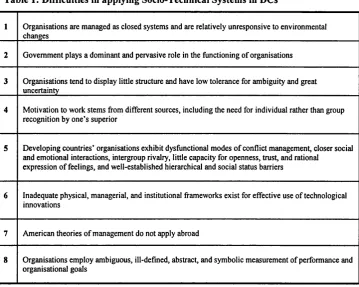
allowed to ordinary users within the organisation’. These problems are outlined in detail
Table 1: Difficulties in applying Socio-Technical Systems in DCs
1 Organisations are managed as closed systems and are relatively unresponsive to environmental changes
2 Government plays a dominant and pervasive role in the functioning o f organisations
3 Organisations tend to display little structure and have low tolerance for ambiguity and great uncertainty
4 Motivation to work stems from different sources, including the need for individual rather than group recognition by one’s superior
5 Developing countries’ organisations exhibit dysfunctional modes o f conflict management, closer social and emotional interactions, intergroup rivalry, little capacity for openness, trust, and rational
expression o f feelings, and well-established hierarchical and social status barriers
6 Inadequate physical, managerial, and institutional frameworks exist for effective use o f technological innovations
7 American theories o f management do not apply abroad
8 Organisations employ ambiguous, ill-defined, abstract, and symbolic measurement of performance and
organisational goals
Source: Kiggundu (1990: 148)
To overcome some of these problems, Kiggundu called for an approach to the adoption
of the STS method that allows for some form of adaptation and modification in different
regions and countries. Rieger et al (1990) discussing the same issue, proposed a cultural
configuration model based on the assumption that internal organisational structures and
processes are conditioned in part by their ambient society’s culture. Similarly, Jaeger
(1990) also hinted at the problem of an uncritical acceptance of western management
theories. The author identified some “value configurations” of DCs and compared them
with western management practices. The conclusion was that these values are very
different from western values and result in behaviours that are different from those which
exist in the west. A similar suggestion was raised by Elmandjra (1992) that, information
technologies are a by-product of the particular socio-cultural environment within which
[image:20.595.44.404.91.378.2]count on the blind and automatic transportation of models” that have emerged in different
environments.
These various suggestions imply the view that solutions and management techniques
developed from the industrialised countries of the ‘west’ cannot be mechanistically
implemented in DCs with the expectation of achieving the same type of results as in the
‘west’. These views and suggestions have, therefore, called for the importance of local
adaptations to western techniques to fit the context of implementation. However, the
precise method of achieving these modifications and the factors that shape local
adaptations are still poorly understood - leaving it a fruitful area for research. In line with
this, the thesis explores the nature of local adaptations to the implementation of IT-
enabled change programmes within the Nigerian banking industry.
In sum, the importance of local adaptations in the use of IT and associated organisational
techniques has been examined from the technology transfer perspective. The western
orientation of IT has meant that most established models of'best IS practices’ are drawn on
research studies from organisations in the advanced industrialised countries of the west.
Questions have been asked about the feasibility of applying such models in other regions
(Avgerou, 1995; Elmandjra, 1992; Ein-Dor, et., al. 1993; Jaeger, 1990; Kiggundu, 1990;
Martisons and Westwood, 1997; Rieger et., al, 1990). Raising such questions imply an
acknowledgement of the narrowness of these models in managing and facilitating
technology-based change and a recognition of differences in environments within which
organisations operate.
1.1.3 From the perspective o f IT and organisational change
The literature on organisation change can be classified into three main categories
(Slappendel, 1996). First are the writings on goal-based change which believe that the
impetus for change arises from factors internal to the organisation (Child, 1972; Kirton,
1980). Second is the adaptation model with its focus on external factors as the reasons why
neither structural properties nor managerial actions as the reasons why organisations’
change. Rather, organisational change is regarded as an emergent process based on the
interaction of both internal and external forces, structural properties and managerial actions.
The goal-based perspective is based on the understanding that individuals are rational in
their actions and are guided by the goals of the organisation - which all members strive
hard to maintain. An approach to organisational change from this perspective is the
planned approach to change. Planned change involves a deliberate, purposeful, and
explicit decision to engage in a program of change (Levy and Murray, 1986). It normally
originates in a decision from management to improve on how the organisation functions,
to create and communicate a vision of the change initiative and to implement necessary
changes (Levy and Murray, 1986; Wilson, 1992; Plant, 1987).
The planned approach to organisational change - because of its emphasis on top
management decision-making - has resulted in a plethora of models aimed to develop and
train managers in a set of competences regarded as necessary for managing change
(Wilson, 1992). These models aim to assist management in understanding and exploiting
opportunities engendered by a change in environment as well as avoiding threats
(Johnson and Scholes, 1989; Teece and Pisano, 1994; Porter, 1980). It has also been
suggested that planned change can be carried out through the changing of the culture of
the organisation as a way of introducing change into the organisation4. Approaches from
this perspective are based on the assumption that people's actions are a function of their
values and cognition (Wilson and Rosenfeld, 1990; Wilson, 1992).
In addition to changing people's behaviour, a planned approach to change also focuses on
changing the organisational paradigm. An organisation's paradigm is defined as the
unquestioned assumptions through which all actions and procedures within the
organisation get meaning (Ranson et. al, 1980; Sheldon, 1980). At a broad conceptual
4 This is based on the assumption that the culture o f an organisation is an instrument that can be managed and manipulated by management. Culture is but one o f many variables (others being size, structure, technology) which can be acted upon or controlled for organisational effectiveness (Allaire and Firsirotu, 1984; Smircich,
level, it is the unquestioned assumption about why the organisation operate and at a more
concrete level it defines what is acceptable behaviour or the best way to approach a
particular situation.
However, some argue that structures and people are not so readily amenable to change.
According to Oliver (1997a) many activities within organisations are so strongly upheld
by the organisation's prevailing culture that decision-makers no longer even question
their appropriateness. These activities are usually upheld because their longevity is
considered sufficient evidence of their usefulness. The reasons adduced for such
institutional inertia are that the cost of making changes may be regarded as greater than
the perceived benefits or it may be that appropriate alternatives cannot be conceived of or
that such alternatives are regarded as unrealistic (DiMaggio and Powell, 1991).
The planned approach to change has generally been criticised as ignoring - to a large
extent -the social, political and economic context in which organisations operate. It has
also been criticised because of its over-insistence on managerial control and authority in
achieving a successful organisational change programme. The failure of the goal-based
approach to consider organisational structures such as roles and positions as being able to
influence and interact with some of the personal qualities of an individual led to a focus
on structural characteristics of the decision-maker and of the organisation. Because a
person occupies a particular role in an organisation, there are expectations which go with
the role and the fact that such a person is expected to conform to the demands of the role
means that individuals are not entirely free and independent. Therefore, behaviour such
as decision-making is - to a large extent - socially mediated (Baldridge and Burnham,
1975).
It is this focus on structural or contextual characteristics which informs the work of the
adaptation school (Goodman, 1982). Unlike the goal-based school, this model views
change as determined mainly by the structural characteristics of the organisation that is
complexity, and centralisation of authority and on environmental components like
customers, suppliers, other organisations and government institutions as the main
determinants of change. In so doing, this perspective shares the objective and overtly
simplistic view of change of the goal-based school. However, its main strength lies in its
consideration of the environment within which the organisation operates.
The view of customers as a source of change is based on the idea that they are a source of
ideas and that they also generate demand which the organisation will aim to satisfy
(Marquis, 1982; Von Hippel, 1988). This is however dependent on the level of
sophistication of customers - which differs across industries and between countries
(Crocombe et al. 1991). The role of institutions and government institutions in promoting
change in organisations has also been widely documented (see for instance King et al.
1994). Other structural characteristics that have been touched upon in the literature are
the size of an organisation where it is believed that large organisations, because of the
large amount of resources at their disposal, are more disposed to change compared to
smaller organisations (Fennell, 1984).
Unlike the two previous perspectives, the interactive process model conceptualises
change as being the product of the interaction of structural influences or factors and the
actions of organisational decision-makers. Change here emerges from the interaction of
the two sets of forces, neither of which is solely responsible for change. It conceptualises
the change process as a complex process of interaction which can best be understood
through a holistic approach that considers the ‘complex and paradoxical relationship
between action and structure’ (Slappendel, 1996).
A number of studies have been carried out from this perspective and have come up with
different explanations of the process of change. Walton (1987) carried out one such study
on the international shipping industry. The study concluded that an industry’s capacity
for change is influenced by the interaction between external forces such as environmental
trends and other components such as the vision, the need, the social context as well as the
the comparative study of innovations in four major organisations by Starkey and
McKinlay (1988) and Pettigrew’s studies of strategic change in ICI and the UK National
Health Service (Pettigrew, 1985; 1992). The interactive model avoids a unidirectional
view of change and the causes of change because change is regarded as a function of the
interaction of forces. This therefore helps in capturing the full complexity of
organisational change by rejecting the rational model of change and embracing the more
subjective and non-rational aspects of organisational life.
Similarly in information systems (IS), IT and organisational change models have evolved
from early teleological models to more subjective and dynamic models which consider IS
as social systems (Land, 1987). IS as social systems implies a shift in focus from looking
at issues of how computers function as hardware and software to an acknowledgement of
the organisation that accommodates such technical systems. This has led in the main to the
study of how organisations are structured, concerns about the people within the
organisations who use the technologies, and how these organisations operate.
The increasing emphasis on the organisational context of IS has been accompanied by a
change in focus from the use of computers within a specific organisation to a much
broader perspective analysing inter-organisational factors that influence IT use (Reekers
and Smithson, 1996) and more recently to a focus on national and international factors
that influence the use of IT in organisations (Barrett et al., 1997; Harindranath, 1997;
Walsham, 1998). The literature on IT and organisational change will be considered in
more details in chapter 3. These developments reflect an increased understanding of the
diverse factors that influence the use of IT and the appropriate approach required to
studying them. One such approach that is increasingly being adopted is the contextualist
approach.
A contextualist approach to the study of IT and organisational change focuses on the
interaction of the multi-level structures and systems within which IT is embedded and the
process of change that takes place over time (Walsham, 1993). However, the
and a conceptual model for linking the external context and the inner organisational
context (Pettigrew, 1992). One of the aims of this thesis therefore is to attempt the
development of such a conceptual framework for the study of technology-based change
in Nigerian banks. In the thesis, concepts and ideas from institutional theory and the
resource-based approach are combined within a contextualist perspective to study
planned technology-based change within the Nigerian banking industry. Such a
combination provides the theoretical underpinning missing in Pettigrew’s model and it
allows for an examination of both rational and symbolic pressures that influence the
process of implementing technology-based organisational change initiatives at various
contextual levels. A rational view of organisational functioning assumes that
organisational behaviour is deliberate, and systematic while a symbolic view believes that
organisational behaviour is compliant, habitual, unreflective and socially justified
(Oliver, 1997). The interesting question from this perspective is how do broadly-based
social norms and pressures in the inter-organisational arena interact with intra-
organisational resources to influence the implementation of IT-related organisational
change within the Nigerian banking system? An attempt will be made to provide answers
to this question in much of our discussion in Chapter 6.
The importance of adopting these views in this study lies in the somewhat different
conceptions of the interaction between organisations and the environment that the two
theories hold - highlighting the rational on one hand and the symbolic on the other.
Although each theory elaborates on important aspects of the interaction, neither captures
on its own the full complexity of issues involved in IT use in organisations. A combined
model that focuses on both the rational and symbolic factors that influence organisational
change seems to potentially aid our understanding better. The resource-based view will
be used to examine rational factors that influence IT and organisational change and the
institutional theory will be used to examine the more social and in particular symbolic
elements involved in the use of IT and associated organisational changes.
A good theory of change, it has been suggested, must be able to explain
(Pettigrew, 1987; Van de Ven et., al, 1988; Walsham, 1993). Approaching organisational
change from an institutional perspective combines both political5 and cultural6 elements
of the change process and is thus useful in explaining continuity and change. Indeed,
Zucker (1986) asserts that ‘once institutions are established they may persist, even though
they are collectively sub-optimal’. This points in the direction of explaining continuity.
1.1,4 Setting the scene: The Nigerian Banking Industry
In Nigeria, change programmes manifest themselves across the economy and society as part
of a general package of reform known as the Structural Adjustment Programme (SAP). SAP
in a general sense is a comprehensive programme of reform aimed at restructuring the
economy by introducing changes in the country’s public and private organisations. It
involves amongst others, a reduction in government spending to reduce public deficit;
devaluation of currencies and the privatisation/commercialisation of nationalised industries.
It also involves the opening of exchange rate dealings - hitherto controlled by the
government - to 'market forces’; and the lifting of trade restrictions (EIU, 1993; Logan and
5 The political perspective provides a view o f organisations as consisting o f more than one super-ordinate goal; organisations are coalitions o f people with divergent interests some o f which may be in harmony or could be opposing (Eisenhardt and Zbaracki, 1992). While the political perspective agrees that people are individually rational; collectively they are less so. Divergences in interest could be as a result o f different expectations o f the future, differences emanating from occupying different positions within the organisation and differences in individual ambitions and interests. It is argued that some o f these differences may be resolved through the use o f political tactics such as coalition formation, co-optation, withholding or exploiting information and employing the use o f outside expertise such as consultants (Eisenhardt & Zbaracki, 1992). The importance o f politics to organisational actions are divided between those who view politics as essential and effective to organisational functioning (Quinn, 1980; Pfeffer, 1992) and those that argue that politics is detrimental to the organisation (Gandz & Murray, 1980).
6 An important component o f the institutional argument is culture. Indeed, the reference to shared systems o f rules and symbolic interactions is heavily laden with cultural ideas. The root o f culture as a concept has been largely traced back to the field o f anthropology where, at various times, culture has been
synonymously used with other concepts such as customs, norms, beliefs or belief system, rituals and ceremonies (Allaire and Firsirotu, 1984; Meek, 1988; Sackmann, 1992). In an attempt to narrow down this complexity, the study o f culture and organisational change has been broadly classified into two main schools: studies focusing on managing culture for change and those on the evolution o f cultures in
Mengisteab, 1993; Olukoshi and Nwokwe, 1994). Just as in most of Africa, this programme
was supported by a loan agreement from the International Monetary Fund (IMF)7. The effect
of SAP on the Nigerian banking sector was in liberalising the process of setting up new
banks. This was considered essential for promoting ‘competition, innovation and efficiency’
(Ebhodaghe, 1991).
Three major events mark out the Nigerian banking industry as an interesting case. Since
government liberalised the industry in September 1986, there has been an explosion in the
number of licensed banks, which increased dramatically from 29 commercial banks and 12
merchant banks in 1986 to a peak of 66 commercial banks and 51 merchant banks by 1995.
Secondly, the increase in the number of banking institutions did not produce the much-
expected financial deepening and economic upturn (Utomi, 1996; Lewis and Stein, 1997).
Instead, by the mid-1990s the industry experienced a major financial and credibility crisis in
which a large number of banks were closed down by the government. The number of banks
closed down rose from 8 in 1989 to 51 by the end of 1995. Recently, in January 1998
government closed down 26 additional banks comprising 13 commercial banks and 13
merchant banks.
The third event is the proliferation of banking technology within the industry. Nigerian
banks now spend an increasing amount of resources on IT in order to improve their services.
In a 1998 survey of banking institutions in Nigeria, Woherem (2000) found that the average
annual IT budget of banks increased from 126 million Naira8 in 1997 to 265 million Naira in
1998. A number of IT-based banking products such as smart cards, home and Internet
banking are being introduced into the sector. Banks are also increasingly automating their
processing systems with a view to providing faster and better quality service to customers.
In order to raise awareness, an increasing number of seminars and workshops are being
organised by bankers and IT vendors. To cater for the increasing appetite of the industry for
technology, quite a large number of IT vendors and software houses have developed in
addition to the ones that have already been in the country.
7 In a study by Mohan (1996) it was revealed that 38 out o f the 43 countries (or 88%) which have introduced the programme had entered into an agreement with the IMF as part o f their SAPs.
The history of computerisation efforts within the banking industry in some industrialised
countries (i.e. U.S.A.) showed that larger banks were the prime movers of designing and
implementing new technological solutions because they could more easily afford the
substantial cost involved (Arthur Andersen, 1986). However in Nigeria, the big banks are
only just joining in response to the threats posed by the new banks that came in after
liberalisation. The sheer number of branches had been a burden on them given the
logistics of computerising such a huge network of branches. In addition to investing
directly in IT, these (old) banks with the aid of consultants are introducing IT-related change
programmes such as BPR.
There is also an increase in the level of activities of large multi-national enterprises some
of them IT/management consultants who advise local banks on how to become global
players (Price and Johri, 1992). In Nigeria, a number of wholly owned foreign banks and
others jointly owned, are now operating within the banking system. In addition, a number
of multi-national IT/Management consultants are working with banks to introduce
strategic plans and major restructuring programmes in the wake of the liberalisation and
the increasing level of competition. Despite these increased activities within the Nigerian
banking industry, the precise nature of changes taking place within the industry and the
factors driving these changes have not been studied. Most studies have only focused on
conducting cross-sectional examination of factors that influence IT adoption (Ogbechie,
1997; Woherem, 2000), without a detailed study of the nature of associated
organisational changes that have taken place within the industry. Therefore, the Nigerian
banking sector can indeed be considered an appropriate setting for a study which aims to
examine the interplay of global trends and local situations. A more detailed discussion of
the developments within the Nigerian banking system is undertaken in chapter 4.
1.2 Purpose of the research
In the face of major environmental changes such as deregulation and liberalisation,
techniques to suit the context of their implementation. However, few of these studies
have actually focused on revealing the nature of these adaptations and the factors
influencing such adaptations. The overall aim of this study, therefore, is to increase
understanding of why and how do these adaptations take place, and what results are
achieved. This is pursued by examining the implementation of IT and planned
organisational change initiatives in two Nigerian banks. These banks are two of the three
oldest surviving banks within the industry and in the aftermath of the liberalisation of the
banking industry embarked on major programmes of restructuring. Focusing on such
banks with a long history of operation will provide a rich social and historical context for
analysing the change initiatives and factors influencing their implementation.
1.3 Research question
The broad research question to which this study is directed is as follows:
How are global technology-based organisational change practices adapted within the local
context of Nigerian banks?
In order to answer these questions, the following issues of interest have been identified for
analysis:
■ Identification of wider practices in IT and organisational change in banking both from
an international (global) perspective and within the Nigerian context.
■ A systematic exploration of the process of implementing IT and organisational change
programmes focusing on the adaptations that takes place during implementation.
■ An explanation of the nature of local adaptations to global change programmes.
1.4 Contributions of the research
The research makes three major contributions.
The field of IT in DCs in recent years has attracted an increasing amount of attention.
More recently, there are increasing concerns about the impact of the liberalisation and
globalisation trends on DCs and consequently organisations in DCs are increasingly
investing in IT and management techniques developed in the ‘west’ and adapting them to
study as to how these various developments are taking place and the factors influencing
them (Sahay and Walsham, 1995). How local adaptations are planned and achieved are
still not properly understood. This study will therefore contribute to the body of studies
interested in explaining the nature of local adaptations to global practices. This kind of
study can act as a pool of knowledge which change agents can tap into and learn from.
Secondly, by combining both institutional theory and the resource-based model, this
study aims to contribute to the growing body of knowledge that combines both rational
and symbolic views to explaining organisational phenomena (Oliver, 1997; Dacin, 1997).
Although in IS, much has been made of the interactive model of IT and organisational
change, studies that combine two seemingly contrasting views such as the resource based
view and the institutional theory are not common. This thesis offers a contribution in this
direction by adopting a paradoxical stance to study the interaction between the
organisation’s resource context and established rules and procedures within the
institutional context and how this in turn influence and is influenced by the change
process.
Thirdly, by making explicit the influence of an organisation’s resource context and its
wider institutional settings on the adaptation process, a third contribution of this study is
to make some tentative suggestions for change agents in DCs attempting to implement
change programmes developed in different contexts.
1.5 Research methodology
Moving on from a discussion of the nature of the research problem, we now consider the
research methodology. In previous sections we concluded that a rational and linear
approach was not sufficient to study organisational change and that a processual, non
linear and interactive approach which considers 'changing' as opposed to 'change' was
more suitable. Such an approach would consider the multi-level contextual factors,
operation, the various ideas and concepts highlighted from the previous section. Finally,
to study IT and organisational change within the Nigerian banking sector would require
an approach that gives a rich description of the developments as well as an interpretative
approach which gives due cognisance to the meaning which people attach to their
everyday situations.
1.5.1 An interpretive research approach
It has been suggested within the IS field that researchers should make explicit the
philosophical assumptions underpinning their research (Orlikowski and Baroudi, 1991;
Walsham, 1995). Within the IS field, research strategies have traditionally been divided
into two camps: the positivist approach and the interpretive approach. The positivist
approach has been the dominant one within the IS field (Orlikowski and Baroudi, 1991)
and it relies on the use of numbers. Such data are used deductively to explain and predict
organisational phenomena and to provide generalisations about organisations. Positivist
approaches assume that the relationship between social reality and humans is
independent, objective and has a cause and effect relationship. This approach has
however been criticised in the IS literature for its treatment of organisational reality
which is regarded as complex and not easily amenable to statistical deductions (Galliers,
1992). A more holistic and interpretive approach which captures the full reality of
organisational behaviour in "its settings" has therefore being proposed and is increasing
being employed in IS research (Walsham, 1993).
The epistemological stance for interpretive approaches is that knowledge is a social
construction with the possibility of more than one interpretation to any particular
phenomena (Walsham, 1993). Interpretive research aims at understanding the
‘intersubjective meanings embedded in social life’ (Gibbons, 1987). Therefore, valid
knowledge is gained through an understanding of these interpretations and meanings that
people ascribe to their actions. Interpretive approaches believe that to theorise about any
particular social phenomena would involve an understanding of that phenomena, which
can only be achieved by ‘getting inside’ of the phenomena; hence the rejection of an
Within the IS discipline, a number of interpretive approaches have been employed in IS
research such as phenomenology (Boland, 1985), Soft Systems methodology (Checkland,
1981), and ethnography (Bentley et. al., 1992; Harvey and Myers, 1995). These studies
have focused on achieving a deep understanding of the social and organisational context
in which IS are being implemented and the mutual interaction between these systems and
their contexts.
Markus and Robey (1988) suggested such an interactive approach when discussing the three
dimensions of causal structure used in explaining IT-related change. The first is a
technological imperative where IT is seen as an external agent and the dominant force for
change. Within this perspective human choice and action is constrained by the force of the
technology. Next is an organisational imperative where humans have unlimited power and
choice over technological options and the outcome of IT use. The choice and use of
information technology depends on the information needs of the organisation and how
decision-makers within the organisation go about satisfying these needs. This perspective
however could be criticised for its neglect of environmental conditions which could
constraint or preclude the making of such choices. Finally, they considered and argued for
the interactive perspective, which posits that the way we use IT, and with what outcomes is
a function of both human choice and contextual characteristics.
Given the nature of IT and organisational change discussed in previous sections and our
embrace of an interactive model, we believe a research approach which aims to interpret
and analyse - from the participants viewpoint - the social context of IT use in Nigerian
banks is appropriate in this study. This becomes important given the research goal of
understanding the nature of local adaptations in the implementation of technology-based
organisational change initiatives in individual banks. Such adaptations, research has
shown, are a function of the different meanings which organisational participants
ascribed to their experiences of technology implementation (Orlikowski, 1996) and
technology in different organisations (Barley, 1986). Therefore in this research we will
employ an interpretive stance and use the case study as the research strategy.
The interpretive approach has been criticised as lacking rigour, precision and credibility
compared to the positivist approach because it is more open to distortion as a result of the
values or purpose of the researcher (Galliers, 1992; Hussey and Hussey, 1997). Also from
the viewpoint of the researched, criticism made of interpretive approach is that
individuals are not always in a position to give a full account of their actions or intentions
and that, more often, all they can offer are anecdotes of what they did and the reasons for
their actions (Giddens, 1984).
1.5,2 The case study strategy
According to Walsham (1993), case studies are perhaps the most appropriate strategy for
conducting empirical research from an interpretive stance. Case studies are defined as an
empirical enquiry that investigates a contemporary issue or event within its real-life
context, especially where the boundary between such issues or event and its context is not
clearly defined (Yin, 1994). Therefore the case study approach is especially useful in
such situations where the contextual conditions of the events being studied are critical
and where the researcher has no control over the events as they unfold. The case study
strategy has been argued to be particularly useful for practice-based problems where the
experiences of the actors are important and the context of action is critical (Galliers,
1992; Lee, 1989).
This is so because the case study approach allows for a ‘thick description’ of the
phenomena under study (Yin, 1994). Such ‘thick descriptions’ gives the researcher access
to the subtleties of changing and multiple interpretations (Walsham, 1995) which would
have been lost in qu