
© 2018, IRJET | Impact Factor value: 6.171 | ISO 9001:2008 Certified Journal | Page 684
Message Hiding Using Steganography and Cryptography
Rohit Kumar Yadav
1, Madan Kushwaha
21M-Tech Student Department of Computer Science and Engineering BIET Lucknow, India 2Assistante Professor Department of Computer Science and Engineering BIET Lucknow, India0
---***---Abstract -
When two entities are communicating with eachother and do not want a third one to listen in. For that they need to Use Cryptography and Steganography to secure their message. By Message hiding using steganography and cryptography Method people can share information with varying degrees of certainty that third parties cannot intercept what was written.
Cryptography and Steganography are two different and popular methods of secret writing. Where Cryptography converts the message in unreadable form and the other Steganography is the art of hiding secret or sensitive information into digital media like images, audio and videos.
Secure Communication Systems used in communication solutions for the military, government, aviation, industrial, and commercial markets
This paper we present and discuss LSB (Least Significant Bit) based image steganography and AES encryption algorithm so as to provide an extra security of data.
Key Words: Message Hiding, Steganography, Cryptography,
Encryption, Decryption, LSB, AES, DES, etc…
1. INTRODUCTION
Steganography is the art and science of hiding secret or sensitive information into digital media like images, audio, videos so as to have secure communication. In steganography we hide our secret information in some cover image such that one cannot track the message. The original Image is called cover image and the image in which message is embedded is called Stego Image. Steganography can also be done with Text, video, audio and protocol steganography.
There is a difference between cryptography and steganography. Cryptography helps us to keep message content in secret form while steganography helps to keep the existence of the message as a secret. If cryptography is forbidden to use then in that case steganography is very useful.
Today there are many applications of steganography. It is used in defence organizations so that data can be safely circulated. it is used in smart identity cards where the information of the person is secretly stored in the image of the person itself. Some other applications are medical imaging, online voting system Etc.
1.1 Types of Steganography:
We can hide our secret information in different media like Text, Image Audio and Videos Etc.
1.2 Steganography Process:
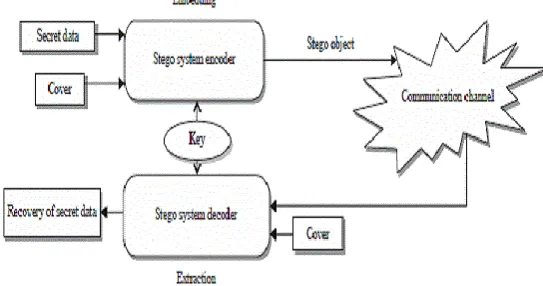
COVER: This is an object used to hold the secret information.
SECRET Data: This is the secret Message which is to be embedded with the cover Image.
STEGO Object: Stego Object is output of embedding process it holds the Secret Message.
[image:1.595.310.582.455.598.2]Key: Key is used in embedding and extracting process.
Fig.1: Steganography Process.
2. LITERATURE REVIEW
© 2018, IRJET | Impact Factor value: 6.171 | ISO 9001:2008 Certified Journal | Page 685 Security of data has become foremost concern now.
Satwinder and Varinder Kaur proposes Dual Security model for hiding Sensitive information with the help of LSB based
steganography and AES encryption Technique. The proposed modelisto hide the sensitive information behind some cover image using LSB based Steganography and then encrypt the image using AES algorithm[7].
Kanika Anand and Er. Rekha Sharma compares the LSB and MSB based steganography with one another according to the MSE (Mean square error) and PSNR (Peak signal to noise ratio) values. LSB works by replacing the least significant bit of the pixel value of the cover image (in most of the cases 8th bit is replaced). In MSB most significant bit of the pixel value is changed in the cover image. Techniques are discussed in detail in this paper. In this paper the results show that LSB Based Steganography is better than MSB based steganography on the basis of MSE and PSNR values [5].
Mr . Vikas Tyagi, Mr. Atul kumar discusses the LSB based steganography and a new encryption algorithm. The proposed model is to first convert the data into encrypted form using the proposed encryption algorithm and then patch the data in the cover image using LSB based Steganography. Steganography can also be done with Text, video, audio and protocol steganography [6].
Douglas selent discusses the detailed concept of AES in this paper. AES is a standard used for encryption of data. AES is a symmetric-key algorithm which means that same key is used for both decryption and encryption of data. AES is block cipher which uses block sizes of 128, 168, 192, 224 and 256 bits. The paper also discusses about announcing of AES and some drawbacks of triple DES (3DES) and DES. AES uses Exclusive –OR operation and substitution and permutation operations, rows and column shifting [1].
Today cryptography plays an important role in security of the information systems. Ritu pahal in this paper efficiently implements AES. AES is implemented for 200 bit using 5*5 state matrix and AES 128 bit is also implemented for 200 bit using 5*5 state matrix .The proposed work is then compared with the 128 ,192, 256 bit AES. Only the mix column transformation is changed in this process. The results show that the proposed algorithm is 50% slower from AES-128, 40% from AES-192, and 25% from AES-256 [4].
3. LSB BASED STEGANOGRAPHY
The LSB is the least significant bit in the pixel value of the image. It works by replacing the least significant bit of some randomly selected pixels in the cover image.
To increase the security of messages sent over internet steganography is used. Various steganography techniques have been proposed so far. Least Significant Bit steganography is one such technique in which least significant bit of pixels of the image is replaced with data bits. This approach has the advantage that it is simplest one
to understand, easy to implement and results in stego-images that contain embedded data as hidden. The disadvantage of Least Significant Bit is that it is vulnerable to steganalysis and is not secure at all. So as to make it more secure, the least significant bit algorithm is modified to work in different way. This proposed approach simply does not pick up least significant bits of pixel in a sequence but is combined with midpoint circle approach to choose which pixels are used to hide message. The goals of this paper are to present theoretic analysis of Least Significant Bit approach and to propose an advanced LSB embedding scheme that exhibits not only the advantages of LSB but also provides additional level of security. The scheme breaks the regular pattern of LSB, resulting in increased difficulty of steganalysis and thereby raising the security level.
LSB works by replacing the least significant bit of the Pixel value of the cover image (in most of the cases 8th bit is Replaced().
Example: Consider a 3- pixel grid in a 24- bit image: 00110011 01100011 01101111
01101110 01101100 00110100 01101101 01100101 01101011
Suppose we want to hide a character ‘y’ in the image. The ASCII code of ‘y’ is 121 whose binary value is 01111001. Now pixels after embedding the message in the image are as shown [3]:
00110010 01100011 01101111 01101111 01101101 00110100 01101100 01100101 01101011
8 bits were to be embedded in the image however only 4 bits were changed. Thus on an average only half of the bits are changed in the embedding process. In LSB process we use BMP (bitmap) images because they are lossless compression images. In lossless compression size of file is reduced but it does not affect the quality of file. The original data in the file is restored when the file is uncompressed.
The pseudo code for LSB is given by:
Embedding the text inside the image:
1. Calculate the Pixels of the image. 2. Make a loop through the pixels.
3. In each pass get the red, green and blue value of pixels. 4. Make the LSB of each RGB pixel to zero.
5. Get the character to be hidden in binary form and hide the 8-bit binary code in the lsb of pixels.
© 2018, IRJET | Impact Factor value: 6.171 | ISO 9001:2008 Certified Journal | Page 686
Extracting the embed message from the image:
1. Calculate the pixels of the image.
2. Loop through the pixels of the Image until one find the 8 consecutive zero.
3. Pick LSB from each pixel element and then convert it into the character.
In LSB when we flip the value of the LSB the value is only affected by 1.
3.1 Comparison with MSB (Most significant Bit) In MSB most significant bit of the pixel value is changed in the cover image. Thus the change In MSB is 1*27 i.e. the value is affected by 128 which is a significant effect on the image.
4. CRYPTOGRAPHY:
Cryptography involves creating written or generated codes that allow information to be kept secret. Cryptography converts data into a format that is unreadable for an unauthorized user, allowing it to be transmitted without unauthorized entities decoding it back into a readable format, thus compromising the data.
Cryptography is also known as cryptology. Cryptography is a technique to provide message confidentiality.
• The term cryptography is a Greek word which means "secret writing".
• It is an art and science of transforming messages so as to make them secure and immune to attacks.
• Cryptography involves the process of encryption and decryption. This process is depicted.
4.1 Cryptography Terminology
The terminology used in cryptography is given below:
Plaintext. The original message or data that is fed into the algorithm as input is called plaintext.
Encryption algorithm. The encryption algorithm is the algorithm that performs various substitutions and transformations on the plaintext. Encryption is the process of changing plaintext into cipher text.
Ciphertext. Ciphertext is the encrypted form the message. It is the scrambled message produced as output. It depends upon the plaintext and the key.
Decryption algorithm. The process of changing Ciphertext into plain text is known as decryption. Decryption algorithm is essentially the encryption algorithm run in reverse. It takes the Ciphertext and the key and produces the original plaintext.
Key. It also acts as input to the encryption algorithm. The exact substitutions and
transformations performed by the algorithm depend on the key. Thus a key is a number or a set of number that the algorithm uses to perform encryption and decryption.
4.2 Cryptography Ciphers
Cryptography ciphers are two types…
Block cipher:
A block cipher is an encryption algorithm that encrypts a fixed size of n-bits of data - known as a block - at one time. The usual sizes of each block are 64 bits, 128 bits, and 256 bits. So for example, a 64-bit block cipher will take in 64 bits of plaintext and encrypt it into 64 bits of ciphertext. In cases where bits of plaintext are shorter than the block size, padding schemes are called into play. Majority of the symmetric ciphers used today are actually block ciphers. DES, Triple DES, AES, IDEA, and Blowfish are some of the commonly used encryption algorithms that fall under this group. Popular block ciphers are DES, 3DES, AES, Blowfish, Twofish.
Stream cipher:
A stream cipher is an encryption algorithm that encrypts 1 bit or byte of plaintext at a time. It uses an infinite stream of pseudorandom bits as the key. For a stream cipher implementation to remain secure its pseudorandom generator should be unpredictable and the key should never be reused. Stream ciphers are designed to approximate an idealized cipher, known as the One-Time Pad. if you have 500 MegaByte video file that you would like to encrypt, you would need a key that's at least 4 Gigabits long. Popular stream ciphers are Rivest Cipher 4 or RC4, WEP, WPA
4.3 Types of Cryptography:
Cryptography can be divided into two types…
Symmetric-key Cryptography:
© 2018, IRJET | Impact Factor value: 6.171 | ISO 9001:2008 Certified Journal | Page 687
Public-Key Cryptography:
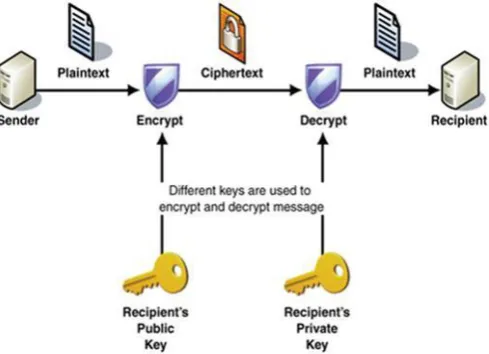
This is the most revolutionary concept in the last 300-400 years. In Public-Key Cryptography two related keys (public and private key) are used. Public key may be freely distributed, while its paired private key, remains a secret. The public key is used for encryption and for decryption private key is used.
4.4 Advanced Encryption Stander AES was introduced to replace DES in commercial applications. Advanced Encryption Standard was announced by National Institute of Standards and Technology (NIST) on November 26, 2001. AES is a symmetric-key algorithm which means that same key is used for both decryption and encryption of data.
AES is also called RIJNDAEL which was named after the name of its inventors John Daemen and Vincent Rijmen. AES is block cipher which uses block sizes of 128, 168, 192, 224 and 256 bits [1]. The key sizes used in AES are 128,192 and 256 bits. There are some differences between AES and DES. DES uses a feistel structure in which the block is divided into two halves before it goes through the steps of encryption whereas in DES , each round consist of a series of functions which are byte substitution, permutation, arithmetic operator over a finite field and X-OR operation with key. AES is faster than 3DES and DES. The basic structure of AES is shown below [7].
Fig 2: [7] Basic Structure of 128 bit AES algorithm
Unlike DES the number of rounds in AES depends on the length of the Key used and thus the number of rounds are variable. 10 rounds are used for 128 bit key, 12 rounds for 192 bit key and 14 rounds for 256 bit key are used. Each of the rounds uses a different 128 bit key which is calculated from the original key.
Fig 3: Relationship between No. of Rounds (R) and Cipher Key Size
Encryption Process
First of all, we take our data and copy the data into the 4x4 Matrix. This is called state matrix. In the initial round each byte of the state matrix is X-OR with each byte of the corresponding key for first round. Each round comprise of four sub processes:-
SubByte( ) – We put each byte into a S-Box (Substitution box) which maps the byte into a different byte. The result is a output matrix with four columns and four rows.
[image:4.595.39.284.181.358.2]© 2018, IRJET | Impact Factor value: 6.171 | ISO 9001:2008 Certified Journal | Page 688
Fig 4: [8] Substitution round in AES.
ShiftRows( ) – In this step we shift the rows to the left.
First row is not shifted. Second, third and fourth row are shifted by one byte, two byte and three byte respectively. Rows are wrapped to the other side [4].
Fig 5: [8] Shift Rows round in AES
MixColumns() - Each column of 4 bytes is transformed using the special mathematical function. The input to the function is the four bytes of one column and output is the four new bytes which replaces the four input bytes [4].
Fig 6: [8] Column Mixing Round in AES.
AddRoundkey(): At the end of each round, the next round key is applied with an X-OR. In the final round we skip the Mix columns step since it slows down the process.
The process of decryption is the inverse of encryption process.
Today AES is used because DES was inherently weak.56- bit key is used in DES which means there are 256 combinations which is easy to crack in case of Brute Force attack. Alternatives to DES like TripleDES (3DES) are available but 3DES is very slow.
Table1. Comparison between AES and DES
PARAMETERS AES DES
Developed in
Year 2000 1977
Cipher Type Symmetric Block
Cipher Symmetric Block Cipher Key Length 128,192,256 bit
key 56 bit key
Possible keys
combination 2128,2192,2256 256 Block size 128,192 or 256
bit key 64 bit
Security Secure Not Secure,
inadequate
5. FUTURE WORK
The proposed work in this paper uses a LSB based steganography Technique called image steganography. The data is embedded into the stego image. The main purpose of the project is to provide security or hiding secret message into cover media. The cover media helps to embed the data. In future we can use different carriers and different keys for encryption and decryption of data which will provide greater security. We can also embed the audio in the carrier media.
6. CONCLUSION
In this paper we use two popular method of information hiding steganography and cryptography. Where we presented LSB based Image Steganography and AES encryption Technique. LSB based image Steganography is a good method of embedding sensitive information behind some cover media Text, Image, Audio and Videos. LSB based steganography in combination with AES will provide a good security model for hiding data. AES is preferred over DES due to its simplicity, more secure and its speed.
7. ACKNOWLEDGEMENT
We are grateful to our Department of Computer Science & Engineering for their support and guidance. I thankful to my Head of department for continue support and providing us an opportunity to review on such an interesting topic. While reading and searching about this topic we learnt about various important and interesting facts.
8. REFERENCES
[1] “ADVANCED ENCRYPTION STANDARD”, Douglas Selent, RIVIER ACADEMIC JOURNAL, VOLUME 6, NUMBER 2, FALL 2010.
[image:5.595.38.257.80.189.2] [image:5.595.310.559.98.276.2] [image:5.595.39.251.302.382.2]© 2018, IRJET | Impact Factor value: 6.171 | ISO 9001:2008 Certified Journal | Page 689 [3] Bin Li, Junhui He, Jiwu Huang, Yun Qing Shi. A survey on
Image steganography and steganalysis, Volume 2, Number 2, April 2011.
[4] “Efficient Implementation of AES”, Ritu Pahal, Vikas Kumar, Volume 3, Issue 7, July 2013 ISSN: 2277 128X IJARCSSE.
[5] Kanika Anand, Er. Rekha Sharma, Comparison of LSB and MSB Based Image Steganography, Ijarssce, Volume 4, Issue 8, August 2014.
[6]Mr. Vikas Tyagi, Mr. Atul kumar, IMAGE STEGANOGRAPHY USING LEAST SIGNIFICANT BIT WITH CRYPTOGRAPHY, Journal of Global Research in Computer Science, Volume 3, No. 3, March 2012.
[7] Satwinder Singh and Varinder Kaur Attri .Dual Layer Security of data using LSB Image Steganography Method and AES Encryption , ISSN: 2231-2307, Volume-2, Issue-3, July 2015.
![Fig 4: [8] Substitution round in AES.](https://thumb-us.123doks.com/thumbv2/123dok_us/8129743.796576/5.595.39.251.302.382/fig-substitution-round-in-aes.webp)
