SVD based Robust Digital Image Watermarking using
Discrete Wavelet Transform
Satendra kumar
Dept. Of Computer Science &Engineering
G. B. Pant Engineering College, Pauri, Uttarakhand INDIA
Ashwini Kumar Saini
Dept. Of Computer Science &Engineering
G. B. Pant Engineering College, Pauri, Uttarakhand INDIA
Papendra Kumar
Dept. Of Computer Science &Engineering
G. B. Pant Engineering College, Pauri, Uttarakhand INDIA
ABSTRACT
As the popularity of digital media is growing, and world is becoming smaller, all due to the internet connectivity and WWW phenomena, the copyright protection of intellectual properties have become a necessity for prevention of illegal copying and content integrity verification. So, to achieve these requirements, a hybrid digital image watermarking scheme based on discrete wavelet transform (DWT) and singular value decomposition (SVD) proposed approach in this paper. To increase and control the strength of the watermark, a scale factor value is used. Our approach, the watermark is not embedded directly on the wavelet coefficients but rather than on the elements of singular values of the cover image with modifying three level Discrete wavelet transform (DWT) HL and LH sub bands. Experimental results are provided in terms of Peak signal to noise ratio (PSNR) and Normalized cross correlation (NCC) to demonstrate the effectiveness of the proposed algorithm against various attacks.
Keywords
Watermarking, Wavelet transform, singular value decomposition (SVD), Peak signal to noise ratio (PSNR), Normalized cross correlation (NCC).
1.
INTRODUCTION
Over the past two decades, there has been a tremendous growth in computer networks and more specifically, the World Wide Web. This along with the exceptional increase in Computer performance has facilitated extensive distribution of multimedia data such as images over the internet quite easily. Publishers, artists, and photographers, however, may be unwilling to distribute pictures over the Internet due to a lack of security, images can be easily duplicated and distributed without the owner’s consent. Digital watermarks have been proposed as a way to tackle this tough issue. This digital signature could discourage copyright violation, and may help determine the authenticity and ownership of an image [4-8].
Security of digital images has turned out to be of great significance with universally present of internet. The introduction of image processing tools has resulted in increased vulnerability for unauthorised copying, modifications of digital images. Besides, the data hiding technologies for digital data like digital watermarking have attracted immense attention recently [7-9].
Digital watermarking provides a possible solution to the problem of easy editing and duplication of images, since it makes possible to identify the author of an image by embedding secret information in it [2].
Depending upon the domain in which the watermark is inserted, these techniques are basically classified into two
categories, i.e., spatial-domain and transform-domain methods. Embedding the watermark into the spatial domain component of the original image is an easy technique as watermark is inserted directly onto the pixel level. It has the advantages of low complexity and easy implementation. However, the spatial-domain methods are generally fragile to image processing operations or other attacks. Transform domain techniques are used to embed the watermark by modulating the magnitude of coefficients in a transform domain, such as discrete cosine transform, discrete wavelet transform (DWT), and singular value decomposition (SVD) [1-3]. The transform domain techniques are usually preferred over spatial domain techniques because they are much more resilient in presence of noise.
A digital watermark is an unnoticeable signal added to digital data, known as cover work, which can possibly be identified at a later stage for ownership proof.
Ideal properties of a digital watermark:
1. A digital watermark should be imperceptible, meaning that it should be perceptually invisible to prevent obstruction of the original image.
2. Watermarks should be robust to filtering, additive noise, compression, cropping and other forms of image manipulations.
Watermarks can be categorized into non blind, semi-blind and blind schemes on basis of the requirements for watermark extraction [15].
Some of the conventional wavelet watermarking techniques embeds the watermark in the components of the first level DWT. Other techniques, that perform a second level decomposition, obtain the approximation sub-band from the first level decomposition, and then decompose it further [1][2].
In this paper, proposed embedding scheme uses a three level decomposition. One of the main contributions of the proposed technique is in decomposing the host image. Primarily the proposed technique aims to improve the robustness of the other watermarking techniques and keeps the watermarked image imperceptible.
The rest of the paper is organized as follow. Section II describes the related work. Section III describes the proposed technique watermark embedded and extraction process in Section IV we shows theexperimental results against various attacks. Conclusion and future work arepresented in section V and all the used references are describes in section VI.
2.
RELATED WORK
the middle and high frequency bands of the image. This algorithm proposed that decoding process involved taking the DWT of a potentially marked image. Sections of the watermark were extracted and correlated with sections of the original watermark. If the cross-correlation was above a threshold, then the watermark was detected. Otherwise, the image was decomposed into finer and finer bands until the entire, extracted watermark was correlated with the entire, original watermark. This technique proved to be more robust than the DCT method [3] when embedded zero-tree wavelet compression and half-toning were performed on the watermarked images.
S.Ramakrishnan, T.Gopalakrishnan, K.Balasam [2] proposed a hybrid image watermarking algorithm which satisfies both imperceptibility and robustness requirements. used singular values of Wavelet Transformation’s HL and LH sub bands to embed watermark. Further to increase and control the strength of the watermark, an optimal watermark embedding method is developed to achieve minimum watermarking distortion. To securely embed the fragile watermarks a secret embedding key is designed, so that the new method is robust to counterfeiting.
Suhad Hajjara, Moussa Abdallah, Amjad Hudaib [12] presented a method for digital image watermarking using the biorthogonal wavelet transform. The method is based on decomposing an image using the Discrete Wavelet Transform (DWT), and then embedding a watermark into significant coefficients of the transform. Biorthogonal wavelets have the property of perfect reconstruction and smoothness.
Chih-Chin Lai and Cheng-Chih Tsai [1] proposed an image-watermarking technique to satisfy both imperceptibility and robustness requirements. To achieve this objective, they proposed a hybrid image-watermarking scheme based on discrete wavelet transform (DWT) and singular value decomposition (SVD). In this approach, the watermark is not embedded directly on the wavelet coefficients but rather than on the elements of singular values of the cover image’s DWT sub-bands.
3.
BACKGROUND REVIEW AND
PROPOSED WORK
3.1
DWT
Discrete wavelet transform is a multi-resolution decomposition of a signal. The low pass filter applied along a certain direction extracts the low frequency (approximation) coefficients of a signal. On the other hand, the high pass filter extracts the high frequency (detail) coefficients of a signal [11].
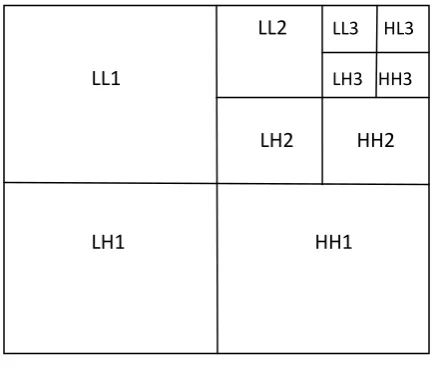
[image:2.595.320.538.74.259.2]In 2D applications, for each level of decomposition, first perform the DWT in the vertical direction, followed by the DWT in the horizontal direction. After the first level of decomposition, there are 4 sub-bands: LL1, LH1, HL1, and HH1. For next each successive level of decomposition, in our proposed approach the LH sub band of the previous level is used as the input. Each component undergoes three levels of decomposition. LH1, HL1, and HH1 contain the highest frequency bands present in the image tile, while LL3 contains the lowest frequency band. The three-level DWT decomposition is shown in Figure 1.
Fig 1: Three level DWT decomposition
3.2
SVD
Singular value decomposition is a linear algebra technique used to solve many mathematical problems [4].
Any image can be considered as a square matrix without loss of generality. So SVD technique can be applied to any kind of images.
The SVD belongs to orthogonal transform which decompose the given matrix into three matrices of same size [3]. To decompose the matrix using SVD technique it need not be a square matrix. Let us denote the image as matrix A. The SVD decomposition of matrix A is given using equation (1)
T
AUSV (1)
U and V are unitary matrices such that U*UT = I
V*VT = I
Where, I is an Identity matrix.
S is the diagonal matrix having in its main diagonal all non-negative singular values of A. These positive singular values can be used to embed watermark. The order of singular matrix S is same as original matrix A [1].
3.3
Proposed Approach
The proposed DWT-SVD watermarking scheme is formulated as given here.
3.3.1 Watermark embedding:
1. Use one-level DWT to decompose the cover image A into four sub-bands (i.e., LL1, LH1, HL1, and HH1). Further next two-level DWT to decompose the HL1 subbands into four sub-bands (i.e., LL3, LH3, HL3, and HH3).
2. Apply SVD to HL3 and LH3 subbands, i.e
,
1, 2
k k k kT
A
U S V
k
(2) Where, k represents one of two subbands.3) Divide the watermark into two parts:
1 2
W
W
W
4) Modify the singular values in HL3 and LH3 subbands with each half of the watermark image and then apply SVD to them respectively, i.e.
k
k
k k kTLL2
LL3HL3
LL1
LH3
HH3
LH2 HH2
Where, α denotes the scale factor. To control the strength of the inserted watermark scale factor is used [1].
5) Obtain the two sets of modified DWT coefficients, i.e.
A
k
U S V
k wk wkT,
k
1, 2
(4)6) Obtain the watermarked image AW by performing three
level inverse DWT.
3.3.2 Watermark extraction:
1) Use three level Haar DWT to decompose the watermarked image Aw into four subbands: LL1, LH1, HL1, and HH1. Further obtained LH3, HL3 subbands performing two level DWT on HL1 subband.
2) Apply SVD to the HL3 and LH3 subbands, i.e.,
,
1, 2
k k k kT
w
w w w
A
U
S V
k
(5)Where, k represents one of two subbands. 3) Compute difference
k k k kT
,
1, 2
w w w w
D
U
S V
k
(6)4) Extract half of the watermark image from each subband, i.e.
, 1, 2 k k
k w f
D S
W k
. (7)
5) Combine the results of Step 4 to obtain the embedded watermark:
[image:3.595.56.542.72.485.2]
W
f
W
f1
W
f2 (8)Fig 2: Proposed approach Watermark embedding process
4.
EXPERIMENTAL RESULTS
The performance of our approach is analysed through the results which are obtained by embedding watermark in all the three level DWT on LH3 and HL3 sub-band SVD matrix. The quality of the watermarked image can be measured in the form of Normalised cross co-relation (NCC). PSNR is the main criteria used to measure the quality of the watermarked image. The peak signal to noise ratio (PSNR) and normalized cross correlation (NCC) are obtained using (8) and (9) respectively.
2 10
255
10 log
PSNR
MSE
(8)Where, Mean Square Error (MSE) and NCC
1 1
2 '
0 0
1
*
n n
ij ij i j
MSE
I
I
N
N
1 1
2 2
1 1 1 1
( , ) *
( , )
(
( , ))
(
( , ))
n m
f i j
n m n m
f
i j i j
W i j
W
i j
NCC
W i j
W
i j
(9)
Here W and Wf are the original watermark and extracted
watermark.
(a) (b)
Obtain two sets of modifying DWT
coefficients Perform 2 levels
Inverse DWT on HL Subband Perform 1 level
Inverse DWT Watermarked
Image Perform 1st Level
DWT on Original Image
image
Perform next 2 Level DWT on HL SubBand
Divide the Watermark two
parts
Apply SVD on LH3 and HL3 band
(c) (d)
(e) (f)
(g) (h)
Figures:- Fig: a Cover image, Fig: b original watermark
image, Fig: c watermarked image, Fig: d extracted watermark, Fig: e watermarked image with guassian noise, Fig: f extracted watermark with guassian noise, Fig: g watermarked image with salt & pepper noise, Fig: h extracted watermark with salt & pepper noise.
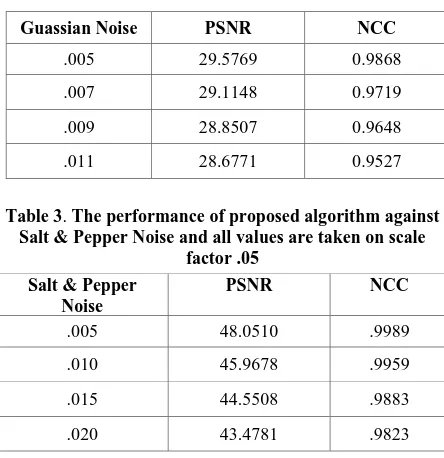
Our proposed approach mandrill image of size 256*256 is taken as watermark whereas the lena image of size 512* 512 is taken as cover image and watermark is embedded in Singular value matrix of LH3 and HL3 subbands. All simulation work is performed using Matlab 7.6. First Table shows the value of PSNR and NCC without any attack. Second Table shows the value of PSNR and NCC with respect to Guassian noise and Performance against Salt & pepper noise is shown in Table third.
Table 1. Shows the Scale factor, PSNR and NCC without any attack
Scale Factor PSNR NCC
0.3 58.6226 .9998
0.5 52.2037 1
0.7 48.6679 1
0.9 46.4961 1
Table 2. The performance of proposed algorithm against Guassian Noise and all values are taken on scale factor .05
Guassian Noise PSNR NCC
.005 29.5769 0.9868
.007 29.1148 0.9719
.009 28.8507 0.9648
[image:4.595.317.539.93.322.2].011 28.6771 0.9527
Table 3. The performance of proposed algorithm against Salt & Pepper Noise and all values are taken on scale
factor .05 Salt & Pepper
Noise
PSNR NCC
.005 48.0510 .9989
.010 45.9678 .9959
.015 44.5508 .9883
.020 43.4781 .9823
5.
CONCLUSION AND FUTURE WORK
In this paper, a hybrid image-watermarking technique based on DWT and SVD has been presented, where the watermark is embedded on the singular values of the cover image’s three level DWT LH3, HL3 subbands. The Experimental results of the proposed technique have shown both the significant improvement in perceptibility and the robustness under possible attacks. Further work of integrating the performance measured against JPEG compression, histogram equalization (HE), Rotation, Scaling, contrast adjustment (CA), cropping, and gamma correction (GC) against various attacks our approach is in progress.
6.
REFERENCES
[1] Chih-Chin Lai, Cheng-Chih Tsai 2010. Digital ImageWatermarking Using Discrete Wavelet Transform and Singular Value Decomposition. Ieee Transactions On Instrumentation And Measurement, Vol. 59, No. 11, November 2010.
[2] S.Ramakrishnan, T.Gopalakrishnan, K.Balasamy, 2011 SVD Based Robust Digital Watermarking For Still Images Using Wavelet Transform . CCSEA 2011, CS & IT.
[3] V.Santhi and Dr. Arunkumar Thangavelu 2009. DWT-SVD Combined Full Band Robust Watermarking Technique for Color Images in YUV Color Space. International Journal of Computer Theory and Engineering, Vol. 1, No. 4, October2009.
[4] Ruizhen Liu and Tieniu Tan, Senior Member, IEEE 2002 An SVD-Based Watermarking Scheme for Protecting Rightful Ownership. IEEE Transactions On Multimedia, Vol. 4, No. 1, March 2002.
[5] S.Poonkuntran, R.S.Rajesh 2011. A Messy Watermarking for Medical Image Authentication. 2011 IEEE.
Patter International Journal of Signal Processing, Image Processing and Patter Recognition Vol. 4, No. 1, March 2011.
[7] I. Cox and M. L. Miller1997. A review of watermarking and the importance of perceptual modeling. Proc. Electronic Imaging, 1997.
[8] M. Swanson, M. Kobayashi, and A. Tewfik 1996. Multimedia data embedding and watermarking technologies,” in Proc. IEEE, Vol. 86,pp. 1064-1087, 1998.
[9] T. Akiyama, F. Motoyoshi, O. Uchida and S. Nakanishi 2006. Hybrid Digital Watermarking for Color Images Based on Wavelet Transform, IADIS International Conference Applied Computing, Spain, February 2006.
[10]X. Xia, C. Boncelet, and G. Arce 1997 A Multiresolution Watermark for Digital Images. IEEE Conf. on Image Processing, vol. I, pp. 548-551, Oct. 1997.
[11]Sanaz Shahraeini and Mahdi Yaghoobi 2011. A Robust Digital Image Watermarking Approach against JPEG Compression Attack.
[12]Based on Hybrid Fractal-Wavelet 2011 International Conference on Computer Communication and Management Proc. of CSIT vol.5 (2011) IACSIT Press, Singapore.
[13]Suhad Hajjara, Moussa Abdallah, Amjad Hudaib 2009. Digital Image Watermarking Using Localized Biorthogonal Wavelets European Journal of Scientific Research ISSN 1450-216X Vol.26 No.4 (2009)
[14]Soo-Chang Pei, Ja-Han Chang, Jian-Jiun Ding, and Ming-Yang Chen 2008. Eigenvalues and Singular Value Decompositions of Reduced Biquaternion Matrices. IEEE Transactions on Circuits And Systems—I: Regular Papers, Vol. 55, No. 9, October 2008