14th International Conference on Wireless Communications, Networking and Mobile Computing (WiCOM 2018) ISBN: 978-1-60595-578-0
1,2,3
Joint Interference Estimation and Detection in Uplink of
Massive MIMO System
Tian-qi Yang1, Jie Wang2,*, Dong-ming Wang3 and Li-jun Zhai4
ABSTRACT
In this article, the joint detection in uplink are studied in Massive MIMO (Massive Multiple-input Multiple-output) system. This article will combine several precoding techniques such as ZF (Zero Force), MMSE (Minimum Mean Square Error), BD (Block Diagonalization) in interference estimation and propose a new structure for joint detection in uplink based on 5G simulation test platform of NCRL (National Mobile Communications Research Laboratory of SEU). Finally, this article will analysis feasibility of the new structure and give out simulation results.
KEY WORD: Massive MIMO, Joint detection, Iterative algorithm
Ⅰ. INTRODUCTION
The last ten years have seen a huge growth in information rate and device connection numbers, New demand is proposed in wireless communication system. As Massive MIMO technology has been researched widely in both Academia and industry, it has become the key technology in next generation wireless communications.
In massive MIMO system, various precoding and detection techniques has been restudied and revised to satisfy the demand of reasonable complexity for Massive MIMO system [1]. In [2] and [3], hybrid precoding and adaptive singular value decomposition (SVD) is proposed respectively. The two-step algorithm which contains QR and bi-diagonalization method is introduced in [4]. The 5G simulation test platform of NCRL(SEU) also use the two-step algorithm to decompose the multi-user MIMO channel into Multiple single-user channels. The specific principle is Explained in the Sec.Ⅱ of the article.
It is known that joint detection can greatly alleviate the issue of pilot contamination [5-6]. Joint channel estimation and data detection is researched in [7-8]. In this article, a typical TDD (Time Division Duplexing) is considered since TDD massive MIMO system can exploiting channel reciprocity. The channel estimation from uplink can be used in downlink data transmissions in TDD system.
computational complexity. Section Ⅳ shows the simulation results and conclusion.
Ⅱ SYSTEM MODEL
This article considers the uplink of a MU-MIMO system. The cellular scene is a single base station serving K UEs simultaneously. In this system, we assume that the uplink and downlink has reciprocity (GDGUT). According to [10], the following precoding scheme is used. We first calculate zero force precoding:
T
1U U U 1
ˆ= ˆ ˆ
K
G G G G G G (1)
ZF precoding forces the interference of other users to zero, at the same time, MMSE precoding is given by:
H H 1
( ) ,
k k k k
d
K P
W H H H I (2)
Where Pd is the average SNR, then make QR decomposition toGˆk.
ˆ ˆ ˆ
k k k
G Q R (3)
Where Qˆk is a Unitary orthogonal matrix, Rˆk is an upper triangular matrix, then we have
D,k ˆ ˆj j
k j k j
I
G Q R
0 (4)
ˆ
k
Q is the precoding matrix which satisfies the principle of BD precoding
algorithm. We can do QR decomposition to all the Gˆkone by one, then we can get the interference suppression matrix of downlink.
IS ˆ1 ˆK
W Q Q (5)
The interference suppression matrix has the ability to diagonal blocks, the specific property is as follows.
1 T
D IS U IS
K
R
G W G W
R
Where Rk Rˆk1 G WU,Tk IS,k . It can be seen that after BD multi-user precoding, the interference between multiple users is eliminated. Next, we can make SVD decomposition to matrixRk.
H
k k k k
R U D V (7)
TT H T
k k k k k k k
R U D V V D U (8)
From (7)-(8), we can know that the downlink single-user precoding matrix is
k
V and the uplink single-user precoding matrix isUk.
As for joint detection. [11] proposed a new Low-Complexity iterative detection for overloaded multiuser MIMO system. Iterative algorithm of soft interference cancellation is studied in [12-14]. In this paper, the LMMSE-ISDIC algorithm is used in data detection unit. If we know the priori information of transmitted signal, the meansand variance matrix V of transmitted signal can be calculated. If the priori information is unknown, we can set them to 0 and 1 respectively. The detection value of the kth sending symbol is
1H H H H 2
r
k ek ek N
s s VH HVH I r H s (9)
From the view of uplink joint receiver, the received signal can be expressed as
1 U,1 1 U,
U, U,
ˆ ˆ +
ˆ ˆ +
K K
K
K
k k k k k k
k k
s
y G U G U n Gs n
s
G U s G U s n
(10)
WhereG G UU,1ˆ1 GU,KUˆK is the uplink multi-user channel matrix. When combining precoding matrix and channel matrix. We can rewrite (10) as follow.
T T T T
IS, IS, U, ˆ IS, U, ˆ + IS,
K
k k k k k k k k k k
k k
W y W G U s W G U s W n (11)
Redefining yk WIS,Tky, we reconsider the receive signal as
k k k k
T T
IS, U , IS,
H T T H 2
IS, U , U , IS,
T IS, U, ˆ + ˆ ˆ E + ˆ K
k k k k k k
k k
K
k k k k k k k k k
k k
k k k k
n W G U s W n
Σ n n W G U U G W I
G W G U
(13)
If the system has no channel estimation error, we have the next formula.
T T H
IS, U, ˆ ˆ U, IS, 0
K
k k k k k k
k k
W G U U G W (14)
Let
H H H H
T H 2 H H
IS, IS,
k k k k k k k k k k
k k k k k k
Σ Σ G VG Σ G G G VG G G
W GG W I G VG G G (15)
Formula (9) can be expressed as
H H 1 H H 1
1 (1 )
k k
k k k k k k
k k k k k
e
e s
v e e
G Σ
s y G s G
G Σ G (16)
The mean and variance of sending signals can be calculated by
2 2
E | |
| k
k
k k k k k k
s
k k
k k k
s
s s s s P s s
v s P s s s
S S (17)Where S is the set of modulated symbol.
Ⅲ. RECEIVER STRUCTURE
OFDM demodulation
OFDM demodulation
Iteration soft detector Interference
estimation mappingSymbol
Symbol decision reconstructed
sending signals
[image:5.595.137.456.91.200.2]result
Figure 1. Receiver framework.
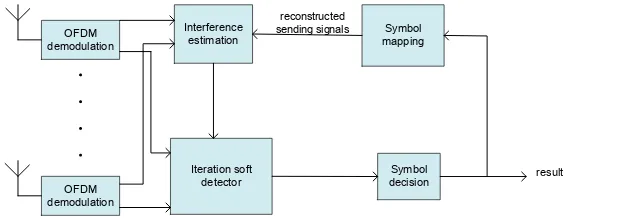
As fig 1 clarifies, receiver firstly obtains the channel estimated value at the pilot point by sending the frequency-domain pilot sequence and uses a certain interpolation algorithm to obtain the initial estimated channel value at the entire frequency point, the initial estimated channel response values are then used for detection. Then send the judged symbols back to the interference estimation unit. The interference estimation unit can use the received signal and the reconstructed sending signal to re-estimate the channel matrix [17]. In this paper, we use Least-Square algorithm to estimate channel and use (1)-(5) to re-calculate interference suppression matrix WIS. Then renew the WIS in the detection unit. the precision of both the channel interference estimation and symbol detection is enhanced simultaneously during the overall iteration process. LS algorithm is described by the next formula.
*1
LS H H 2
s
H s s s y y
s
(18)
Where s is the sending sequence and y is the corresponding received sequence, *
s is the conjugation of s. In joint iterative interference estimation and signal detection algorithm. The base station firstly uses pilot reference signal to estimate multipath fading channel information approximately and the demodulator use the estimated CSI (Channel State Information) to demodulate the received signal. There exits errors in demodulation due to ISI and ICI in pilot reference signal. The interference term of pilot can be eliminated by reconstructing the transmit signal and exchanging information between the two units. Thus, the joint algorithm can enhance the accuracy of detection.
Ⅳ. SIMULATION AND CONCLUSION
The simulation environment of this paper is similar to SCME Urban micro-cell, it has six clusters, each cluster delay and power are in tableⅠ.
TABLEⅠ. CLUSTER DELAY AND POWER.
Cluster # Delays[ns] Power[dB]
1 0 0
2 200 -29.05
3 287.5 -3.57
4 662.5 -20.94
5 812.5 -5.28
6 925 -26.96
This paper considers one base station in one cell and the base station serves 16 UEs simultaneously, each UE has 8 antennas, Correspondingly, the base station has 128 antennas, the number of each user data stream is 4. The modulation type is QPSK. Assume that users are evenly distributed around the base station. The number of iteration in LMMSE-ISDIC is 7 and the number of overall iterations between detection unit and interference estimation unit is 2.
This paper gives the BER (Bit Error Rate) and system achieve rate in uplink when the speed of UE is 3km/h and 30km/h. The achieve rate is calculated by data blocks, each data block of user contains 2400 information bits. The ZF precoding uses (1) to eliminate inter-user interference while the MMSE precoding uses (4). The original curves use ZF precoding and MMSE detection algorithm with no iteration. The ISDIC curves use LMMSE-ISDIC iterative detection algorithm with no overall iteration. Then the WIS+ISDIC curves use MMSE precoding, LMMSE-ISDIC iterative detection and has overall iteration between interference estimation unit and detection unit. The curve ISDIC(MMSE precode) is equal to WIS+ISDIC(iter=0). The results are as follows.
(a) (b) Figure 3. System performance when speed is 30km/h.
From the simulation results, we find that MMSE precoding performs better than ZF precoding and ISDIC algorithm exploits iteration to enhance performance, which can improve 0.3-0.7 dB in bit error rate at 3
10 from fig 2. With the mobile speed increases, the doppler-frequency becomes larger, which will cause severe deterioration to the system. It is important that the overall iteration between interference estimation unit and detection unit can greatly improve system performance at the cost of complexity since it can exchange information among different units. Each iteration can provide approximately 2 dB gain at BER is 3
10 from fig 2. To reduce system complexity, we set the number of overall iteration to a relatively small number and it can still create a good performance gain. The convergence of iteration and the performance of the whole system with decoder will be discussed in future works.
REFERENCES
[1] Pei-Yun Tsai and Chin-Yi Liu, "Reduced-Complexity SVD with Adjustable Accuracy for Precoding in Large-scale MIMO Systems" in IEEE: 978-1-4673-9604, 2015.2.
[2] L. Liang, W. Xu, and X. Dong, "Low-complexity hybrid precoding in massive multi-user MIMO systems," IEEE Wireless Communications Letters, vol. 3, pp. 653-656, Dec. 2014. [3] J. Chen, and V. K. N. Lau, "Multi-stream iterative SVD for massive MIMO
communication systems under time varying channels," in Proceeding of International Conference on Acoustics, Speech, and Signal Processing, May 2014, pp. 3152-3156. [4] L. Hogben, Handbook of Linear Algebra. Chapter 45, Chapmen & Hall/CRC, Second
Edition, 2013.
[5] E. G. Larsson, O. Edfors, F. Tufvesson and T. L. Marzetta, "Massive MIMO for next generation wireless systems," IEEE Communications Magazine, vol. 52, pp. 186-195, Feb 2014.
[6] S.G. Wilson, J. Freebersyser and C. Marshall, "Multi-symbol detection of M-DPSK," in Global Telecommunications Conference and Exhibition 'Communications Technology for the 1990s and Beyond' (GLOBECOM), pp.1692-1697 vol.3, 27-30 Nov 1989.
[7] W-K. Ma, B-N. Vo, T. N. Davidson, and P-c. Ching, "Blind ML detection of orthogonal space-time block codes: High-performance, efficient implementations," IEEE Transactions on Signal Processing, vol. 54, no.2, pp. 738-751, Feb. 2006.
IEEE Signal Processing and Signal Processing Education Workshop (SPISPE), pp. 172-177, 2015.
[9] Dongming Wang, "5G test platform algorithm and principle" form NCRL (National Mobile Communication Research Lab, Southeast University) 2015.3
[10] Hakjea Sung, Generalized Channel Inversion Methods for Multiuser MIMO Systems, TCOM, 2009.
[11] M. Chen, and A. G. Burr, "Low-Complexity Iterative Detection for Overloaded Uplink Multiuser MIMO OFDM System," ITG Workshop on Smart Antennas, Dresden, Germany, pp. 338-342, Mar. 2012.
[12] J. Rößler, W. Gerstacker, A. Lampe, and J. Huber, "Matched-filter and MMSE-based iterative equalization with soft feedback for QPSK transmission, " in Proceedings of International Zurich Seminar on Broadband Communications(IZS’02), Zurich, Switzerland, Feb. 2002.
[13] J. Luo, K. R. Pattipati, P. K. Willett, and F. Hasegawa, "Near-optimal multiuser detection in synchronous CDMA using probabilistic data association," IEEE Commun. Letters, vol. 5, no. 9, pp. 361–363, May 2001.
[14] X. Wang and V. Poor, "Iterative (turbo) soft interference cancellation and decoding for coded CDMA, "IEEE Trans. Commun., vol. 47, no. 7, pp.1046–1061, July 1999.
[15] H. Vikalo, B. Hassibi and P. Stoica, "Efficient joint maximum-likelihood channel estimation and signal detection," IEEE Transactions on Wireless Communications, vol. 5, no. 7, pp. 1838-1845, Jul 2006 .
[16] L Motedayen-Aval, A. Krishnamoorthy and A. Anastasopoulos, "Optimal joint detection/estimation in fading channels with polynomial complexity," IEEE Trans. Inf. Theory, 2007.
[17] Bing Han, Xiqi Gao, Xiaohu You, "An Iterative Joint Channel Estimation and Symbol Detection Algorithm Applied in OFDM System with High Data to Pilot Power Ratio," IEEE International Conference on Communications, 2003, 3:2076-2080 vol.3.
[18] W. Wang and X. Gao, "Soft information reservation turbo receiver for MIMO transmission for frequency-selective rayleigh fading channel," To be submitted.