Journal of Inequalities and Applications Volume 2009, Article ID 385298,20pages doi:10.1155/2009/385298
Research Article
Global Exponential Stability of Periodic
Oscillation for Nonautonomous BAM Neural
Networks with Distributed Delay
Yi Wang,
1Zhongjun Ma,
2, 3and Hongli Liu
11School of Mathematics and Statistics, Zhejiang University of Finance & Economical,
Hangzhou 310012, China
2School of Mathematics and Computing Science, Guilin University of Electronic Technology,
Guilin 541004, China
3School of Mathematical Science and Computing Technology, Central South University,
Changsha 410083, China
Correspondence should be addressed to Yi Wang,[email protected]
Received 22 March 2009; Revised 7 July 2009; Accepted 2 October 2009 Recommended by Alexander I. Domoshnitsky
We derive a new criterion for checking the global stability of periodic oscillation of bidirectional associative memoryBAM neural networks with periodic coefficients and distributed delay, and find that the criterion relies on the Lipschitz constants of the signal transmission functions, weights of the neural network, and delay kernels. The proposed model transforms the original interacting network into matrix analysis problem which is easy to check, thereby significantly reducing the computational complexity and making analysis of periodic oscillation for even large-scale networks.
Copyrightq2009 Yi Wang et al. This is an open access article distributed under the Creative Commons Attribution License, which permits unrestricted use, distribution, and reproduction in any medium, provided the original work is properly cited.
1. Introduction
The bidirectional associative memoryBAMneural network which was first introduced by Kosko in 19871,2is formed by neurons arranged in two layers. The neurons in one layer are fully interconnected to the neurons in the other layer, while there are no interconnections among neurons in the same layer. Through iterations of forward and backward information flows between the two layers, it performs a two-way associative search for stored bipolar vector pairs and generalizes the single-layer autoassociative hebbian correlation to a two-layer pattern matched heteroassociative.
to some practical problems, the properties of equilibrium points play important roles. An equilibrium point can be looked as a special periodic solution of neural networks with arbitrary period. In this sense, the analysis of periodic solutions of neural networks could be more general than that of equilibrium points. There are some results on the existence and stability of periodic solution of BAM neural networks. Liu et al.20, 21obtained several sufficient conditions which ensure existence and stability of periodic solution for BAM neural networks with periodic coefficients and time-varying delays. Subsequently, Guo et al.22
obtained some sufficient conditions ensuring the existence, uniqueness, and stability of the periodic solution for BAM neural networks with periodic variable coefficients and variable delays, and they also estimated the exponentially convergent rate. Song et al. obtained several sufficient conditions which ensure existence and stability of periodic solution for BAM neural networks with periodic coefficients and periodic time-varying delays23. Moreover, neural networks usually has a spatial extent due to the presence of an amount of parallel pathways with a variety of axon sizes and lengths. Thus, the delays in neural networks are usually continuously distributed. Recently, there are some authors studied the BAM neural networks with distributed delays and constants coefficients24–26.
Until recently, few studies have considered periodic solution for the BAM neural networks with periodic coefficients and distributed delays. Zhou et al. considered the periodic solution for the BAM neural networks with period coefficients and continuously distributed delays 27. However, the result in Zhou et al. contains two limitations, one made for periodicT and the other is min1i,jn{ai−mj1djiNji, cj−i1n bijMij} > 0,
which also in the Wang et al.28. This limitation is being removed by this paper. Based on the continuation theorem of Mawhin’s coincidence degree theory, the nonsingularM-matrix and Lyapunov functionals, we derive a new global exponential stability criterion in matrix form for periodic oscillation of BAM neural networks with period coefficients and distributed delay. Moreover, our criterion is easy to check out.
The paper is organized as follows. Our model and some preliminaries are given in
Section 2. The existence of periodic solution is proved inSection 3. The exponential stability of periodic oscillator is considered inSection 4. An example is shown in Section 5. Several summary remarks are finally given inSection 6.
2. Preliminaries
In this paper, we study the BAM neural networks with periodic coefficients and continuously distributed delays modeled by the following system:
˙
uit −aituit
m
j1
bijthij
tij
0
fijsvjt−sds
Iit,
˙
vjt −cjtvjt
n
i1
djiteji
τji
0
gjisuit−sds
Ljt,
2.1
wherei1,2, . . . , n;j 1,2, . . . , m;ait>0 andcjt>0 denote the rate with which the cells
iandjreset their potential to the resting state when isolated from the other cells and inputs;
bijtanddjitare connection weights of the neural network;Iit,Ljtdenote theith and
cell andjth cell at timet, respectively. Moreover, thejth cell has an impact on theith cell in the time oftijand thejth cell has an impact on theith cell in the time ofτji.
Ifuitandvjtsatisfy system2.1anduitT uit,vjtT vjt, then they
areT-periodic solutions of system2.1. The initial conditions associated with system2.1
are given as follows:
uis φis, vjs ψjs, s∈−∞,0, 2.2
whereφis, ψjsare continuous functioni1,2, . . . , n;j1,2, . . . , m.
Throughout this paper, we make the following assumptions.
Assumption 2.1. ait,bijt,cjt,djit,IitandJjtare continuousT-periodic functions on
R. In addition,ai supt∈R|ait| <∞,a−i inft∈R|ait|> 0,bij supt∈R|bijt|< ∞,ci
supt∈R|cjt|<∞,ci−inft∈R|cjt|>0,dji supt∈R|djit|<∞,Iisupt∈R|Iit|<∞, and
Lj supt∈R|Ljt|<∞.
Assumption 2.2. Signal transmission functionshiju,ejivare bounded onR, and there exist
numberMij>0 andNji>0 such that
hiju−hijv Mij|u−v|, ejiu−ejiv Nji|u−v| 2.3
for eachu, v∈R, i1,2, . . . , nandj1,2, . . . , m.
Assumption 2.3. The delay kernelsfijs, gjis :0,∞ → 0,∞ i 1,2, . . . , n;j 1,2,
. . . , mare continuous and integrable and satisfy
∞
0
fijsds1,
∞
0
gjisds1. 2.4
Assumption 2.4. The delay kernelsfijs, gjis :0,∞ → 0,∞ i 1,2, . . . , n;j 1,2,
. . . , msatisfy
∞
0
eαsfijsds1,
∞
0
eαsgjisds1, 2.5
whereαis a bounded positive real number.
Now, we give some useful notations, definitions, and lemmas as follows: u
T
0|us|2ds
1/2andv 1/TT
0vsds, whereus∈CR,R, vsisT-periodic function.
Assume thatTn×n{A a
ijn×n:aij0, i /j}, then we have the following.
Lemma 2.5see17,29,30. LetA∈Tn×n. Then, each of the following conditions is equivalent to
the statement ‘Ais a nonsingular M -matrix’:
aall of the principal minors ofAare positive;
cAis inverse-positive; that is,A−1exists andA−10;
dthere is a vectorx(ory), whose elements are all positive, such that the elements ofAx(or
ATy) are all positive;
eAhas all positive diagonal elements and there exists a positive diagonal matrixDsuch that
ADis strictly diagonally dominant; that is,
aiidi>
i /j
aij dj, i1,2, . . . , n. 2.6
In the following, we introduce some concepts and results from the book by Gaines and Mawhin31.
Let X and Z be two Banach spaces,L : DomL ⊂ X → Z a linear mapping, and
N :X → Za continuous mapping. The mappingLwill be called a Fredholm mapping of index zero if dim KerLcodimImL <∞andImLis closed inZ. IfLis a Fredholm mapping of index zero and there exist continuous projectorsP :X → XandQ:Z → Zsuch thatImP
KerL, KerQImLImI−Q, it follows that mappingL|DomLKerP :I−PX → ImLis
invertible. We denote the inverse of that mapping byKP. IfΩis an open bounded subset ofX,
the mappingNwill be calledL-compact on ifQNΩis bounded andKPI−QN:Ω → X
is compact. SinceImQis isomorphic to KerL, there exists an isomorphismJ :ImQ → KerL.
Lemma 2.6Mawhin’s continuation theorem. Let X and Zbe two Banach spaces andL be a
Fredholm mapping of index zero. Assume thatΩ ⊂Xis an open bounded set andN :X → Zis a continuous operator which isL-compact onΩ. ThenLxNxhas at least one solution inDomLΩ, if the following conditions are satisfied:
afor eachλ∈0,1, x∈∂ΩDomL, Lx /λNx;
bfor eachx∈∂ΩKerL,QNx /0;
cdeg{JQNx,ΩKerL,0}/0,
whereJ:ImQ → KerLis an isomorphism.
3. Existence of Periodic Solutions
Now we give the following sufficient conditions on the existence of periodic solutions.
Theorem 3.1. Assume that Assumptions2.1–2.3hold. Then, system2.1has at least one T-periodic
solution, if
P
In P12
P21 In
3.1
is a nonsingularM-matrix, whereIn is unite matrix andP12 pijn×m, pij −bijMij/a−i;P21
Proof. LetX Z {xt u1t, . . . , unt, v1t, . . . , vmt ∈ CR,Rnm | uit uit
T, vjt vjtT, i1,2, . . . , n; j 1,2, . . . , m}, thenXis a Banach space with the norm
x1ni1maxt∈0,T|uit|
m
j1maxt∈0,T|vjt|.
LetL: DomL⊂X → Z,P :XDomL → KerL,Q:X → X/ImL, andN:X → Z
be given by the following:
Lx u˙1t,u˙2t, . . . ,u˙nt,v˙1t,v˙2t, . . . ,v˙mt,
P xQx u1t, u2t, . . . , unt, v1t, v2t, . . . , vmt,
Nx ⎛ ⎜ ⎜ ⎜ ⎜ ⎜ ⎜ ⎜ ⎜ ⎜ ⎜ ⎜ ⎜ ⎜ ⎜ ⎜ ⎜ ⎜ ⎜ ⎜ ⎜ ⎝
−a1tu1t m
j1
b1jth1j
t1j
0
f1jsvjt−sds
I1t
· · ·
−antunt m
j1
bnjthnj
tnj
0
fnjsvjt−sds
Int
−c1tv1t n
i1
d1ite1i
τ1i
0
g1isuit−sds
L1t · · ·
−cmtvmt n
i1
dmitemi
τmi
0
gmisuit−sds
Lmt
⎞ ⎟ ⎟ ⎟ ⎟ ⎟ ⎟ ⎟ ⎟ ⎟ ⎟ ⎟ ⎟ ⎟ ⎟ ⎟ ⎟ ⎟ ⎟ ⎟ ⎟ ⎠ . 3.2
It is easy to see thatL is a linear operator with KerL {xt | xt κ ∈ Rnm}.
ImL {xt | xt ∈ Z,T0xtdt 0}is closed inZ, and dim KerL codimImL nm. Therefore,Lis a Fredholm mapping of index zero. It is easy to prove thatP andQare two projectors, andImP KerL,ImLKerQImI−Q. By using the Arzel´a-Ascoli theorem, it is easy to prove that for every bounded subsetΩ∈X, KpI−QNare relatively compact
onΩinX, that is,NisL-compact onΩ. Consider the operator equation
LxλNx, λ∈0,1, 3.3
that is
˙
uit −λaituit λ
m
j1
bijthij
tij
0
fijsvjt−sds
λIit,
˙
vjt −λcjtvjt λ
n
i1
djiteji
τji
0
gjisuit−sds
λLjt,
3.4
wherei 1,2, . . . , nandj 1,2, . . . , m.Denoteμi λ
m
j1bijsups∈R|hijs|Ii. By using
3.4, we obtain
Multiplying both sides of3.5byeλt0aisds, we have
−μieλ
t
0aisds
uiteλ
t
0aisds
μieλ
t
0aisds. 3.6
Integrating the inequality above from 0 toν ν0 27, we obtain
−μi
ν
0
eλt0aisdsdtu
iνeλ
ν
0aisds−ui0μi
ν
0
eλt0aisdsdt. 3.7
Hence,
−μi
ν
0
e−λνtaisdsdtu
i0e−λ
ν
0aisdsu
iνμi
ν
0
e−λνtaisdsdtu
i0e−λ
ν
0aisds 3.8
forνt0. So we have
−
|ui0| −
μi
λa−i
e−λa−iν− μi
λa−i uiν
|ui0| −
μi
λa−i
e−λa−iν μi
λa−i , 3.9
that is,
|uiν|
|ui0| −
μi
λa−i
μi
λa−i , 3.10
which implies thatuiis bounded and similarlyvj. By theAssumption 2.3, we know that
tij
0
fijsvjt−sds 3.11
is uniformly convergent. Therefore, the following iterated integral:
T
0
uit
tij
0
fijsvjt−sds dt 3.12
can be changed integrating order.
Suppose thatu1t, . . . , unt, v1t, . . . , vmt∈Xis any periodic solution of system
2.1for a certainλ∈0,1. Multiplying both sides of
˙
uit −λaituit λ
m
j1
bijthij
tij
0
fijsvjt−sds
byuitand integrating from 0 toT, we obtain
T
0
λaitu2itdt
T
0
λ
m
j1
bijtuithij
tij
0
fijsvjt−sds
dt
T
0
λIituitdt. 3.14
From Assumptions 2.1, 2.2, and 2.3 and noting that T0|vjt − s|2dt1/2
T
0|vjt|2dt
1/2v
j, we have
a−i
T
0
u2itdt
T
0
aitu2itdt
T
0 m
j1
bijtuit
hij
tij
0
fijsvjt−sds
−hij0
dt
T
0 m
j1
bijthij0uitdt
T
0
Iituitdt
m
j1
bijMij
∞
0
fijs
T
0
vjt−s |uit|dt ds
√T
⎛
⎝m
j1
bij hij0 Ii
⎞
⎠ui
m
j1
bijMijvjui
√
T
⎛
⎝m
j1
bij hij0 Ii
⎞ ⎠ui,
3.15
that is,
ui
1
a−i
m
j1
bijMijvj
√
T a−i
⎛
⎝m
j1
bij hij0 Ii
⎞
⎠. 3.16
By similar argument, we have
vj
1
c−j
n
i1
djiNjiui
√
T c−j
n
i1
dji eji0 Lj
. 3.17
It follows3.16and3.17that
whereP In P12
P21 In
, In is a unite matrix andP12 pijn×m, pij −bijMij/a−i;P21 qjim×n,
qji−djiNji/cj−, y u1,u2, . . . ,un,v1,v2, . . . ,vm,s s1, s2, . . . , snm, si
√
Tmj1bij|hij0|Ii/a−i, snj√Tni1dji|eji0|Lj/c−j, 1in, 1j m.
Application ofLemma 2.5yields
yP−1sr1, r2, . . . , rnm, 3.19
which implies that
uiri, vjrnj. 3.20
It is not difficult to check that there existt∗i, t∗nj∈0, Tsuch that
ui
t∗i √ri
T, vj
t∗njr√nj
T 3.21
for 1 inand 1 j m. Multiplying both sides of3.13by ˙uit i 1,2, . . . , nand
integrating from 0 toT, we obtain
u˙i2λ m
j1
T
0
bijtu˙ithij
tij
0
fijsvjt−sds
dt
−λ
T
0
aitu˙ituitdtλ
T
0
Iitu˙itdt
λ
m
j1
T
0
bijtu˙it
hij
tij
0
fijsvjt−sds
dt−hij0
λ
m
j1
T
0
bijthij0u˙itdt−λ
T
0
aituitu˙itdtλ
T
0
Iitu˙itdt
m
j1
bijMij
∞
0
fijs
T
0
|u˙it|2dt
1/2T
0
|vjt−s|2dt
1/2
ds
√T
m
j1
bij hij0 u˙iai
T
0
|u˙it|2dt
1/2T
0
|uit|2dt
1/2
√TIiu˙i
m
j1
bijMiju˙ivjaiu˙iui
√
T
m
j1
bij hij0 u˙i √
TIiu˙i.
3.22
Therefore,u˙imj1bijMijvjaiui √
It is easy check that
uit uit∗
T
t∗u˙itdt
ri √
T
√
Tu˙i
√ri
T
√
T
⎡
⎣m
j1
bijMijvjaiui
√
T
⎛
⎝m
j1
bij hij0 Ii
⎞ ⎠ ⎤ ⎦
√ri
T
√
T
⎡
⎣m
j1
bijMijrnjairi
√
T
⎛
⎝m
j1
bij hij0 Ii
⎞ ⎠ ⎤
⎦√ri
T ζi,
vjt
rnj
√
T
√
T
n
i1
djiNjiricjrnj
√
T
n
i1
dji eji0 Lj
r√nj
T ζnj.
3.23
Letξiri/ √
Tζiandξnjrnj/
√
Tζnj 0< 1. We take
Ω x u1t, . . . , unt, v1t, . . . , vmt∈X| |uit|< ξi, vjt < ξnj
. 3.24
Obviously, conditionaofLemma 2.6is satisfied. Whenx∈∂ΩKerL∂ΩRnm,
xis a constant vector inRnmwith|uit|ξi,|vjt|ξnj. Then, we have
uiQNxi−aiu2i ui
m
j1
bijhij
vj
uiIi,
vjQNxnj−cjvj2vj
n
i1
djiejiui vjLj.
3.25
We claim that there exists someiorj 1in, 1jmsuch that
uiQNxi<0 or vjQNxnj<0. 3.26
IfuiQNxi 0 andvjQNxnj0, then, we obtain
aiu2i ui m
j1
bijhij
vj
uiIi
m
j1
uibij
hij
vj
−hij0 ui m
j1
bijhij0 uiIi
|ui|
m
j1
bijMij vj |ui| m
j1
bij hij0 |ui|Ii.
Which implies
ξi
1
ai m
j1
bijMijξnj
1
ai
⎛
⎝m
j1
bij hij0 Ii
⎞
⎠ 1
a−i
m
j1
bijMijξnj
si √
T. 3.28
By a similar argument, we obtain
ξnjc1
j n
i1
djiNjiξi 1
cj
n
i1
dji eij0 Lj
1
c−j
n
i1
djiNjiξi
snj
√
T. 3.29
On the other hand,
ξ >√r
T ζ >
r
√
T
P−1s √
T , 3.30
whereξ ξ1, ξ2, . . . , ξnm,ζ ζ1, ζ2, . . . , ζnm,andr r1, r2, . . . , rnm. It follows that there
exists someiorjsuch that
ξi−
1
a−i
m
j1
bijMij
ξnj> √si
T 3.31
or
ξnj− 1
c−j
n
i1
djiNjiξi>
snj
√
T, 3.32
which is contradiction with 3.28 and 3.29. Then, there exists some ior j 1 i n, 1j msuch thatuiQNxi<0 orvjQNxnj<0. Therefore,
QNx1
n
i1
|QNxi|
m
j1
QNx
nj >0. 3.33
This indicates that conditionbofLemma 2.6is satisfied.
Define Hx, θ −θx 1−θQNx, θ ∈ 0,1, where x u1t, . . . , unt, v1t,
. . . , vmt∈Rnm. Whenx∈KerL
∂Ω, we have
Hx, θ1
n
i1
|Hui, θ| m
j1
H
vj, θ
n
i1
|−θui 1−θQNxi| m
j1
−θv
j 1−θQNxj >0.
According to the invariant of homology, we have
degJQNx,Ω!KerL,0/0, 3.35
where J : ImQ → KerL is an isomorphism. Therefore, according to the continuation theorem of Gaines and Mawhin, system2.1has at least oneT-periodic solution. The proof is completed.
Remark 3.2. In 27, the period T was assumed to be T < min{1/ai,1/cj}. In 28, the inequations min1i,jn{ai−mj1djiNji, cj−ni1bijMij}>0 must hold and also in27.
Here, the limitation is being removed.
4. Global Exponential Stability of Periodic Solution
In this section, we discuss the global exponential stability of the periodic solution of system
2.1. Under the assumptions ofTheorem 3.1, system2.1has at least oneT-periodic solution
x∗t u∗1t, . . . , u∗nt, v1∗t, . . . , vm∗t. 4.1
Now, we give the following definition about global exponential of periodic solution:
Definition 4.1. The periodic solutionx∗tof model2.1is said to be globally exponentially stable, if there exist positive constantsβ, Msuch that
⎛
⎝n
i1
|ut−u∗t|2
m
j1
|vt−v∗t|2
⎞ ⎠
1/2
≤Mx0−x0∗2e−βt 4.2
for all t > 0, wherex0, x∗0 represent the history of x and x∗ on −∞,0,respectively, and x0−x∗02 {ni1sup−∞<t0|φit−u∗it|2mj1sup−∞<t0|ψjt−v∗jt|2}1/2.
Definition 4.2. A matrix M is said to be diagonally dominant if|mii| j /i|mij|for alli, |mii|>j /i|mij|for at least onei, wheremijdenotes the entry in theith row andjth column.
Theorem 4.3. Assume that Assumptions2.1,2.2,2.4hold andPis a nonsingularM-matrix, where
P is the same as inTheorem 3.1. System2.1has a unique T-periodic solution, which is globally exponentially stable, ifQ−αIT ∈Tand is a weakly diagonally dominant matrix as
Q
Q11 Q12 Q21 Q22
, 4.3
where Q11 diag2a−1 −
m
j1b1jM1j,2a−2 −
m
j1b2jM2j, . . . ,2a−n −
m
j1bnjMnj; Q12
mijn×m,mij −bijMij;Q21 njim×n,nji −djiNji;Q22 diag2c−1 −
n
i1d1iN1i,2c−2 −
n
i1d2iN2i, . . . ,2c−m−
n
Proof. Letzt u1t−u1∗t, . . . , unt−u∗nt, v1t−v∗1t, . . . , vmt−vm∗t. Then,
zitz˙it −ait|zit|2 m
j1
bijtzithij
"tij
0
fijs
#
znjt−s v∗jt−s
$
ds
%
−m j1
bijtzithij
tij
0
fijsv∗jt−sds
−a−i|zit|2
m
j1
bijMij
tij
0
fijszitznjt−sds
−a−i|zit|2
m
j1
bijMij
∞
0
fijs
|zit|2 znjt−s 2
2 ds
−a−i|zit|2
1 2
m
j1
bijMij
|zit|2
∞
0
fijs znjt−s 2ds
,
znjtz˙njt−c−j znjt 2 1
2
n
i1
djiNji znjt 2
∞
0
gjis|zit−s|2ds
4.4
fori1,2, . . . , nandj1,2, . . . , m.
We define the following Lyapunov functionals:
&
Vit
eαt
α |zit|
2 1
α
m
j1
bijMij
∞
0
t
t−s
fijs znjγ 2eαγsdγds,
&
Vnjt e
αt
α znjt
2 1
α
n
i1
djiNji
∞
0
t
t−s
gjis zi
γ 2eαγsdγds.
4.5
Calculating the Dini upper right derivative ofV&jtandV&njtalong the solution of
2.1, and estimating it via the assumptions32, we have
DV&iteαt|zit|2e αt
α
⎧ ⎨
⎩−2a−i|zit| 2m
j1
bijMij
*
|zit|2
∞
0
fijs znjt−s 2ds
+⎫⎬ ⎭ eαt α ⎧ ⎨ ⎩ m j1
bijMij
*∞
0
fijs znjt 2eαsds−
∞
0
fijs znjt−s 2ds
+⎫⎬ ⎭
eαt
α
⎛
⎝αm
j1
bijMij−2a−i
⎞
⎠|zit|2 eαt
α
m
j1
bijMij znjt 2
∞
0
fijseαsds
eαt α ⎧ ⎨ ⎩ ⎛ ⎝α m j1
bijMij−2a−i
⎞
⎠|zit|2 m
j1
bijMij znjt 2
⎫ ⎬
DV&njt e αt α " α n i1
djiNji−2c−j
znjt 2n i1
djiNji|zit|2
%
. 4.6
Let
Q
Q11 Q12 Q21 Q22
, 4.7
where Q11 diag2a−1 −
m
j1b1jM1j,2a−2 −
m
j1b2jM2j, . . . ,2a−n −
m
j1bnjMnj; Q12
mijn×m,mij −bijMij;Q21 njim×n,nji −djiNji;Q22 diag2c−1 −
n
i1d1iN1i,2c−2 −
n
i1d2iN2i, . . . ,2c−m−
n
i1dmi Nmi.
Consider the Lyapunov functional
Vt
nm
k1
&
Vkt. 4.8
WhenQ−αIT∈Tand is a weakly diagonally dominant matrix, calculating the Dini upper right derivative ofValong the solution of2.1, we have
DVt D
nm
k1
&
Vkt
eαt α ⎧ ⎨ ⎩ ⎛ ⎝−2a−
i m
j1
bijMijα
⎞
⎠|zit|2m j1
bijMij znjt 2
⎫ ⎬ ⎭ eαt α " −2c−j
n
i1
djiNjiα
znjt 2n i1
djiNji|zit|2
%
eαt
α
⎧ ⎨ ⎩−2a−i
m
j1
bijMij
n
i1
djiNjiα
⎫ ⎬ ⎭|zit|2
eαt
α
⎧ ⎨ ⎩−2c−j
n
i1
djiNji
m
j1
bijMijα
⎫ ⎬
⎭|znit|2<0.
4.9
Therefore, forVtV0,
V0 1
α ⎧ ⎨ ⎩ nm k1
z2i0
m
j1
bijMij
∞
0
0
−s
fijs znjγ 2eαγsdγds
n
i1
djiNji
∞
0
0
−s
gjis zi
γ 2eαγsdγds
1
α
⎧ ⎨
⎩nm
m
j1
bijMij
∞
0
0
−s
fijseαγsdγds
n
i1
djiNji
∞
0
0
−s
gjiseαγsdγds
% max
k∈{1,...,mn}supγ0z 2 k
γ
1
αnmk∈{max1,...,mn}supγ0z 2 k
γ
1
αnm
⎧ ⎨ ⎩
n
i1
sup
−∞<t0
φit−u∗ it
2
m
j1
sup
−∞<t0
ψ
jt−vj∗t
2⎫⎬
⎭.
4.10
Thus,
eαt
⎛
⎝n
i1
|ut−u∗t|2
m
j1
|vt−v∗t|2
⎞
⎠< αVt< αV0
nm
⎧ ⎨ ⎩
n
i1
sup
−∞<t0
φit−u∗ it
2
m
j1
sup
−∞<t0
ψ
jt−v∗jt
2⎫⎬
⎭,
4.11
that is,
⎛
⎝n
i1
|ut−u∗t|2
m
j1
|vt−v∗t|2
⎞ ⎠
1/2
<√nmx0−x∗02e−
αt/2. 4.12
This means that periodic solution of system2.1is globally exponentially stable. The proof is completed.
Remark 4.4. For system2.1, when delay kernelsfijs,gjisareδ-functions, that is, we take
fijs δs−iandgjis δs−σj, then system2.1can be reduced to a fixed time delay
system and all above theorems are hold.
5. Example
50 40
30 20
10 0
T −1.5
−1
−0.5 0 0.5 1 1.5 2
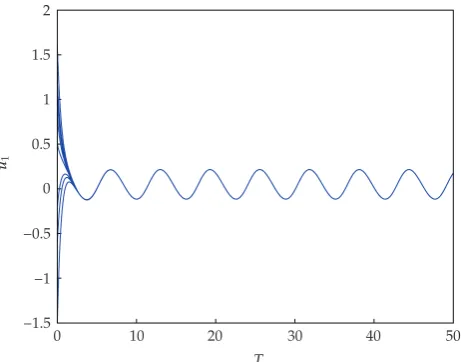
[image:15.600.185.416.97.278.2]u1
Figure 1:Time evolution ofu1of system5.1.
Consider the following BAM neural networks:
˙
uit −aituit
3
j1
bijthij
tij
0
fijsvjt−sds
Iit,
˙
vjt −cjtvjt
3
i1
djiteji
τji
0
gjisuit−sds
Ljt.
5.1
We select a set of parameters asα4/5,ait 20.1 sint,cjt 20.1 cost,fijs
gjis e−s,Iit −0.20.4 costandLjt 0.30.3 sint,hijs tanhs,ejis 1/1s,
tijτji20,
bijt
3×3
⎛ ⎜ ⎜ ⎝
0.10.1 sint 0.20.1 sint 0.30.1 sint
0.50.1 sint 0.40.1 sint 0.30.1 sint
0.30.1 sint 0.20.1 sint −0.50.1 sint
⎞ ⎟ ⎟
⎠,
djit
3×3
⎛ ⎜ ⎜ ⎝
0.20.1 cost 0.40.1 cost 0.10.1 cost
−0.20.1 cost 0.30.1 cost 0.50.1 cost
0.50.1 cost 0.20.1 cost 0.30.1 cost
⎞ ⎟ ⎟
⎠.
5.2
50 40
30 20
10 0
T −1.5
−1
−0.5 0 0.5 1 1.5 2
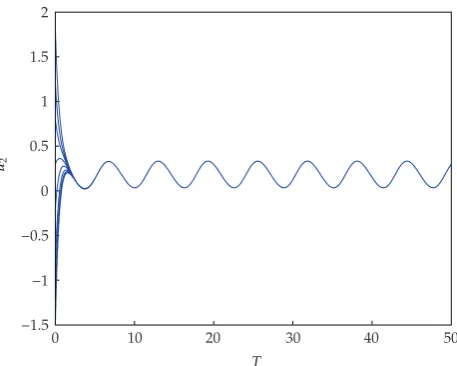
[image:16.600.186.415.96.279.2]u2
Figure 2:Time evolution ofu2of system5.1.
50 40
30 20
10 0
T −2
−1.5
−1
−0.5 0 0.5 1 1.5 2
[image:16.600.183.417.323.504.2]u3
Figure 3:Time evolution ofu3of system5.1.
It is easy to check that maxhij 1 and maxeji 1. LetMij 1 andNji1. By some
computations, we obtain
P
⎛ ⎜ ⎜ ⎜ ⎜ ⎜ ⎜ ⎜ ⎜ ⎜ ⎜ ⎜ ⎝
1 0 0 −0.1053 −0.1579 −0.2105
0 1 0 −0.3158 −0.2632 −0.2105
0 0 1 −0.3158 −0.1579 −0.2105
−0.1579 −0.2632 −0.1053 1 0 0
−0.1579 −0.2105 −0.3158 0 1 0
−0.3158 −0.1579 −0.2105 0 0 1 ⎞ ⎟ ⎟ ⎟ ⎟ ⎟ ⎟ ⎟ ⎟ ⎟ ⎟ ⎟ ⎠
50 40
30 20
10 0
T −2
−1.5
−1
−0.5 0 0.5 1 1.5
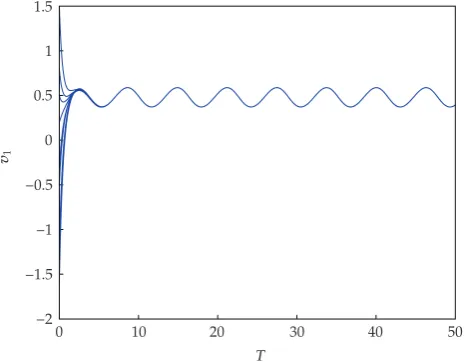
[image:17.600.184.417.99.280.2]v1
Figure 4:Time evolution ofv1of system5.1.
50 40
30 20
10 0
T −2
−1.5
−1
−0.5 0 0.5 1 1.5 2
[image:17.600.185.415.310.495.2]v2
Figure 5:Time evolution ofv2of system5.1.
Q
⎛ ⎜ ⎜ ⎜ ⎜ ⎜ ⎜ ⎜ ⎜ ⎜ ⎜ ⎜ ⎝
2.9 0 0 −0.2 −0.3 −0.4
0 2.3 0 −0.6 −0.5 −0.4
0 0 2.5 −0.6 −0.3 −0.4
−0.3 −0.5 −0.2 2.8 0 0
−0.3 −0.4 −0.6 0 2.5 0
−0.6 −0.3 −0.4 0 0 2.5 ⎞ ⎟ ⎟ ⎟ ⎟ ⎟ ⎟ ⎟ ⎟ ⎟ ⎟ ⎟ ⎠
.
5.3
50 40
30 20
10 0
T −2
−1.5
−1
−0.5 0 0.5 1 1.5
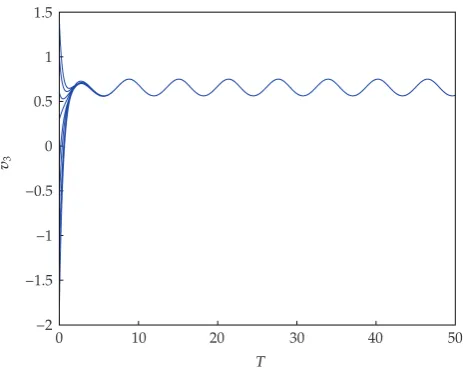
[image:18.600.184.416.96.280.2]v3
Figure 6:Time evolution ofv3of system5.1.
is globally exponentially stable. In Figures1,2,3,4,5, and6, we plot the trajectories ofuiand
vj, respectively.
6. Conclusion
In this paper, we derive a new criterion for checking the global stability of periodic oscillation of BAM neural networks with distributed delay and periodic external input sources and find that the criterion rely on the Lipschitz constants of the signal transmission functions, weights of the neural network and delay kernels by using the continuation theorem of Mawhin’s coincidence degree theory, the nonsingularM-matrix and Lyapunov function. The proposed model transforms the original interacting network into matrix analysis, thereby significantly reducing the computational complexity and making analysis of periodic oscillation for even large-scale networks. Most importantly, our result is very practical in the design of BAM neural networks.
Acknowledgments
The authors thank the anonymous reviewers for the insightful and constructive comments, and also thank for helpful discussion Professor Zengrong Liu. This work is supported by the NNSFno. 60964006.
References
1 B. Kosko, “Bidirectional associative memories,”IEEE Transactions on Systems, Man, and Cybernetics, vol. 18, no. 1, pp. 49–60, 1988.
2 B. Kosko, “Adaptive bidirectional associative memories,”Applied Optics, vol. 26, no. 23, pp. 4947– 4960, 1987.
4 J. Cao and L. Wang, “Periodic oscillatory solution of bidirectional associative memory networks with delays,”Physical Review E, vol. 61, no. 2, pp. 1825–1828, 2000.
5 J. Cao and L. Wang, “Exponential stability and periodic oscillatory solution in BAM networks with delays,”IEEE Transactions on Neural Networks, vol. 13, no. 2, pp. 457–463, 2002.
6 J. Cao and Q. Song, “Stability in Cohen-Grossberg-type bidirectional associative memory neural networks with time-varying delays,”Nonlinearity, vol. 19, no. 7, pp. 1601–1617, 2006.
7 A. I. Domoshnitsky and M. V. Sheina, “Nonnegativity of the Cauchy matrix and the stability of a system of linear differential equations with retarded argument,”Differentsial’nye Uravneniya, vol. 25, no. 2, pp. 201–208, 1989.
8 D. Ba˘ınov and A. I. Domoshnitsky, “Nonnegativity of the Cauchy matrix and exponential stability of a neutral type system of functional-differential equations,”Extracta Mathematicae, vol. 8, no. 1, pp. 75–82, 1993.
9 A. I. Domoshnitsky and M. Drakhlin, “Periodic solutions of differential equations with delay depending on solution,”Nonlinear Analysis: Theory, Methods & Applications, vol. 30, no. 5, pp. 2665– 2672, 1997.
10 R. P. Agarwal and A. I. Domoshnitsky, “Non-oscillation of the first-order differential equations with unbounded memory for stabilization by control signal,”Applied Mathematics and Computation, vol. 173, no. 1, pp. 177–195, 2006.
11 A. Chen, L. Huang, Z. Liu, and J. Cao, “Periodic bidirectional associative memory neural networks with distributed delays,”Journal of Mathematical Analysis and Applications, vol. 317, no. 1, pp. 80–102, 2006.
12 X. Liao and J. Yu, “Qualitative analysis of bi-directional associative memory with time delay,”
International Journal of Circuit Theory and Applications, vol. 26, no. 3, pp. 219–229, 1998.
13 X. Liao and K.-W. Wong, “Global exponential stability of hybrid bidirectional associative memory neural networks with discrete delays,”Physical Review E, vol. 67, no. 4, Article ID 042901, 4 pages, 2003.
14 S. Mohamad, “Global exponential stability in continuous-time and discrete-time delayed bidirectional neural networks,”Physica D, vol. 159, no. 3-4, pp. 233–251, 2001.
15 Y. Liu and W. Tang, “Existence and exponential stability of periodic solution for BAM neural networks with periodic coefficients and delays,”Neurocomputing, vol. 69, no. 16–18, pp. 2152–2160, 2006. 16 H. Wang, X. Liao, and C. Li, “Existence and exponential stability of periodic solution of BAM neural
networks with impulse and time-varying delay,”Chaos, Solitons and Fractals, vol. 33, no. 3, pp. 1028– 1039, 2007.
17 F. Ren and J. Cao, “Periodic oscillation of higher-order bidirectional associative memory neural networks with periodic coefficients and delays,”Nonlinearity, vol. 20, no. 3, pp. 605–629, 2007. 18 C. Huang, Y. He, and L. Huang, “New results of a class of two-neuron networks with time-varying
delays,”Journal of Inequalities and Applications, vol. 2008, Article ID 648148, 14 pages, 2008.
19 Y. Li, Y. Hua, and Y. Fei, “Global exponential stability of delayed Cohen-Grossberg BAM neural networks with impulses on time scales,”Journal of Inequalities and Applications, vol. 2009, Article ID 491268, 17 pages, 2009.
20 Z. Liu, A. Chen, J. Cao, and L. Huang, “Existence and global exponential stability of periodic solution for BAM neural networks with periodic coefficients and time-varying delays,”IEEE Transactions on Circuits and Systems. I, vol. 50, no. 9, pp. 1162–1173, 2003.
21 Z. Liu, A. Chen, J. Cao, and L. Huang, “Existence and global exponential stability of almost periodic solutions of BAM neural networks with continuously distributed delays,”Physics Letters A, vol. 319, no. 3-4, pp. 305–316, 2003.
22 S. Guo, L. Huang, B. Dai, and Z. Zhang, “Global existence of periodic solutions of BAM neural networks with variable coefficients,”Physics Letters A, vol. 317, no. 1-2, pp. 97–106, 2003.
23 Q. Song and Z. Wang, “An analysis on existence and global exponential stability of periodic solutions for BAM neural networks with time-varying delays,”Nonlinear Analysis: Real World Applications, vol. 8, no. 4, pp. 1224–1234, 2007.
24 H. Zhao, “Global stability of bidirectional associative memory neural networks with distributed delays,”Physics Letters A, vol. 297, no. 3-4, pp. 182–190, 2002.
27 T. J. Zhou, A. P. Chen, and Y. Y. Zhou, “Existence and global exponential stability of periodic solution to BAM neural networks with periodic coefficients and continuously distributed delays,”Physics Letters A, vol. 343, no. 5, pp. 336–350, 2005.
28 Y. Wang, G. Zhang, and Z. R. Liu, “Dynamics of periodic bidirectional associative memory neural networks with distributed delays,” submitted.
29 X.-B. Liang, “A comment on “on equilibria, stability, and instability of Hopfield neural networks”,”
IEEE Transactions on Neural Networks, vol. 11, no. 6, pp. 1506–1507, 2000.
30 A. Berman and R. J. Plemmons,Nonnegative Matrices in the Mathematical Sciences, Computer Science and Applied Mathematic, Academic Press, New York, NY, USA, 1979.
31 R. E. Gaines and J. L. Mawhin,Coincidence Degree, and Nonlinear Differential Equations, vol. 568 of
Lecture Notes in Mathematics, Springer, Berlin, Germany, 1977.