An Un-Static Approach for Resource Allocation
under Assigned User Groups
Vinutha A1, Sujatha Cyril2
1,2
Department Of Electronics and Communication, Atria Institute of Technology
Abstract: This project presents about an algorithm named joint resource allocation which combines un-static user grouping ,
multi cell cooperation, and resource blocking allocation for LP-OFDMA(linearly pre-coded orthogonal frequency multiplexing) in Multiple-user multi inputs and multi outputs(MIMO) systems. Initially grouping of users in multiple cells is effectively developed using minimum mean square error (MMSE) equalization and modulated flexibly with Bit Error Rate (BER) constraint. To frame and resolve a new output maximization issue RB pattern, Grouping of users dynamically and selection of cells are included in resource allocation as assigned. Iterative Hungarian algorithm based on user and resource pattern(IHA_URP) is used to resolve maximal problem into a sequence of minimal sub problems to acquire the result by reducing the computing complexity consecutively to obtain favourable solution . The simulation result of this project with effectively grouping the users in multiple cell with multiple resource distribution algorithm accounts high quality system output with BER assurance than the algorithm that firmly groups the users and alternative system in the written works. Keywords: LP-OFDMA, MIMO, MMSE, IHA_URP, BER
I. INTRODUCTION
II. PROPOSED WORK
Fig1. Demonstration of multiple cell uplink Multi-User Multi Inputs And Multi Outputs
Every cell contains one Base station outfitted with Nr receiving antenna with L facilitated Base Stations (i.e. L cells), with user U individual receiving antenna. In multiple-cell uplink Multi-User Multi Inputs and Multi Outputs frame work structure
hm,l,u,j = √βm,l,u,jγm,l,u,j (1) Equation 1 is the proliferation factor from the l-th cell of m-th receiving base station of jth cell of user U.
Here γm,l,u,j is lower scale paling parameter, which is zero mean iid, equilibrium circle random vector complex Gaussian with
uneven parameter , and βm,l,u,j is higher scale paling parameter modelling attenuation factor geometrically and paling of darkness that are thought to be consistent above a cognizance duration time from the earlier. In view of the end goal to expand the phantom effectiveness and in-habitance level contrasted and traditional FDMA, users in the bunch shape Multi-cell Multi Inputs And Multi Outputs gatherings and work over a similar time frequency asset, while distinctive gatherings involve orthogonal assets to kill the other gathering obstruction.,
we consider L composed cells in order to shape a bunch where L cells allocates identical NRB Resource Blockings with receiving antenna Nr besides user could match through other progressively crosswise over cells. This plan is named as the multiple - cell collaboration. Here execution of the proposed calculation in the framework. Contrasted and the individual-cell methods, the proposed multiple-cell calculation needs the trading of Channel state information and planning data between every agreeable BS and the focal preparing unit of the bunch, which presents the backhaul overhead. It is accepted that Base Station are associated with a concentrated unit with fast backhaul joins whose data transmission is adequate to encourage the initiated planning calculation. We define and take care of another throughput amplification issue whose asset distribution incorporates cell choice, un-static users gathering and RB design task. Besides, to lessen the computational many-sided quality altogether, particularly on account of substantial quantities of users and Resource Blockings, we introduce an effective iterative Hungarian calculation in view of users and asset segments (IHA URP) to take care of the issue by breaking down the extensive scale issue into a progression of little scale sub-issues, which can acquire near ideal arrangement with much lower many-sided quality.
A. Step 1: Resource Blocking
1) Consider the incoming resources as ‘R’ for each resource blocking (RB) as R={R1,R2,R3….Rn}. With an interval of time ‘t’ 2) Such that each of Ri has a resource at RBi as
R={(RB)1, (RB)2,……..(RB)n} (3) 3) Each of the resources is bound to RB as
B. Step 2: Receiving Antenna
1) Each of the incoming signal is received to an antenna ‘A’ such that RBi with one interval is attached to a resource antenna that is,
A=(Ai RB) (5) It means that ‘A’ antenna it is a subset of RB
C. Step 3: Modulation
On transmission, the signals are modulated at an amplifying frequency for better BER proportion. The modulation is given as: M=n lim0(IX)(RB) (6)
Here Ix is a data bit stream under modulation is differentiated with respect resource blocks and Multi Inputs and Multi Outputs attributed modulation signal is generated.
Here the incoming signal I captured at demodulation attached antenna and hence the modulation can be shown as
Dm=n lim0IXRB (7) Hence integration equation has come out of equation (6) to generated from (7)
III.RESULTS
This chapter gives brief outline for results which are explained below with the following images for different output parameters and analysis of results can be
Table 1: Simulation Parameters
Channel model: ITU Ped-A Carrier frequency: 0.625MHz
Channel Sampling frequency: 1.92MHz Maximum Doppler shift: 10Hz
Parameters
Cell radius:140m Decay exponent : 2
Shadow-paling standard deviation shadow: 8Db
FFT size: 128 Modulation: MQAM
NRB: 8 NscRB: 12
Simulation
OFDM symbols per frame : 14 RB conFig: 12 7
Number of cells per cluster L: 4,3,2,1 MIMO detector: MMSE Parameters
number of users per cell U: 1 BS receiving antenna number Nr: 4
UE transmitting antenna number: 1 Transmission time interval (TTI) duration: 1ms
[image:4.612.83.525.242.404.2]
Fig 2 Hexagonal cellular network with UE and BS Fig 3 Network With Link establishment
Fig 2 and 3 represents the hexagonal cell representation and connections established between network and the users.
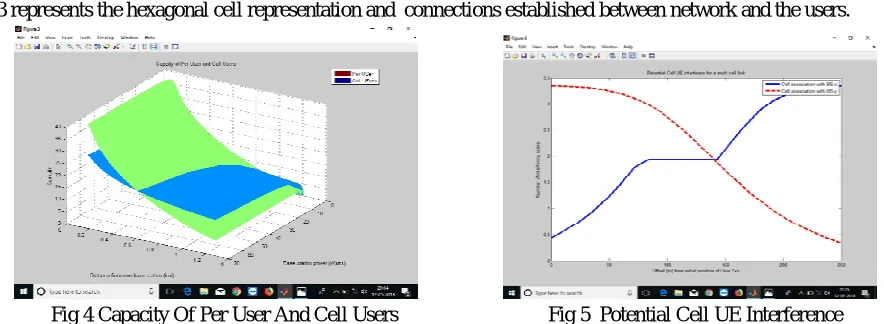
Fig 4 Capacity Of Per User And Cell Users Fig 5 Potential Cell UE Interference
The figure 4 shows that once the connection establishment is done comparison between per user and cell user is done that is there are limited number of cells and network usage is more number here power is constant but capacity is higher and fig 5 shows potential with respect to the base station, links are with compatibility of the base station.
[image:4.612.99.511.468.654.2]
Fig 6 Output For PPP Voronoi Deployment Fig 7 Throughput For Hexagonal Deployment
Fig 8 Inner Region Probability Fig 9 Outer Region Probability
The Fig 8 shows the probability of the users in the inner region in a cluster And Fig 9 shows the probability of users in cluster in the outer region
Fig 10 Different Resource Allocation Algorithm Fig 11 Different User Grouping Algorithm
The figure 10 shows the different resource allotments when the data is transmitted where red indicates the dynamic user grouping with multi cells green indicates dynamic user grouping without multi cell co-operation. blue indicates the fixed 2 user group and pink is fixed 2 user group. and the last blue indicates no user groups and
[image:5.612.103.514.440.542.2] [image:5.612.98.291.625.722.2]
Fig 12 Normalizes RB Over Utilization Avoidance Optimization Fig 13 Distance covered by the base station
The figure 12 shows the normalized resource blocking over utilization of resources for fixed 3 users and 2 users and dynamic groups with peer to peer in the hexagonal This figure shows user coverage from base station when the user is in motion. Different distances are considered and the graphs are visualized. And Fig 13 shows user coverage from base station when the user is in motion. Different distances are considered and the graphs are visualized.
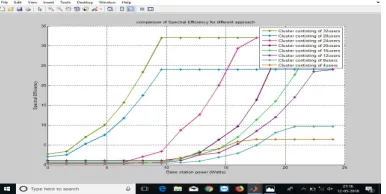
Fig 14 shows that use of un-static user allocation for ore number of users efficiency achieved in spectrum is more and Fig 15 shows that multi-cell corporation has more proficiency when compared to no user grouping and fixed user grouping.
IV.CONCLUSION AND FUTURE SCOPE
This project presents Un-static user gathering and algorithmic allotment of joint resources for LP-OFDMA uplink in multi-cell Multi inputs and Multi Outputs frameworks. We determined the un-static multi-cell user gathering norms and presented a novel algorithmic allotment of joint resources with multi-cell collaboration to accomplish most extreme framework general output with least mean square mistakes (MMSE) levelling and Adaptive Modulation procedures. Furthermore, to decrease the calculation many-sided quality, we present a productive algorithm called IHA_URP for arrangement of the joint assets designation issue. Re-enactment comes about exhibited that the proposed calculation achieves preferable framework output over both the conventional calculations with settled users gathering and the algorithms without multi-cell collaboration. In the current project is proposed for cellular resource allocation with minimal spectrum, to attain a maximum throughput un-static user gathering norms are been initiated with joint resource algorithm with multi cellular collaboration. Further enhancement of the current project is proposed for cellular is initiated. IHA_URP is used to reduce the computing complexity. Future enhancement of this project is to add the internal assessment for transport learning machine
V. ACKNOWLEDGMENT
I would like to thank Dr Sujatha Cyril, Associate professor , Atria Institute of Technology, for her constant support and help. My sincere thanks to anonymous reviewers for their for their valuable comments and useful suggestions
REFERENCES
[1] H. Zhao, S. Ma, F. Liu, and Y. Tang, “A Suboptimal Multiuser Pairing Algorithm with Low Complexity for Virtual MULTI INPUTS AND MULTI OUTPUTS Systems,” IEEE Trans. Veh. Tech., vol. 63, no. 7, pp. 3481-3486, Jan. 2014
[2] J. Fan, G. Y. Li, Q. Yin, B. Peng, and X. Zhu, “Joint User Pairing and Resource Allocation for LTE Uplink Transmission,” IEEE Trans. Wireless Commun., vol. 11, no. 8, pp. 2838-2847, Aug. 2012.
[3] M. A. Ruder, D. Ding, U. L. Dang, A. V. Vasilakos, and W. H. Gerstacker, “Joint user grouping and frequency allocation for multiuser SC-FDMA transmission,” Physical Communication, vol. 8, pp. 91-103, 2013.
[4] N. Prasad, H. Zhang, H. Zhu, and S. Rangarajan, “Multi-User MULTI INPUTS AND MULTI OUTPUTS Scheduling in the Fourth Generation Cellular Uplink,” IEEE Trans. Wireless Commun., vol. 12, no. 9, pp. 4272-4285, Sept. 2013.
[5] X. F. Lu, K. Yang, W. N. Li, S. J. Qiu, and H. L. Zhang, “Joint user grouping and resource allocation for uplink virtual MULTI INPUTS AND MULTI OUTPUTS systems,” Science China Information Sciences, vol. 59, pp. 1-14, 2016.