2018 International Conference on Computational, Modeling, Simulation and Mathematical Statistics (CMSMS 2018) ISBN: 978-1-60595-562-9
Multi-targets Priority Ordering Based on Fuzzy Neural Networks
Hong-bin ZHANG, Yan-qiu JU
*, Shao-jie ZHANG and Chi QI
Department of Avionics and Weapon Engineering, Army Aviation Institute Beijing, China *Corresponding author
Keywords: Multi-targets, Priority ordering, Fuzzy neural networks, Model, Sensors management.
Abstract. Application of fuzzy neural networks in multi-targets priority ordering is introduced in this paper. Based on the establishing of multi-targets ordering model, the multi-targets priority ordering sets, the structure and parameters for fuzzy neural networks are given in the course of multi-targets priority ordering. It has made very pleased result through experiment of certain type multi-targets priority ordering, and it is important to helicopters detective sensors management. The application of fuzzy neural networks has a good reference to multi-targets priority ordering in helicopters detective sensors management.
Introduction
In helicopters detective sensors management, how to use the different sensors to detect, identify and track multi-targets in accurate has been a puzzle problem. Multi-targets priority ordering is one of the key methods to solve this problem.
At present, there are several methods for multi-targets priority ordering. Such as analytic hierarchy process (AHP) [1], fuzzy evaluation [2,3], Vague sets[4,5], neural networks[6], et al.
In all of these methods, the AHP is a traditional method and be used widely. It is a simple method for resolving the complex and fuzzy problems, especially in the complete quantitative analysis. But it also has many disadvantages, for example: anthropogenic influence, the indicators and weights must be complete quantitively, et al.
According the disadvantages of the AHP, Vague sets method was proposed to improve the AHP. The anthropogenic influence can be reduced by using the vague sets, but there are many problems in the practical application. If the internal differences of some indicators are large, but the actual impact weight is small, the verification results can’t match the actual situation.
The neural networks is a non-linear dynamic system, which is structured by neural units according to certain rules [7]. But, there are some disadvantages in the using of neural networks for multi-targets priority ordering, such as: the training of neural networks must have a mass of sample data, the training time is overlong. However, the fuzzy neural networks [8,9] as one of the neural networks, it can avoid the hereinbefore problems in multi-targets priority ordering.
So, the application of fuzzy neural networks in multi-targets priority ordering is proposed in this paper.
The Theory Basis of the Fuzzy Neural Networks
There are many methods and theories in fuzzy neural networks. The ANFIS is a fuzzy neural network program based on the MATLAB. The ANFIS can construct a fuzzy inference system by a certain given input/output data collection. Then, the membership function of the system is adjusted by a single Back Propagation (BP) arithmetic or this arithmetic combined with the least square method.
The ANFIS can be expressed by the following two fuzzy rules, the rules includes two premises: x and y, and a conclusion.
R1: if x is A1and y is B1, then f1=p1x+q1y+r1
R2: if x is A2and y is B2, then f2=p2x+q2y+r2
The first layer is to calculate the membership function of every language variable, and the note membership function of the ith note is the following:
) (
1 U x O
i
A
i (1)
In where, the x is the input of the ith note; the Ai is the language variable; theOi1 is the
membership function.
The second layer is to calculate the activated intensity of every rule, and the note function of the ith note is the following:
2 , 1 ), ( * ) (
U x U x i
W
i
i B
A
i (2)
The third layer is to calculate the ratio of every rules activated intensity to the sum of all the rules activated intensity (normalized activated intensity), the note function of the ith note is the following:
) /(W1 W2 W
Wi i (3) The fourth layer is to calculate the weighted output of every rule, the note function of the ith note is the following:
) ( * * 4 i i i i i i
i W f W p x q y r
O (4) In where, {pi,qi,ri}named as conclusion parameters muster.
The fifth layer is the output layer of the network, it includes only one note, and it is to calculate the whole output of the system. The note function of the ith note is the following:
i i i i i i i ii W f W f W
O5 ( * ) ( * )/ (5)
By the above steps, the ANFIS can learn the historical data and achieve the experimental knowledge by the error gradient decreased algorithm.
Multi-targets Priority Ordering Based on the ANFIS
Multi-targets Ordering Model
There are many factors of multi-targets priority ordering in the helicopters detective sensors management. The characteristics of mission, targets type, sensors performance, et al, are included in the multi-targets priority ordering.
Detecting, identify, attacking and self-defending are the main missions of helicopter. The target is primarily the ground target; these targets are characterized by “low, small, and slowly”. The detective sensor mainly includes radar, infrared and television imaging.
In the multi-targets priority ordering of helicopters detective sensors management, there are many parameters, such as the targets type, situational, identity, threat index, et al. And, these parameters will be changed by the time. So, the first step of multi-targets priority ordering is to choose the parameters that can reflect the multi-targets state. Furthermore, the priority of multi-targets can be ordered exact by these chosen parameters.
Integrated above factors and hierarchy model, the multi-targets ordering model is proposed as Figure 1.
In this model, there are five factors for multi-targets priority ordering. On the one hand, the targets priority can be comprehensive reflected by these factors. On the other hand, the number of the factors is moderate reduced. So, it can be applied in the multi-targets priority ordering based on the fuzzy neural networks.
The Training Data Sets Formatting of ANFIS
Based on the model which is proposed in the previous section, five parameters are chosen as the input of the ANFIS. When one or more parameters of the five parameters changed, the ordering of the targets priority can be reflected directly. It means, so as we inspect these parameters and input they into the trained ANFIS, the priority ordering of the targets can be given.
Establishing the ANFIS Model and Priority Ordering.
The multi-targets priority ordering data are divided equally into 3 groups. And they are differently taken as the training sample, detecting sample and testing sample for the ANFIS.
For insuring the veracity of the multi-targets priority ordering by ANFIS, all of the parameters are normalized [0, 1].
The output of the ANFIS is the targets priority order, namely the multi-targets priority ordering results, which are expressed as indicated as weight.
The parameters of the ANFIS are the following: the Gauss function is taken as the membership function of the input data, the number of every input variable membership function is 3. The liner function is taken as the membership function of the output. The hybrid method, which is formed by the BP arithmetic and the least square method, is taken as the study arithmetic of the ANFIS. The error tolerance is set as 0, and the training steps are set as 10, then the ANFIS is trained.
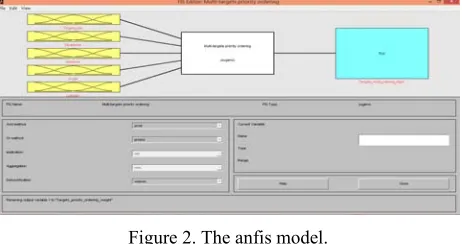
[image:3.612.192.423.389.511.2]Then, the multi-targets priority ordering model based on the ANFIS was established, it can be seen in the Figure 2.
Figure 2. The anfis model.
After 10 steps training, the training error reduced to 3.33 *10-7, it is shown in the Figure 3. It
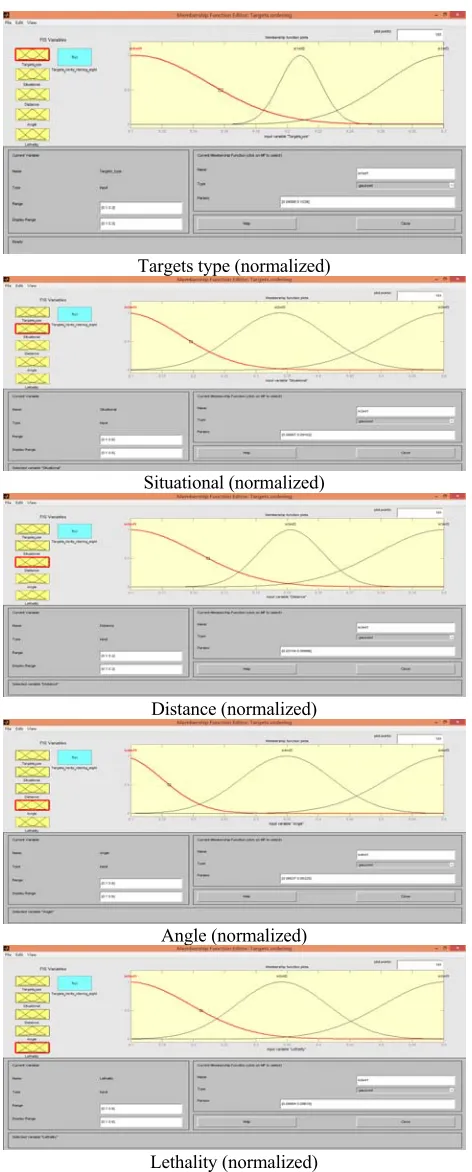
means the ANFIS has very strong non-liner reflecting ability. The adjusting of every input variable membership function can be seen in the Figure 4.
[image:3.612.180.432.563.673.2]Targets type (normalized)
Situational (normalized)
Distance (normalized)
Angle (normalized)
[image:4.612.189.425.61.647.2]Lethality (normalized)
Figure 4. Adjusting of the membership function.
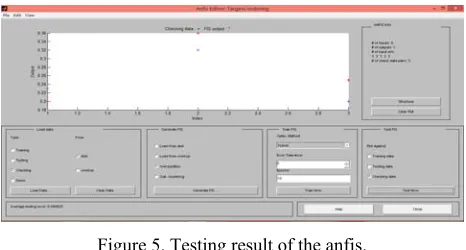
Figure 5. Testing result of the anfis.
[image:5.612.190.423.64.189.2]The comparing of the ANFIS output and the neural networks result is shown in the Table 1.
Table 1. Comparing the anfis output and the neural networks output.
Num Targets priority ordering
weight(normalized) NN result
ANFIS result
1 0.23 0.35 0.2
2 0.32 0.28 0.36
3 0.2 0.15 0.25
It can be seen from the TABLE I that the ANFIS output is different to the targets priority ordering weight result by neural networks. This is because of the adjusting of the input variable membership function. The error is in certain range, which means the result is approved. At the same time, it can be seen that the ANFIS outputs are more accurate than the neural networks result. So, the result of the engine fault prediction by the ANFIS model is good.
Summary
In this paper, the fuzzy neural networks application in multi-targets priority ordering is proposed. The advantages of the method are the following:
a. The membership function of input variable is auto adjusted by the self-learning of the ANFIS, and the artificial factors in the dependability evaluation are avoided.
b. The amount of training data is small then the data demanding of the neural networks. That means the strict requirement of training data can be avoided.
c. The request of the input variable number, kind et al is not strict. The relativity factors of the fault prediction can all be taken as the input variable. Therefore the model has good generalization ability. At the same time, the information reflected by this model is more roundly. The fault predicting is not more based only one index. The result is more reliable than the traditional method result.
d. The result of the ANFIS model has the more accurate targets priority ordering weight result then by using the neural networks, which means the application of the ANFIS in multi- targets priority ordering is more effective.
References
[1]Ju Chuan-wen, Yang Xiu-zhen, Wang Xi-ren etc. Sorting of Multi-target’s threat in multi-sensor management system [J]. Electronics Optics & Control, No. 3(2001), pp. 8-12.
[2]Ma Ying, Zhang Zhijun, Xiao Bingsong etc. Target priority ordering algorithm based on linear weighted method and improved analytic hierarchy process [J]. Journal of Projectiles, Rockets, Missiles and Guidance, Vol. 35(2015), pp. 165-170.
[4]Liu Xin-yi, Shan Gan-lin, Wang Yi-chuan. Method based on Vague set for target priority [J]. Fire control & command control, Vol. 40 (2015), pp: 87-91.
[5]Chen S.M., Tan J.M. Handling multi-criteria fuzzy decision-making problems based on Vague set theory [J]. Fuzzy Sets and Systems, Vol. 114(2000), pp: 103-113.
[6]Chen Sheng lai. Study on target priority evaluation method in airborne sensor management [J]. Computer measurement & control, Vol.12(2012), pp: 3292-32944, 3298.
[7]S. Kumar, in: Neural networks. Beijing: Tsinghua University press (2006).
[8]Sugeno M., Kang G.T. Structure Identification of Fuzzy Model [J]. Fuzzy Sets and Systems, Vol. 28(1998), pp: 15-33.