FUZZY NEURAL NETWORKS WITH GENETIC
ALGORITHM-BASED LEARNING METHOD
M. REZA MASHINCHI
FUZZY NEURAL NETWORKS WITH GENETIC ALGORITHM-BASED LEARNING METHOD
M. REZA MASHINCHI
A thesis submitted in fulfilment of the requirements for the award of the degree of
Doctor of Philosophy (Computer Science)
Faculty of Computing Universiti Teknologi Malaysia
ACKNOWLEDGEMENT
I am deeply grateful to my supervisor, Prof. Dr. Ali Selamat, for his detailed and constructive comments and for his understanding and important support throughout this work. Also, my sincere thanks are due to the official examiners
Assoc. Prof. Dr.
Muhammad Suzuri Hitam, and, Prof. Dr. Siti Mariyam ShamsuddinABSTRACT
ABSTRAK
TABLE OF CONTENTS
CHAPTER TITLE PAGE
DECLARATION ii
DEDICATION iii
ACKNOWLEDGEMENT iv
ABSTRACT v
ABSTRAK vi
TABLE OF CONTENTS vii
LIST OF TABLES xi
LIST OF FIGURES xvi
LIST OF ABBREVIATION xxiv
LIST OF APPENDICES xxv
1 INTRODUCTION 1
1.1 Introduction 1
1.2 Problem background 3
1.3 Problem statement 12
1.4 Thesis aim 13
1.5 Thesis objectives 14
1.6 Thesis scope 14
1.7 Significance of thesis 15
1.8 Contribution of thesis 15
1.9 Thesis plan 16
1.10 Organization of thesis 16
1.11 Summary 18
2 LITERATURE REVIEW 19
2.2 Soft computing techniques 21
2.2.1 Fuzzy sets theory 21
2.2.2 Genetic algorithms (GAs) 30
2.3 Granular computing 37
2.3.1 Structure of granular computing 38
2.3.2 Fuzzy information granulation (FIG) 44
2.3.3 Granular neural networks (GNNs) 48
2.4 Hybrid approaches 61
2.4.1 GA-based fuzzy artificial neural networks
(GA-FANNs) 61
2.4.2 GA-based fuzzy granular neural networks
(GA-FGNNs) 65
2.5 Data sets 69
2.5.1 Liu rule set (Liu, et al., 2005) 71
2.5.2 Aliev rule set (Aliev, et al., 2001) 72 2.5.3 Customer satisfactory rule set (Fasanghari, et
al., 2008) 73
2.5.4 Uranium data set (Staudenrausch, et al., 2005) 74 2.5.5 Uranium data set (Houston, et al., 1987) 75
2.5.6 Wine data set 75
2.5.7 Servo data set 76
2.5.8 Iris data set 76
2.5.9 Concrete compressive strength data set 77
2.5.10 Hepatitis data set 77
2.5.11 Pima Indian diabetes data set 77
2.5.12 Liver disorder data set 78
2.6 Summary 78
3 METHODOLOGY 80
3.1 Introduction 81
3.2 General research framework 81
3.3 Data preparation 82
3.4 Data division 83
3.5 Proposed GA-based fuzzy granular neural networks 83
3.5.1 Proposed granulation 85
3.5.2 Integration and reasoning 96
3.6.1 One-phase GA-based fuzzy artificial neural
networks 102
3.6.2 Proposed two-phase GA-based fuzzy artificial
neural networks 103
3.7 Validation and measurements 106
3.7.1 K-fold validation 106
3.7.2 Error and time 107
3.7.3 Rule strength measurements 107
3.7.4 Goodness-of-fit measurements 108
3.7.4.1 Lilliefors test 108
3.7.4.2 Pearson test 109
3.7.5 Classifier performance measurements 109
3.8 Summary 112
4 RESULTS OF THE PROPOSED METHODS 114
4.1 Introduction 115
4.1.1 General framework 115
4.2 Proposed GA-based fuzzy granular neural networks 116
4.2.1 Granulation 119
4.2.2 Integration and reasoning 121
4.3 Improved two-phase GA-based fuzzy artificial neural
networks 124
4.3.1 Testing on Aliev and Liu data sets 125
4.3.1.1 Phase definitions 126
4.3.1.2 Superiority of the improved method 127 4.3.1.3 Accuracy of the improved method 130
4.3.1.4 Testing and prediction 133
4.3.1.5 Comparison with earlier works 135
4.4 Testing on a uranium data set 137
4.5 Testing on e-commerce data set 140
4.5.1 Testing the designed evaluator systems 143 4.5.2 Accuracy of designed evaluator systems 147
4.6 Discussion 150
4.7 Summary 153
5 TATISTICAL ANALYSIS OF THE PROPOSED METHODS 155
5.1 General framework 155
5.2.1 Statistical results of one-phase method 158 5.2.2 Statistical results of proposed two-phase method 166
5.3 Phase II: Rule strength analysis 179
5.4 Phase III: Classifier performance analysis 185
5.5 Discussion 189
5.6 Summary 190
6 CONCLUSION 191
6.1 Introduction 191
6.2 Summary of work 193
6.3 Research findings and contributions 194
6.4 Limitations of work 195
6.5 Conclusion 196
6.6 Future works 196
REFERENCES 198
LIST OF TABLES
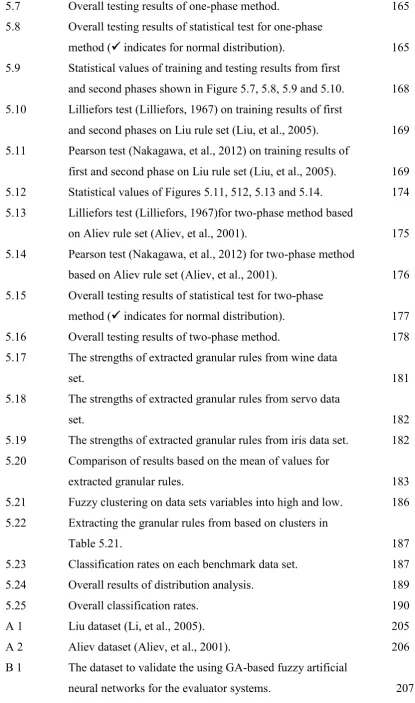
TABLE NO TITLE PAGE
1.1 Related researches on granular computing and descriptions
of each from the soft computing perspective. 4
1.2 List of a few proposed learning methods for fuzzy artificial
neural networks. 10
1.3 Learning convergences of the methods in Table 1.2. 11 1.4 Speed of convergences of the methods in Table 1.2. 12 2.1 Major studies on granular computing streaming to granular
neural networks. 42
2.2 Different studies using the notion of information
granulation. 47
2.3 Some studies on granular classification models. 48 2.4 List of proposed learning methods for fuzzy artificial neural
networks (FANNs). 59
2.5 The major studies for GA-based fuzzy artificial neural
networks (FANNs). 64
2.6 The data sets are used here based on their nature; inexact data sets are used for fuzzy artificial neural networks and
exact data sets are used for granular neural networks. 70 2.7 Liu data set (Liu, et al., 2005) with inputs and and
outcome . 71
3.1 Calculating the weights for the G-rules and eliminating
3.2 Pruning the multi-out G-rules based on the example of
Table 3.1. 96
3.3 Eight possible granular rule bases that can be obtained
based on Table 3.2. 96
4.1 Data sets used in this chapter. 116
4.2 Obtained fuzzy clusters for each data set. 120
4.3 Number of all constructed granular rules before pruning for
each data set. 121
4.4 Number of final granular rules after pruning for each data
set. 121
4.5 Final granular rules, abbreviated as G-rules, for each data set after pruning; they are given in linguistic forms of low
and high, abbreviated as L and H. 121
4.6 The results of GA-based fuzzy granular neural networks compared to GA-based crisp artificial neural networks, where error and time are listed based on improvement
obtained from GA-based fuzzy granular neural networks. 122 4.7 Comparison of one- and two-phase GA-based methods
using the fitness function
F
P given in equation (10). 129 4.8 Comparison results for two-phase GA-based methods usingfour methods of fitness functions , . 130 4.9 Comparison results of training for one and two-phase
GA-based methods using the data set of Table A1 in Appendix
A. 131
4.10 Comparison results of training for one- and two-phase GA-based methods using the data set of Table A2 in Appendix
A. 131
4.11 Inputs to the trained network based on a two-phase method
using data set Table A1 from Appendix A. 134
4.12 Predicted outcomes from the trained network based on a two-phase GA-based method for input values of Table
4.13 Explanations on comparing the proposed method with the
earlier work (Mashinchi, 2007). 137
4.14 Summary of comparisons between proposed method and
other methods. 137
4.15 Estimation of GA-based fuzzy artificial neural networks
based on C1 of Appendix C. 140
4.16 Estimation of GA-based fuzzy artificial neural networks
based on C4 in Appendix C. 140
4.17 The data to validate the use of GA-based fuzzy artificial neural networks for a customer satisfactory evaluator
system. 143
4.18 The training result of one-phase and two-phase evaluator
systems based on data set Table 4.17. 144
4.19 Two new customers’ opinions to test the trained evaluator
systems. 144
4.20 The results of training based on Table B1 of Appendix B. 148 4.21 The testing results of trained one- and two-phase evaluator
systems based on three new customers. 148
4.22 The performance of GA-based fuzzy granular neural networks on iris data set compared to other methods
addressed in a work (Daniel, et al., 2009). 151
4.23 The comparison results of one- and two-phase GA-based methods, where the error and time are given in percentages
based on the two-phase method. 152
5.1 Statistical values of Figures 5.3 and 5.4. 160
5.2 Lilliefors test, at 5% significance level, for one-phase
method based on Liu rule set. 160
5.3 Pearson test (Nakagawa, et al., 2012) for one-phase method
based on Liu rule set (Li, et al., 2005). 161
5.4 Statistical values of Figure 5.5 and Figure 5.6. 163 5.5 Lilliefors test (Liu, et al., 2005) for one-phase method
based on Aliev rule set (Aliev, et al., 2001). 163 5.6 Pearson test (Nakagawa, et al., 2012) for one-phase method
5.7 Overall testing results of one-phase method. 165 5.8 Overall testing results of statistical test for one-phase
method ( indicates for normal distribution). 165 5.9 Statistical values of training and testing results from first
and second phases shown in Figure 5.7, 5.8, 5.9 and 5.10. 168 5.10 Lilliefors test (Lilliefors, 1967) on training results of first
and second phases on Liu rule set (Liu, et al., 2005). 169 5.11 Pearson test (Nakagawa, et al., 2012) on training results of
first and second phase on Liu rule set (Liu, et al., 2005). 169 5.12 Statistical values of Figures 5.11, 512, 5.13 and 5.14. 174 5.13 Lilliefors test (Lilliefors, 1967)for two-phase method based
on Aliev rule set (Aliev, et al., 2001). 175
5.14 Pearson test (Nakagawa, et al., 2012) for two-phase method
based on Aliev rule set (Aliev, et al., 2001). 176 5.15 Overall testing results of statistical test for two-phase
method ( indicates for normal distribution). 177
5.16 Overall testing results of two-phase method. 178
5.17 The strengths of extracted granular rules from wine data
set. 181
5.18 The strengths of extracted granular rules from servo data
set. 182
5.19 The strengths of extracted granular rules from iris data set. 182 5.20 Comparison of results based on the mean of values for
extracted granular rules. 183
5.21 Fuzzy clustering on data sets variables into high and low. 186 5.22 Extracting the granular rules from based on clusters in
Table 5.21. 187
5.23 Classification rates on each benchmark data set. 187
5.24 Overall results of distribution analysis. 189
5.25 Overall classification rates. 190
A 1 Liu dataset (Li, et al., 2005). 205
A 2 Aliev dataset (Aliev, et al., 2001). 206
B 1 The dataset to validate the using GA-based fuzzy artificial
B 2 The dataset to find the capability of using GA-based fuzzy
artificial neural networks for the evaluator systems. 208 C 1 Unsure dataset (Staudenrausch, et al., 2005) modeled in the
form of fuzzy values. 209
C 2 Crisp dataset before granulation (Houston, et al., 1987). 210 C 3 Clusters definition into low and high for each chemical
element of dataset of (Houston, et al., 1987) in the form of
fuzzy numbers . 210
C 4 Linguistic rules correspondent with dataset of (Houston, et al., 1987), which is obtained after granulations and rule
LIST OF FIGURES
FIGURE NO TITLE PAGE
1.1 Granular neural networks and fuzzy neural networks in conjunction with soft computing and granular computing
areas. 4
1.2 An example of crisp modeling in dealing with a function. 5 1.3 An example of fuzzy modeling in dealing with a function. 6 1.4 Different optimum explorations for fitness landscape (Weise,
2007). 7
1.5 A well-shaped fuzzy value represented with eleven α-cuts. 8
1.6 A triangular fuzzy value with two α-cuts. 8
1.7 Different types of fuzzy numbers, triangular and trapezoidal in symmetrical and asymmetrical representation. 9 2.1 An overall view of the involved approaches to derive the
combined approaches. 19
2.2 An overall view of the basic and combined models used in this thesis. The symbol indicates the combination of two models (note: FIG-CANN is denoted for fuzzy information granulation based crisp artificial neural networks, and, CIG-FANN is denoted for crisp information granulation based
fuzzy artificial neural networks). 20
2.3 The role of fuzzy sets with respect to the future and past in collaboration with genetic algorithms (GAs) and granular
neural networks (GNNs). 24
2.4 Simple fuzzy numbers in respect to the normality and
2.5 Well-shaped fuzzy numbers in respect to the normality and
convexity. 26
2.6 Nested intervals in a normal and convex fuzzy number. 27 2.7 Computation of , based on equation (2.5). 28 2.8 Computation of , based on equation (2.9). 29
2.9 General schema of genetic algorithms. 33
2.10 An example of a roulette wheel selection operator in genetic
algorithms. 34
2.11 A typical crossover. 35
2.12 A uniform crossover. 35
2.13 An example of the mutation function. 36
2.14 An example of the idea of granular computing by drawing different approaches under one computational unit, which is given by this thesis based on the studies in the literature. 39 2.15 The procedures of emerging an approach under the model of
granular computing, which is modified by this thesis based
on studies in the literature. 40
2.16 A general model of information granulation. 45
2.17 Crisp artificial neural networks as the conventional class,
which is able to process crisp numerical values. 50 2.18 Granular neural networks as a new class for artificial neural
networks, which is able to process the non-numeric values
formed in granules. 50
2.19 An example of a descriptive neural network in three-layer
feed-forward architecture. 52
2.20 An example of a higher-level of granular neural networks
under the model of granular computing. 52
2.21 Conventional artificial neural networks contrast to the
corresponding ones in the hybrid with the fuzzy model. 54 2.22 Classification of neuro-fuzzy systems (Liu, et al., 2004). 54
2.23 Regular fuzzy neuron (Liu, et al., 2004). 55
2.24 Topological structure of fuzzy artificial neural network (Liu,
2.25 General scheme of GA-based fuzzy artificial neural
networks. 62
2.26 A three-layer, feed-forward fuzzy artificial neural network, where each fuzzy value can be obtained by genetic
algorithms. 62
2.27 Involved techniques to improve the granular neural networks
based on genetic algorithms. 66
2.28 Structure of GA-based fuzzy granular neural networks. 67 2.29 The structure of granulation, in Figure 2.25, for a granular
neural network. 68
2.30 Linguistic variables of the Liu rule set (Li, et al., 2005)
represented in alpha cuts. 72
2.31 Customer evaluation system. 73
2.32 Customer service satisfaction index (Fasanghari, et al., 2008). 74
3.1 General research framework for methodology. 82
3.2 General methodology of GA-based crisp artificial neural
networks. 83
3.3 General methodology of GA-based fuzzy granular neural
networks. 84
3.4 Granulation of crisp data to extract the granular rule base. 85
3.5 Extraction of the granular rules. 86
3.6 The steps of extracting the granular-rules. 87
3.7 The steps of granulation to extract the granular rules from a
crisp data set. 88
3.8 Detail of step 2 of Figure 3.7 to find the intersected parts of
two clusters. 89
3.9 An example for intersecting parts of two granules in a data
set. 90
3.10 Detail of Step 3 of Figure 3.7 to find all possible granular
rules. 91
3.11 Finding all possible rules based on Figure 3.10, following the
example in Figure 3.9. 92
3.12 Detail of Step 4 of Figure 3.7, to prune the repeated granular
3.13 Details of Step 5 in Figure 3.7, to prune multi-output granular
rules. 95
3.14 The methodology of integration and reasoning in GA-based
fuzzy granular neural networks. 97
3.15 Different types of fuzzy neural networks vary based on the
values of biases and weights. 99
3.16 Three-layer fuzzy neural network architecture. 100 3.17 The steps of one-phase GA-based fuzzy artificial neural
networks 102
3.18 Algorithm of one-phase GA-based fuzzy artificial neural
networks. 103
3.19 Schema of two-phase GA-based learning method. 104 3.20 Flowchart of two-phase GA-based learning method. 105
3.21 K-fold cross validation. 106
3.22 Framework to study GA-based granular neural networks. 112 3.23 Framework to study GA-based fuzzy artificial neural
networks. 113
4.1 General framework to conduct the results. 115
4.2 Preparation of the test data for GA-based fuzzy granular
neural networks. 116
4.3 Steps used in implementing GA-based artificial neural
networks and GA-based fuzzy granular neural networks. 118 4.4 The steps of granulation to extract the granular rules from a
crisp data set. 119
4.5 The flowchart of defuzzifier. 122
4.6 Results of phase definitions (shown in the form of first phase% - second phase%) using the data set of Table A(1), where the overall error is computed based on errors from the
first and second phases. 126
4.7 Results of phase definitions (shown in the form of: first phase% - second phase%) using the data set of Table A2, where the overall error is computed based on errors from the
4.8 Membership functions for Small, Medium and Large, where vector X indicates real numbers and indicates the
membership function. 128
4.9 Training results of one- and two-phase GA-based methods
using the data sets of Table A1 of Appendix A. 128 4.10 Training results of one- and two-phase GA-based methods
using the data sets of Table A2 of Appendix A. 129 4.11 Training convergence of the two-phase GA-based method
using the data set of Table A1 in Appendix A. 132 4.12 Training convergence of the two-phase GA-based method
using the data set of Table A2 in Appendix A. 132 4.13 The outcomes from a trained network based on data set of
Tables A1 in Appendix A. 133
4.14 An example of a multimodal error function (Weise, 2007). 136 4.15 Learning behavior of designed GA-based fuzzy artificial
neural networks in terms of generated error by increasing the
training data. 138
4.16 Learning time behavior of designed GA-based fuzzy artificial neural networks by increasing the training data. 138 4.17 Learning behavior of designed GA-based fuzzy artificial
neural networks in terms of generated error using different
populations. 139
4.18 General structure of the one-phase evaluator system. 141 4.19 General structure of the two-phase evaluator system. 141
4.20 The steps of the one-phase evaluator system. 142
4.21 The steps of the two-phase evaluator system. 142 4.22 Two customers’ opinions depicted equivalent to Table 4.19. 143 4.23 Predicted gap for the first test customer using the trained
one-phase evaluator system. 145
4.24 Predicted gap for the second test customer using the trained
one-phase GA-based evaluator system. 145
4.25 Different assignments to the first and second phases of the two-phase evaluator system using the data set of Table B1 in
4.26 Predicted gap for the first test customer using the trained
two-phase GA-based evaluator system. 146
4.27 Predicted gap for the second test customer using the trained
two-phase GA-based evaluator system. 147
4.28 The variation of generated error in different populations
using the one-phase GA-based evaluator system. 148 4.29 Different cases of allotments for the first and second phases
of the two-phase GA-based evaluator system using the Table
B1 data set. 149
4.30 The variation of generated error using the two-phase
GA-based evaluator system. 150
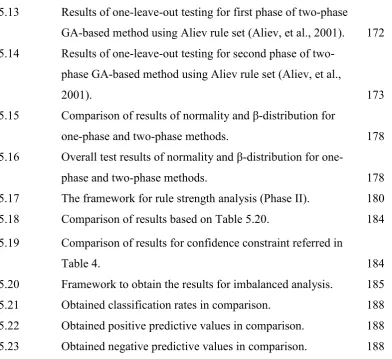
5.1 General framework to conduct the analysis results. 156 5.2 The framework for distribution analysis (phase I). 157 5.3 Results of one-leave-out training for one-phase GA-based
method using Liu rule set. 158
5.4 Results of one-leave-out testing for one-phase GA-based
method using Liu rule set using. 159
5.5 Results of one-leave-out training for one-phase GA-based
method base on Aliev rule set (Aliev, et al., 2001). 161 5.6 Results of one-leave-out testing for one-phase method based
on Aliev rule set (Aliev, et al., 2001). 162
5.7 Results of one-leave-out training for first phase of two-phase GA-based method using Liu rule set (Liu, et al., 2005). 166 5.8 Results of one-leave-out training for second phase of
two-phase GA-based method using Liu rule set (Liu, et al., 2005). 167 5.9 Results of one-leave-out testing for first phase of two-phase
GA-based method using Liu rule set (Li, et al., 2005). 167 5.10 Results of one-leave-out testing for second phase of
two-phase GA-based method using Liu rule set (Li, et al., 2005). 168 5.11 Results of one-leave-out training for first phase of two-phase
GA-based method using Aliev rule set (Aliev, et al., 2001). 170 5.12 Results of one-leave-out training for second phase of
two-phase GA-based method using Aliev rule set (Aliev, et al.,
5.13 Results of one-leave-out testing for first phase of two-phase
GA-based method using Aliev rule set (Aliev, et al., 2001). 172 5.14 Results of one-leave-out testing for second phase of
two-phase GA-based method using Aliev rule set (Aliev, et al.,
2001). 173
5.15 Comparison of results of normality and β-distribution for
one-phase and two-phase methods. 178
5.16 Overall test results of normality and β-distribution for
one-phase and two-one-phase methods. 178
5.17 The framework for rule strength analysis (Phase II). 180
5.18 Comparison of results based on Table 5.20. 184
5.19 Comparison of results for confidence constraint referred in
Table 4. 184
5.20 Framework to obtain the results for imbalanced analysis. 185
5.21 Obtained classification rates in comparison. 188
LIST OF SYMBOLS
- Fuzzy weights of fuzzy artificial neural networks
- Union , where
- Summation , where
- Left boundary of -cut at level l - Right boundary of -cut at level l
- Fuzzy valued bias
- Fuzzy valued input
- fuzzy outcome
- Intersection of edges in FANNs
- Aggregation of edges in FANNs
- Proposed fitness function - Aliev fitness function
- Left boundaries of -cuts target values - Left boundaries of -cuts for target
values
- Left boundaries of -cuts outcome values
- Left boundaries of -cuts outcome values
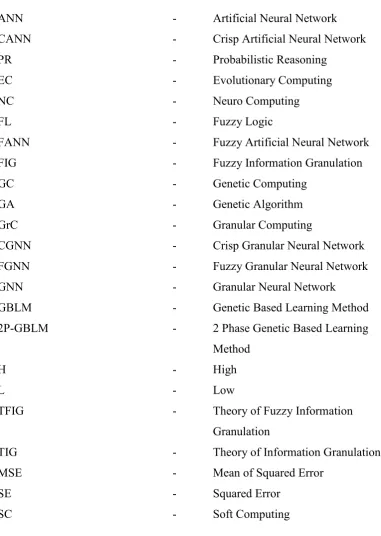
LIST OF ABBREVIATION
ANN - Artificial Neural Network
CANN - Crisp Artificial Neural Network
PR - Probabilistic Reasoning
EC - Evolutionary Computing
NC - Neuro Computing
FL - Fuzzy Logic
FANN - Fuzzy Artificial Neural Network
FIG - Fuzzy Information Granulation
GC - Genetic Computing
GA - Genetic Algorithm
GrC - Granular Computing
CGNN - Crisp Granular Neural Network
FGNN - Fuzzy Granular Neural Network
GNN - Granular Neural Network
GBLM - Genetic Based Learning Method
2P-GBLM - 2 Phase Genetic Based Learning
Method
H - High
L - Low
TFIG - Theory of Fuzzy Information
Granulation
TIG - Theory of Information Granulation
MSE - Mean of Squared Error
SE - Squared Error
LIST OF APPENDICES
APPENDIX TITLE PAGE
A Standard fuzzy rule sets Liu (Liu, et al., 2005) and
Aliev (Aliev, et al., 2001) 205
B Customer satisfactory dataset (Fasanghari, et al.,
2008) 207
C Uranium datasets (Staudenrausch, et al.,
2005)(Houston, et al., 1987) 209
CHAPTER 1
INTRODUCTION
1.1 Introduction
This chapter presents a brief introduction to the notions that are used to achieve the aim of this thesis. The aim is to use granular computing for problems solving. The introduced notions are granular computing, granular neural networks, fuzzy artificial neural networks, fuzzy information granulation, generic algorithms and fuzzy sets theory. The reason for this study is to investigate the aim of artificial computations that is to solve a problem with the least amount of cost and the best accuracy. Problems become more difficult to be solved when their corresponding data sets are large or contain uncertain information. In the literature of artificial computations, there are many nature inspired computations such as evolutionary computations, artificial neural networks, artificial immune systems, swarm intelligence, etc. (Zomaya, 2006) (Kari, et al., 2008). However, there are two issues behind the proposed algorithms; which are the ability of each algorithm to solve only a particular type of problem; and their performance in solving the problem. To overcome these two issues, this thesis uses granular computing with the aid of learning and optimization mechanisms for an optimal learning from granular rules.
Therefore, granular neural networks have been used for learning mechanism; meanwhile fuzzy artificial neural networks are centered in the granular neural networks. Also, the genetic algorithms (GA) are used to increase the performance of fuzzy artificial neural networks. Therefore, GA-based fuzzy artificial neural networks are used in the main part for granular neural networks.
computations as the source of inspiration for artificial computations, the human mind is known to be superior in problem solving, for example processing large and also uncertain information. The superiority of mind is spotted when an attempt is made to solve a complex problem. A problem is called complex when its components or their relations are difficult to understand. Since uncertainties are considered complexity, a problem consisting of uncertainties becomes complex. Solving complex problems is promised by the granular computing model, which has been inspired from the way that the human mind solves such problems. A major key in granular computing is granulation, which is similar to abstraction in the human mind (Zadeh, 1997). Granulation and granular computing are two similar meanings to information granulations. Historically, the notion of granular computing emerged from the theory of information granulation, which initially was proposed based on fuzziness. Similar to granular computing, the theory of fuzzy information granulation is inspired from how the human mind reacts to solve problems (Zadeh, 1997). It is known as a key in the mind-processing mechanism; a system must consider it in solving a complex problem (Zadeh, 1997).
1.2 Problem background
Artificial neural networks have already been positioned as an important class of non-linear systems. They are highly adaptable systems that have been used for many areas of applications. Crisp artificial neural networks are primarily geared toward the intensive processing of numerical data. However, as the dimensionality of the problems increases, the computational complexity becomes visible because the sizes of the data sets grow up rapidly (Pedrycz, et al., 2001). Therefore, the weak points of crisp artificial neural networks are identified as follows:
(i) Inability to tackle large-scale data, which causes inefficient learning within these networks, and thus predicts unsuitable outcomes.
(ii) Inability to process non-numeric data, such as uncertainties and linguistic variables.
Figure 1.1: Granular neural networks and fuzzy neural networks in conjunction with soft computing and granular computing areas.
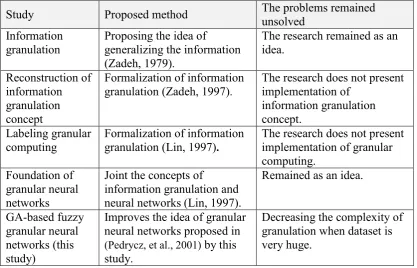
A potential solution for solving complex problems is granular computing. Since 1997, the proposal by L.A Zadeh that described granular computing, this method has become an attractive research area. However, most of the studies in this field are theoretic which needs to be studied in actual applications. Table 1.1 presents a few studies on granular computing, and the remaining issues.
Table 1.1: Related researches on granular computing and descriptions of each from the soft computing perspective.
The problems remained unsolved
Proposed method Study
The research remained as an idea.
Proposing the idea of
generalizing the information (Zadeh, 1979).
Information granulation
The research does not present implementation of
information granulation concept.
Formalization of information granulation (Zadeh, 1997). Reconstruction of
information granulation concept
The research does not present implementation of granular computing.
Formalization of information granulation (Lin, 1997).
Labeling granular computing
Remained as an idea. Joint the concepts of
information granulation and neural networks(Lin, 1997). Foundation of
granular neural networks
Decreasing the complexity of granulation when dataset is very huge.
Improves the idea of granular neural networks proposed in (Pedrycz, et al., 2001) by this study. GA-based fuzzy granular neural networks (this study) Granular computing Soft computing ANN Fuzzy
Based on Table 1.1, this study improves the granular neural based on GA-based fuzzy artificial neural networks. Furthermore, an information granulation has been investigated to extract the fuzzy granules from the crisp data sets. Therefore, in this thesis, fuzzy sets theory has been used for granular neural networks due to the following reasons:
(i) Fuzzy sets support the modeling of the concepts that exhibit continuous boundaries (Pedrycz, et al., 2001) (Hans-Jurgen, et al., 2012). Continuous boundaries are used to represent fuzzy values on real numbers. Fuzzy values are used to tune fuzzy artificial neural networks by genetic algorithms.
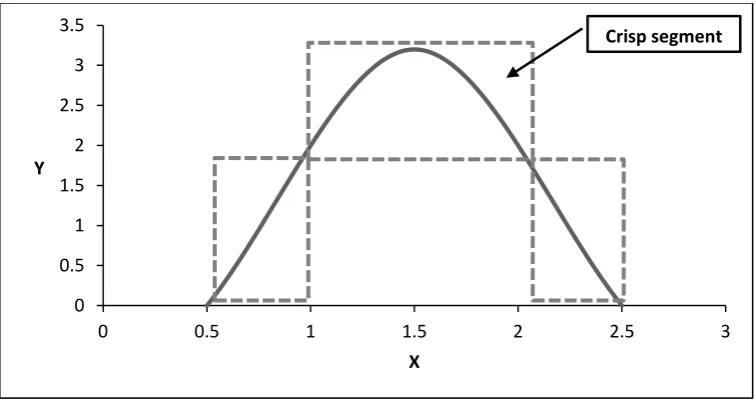
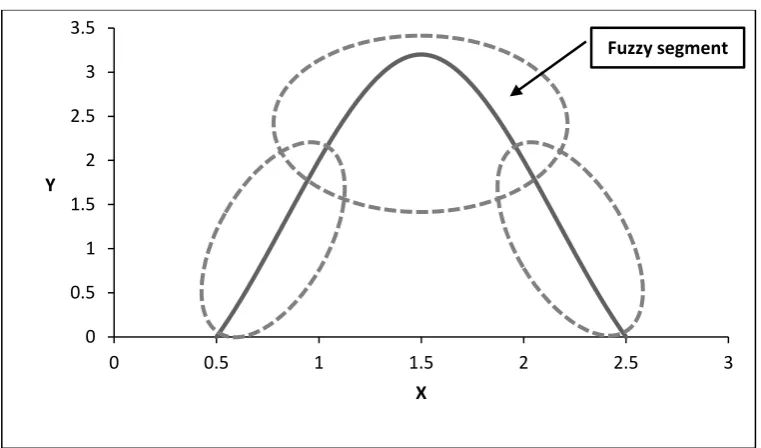
(ii) Fuzzy sets exhibit well-defined semantics and fully meaningful conceptual entities from building modules that are identified in problem solving (Pedrycz, et al., 2001) (Hans-Jurgen, et al., 2012). The originality of the source problem is preserved after modeling it in the fuzzy concept. Meanwhile, it is possible to simplify the fuzzy modeled problem using the concept of granulation. This has been illustrated by two examples in Figure 1.2 and Figure 1.3, respectively with the illustrated modeling of a function in crisp and fuzzy representations. An advantage to fuzzy modeling, as shown in Figure 1.3, is that it does not have the crispness when moving from one segment as a concept to another. This can benefit a rule-based system to decrease the effects from a noisy data.
Figure 1.2:An example of crisp modeling in dealing with a function. 0
0.5 1 1.5 2 2.5 3 3.5
0 0.5 1 1.5 2 2.5 3
Y
X
Figure 1.3: An example of fuzzy modeling in dealing with a function.
Due to the above advantages, (i) and (ii), fuzzy modeling has been combined with artificial neural networks to improve the learning mechanism (Zomaya, 2006). This is called as fuzzy artificial neural networks, which are used in this thesis as the main part of granular neural networks. As the fuzzy artificial neural networks are successfully used in learning and approximate reasoning, improvements are still required to increase their performance. There are some issues that need to be considered as follows:
(i) Finding the global solution: The existing methods are usually being trapped into local minima when searching for the optimal network as shown in Figure 1.4. An accurate learning method is needed to avoid local minima and to find an optimal network similar to what is ideal (Arotaritei, 2011). This becomes more notable when the number of alpha cuts is increased to shape the fuzzy numbers. Having more alpha cuts increases the possibility of trapping in the local minima.
0 0.5 1 1.5 2 2.5 3 3.5
0 0.5 1 1.5 2 2.5 3
Y
X
Figure 1.4:Different optimum explorations for fitness landscape (Weise, 2007).
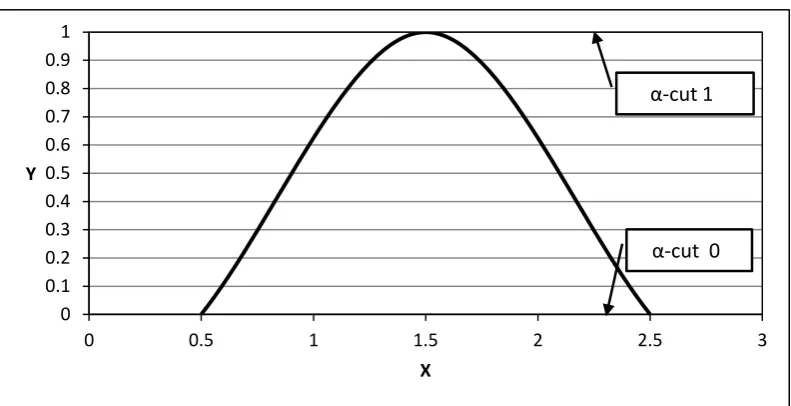
(ii) Increasing the convergence speed: The execution time in finding the optimal network needs to be considered in two cases. First, when learning and reasoning the outcome for an online application. Second, when a well-shaped fuzzy number is needed for a better outcome. Figures 1.5 and 1.6 shows well-shaped fuzzy value with several alpha-cuts and a triangular fuzzy value in two alpha cuts (Lee, 2005) (Hans-Jurgen, et al., 2012). The processing of a well-shaped fuzzy value is more time consuming due to two consequent reasons. First, numerous alpha cuts need to be optimized. Then, they must be optimized within an unconstrained searching space; because the optimal value for each boundary of each alpha-cut can be any real number.
Global optimum
Figure 1.5: A well-shaped fuzzy value represented with eleven α-cuts.
Figure 1.6:A triangular fuzzy value with two α-cuts.
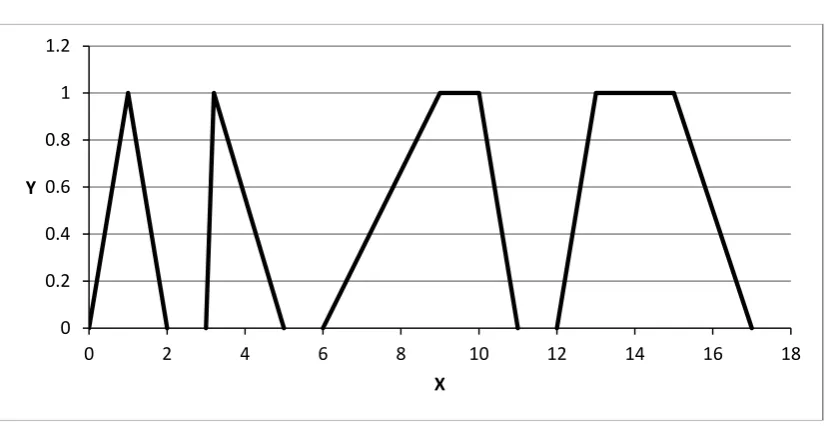
(iv) Dealing with all types of fuzzy values: Most of the existing learning methods for fuzzy artificial neural networks are unable to deal with all kinds of fuzzy numbers (Arotaritei, 2011). This would result in a lack of these networks being applicable to different applications. Therefore, a suitable fuzzy artificial neural network is required to deal with all types of fuzzy numbers as shown in Figure 1.7 (Lee, 2005).
0 0.1 0.2 0.3 0.4 0.5 0.6 0.7 0.8 0.9 1
0 0.5 1 1.5 2 2.5 3
Y
X
α-cut 0
-α-cut 1
-0 1
0 0.5 1 1.5 2 2.5 3
Y
X
α-cut 1
-Figure 1.7: Different types of fuzzy numbers, triangular and trapezoidal in symmetrical and asymmetrical representation.
Based on the above-mentioned issues for fuzzy artificial neural networks, there are some major methods that have been proposed in the literatures. First, the direct fuzzification is proposed that fuzzifies the delta rule from the feed-forward artificial neural networks (Buckley, et al., 1992, 1995), (Hayashi, et al., 1993). This method has been rejected from a theoretical point of view (Liu, et al., 2004). Later, some learning approaches for triangular symmetric fuzzy values were proposed (Ishibuchi, et al., 1995, 2001). However, they are not able to deal with other bounded convex types of fuzzy values. Consequently, an approach based on the derivation of the min-max function has been proposed (Zhang, et al., 1996, 1999), (Liu, et al., 2004, 2005) to deal with all types of bounded convex fuzzy values. In all of the above-mentioned methods, avoiding trapping in local minima is not promised. This is due to using the back propagation algorithm, which is a local optimizer.
Another method used in studying fuzzy artificial neural networks is based on genetic algorithms. Buckley et al (Buckley, et al., 1994) introduced the use of genetic algorithms for the first time, and then Aliev et al. (Aliev, et al., 2001) reintroduced it. The reason of these two studies was using the ability of genetic algorithms to improve the fuzzy artificial neural networks. A recent works has been done for these networks by (Arotaritei, 2011). This method has the ability to deal with all types of fuzzy values that are bounded and convexed. However, the speed of learning convergence still needs to be improved. The summary of mentioned methods is given
0 0.2 0.4 0.6 0.8 1 1.2
0 2 4 6 8 10 12 14 16 18
Y
in Table 1.2; also, a description for each method is given in Table 1.3 and Table 1.4 in terms of learning and the speed of convergences.
Table 1.2: List of a few proposed learning methods for fuzzy artificial neural networks.
Researcher Learning method
Name Advantages Disadvantages
Buckley and Hayashi (1993)
Direct fuzzification
It proposes fuzzy artificial neural networks for the first time, which fuzzifies delta rule form feed-forward artificial neural networks.
It has been rejected from mathematical aspect.
Zhang, et al. (1996)
Derivation of min-max function
It improves fuzzy artificial neural networks to deal with all types of fuzzy values.
It does not have an adequate learning ability.
Aliev et al. (2001)
GA-based FANNs
It applies the idea of using genetic algorithms for fuzzy artificial neural networks, which were firstly sparked in 1994. It could successfully deal with all types of fuzzy values.
It does not have an adequate speed of learning convergence to be applicable for real applications. Mashinchi (2007) Two-phase FANNs based on BP
Proposing FANNs that learn fuzzy rule set in two phases.
Low learning
convergence due to using local optimizer in the first stage.
Mashinchi, et al. (2009)
Three-term fuzzy back-propagation
The proposed method enhances the speed of back-propagation based FANNs by adding a fuzzy
proportional factor.
High possibility of trapping into local minima for learning convergence process. Arotaritei (2011) Local crossover GA-based FANNs
Improves according to feed-forward (FFNR) and fuzzy recurrent networks (FRNN).
Needs to be compared with other methods.
This study
Two-phase GA-based FANNs
It improves the
conventional GA-based method by Aliev in terms of generated error and execution time.
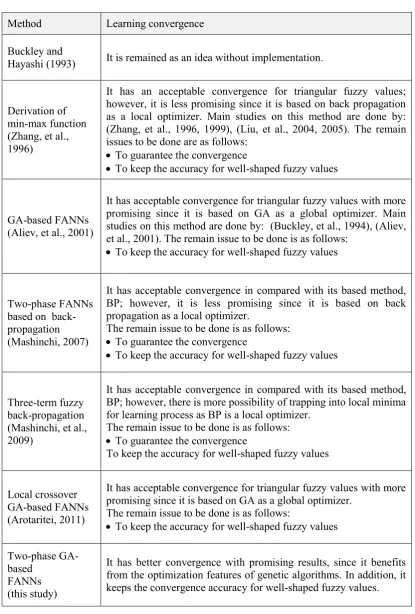
Table 1.3: Learning convergences of the methods in Table 1.2.
Method Learning convergence
Buckley and
Hayashi (1993) It is remained as an idea without implementation.
Derivation of min-max function (Zhang, et al., 1996)
It has an acceptable convergence for triangular fuzzy values; however, it is less promising since it is based on back propagation as a local optimizer. Main studies on this method are done by: (Zhang, et al., 1996, 1999), (Liu, et al., 2004, 2005). The remain issues to be done are as follows:
To guarantee the convergence
To keep the accuracy for well-shaped fuzzy values
GA-based FANNs (Aliev, et al., 2001)
It has acceptable convergence for triangular fuzzy values with more promising since it is based on GA as a global optimizer. Main studies on this method are done by: (Buckley, et al., 1994), (Aliev, et al., 2001). The remain issue to be done is as follows:
To keep the accuracy for well-shaped fuzzy values
Two-phase FANNs based on back-propagation (Mashinchi, 2007)
It has acceptable convergence in compared with its based method, BP; however, it is less promising since it is based on back propagation as a local optimizer.
The remain issue to be done is as follows:
To guarantee the convergence
To keep the accuracy for well-shaped fuzzy values
Three-term fuzzy back-propagation (Mashinchi, et al., 2009)
It has acceptable convergence in compared with its based method, BP; however, there is more possibility of trapping into local minima for learning process as BP is a local optimizer.
The remain issue to be done is as follows:
To guarantee the convergence
To keep the accuracy for well-shaped fuzzy values
Local crossover GA-based FANNs (Arotaritei, 2011)
It has acceptable convergence for triangular fuzzy values with more promising since it is based on GA as a global optimizer.
The remain issue to be done is as follows:
To keep the accuracy for well-shaped fuzzy values
Two-phase GA-based
FANNs (this study)
Table 1.4: Speed of convergences of the methods in Table 1.2.
In order to improve the performance of fuzzy artificial neural networks, this thesis proposes an improved GA-based fuzzy artificial neural network to overcome the speed and the learning convergence when dealing with well-shaped fuzzy values.
1.3 Problem statement
Complex problems are known to be difficult to solve since understanding them is not easy. An example of complex problems is the unsteadiness of things such as linguistic variables. Involving uncertainties and enlargement of the problems to be
Method Speed of convergence
Buckley and Hayashi
(1993) It is remained as an idea without implementation.
Derivation of
min-max function (Zhang, et al., 1996)
It has acceptable speed of convergence in learning triangular fuzzy values, however, there is a remained issue to be done as follows:
To keep the speed of convergence for well-shaped fuzzy values
GA-based FANNs (Aliev, et al., 2001)
It has acceptable convergence for triangular fuzzy values, however, there is a remained to be done as follows:
To keep the accuracy for well-shaped fuzzy values
Two-phase FANNs based on back-propagation (Mashinchi, 2007)
It has better speed of convergence in learning well-shaped fuzzy values in compared with its base method back-propagation. The remained to be done as follows:
To keep the accuracy for well-shaped fuzzy values
Three-term fuzzy back-propagation (Mashinchi and Shamsuddin, 2009)
It has better speed of convergence in compared with its base method back-propagation due to adding a fuzzy proportional factor. The remained to be done is as follows:
To keep the accuracy for well-shaped fuzzy values
Local crossover GA-based FANNs (Arotaritei, 2011)
It has acceptable convergence for triangular fuzzy values, however, there is a remained to be done as follows:
To keep the accuracy for well-shaped fuzzy values
Two-phase GA-based FANNs
(this study)
tackled cause the problems to be complex. To solve complex problems, simplification of the problems and learning mechanisms can be taken. Respectively, fuzzy granulation and fuzzy artificial neural networks can be used. The combination of these two has emerged in granular neural networks, where fuzzy artificial neural networks can play an important role. If the performance of fuzzy artificial neural networks is increased, therefore, the performance of granular neural networks can be improved. Meanwhile, the complex problem needs to be simplified in the form of a fuzzy rule base to be fed to fuzzy artificial neural networks.
Therefore, the hypothesis of this thesis is stated as follows:
“How a complex problem can be solved by granular neural networks
and how fuzzy artificial neural networks can collaborate to increase the performance of granular neural networks in solving complex problems.”
1.4 Thesis aim
1.5 Thesis objectives
The objectives of the thesis are defined as follows:
(i) To propose the reasoning on crisp data sets in fuzzy artificial neural networks using genetic algorithms.
(ii) To propose the transformation of crisp data sets into fuzzy granular rule bases to train fuzzy artificial neural networks.
(iii) To evaluate the performance of proposed fuzzy artificial neural networks based on genetic algorithms with their conventional method and crisp artificial neural networks.
1.6 Thesis scope
The scope of this thesis is defined as follows:
(i) Three standard fuzzy rule sets and six crisp data sets are used to test the improved methods. The rule sets, and also uncertain data sets, are used to test the two-phase GA-based fuzzy artificial neural networks, and the data sets are used to test the fuzzy granular neural networks.
(iii) Comparisons for the improved methods are done in terms of generated errorr, execution time, and distribution. To this end, improved two-phase GA-based fuzzy artificial neural networks are compared with corresponding conventional method, and improved GA-based fuzzy granular neural networks are compared with GA-based crisp artificial neural networks.
(iv) Implementations for GA-based fuzzy artificial neural networks are done using Matlab, and the implementations for GA-based fuzzy granular neural networks and GA-based artificial neural networks are done using Microsoft C++.
1.7 Significance of thesis
The significance of this thesis is as follows:
(i) Fuzzy artificial neural networks based on genetic algorithms have been studied and improved using the notion of granular neural networks.
(ii) Fuzzy artificial neural networks can be studied using available data sets for application, and they have been improved in terms of generated error and execution time.
(iii) A granular rule extraction is proposed to simplify a crisp data set and represent it in fuzzy form.
1.8 Contribution of thesis
This thesis contributes to problem solving via soft computing by granulation. A granular rule extraction is given to simplify the problems, and granular learning approaches are improved for reasoning based on these granules. More specifically, three methods have been proposed in this thesis as follows:
(ii) GA-based fuzzy artificial neural networks are improved in terms of generated error and execution time. The improved method can learn well-shaped fuzzy values represented in alpha-cuts.
(iii) A granulation method is improved to extract fuzzy granular rules from a crisp data set. It prepares the collaboration of crisp data sets with fuzzy artificial neural networks.
1.9 Thesis plan
The direction of the thesis is taken from research background of the author on solving complex problems by human cognition. Here, granular computing and soft computing are chosen due to their similarities with human cognition. Reasoning based on granules is considered for a crisp data set, and thus a granulation method has been presented. The granulation method uses fuzzy representation, and reasoning is based on fuzzy granules. Respectively, fuzzy granulation and fuzzy artificial neural networks are used, and genetic algorithms aid in improving the learning performance. Drawing these three methods under the model of granular computing constructs GA-based granular neural networks as the main idea. The constructed method is presented to achieve the aim and objectives of this thesis. In addition, GA-based fuzzy artificial neural networks are improved due to their impact on enhancing the GA-based fuzzy granular neural networks. Eventually, contribution of this thesis is carried out for improved methods by comparison.
1.10 Organization of thesis
The organization of individual chapters is as follows:
(i) Chapter 1 presents an overview of the thesis. The problem under study is introduced and the reasons for such study are described. The reasoning process by using granules for crisp data sets is highlighted. The background to the problem is given, and previously utilized approaches published in available literature are reviewed. The objectives and scope of the study are defined along with the aim of thesis. Finally, a synopsis of the likely contribution of the study is given according to the defined aims and objectives.
(ii) Chapter 2 introduces the data sets that are used for the experiments. It also provides a review of soft computing, granular computing and the hybrid techniques that have arisen between them. Fuzzy sets theory and genetic algorithms are discussed with respect to soft computing, and fuzzy information granulation and granular neural networks are discussed with respect to granular computing.
(iii) Chapter 3 discusses the methodology of improved methods that is used to carry out this study. Improved GA-based granular neural networks are presented, including the concepts of granulation and GA-based fuzzy artificial neural networks. The granulation method is presented in order to extract the fuzzy granular rules. The general architecture of fuzzy artificial neural networks and the schema of improved GA-based fuzzy artificial neural networks are also presented.
(iv) Chapter 4 presents the detailed implementation and results of the improved granular neural networks. The constructed algorithms of granulation are detailed, including the fuzzy C-mean, granular rules extraction, granular rule contraction, pruning the granular rules and the defuzzifier.
improved GA-based fuzzy artificial neural networks that are given in Chapter 4.
(v) Chapter 5 reveals the analysis results for distribution, rule strength, and classifier performance. The results are obtained from the proposed methods: two-phase based fuzzy artificial neural networks, granulation, and GA-based fuzzy granular neural networks. The results are carried out in compared with one-phase GA-based fuzzy artificial neural networks and GA-based crisp artificial neural networks, which are based on three data sets: Liver disorder, hepatitis, and diabetes.
(vi) Chapter 6 discusses the work that has been done to complete this study. The proposed approaches are discussed and the work is summarized to conclude the results and analysis of Chapter 4. Finally, the future work is addressed in this chapter.
1.11
Summary
REFERENCES
Aliev R.A., Fazlollahi B. and Vahidov R.M. (2001). Genetic Algorithm-based Learning of Fuzzy Neural Network. Part 1. Feed-forward Fuzzy Neural Networks, Fuzzy Sets and Systems. 118, pp. 351–358.
Angelov P., Xiaowei Z. and Klawonn F. (2007). Evolving Fuzzy Rule-based Classifiers. IEEE Symposium on Computational Intelligence in Image and Signal Processing. pp. 220-225.
Arotaritei D. (2011). Genetic Algorithm for Fuzzy Neural Networks using Locally Crossover. International Journal of Computers, Communications & Control. 5, pp. 8-20, ISSN 1841-9836.
Bargiela A. and Pedrycz W. (2002). Granular Computing: An Introduction. Boston: Kluwer Academic Publishers.
Brereton R.G. (2009). Steepest Ascent, Steepest Descent, and Gradient Methods. Comprehensive Chemometrics. 1, pp. 577-590.
Buckley J.J., Reilly K.D, and Hayashi Y. (1994). Genetic Learning Algorithms for Fuzzy Neural Nets. IEEE World Congress on Computational Intelligence. 3, pp. 1969–1974.
Buckley J.J. and Hayashi Y. (1992). Fuzzy Neural Nets and Applications. Fuzzy Sets and AI. 1, pp. 11–41.
Buckley J.J. and Hayashi Y. (1995). Neural Nets for Fuzzy Systems. Fuzzy Sets and Systems. 71, pp. 265–276.
Chelouah R. and Siarry P. (2003). Genetic and Nelder-Mead Algorithms Hybridized for a More Accurate Global Optimization of Continuous Multiminima Functions. European Journal of Operational Research. 148, pp. 335-348.
Collani E. V. (2008). Defining and Modeling Uncertainty. Journal of Uncertain Systems. 2, pp. 202-211.
Daniel F. L., Pyramo C. Jr. and Gomi F. (2009). Evolving Granular Classification Neural Networks. IEEE International Joint Conference on Neural Networks. pp. 1736-1743.
Der-Chiang L., Chiao-Wen L. and Hu S. C. (2010). A Learning Method for the Class Imbalance Problem with Medical Datasets. Computers in Biology and Medicine. 40, pp. 509-518.
Dick S. and Kandel A. (2001). Granular Weights in a Neural Network. IFSA World Congress and 20th NAFIPS International Conference. 3, pp. 1708-1713.
Fasanghari M. and Roudsari F. H. (2008). The Fuzzy Evaluation of E-Commerce Customer Satisfaction. World Applied Sciences Journal. 4, pp. 164-168.
Fasanghari R. M. and Habibipour F. (2008). The Fuzzy Evaluation of E-Commerce Customer Satisfaction. World Applied Sciences Journal. 4(2), pp. 164-168.
Fawcett T. (2006). An Introduction to ROC Analysis. Pattern Recognition Letter. 27, pp. 86-874.
Gabrys B. and Bargiela A. (2000). General Fuzzy Min-Max Neural Network for Clustering and Classification. 11(3), pp. 769-783.
Giunchglia F. and Walsh T. (1992). A Theory of Abstraction. Artificial Intelligence. 323-390 , pp. 56.
Guangfei Y. (2011). A Novel Evolutionary Method to Search Interesting Association Rules by Keywords. Expert Systems with Applications. 38, pp. 13378-13385. Hamrouni T., Yahia S. B. and Nguifo E. M. (2009). Sweeping the Disjunctive Search
Space Towards Mining New Exact Concise Representations of Frequent Itemsets. Data and Knowledge Engineering. 10, pp. 1091–1111.
Hayashi Y., Buckley J.J. and Czogola E. (1993). Fuzzy Neural Networks with Fuzzy Signals and Weights, International Joural of Intelligent Systems. 8, pp. 527-537. He H. and Garcia A. E. (2009). Learning from Imbalanced Data, IEEE Transactions
on knowledge and Data Engineeting. 21(9), pp. 1263-1284.
He H. (2009) Learning from Imbalanced Data. IEEE Transactions on Knowledge and Data Engineeting. 21(9), pp.1263-1284.
Hoheisela T., Kanzowa C., and Mordukhovich B. S. (2012). Generalized Newton’s Method Based on Graphical Derivatives. Nonlinear Analysis: Theory, Methods & Applications. 75(3), pp. 1324-1340.
Holland H. J. (1975). Adaptation in Natural and Artificial Systems, University of Michigan Press.
Holland H. J. Genetic Algorithms (1992). Scientific America, 267, pp. 66-72.
Houston R.S. and Karlstrom D.E. (198). Application of The Time and Strata Bound Model for The Origin of Uranium Bearing Southeastern Wyoming. Deposits in Proterozoic Quartz-pebble Conglomerates, Report of The Working Group on Uranium Geology Organized By The International Atomic Energy Agency. - USA : IAEA-TECDOC-427.
Hans-Jurgen S. and Antonsson E. K. (2012). Fuzzy Sets in Engineering Design and Configuration. International Series in Intelligent Technologies. 9, ISBN: 978-0-7923-9802-8.
Ishibuchi H. and Nii M. (2001). Numerical Analysis of Learning of Fuzzified Neural Networks from Fuzzy If-Then Rules. Fuzzy Sets and Systems. 120, pp. 281–307. Ishibuchi H., Kwon K. and Tanakan H. A (1995). Learning Algorithm of Fuzzy
Neural Networks with Triangular Fuzzy Weights. Fuzzy Sets and Systems. 71, pp. 277-293.
Jea K. F. and Chang M. Y. (2008). Discovering Frequent Itemsets by Support Approximation and Itemset Clustering. Data and Knowledge Engineering. 65(1), pp. 90–107.
Kari L. and Rozenberg G. (2008). The Many Facets of Natural Computing. 51(10), pp. 72-83
Karmarkar N. (1984). A New Polynomial Time Algorithm for Linear Programming. Combinatorica, 4(4), pp. 373–395.
Karush W. (1939). Minima of Functions of Several Variables with Inequalities as Side Constraints. Chicago : Department of Mathematics, University of Chicago. Kasabov N. and Woodford B. (1999). Rule insertion and Rule Extraction from
Evolving Fuzzy Neural Networks: Algorithms and Applications for Building Adaptive, Intelligent Exert Systems. IEEE International Fuzzy Systems. 3, pp. 1406-1411.
Kuhn H. W. and Tucker A. W. (1951). Nonlinear Programming, Second Berkeley Symposium. Berkeley: University of California Press, pp. 481-492.
Kwak K. and Pedrycz W. (2010). A Design of Genetically Oriented Linguistic Model with the Aid of Fuzzy Granulation. IEEE International Conference on Fuzzy Systems. pp. 1-6.
Lam P. S., Bouzerdoum A. and Hoang N. G. (2009). Learning Pattern Classification Tasks with Imbalanced Data Sets. Pattern recognition, pp. 193-208.
Lee K. H. (2005). First Course on Fuzzy Theory and Applications. Advances in Soft Computing. Springer Berlin / Heidelberg.
Li P. and Li H.X. (2005). Approximation Analysis of Feed Forward Regular Fuzzy Neural Network with Two Hidden Layers. Fuzzy Sets and Systems. 150, pp. 373– 396.
Li Y. and Yu F. (2010). Optimized Fuzzy Information Granulation Based Machine Learning Classification. Seventh International Conference on Fuzzy Systems and Knowledge Discovery (FSKD). 1, pp. 259-263.
Lilliefors H. W. (1967). On the Kolmogorov-Smirnov Test for Normality with Mean and Variance Unknown. Journal of the American Statistical Association. 62, pp. 399-402.
Lilliefors H. W. (1969). On the Kolmogorov-Smirnov Test for the Exponential Distribution with Mean Unknown. Journal of the American Statistical Association. 64, pp. 387–389.
Lin T. Y., Yao Y. Y. and Zadeh L. A. (2002). Data Mining, Rough Sets and Granular Computing. Germany: Physica-Verlag GmbH Heidelberg, pp. 110-1537.
Lin T.Y. (1997). From Rough Sets and Neighborhood Systems to Information Granulation and Computing in Words. European Congress on Intelligent Techniques and Soft computing. pp. 1602-1607.
Liu P. and Li H.X. (2005). Approximation Analysis of Feed Forward Regular Fuzzy Neural Network with Two Hidden Layers. Fuzzy Sets and Systems. 150, pp. 373– 396.
Liu P. and Li H.X. (2004). Fuzzy Neural Network Theory and Application, World Scientific, River Edge, NJ.
Mashinchi M. H. (2007). A New Fuzzy Back-propagation Learning Method Based on Derivation of Min-max Function Tuned with Genetic Algorithms. Master Thesis, Universiti Teknologi Malaysia.
Mashinchi M. H. and Shamsuddin S. M. (2009). Three-term Fuzzy Back-Propagation. Foundation of Computational Intelligence. 201, pp 143-158.
Maydeu-Olivares A. and Garca-Forero C. (2012). Goodness-of-Fit Testing. International Encyclopedia of Education. International Encyclopedia of Education Oxford: Elsevier, pp. 190-196.
Nakagawa S., Hashiguchib H. and Naoto N. (2012). A Measure of Skewness for Testing Departures from Normality. Computational Statistics and Data Analysis. To Be Appeared.
Narushima Y. and Yabeb H. (2012). Conjugate Gradient Methods Based on Secant Conditions that Generate Descent Search Directions for Unconstrained Optimization. Journal of Computational and Applied Mathematics. 236(17), pp. 4303-4317.
Panoutsos G. A., Mahfous M., Mills G. H., and Brown B. H. (2010). Generic Framework For Enhancing The Interpretability of Granular Computing-based Information, IEEE International Conference on Digital Object Identifier. pp. 19-24.
Pawlak Z. (1987). Rough logic. Bulletin of Polish Academic Science and Technology. 35, pp. 253-258.
Pedrycz W. and Gacek A. (2002). Temporal Granulation and its Application to Signal Analysis. Information Sciences. 143, pp. 47.
Pedrycz W. and Valente D. O. J. (2008). A Development of Fuzzy Encoding and Decoding Through Fuzzy Clustering. IEEE Transactions on Instrumentation and Measurement. 57(4), pp. 829-837.
Pedrycz W. and Vukovich G. (2001). Granular Neural Networks. Neurocomputing. 36, pp. 205-224.
Pedrycz W. (2001). Granular Computing: An Emerging Paradigm. Heidelberg: Physica-Verlag,.
Reformat M. and Pedrycz W. (2001). IEEE Evoluionary Optimization of Information Granules. IFSA World Congress and 20th NAFIPS International Conference. 4, pp. 2035-2040.
Sijtsma K. and Emons W. H. M. (2010). Nonparametric Statistical Methods. International Encyclopedia of Education, Elsevier, pp. 347-353.
Simpson P. (1992). Fuzzy Min-Max Neural Networks. Part I: Classification. IEEE Tranactions on Neural Networks. 3-5, pp. 776-786.
Sivanandam S. N. and Deepa S. N. (2008). Introduction to Genetic Algorithms. Springer Berlin Heidelberg.
Staudenrausch S. (2005). Diversity of The Ectomycorrhiza Community at a Uranium Mining Heap, Biol Fertil Soils. 41, pp. 439-446.
Tsoukalas L. H and Uhrig R. E. (1997). Fuzzy and Neural Approaches in Engineering, New York: John Wiely & Sons Inc.
Weise T. (2007). Global Optimization Algorithms – Theory and Application. Thomas Weise, Online available as e-book at http://www.it-weise.de.
Yao Y. Y. and Yao J. T. (2002). Induction of Classification Rules by Granular Computing. Rough Sets and Current Trends in Computing, Proceedings of the Third International Conference on Rough Sets and Current Trend in Computing. pp. 331-338.
Yao Yiyu (2010). Human-Inspired Granular Computing. Novel Development in Granular Computing: Applications for Advanced Human Reasoning and Soft Computation. 212, pp. 15-143.
Yeung D. S. (2010). Sensitivity Analysis for Neural Networks. Verlag Berlin Heidelberg: Springer.
Yu F. and Cai R. (2010). Optimized Fuzzy Information Granulation of Temporal Data. Seventh IEEE Internation Conference on Fuzzy Systems and Knowledge Discovery. 1, pp. 419-423.
Zadeh L.A. (1965). Fuzzy Sets. Information and Control. 8, pp. 338-359.
Zadeh L.A. (1979). Fuzzy Sets and Information Granularity. Advances in Fuzzy Set Theory and Applications. Editors: M. Gupta R. Ragade, R. Yager. Amsterdam: North-Holland, pp. 3-18.
Zadeh L. A. (1997). Toward a Theory of Fuzzy Information Granulation and its Centrality in Human Reasoning and Fuzzy Logic. Fuzzy Sets and Systems. 90 pp. 111-127.
Zhang X. (1999). An Efficient Computational Algorithm for Min-Max Operations. Fuzzy Sets and Systems. 104, pp. 297–304.
Zhang X., Hang C.C. and Wang P.Z. (1996). The Min-Max Function Differentiation and Training Of Fuzzy Neural Networks. IEEE Transactions on Neural Networks. 7, pp. 1139–1150.
Zhao Y., Yao Y. and Yao J. T. (2006). Level-wise Construction of Decision Trees for Classification. International Journal of Software Engineering and Knowledge Engineering, World Scientific Publishing, 16(1), pp. 103-126.
Zheng R.T. (2005), A Staged Continuous Tabu Search Algorithm for the Global Optimization and its Applications to the Design of Fiber Bragg Gratings, Computational Optimization and Applications. 30, pp. 319–335.
Zhou Z., Jiang Y. and Chen S. (2000). A General Neural Framework for Classification Rule Mining. International Journal of Computers, Systems, and Signals. 1(2), pp. 154-168.