Munich Personal RePEc Archive
Program Management for Social
Development
Kannan, Srinivasan
AMCHSS
2009
Online at
https://mpra.ub.uni-muenchen.de/14178/
Program Management for Social Development
Dr. Kannan Srinivasan
Associate Professor
Achutha Menon Centre for Health Science Studies
Sree Chitra Tirunal Institute for Medical Sciences and Technology Thiruvanthapuram
Program Management
Program Management is an important step in Social Development. There are variety of uses of the term "program" in organizations. In general use, a program is a collection of organizational resources that is geared to accomplish a certain major goal or set of goals. This definition of a program is similar to that of an organization and a system. A program is also an organization and a system. It is created for a purpose for a time period. Program is a time bound set of activities having larger scope than a project. Otherwise the steps of Program Management is similar to that of Project Management.
Planning
[image:2.612.75.245.533.709.2]Planning is an important thing performed before any program. In national level planning is an effort to allocate resources for the Goal spelt out by the government. Countries like India have an experience of Five Year Plans for more than 50 years. Later the developed countries followed this model. In program management the first step is planning. This will help the public authority to prioritise the allocation for different sectors. This is also applicable within a sector. Planning is an exercise which is done after the governments set their goal based on the vision the country has. Generally these are set based on the long term requirement of the nation. Planning being a long term effort it is important to foresee the long term goals of a nation. The following chart shows the different levels of planning process. It starts with the vision and mission of the country, followed by the goals, objectives, programs, projects, and they are broken down to different tasks.
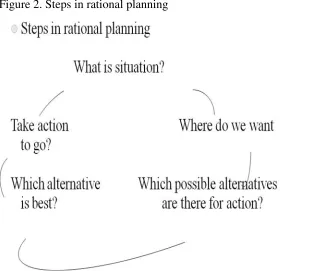
According to Green in planning there are different approaches. One approach is called comprehensive rationalism. According to Green, the comprehensive rationalism, first one has to analyse the situation, followed by the where does a country want the planning to happen, then followed by the analysis of possible alternatives, selection of best alternatives and acting on them. Following figure explains the comprehensive rationalism.
[image:3.612.73.382.211.482.2]Comprehensive rationalism
Figure 2. Steps in rational planning
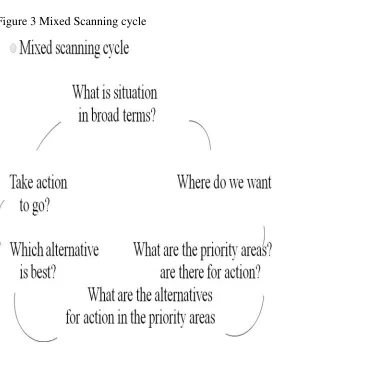
The second approach is called mixed scanning cycle. As per this, the analysis of the situation follows the where a country wants to go, followed by the priority areas, the possible alternatives, selecting best alternatives and taking the action. This is given in Figure 3.
Figure 3 Mixed Scanning cycle
Source: Green, Andrew, An introduction to Health Planning for developing health systems, Third Edition, Oxford University Press, 2007
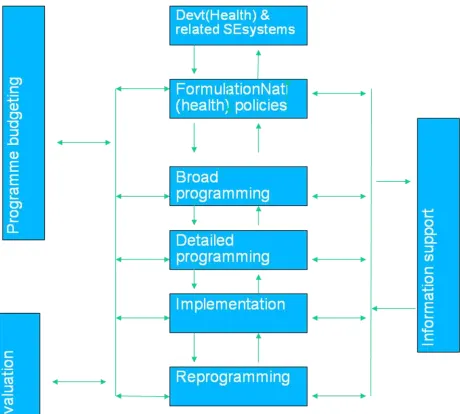
Figure 4 Managerial Process for National Health Development WHO
Source: Managerial Process for National Health Development Guiding Principles for use in support of strategies for health for all by the year 2000, WHO 1981, accessed from
http://whqlibdoc.who.int/publications/9241800054.pdf
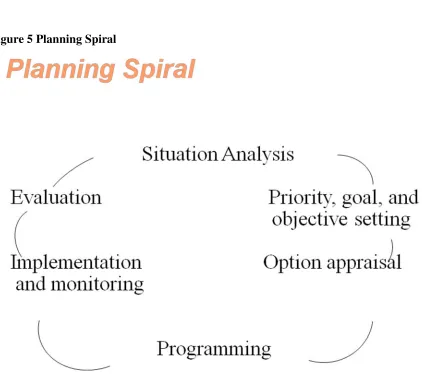
Figure 5 Planning Spiral
Source: Green, Andrew, An introduction to Health Planning for developing health systems, Third Edition, Oxford University Press, 2007
Situational analysis
Situation analysis is the first step in planning. In this step we study the current projected situation such as demographic pattern, future development needs, identification of the socio-economy and provision of other sectors, infrastructure of the development sector and the pattern of services provided such as facilities, utilization, organisational structure, interrelationships, current and future resources of the sector-financial and real resources- personnel, equipment, buildings and the Environment including political, socio-cultural and economic environment are studied. The sectors other than the selected sectors are important because they may have an impact on the current program. For an example, in health the provision of drinking water and draining facilities will have direct impact on a program related to water born diseases.
Priority Setting
What a program wants to achieve ?
Whether the program is influenced by the situational analysis, development needs such education and health needs ?
Whether the program is influenced by the broad policy objectives of the organization or state?
Whether priorities are feasible within politico-social climate and within the context of available resources?
Whether the clear criteria for the selection of priority problems needed? Whether the proposed program is Politically feasible?
Rationale for planning
Planning is inevitable because there is a shortfall in available resources and all of them have competing utilities. For an example, in health program, if I allocate a physician for a specific program he may have to forego the day to day practices, which is also an important activity one has to get involved. So it is important to note how decisions has to be made to use of such resources. It is also important to note that this will depend on how the how the priorities are set.
Approaches of planning
In general there are two types of planning. a. Demand based market mechanism and b. need-based planning approach. In the demand based planning the market forces plays a vital role. Depending upon the availability of the resource the demand for the resource vary. This will decide the availability of the resource. The plan will be adapted according to the availability. In need based planning approach, the planning done based on the need irrespective of the availability of the resource. For an example, if there is a shortage of manpower in a specialty, the planner will go ahead planning a required number of personnel in such specialty. This is basically assuming that the manpower will be mobilized from other sources or countries. Here the objective is not to postpone the program due to non availability of some resources.
One of the major functions of planning process is to determine major needs, to devise suitable programs for meeting them and allocate resources accordingly. In general there are limitations of resources to meet the needs. In this situation one has to decide on which one to meet and which have to be left. By just achieving economic development one will not remove the need for priority setting.
Setting Priorities
The next step is to setting priorities. Based on the situation analysis the planners will know the ground level situation on various problems. This will help in prioritise the problems. It is also observed that different approaches planning lead to different results. So it is crucial to adapt an approach which gives maximum benefit to the community. Now the issue is to answer the following questions.
•Who should set priorities?
•How one should set priorities?
•The underlying factors and attitudes towards priorities
Programming
The next step in the planning is Programming. On popular method in programming is called Logical Framework Analysis. This is a method which has been used by many of the development agencies for the program management. This gives a framework which helps one to plan the program well ahead by identifying the inputs, outputs and the verifiable indicators for monitoring and evaluation.
Logical Framework Analysis
Logical Framework Analysis is a design which is used for planning, designing, implementing and evaluating projects or programs. There four major steps in LFA. They are,
1. Situational Analysis 2. Strategy Analysis 3. Project Planning matrix 4. Implementation
In the Situation Analysis stage the program manager has to perform following analyses. 1. Stakeholder Analysis
2. Problem Analysis 3. Objective Analysis
In Stakeholder Analysis the program manager has to look for the stakeholders involved in the program, the facilitators involved in program, the type of expertise needed, and so on. For that purpose following questions will be raised.
Who are the stakeholders involved in the project and how are they affected? Who will be involved?
Where ?
Who will facilitate the development?
What background materials, documents, and expertise needed? What materials and logistics required?
In the next step of situational analysis, the analysis of problems is performed. For that purpose the following questions to be raised.
Which are the problems the project is addressing? What are the root causes of the those problems?
What is the larger picture in which those problems and their root causes exist? What are the linkages between problems?
For this purpose a problem tree approach is followed. It is basically a brainstorming approach, in which all the stakeholders are asked to discuss the problems and list the causes of the problems stated. Then the problems are displayed and moved up and down to develop a tree structure explaining the cause and effect at various levels of the problem.
This is basically a positive mirror of problem tree. Here, The problems are restated as objectives. This will help in stating the objectives, goals and strategies in the LFA.
Logical Framework Matrix
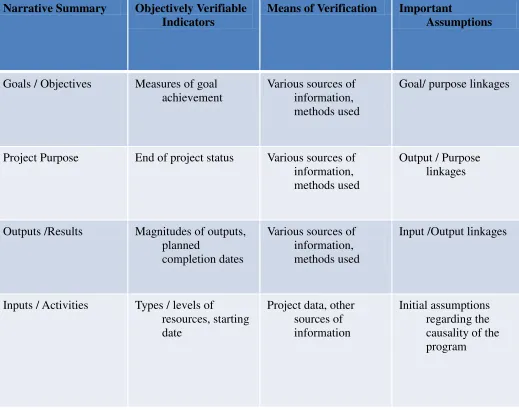
Refer Figure 6. This is a matrix of the LFA for program management. This a matrix which is developed based on the objectives identified using the objective tree. Based on the levels of the objectives from the bottom to top the objectives are listed from outputs to goals. The beauty of this matrix is one has to commit the indicators which are verifiable in nature. It is also important for one to commit the means of verification. For an example, if one gives training as an objective, one has to give indicators such as number of people to be trained, number of districts to be covered, and so on as indicators. For the verification one has to mention the training register showing the number of trainers attended the training, the training schedule with the topics of training, and so on. This will help one to monitor and evaluate the program easily.
Narrative Summary Objectively Verifiable
Indicators
Means of Verification Important
Assumptions
Goals / Objectives Measures of goal achievement
Various sources of information, methods used
Goal/ purpose linkages
Project Purpose End of project status Various sources of information, methods used
Output / Purpose linkages
Outputs /Results Magnitudes of outputs, planned
completion dates
Various sources of information, methods used
Input /Output linkages
Inputs / Activities Types / levels of
resources, starting date
Project data, other sources of information
[image:9.612.69.588.255.665.2]Initial assumptions regarding the causality of the program
Figure 6 LFA Matrix
Conclusion
From the above it is very clear that the program management is not just planning a development program, but also gives a framework for monitoring and evaluation. This will also help one to plan the program with required resources with a clear deliverables and outputs.
Reference
1. Ashwani Saith, M. Vijayabaskar, ICTS and Indian Economic Development: Economy, Work, Regulation, SAGE Publications, 2005
2. Butler, Douglas, "India - technology in education some reflections on a recent seminar tour of Western India", ICT Training Centre, Oundle School, UK,
www.argonet.co.uk/oundlesch, May 2001
3. Green, Andrew, An introduction to Health Planning for developing health systems, Third Edition, Oxford University Press, 2007
4. LFA, UNSO Office to Combat Desertification and Drought, Capacity Building Workshop for Dryland Management Beirut, Lebanon May 3-5, 2000 UNDP http://www.undp.org/seed/unso
5. Managerial Process for National Health Development Guiding Principles for use in support of strategies for health for all by the year 2000, WHO 1981, accessed from
http://whqlibdoc.who.int/publications/9241800054.pdf on March 20 2009.
6. Michael Dougherty, Exploring New Modalities Experiences with Information and Communications Technology Interventions in the Asia-Pacific Region A Review and Analysis of the Pan-Asia ICT R&D Grants Programme UNDP-APDIP ICT4D Series 2006
7. Rao, T.P. Rama, "ICT for Social Development: Some Experiences and Observations", Center for Electronic Governance, Indian Institute of Management, Ahmedabad- Prepared for IT Seminar on 18th September, 2004, at Madras Institute of Development Studies, Chennai.
8. Snyder, Kristen, "The Digital Culture and Communication: More than just Classroom Learning", Mid Sweden University, Seminar.net - International journal of media, technology and lifelong learning Vol. 1, Issue 2, 2005