Optimal Placement of Distributed Generation for
Reliability Benefit in Distribution Systems
N. Rugthaicharoencheep, A. Chalangsut
Department of Electrical Engineering, Faculty of Engineering, Rajamangala University of Technology Phra Nakhon, Bangkok, Thailand
Email: [email protected]
Received February, 2013
ABSTRACT
A distributed generator is a small-scaled active generating unit located on or near the site where it is to be used. Several benefits have been realized by installing distributed generators in a distribution network. Among them is reliability im-provement if their locations and sizes are appropriately determined. For this reason, reliability benefit is investigated in this paper with the main objective for the optimal placement and sizing of distributed generators in a distribution system to minimize the customer interruption cost subject to the maximum number of distributed generators, total capacity of distributed generators, bus voltage limits, current transfer capability of the feeders and only one distributed generator for one installation position. The technique employed to solve the minimization problem is based on a developed Tabu search algorithm and reliability worth analysis. The Tabu search algorithm is a local search that uses memory to avoid being trapped around a local neighborhood and help to move away from a local optimum solution. The reliability worth analysis provides an indirect measure for cost implication associated with power failure. The developed methodology is tested with a distribution system of Provincial Electricity Authority (PEA). Numerical results from the tests demonstrate that distributed generators can be used to promote the reliability of the distribution system.
Keywords: Distributed Generation; Reliability; Tabu Search; Distribution System
1. Introduction
Electricity has always been the major part of human de-velopment and it has gone through various changes with time. Traditionally, much of the electricity generated has been produced by large-scaled, centralized power plants using fossil fuels (e.g., coal, oil and gas), hydropower or
nuclear power. The electrical energy is transmitted over long distances by extra high voltage (EHV) or ultra high voltage (UHV) transmission lines and from there the high voltage levels are converted to low voltage levels through distribution lines in the distribution system to end-use customers [1].
Such a centralized generation pattern, however, suffers a number of drawbacks, such as a high level of depend-ence on imported fuels that are very vulnerable, trans-mission losses, the necessity for continuous upgrading and replacement of the transmission and distribution fa-cilities and therefore high operating cost, and environ-mental impact. In addition, as electric demand is substan-tially increasing as a result of economic and social growths, the construction of a large sized power plant is running into financial and technical difficulties, because it is capital intensive and needs considerable amount of time.
An ideal alternative on electric distributions to electric users is the installation of a small sized generator or commonly known as distributed generator (DG). DG is a small-scale active generating unit located on or near the site where it is to be used (i.e., in distribution systems).
The primary energy resources of DG could be wind, so-lar, biomass, fuel cells and hydrogen, etc [2].
The technique employed to solve the minimization problem is based on a developed Tabu search algorithm and reliabilty worth analysis. The Tabu algorithm sys-tematically searches solutions expressed in forms of the location and size of DGs. The solution obtained will then be passed to reliability worth analysis to evaluate the quality of the solution. The process is repeated until the best solution has been found. The developed methodol-ogy is tested with a distribution system of Provincial Electricity Authority (PEA) with 26 load points.
2. Tabu Search
Tabu search is a meta-heuristic that guides a local heuris-tic search strategy to explore the solution space beyond local optimality [4]. The basic idea behind the search is a move from a current solution to its neighborhood by ef-fectively utilizing a memory to provide an efficient search for optimality. The memory is called “Tabu list”, which stores attributes of solutions. In the search process, the solutions are in the Tabu list cannot be a candidate of the next iteration. As a result, it helps inhibit choosing the same solution many times and avoid being trapped into cycling of the solutions [5]. The quality of a move in solution space is assessed by aspiration criteria that pro-vide a mechanism for overriding the Tabu list. Aspiration criteria are analogous to a fitness function of the genetic algorithm and the Bolzman function in the simulated annealing.
In the search process, a move to the best solution in the neighborhood, although its quality is worse than the current solution, is allowed. This strategy helps escape from local optimal and explore wider in the search space. A Tabu list includes recently selected solutions that are forbidden to prevent cycling. If the move is present in the Tabu list, it is accepted only if it has a better aspiration level than the minimal level so far. Figure 1 shows the
main concept of a search direction in Tabu search [6].
3. Reliability Indices
The basic distributed system reliability indices at a load point are average failure rate λ, average outage duration r,
and annual outage duration U. With these three basic
load point indices, the following system reliability indi-ces can be calculated [7].
System average interruption frequency index (SAIFI)
= i i i
N SAIFI
N
(1)System average interruption duration index (SAIDI)
= i i i
U N SAIDI
N
(2)Customer average interruption duration index (CAIDI)
= i i i i
U N CAIDI
N
(3)Average service availability index (ASAI)
8760 =
8760 i
i
N ASAI
N
i i
U N
(4)Average service unavailability index (ASUI)
= 1
8760 i i
i
U N
ASUI ASAI
N
(5)Energy not supplied index (ENS)
( ) = a i i
ENS
L U (6)Average energy not supplied index (AENS)
( ) = a i i
i
L U
AENS
N
(7)where
i
l = failure rate of load point i
i
N = number of customers of load point i
i
U = annual outage time of load point i
( )
a i
L = average load connected to load point i
h
l = failure rate of contingency h
h
r
= average outage time of contingency h [image:2.595.309.540.81.446.2]A basic approach to quantifying the worth of electric service reliability is to estimate customer interruption costs due to electric power supply interruptions. One convenient way is an interpretation of customer interrup-tion costs in terms of customer damage funcinterrup-tions. The customer damage functions can be determined for given customer types and aggregated to make sector customer damage functions (SCDF), which reflect economic con-sequences of supply interruption as a function of cost in different groups of customers [8].
[image:2.595.331.520.589.708.2]4. Problem Formulation
Objective function:
1 1
Minimize ( )h i
n n
i hi h h h i
ECOST L C r
(8)Constraints:
Power flow equations:
1
cos( )
B
N
k ik i k ik k i
P Y V V i
(9)1
sin( )
B
N
k ik i k ik k i
Q Y V V i
(10)Voltage of each bus must be within specified limits:
min max
k k k
V V V (11)
Current transfer capability of feeders:
max, {1, 2,... }
l l l
I I l N (12)
Maximum number of DGs to be installed:
1
{1, 2,... }
B
N
jk DG C k
e n j N
(13) Maximum installed capacity of DGs:1 1 C BN N j jk k j
C e G
(14)Decision variables for the installation of a DG:
0 if the DG is not installed at bus 1 if the DG is installed at bus
with the capacity at step jk k e j k (15)
Only one DG can be installed at one position:
1
1 {1, 2,... }
C
N jk j
e k N
B (16)where
hi
C = Outage cost ($/kW) of customer due to con-tingency with an outage duration of h
r
hh
L = load at load point i
i
n
= total number of load pointsh
n
= number of contingenciesk
P = power active power at bus k
k
Q = power reactive power at bus k
ik
Y = element (i,k) in bus admittance matrix
ik
q = angle of Yik
k
d = voltage angle at bus k
min
k
V = minimum voltage at bus k
max
k
V = maximum voltage at bus k
l
N = number of feeders
l
I = current flow in feeder l
max
l
I = maximum current capability of feeder l
B
N = number of buses
jk
e = decision variable for installation of a DG at bus k with the capacity at step j
DG
n = total maximum of distributed generation
C
N = number of capacity steps of a DG
j
C = capacity at step of distributed generation j
G = maximum total installed capacity
5. Solution Algorithm
The solution algorithm for the problem is described step by step as follows:
Step 1: Randomly select a feasible solution from the search space: S0ÎΩ. Set the size of a Tabu list, maximum iteration and iteration index m=1. Step 2: Let the initial solution obtained in step 1 be the
current solution and the best solution: Sbest = S0, and Scurrent = S0.
Step 3: Perform a power flow analysis to determine whether the current solution satisfies the con-straints defined in (9) and (10). A penalty factor is applied for constraint violation.
Step 4: CalculateEC using (8) with consideration of load point restoration.
OST
Step 5: Calculate the aspiration level of Sbest : fbest = f(Sbest). The aspiration level is the sum of
and a penalty function.
ECOST
Step 6: Generate a set of solutions in the neighborhood of Scurrent. This set of solutions is designated as Sneighbor.
Step 7: Calculate the aspiration level for each member of Sneighbor , and choose the one that has the highest aspiration level, Sneighbor_best.
Step 9: Accept Sneighbor_best if has a better aspiration level than fbest and set Scurrent = Sneighbor_best , or else select a next-best solution that is not in the Tabu list to become the current solution.
Step 10: Update the Tabu list and set m = m+1.
Step 11: Repeat steps 6 to 10 until the specified maxi-mum iteration has been reached and report the best solution.
where
0
S = initial solution
Ω = search space
best
S = best solution in search space
current
S = current solution in search space
best
f = objective function of Sbest
neighbor
S = neighborhood solutions of Scurrent
_
neighbor best
S = best solution of Sneighbor
6. Case Study
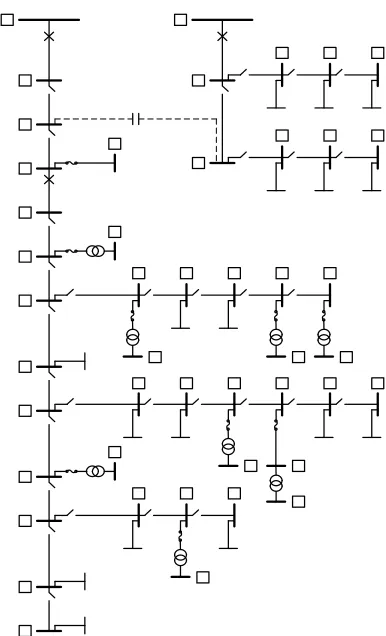
The developed Tabu search algorithm was tested with a distribution system of PEA consisting of two feeders KWA01 and KWA06. The system is modified [9] to in-clude disconnecting switches and fuses so that the benefit of DGs can be realized. There are 6 load points in feeder KWA01 and 20 load points in feeder KWA06. The con-figuration of the system is shown in Figure 2. The
maximum iteration for Tabu search is 1,000. The mini-mum and maximini-mum voltages for each bus are 0.95 p.u. and 1.05 p.u. The sizes of DGs are 100 kW, 200 kW, 300 kW, 400 kW and 500 kW. The failure of a transformer is recovered by repair. All the protective devices and DGs are assumed to be fully reliable. Seven cases are investi-gated in this case study.
Case 1: No DG is installed in the system.
Case 2: No more than one DG can be installed in the system.
Case 3: No more than two DGs can be installed in the system.
Case 4: No more than three DGs can be installed in the system.
Case 5: Total installed capacity of DGs cannot be greater than 600 kW and no more than four DGs can be installed in the system
Case 6: The same as case 5 except that total installed capacity of DGs cannot be greater than 800 kW. Case 7: The same as case 5 except that total installed
capacity of DGs cannot be greater than 1,000 kW
Figure2. Single line diagram of two feeders of PEA.
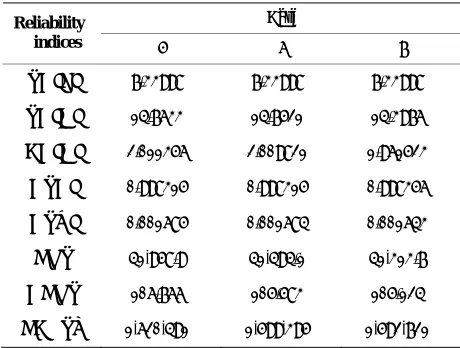
The results from the case study are shown in Tables 1, 2 and 3. All the cases have the same SAIFI because this
index depends only on the reliability of components (e.g., lines, transformers) and is not affected distributed gen-erators to be installed.
[image:4.595.327.520.85.403.2]We can see that the overall reliability indices of cases 2 to 7 are improved compared with that of case 1 (base case). In cases 2, 3, and 4, where the number of DGs is limited at 1, 2, and 3 respectively, see reductions in the system ECOST. It is very interesting to note that the constraint given in (13) is binding for these three cases.
Table 1. Location and capacity of distributed generators.
Location of DG (bus) Capacity of DG (kW) Case
KWA01 KWA06 KWA01 KWA06
1 - - - -
2 - 24 - 500 3 6 24 300 500
4 6, 9 24 300, 300 500
5 7 24 100 500 6 9 24 300 500
[image:4.595.306.540.594.735.2]Table 2. Reliability indices of case study 1-4.
Reliabil-ity Case
indices 1 2 3 4
SAIFI 7.33998 7.33998 7.33998 7.33998
SAIDI 17.8899 14.7669 14.7593 14.7484
CAIDI 2.43733 2.01184 2.01080 2.00932
ASAI 0.997958 0.998314 0.998316 0.998317
ASUI 0.002042 0.001686 0.001684 0.001683
ENS 45,746.8 42,008.7 41,347.6 40,833.1
AENS 116.404 106.892 105.210 103.007
ECOST 1,787,061 1,622,746 1,592,748 1,569,397
Table 3. Reliability indices of case study 5-7.
Case
Reliability
indices 5 6 7
SAIFI 7.33998 7.33998 7.33998
SAIDI 14.7633 14.7521 14.3976
CAIDI 2.011356 2.009821 1.961523
ASAI 0.998315 0.998315 0.998356
ASUI 0.001685 0.001684 0.001643
ENS 41,958.9 41,494.1 41,313.7
AENS 106.766 105.583 105.124
ECOST 1,620,491 1,599,395 1,592,721
The reason is that to minimize the system ECOST, as many DGs as possible should be installed. However, for example, in case 3, a 300 kW unit, instead of a 400 kW or a 500 kW unit, is placed at bus 6. An explanation for this is that the 300 kW unit is sufficient for the demand at bus 6. Had the 400 or 500 kW unit been placed at bus 6 the system ECOST would have been the same. Likewise, a 300 kW in case 4 installed at bus 9 can sufficiently cover the demands of LP4, LP5, and LP6.
With regard to cases 5, 6, and 7, the constraint on total capacity of DGs is binding but the constraint on maxi-mum number of DGs is not. The same reason given in cases 2, 3, and 4 are also used to explain the binding of these three cases. It is observed that a DG, if its size is large enough, tends to be installed at the end of a feeder. Such a placement is reasonable because the load point at the end of feeder has the highest failure rate and there-fore most frequently needs a backup generation. In addi-tion, the DG is able to supply power to upstream load points.
7. Conclusions
This paper has presented a Tabu search-based method for optimal placement of distributed generation in distribu-tion systems with the main objective to maximize reli-ability benefits described in forms of the customer inter-ruption cost. From reliability point of view, distributed generators are served as back up generation for load points that would otherwise have been left disconnected until the repair of a faulted component had been com-pleted. The effectiveness of the proposed method was demonstrated by a case study of a distribution network of PEA with 26 load points. It can be seen from the case study that distributed generators can reduce the customer interruption cost and therefore improve the reliability of the system.
REFERENCES
[1] T. Wang, L. F. Ochoa and G. P. Harrison, “DG Impact on Investment Deferral: Network Planning and Security of Supply,” IEEE Transaction Power Systems, Vol. 25, No.
2, 2010, pp. 1134-1141.
doi:10.1109/TPWRS.2009.2036361
[2] J. Zhang, H. Cheng and C. Wang, “Technical and Eco-nomic Impacts of Active Management on Distribution Network,” Electrical Power and Energy Systems, Vol. 31,
No. 2-3, 2009, pp. 130-138. doi:10.1016/j.ijepes.2008.10.016
[3] J. Mutale, “Benefits of Active Management of distribution
networks with distributed generation,” in Proc. Power System Conf. and Exposition, 2006,pp. 601-606.
[4] D. Berna and A. Cigdem, “Simulation Optimization Using Tabu Search,” Proceedings of the 2000 Winter Simulation Conference, 2000, pp. 805-810.
[5] F. Glover, Tabu Search-Part I. ORSA J. Computing, Vol. 1,
No. 3, 1989.
[6] M. Hiroyuki and O. Yoshihiro, Parallel Tabu Search for Capacitor Placement in Radial Distribution System.
Power Engineering Society Winter Meeting, 23-27
Janu-ary, Vol. 4, 2000, pp. 2334-2339.
[7] R. Billinton and R. N. Allan, “Reliability Evaluation of Power Systems,” Pitman Advanced Publishing Program, 1984.doi:10.1007/978-1-4615-7731-7
[8] L. Goel and R. Billinton, “A Procedure for Evaluating Interrupted Energy Assessment Rates in an Overall Elec-tric Power System,” IEEE Transaction on Power Systems,
Vol. 6, No. 4, 1991, pp. 1398-1403. doi:10.1109/59.116981
[image:5.595.56.286.307.481.2]Appendix
Table A1. Customer data of feeder KWA01. Table A4. Reliability parameters of feeders KWA01 and KWA06.
Demand Load
Point
Number of
Customer Type P (kW) Average Q (kVAR)
LP1 1 Large Business 700 433.83 LP2 1 Large Business 700 433.83 LP3 1 Medium Business 220.5 136.65 LP4 1 Medium Business 35 21.69 LP5 1 Medium Business 105 65.07 LP6 1 Medium Business 105 65.07
Component l (f/yr) r(hr) sw(hr)
Transformers 0.0150 200 -
Line 0.3700 5 1.06
where l = failure rate of component; r = repair time; sw=
switching time
Table A5. Type and length of feeder KWA01.
Line No. Type Length (km)
1 SAC 185 1.0760
2 PIC 185 0.9740
3 PIC 185 0.0066
4 PIC 185 0.1960
5 SAC 185 2.1750
6 SAC 185 0.4150
7 SAC 185 0.0610
8 SAC 185 0.0130
[image:6.595.308.539.143.194.2]9 SAC 185 0.9800
Table A2. Customer data of feeder KWA06.
Demand Load
Point
Number of
Customer Type P (kW)
[image:6.595.58.286.271.548.2]Average Q (kVAR) LP1 1 Large Business 3,130.75 1,940 LP2 105 Residence 32.50 20.14 LP3 31 Residence 9.75 6.04 LP4 1 Medium Business 110.25 68.33 LP5 31 Residence 9.75 6.04 LP6 31 Residence 9.75 6.04 LP7 21 Residence 6.50 4.03 LP8 1 Government 45.50 28.20 LP9 21 Residence 6.50 4.03 LP10 1 Small Business 10.50 6.51 LP11 1 Medium Business 175 108.46 LP12 31 Residence 9.75 6.04 LP13 84 Residence 26 16.11 LP14 1 Medium Business 56 34.71 LP15 1 Medium Business 175 108.46 LP16 1 Government 22.75 14.10 LP17 1 Government 17.50 10.85 LP18 1 Government 35 21.69 LP19 21 Residence 6.50 4.03 LP20 1 Government 9.75 6.04
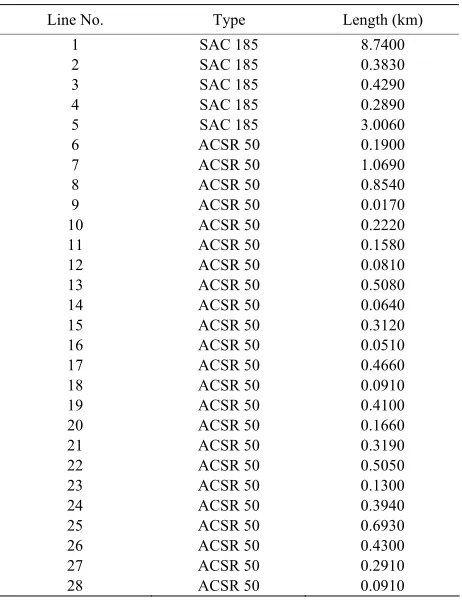
Table A6. Type and length of feeder KWA06.
Line No. Type Length (km)
1 SAC 185 8.7400
2 SAC 185 0.3830
3 SAC 185 0.4290
4 SAC 185 0.2890
5 SAC 185 3.0060
6 ACSR 50 0.1900
7 ACSR 50 1.0690
8 ACSR 50 0.8540
9 ACSR 50 0.0170
10 ACSR 50 0.2220
11 ACSR 50 0.1580
12 ACSR 50 0.0810
13 ACSR 50 0.5080
14 ACSR 50 0.0640
15 ACSR 50 0.3120
16 ACSR 50 0.0510
17 ACSR 50 0.4660
18 ACSR 50 0.0910
19 ACSR 50 0.4100
20 ACSR 50 0.1660
21 ACSR 50 0.3190
22 ACSR 50 0.5050
23 ACSR 50 0.1300
24 ACSR 50 0.3940
25 ACSR 50 0.6930
26 ACSR 50 0.4300
27 ACSR 50 0.2910
28 ACSR 50 0.0910
Table A3. Customer damage function.
Duration in Hours and Interruption Cost (Baht/kW)
Type
1 hr 2 hr 4 hr 8 hr
Residence 8.694 19.050 39.762 80.716
Small Business 166.172 288.467 591.748 1,054.216
Medium Business 55.006 92.647 193.661 363.221
Large Business 50.877 79.913 145.614 251.938
[image:6.595.309.540.394.694.2]![Figure 1main concept of a search direction in Tabu search [6].](https://thumb-us.123doks.com/thumbv2/123dok_us/7900441.743681/2.595.331.520.589.708/figure-main-concept-search-direction-tabu-search.webp)