0095-1137/06/$08.00⫹0 doi:10.1128/JCM.44.1.71–76.2006
Copyright © 2006, American Society for Microbiology. All Rights Reserved.
Validation of VITEK 2 Version 4.01 Software for
Detection, Identification, and Classification of
Glycopeptide-Resistant Enterococci
Marianne Abele-Horn,* Leif Hommers, Rene
´ Trabold, and Matthias Frosch
Institute of Hygiene and Microbiology, University of Wu¨rzburg, Josef-Schneider-Strasse 2, 97080 Wu¨rzburg, Germany
Received 6 September 2005/Returned for modification 20 September 2005/Accepted 24 October 2005
We evaluated the ability of the new VITEK 2 version 4.01 software to identify and detect glycopeptide-resistant enterococci compared to that of the reference broth microdilution method and to classify them into thevanA,vanB,vanC1, andvanC2genotypes. Moreover, the accuracy of antimicrobial susceptibility testing with agents with improved potencies against glycopeptide-resistant enterococci was determined. A total of 121 enterococci were investigated. The new VITEK 2 software was able to identify 114 (94.2%) enterococcal strains correctly to the species level and to classify 119 (98.3%) enterococci correctly to the glycopeptide resistance genotype level. OneEnterococcus casseliflavusstrain and sixEnterococcus faecium vanAstrains with low-level resistance to vancomycin were identified with low discrimination, requiring additional tests. One of thevanA strains was misclassified as thevanBtype, and one glycopeptide-susceptibleE. faciumwild type was misclas-sified as thevanAtype. The overall essential agreements for antimicrobial susceptibility testing results were 94.2% for vancomycin, 95.9% for teicoplanin, 100% for quinupristin-dalfopristin and moxifloxacin, and 97.5% for linezolid. The rates of minor errors were 9% for teicoplanin and 5% for the other antibiotic agents. The identification and susceptibility data were produced within 4 h to 6 h 30 min and 8 h 15 min to 12 h 15 min. In conclusion, use of VITEK 2 version 4.01 software appears to be a reliable method for the identification and detection of glycopeptide-resistant enterococci as well as an improvement over the use of the former VITEK 2 database. However, a significant reduction in the detection time would be desirable.
The first glycopeptide-resistant enterococci (GRE) that
har-bored thevanAtransposon were identified in 1987 in Europe
(10). Within 10 years GRE represented⬎25% of the
entero-cocci that cause bloodstream infections in hospitalized patients
in the United States (2). ThevanAand vanBgenotypes (two
genetically distinct forms of resistance) are recognized to be clinically important, whereas GRE strains harboring the
intrin-sic resistance genes vanC1 and vanC2 seem to play a less
important clinical role. Contrary to the rates in other countries, the rates of GRE in German hospitals are low and GRE account for only about 1% of enterococcal isolates (8), but increasing rates in stool and clinical samples were reported recently (1, 17). Moreover, the numbers of nosocomial infec-tions and the rates of transmission of GRE have increased (17). As GRE infections appear to be more deadly and more costly than infections caused by vancomycin-susceptible strains (15), rapid and reliable results of identification and antimicro-bial susceptibility testing (AST) are necessary for the adequate treatment of infections caused by GRE and the prevention of transmission of GRE strains.
Many laboratories worldwide have adopted the VITEK
au-tomated system (bioMe´rieux, Nu¨rtingen, Germany) for the
detection of GRE strains in routine clinical microbiology. Ear-lier reports indicated that previous versions of the VITEK 2 software often had problems with the identification and AST
of GRE, especially strains harboring the vanB, vanC1, and
vanC2genes (11, 12). To overcome these problems the VITEK 2 system has successfully been improved. The recently intro-duced VITEK 2 version 4.01 software claims to be more sen-sitive than earlier versions of the software for the detection of enterococci with reduced susceptibilities to glycopeptide anti-biotics. In this study, 121 selected isolates of enterococci were used to investigate whether the new VIITEK 2 software im-proved the ability to identify and detect enterococci with de-creased susceptibilities to the glycopeptides vancomycin and teicoplanin. Moreover, the reliability of the VITEK 2 software for the testing of the newer antimicrobial agents with improved potencies against enterococci (quinupristin-dalfopristin, moxi-floxacin, and linezolid) was determined.
MATERIALS AND METHODS
The study was conducted in three phases. In phases I and II, identification of enterococcal species and classification of the glycopeptide resistance genotype were investigated. Phase III compared the AST results determined by the VITEK 2 software and those determined by the reference broth microdilution (BMD) method.
Bacterial strains.The strains used in this study were isolated over 3 years in
the context of a program of screening for GRE from different patients referred to hematologic or intensive care units. All GRE strains were stored at⫺70°C in the strain collection of the Institute for Hygiene and Microbiology of the Uni-versity of Wu¨rzburg. For the study, the GRE strains were transferred from storage at⫺70°C, placed onto brain heart infusion plates, and subcultured a second time.
Identification of enterococcal species.The GRE isolates were identified to the
species level on the basis of standard methods, like colony morphology, Gram stain, catalase and pyrase testing, the presence of the Lancefield group D anti-gen, pigment production, motility testing, methyl-alpha-D-glucopyranoside (MPG) acidification tests, and the API STREP system (bioMe´rieux, Nu¨rtingen, Germany). Strains carrying thevanC1or thevanC2gene were identified as Enterococcus gallinarumorEnterococcus casseliflavus(4, 14). The standard iden-* Corresponding author. Mailing address: Institute of Hygiene and
Microbiology, Josef-Schneider-Strasse 2, 97080 Wu¨rzburg, Germany. Phone: 0049-931-201-46941. Fax: 0049-931-201-46445. E-mail: mhorn @hygiene.uni-wuerzburg.de.
71
on May 16, 2020 by guest
http://jcm.asm.org/
tification results were compared with those obtained with the new VITEK 2 cards (GP identity card) for the identification gram-positive cocci, according to the manufacturer’s instructions.
Classification of the enterococcal glycopeptide resistance genotypes.For the
classification of the enterococcal resistance genotypes, PCR assays for thevanA, vanB,vanC1, andvanC2genes were used to assess the presence of the various glycopeptide resistance genes. The PCR results for thevanA,vanB,vanC1, and vanC2 genotypes were compared with the phenotype-genotype classification obtained with the new VITEK 2 system.
AST.The susceptibilities of the isolates to vancomycin, teicoplanin, and anti-microbial agents with improved potencies against GRE strains were tested: quinupristin-dalfopristin forE. faecium, linezolid, and moxifloxacin. For the BMD method, 96-well MIC plates (Micronaut-S MRSA/IFSG GP panel; Merlin Diagnostika, Bornheim-Hersel, Germany) were used according to the manufac-turer⬘s recommendations. The concentrations of the antibiotic agents used are shown in Table 1. Testing and interpretation of the results for vancomycin, teicoplanin, quinupristin-dalfopristin, and linezolid were performed according to the Clinical and Laboratory Standards Institute (CLSI) standards (3). MICs were interpreted as indicating susceptible, intermediate, or resistant categories ac-cording to the breakpoints recommended by the CLSI (3) or for moxifloxacin (susceptible, MICⱕ1g/ml; intermediate, MIC⫽2g/ml; resistant, MICⱖ4 mg/ml) recommended by the pharmaceutical manufacturer (Bayer, Leverkusen, Germany, personal communication). For the VITEK 2 method, the new ATS-534 cards and the version 4.01 software were used. Testing was performed according to the manufacturer’s instructions. To resolve discrepancies, the VITEK 2 and the reference tests were repeated in triplicate when discordant results occurred.
Interpretive category errors were assessed for each drug on the basis of the definitions given by van den Braak et al. (16). A very major error was defined as occurring when an isolate that was resistant by the BMD method appeared to be susceptible by the VITEK 2 test method. A major error was defined as occurring when an isolate that was susceptible by the BMD method scored resistant by the VITEK 2 test method. Thus, a lack of sensitivity of a given test was considered a more serious handicap than a lack of specificity. A minor error was defined as a discrepancy between the results of the BMD method and the VITEK 2 test
method that differed by only one interpretation category. The sensitivity of the VITEK 2 test method was defined as the ability of the method to correctly distinguish the enterococci harboring thevanA,vanB,vanC1, orvanC2resistance determinants from susceptible strains not harboring these genes. However, among the enterococcal strains for which vancomycin MICs were 8 to 16g/ml, both intermediate and resistant results were considered correct, since both in-terpretation categories correctly distinguish these enterococci from fully suscep-tible strains (vancomycin MIC, 4g/ml; teicoplanin MIC, 8g/ml). For report-ing of the accuracy of VITEK 2 compared to the results of the reference method, the overall percent agreement was defined as 100⫻(number of strains with the reference drug MIC⫾1 dilution/total number of strains tested).
Quality control strains.The quality control strains used for the BMD method
wereEnterococcus faecalisATCC 29212 andE. faecalisATCC 51299. For the VITEK 2 method, the quality control strains used wereE. faecalisATCC 29212 andStaphylococcus aureusATCC 29213. The control organisms for PCR wereE. faecalisATCC 51299 (vanBpositive), E. faeciumBM 4147 (vanA positive), E. gallinarumBM 4174 (vanC1positive),E. casseliflavusATCC 25788 andE. flavescensCCM 439 (vanC2andvanC3positive, respectively), andE. faecalis ATCC 29212 (negative control).
RESULTS
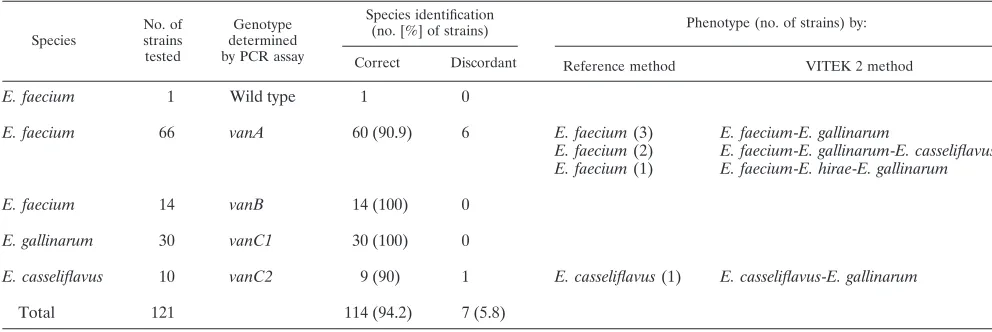
Identification of enterococcal species by the new VITEK 2 identification card (GP identity card) versus that by standard methods.The VITEK 2 system correctly identified 114 of 121
(94.2%) strains to the species level (Table 2). For sixE.
fae-cium vanAstrains, the species identification by the VITEK 2 method was discordant with the identification by the standard
method (Table 2). Three of theE. faecium vanAstrains were
identified with low discrimination asE. faecium-E. gallinarum
and two were identified as E. faecium-E. gallinarum-E.
cas-seliflavus, because the software of the VITEK 2 system was not able to differentiate between the two or three species. One of the E. faecium vanA strains was identified as E. faecium-E. hirae-E. gallinarum, and the genotype was misidentified as
vanB (Table 3). Most of the strains mentioned above and
identified with low discrimination were due to E. faecium
strains with low-level resistance to vancomycin (ⱕ32g/ml), in
contrast to the correctly identified strains, whose vancomycin
MICs wereⱖ256g/ml. Additional motility tests,
pigmenta-tion tests, as well as MPG acidificapigmenta-tion tests solved the
discrep-ancies and increased the rate of agreement for theE. faecium
isolates to 98.5%. In addition, one of theE. casseliflavusstrains
that was identified with low discrimination asE. casseliflavus-E.
[image:2.585.43.284.89.186.2]gallinarumcould be correctly identified after a pigmentation
TABLE 1. Antimicrobial concentration ranges and breakpoints used in AST
Antimicrobial agent
MIC range (g/ml)
Broth microdilution
method
VITEK 2 method
Vancomycin 0.25–32 1–32
Teicoplanin 0.125–16 0.5–32
Quinupristin-dalfopristin 0.125–16 0.25–16
Linezolid 0.125–16 0.5–8
Moxifloxacin 0.063–8 0.25–8
TABLE 2. Discrepancies between identification with the VITEK 2 system and by reference method
Species
No. of strains tested
Genotype determined by PCR assay
Species identification
(no. [%] of strains) Phenotype (no. of strains) by:
Correct Discordant Reference method VITEK 2 method
E. faecium 1 Wild type 1 0
E. faecium 66 vanA 60 (90.9) 6 E. faecium(3) E. faecium-E. gallinarum
E. faecium(2) E. faecium-E. gallinarum-E. casseliflavus E. faecium(1) E. faecium-E. hirae-E. gallinarum
E. faecium 14 vanB 14 (100) 0
E. gallinarum 30 vanC1 30 (100) 0
E. casseliflavus 10 vanC2 9 (90) 1 E. casseliflavus(1) E. casseliflavus-E. gallinarum
Total 121 114 (94.2) 7 (5.8)
on May 16, 2020 by guest
http://jcm.asm.org/
[image:2.585.42.538.560.726.2]test, which increased the agreement for the vanC2 group to 100% (Table 2).
Classification of enterococcal resistance genotypes with VITEK 2 system and by PCR.The VITEK 2 system classified allE. faecium vanBstrains and allE. gallinarumand E. cas-seliflavusstrains correctly as thevanB,vanC1, andvanC2types;
and 65 of 66 (98.5%)E. faecium vanAstrains were correctly
detected asvanAtypes (Table 3). In onevanA gene-positiveE.
faeciumisolate, the MIC of vancomycin was 32g/ml by the BMD and VITEK 2 methods, but the MIC of teicoplanin
showed discrepant results (MICs, 4g/ml by the BMD method
and 1 g/ml by the VITEK 2 method). According to this
constellation, the VITEK 2 system misidentified thisvanAtype
as avanBtype (Table 3). In addition, oneE. faeciumwild-type
strain was misclassified by the VITEK 2 system as a
glycopep-tide-resistantvanAtype. The PCR results for thevanA,vanB,
andvanCgenes were negative; and the strain was susceptible
to vancomycin (MIC, 2g/ml) and teicoplanin (MIC, 1g/ml)
by the BMD method but resistant to vancomycin (MIC, 16
g/ml) and susceptible to teicoplanin (MIC, 4g/ml) by the
VITEK 2 method (one minor error).
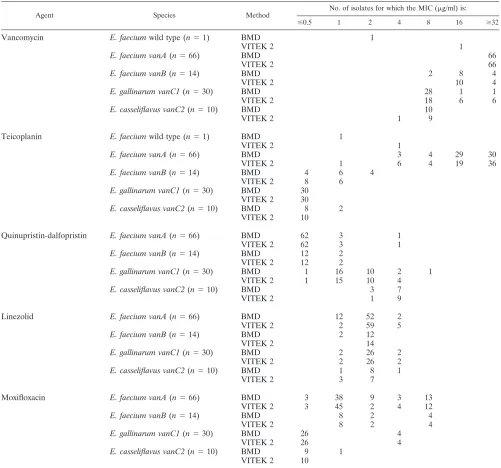
AST by MBD method versus VITEK 2 method.Tables 4 and 5 show the AST results generated by the BMD reference method and the VITEK 2 method with the new AST-534 cards (version 4.01 software). The sensitivity of vancomycin
suscep-tibility testing by the VITEK 2 method for the detection ofE.
faecium vanAandE. casseliflavusstrains was 100% (Table 5).
In contrast, by the VITEK 2 method theE. faecium
vancomy-cin-susceptible wild-type strain tested resistant to vancomycin
(MIC, 16 mg/ml versus 4 g/ml by the BMD method) but
susceptible to teicoplanin (2g/ml versus 1g/ml by the BMD
method). The sensitivities of the VITEK 2 system for the
detection ofE. faecium vanB strains andE. gallinarumwere
85.7 and 86.7%, respectively (Table 5). When the vancomycin test results were analyzed, five minor errors were found among theE. gallinarumstrains (5 of 30; 16.7%) and one minor error
was found among theE. casseliflavusstrains (1 of 10; 10%). No
minor errors were encountered among thevanA orvanB E.
faeciumstrains (Table 5).
The sensitivities of teicoplanin susceptibility testing were 97
and 85.7% for theE. faecium vanAandvanBstrains,
respec-tively, and 100% for the E. gallinarum and E. casseliflavus
strains (Table 5). Eleven minor errors occurred among 66 samples (16.7%) when the teicoplanin susceptibility test results
were analyzed for the detection of E. faecium vanA strains
(Table 5). In one case, the MIC of vancomycin was 32g/ml by
both methods, but the MIC of teicoplanin showed discrepant
results (MICs, 4g/ml by the BMD method and 1g/ml by the
VITEK 2 method). As mentioned above, thisvanAstrain was
misclassified as avanBstrain by the VITEK 2 method (Table 3).
No minor, major, or very major errors were encountered among the E. faecium vanB, E. gallinarum, or E. casseliflavus strains (Table 5).
AST of quinupristin-dalfopristin by the VITEK 2 method
en-countered four minor errors (4 of 30; 13.3%) among theE.
galli-narumstrains and two minor errors (2 of 10; 20%) among theE. casseliflavusstrains (Table 5). In addition, AST with linezolid by the VITEK 2 method resulted in four minor errors (6.1%) among
the 66E. faecium vanAstrains and one minor error among theE.
gallinarumandE. casseliflavusstrains. Finally, AST with moxi-floxacin by the VITEK 2 method resulted in 6 minor errors (9%)
among the 66vanAenterococci (Table 5).
The overall rates of agreement of AST with the new VITEK 2 system compared with that by the reference BMD method for GRE are shown in Table 6. The rates of agreement were 94.2% (113 of 121) for the vancomycin test results, 95.9% (116 of 121) for the teicoplanin test results, 100% (121 of 121) for the quinupristin-dalfopristin and moxifloxacin test results, and 97.5% (118 of 121) for the linezolid test results.
The mean time required to obtain antimicrobial susceptibil-ity test results for the enterococci tested in this study was 10 h (range, 8.25 to 14.75 h). The time for identification by the VITEK 2 system ranged from 4 h to 6.5 h, with a mean value of 5.25 h. For the additional tests (the motility, pigmentation, and MGP tests), 24 h to 48 h was necessary.
DISCUSSION
According to our knowledge, this is the first study in Germany that has assessed the ability of the VITEK 2 version 4.01 software to identify (GP identity card), classify, and detect (AST-534 card) enterococcal isolates with reduced susceptibilities to glycopep-tides. Moreover, we also evaluated the accuracy of AST with newer agents with improved activities against GRE strains.
Our data show that the new VITEK 2 software (version 4.01) was able to identify and detect GRE and to classify them
reliably asvanA,vanB, vanC1, andvanC2strains. Of 121
en-terococcal strains, 114 (94.2%) were correctly identified to the
species level asE. faecium, E. gallinarum, orE. casseliflavus.
With the exception of oneE. casseliflavusisolate, no problems
with the identification ofE. faecium vanB,E. casseliflavus, and
E. gallinarumstrains were observed. In contrast, some failures
with the identification of E. faecium vanA strains occurred,
where the correct identification rate was only 90.9% (Table 2). Six of the 66 isolates were phenotypically identified with low
discrimination asE. faecium-E. gallinarum(three strains),E.
faecium-E. gallinarum-E. casseliflavus(two strains), orE. fae-cium-E. hirae-E. gallinarum (one strain). The last strain was
also misclassified as being of thevanBtype. All these strains
required additional tests (motility, pigmentation, and MPG acidification tests) for correct identification to the species level. The performance of further tests led to a correct identification rate of 100%, but the identification time increased by 24 h to 48 h, which is not acceptable from a clinical point of view. Nevertheless, our results with the new VITEK 2 software for
[image:3.585.41.285.90.193.2]the identification ofE. faecium vanBstrains are better than the
TABLE 3. Discrepancies between classification of GRE genotypes with the VITEK 2 system and by PCR assays
Species
No. of strains tested
Genotype determined by PCR
assay
Genotype identification
(no. [%] of strains) genotype-VITEK 2
phenotype Correct Discordant
E. faecium 1 Wild type 0 1 vanA E. faecium 66 vanA 65 (98.5) 1 vanB E. faecium 14 vanB 14 (100) 0
E. gallinarum 30 vanC1 30 (100) 0 E. casseliflavus 10 vanC2 10 (100) 0
Total 121 119 (98.3) 2 (1.7)
on May 16, 2020 by guest
http://jcm.asm.org/
reported results obtained with the former VITEK 2 system.
Concerning theE. faecium vanAstrains, our results of 90.9%
either fell within the range obtained by others, who have dem-onstrated a correlation between 83 and 95.3% for the results obtained with former VITEK 2 systems and those obtained by the reference method (7, 10; E. Halle, I. Klare, and U. B.
Go¨bel, Abstr. 9th Eur. Congr. Clin. Microbiol. Infect. Dis.,
abstr. P147A, 1999), or are poorer in comparison to those of other authors using newer VITEK 2 software (16). Van den
Braak et al. (16) investigated onlyE. faecium vanAstrains with
a high level of resistance to vancomycin (ⱖ256 g/ml) and
found 100% agreement between the VITEK 2 and the
refer-ence methods. This is in accordance with our data, where allE.
faecium vanA strains with high-level vancomycin resistance
(MICs,ⱖ256g/ml) were correctly identified. On the other
side, all isolates identified with low discrimination were E.
faecium vanA strains (positive forvanA genes by PCR) with
low-level resistance to vancomycin (MICs, ⱕ32 g/ml) and
teicoplanin (MICs, 4 to 16g/ml).
To our knowledge, very few studies have evaluated the
VITEK 2 system for the identification ofE. gallinarumandE.
casseliflavus. In this study, allE. gallinarumstrains and 90% of theE. casseliflavusstrains were correctly identified. This is a significant improvement over the results obtained with the former VITEK 2 system and over the results obtained by other nonautomated methods. According to our experience (data not shown), the former VITEK 2 system database could not
[image:4.585.42.543.80.548.2]reliably differentiate betweenE. casseliflavusandE. gallinarum
TABLE 4. MICs of antimicrobial agents against enterococci generated by broth microdilution and VITEK 2 methods
Agent Species Method
No. of isolates for which the MIC (g/ml) is:
ⱕ0.5 1 2 4 8 16 ⱖ32
Vancomycin E. faeciumwild type (n⫽1) BMD 1
VITEK 2 1
E. faecium vanA(n⫽66) BMD 66
VITEK 2 66
E. faecium vanB(n⫽14) BMD 2 8 4
VITEK 2 10 4
E. gallinarum vanC1(n⫽30) BMD 28 1 1
VITEK 2 18 6 6
E. casseliflavus vanC2(n⫽10) BMD 10
VITEK 2 1 9
Teicoplanin E. faeciumwild type (n⫽1) BMD 1
VITEK 2 1
E. faecium vanA(n⫽66) BMD 3 4 29 30
VITEK 2 1 6 4 19 36
E. faecium vanB(n⫽14) BMD 4 6 4
VITEK 2 8 6
E. gallinarum vanC1(n⫽30) BMD 30
VITEK 2 30
E. casseliflavus vanC2(n⫽10) BMD 8 2
VITEK 2 10
Quinupristin-dalfopristin E. faecium vanA(n⫽66) BMD 62 3 1
VITEK 2 62 3 1
E. faecium vanB(n⫽14) BMD 12 2
VITEK 2 12 2
E. gallinarum vanC1(n⫽30) BMD 1 16 10 2 1
VITEK 2 1 15 10 4
E. casseliflavus vanC2(n⫽10) BMD 3 7
VITEK 2 1 9
Linezolid E. faecium vanA(n⫽66) BMD 12 52 2
VITEK 2 2 59 5
E. faecium vanB(n⫽14) BMD 2 12
VITEK 2 14
E. gallinarum vanC1(n⫽30) BMD 2 26 2
VITEK 2 2 26 2
E. casseliflavus vanC2(n⫽10) BMD 1 8 1
VITEK 2 3 7
Moxifloxacin E. faecium vanA(n⫽66) BMD 3 38 9 3 13
VITEK 2 3 45 2 4 12
E. faecium vanB(n⫽14) BMD 8 2 4
VITEK 2 8 2 4
E. gallinarum vanC1(n⫽30) BMD 26 4
VITEK 2 26 4
E. casseliflavus vanC2(n⫽10) BMD 9 1
VITEK 2 10
on May 16, 2020 by guest
http://jcm.asm.org/
but identified the majority of these strains asE. gallinarum-E. casseliflavus. This was confirmed in a study carried out by Ramotar et al. (13), where the VITEK GPI correctly identified
only 13 of 115 (11.3%)vanC1-containing isolates of GRE asE.
gallinarum and identified none of the vanC2-containing
iso-lates asE. casseliflavus. In the same study, the authors
dem-onstrated that the motility tests alone are not sufficient for the
correct differentiation ofE. faecium andE. gallinarum, since
some of the E. gallinarum strains were nonmotile, and an
additional MPG acidification test was necessary for discrimi-nation.
No problems were observed with the genotypic classification of GRE. Of 121 enterococcal strains, 119 (98.3%) were
cor-rectly classified to the glycopeptide resistance genotype level by the new VITEK 2 software. One of these strains which was
misclassified as avanB type was clearly an E. faecium vanA
strain with low-level vancomycin resistance (MIC, 32g/ml) by
the BMD and the VITEK 2 methods but discordant
suscepti-bility to teicoplanin by the BMD method (MIC, 4g/ml) and
the VITEK 2 method (MIC, 1g/ml). This constellation may
explain the difficulty with the correct identification and classi-fication by the VITEK 2 method. In the second case, a
glyco-peptide-susceptibleE. faeciumwild-type strain with discordant
teicoplanin susceptibilities by the BMD method (MIC, 1g/
ml) and the VITEK 2 method (MIC, 4g/ml) and discordant
[image:5.585.42.542.87.377.2]vancomycin test results by the BMD method (MIC, 2g/ml)
TABLE 5. Comparison of MICs generated by the VITEK 2 method (P534 cards) with MICs generated by the reference microbroth dilution method for 121 enterococcia
Species Drug
No. of VITEK 2 MICs that differed from reference MICs
by the following dilution EA
(no. [%])
No. of errors
⫺3 ⫺2 ⫺1 Concordant ⫹1 ⫹2 ⫹3 Minor Major Very major
E. faeciumwild type (n⫽1) Vancomycin 0 1 1
Teicoplanin 0 1
E. faecium vanA(n⫽66) Vancomycin 66 66 (100)
Teicoplanin 1 1 5 52 7 64 (97) 11
Quin-dalfo 40 26 66 (100)
Linezolid 1 54 11 65 (98.5) 4
Moxifloxacin 9 56 1 66 (100) 6
E. faecium vanB(n⫽14) Vancomycin 2 10 2 12 (85.7)
Teicoplanin 2 4 8 12 (85.7)
Quinu-dalfo 10 4 14 (100)
Linezolid 12 2 14 (100)
Moxifloxacin 14 14 (100)
E. gallinarum vanC1(n⫽30) Vancomycin 19 7 4 26 (86.7) 5
Teicoplanin 30 30 (100)
Quinu-dalfo 2 25 3 30 (100) 4
Linezolid 27 1 2 28 (93) 1
Moxifloxacin 30 30 (100)
E. casseliflavus vanC2(n⫽10) Vancomycin 1 9 10 (100) 1
Teicoplanin 1 9 10 (100)
Quinu-dalfo 2 8 10 (100) 2
Linezolid 3 7 10 (100) 1
Moxifloxacin 2 8 10 (100)
aDilutions indicate the number of VITEK 2 MIC dilutions compared to reference microbroth dilution MICs. EA, essential agreement (present VITEK 2 MICs
within 1 dilution of reference MICs); minor error, intermediate by either the VITEK 2 or reference method and either susceptible or resistant by the other method. Quin-dalfo, quinupristin-dalfopristin.
TABLE 6. Comparison of MICs generated by the VITEK 2 method (P534 cards) with MICs generated by the reference microbroth dilution method for 121 enterococcia
Drug
No. of VITEK 2 MICs that differed from reference MICs by the following dilution:
EA (no. [%]) No. (%) of minor errors
⫺3 ⫺2 ⫺1 Concordant ⫹1 ⫹2 ⫹3
Vancomycin 3 104 7 6 1 113 (94.2) 6 (5)
Teicoplanin 1 3 10 99 7 1 116 (95.9) 11 (9)
Quin-dalfo 4 84 33 121 (100) 6 (5)
Linezolid 1 3 100 15 2 118 (97.5) 6 (5)
Moxifloxacin 12 108 1 121 (100) 6 (5)
aDilutions indicate the number of VITEK 2 MIC dilutions compared to reference microbroth dilution MICs. EA, essential agreement (present VITEK 2 MICs
within 1 dilution of reference MICs); minor error, intermediate by either the VITEK 2 or reference method and either susceptible or resistant by the other method. There were no major or very major errors. Quin-dalfo, quinupristin-dalfopristin.
on May 16, 2020 by guest
http://jcm.asm.org/
[image:5.585.42.542.620.699.2]and the VITEK 2 method (16g/ml) was, as mentioned above,
misclassified as a vancomycin-resistantvanAstrain. In this
par-ticular case, the vancomycin resistance obtained by the VITEK 2 method was confirmed several times, with MICs ranging
from 16 to 32g/ml.
Several studies have been conducted to evaluate automated methods for the detection of GRE. Most studies identified major problems with the detection of enterococci harboring the vanB, vanC1, or vanC2 gene (7, 11, 12). In the study of Ligozzi et al., the VITEK 2 system correctly detected all
vanA-carrying resistant enterocooci but failed to detect 4 of 22
teicoplanin-resistant isolates (11). In a study of Garcia et al., the VITEK 2 system (AST-P516 card) failed to detect 2 of 57
(3.5%)vanAisolates, 3 of 16 (18.8%)vanBisolates, and 1 of 26
(3.8%) vanC1 isolates (7). In this study, the sensitivities of
vancomycin susceptibility testing with the new VITEK 2
soft-ware were 100% forE. faecium vanAandE. casseliflavus vanC2
strains and 85.7 and 86.7% forE. faecium vanBand E.
galli-narum vanC1strains, respectively. Concerning the enterococ-cal glycopeptide resistance genotypes of these strains, the
VITEK 2 version 4.01 software correctly identified allE.
fae-cium vanB strains and all E. gallinarum strains, despite the
incorrect vancomycin MIC, asvanB and vanC1 enterococci,
respectively. All together, the new VITEK 2 system has a
sensitivity of 98.5% for the detection of vanA strains and a
sensitivity of 100% for the detection of vanB, vanC1, and
vanC2 enterococci. These results are better than those ob-tained by authors using the former VITEK 2 database (7, 10) and fell within the range obtained by others who have used the newer VITEK 2 software and who have demonstrated
corre-lations of between 90 and 100% for vanA, vanB, andvanC1
strains and about 79 to 80% forvanC2strains (9, 16).
Com-pared to the Phoenix system, which detected 95% of thevanA
strains and 77% of thevanBisolates tested, the new VITEK 2
software gave equal or better results (5; A. M. Butterworth, B. Turng, M. Votta, T. Wiles, J. Salomon, and J. Reuben, 12th Eur. Congr. Clin Microbiol. Infect. Dis., abstr. P 706, 2002).
Some minor errors (n ⫽ 17) occurred with the VITEK 2
system with the detection of GRE. However, the majority of
the minor errors for the vanA group were for intermediate
strains with teicoplanin (n⫽11), which were reported to be
resistant by the VITEK 2 system or vice versa. In the case of
one minor error, a vancomycin-susceptible E. faecium wild
type was, as mentioned above, misclassified as a
vancomycin-resistantvanAstrain. This minor error could not be explained.
The minor errors for thevanC1group were mostly
vancomy-cin-intermediate strains that were reported to be resistant by the VITEK 2 method.
Concerning the AST of the newer agents effective against
enterococci (quinupristin-dalfopristin for the testing ofE.
fae-ciumstrains, linezolid, and moxifloxacin), the VITEK 2 system
also showed excellent results, with essential agreement ranging from 97.5 to 100%. Only a few minor errors occurred.
The mean time to the retrieval of identification results for the enterococci was 5 h 15 min, with a range of from 4 h to 6 h 30 min. The VITEK 2 results for susceptibility testing takes 10 h, with a range of 8 h 15 min to 12 h 15 min. This is a disadvantage over the former software, which needed only 3 h for the identification of enterococci and about 8 h for suscep-tibility testing (6, 16). Although identification and AST results
are obtained faster by the VITEK 2 method than by overnight conventional methods, it implies that results can still not be obtained in one working shift. To maximize the impact of rapid testing, further improvement of the speed without compromis-ing the accuracy is desirable.
In conclusion, new version 4.01 of the VITEK 2 system software appears to be a reliable method for the identification and classification of GRE and an improvement over the former VITEK 2 database and conventional methods. However, the detection of teicoplanin resistance and the detection of
entero-coccal strains containing thevanA gene with low-level
vanco-mycin resistance should be improved. Moreover, further re-duction of the detection time would be desirable.
ACKNOWLEDGMENT
We thank Holger Ruessmann for critical reading of the manuscript.
REFERENCES
1.Borgmann, S., D. M. Niklas, I. Klare, L. T. Zabel, P. Buchenau, I.
Auten-rieth, and P. Heeg.2004. Two episodes of vancomycin-resistantEnterococcus
faeciumoutbreaks caused by two genetically different clones in a newborn intensive care unit. Int. J. Hyg. Environ. Health207:386–389.
2.Centers for Disease Control and Prevention.2001. National Nosocomial
Infections Surveillance (NNIS) system report, data summary from January 1992–June 2001, issued August 2001. Am. J. Infect. Control29:404–421.
3.Clinical and Laboratory Standards Institute.2005. Performance standards
for antimicrobial susceptibility testing; fifteenth informational supplement, M100-S15, vol. 25, no. 1. Clinical and Laboratory Standards Institute, Wayne, Pa.
4.Dutka-Malen, S., S. Evers, and P. Courvalin.1995. Detection of
glycopep-tide resistance genotypes and identification to the species level of clinically relevant enterococci by PCR. J. Clin. Microbiol.33:24–27.
5.Fahr, A. M., U. Eigner, M. Armbrust, A. Caganic, G. Dettori, C. Chezzi, L.
Bertoncini, M. Benecchi, and M. G. Menozzi.2003. Two-center collaborative
evaluation of the performance of the BD Phoenix automated microbiology system for identification and antimicrobial susceptibility testing of Entero-coccusspp. andStaphylococcusspp. J. Clin. Microbiol.41:1135–1142.
6.Funke, G., and P. Funke-Kissling.2005. Performance of the new VITEK 2
GP card for identification of medically relevant gram-positive cocci in a routine clinical laboratory. J. Clin. Microbiol.43:84–88.
7.Garcia-Garrote, F., E. Cercenado, and E. Bouza.2000. Evaluation of a new
system, VITEK 2, for identification and antimicrobial susceptibility testing of enterococci. J. Clin. Microbiol.38:2108–2111.
8.Klare, I., C. Konstabel, D. Badstubner, G. Werner, and W. Witte.2003.
Occurence and spread of antibiotic resistance inEnterococcus faecium. Int. J. Food Microbiol.88:269–290.
9.Kobayashi, I., H. Muraoka, T. Iyoda, M. Nishida, M. Hasegawa, and K.
Yamaguchi.2004. Antimicrobial susceptibility testing of vancomycin
resis-tantEnterococcusby the VITEK 2 system, and comparison with two NCCLS reference methods. J. Med. Microbiol.53:1229–1232.
10.Leclerq, R., E. Derlot, J. Duval, and P. Courvalin.1998. Plasmid-mediated
resistance to vancomycin and teicoplanin inEnterococcus faecium. N. Engl. J. Med.319:157–161.
11.Ligozzi, M., C. Bernini, M. G. Bonora, M. de Fatima, J. Zuliani, and R.
Fontana.2002. Evaluation of the VITEK 2 system for identification and
antimicrobial susceptibility testing of medically relevant gram-positive cocci. J. Clin. Microbiol.40:1681–1686.
12.Okabe, T., K. Oana, Y. Kawakami, M. Yamaguchi, Y. Takahashi, Y.
Okimura, T. Honda, and T. Katsuyama.2000. Limitations of the VITEK
GPS-418 cards in exact detection of vancomycin-resistant enterococci with thevanBgenotype. J. Clin. Microbiol.38:2409–2411.
13.Ramotar, K., W. Woods, L. Larocque, and B. Toye.2000. Comparison of
phenotypic methods to identify enterococci intrinsically resistant to vanco-mycin (vanC VRE). Diagn. Microbiol. Infect. Dis.36:119–124.
14.Sahm, D. F., L. Free, and S. Handwerger.1995. Inducible and constitutive
expression ofvanC1-encoded resistance to vancomycin inEnterococcus galli-narum. Antimicrob. Agents Chemother.39:1480–1484.
15.Salgado, C. D., and B. M. Farr.2003. Outcomes associated with
vancomycin-resistant enterococci: a meta-analysis. Infect. Control Hosp. Epidemiol.24:690–698.
16.van den Braak, N., W. Goessens, A. van Belkum, H. A. Verbrugh, and H. P.
Endtz.2001. Accuracy of the VITEK 2 system to detect glycopeptide
resis-tance in enterococci. J. Clin. Microbiol.39:351–353.
17.Werner, G., I. Klare, F. B. Spencker, and W. Witte.2003. Intra-hospital
dissemination of quinupristin-dalfopristin- and vancomycin-resistant Entero-coccus faeciumin a paediatric ward of a German hospital. Antimicrob. Agents Chemother.52:113–115.