Copyright © 1999, American Society for Microbiology. All Rights Reserved.
Use of Base Excision Sequence Scanning for Detection of
Genetic Variations in St. Louis Encephalitis Virus Isolates
RE´MI N. CHARREL,
1* NICOLAS LE´VY,
2ROBERT B. TESH,
1ANDLAURA J. CHANDLER
1Center for Tropical Diseases, Department of Pathology, University of Texas Medical Branch,
Galveston, Texas,
1and INSERM U491, Ge´ne´tique Me´dicale et De´veloppement,
Faculte´ de Me´decine, Marseille, France
2Received 16 December 1998/Returned for modification 4 February 1999/Accepted 16 March 1999
Twenty-two isolates of St. Louis encephalitis (SLE) virus of various geographical origins (Brazil, Argentina,
Panama, Texas, Missouri, Maryland, California, and Florida) were examined for genetic variation by the base
excision sequence scanning (BESS T-scan) method. A fragment was amplified in the envelope gene with the
forward primer labeled in the PCR. The BESS T-scan method determined different clusters according to the
profiles generated for the isolates and successfully grouped the isolates according to their geographical origins.
Two major clusters, the North American cluster (cluster A) and the South and Central American cluster
(cluster B), were defined. Two subgroups, the Texas-California subgroup (subgroup A1) and the
Missouri-Maryland-Florida subgroup (subgroup A2), were distinguished within group A. Similarly, group B strains were
subclustered to a South American subgroup (subgroup B1) and a Central American subgroup (subgroup B2).
These results were consistent with those obtained by DNA sequencing analysis. The ability of the BESS T-scan
method to discriminate between strains that present with high degrees of nucleotide sequence similarity
indicated that this method provides reliable results and multiple applications for other virus families. The
method has proven to be suitable for phylogenetic comparison and molecular epidemiology studies and may be
an alternative to DNA sequencing.
St. Louis encephalitis (SLE) virus is a member of the genus
Flavivirus
within the family
Flaviviridae
. On the basis of its
antigenic reactivity, SLE virus has been placed in the Japanese
encephalitis serogroup. First isolated in Missouri in 1933, SLE
virus has been responsible for approximately 5,000 officially
reported human cases of infection in the United States since
1955 (16). SLE virus has been isolated from various species of
Culex
mosquitoes and birds. In tropical America, SLE virus has
also been isolated from many non-
Culex
mosquito species. The
case-fatality ratio for human disease is variable depending on
the geographical location (16). Thus, the epidemiology of SLE
virus still needs to be clarified, although a recent report has
helped to clarify the mechanisms of viral persistence and
trans-mission in nature (9). Since the earliest days of virology, typing
of viruses has been an important tool for the characterization
of viral populations and for the study of their epidemiology.
Typing provides information on the relationships among
iso-lates within the same group, species, or genus. Historically,
serological methods have been used to identify antigenic
dif-ferences among virus populations. Increasingly, nucleotide or
deduced amino acid sequence data have largely replaced
se-rology as a means of providing more sophisticated
epidemio-logical information. However, most molecular methods other
than DNA sequencing, such as PCR-based techniques,
pulsed-field gel electrophoresis, and ribotyping, either are not suitable
for viruses or provide data that are too weakly discriminative
for typing purposes.
Although sequencing is still the preferred method, it is an
expensive and time-consuming technique, especially when
large numbers of samples need to be processed. Thus, other
molecular methods that are easier and less expensive to
per-form would be useful for typing of virus isolates for
epidemi-ological studies.
Recently, base excision sequence scanning (BESS) has been
used to detect and localize point mutations in mammalian
genes (6). The PCR product, which is amplified with one
la-beled primer and a dUTP-containing nucleotide mixture, is
then enzymatically treated with a combination of uracil-
N
-glycosylase and endonuclease IV. The resulting nested labeled
fragments are then separated on a standard sequencing gel and
are detected by fluorescent dye detection.
We report here the results of studies in which we evaluated
the usefulness of BESS for the detection of genetic variations
in virus populations and for phylogenetic analysis. We have
applied this technique to characterization and strain
compar-ison of 22 isolates of SLE virus from various geographical
locations in the Americas and have compared the results with
those obtained by direct PCR sequencing.
MATERIALS AND METHODS
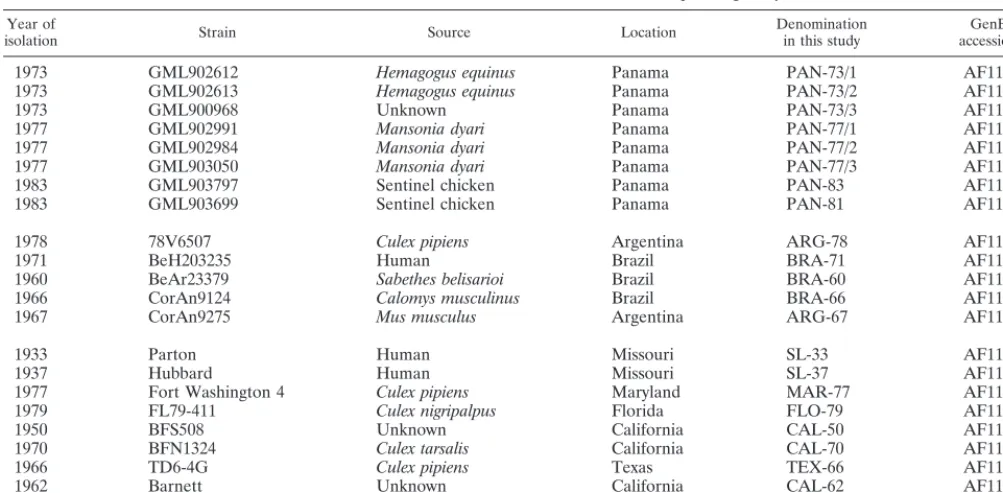
SLE virus strains.The SLE virus strains used in this project were part of a larger phylogenetic study based on comparison of the nucleotide sequences of the envelope gene. The 22 SLE virus isolates used in this study are listed in Table 1 by strain, source, geographical location, year of isolation, GenBank accession number, and identification code used in the phylogenetic trees. Each virus strain was inoculated onto a confluent Vero cell monolayer, and virus and cells were incubated for 3 to 5 days at 37°C in 25-cm2flasks until a 31cytopathic effect was
evident. Following passage in Vero cells, a stock of each isolate was prepared and stored at270°C until the time of RNA extraction.
RNA purification and reverse transcription procedure.For RNA extraction, stock material was thawed, and 200ml was removed and mixed with 600ml of Trizol LS reagent (Gibco-BRL, Gaithersburg, Md.). Following incubation at room temperature for 5 min, 200ml of chloroform was added, and the materials were mixed and incubated again for 5 min. The aqueous phase was separated by centrifugation, and the RNA was precipitated from the solution by addition of an equal volume of isopropanol. RNA was recovered by centrifugation and was resuspended in 50ml of sterile, RNase-free water.
Oligonucleotide primers.Primers were designed on the basis of the sequence of SLE MSI-7 (Genbank accession no. M16614) with the MacVector program (Oxford Molecular Group, Oxford, England). Primers were designed to amplify
* Corresponding author. Present address: Department of Pathology,
Center for Tropical Diseases, Keiller Building, 3.150, University of
Texas Medical Branch, Galveston, TX 77555-0609. Phone: (409)
747-2428 or (409) 747-2466. Fax: (409) 747-2429. E-mail: rncharre@utmb
.edu.
1935
on May 15, 2020 by guest
http://jcm.asm.org/
a 750-bp portion of the 59half of the envelope gene. The sequence of the forward primer (primer F880) is 59-GATTGGATGGATGCTAGGTAG-39and repre-sents nucleotides 880 to 901. The sequence of the reverse primer (B1629) is 59-GGTTCAAGTCGTGAAACCAGTC-39and represents nucleotides 1629 to 1608.
Reverse transcription.Five microliters of RNA was mixed with 15 pmol of the reverse primer (primer B1629) in a total reaction volume of 12.7ml. The mixture was heated to 70°C for 5 min to denature the secondary structure in the RNA and was then cooled to 20°C for primer annealing. Reverse transcription was performed by adding 7.3ml of reverse transcription buffer so that each reaction mixture contained 25 mM Tris-HCl (pH 7.3), 75 mM KCl, 3 mM MgCl2, 20 mM
dithiothreitol, and 60 Units of Superscript II (Gibco BRL). Synthesis of cDNA was performed by incubation at 42°C for 1 h. The reverse transcriptase was denatured at 95°C for 5 min. PCR amplification was performed immediately following cDNA synthesis.
PCR protocol.Five microliters of the reverse transcription reaction mixture was transferred to 40ml of 13PCR buffer (1.5 mM MgCl2, 50 mM KCl, 10 mM
Tris-HCl [pH 9.0], 0.1% Triton X-100, each nucleotide at a concentration of 200
mM, and 200 pmol of each primer). The solution was overlaid with 50ml of sterile mineral oil, and the samples were heated to 80°C. While the tubes were held at 80°C, 10ml of 13PCR buffer containing 1.5 U ofTaqDNA polymerase (Pro-mega, Madison, Wis.) was added to each tube. The samples were amplified on a PTC-100 thermocycler (MJ Research, Watertown, Mass.) by the following pro-gram: denaturation at 92°C for 1 min, primer annealing at 56°C for 1 min, and extension at 72°C for 2 min for 25 cycles, followed by a 7-min final extension at 72°C. The complete PCR product from the complete 50ml was purified with the Wizard PCR Preps DNA purification system (Promega) and was stored at
220°C.
BESS product amplification.Two microliters of a 1:50 dilution of the purified PCR product was used as the target DNA for amplification on a PTC-100 thermocycler (MJ Research) in a 25-ml reaction mixture containing 2.5ml of 103
PCR buffer (Promega), 1.5 mM (final concentration) MgCl2, 2ml of BESS
T-scan dNTP Mix with each deoxynucleoside triphosphate at a concentration of 2.5 mM and 200mM dUTP (Epicentre, Madison, Wis.), 1.25 U ofTaqDNA polymerase (Promega), 3 pmol of 6-carboxyfluorescein (6-FAM)-labeled for-ward primer (Perkin-Elmer, Foster City, Calif.), and 3 pmol of a reverse primer. The amplification cycles were identical to those mentioned above. All products of the reverse transcription-PCRs were revealed by UV transillumination after electrophoresis on a 1.2% agarose gel containing ethidium bromide to verify that only the specific band had been amplified.
Assembly of the excision and cleavage reaction.Eight microliters of PCR product containing dUTP was mixed, on ice, with 1ml of BESS T-scan 103
excision enzyme buffer, 0.5ml of BESS T-scan excision enzyme mixture, and 0.5
ml of sterile water (Epicentre). This mixture was incubated at 37°C for 30 min, and the reaction was stopped by heating at 95°C for 2 min. The BESS T-scan excision enzyme mixture contains uracilN-glycosylase (UNG) and endonuclease IV. UNG hydrolyzes the uracil-glycosidic bond (base excision) at a
dU-contain-ing DNA site, releasdU-contain-ing uracil and creatdU-contain-ing an alkali-sensitive apyrimidic site in the DNA (4). Endonuclease IV specifically cleaves the phosphodiester bond 39to the abasic site, generating a defined series of fragments (13). The amplification of the target with the 6-FAM-labeled primer allows detection of the nested fragments that result from the excision reaction.
Gel electrophoresis.Two microliters of the excision and cleavage reaction mixture was mixed with 2ml of formamide and 0.5ml of the fluorescent dye-labeled GS500 size marker (Perkin-Elmer), and the mixture was heated at 95°C for 2 min and then quickly cooled on ice. Two microliters was loaded onto a standard sequencing gel (6 M urea, 4.8% PAGE-PLUS; Amresco, Solon, Ohio), and the gel was run for 4 h on a ABI Prism 377XL automated sequencer (Perkin-Elmer).
Data collection.The fluorescence-labeled nested PCR fragments were sepa-rated according to their size by gel electrophoresis, detected as peaks by the fluorescent dye, and sized by determination of comigration with the size marker. The analysis of the resulting profiles was performed with Genotyper, version 2.0, software (Perkin-Elmer). Fragments smaller than 25 nucleotides were detected concurrently with the remaining labeled primer and resulted in a scrambled signal. For the PCR fragments larger than 210 nucleotides, the signal decreased and several labeled fragments were not detected. Therefore, the analysis was done only with the BESS T-scan fragments between nucleotides 924 and 1105 (numbered after strain MSI-7; GenBank accession no. M16614). The results were provided in a spreadsheet format in which labeled fragments were ordered by size and were converted into a sequence-like format, which was amenable to analysis with phylogenetics software. The sequence-like data were constructed by replacing each detected fragment with a T. Nucleotides other than T, potentially A, C, or G, were identified as V, the code for a non-T nucleotide according to the nomenclature for the identification of redundancies (see Fig. 2). The data were analyzed with the MEGA software program (10) by using the Jukes-Cantor algorithm and the neighbor-joining method. The robustness of the resulting branching patterns was tested by bootstrap analysis with 500 replications.
Determination of the nucleotide sequences of the 22 SLE virus strains.The PCR products amplified from the virus isolates listed in Table 1 were sequenced directly with the F880 and B1629 primers on a ABI Prism 377XL automated sequencer with BigDye Terminator Cycle Sequencing Ready Reaction Kit with Amplitaq FS (Perkin-Elmer). Nucleotide sequences located between positions 924 to 1604 (681 nucleotides) were used to perform phylogenetic analysis.
RESULTS
[image:2.612.54.556.83.329.2]The PCR products obtained by the standard protocol and by
the BESS T-scan protocol are presented in Fig. 1. The results
of the conversion of the primary data (BESS T-scan fragments)
into a binary sequence suitable for phylogenetic analysis and
comparison of virus isolates are presented in Fig. 2.
TABLE 1. SLE virus isolates used for BESS T-scan and sequencing analyses
Year of
isolation Strain Source Location Denominationin this study accession no.GenBank
1973
GML902612
Hemagogus equinus
Panama
PAN-73/1
AF112375
1973
GML902613
Hemagogus equinus
Panama
PAN-73/2
AF112376
1973
GML900968
Unknown
Panama
PAN-73/3
AF112377
1977
GML902991
Mansonia dyari
Panama
PAN-77/1
AF112378
1977
GML902984
Mansonia dyari
Panama
PAN-77/2
AF112379
1977
GML903050
Mansonia dyari
Panama
PAN-77/3
AF112380
1983
GML903797
Sentinel chicken
Panama
PAN-83
AF112381
1983
GML903699
Sentinel chicken
Panama
PAN-81
AF112382
1978
78V6507
Culex pipiens
Argentina
ARG-78
AF112383
1971
BeH203235
Human
Brazil
BRA-71
AF112384
1960
BeAr23379
Sabethes belisarioi
Brazil
BRA-60
AF112385
1966
CorAn9124
Calomys musculinus
Brazil
BRA-66
AF112386
1967
CorAn9275
Mus musculus
Argentina
ARG-67
AF112387
1933
Parton
Human
Missouri
SL-33
AF112388
1937
Hubbard
Human
Missouri
SL-37
AF112389
1977
Fort Washington 4
Culex pipiens
Maryland
MAR-77
AF112390
1979
FL79-411
Culex nigripalpus
Florida
FLO-79
AF112391
1950
BFS508
Unknown
California
CAL-50
AF112392
1970
BFN1324
Culex tarsalis
California
CAL-70
AF112393
1966
TD6-4G
Culex pipiens
Texas
TEX-66
AF112394
1962
Barnett
Unknown
California
CAL-62
AF112395
1968
68V1587
Culiseta inornata
Texas
TEX-68
AF112396
on May 15, 2020 by guest
http://jcm.asm.org/
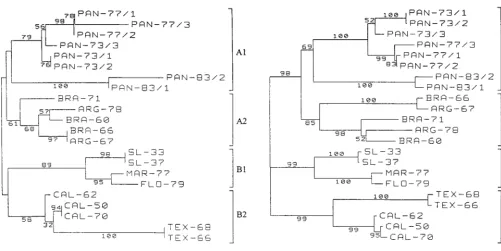
Phylogenetic trees based on the 182-nucleotide fragment
analyzed by the BESS T-scan method (Fig. 3) and from
anal-yses of 182- and 681-nucleotide sequences (Fig. 4 and 5,
re-spectively) are presented in Figures 3, 4, and 5, respectively.
Regardless of the method (the BESS T-scan method or
nucle-otide sequencing), the 22 isolates formed four groups on the
basis of their geographical origins.
Eight Panamanian isolates form a clade designated group
A1, and five South American isolates form group A2. Group
A1 isolates were subgrouped according to the year of isolation,
but the case group A2 isolates were not subgrouped. The two
Panamanian isolates recovered in 1981 and 1983 are very
di-vergent from the isolates recovered in 1973 and 1977 (6.1 to
6.9% distance in a pairwise comparison of nucleotide
sequenc-es). This divergence was identified by both BESS T-scan and
sequence analyses.
North American isolates were divided into two groups:
[image:3.612.54.290.71.198.2]group B1, which included four isolates recovered from
Mis-souri, Maryland, and Florida, and group B2, which contained
five isolates from California and Texas. They were clearly
grouped according to their geographical origins, regardless of
the year of isolation. The robustness of these groupings was
[image:3.612.311.555.77.306.2]FIG. 1. RT-PCR amplification of SLE virus SL-33. Lane M, Marker VIII (Boehringer-Mannheim, Mannheim, Germany); lane 1, PCR product obtained by the standard protocol (with each deoxynucleoside triphosphate at a concen-tration of 200mM); lane 2, PCR product obtained by the BESS T-scan protocol (each deoxynucleoside triphosphate at a concentration of 2.5 mM and 200mM dUTP).
FIG. 2. BESS T-scan profile analysis of fragments detected with Genotyper, version 2.0, software (rows A and B) and the binary sequence (row C) used for phylogenetic analysis. A, size of the marker that comigrated with the sample; B, each value corresponds to the size of a BESS T-scan fragment; C, the binary sequence was deduced from the BESS T-scan fragments (each detected fragment corresponds to a T base); D, DNA sequence of isolate SL-33; E, nucleotide positions are numbered relative to the MSI-7 strain (GenBank accession no. M16614);2, absence of the detected fragment; V, nucleotide A, C, or G.
FIG. 3. Phylogenetic analysis of SLE virus isolates based on a 182-nucleotide fragment between nucleotides 924 and 1105 (numbered after strain MSI-7 [Gen-Bank accession no. M16614]) located in the envelope gene by BESS T-scan technique. Distances and groupings between the 22 isolates were determined by the Jukes-Cantor algorithm and neighbor-joining method with the MEGA soft-ware program (10). Bootstrap values are indicated and correspond to 500 rep-lications.
on May 15, 2020 by guest
http://jcm.asm.org/
[image:3.612.126.483.476.689.2]confirmed by the high bootstrap values, which ranged from 69
to 100%, obtained for each of the four groups in Fig. 5. The
same groupings were obtained when the DNA sequences were
trimmed to 182 nucleotides; the bootstrap values were lower.
Bootstrap values from the results obtained by the BESS T-scan
method were variable and ranged from 36 to 76% for the same
four groups. The bootstrap values obtained from BESS T-scan
data (Fig. 3) are lower than those obtained from nucleotide
sequence analysis (Fig. 4 and 5). Nevertheless, the groupings of
the three 1977 and the two 1983 Panamanian isolates, SL-33
and SL-37, MAR-77 and FLO-79, TEX-68 and TEX-66, and
CAL-50 and CAL-70 are supported by high bootstrap values
(94 to 99%) in Fig. 3.
DISCUSSION
Historically, epidemiological typing of virus isolates has
been performed by serological techniques. Molecular
tech-niques can provide a powerful approach to epidemiological
typing because of their ability to detect minor genetic changes
not reflected by serology tests. DNA sequencing is currently
the “gold standard” in the molecular analysis of viruses.
How-ever, DNA sequencing of RNA viruses, especially viruses that
are difficult to culture, remains expensive, time-consuming,
and sometimes, technically challenging. A highly purified
prod-uct is required for direct sequencing, and in some cases
se-quencing must be preceded by cloning and subcloning
proce-dures.
Viruses, because of their small genome size and in many
cases their RNA content, are not easily typed by such methods
as pulsed-field gel electrophoresis of DNA macrorestriction
fragments or PCR-based techniques (random amplification of
polymorphic DNA, repetitive extragenic palindromic
element-based PCR, enterobacterial repetitive intergenic
consensus-based PCR, or PCR-ribotyping). Recently, viruses have been
typed by various techniques used as alternatives to DNA
se-quencing (1, 3, 5, 7, 8, 12, 17–21, 23–25). Most of these involve
PCR amplification followed by restriction fragment length
polymorphism (RFLP) analysis, single-strand conformational
polymorphism (SSCP) analysis, cleavase fragment length
poly-morphism (CFLP; Third Wave Technologies, Madison, Wis.),
and heteroduplex migration analysis (HMA).
The SSCP and HMA techniques have successfully been used
for genotype characterization of hepatitis C virus (11) and for
epidemiological studies of parvovirus B19, enterovirus,
Ep-stein-Barr virus, human immunodeficiency virus type 1,
influ-enza virus, and bunyaviruses (1, 5, 8, 12, 17, 19, 25).
By RFLP analysis, the choice of enzymes used for restriction
digestion needs to be based on the comparison of a large
number of sequences to be reliable, and thus, RFLP analysis is
more frequently applied to highly studied viruses. However,
even in this favorable case, only relatively short genomic
re-gions (sequences of from a few to 20 bases) are investigated for
mutations. Additionally, when isolates are closely related,
spe-cific distinguishing restriction patterns can rarely be
deter-mined.
CFLP has recently been used for hepatitis C virus genotype
determination (14), and seems to be a promising technique,
but as for the SSCP and HMA techniques, precise localization
of the mutations is not possible. Moreover, the pattern
pro-vided presents many bands, and computerized analysis may be
required when numerous isolates are investigated. The RFLP,
SSCP, and HMA techniques allow analysis of DNA sequences
longer than those that can be analyzed by BESS T-scanning,
but because quantitative data are not collected, they are not
FIG. 4. Phylogenetic analysis of SLE virus isolates based on a 182-nucleotide [image:4.612.55.557.74.325.2]DNA sequence between nucleotides 924 and 1105 (numbered after strain MSI-7 [GenBank accession no. M16614]) located in the envelope gene. Distances and groupings between the 22 isolates were determined by the Jukes-Cantor algo-rithm and neighbor-joining method with the MEGA software program (10). Bootstrap values are indicated and correspond to 500 replications.
FIG. 5. Phylogenetic analysis of SLE virus isolates based on a 681-nucleotide DNA sequence between positions 924 to 1604 (numbered after strain MSI-7 [GenBank accession no. M16614]) located in the envelope gene. Distances and groupings between the 22 isolates were determined by the Jukes-Cantor algo-rithm and neighbor-joining method with the MEGA software program (10). Bootstrap values are indicated and correspond to 500 replications.
on May 15, 2020 by guest
http://jcm.asm.org/
suitable for phylogenetic analysis. Mutation mapping cannot
be achieved by HMA or SSCP analysis, and both techniques
need to be optimized to provide reliable results. CFLP and
RFLP provide a more precise localization of the mutations,
but neither method indicates the nature or the exact position
of the mutations. Finally, most of these methods cannot be
used for phylogenetic analysis because of the paucity of
quan-titative data that they generate. Moreover, in none of these
techniques do the resulting patterns consistently correlate with
the nucleotide sequences of the isolates under study.
The BESS T-scan method is a rapid and powerful method
for the detection and precise localization of 95% of the
muta-tions in mammalian genes (6). With only one labeled primer,
this method can distinguish all the thymidine mutations; thus,
6 of 12 theoretically possible mutations can be detected. The
patterns are virtually identical to a T lane sequencing ladder,
which represents the banding profile of dUTP incorporation
during PCR amplification.
In the study described here, we evaluated the BESS T-scan
method as a tool to study the molecular epidemiology of SLE
virus isolates recovered in the Americas. We compared the
ability of the BESS T-scan method to that of direct sequencing
to identify genetic variation among the isolates and to provide
phylogenetic data. The 22 isolates have been correctly assigned
to distinct groups according to their geographical origins,
de-spite pairwise nucleotide distances of less than 10.2% (data not
shown) between isolates belonging to distinct groups. The
lower bootstrap values obtained by the BESS T-scan method
compared to those obtained from analysis of a 681-nucleotide
sequence may reflect the fact that a shorter fragment has been
analyzed and that BESS T-scan data consist of binary results
(V or T), whereas traditional nucleotide sequence data (A,
C, T, or G) do not. Interestingly, the bootstrap values
ob-served for the sequences analyzed by sequencing of the
182-nucleotide sequence and BESS T-scan analysis are not
very different.
The results indicated that SLE virus isolates from
homoge-neous genetic groups depending on their geographical origins,
which is in agreement with the results reported by others (2, 9,
15, 22). Pairwise nucleotide distances observed between
iso-lates from distinct geographical areas were similar to those
reported previously (9).
Compared to nucleotide sequence data, the results obtained
by the BESS T-scan method demonstrate its capability to
dis-criminate between closely related virus strains and thus its
usefulness for epidemiological and phylogenetic studies.
Al-though not yet tested, the BESS T-scan method has the
po-tential to be used for genetic comparison of viral strains
in-volved in clinical outbreaks of viral diseases such as rotavirus,
cytomegalovirus, and hepatitis C virus infections to help
inves-tigate their epidemiology. Further studies with more data and
others viruses are necessary to confirm the potential of the
BESS T-scan method to be an alternative to DNA sequencing
for epidemiological and phylogenetic analyses of viral
popula-tions.
In conclusion, any viral population that presents with
vari-ability similar to that observed for SLE virus and that can be
amplified with primers is a candidate for study of its
phyloge-netic makeup and its molecular epidemiology by application of
the BESS T-scan technology.
ACKNOWLEDGMENTS
We are grateful to Robert E. Shope and Sophie Le Pogam for
critical review of the manuscript and to Doug Norris and Bill Sweeney
for help with the BESS T-scan and sequencing experiments.
This work was supported in part by grants from the National
Insti-tutes of Health (AI-10984) and from the John Sealy Memorial
En-dowment Fund for Biomedical Research. R.N.C. is partly supported by
grants from the French Foreign Affairs Ministry (Bourse Lavoisier)
from Servier Laboratories and from The Philippe Foundation.
REFERENCES
1.Black, W. C., D. L. Vanlandingham, W. P. Sweeney, L. P. Wasieloski, C. H. Calisher, and B. J. Beaty.1995. Typing of LaCrosse, snowshoe hare, and Tahyna viruses by analyses of single-strand conformation polymorphisms of the small RNA segments. J. Clin. Microbiol.33:3179–3182.
2.Bowen, G. S., T. P. Monath, G. E. Kemp, J. H. Kerschner, and L. J. Kirk.
1980. Geographic variation among St. Louis encephalitis virus strains in the viremic responses of avian hosts. Am. J. Trop. Med. Hyg.29:1411– 1419.
3.Delwart, E. L., E. G. Shpaer, J. Louwagie, F. E. McCutchan, M. Grez, H. Rubsamen-Waigmann, and J. I. Mullins.1993. Genetic relationships deter-mined by a DNA heteroduplex mobility assay: analysis of HIV-1 env genes. Science262:1257–1261.
4.Duncan, B. K.1981. DNA glycosylases, p. 565–586.InP. D. Boyer (ed.), The enzymes, 3rd ed. Academic Press, Inc., New York, N.Y.
5.Fujioka, S., H. Koide, Y. Kitaura, H. Duguchi, and K. Kawamura.1995. Analysis of enterovirus genotypes using single-strand conformation polymor-phisms of polymerase chain reaction products. J. Virol. Methods.51:253– 258.
6.Hawkins, G. A., and L. M. Hoffman.1997. Base excision sequence scanning. Nat. Biotechnol.15:803–804.
7.Katayama, Y., K. Shibahara, T. Kohama, M. Homma, and H. Hotta.1997. Molecular epidemiology and changing distribution of genotypes of measles virus field strains in Japan. J. Clin. Microbiol.35:2651–2653.
8.Kerr, J. R., M. D. Curran, J. E. Moore, D. D. Erdman, P. V. Coyle, T. Nunoue, D. Middleton, and W. P. Ferguson.1995. Genetic diversity in the non-structural gene of parvovirus B19 detected by single-stranded confor-mational polymorphism assay (SSCP) and partial nucleotide sequencing. J. Virol. Methods53:213–222.
9.Kramer, L. D., S. B. Presser, J. L. Hardy, and A. O. Jackson.1997. Geno-typic and phenoGeno-typic variation of selected Saint Louis encephalitis viral strains isolated in California. Am. J. Trop. Med. Hyg.57:222–229. 10. Kumar, S., K. Tamura, and M. Nei.1993. MEGA: molecular evolutionary
genetics analysis, version 1.02. Pennsylvania State University, University Park, Pa.
11. Lareu, R. R., N. R. Swanson, and S. A. Fox.1997. Rapid and sensitive genotyping of hepatitis C virus by single-strand conformation polymorphism. J. Virol. Methods64:11–18.
12. Lin, J. C., B. K. De, and S. C. Lin.1993. Rapid and sensitive genotyping of Epstein-Barr virus using single-strand conformation polymorphism analysis of polymerase chain reaction products. J. Virol. Methods43:233– 246.
13. Lloyd, R. S., and S. M. Linn.1993. Nucleases involved in DNA repair, p. 263–316.InS. M. Linn, R. S. Lloyd, and R. J. Roberts (ed.), Nucleases, 2nd ed. Cold Spring Harbor Laboratory Press, Cold Spring Harbor, N.Y. 14. Marshall, D. J., L. M. Heisler, V. Lyamichev, C. Murvine, D. M. Olive, G. D.
Ehrlich, B. P. Neri, and M. de Arruda.1997. Determination of hepatitis C virus genotypes in the United States by cleavase fragment length polymor-phism analysis. J. Clin. Microbiol.35:3156–3162.
15. Monath, T. P., C. B. Cropp, G. S. Bowen, G. E. Kemp, C. J. Mitchell, and J. J. Gardner.1980. Variation in virulence for mice and rhesus monkeys among St. Louis encephalitis virus strains of different origin. Am. J. Trop. Med. Hyg.29:948–962.
16. Monath, T. P., and F. X. Heinz.1996. Flaviviruses, p. 961–1034.InB. N. Fields, D. M. Knipe, and P. M. Howley (ed.), Fields virology, 2nd ed., vol. 1. Lippincott-Raven, Philadelphia, Pa.
17. Novitsky, V., C. Arnold, and J. P. Clewley.1996. Heteroduplex mobility assay for subtyping HIV-1: improved methodology and comparison with phyloge-netic analysis of sequence data. J. Virol. Methods59:61–72.
18. Pawlotsky, J. M., M. Pellerin, M. Bouvier, F. Roudot-Thoraval, G. Germani-dis, A. Bastie, F. Darthuy, J. Remire, C. J. Soussy, and D. Dhumeaux.1998. Genetic complexity of the hypervariable region 1 (HVR1) of hepatitis C virus (HCV): influence on the characteristics of the infection and responses to interferon alfa therapy in patients with chronic hepatitis C. J. Med. Virol.
54:256–264.
19. Peters, T., H. J. Schlayer, B. Hiller, B. Rosler, H. Blum, and J. Rasenack.
1997. Quasispecies analysis in hepatitis C virus infection by fluorescent single strand conformation polymorphism. J. Virol. Methods64:95–102. 20. Ritacco, V., M. Di Lonardo, A. Reniero, M. Ambroggi, L. Barrera, A.
Dam-brosi, B. Lopez, N. Isola, and I. N. de Kantor.1997. Nosocomial spread of human immunodeficiency virus-related multidrug-resistant tuberculosis in Buenos Aires. J. Infect. Dis.176:637–642.
21. Saitoh-Inagawa, W., A. Oshima, K. Aoki, N. Itoh, K. Isobe, E. Uchio, S. Ohno, H. Nakajima, K. Hata, and H. Ishiko. 1996. Rapid diagnosis of adenoviral conjunctivitis by PCR and restriction fragment length polymor-phism analysis. J. Clin. Microbiol.34:2113–2116.
22. Trent, D. W., T. P. Monath, G. S. Bowen, A. V. Vorndam, C. B. Cropp, and
on May 15, 2020 by guest
http://jcm.asm.org/
G. E. Kemp.1980. Variation among strains of St. Louis encephalitis virus: basis for a genetic, pathogenetic, and epidemiologic classification. Ann. N. Y. Acad. Sci.354:219–237.
23.van Belkum, A., L. Juffermans, L. Schrauwen, G. van Doornum, M. Burger, and W. Quint.1995. Genotyping human papillomavirus type 16 isolates from persistently infected promiscuous individuals and cervical neoplasia patients.
J. Clin. Microbiol.33:2957–2962.
24. Zou, S.1997. A practical approach to genetic screening for influenza virus variants. J. Clin. Microbiol.35:2623–2627.
25. Zou, S., C. Stansfield, and J. Bridge.1998. Identification of new influenza B virus variants by multiplex reverse transcription-PCR and the heteroduplex mobility assay. J. Clin. Microbiol.36:1544–1548.