By Shannon L. Ferrell (Oklahoma State University) and Larry Sanders (Oklahoma State University)
technical supplement
About this technical supplement
This technical supplement to the NARDeP published white paper, “Natural Gas Extraction: Issues and Policy Options,” has not been peer reviewed and is made available to provide more detail on background and technical details of natural gas fracking.
Figures and Tables
The figures and tables used in this document have been cited and all were created using public funding and originally appeared in publications within the public domain.
Funding
This project was funded through a contract with the National Agricultural and Rural Development Policy Center.
Cover Photo: Deep Well Natural Gas Rig, Casper, Wyoming Photo Courtesy U.S. Bureau of Land Management Photo Library
http://www.blm.gov/wo/st/en/bpd.html
This is a publication of the National Agricultural & Rural Development Policy Center (NARDeP). NARDeP was formed by the Regional Rural Development Centers in response to the increasingly contentious and complex agricultural and rural development policy issues facing the U.S. NARDeP is funded by USDA National Institute of Food and Agriculture (NIFA) under a competitive grant (Number 2012-70002-19385), and works with the land-grant college
and university system and other national organizations, agencies, and experts to develop and deliver timely policy-relevant information. NARDeP is an
Contents
Glossary ... 1
Acronyms and Abbreviations ... 3
1. Executive Summary ... 4
2. Introduction to Natural Gas Extraction... 5
2.1. A Brief History of Natural Gas ... 5
2.2. Natural Gas Extraction Today ... 7
2.2.1. Traditional Vertical Well Development ... 7
2.2.2. Horizontal Drilling ... 10
2.2.3. Hydraulic Fracturing ... 12
2.2.4. Production and Transportation of Gas ... 16
2.2.5. Local Impacts ... 16
3. Issue Background ... 16
3.1 Water Quality Issues ... 17
3.1.1. Groundwater Issues ... 17
3.1.3. Surface Water Issues ... 29
3.2. Water Quantity Issues ... 31
3.2.1. Quantities of Water Needed for Hydraulic Fracturing Processes ... 32
3.2.2. Water Sources ... 33
3.3. Air Quality Issues ... 35
3.4. Waste Issues ... 39
3.4.3. Handling Naturally Occurring Radioactive Materials (NORM) ... 40
3.5 Community and Landowner Issues ... 41
3.5.1 The “Boomtown” Model ... 41
3.5.2 Services ... 43
3.5.3. Housing ... 43
3.5.4. Transportation and Utilities ... 44
3.5.5. Employment and Workforce Availability ... 45
3.5.6. Locus of Costs and Revenues ... 46
3.5.7. Sociological Impacts ... 47
3.5.8. Landowner Issues ... 48
Glossary
annulus The circular space between an oil or natural gas well
casing and the sides of the wellbore
brine (saltwater) Water with high concentrations of dissolved minerals
(frequently used to describe water with total dissolved solids of 5,000 ppm or more) often produced along with oil or natural gas
Class II injection wells Wells used for the injection of water to produce oil and gas, but not used for hydraulic fracturing operations
compressors used to pressurize gas to the necessary level for
pipeline transport
dehydration removing any remaining water from the gas by
bubbling the gas through a material that will absorb the water -‐ often ethylene glycol
dehydrators uses a glycol solution to extract water vapor from the
gas
drilling mud a mixture of water, minerals, and other chemical
components used for a number of purposes in the well, such as cooling the drill bit, flushing drill cuttings to the surface, and providing outward pressure on the wellbore to counteract the inward pressure of the surrounding geological formations flaring process the process of igniting the natural gas that returns through the wellbore before the connection of the well to the pipeline
flowback water water injected into the wellbore that returns to the
surface
freeboard the height gap between the fluid level and the top
elevation of the embankment
green completion procedures used to capture and control gas
emissions from the very beginning of gas production including the capture of gases from flowback and produced water
heater-‐treater used to break up emulsified petroleum liquids
Hydraulic fracturing (fracking or
fracing) the process of injecting fluids into a geologic formation to cause the fracturing of that formation
hydrocarbons coal, oil, and natural gas
hazardous waste a waste regulated by RCRA or CERCLA based on its possession of hazardous characteristics or its potential for its harm to the environment or health orphaned wells wells that are not actively producing oil or gas, and
for which the operator is or was unknown or insolvent
produced water water that was already present in the hydrocarbon-‐
bearing formation that is forced to the surface by the natural gas extraction process
proppant frequently silica or quartz sand -‐ after water, the
larger component of the fracturing fluid; holds the fractures created by the process open, allowing the natural gas to flow into the wellbore
secondary recovery the injection of water into a hydrocarbon bearing
formation to increase the pressure on the formation and drive additional oil or gas toward the wellbore
setback requirements required minimum distances between oil and gas
wellbores and water wells to minimize risk of interaction between the two
solid waste Waste regulated under RCRA, which can include
hazardous and non-‐hazardous waste
source rock geologic formations that created hydrocarbons
surface casing Casing that must be installed to a depth below the deepest source of fresh water encountered by the well, and must be surrounded by cement to seal both the well and the fresh water-‐containing formation apart from each other
sweetening removing corrosive gases such as carbon dioxide and
hydrogen sulfide
sweetening units used to remove hydrogen sulfide from natural gas
tertiary recovery typically involves efforts to reduce the viscosity of oil or to make it more mobile in the subsurface by the introduction of steam, carbon dioxide, or by using subterranean fire
well-‐integrity (failure) issues the well casing and/or its cement seal becoming damaged due to heat or pressures of the
underground environment or by the action of the potentially corrosive materials flowing through the well
Acronyms and Abbreviations
Acronym Full Term
API American Petroleum Institute
BLM Bureau of Land Management
BTEX Benzene, Toluene, Ethylbenzene, and Xylene; volatile aromatic compounds typically found in petroleum products such as gasoline and diesel fuel.
CAA Clean Air Act
CBM Coalbed methane
CERCLA Comprehensive Environmental Response, Compensation and Liability Act COGA Colorado Oil and Gas Association
CWA Clean Water Act of 1977
DEHP di(2-‐ethykhexyk)phthalate
DOE U.S. Department of Energy
DRBC Delaware River Basin Commission
E&P Exploration and production processes
EIA U.S. Energy Information Administration
EIS Environmental Impact Statement
EPA U.S. Environmental Protection Agency
EPAct Energy Policy Act of 2005
ERG Emergency Response Guidebook
FRAC Act The Fracturing Responsibility and Awareness of Chemicals Act of 2011 FRESH Act The Fracturing Regulations are Effective in State Hands Act
FWPCA Federal Water Pollution Control Act of 1972 IOGCC Interstate Oil and Gas Compact Commission NORM Naturally Occurring Radioactive Materials NPDES National Pollutant Discharge Elimination System
NSPS New Source Performance Standards
PADEP Pennsylvania Department of Environmental Protection
POTWs Publicly Owned Treatment Works
ppm parts per million (a concentration of 1:1,000,000) RCRA Resource Conservation and Recovery Act
SDWA Safe Drinking Water Act
SGEIS Supplemental Generic Environmental Impact Statement
SRBC Susquehanna River Basin Commission
TCF Trillion cubic feet TDS total dissolved solids
UIC Underground Injection Control
USDW Underground Source of Drinking Water
USGS U.S. Geological Survey
1. Executive Summary
Although natural gas extraction using hydraulic fracturing has existed for decades, it has seen tremendous growth in recent years as it, along with horizontal drilling, allows oil and gas operators to tap into vast reserves of natural gas in shale rock formations that otherwise would be inaccessible.
Current policies governing natural gas extraction are primarily a mix of private, voluntary efforts and collaboration between federal and state agencies. Simultaneously, calls exist for both more and less government intervention. Currently, there is a lack of objective, science-‐based information regarding both the potential impacts of natural gas extraction and hydraulic fracturing to water, air, and other environmental media, as well as the long-‐ range impacts of natural gas “booms” to local communities, but basic assumptions and theory can provide a foundation for reasonable discussion of likely impacts.
Maintaining the status quo mix of government policies and free market guidelines will likely continue to limit public cost, but do little to further respond to concerns about the adverse consequences of hydraulic fracturing. Natural gas supplies will continue to expand, limiting energy price increases or even pushing prices down. If those concerns prove unfounded over time, public costs will have been contained and economic development unaffected. However, if concerns prove well-‐founded, existing policies will be too little too late, possibly resulting in serious, if not irreparable, harm to the environment and possibly leaving bankrupt communities to deal with the boom-‐bust consequences.
Expanding government intervention will likely increase public cost, limit growth in natural gas supply, and possibly increase the price of energy. If environmental concerns prove unfounded, many will consider the expense a waste and be frustrated at the high opportunity cost. There will also be barriers to economic development; for communities with few options, this could be devastating. However, if the concerns are justified over time, the benefits to the environmental assets protected could be well worth the expense.
Reducing government involvement will save tax dollars and allow natural gas supply to grow, likely resulting in lower energy prices. If concerns are unfounded, there will be few or no adverse impacts to the environment and communities. However, if those concerns are found to be justified, the environmental harm could be irreversible for centuries. The economic benefits to some communities may not justify the losses related to environmental contamination.
If consensus has been found among any of these issues, it is that much more research is needed to objectively and scientifically quantify both the environmental and long-‐range economic impacts of natural gas development.
2. Introduction to Natural Gas Extraction
The extraction and use of natural gas by humans is not a recent event. Indeed, humans have been using natural gas in one form or another for millennia. What have captured the public’s attention in recent years are the changes in how natural gas is extracted and used. This section will discuss briefly the history of natural gas before exploring the current techniques used to extract natural gas and the uses of natural gas today. The section concludes with a framing of the natural gas issue.
2.1. A Brief History of Natural Gas
Natural gas, like many other fossil fuels, comes from the transformation of organic materials over millions of years. Most natural gas is formed from the remains of tiny plants and animals that died and accumulated in thick layers at the bottoms of ancient seas. Over time, layers of sand, silt, and other inorganic materials accumulated on top of these remains. As more and more materials piled on top of these layers, incredible pressures and temperatures developed. Over time, these pressures and temperatures converted the organic material into what we now refer to as hydrocarbons, such as coal, oil, and natural gas. Similarly, these pressures also transformed the inorganic material above them into rock, which trapped the hydrocarbons beneath them.1
Occasionally, cracks would develop in these rock formations, allowing the hydrocarbons to reach the surface. Historians believe the first natural gas seeps were discovered in Iran between 6000 and 2000 B.C., where lightning strikes likely started the “eternal fires” that gave rise to the fire-‐worship of the ancient Persians.2 As early as 900 B.C., natural gas was
harvested and used in China, where the first wells dug specifically to obtain natural gas were dug around 200 B.C.3
North America’s first natural gas well came in 1821 in Fredonia, New York.4 While natural
gas use slowly expanded, petroleum operators still considered natural gas a relatively worthless by-‐product of oil production to be disposed of rather than collected and used.5
Gradually, though, more and more uses for natural gas appeared. The first widespread use of natural gas was for street lamps (though coal gas was more prevalently used), but Robert Bunsen’s invention of a burner that mixed natural gas allowed for gas heating for homes and cooking.6 Slowly in the U.S., as well as in Europe, natural gas pipelines began to
appear. With this infrastructure in place, natural gas took its place as an important fuel source during the crude oil shortages of the 1960s and 1970s.7
1 U.S. ENERGY INFORMATION ADMINISTRATION (EIA), NATURAL GAS EXPLAINED: HOW WAS NATURAL GAS FORMED (2012) available at
http://www.eia.gov/energyexplained/index.cfm?page=natural_gas_home (last visited September 10, 2012). 2 ENYCLOPAEDIA BRITANNICA, NATURAL GAS, available at http://www.britannica.com/EBchecked/topic/406163/natural-‐
gas/50586/History-‐of-‐use, (last visited September 7, 2012.) 3 Id.
4 U.S. DEPARTMENT OF ENERGY (DOE), THE HISTORY OF NATURAL Gas, available at
http://www.fossil.energy.gov/education/energylessons/gas/gas_history.html (last visited September 10, 2012). 5 ENCYCLOPAEDIA BRITANNICA, supra note 2.
6 DOE, supra note 4.
Natural gas use in the U.S. has grown fairly steadily since the mid 1980s. Today, it serves as a major energy source in the U.S. In 2011, it accounted for approximately 25 percent of U.S. energy use, with 24.37 trillion cubic feet (TCF) of natural gas consumed.8
Figure 2-‐1. U.S. Natural Gas Consumption by year in Trillion Cubic Feet (TCF)9
For over a century, the primary use of natural gas has been as a fuel for industrial processes that require large amounts of thermal energy, followed by home and business heating, respectively.10 Its greatest growth has come from electrical generation, where
usage of natural gas has more than doubled between 1990 and 2011.11 A number of factors
including relatively low cost, expansion of natural gas-‐fueled generating capacity, and relatively low emissions are expected to continue the growth of natural gas as source of electrical generation fuel.12 Similarly, its use as a transportation fuel continues to rise, with
its use more than doubling in the last ten years.13
8 EIA, NATURAL GAS EXPLAINED: USE OF NATURAL GAS, available at http://www.eia.gov/energyexplained/index.cfm?page=natural_gas_use, (last visited September 10, 2012.
9 Figure source: EIA, MONTHLY ENERGY OVERVIEW, AUGUST 2012, available at http://www.eia.gov/totalenergy/data/monthly/#naturalgas, (last visited September 10, 2012).
10 EIA, EIA MONTHLY ENERGY OVERVIEW, AUGUST 2012, available at http://www.eia.gov/totalenergy/data/monthly/#naturalgas (last visited September 10, 2012).
11 Id.
12 See, e.g. EIA, NATURAL GAS DEMAND AT POWER PLANTS WAS HIGH IN SUMMER 2012, Today in Energy, September 7, 2012, available at
http://www.eia.gov/todayinenergy/detail.cfm?id=7870 (last visited September 10, 2012); U.S. ENVIRONMENTAL PROTECTION AGENCY (EPA), CLEAN ENERGY: NATURAL GAS, available at http://www.epa.gov/cleanenergy/energy-‐and-‐you/affect/natural-‐gas.html (last visited September 10, 2012).
13 EIA, U.S. NATURAL GAS VEHICLE FUEL CONSUMPTION, available at http://www.eia.gov/dnav/ng/hist/n3025us2A.htm (last visited September 10, 2012).
Figure 2-‐2. Natural Gas Consumption by Sector, Time-‐series (TCF) and 2011 Snapshot14
2.2. Natural Gas Extraction Today
Society’s increasing energy needs have led oil and gas operators to constantly seek new technologies for extracting resources. The two technologies responsible for the significant growth of natural gas production in recent years – directional (sometimes called “horizontal”) drilling and hydraulic fracturing (sometimes called “fracing” or “fracking”) – have actually been in use for decades. Relatively recent breakthroughs in these technologies made tremendous differences in their application, though, and made development of several more natural gas resources an economic possibility.
2.2.1. Traditional Vertical Well Development
The processes discussed in section 2.1 above creates deposits of oil and natural gas in geologic formations distributed throughout the world. Some of these deposits occur so close to the surface that they actually seep out of the ground, like the deposits of gas tapped in Fredonia, New York, or the oil seeps of Titusville, Pennsylvania, that led to the first U.S. oil well.15 More commonly, though, operators must drill wells hundreds or thousands of
feet beneath the surface to reach formations that have trapped significant amounts of oil and/or natural gas.
The use of the word “trapped” is significant. Oil and gas start out in the geologic formations that created them (sometimes called “source rock”), but over time, the water that was in the sediments forming the oil and gas may displace those hydrocarbons. 16 Since the oil
and gas molecules are lighter than water, they are buoyant. This buoyancy and other geologic pressures force the oil and gas upward through the pore spaces in the surrounding rock.17 If they do not encounter any other obstacles, the oil and gas eventually find their
way to the surface and form seeps. In many other cases, though, they encounter a less permeable geologic formation (that is, the rock is less porous) that stops the oil and gas
14 Figure source: EIA, supra note 10.
15 MARTIN S. RAYMOND AND WILLIAM L. LEFFLER, OIL AND GAS PRODUCTION IN NONTECHNICAL LANGUAGE, 1 (2006). 16 See id. at 44, 57.
from moving either laterally or vertically.18 This area forms a “trap” where the oil and gas
accumulate. It should be noted that the water that helped force the oil and gas upward will likely inhabit the same formation, meaning that production of oil and gas will likely also produce some of this water. This water frequently contains high levels of dissolved minerals from the surrounding rock, and is often called “saltwater” or “brine.”19
Generally, the oil and gas industry works to locate these traps because they represent the easiest and, therefore, the most economic sources of the resource. To locate these traps, operators frequently use seismic exploration. Seismic exploration directs waves of sound energy into the ground and uses sensors to record the reflection of those sound waves off of the subsurface rock layers.20 By measuring the differences in these reflections,
petroleum geologists can visualize the shape of the formations and locate areas likely to contain oil and gas traps.21 Different techniques may be used to generate the sound based
on the local conditions. In some cases, holes may be dug between 60 and 100 feet deep to place explosives into the bedrock. These explosives are then detonated to generate the sound waves used for seismic data.22 In other situations, a large truck (sometimes called a
“vibrator” or “thumper truck") will use hydraulic rams and the weight of the truck to generate the vibrations needed to generate the seismic data.23
Once seismic surveying identifies an area likely to hold oil and gas deposits, those deposits must be reached by an oil and gas well. Rotary drilling rigs create most oil and gas wells today. A modern rotary drilling rig contains numerous components that allow it to assemble the drill stem, bore the well, remove the drilled material from the well, and assemble the casings that make up the final construction of the well. Since a rig must drill a well and then move on to another location, the components of the rig and its supporting equipment can be trucked to a wellsite, assembled, and then disassembled and transported to another site.24 Thus, assembling and disassembling a rig will involve numerous truck
trips to the wellsite.
To drill an oil or gas well (a “make hole” in the language of the industry), the operator attaches a “bit” that will cut, gouge, or break up the rock in the formations below the rig to a length of pipe called the “drill string.” A “turntable” on the rig rotates the bit and drill string to create the drilling action. As the bit digs deeper and deeper, the operator uses the rig to attach additional lengths of drill string to continue making the drill longer.25
Conditions for the drill bit are harsh. The action of drilling creates debris that must be removed from the well. Drilling also generates high temperatures for the bit. Additionally, at the depth of some wells – often thousands of feet deep – the surrounding formations themselves generate tremendous pressures and temperatures. For this purpose, the hollow drill string allows the operator to circulate a material called “drilling mud” down the string, through the drill bit, and back up to the surface of the well. Despite its name,
18 Id. at 44. 19 Id. at 57.
20 NORMAN J. HYNE, NONTECHNICAL GUIDE TO PETROLEUM GEOLOGY, EXPLORATION, DRILLING, AND PRODUCTION, 213 (2001). 21 Id.
22 Id. at 214. 23 Id.
24 RAYMOND & LEFFLER, supra note 15 at 96. 25 See id.
drilling mud is not simply water and dirt; rather, it is a carefully formulated mixture of components designed to give it very specific properties of density and viscosity as well as allowing it to serve a number of functions in the creation of the well.26 Drilling mud has
several key purposes. These functions include creating internal pressure on the borehole to counteract the pressure of the surrounding geologic formation; to lubricate and cool the drill bit, and to lift the drill cuttings out of the borehole.27 Once the mud returns to the
surface, it is processed to remove the drill cuttings and recycled until it loses its usefulness.28 These drill cuttings include all of the materials removed from the wellbore
and can include a wide variety of minerals and other substances. Operators frequently store spent mud, drill cuttings, and salt water produced form the well in a large earthen pit called a “reserve pit.”29 Eventually, the operator must dispose of the materials stored in the
reserve pit or close the pit to permanently contain the materials.
To reach the targeted formation, the drill may pass through a number of formations including aquifers that contain freshwater, saltwater formations, and other geologic strata. Without further action by the operator, the wellbore could create the opportunity for saltwater, hydrocarbons, or other materials to travel through it and mix with the freshwater, thereby contaminating it. Thus, once the operator reaches his or her desired depth, a decision must be made – whether to “complete” the well or to “plug” it.
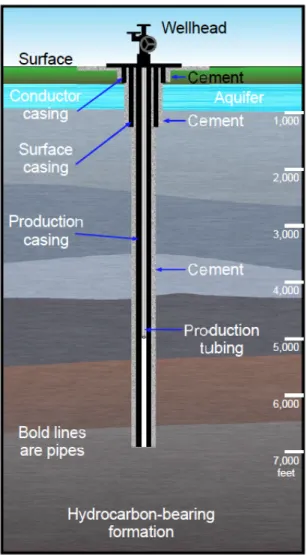
If the well appears capable of producing enough oil and/or gas to justify the cost, the operator will “complete” the well by installing casing.30 Several types off casing will be
used to create the final structure of the well, enabling the well to withstand the pressures acting on it and prevent the mixing of substances from the formations penetrated by it. The first casing, called “conductor” casing serves as a foundation and guide for the casings to follow.31 Next, the operator installs “surface” casing. Surface casing serves a crucial
function; it must be installed to a depth below the deepest source of freshwater encountered by the well and must be surrounded by cement to seal both the well and the freshwater-‐containing formation apart from each other.32 In some wells, “intermediate”
casing may follow the surface casing.33 Finally, “production” casing forms the remainder of
the well down to its final depth. After placing all casing, the operator will pump cement down through the casing and out the end of the casing, causing it to flow back up the well around the outside of the casing (the space between the casing and the sides of the well is sometimes called the “annulus”) until it reaches the surface again.34 This process seals off
the formations encountered by the well to prevent leaking of substances from the formations and any pollution that could be caused by such leaking.35 Given the importance
of this function, and the immense stresses placed on the well, the concrete used must be carefully formulated and installed.36
26 Id. 27 Id. 28 Id. at 100.
29 HYNE, supra note 20 at 239.
30 RAYMOND & LEFFLER, supra note 15 at 139. 31 HYNE, supra note 20 at 241.
32 EPA OFFICE OF RESEARCH AND DEVELOPMENT, PLAN TO STUDY THE POTENTIAL IMPACTS OF HYDRAULIC FRACTURING ON DRINKING WATER RESOURCES,” 14 (2011).
33 Id.
34 RAYMOND & LEFFLER, supra note 15 at 140-‐141. 35 Id.
Figure 2-‐3. Well Casing Diagram37
If the well seems uneconomic to produce, it will be “plugged.” After removing any casing already in place, the operator will install a series of concrete plugs at specific depths to seal off any zones at risk of leaking substances that could contaminate groundwater, including a plug at the base of the lowest depth of freshwater. 38
2.2.2. Horizontal Drilling
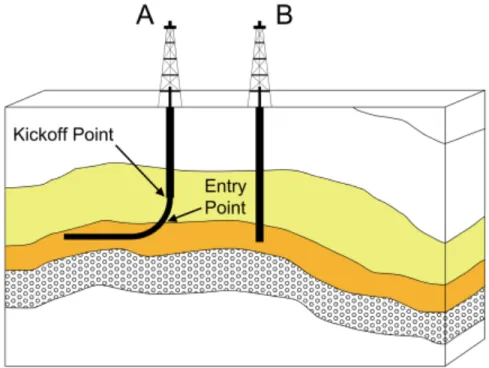
To this point, the discussion has focused on the development of a traditional vertical well. Such wells can only extract oil or gas from the portion of the well that intersects the hydrocarbon-‐bearing formation. As a result, operators sought formations that were highly “permeable” and thus allowed the oil or gas to flow to the end of the wellbore. Conversely, formations that were not highly permeable did not allow oil or gas to be recovered in amounts that justified the cost of drilling and completing the well.
Advancements in horizontal drilling technology changed the situation, though. With horizontal drilling, the wellbore direction can now follow along a formation for a significant
37 Figure source: EPA, supra note 32.
length. This exposes a much greater portion of the wellbore to the formation than a traditional vertical well would allow. 39 A horizontal well in the Marcellus shale of
Pennsylvania may intercept 2,000 to 6,000 feet of formation where a vertical well could only intercept 50 feet.40
Figure 2-‐4. Comparison of Vertical and Horizontal Wells41
Operators have had the capability of drilling wells at a non-‐vertical angle for decades.42
These wells, sometimes called “deviated” or “slant” wells were sometimes used to access formations that could not be accessed by a vertical well such as formations beneath water or other environmentally sensitive sites, or sites that were too rugged to reach.43 However,
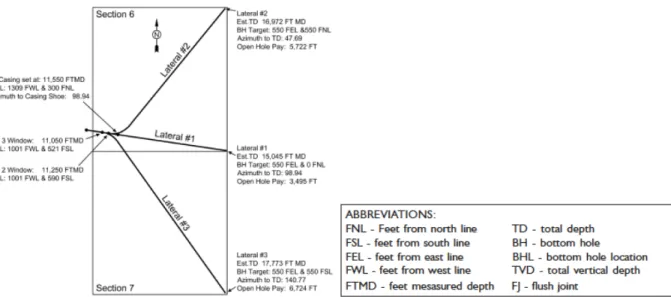
recent advancements in drilling technology have allowed operators to have much greater control in directing the drill bit.44 This allows operators to reach horizontal distances of
nearly five miles from the well pad.45 Horizontal drilling also allows for eight or more wells
to be drilled from a single well pad, allowing a given parcel of land to be developed by a much smaller number of surface well pads than if vertical wells were used.46 Horizontal
wells generally require more time and expense to complete than a traditional vertical well.47
39 DOE OFFICE OF FOSSIL ENERGY AND NATIONAL ENERGY TECHNOLOGY LABORATORY, MODERN SHALE GAS DEVELOPMENT IN THE UNITED STATES: A PRIMER, ES-‐3 (2009), available at http://www.netl.doe.gov/technologies/oil-‐gas/publications/epreports/shale_gas_primer_2009.pdf (last visited September 26, 2012).
40 Id. at 47.
41 Figure Source: Lynn Helms, Horizontal Drilling, North Dakota Department of Mineral Resources Newsletter, March, 2008 at 1, available
at https://www.dmr.nd.gov/ndgs/newsletter/NL0308/pdfs/Horizontal.pdf (last visited September 27, 2012). 42 RAYMOND & LEFFLER, supra note 15 at 16.
43 HYNE, supra note 20 at 281-‐282.
44 For a more detailed discussion of these technologies and the techniques used to direct and survey the wellbore in horizontal drilling,
see HYNE, supra note 20 at 285-‐294.
45 See, e.g. Thomas M. Redlinger and John McCormick, Longer, Deviated Wells Push Drill Pipe Limits, DRILLING CONTRACTOR, March, 2011,
available at http://www.drillingcontractor.org/longer-‐deviated-‐wells-‐push-‐drill-‐pipe-‐limits-‐8779 (last visited September 12, 2012). 46 See DOE, supra note 39 at 47-‐48.
Figure 2-‐5. Sample Horizontal Drilling Plan48
2.2.3. Hydraulic Fracturing
Horizontal drilling allows operators to expose a much greater area of the wellbore to the hydrocarbon-‐containing formation, but even that exposure will not produce the desired flow of oil or gas if the formation does not permit the oil and gas molecules to migrate through the formation and into the wellbore. This issue kept operators from tapping into the significant reserves of natural gas contained in shale formations. Shale rock’s tight formations, in their natural state, frequently lack the pathways that allow a well to collect oil and gas economically. That is where hydraulic fracturing makes the difference.
Figure 2-‐6. Shale Gas Plays in the Lower 48 States49
Hydraulic fracturing was first used in the 1940’s.50 Traditionally, wells that were near the
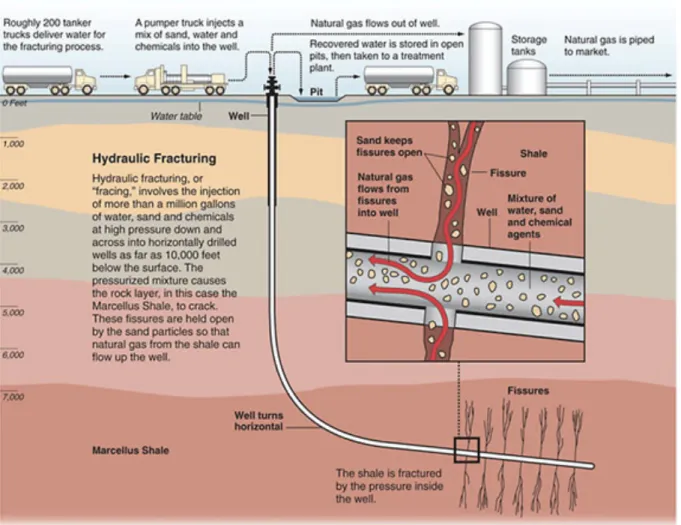
end of their useful life were hydraulically fractured to stimulate the last remaining production from them. Fracturing fluid (composed primarily of water) was forced down the well at high pressures to exploit weaknesses in the hydrocarbon-‐containing formation, opening cracks in the formation that would allow for an improved flow of oil and gas into the well.51 Hence, the term “hydraulic fracturing.”
49 Figure Source: EIA, Natural Gas: Maps: Exploration, Resources, Reserves, and Production, available at
http://www.eia.gov/pub/oil_gas/natural_gas/analysis_publications/maps/maps.htm (last visited September 27, 2012). 50 HYNE, supra note 20 at 560.
Figure 2-‐7. Hydraulic Fracturing Process52
Modern hydraulic fracturing involves very precise seismic surveys of the formation to be fractured to determine the amount, composition, and pressure of fracturing fluid necessary to create fractures in the right rock formation.53 Water remains the primary component of
most fracturing fluids, though some fluids are petroleum-‐based. Water provides a virtually incompressible fluid to generate pressure against the hydrocarbon-‐containing rock, give the fluid volume, and serve as a carrier to transport the other materials. In some cases, diesel fuel may be used instead of water to modify the physical properties of the fluid (such as the fluid’s viscosity or lubricity) or to serve as a solvent for other fluid components.54
Fracturing fluids also contain “proppant,” so called because it consists of particles (frequently sand, though ceramic beads or other spherical materials may be used) forced into the fractures to hold (“prop”) them open, allowing oil or gas to flow through them.55
Fracturing fluid often contains numerous other substances with a wide variety of functions, as shown in Table 2-‐1 below.
52 Figure Source: EIA, WHAT IS SHALE GAS AND WHY IS IT IMPORTANT, available at http://www.eia.gov/energy_in_brief/about_shale_gas.cfm (last visited September 27, 2012).
53 DOE, supra note 39 at 56.
54 EPA, UNDERGROUND INJECTION CONTROL (UIC) PROGRAM PERMITTING GUIDANCE FOR OIL AND GAS HYDRAULIC FRACTURING ACTIVITIES USING DIESEL FUELS, UIC PROGRAM GUIDANCE #84 – DRAFT, available at
http://water.epa.gov/type/groundwater/uic/class2/hydraulicfracturing/upload/hfdieselfuelsfs.pdf (last visited September 18, 2012). 55 Id.
Table 2-‐1. Common Components of Hydraulic Fracturing Fluid56
Hydraulic fracturing requires significant amounts of water, frequently ranging between 2 and 4 million gallons or more to complete a well.57 Operators may use surface water from
streams, rivers, ponds, and lakes if they are available; groundwater wells may provide water if no surface water is available.58
56 Table source: DOE, supra note 39 at 63. 57 Id. at 64.
Once the fracturing fluid is formulated, the operator injects it at high pressures into the targeted formation. This operation may take a number of fracturing trucks working together to generate the fluid pressures and volumes needed.59 After the fractures form,
the operator releases the pressure on the well. This allows some of the fracturing fluid to return to the surface (though the amount of this fluid, sometimes called “flowback” can vary greatly depending on the formation). The operator may recycle this flowback for subsequent hydraulic fracturing operations.60 Wells may also produce salt water in the
targeted formation (this water may be called “produced water”) that can contain minerals and gases associated with the formation beyond natural gas and oil. When flowback and produced water cannot be reused in the well, the operator must find a way to dispose of the water. Options for disposal include injecting the water in an underground disposal well, treating the water and releasing it to a nearby water body, applying the water to land, or disposing of it through a nearby waste water treatment plant.61
2.2.4. Production and Transportation of Gas
Natural gas extracted from the well must get to market. Typically, operators will use pipelines to connect gas wells to a central facility that may remove any remaining water from the gas in a process called “dehydration,” often accomplished by bubbling the gas through a material that will absorb the water (such as ethylene glycol).62 “Sweetening”
units may remove corrosive gases such as carbon dioxide and hydrogen sulfide.63 Once the
gas meets the requirements to be shipped to buyers by pipeline, large compressors bring the gas to the pressure needed to move the gas through the pipeline. These compressors may be powered by natural gas, electricity, or diesel.64
2.2.5. Local Impacts
As demonstrated by this discussion, natural gas production involves a great number of processes. In areas experiencing a great deal of natural gas exploration and production, this may mean that large numbers of workers and significant quantities of supplies are needed. This need can trigger economic impacts in both the local community and the region at large. As an example, natural gas development in the Marcellus Shale of Pennsylvania has been estimated to create anywhere from 10,000 to 140,000 jobs.65
3. Issue Background
The rapid expansion of the natural gas industry has generated vigorous discussion across a broad spectrum of stakeholders. The breadth of the concerns voiced in the debate mirrors the diversity of those involved. Topics in the natural gas conversation range from environmental impacts to stresses on “boomtown” communities, with everyone from the President of the United States to documentarians weighing in on the issue. Section 3 lays
59 See HYNE, supra note 20 at 425. 60 EPA, supra note 32 at 23. 61 EPA, supra note 32 at 43, 49, 81. 62 See HYNE, supra note 20 at 369. 63 Id.
64 See id. at 370. 65 See note 246 infra.
out some of the most common concerns associated with natural gas extraction and provides research-‐based background for these issues. This information creates a foundation for discussion of the policy options presented in Section 4.
3.1 Water Quality Issues
Stakeholders frequently express concern regarding the impact of natural gas extraction activities on the quality of water resources. Some worry that the hydraulic fracturing process could introduce harmful chemical constituents into groundwater resources or that substances associated with natural gas extraction could reach surface water resources. Additionally, many stakeholders worry about what chemicals hydraulic fracturing fluids introduce into the environment.
These concerns gathered enough public attention to prompt Congress to action. In 2009, Congress directed the U.S. Environmental Protection Agency (EPA) to conduct a rigorous study of the relationship between hydraulic fracturing and drinking water.66 In preparing a
plan of study for the issue, EPA identified the following five over-‐arching issues that could link hydraulic fracturing to water impacts:67
1. Water Acquisition: What are the potential impacts of large volume water withdrawals from ground and surface waters on drinking water resources?
2. Chemical Mixing: What are the possible impacts of surface spills on or near well pads of hydraulic fracturing fluids on drinking water resources?
3. Well Injection: What are the possible impacts of the injection and fracturing process on drinking water resources?
4. Flowback and Produced Water: What are the possible impacts of surface spills on or near well pads of flowback and produced water on drinking water resources?
5. Wastewater Treatment and Waste Disposal: What are the possible impacts of inadequate treatment of hydraulic fracturing wastewaters on drinking water resources?
EPA estimates a 2014 completion of its report, with a preliminary report due in late 2012.68
When completed, the study will represent the largest and most comprehensive effort to date created to objectively evaluate the environmental impacts of natural gas extraction. In the meantime, the discussion regarding groundwater, surface water, and fracturing fluids impacts continues and must use the existent base of research information and expert opinion based on sound scientific theory.
3.1.1. Groundwater Issues
Perhaps no issue related to natural gas extraction has garnered as much attention, debate, and emotion as the potential impacts it may have on groundwater resources. Concern about these impacts was one of the primary causes leading to the state of New York’s moratorium on hydraulic fracturing activities.69 Concerns regarding hydraulic fracturing’s
66 DEPARTMENT OF THE INTERIOR, ENVIRONMENT, AND RELATED AGENCIES APPROPRIATIONS ACT, 2010, H.R. 2996, 111th Cong. (enacted) Conf. Comm. Report, available at http://www.gpo.gov/fdsys/pkg/CRPT-‐111hrpt316/pdf/CRPT-‐111hrpt316.pdf (last visited September 14, 2012).
67 EPA, supra note 32 at ix.
68 EPA, EPA’S STUDY OF HYDRAULIC FRACTURING AND ITS POTENTIAL IMPACT ON DRINKING WATER RESOURCES, available at
http://www.epa.gov/hfstudy/index.html (last visited September 12, 2012).
69 See e.g. NEW YORK DEPARTMENT OF ENVIRONMENTAL CONSERVATION, MARCELLUS SHALE, available at