Integration of Civil Engineering and Construction Management Education: A Multidisciplinary, Mentor-led Capstone Experience
Abstract
Our Department of Civil Engineering offers accredited degrees in both Civil Engineering and Construction Management. We have capitalized on the proximity of these programs, and on close interactions with local professional firms, to create a novel multidisciplinary Capstone Design Course. Student teams comprised of civil engineering and construction management students work closely with professional engineering mentors on 30% design and construction plans for real-world projects. The integration of engineering and construction management components provides students with skills important to the engineering/construction workplace, but less common in undergraduate education. Emphasis on project deliverables and presentations, working with mentors in their engineering offices, and structure of the course around responding to a Request for Proposals, help provide students with a realistic project experience. Benefits of this structure include:
Strong collaboration between faculty, students, and practicing professional engineers. Close ties with local professionals enable development of rigorous mentor-led projects. Students work closely with mentors to produce multiple deliverables and presentations with formal mechanisms for frequent feedback.
Benefits to health, safety, and welfare of the public. Future engineers receive training on real world projects and participating firms gain a valuable recruiting tool. Residing in a recognized Hispanic-serving Engineering School, this course also helps prepare under-represented groups for careers in Civil Engineering.
Impacts on raising social consciousness. Most projects are in local communities, and many are influenced by the rich cultural heritage and needs of diverse populations. Students visit project sites and address relevant social and cultural issues as they relate to specific projects.
Impacts of partnering teaching and professional practice. Project-based, practitioner-led learning is an ideal way to partner teaching with professional practice. This approach gives students first-hand experience with the work of practicing engineers and construction managers.
Multidiscipline and/or allied profession participation. The integration of engineering and construction management yields a powerful and important multidisciplinary experience. Students get excellent opportunities to work with the “other sides” of their professions, providing valuable skills for use after they join the workforce.
Knowledge and skills gained. Students gain knowledge of how to gather needed information, to apply technical skills to solve real problems, and how to collaborate across technical and professional disciplines in a design/build project setting.
Viability of technology used. Students are evaluated based on the viability and cost-effectiveness of their project designs - an important goal of the capstone course is to
Integration of Civil Engineering and Construction Management Education: A Multidisciplinary, Mentor-led Capstone Experience
INTRODUCTION
Our Department of Civil Engineering has adopted a novel structure for its capstone course, which combines the disciplines of Civil Engineering and Construction Management into a single project experience for our undergraduate students, under the mentorship of practicing engineers and construction managers. We are ideally situated to offer this course because we offer accredited undergraduate degrees in both Civil Engineering and Construction Management.
The course incorporates in-depth mentoring from local consulting firms and integration of engineering design with construction management tools and analyses for the development of a series of deliverables structured around responses to a Request for Proposal, culminating in a full proposal with 30% design documents. This format has resulted in a highly successful team experience in which engineering students solve real-world design problems, while learning about practicalities of construction and management. Construction management students in turn learn about the challenges and practicalities of engineering design, and all students benefit from working in teams under strict time constraints for production of periodic deliverables, under the close mentorship of local engineering and construction professionals.
This document provides background related to our Department and the development of this course, describes the course structure, describes a recent example project, and presents benefits to students, mentors, and faculty.
PROJECT DESCRIPTION Background
The Department of Civil Engineering has an excellent history of collaboration with local professionals, including many alumni of our program. Since 1993, we have structured our Capstone Courses as design experiences led by practicing engineers from local engineering and construction firms and government agencies. In all, more than 30 local firms and agencies have participated since this course format was developed. Most firms have participated more than once and a some have participated more than 10 times, which is testimony to the fact that the local professional engineers view this as a valuable opportunity to interact with and recruit students.
Our Department is unusually well positioned to provide interaction between civil engineering and construction management students. The department offers a B.S. in Civil Engineering accredited through ABET, and a B.S. in Construction Management accredited through the American Council for Construction Education (ACCE). That these programs reside in the same academic department provides a synergy between design and construction that is rare in higher education in the United States, although
An appropriate venue for integrating design and construction education is the senior capstone courses that all undergraduate students take during their last semester before graduation. For many years the Department offered two separate capstone courses (Design of Civil Engineering Systems and Design Construction Integration). However, the existence of separate courses missed the opportunity to integrate design and construction knowledge, as is commonly required in real-world Civil Engineering projects. The Department recently combined these courses to provide a mentor-led design experience similar to that in a real-world project, as described in detail below.
Course Structure: Combined Civil Engineering and Construction Management Capstone Experiences
In the fall semester of 2007, the Civil Engineering and Construction Management Capstone courses were combined. In this new structure, students from each discipline are assigned to teams of 4 to 6 students, including both engineers and construction managers. The goal of the restructured course was to retain the strengths of the previous capstone courses (primarily the project-based learning that used local consulting firms and real projects) while exposing students to design-build concepts and increasing interdisciplinary interactions. The project-based format of the course is also attractive to the many “non-traditional” students in our program, who often have worked many years in the field.
Before the beginning of the semester, project mentors are recruited from local engineering and construction firms, and sometimes government agencies. Mentors from each firm propose a project that combines several civil engineering disciplines (e.g., hydrology, geotechnical engineering, transportation, hydraulics, structures, and/or water quality) and also lends itself to incorporation of construction management skills (e.g., cost estimation and control, construction phasing, scheduling, and safety planning). Ensuring that projects have multiple components allows each student to work in his or her area of greatest interest (for instance, one student may choose to act as the project structural engineer, another as the hydraulics engineer) and also teaches the students how to integrate multidisciplinary work. The faculty administering the course works with the firm to tailor the project to meet the unique needs of the class, and to ensure an appropriate scope of work for the course.
The engineering projects are usually active or recently completed by the mentor firms. By using real projects, the students have access to background data, soils reports, hydrologic data, and other technical resources. They are also forced to address non-engineering factors, such as economic limitations, utility conflicts, and community and cultural concerns that impact engineering and construction decisions. In most cases, the project design is in progress at the consulting firm, although the firm is typically further along than are the students. The student teams essentially complete parallel design efforts to the actual designs being conducted by the firms, but they do not have access to the consultants’ design plans and so they typically produce designs quite different from those of their mentor partners.
The professional engineer mentors from each firm act as technical advisors to the students, meeting with them weekly and providing guidance and instruction on the design effort. The mentors working with each team typically include a project manager, who provides overall guidance, and one to three younger engineers, who provide day-to-day interaction with the student teams. In addition, the students are encouraged to consult other experts within the company (for example, structural or hydraulics engineers) in addition to faculty, as the needs of the project require. The consultants are instructed to provide guidance but to not make design decisions for the students. In many cases, the consulting firm sets up a work space at the firm’s office for students to use, and the students have completed significant portions of the work in the consultants’ offices. In this manner, students also gain a practical understanding of the routine work environment of professional engineers.
The course follows an aggressive schedule that requires the students to work diligently throughout the semester, placing an emphasis on written deliverables and oral presentations. The current format for the class simulates a two-step selection process for a design-build project, with responses to a fictitious Request for Qualifications (RFQ) and a Request for Proposals (RFP), thus simulating a real-world proposal process. The RFP is developed by the faculty and consultant mentor to describe the client needs of each project. In order to emphasize project design, the RFP requests a well-developed (30%) design. The course requirements center on three major submittals, each consisting of both a written report and an oral presentation, which serve to develop writing, report preparation, and presentation skills, including:
• Statement of Qualifications (SOQ) • Mid-semester progress report • Final proposal (30% design).
The course is configured as if the project was being delivered using a design-build delivery system (some construction phases will occur concurrently with design phases), which serves to integrate unique aspects of construction and construction management into the projects.
Student teams are organized, meet with their mentors, and are introduced to their project during the first week of class. By the third or fourth week, they have created a fictitious company and respond to a Request for Qualifications (RFQ) for the project they have been assigned. The SOQ must contain a description of the firm, with an organization chart and experience of the firm and team members, a description of the proposed project, the firm’s approach to design, some tentative alternatives that might be evaluated, and a proposed construction management approach.
The students present their qualifications in an interview setting. Civil Engineering faculty and mentor partners attend the SOQ presentations and participate to help create a real “interview” experience for the students, who are expected to provide a professional-looking presentation, including quality of presentation materials, professional attire and
complete a written evaluation of student presentations, and each team is provided with written feedback on their written and oral presentations. The student firms are then advised that they have been short-listed and will be allowed to submit a full proposal for design-build services.
The second major submittal is a progress report midway through the semester. For this submittal, the students are expected to develop and evaluate a number of design alternatives meeting clients’ needs for their project. For example, alternatives may include differing roadway alignments, materials for a bridge (steel, cast-in-place concrete, prefabricated concrete), whether sewers will flow by gravity or require a lift station, or different treatment processes for a wastewater facility. For each set of alternatives, the team must prepare a quantitative analysis for use in comparing different options in a decision matrix. This analysis includes some combination of cost of materials, availability of materials, schedule, ease of construction, quality and effectiveness at meeting client needs, and possibly other factors. Written reports and oral presentations are both required. As with the SOQ presentations, faculty and mentors participate and provide feedback to give students with design guidance and to help develop their communication skills.
The final deliverable, turned in and presented the last week of the semester, is the Proposal for Design-Build Services. The proposal contains a summary of the project and highlights of the design process elements and recommendations, detailed design drawings, and specifications. The detailed engineering drawings are at the 30% design stage, drawn using AutoCAD or other computer-aided design software. The students must also submit their calculations, results from design and analysis software, and any other materials used in developing their designs. Construction management students prepare a project schedule, phasing plans, plans for quality assurance and safety, plans for managing resources, manpower, and equipment, and a guaranteed maximum price. The written report is configured as a Proposal for Design-Build Services, and the oral presentation is configured as an interview for the project.
In addition to the three major submittals, each team prepares an internal project control plan, consisting of an organization chart and a schedule for tasks and work flow throughout the semester. Most of the work is completed by the teams outside the classroom, but the class meets as a whole once each week during the semester. In these weekly class meetings, the instructor or other guest speaker provides lessons on specific topics such as project delivery systems, the design-build process, professional practices issues, lifelong learning, and the virtues of attending graduate school. In addition, the teams give short (5-minute) weekly progress reports.
EXAMPLE PROJECT: WASTEWATER POND FOR A RURAL COMMUNITY
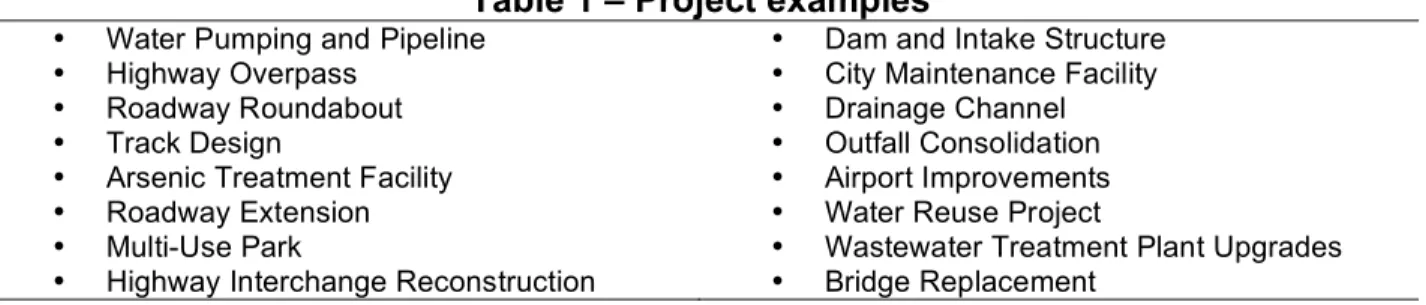
A wide variety of projects have been addressed by the student teams in this course, a few of which are listed in Table 1 to give an idea of common types of projects. A recent project is described in some detail below to illustrate course conduct and scope.
Table 1 – Project examples
• Water Pumping and Pipeline • Dam and Intake Structure
• Highway Overpass • City Maintenance Facility
• Roadway Roundabout • Drainage Channel
• Track Design • Outfall Consolidation
• Arsenic Treatment Facility • Airport Improvements
• Roadway Extension • Water Reuse Project
• Multi-Use Park • Wastewater Treatment Plant Upgrades
• Highway Interchange Reconstruction • Bridge Replacement
A recent wastewater pond project consisted of the design and construction of a new wastewater treatment pond as an extension of an existing system for a small rural community with limited financial resources. This project was suggested by professional engineer mentors at a local civil engineering firm, with two semesters of previous experience with this course, as having excellent potential for meeting the objectives of integrating designs across disciplines, incorporating construction management skills, and providing a realistic design experience. This firm has been working with the client on various phases of their wastewater system since 2002, and so had excellent data for the students to draw on for their design.
The project addressed a fictitious RFP (based on real client needs) to expand the capacity of an existing wastewater pond system. The client currently has four wastewater treatment ponds which have reached their design capacity. Failed efforts by a previous firm have delayed design and construction of expanded facilities, leading to schedule constraints for construction. In addition, construction costs were required to remain under $400,000 due to availability of grant funds, and pond volume and depth were constrained to remain outside of the jurisdiction of the State Engineer. These realistic, non-engineering criteria illustrate the value to students in using real-world engineering projects.
The design team consisted of six undergraduate students (four Civil Engineering and two Construction Management majors), all of whom were in the last semester of their studies. The team members were selected based on the student survey results that indicated interests in geotechnical engineering, water quality, hydraulics, structures, and construction management. In their second week of classes, the team began weekly meetings at the offices of their mentor consultants, where they began gathering information about the project. The students created the firm “Vandalay Design-Build, Inc.” Their organizational plan assigned project roles for each technical area, and lead personnel for the engineering and construction management components of the project. This information, as well as team qualifications, were included in their SOQ submitted and presented 3 weeks into the semester.
After acceptance of their SOQ and shortlisting for a final proposal, the students received their RFP and began engineering analyses and development of alternatives. Two alternatives were compared for each of the design components: pond layout (single pond or two ponds), liner type (HDPE or PVC), and lift station type (pre-fabricated or
durability. The selected set of design components for further development in the Final Proposal was a single facultative lagoon with an HDPE liner and a pre-fabricated lift station, which were projected to meet the client’s needs. These findings were presented at the mid-semester report presentation, along with submittal of a written report.
In-depth analyses for the final design required close collaboration with the project mentors to aid in the gathering of additional information and detailed design. Hydraulic analyses included development of maximum flow rates, head losses, hydraulic grade lines, hydraulic and sizing calculations for a lift station, and piping for delivery of wastewater to the new pond and future connections. Structural calculations and design of a trapezoidal concrete conduit enclosing the piping for protection during compaction of berm materials were included. Hydrologic analyses consisted of evaluating the new lagoon for sufficiency with respect to the zero discharge requirement, including development of flows, precipitation, and evaporation rates based on National Oceanic and Atmospheric Administration (NOAA) data. Geotechnical components included reviewing existing studies of the site and performing slope stability analyses. Six configurations were evaluated with differing berm slopes, heights, and locations to optimally balance the cut/fill values and reduce construction costs, while providing adequate berm stability.
The construction management portion of the project was integrated with the design. In addition to a detailed cost analysis, based on quantity estimates of all construction elements, an Earned Value Management System (EVMS) approach was described to monitor and control project costs during construction. A project phasing plan was also developed, which consisted of describing and scheduling preconstruction, earthwork, liner installation, pipe installation, and demobilization phases, for a total estimated duration of 90 days.
The students’ final proposal included a 30% design, with construction drawings and specifications, for the facultative pond system, including all associated piping, liner, a lift station, and berm details, and a concrete spillway. These designs and plans were included in a written proposal and they were presented in a final proposal to faculty, consultants, and fellow students at the end of the semester, which was again conducted in an interview setting. A final round of written evaluations from all attendees of the student presentations were gathered. At the conclusion of the course, the student team was awarded the project based on an excellent written and oral presentation.
CONCLUSIONS
Our novel CE/CM Capstone structure has demonstrated a highly successful and well-received collaboration between mentors, students, and faculty. Specific benefits include:
Collaboration of faculty, students, and professional engineers. Our Department has been collaborating with professional engineers from local engineering firms and government agencies to teach our senior capstone course since 1993. The regular participation and enthusiasm of local firms is testimony to their support of educating future engineers and benefits of identifying and recruiting the best students. This
collaboration provides benefits to students by providing them with opportunities to gain practical experience in working with consultants, as well as learning the responsibilities of being an active member of the engineering community. For the faculty, consultant mentors bring invaluable practical experience to the classroom.
Benefits to health, safety, and welfare of the public. Future engineers receive training on real world projects and participating firms gain a valuable recruiting tool. Residing in a recognized Hispanic-serving Engineering School, this course also helps prepare under-represented groups for careers in Civil Engineering.
Impacts on raising social consciousness. Most projects are located in local communities, which provides students with an increased awareness of their social impact. Student teams typically visit the project site and are made aware of the social and cultural issues surrounding the project by their consultant mentors. These projects are often influenced by the needs and rich cultural heritage of nearby communities, which students must often account for in their proposed designs.
Impacts of partnering teaching and professional practice. Project-based, practitioner-led learning is an ideal way to partner teaching with professional practice. This approach gives students first-hand experience with the work of practicing engineers and construction managers.
Multidiscipline and/or allied profession participation. The integration of engineering and construction management yields a powerful and important multidisciplinary experience. Students get invaluable opportunities to work with the “other sides” of their professions, which is a common need in many engineering firms, but is relatively rare at a meaningful level in undergraduate civil engineering programs.
Knowledge or skills gained. CE and CM students gain knowledge of how to identify and gather needed information, to apply technical skills to solve real problems, and how to collaborate across technical and professional disciplines in a design/build project setting.
Viability of technology used. An important goal of the capstone course is to gain experience in developing realistic, practical designs. Students are evaluated based on the viability and cost-effectiveness of their project designs. Working closely with practitioner mentors, evaluating alternative design comparisons using a decision matrix, and including multiple feedback mechanisms all help ensure that the final designs are viable.