A GRASP Algorithm Based on
New Randomized Heuristic for
Vehicle Routing Problem
Abdesslem Layeb, Meryem Ammi and Salim Chikhi
Computer Science Department, University of Constantine, AlgeriaThis paper presents a novel GRASP algorithm based on a new randomized heuristic for solving the capacitated vehicle routing problem. This problem is characterized by a fleet of homogenous vehicle capacity that will start from one depot, to serve a number of customers with demands that are less than the vehicle capacity. The proposed method is based on a new constructive heuristic, and a simulated annealing procedure as an improvement phase. The new constructive heuristic uses four steps to generate feasible initial solutions, and the simulated annealing enhances these solutions found to reach the optimal one. We tested our algorithm on two sets of benchmark instances and the obtained results are very encouraging.
Keywords: optimization problems, CVRP, constructive heuristics, nearest neighbor heuristic
1. Introduction
The Vehicle Routing Problem(VRP), proposed by Dantzig and Ramser [1], is an important re-search area in operation re-search given its impor-tance in logistic planning. In this paper we con-sider the Capacitated Vehicle Routing Problem
(CVRP), in which each customer has a known demand less than the vehicle capacity. All the vehicles start from one depot, serve the demands of a set of customers, and return to the same de-pot. The aim is to determine the total traveled distance, in a way that each customer is visited exactly once by a single vehicle, subject to the restriction that the total load on any vehicle as-sociated with a given route does not violate the vehicle capacity. Although the problem appears to be easy to state, it belongs to NP-hard prob-lems category, and needs a huge time and space to resolve optimally, especially with hard VRP instances[2, 3].
Several methods were proposed to solve the CVRP that can be classified in three main classes. The first class contains the exact algorithms which are able to find the exact solution of the CVRP, although they have an exponential com-plexity [3]. The most popular algorithms of this class are based on the Branch & Bound[6], Branch & Cut[7], column generation[8], and set partitioning[9]. Unfortunately, the exact meth-ods are impracticable for large CVRP instances. The second class contains heuristic techniques or constructive methods, in which the solutions are constructed progressively. The main fea-tures of the constructive heuristics are the sim-plicity and the rapidity to find good acceptable solutions. The best known heuristics for CVRP are the saving heuristic of Clarke and Wright
explore efficiently the solution space. However, they are slower than the constructive heuristics and depend on the initial solutions. In addition to the previous methods, several hybrid methods have emerged in recent years[21, 22], which hy-bridize between exact methods, metaheuristics or constructive heuristics.
Greedy Randomized Adaptive Search Proce-dure (GRASP) is a metaheuristic algorithm commonly applied to several combinatorial op-timization problems. A GRASP is an itera-tive procedure, where each GRASP iteration consists of two phases: construction and lo-cal search. The construction phase is a greedy procedure used to build a feasible solution[23, 24]. The second phase is a local search used to enhance the solution found in the construc-tive phase. The two stages are repeated several times independently and the best overall solu-tion is selected as the final result. This tech-nique was successfully used to solve the VRP problems[25,26].
The purpose of this paper is to present new GRASP algorithm based on a new heuristic and the simulated annealing for solving the CVRP. The idea of the new heuristic is based on the density between demands and distances of cus-tomers, and it was first proposed for the knap-sack problem[27]. The first step of the proposed heuristic consists of computing the density ma-trix of the problem. Then, a giant tour is con-structed subject to the order given by the density matrix; the costumer with the high density in the current route is selected to be the next visited customer. In the stochastic version, a non vis-ited customer can be selected randomly with some probability, even if its density is smaller. In the next phase, the giant tour is split into feasible routes subject to the vehicle capacity. Finally, each route is reordered by the use of the nearest neighbor heuristic. In the second phase of our algorithm, we apply the simulated annealing based on a set of operators such as the swap inter- and intra-routes, and the 2-opt move intra- and inter-routes. The computational re-sults over a set of known instances show the effectiveness of the proposed heuristic.
The rest of the paper is organized as follows. In Section 2, a formulation of the tackled problem is given. In Section 3, the proposed method is described. Experimental results are discussed in Section 4. Finally, a conclusion and future works are drawn.
2. Capacitated Vehicle Routing Problem Formulation
The Capacitated Vehicle Routing Problem
(CVRP)consists of a number of customers with known demands, served by a number of vehi-cles departing from one depot. The objective function of the CVRP that should be minimized is the total cost distance travelled by all the ve-hicles. The problem is solved subject to the following constraint[24, 25]:
• midentical vehicles of capacitycap. • ncustomers with demandsdi>0,
i=1, . . . ,n
• All vehicles routes start and end at the depot • Each vehicle serves a subset of customers • Each customer is served once and by one
vehicle
Moreover, there is an integer programming for-mulation of the CVRP. Having the following variables:
• i: is the index of customer(i=1,2, . . . ,n),
nis the number of customers, and the index of depot isi=0;
• k: is the index of vehicle(k= 1,2, . . . ,m),
mis the number of vehicles; • di: the demand of customeri;
• Distij: the distance cost between customeri
and customerj;
• cap: the capacity of vehicle;
• yik: binary variable: its value is 1 if the customer i is delivered by the vehiclek; oth-erwise it is 0;
• xijk: binary variable: its value is 1 if the
vehiclektravels directly from customerito customerj, otherwise it is 0.
The objective function is:
min
m
k=1
n i=1 n j=1
Distij∗xijk (1)
Subject to
n
i=1
m
k=1
yik =1 i=1. . .n (3)
n
i=1
xijk =ykj j=1. . .m,∀k (4) n
j=1
xijk =yki i=1. . .n,∀k (5)
where equation (1)indicates that the objective function of the VRP problem is to minimize the total distance; the constraint equation (2)
controls that the load of each vehicle does not exceed its capacity; the constraint equation (3) signifies that each customer’s demand must be satisfied by one vehicle; the constraint equations
(4)and(5)ensure that there is only one vehicle which arrives and departs from a customer.
3. The Proposed Algorithm
To solve the Capacitated Vehicle Routing Prob-lem, we propose a new algorithm based on Greedy Randomized Adaptive Search Proce-dure (GRASP). GRASP is a two-phase meta-heuristic technique used to solve hard combi-natorial optimization problems. The first phase is a constructive phase used for the construc-tion of initial soluconstruc-tions while the second phase is generally a local search method used for the improvement of the solutions found in the first phase[23, 24]. A generic GRASP approach is described in Figure 1.
The main difference between our algorithm and the other GRASP approaches used for solving the CVRP is the use of a novel randomized heuristic to construct the initial solutions. In order to show how GRASP concepts have been tailored to the problem at hand, we need first to present the novel heuristic used to generate the initial solutions.
Figure 1.The GRASP metaheuristic scheme.
3.1. The constructive phase
Constructive heuristics construct a feasible so-lution by adding one element to the current par-tial solution until a complete one is found. In this paper, we present a new heuristic algorithm for the capacitated vehicle routing problem. The proposed method is inspired by the den-sity ordered heuristic of the knapsack problem
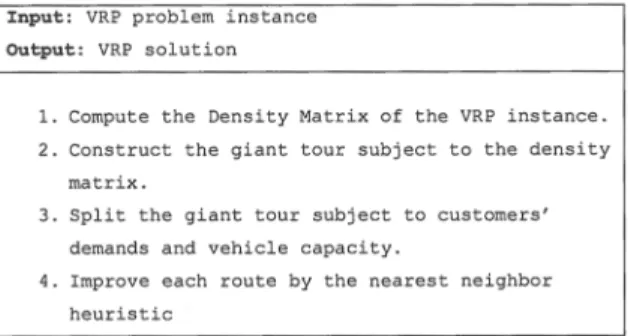
[27]. It follows the Route-first Cluster-second strategy [3, 4], which consists in constructing first a giant tour followed by the split of this tour into feasible routes. The main steps of the proposed heuristic are described by the follow-ing algorithm:
Figure 2.The heuristic scheme.
We explain in more details the proposed heuris-tic. Given a VRP instance, with one depot, n
customers, each customer has a static demand
di, and m vehicles of identical capacity cap.
Our heuristic starts with the computation of the density values between every pair of customers
(including the depot). The density value is the difference between the vehicle capacity and the customers’ demands; the result is divided by the distance between a pair of customers, as described by the following equation:
Density(i,j)
= |(cap−(di+dj)|
p
(dist(i,j)k∗Density(i,depot)∗Density(j,depot))
Density(i,i) = 0
i=1 :n; j=1 :n; k,p∈ {1,2,3,4} (6)
between the customer iand the depot,k andp
are integer parameters between 1 and 4 that af-fects the solution’ quality. Ifphas a big value, the customer with the lowest demand over the vehicle’s capacity will be selected to be the next visited one. Also ifkhas a big value, the choice of the next visited customer will be the customer whose angular distance is very small.
Secondly, we construct a giant tour by using the density matrix as ordering criteria. We sup-pose having one vehicle with unlimited capacity used to visit all customers which are ordered by their density. First, we begin with the customer
is having the highest density value to the
de-pot (Max(density(depot,is)). Then, we select
a second customer inext to visit, who has the
highest density value with the previous visited customers is(Max(density(is,inext)). However,
in the stochastic version, we can select a ran-dom unserved customer with some probability, which leads to generate diverse solutions. The process is repeated until all the customers are in-serted into the giant tour. The third step of our heuristic consists of splitting the giant tour into feasible routes subject to the order defined in the previous step and the vehicle capacity. For each vehicle, the current customer in the giant tour is selected if its demands can be satisfied by the available vehicle capacity; else, the next customer is selected. The process is repeated until all the customers are inserted into feasible routes.
Finally, in order to enhance the solution qual-ity, the nearest neighbor heuristic is applied on each sub tour if a better solution is found. The nearest neighbor heuristic works as follows: the vehicle starts at the depot and then visits the cus-tomer nearest to the depot. From there, it visits the nearest customer that has not been visited so far, etc., until all the customers in one route are visited, and therefore the vehicle returns to the depot. However, we can use other sophisticated heuristics in order to improve efficiency of each route, such as the k-opt approach, swap, etc.
3.2. The local search phase
The Stochastic Local Search (SLS) methods were demonstrated to be useful in solving many complex problems. The Simulated Annealing
(SA)algorithm[28, 29]is among the most used
local search methods in solving many hard com-binatorial optimization problems. The Simu-lated Annealing is inspired by the annealing process in the metallurgy [29]. The simulated annealing starts from a given solution, and ap-plies iteratively some perturbations on this solu-tion in order to get a new one. The perturbasolu-tion is accepted if it has the effect of reducing the objective function(or energy) of the problem; Otherwise, SA can accept uphill moves with the probability exp(ΔE/T), where ΔE is the difference between the objective value of the current solution and the modified one, and T
is the temperature parameter. The temperature
T decreases during the search process. Con-sequently, at the first steps of SA, the proba-bility of accepting uphill moves is great, and decreases progressively until it is difficult to ac-cept new uphill moves. The simulated anneal-ing was among the first local search algorithms developed for the routing problems[28]. In our paper, we use a standard SA procedure with a random neighborhood structure composed of 7 neighborhoods operators. Four of them operate within the routes called intra-route improved operators, and the others called inter-route im-proved operators, operate between two routes. In the following, we present the different neigh-borhoods operators used within the simulated annealing procedure.
3.2.1. Intra-route operators
Several intra-route operators have been pro-posed in the literature; generally, they are taken from the TSP improvement operators. Among the well-known intra-route improvement oper-ators, we have used the following operoper-ators,(it should be noted that in one run we apply ran-domly one operator to improve one route).
• Move operator
One random customer is moved from its current position to a new random one(Figure 3).
• Swap operator
The Swap operator consists of selecting randomly two positions along the individ-ual and swaps their contents, as shown in following figure.
Figure 4.Swap operator.
• Inversion operator
The inversion operator is closely related to the 2-opt operator, it aims to inverse a subsequence between two customers in the route(Figure 5)
Figure 5.Inversion operator.
• Intra-route two-opt operator
The 2-opt operator is among the most ro-bust improvement operators for TSP prob-lems. It is an iterative operator, at each step we delete two edges and add two new edges, and the process is repeated until no future im-provement can be done. The 2-opt improve-ment operator operates as shown in Figure 6.
Figure 6.Intra-route 2-opt operator.
3.2.2. Inter-route operators
This kind of operators is developed specifically for VRP; they involve more than one route.
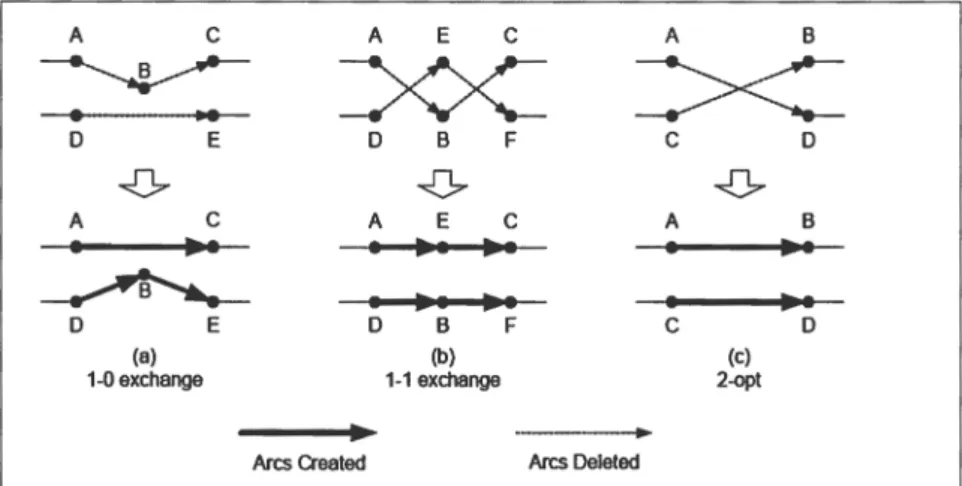
• 1-0 exchange operator
A customer is deleted from one route and in-serted in another route, in order to get good solution, the deleted customer is inserted in the best position in the second route(Figure 7a).
• 1-1 exchange operator
Two customers are deleted from two differ-ent routes, and each deleted customer is in-serted in the other route. In order to get good solution, the deleted customer is inserted in the best position in the second route(Figure 7b).
• Inter-route two-opt operator
The Inter-route two-opt operator removes one edge from two different routes and re-links the first node of the edge with a second node of the second edge and vice versa (
Figure 7c).
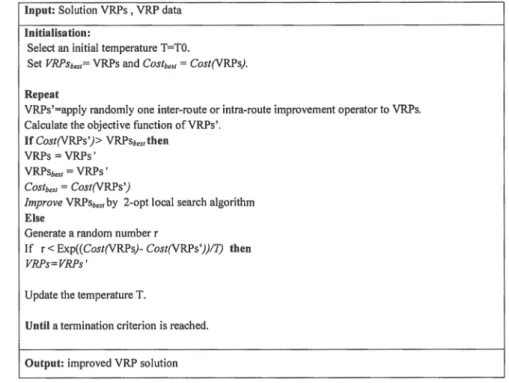
The previous operators are integrated in the sim-ulated annealing procedure, the choice of the simulated annealing is to escape from the local minima, uphill moves can be accepted in order to avoid being trapped in local minima.
At the beginning, the SA parameters like the temperature T is set to T0. Then, an initial
solution VRPsis constructed by using the ran-domized heuristic described in Section 2.1. The current best solution VRPsbest and the best
ob-jective function Costbestare set to beVRPs and
Cost(VRPs), respectively.
At each iteration, a new solutionVRPs’is gen-erated from the neighborhood ofVRPsby using randomly one of the improvement operators de-scribed previously If the new solution is better than the current best, then we save the current solution as the best current one. However, the uphill move can be accepted with the probability
exp(−Δ/T), whereΔis the difference between solutions costs Cost(VRPs’) and the Costbest.
At each iteration the current temperature T is decreased by using cooling scheme T ← αT, where 0 < α < 1. Moreover, to increase the convergence of the proposed algorithm, each new best solution is improved by using a local search procedure based on 2-opt operator
The algorithm is terminated when the cool tem-perature coolTFis reached. The proposed
sim-ulated annealing used for VRP is described in the following figure.
4. Experimental Results
The proposed algorithm called GRASPVRP is implemented in Matlab 7 and tested on Core Duo 2 GHZ with 2 GB of memory. In order to evaluate the performances of our algorithm, we have used two data sets. The first test data sets used in this experiment study are taken from the VRP benchmarkshttp://www.branchandcut. org/VRP/data/. The VRP instances are taken
from series A, B, E, F, G, P and M. All the tests used, are presented in the following tables with the same format name(X-nNC-kNV)where X denotes the name of the data sets(A, B, E, F, G, P, M), NC is the number of customers includ-ing the depot, and NV represents the number of vehicles. For example, the data set “ A-n80-k10” refers to an instance having 80 customers
(including the depot)and 10 vehicles. Respec-tively,AandBcontain small VRP tests. How-ever, the other data sets contain generally hard VRP instances. The second data sets contain 14 benchmark problems proposed by Christofides
[30]. The Christofides instances 6 to 10, 13 and 14 have, besides the capacity constraint, max-imum route length limits and non-zero service times.
The obtained results are summarized in Tables 1, 2, 3 and 4. Finally, statistical tests of Frei-dman were carried out to test the significance of accuracy’ difference of each method in this experiment.
4.1. Results and discussion of the proposed heuristic
In the first part of experiments, we have re-ported the best results found by the deterministic version of the proposed heuristic HDVRP, the randomized one (RHDVRP) and the proposed GRASP based on RHDVRP (GRASPVRP). The number of iterations in RHDVRP and GRASPVRP and algorithm is 30.
In the test data set A(Table 1), the GRASVRP results are the nearest to the best known solu-tions. Indeed, there is no significant difference between the results of GRASPVRP and those of the best known ones. It is clear that the RHD-VRP and GRASPRHD-VRP are better than the deter-ministic heuristic HDVRP, as it is confirmed by Freidman test(Figure 9).
HDVRP RHDVRP GRASPVRP Bestknown
A-n80-k10 2180 2085 1763 1763
A-n63-k10 1708 1667 1315 1314
A-n69-k9 1485 1436 1159 1159
A-n65-k9 1580 1500 1177 1174
A-n60-k9 1694 1618 1354 1354
A-n62-k8 1461 1461 1288 1288
A-n54-k7 1485 1426 1167 1167
A-n45-k7 1447 1395 1146 1146
A-n45-k6 1159 1068 950 944
A-n33-k6 913 818 742 742
A-n39-k5 1004 947 822 822
A-n34-k5 947 911 778 778
Table 1. Results for A instances.
HDVRP RHDVRP GRASPVRP Bestknown
B-n78-k10 1591 1414 1221 1221
B-n67-k10 1431 1263 1032 1032
B-n66-k9 1730 1506 1316 1316
B-n64-k9 1403 1107 861 861
B-n50-k8 1573 1503 1312 1312
B-n57-k7 1643 1457 1153 1153
B-n44-k7 1191 1060 909 909
B-n45-k6 972 743 678 678
B-n38-k6 1060 970 805 805
B-n45-k5 869 826 751 751
B-n35-k5 1130 1075 955 955
Table 2.Results for B instances.
In the second experiment, we have tested our al-gorithm on theBdata set(Table 2), the proposed GRASPVRP is able to find the exact solutions of all the B benchmarks. The performance of RHDVRP in this experiment is better than its performance in the previous experiment; it is successful in the Freidman test,(Figure 10).
In the third experiment held on the hard in-stances category(Table 3), the GRASPVRP re-sults are the nearest to the best known ones. On the other hand, the deterministic version of the HDVRP and its randomized version RHDVRP are not successful in this experiment (Figure 11).
HDVRP RHDVRP GRASPVRP Bestknown
E-n101-k8 1072 1056 815 815
E-n101-k14 1424 1319 1071 1071
F-n135-k7 1631 1319 1162 1162
F-n72-k4 365 357 237 237
G-n262-k25E 8423 8095 5592 5543
M-n151-k12E 1531 1444 1021 1015
M-n200-k17E 1850 1757 1292 1281
M-n200-k16E 1876 1730 1310 1284
M-n101-k10 1120 1048 820 820
P-n101-k4 865 838 681 681
P-n76-k4 788 737 593 593
P-n70-k10 1049 1030 827 827
Table 3.Results for hard instances(the results G and M instances are taken fromxtremeroutewebsite).
Figure 10.Freidman test compares HDVRP, RHDVRP, GRASPVRP, and best known on B data set.
Figure 12. Freidman test compares HDVRP, RNNVRP, NNVRP, RHDVRP, and best known on all instances.
Figure 12 shows the performances of all pro-grams on the entire tests. As it is shown in the Friedman test, there is no significant dif-ference between the GRASVRP results and the best known solutions. However, the results of HDVRP and its randomized version RHDVRP are far from the best solutions.
In this section, we report the results of GRASPVRP compared against the best results reported so far in the table below, on the bench-mark of Christofides instances. We have com-pared our algorithm with six popular and effi-cient algorithms, namely, simulated annealing
with Tabu (OSA) [28], Tabu search for VRP
(TS) by Toth and Vigo [31] adaptive mem-ory programming method called (SEPAS) by Tarantilis[22], a savings ants(SA)[32], GRASP algorithm of Prins (GRELS) [33] and finally a GRASP algorithm based on Neighborhood Search(MPNS-GRASP) [26].
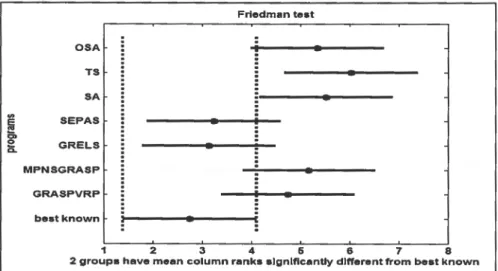
As it can be drawn from Table 4, the GRASPVRP has found the optimal solution for 6 out of 14 instances of Christofides. For the rest of the instances, our results do not show a significant difference between them and those reported as the best known, as shown in Figure 13, the
Instance OSA TS SA SEPAS GRELS MPNS-GRASP GRASP-VRP BKS
C1 524.61 524.61 524.61 524.61 524.61 524.61 524.61 524.61
C2 835.32 838.6 840.61 835.26 835.26 836.39 836.18 835.26 C3 827.53 828.56 828.21 826.14 826.14 826.14 826.14 826.14 C4 1044.35 1033.21 1037.57 1028.42 1029.48 1032.24 1031.8 1028.42 C5 1334.55 1318.25 1306.91 1311.48 1294.09 1314.25 1308.6 1291.29
C6 555.43 555.43 555.43 555.43 555.43 555.43 555.43 555.43
C7 909.68 920.72 917.5 909.68 909.68 909.68 914.5 909.68
C8 866.75 869.48 865.94 865.94 865.94 865.94 874.89 865.94 C9 1164.12 1173.12 1173.94 1162.55 1162.55 1175.86 1177.9 1162.55 C10 1420.84 1435.74 1415.53 1407.21 1401.46 1412.11 1412.6 1395.85
C11 1042.11 1042.87 1043.46 1042.11 1042.11 1042.11 1042.11 1042.11
C12 819.56 819.56 819.56 819.56 819.56 821.12 819.55 819.56
C13 1550.17 1545.51 1546.84 1544.01 1545.43 1548.53 1548 1541.14
C14 866.37 866.37 866.37 866.37 866.37 868.62 866.37 866.37
Figure 13.Freidman test compares GRASP program against other programs on Christofides instances.
results of our algorithm are close to the best known. These results show that GRASPVRP is better than some other approaches, such as Tabu Search (TS) and Simulated Annealing(OSA), the SEPAS program based on adaptive memory programming, our algorithm ranks the third as reported by the Friedman test.
5. Conclusion
In this paper we presented a new GRASP al-gorithm to solve the capacitated vehicle rout-ing problem. The proposed approach is based, firstly, on a new constructive heuristic; the first phase of this heuristic is the construction of a giant tour subject to the density value of each customer. The tour is split according to the customers’ demands and the available vehicle capacity. Secondly, to enhance the quality of the solution found by the construction phase, we have used an adaptive simulated annealing based on several neighborhood operators as the second phase of the GRASP algorithm. The ob-tained results on two different benchmarks are very encouraging and demonstrate the quality of the proposed approach.
References
[1] G. B. DANTZIG, J. H. RAMSER, The Truck
Dispatch-ing Problem. Management Science, 6(1) (1959), 80–91.
[2] P. TOTH, D. VIGO, (EDS.), The Vehicle Routing Problem. SIAM Monographs on Discrete Mathe-matics and Applications, SIAM,(2002a) Philadel-phia
[3] G. LAPORTE, Fifty years of vehicle routing.
Trans-portation Science43(4) (2009), 408–416
[4] G. LAPORTE, F. SEMET,(2001). Classical heuristics
for the capacitated VRP. P. Toth, D. Vigo, eds.,The vehicle routing problem, Society for Industrial and Applied Mathematics, Philadelphia, PA. pp. 109– 128
[5] M. CHARIKAR, S. KHULLER, B. RAGHAVACHARI,
Al-gorithms for capacitated vehicle routing. SIAM Journal on Computing,31(3) (2001b)665–682. [6] P. TOTH, D. VIGO,(2001). Branch-and-bound
algo-rithms for the capacitated VRP. In: Toth, P., Vigo, D. (Eds.), The Vehicle Routing Problem. SIAM: Philadelphia, pp. 29–52.
[7] J. LYSGAARD, A. LETCHFORD, R. EGLESE, A new branch-and-cut algorithm for capacitated vehicle routing problems. Math. Program, 100 (2004), 423–445.
[8] R. BALDACCI, A. MINGOZZI, A unified exact method
for solving different classes of vehicle routing prob-lems.Math. Program,120(2009), 347–380. [9] R. BALDACCI, N. CHRISTODES, A. MINGOZZI, An
[10] G. CLARKE, J. W. WRIGHT, Scheduling of vehicles
from a central depot to a number of delivery points.
Operations Research,12(4) (1964), 568–581. [11] B. GILLETT, L. MILLER, A Heuristic Algorithm
for the Vehicle Dispatch Problem.Operations Re-search,22(1974), 340–349.
[12] A. M. CAMPBELL, M. SAVELSBERG, Efficient
inser-tion heuristics for vehicle routing and scheduling problems.Transportation Science,38(2004), 369– 378.
[13] D. M. RYAN, C. HJORRING, F. GLOVER, Extensions of the Petal Method for Vehicle Routing.Journal of the Operational Research Society, 44 (1993), 289–296.
[14] G. A. P. KINDERWATER, M. W. P. SAVELSBERGH,
Ve-hicle routing: handling edge exchanges. In E. H. L. Aarts and J. K. Lenstra(eds),Local Search in Com-binatorial Optimization Wiley, (1997)Chichester, England.
[15] S. LIN, Computer solutions of the traveling
sales-man problem. Bell System Technical Journal, 44
(1965), 2245–2269.
[16] B. M. BAKER, M. A. AYECHEW, A genetic algo-rithm for the vehicle routing problem.Computers & Operations Research,30(2003), 787–800. [17] T. J. AI, V. KACHITVICHYANUKUL, Particle swarm
optimization and two solution representations for solving the capacitated vehicle routing problem.
Computers & Industrial Engineering, 56 (2009), 380–387.
[18] J. BELL, E. MCMULLEN, R. PATRICK, Ant colony optimization techniques for the vehicle routing problem.Advanced Engineering Informatics,18(1) (2004), 41–48.
[19] M. GENDREAU, A. HERTZ, G. LAPORTE, A tabu
search heuristic for the vehicle routing problem.
Management Science,40(1994), 1276–1290. [20] P. CHEN, H.-K. HUANG, X.Y. DONG, Iterated
vari-able neighborhood descent algorithm for the capac-itated vehicle routing problem.Expert Systems with Applications,37(2010), 1620–1627.
[21] J. BERGER, M. BARKAOUI, (2003). A hybrid ge-netic algorithm for the capacitated vehicle routing problem. In Cant´u-Paz, E., ed.: GECCO03. LNCS 2723, Illinois, Chicago, USA, Springer-Verlag, pp. 646–656
[22] C. D. TARANTILIS, E. E. ZACHARIADIS, C. T. KIRA -NOUDIS, A hybrid metaheuristic algorithm for the
integrated vehicle routing and three dimensional container-loading problem. IEEE Transactions on Intelligent Transportation Systems,10(2009), 255– 271.
[23] A. LAYEB, M. SELMANE, M. BENCHEIKH EL
-HOUCINE, A new greedy randomized adaptive search procedure for multiple sequence alignment, to ap-pear in International Journal of Bioinformatics Research and Applications, Inderscience publisher,
9(4) (2013), 323–335.
[24] A. V. MOURA, R. A. SCARAFICCI, A GRASP
strat-egy for a more constrained School Timetabling Problem.International Journal of Operational Re-search,7(2) (2010), 152–170.
[25] CH. DUHAMEL, PH. LACOMME, CH. PRINS, C. PROD
-HON, A GRASP×ELS approach for the capacitated
location-routing problem.Computers & Oper-ations Research,37(11) (2010), 1912–1923.
[26] Y. MARINAKIS, Multiple Phase Neighborhood Search GRASP for the Capacitated Vehicle Routing Problem.Expert Systems with Applications,39(8) (2012), 6807–6815.
[27] KOHLI, RAJEEV, R. KRISHNAMURTI, A Total-Value
Greedy Heuristic for the Integer Knapsack Problem.
Operations Research Letters,12(2) (1992), 65–71.
[28] I. OSMAN, Metastrategy simulated annealing and tabu search algorithms for the vehicle routing prob-lem. Annals of Operations Research, 41 (1993), 421–451
[29] S. KIRKPATRICK, C. D. GELATT, M. P. VECCHI, Op-timization by Simulated Annealing. Science, 220
(1983), 671–680.
[30] N. CHRISTOFIDES, (ED.)ET AL.,Combinatorial Op-timization. John Wiley & Sons, Chicester, pp. 315–338.
[31] P. TOTH, D. VIGO, The granular tabu search and its application to the VRP. INFORMS.J. Comput.,15
(2003), pp. 333–346.
[32] M. REIMANN, K. DOERNER, R. F. HARTL, D-Ants:
Savings based ant divide and conquer the ve-hicle routing problem. Computers & Operations Research,31(2004), 563–591.
[33] C. PRINS, (2009) A GRASP x evolutionary local
search hybrid for the Vehicle Routing Problem, Bio-inspired algorithms for the Vehicle Routing Problem, F.B. Pereira and J. Tavares(eds), Studies in Computational Intelligence, Springer, pp. 35–53,
Received:August, 2012
Revised:January, 2013
Accepted:February, 2013
Contact addresses:
Abdesslem Layeb Computer Science Department University of Constantine Algeria e-mail:[email protected]
Meryem Ammi Computer Science Department University of Constantine Algeria e-mail:[email protected]
ABDESSLEMLAYEBis an Associate Professor in the Department of Computer Science at the University of Constantine, Algeria. He is a member of MISC Laboratory. He received his PhD in Computer Sci-ence from the University of Constantine, Algeria. He is interested in combinatorial optimisation methods and their applications in solving several problems.
MERYEMAMMIis a PhD student in Computer Science at the University
of Constantine. She is a member of the SCAL team of MISC Lab-oratory. Her research areas include soft computing and artificial life techniques and their application in solving vehicle routing problems.