Original Research Article
Clinical study of neonatal septicemia with reference to early
indicators of sepsis
E. Kishore*, Sreedhar S. V. S.
INTRODUCTION
Septicemia in the neonatal infant refers to a generalized microorganism infection documented by a positive blood culture within the initial four weeks of life. Although an outsized newborn service is probably going to possess lower than ten infants with generalized infection annually, the identification of infant sepsis ought to be thought of in nearly each sick baby.1 Infant sepsis
features a high case morbidity while not treatment; however, with presently accessible antimicrobial agents,
on paper, all cases of infant sepsis is also treated with success. Thus, there is an urgent need for early diagnosis and proper management.2 the following discussion will
attempt to develop appropriate guidelines for the diagnosis and treatment of septicemia in the neonatal infant. Similar clinical considerations are involved whenever septicemia is suspected in the first few months of life, particularly in the premature infant. Septicemia of the neonate is usually a life-threatening disease, wherever early identification and prompt treatment are essential for the outcome. The early signs and symptoms of infection ABSTRACT
Background: The use of CRP (C-reactive protein) in early diagnosis of neonatal septicemia. The usefulness of CRP
in early detection of neonatal septicemia/meningitis and urinary tract infection was studied in a neonatal unit using a semi-quantitative latex-agglutination as a rapid screening method and electroimmuno assay as reference method for CRP determination.
Methods: The present study was conducted among 150 patients 218 samples were taken for serum globulin
determinations. Additionally, all infants born at the hospital throughout August 2016 to February 2017 with a designation of blood disease, infectious disease or tract infection (UTI) were retrospectively studied. Depending on the clinical course and therefore the results of the culture the 110 infants were divided into four groups.
Results: The 110 infants in 92% of non-infected infants CRP was 16 mg/l and 80% had CRP <10 mg/l up to 3 days
of age. After 3 days of age 93% had CRP <12 mg/l. The initial CRP level was increased in 9 out of 11 patients (82%) with bacterial septicemia. Low CRP was seen in one patient with total agranulocytosis and septicemia from
Streptococcus type B and in one patient with Staphylococcus albussepsis. A rise in CRP was also seen in very pre-term infants with septicemia. Increased initial CRP was uncommon in neonatal urinary tract infection (2 of 9) but a rise was seen in 3 additional patients.
Conclusions: A comparison between CRP, total neutrophil blood cell count and hand neutrophil count as diagnostic
parameters was in favor of CRP at this early stage of infection. CRP is of definite value as an aid in early diagnosis of neonatal septicemia and bacterial meningitis.
Keywords: C-reactive protein, Neutrophils, Meningitis, Septicemia, Urinary tract infection Department ofPediatrics, Narayana Medical College, Nellore, Andhra Pradesh, India
Received: 06 June 2017
Revised: 17 June 2017
Accepted: 29 June 2017
*Correspondence:
Dr. E. Kishore,
E-mail: [email protected]
Copyright: © the author(s), publisher and licensee Medip Academy. This is an open-access article distributed under
the terms of the Creative Commons Attribution Non-Commercial License, which permits unrestricted non-commercial use, distribution, and reproduction in any medium, provided the original work is properly cited.
are often unspecific and vague. Therefore, routine laboratory aids which are simple, rapid and specific are badly needed.
Previous authors have separated neonatal septicemias into two groups, primary septicemia and secondary septicemia associated with major anomalies, focal infections, debilitating illness, and surgical procedures. In some reviews, several or all cases of secondary septicemia haven't been enclosed. During this comment, all cases of baby sepsis are thought of neonatal septicemia are considered, additionally suppose that it's helpful to subdivide primary sepsis into early and late (after seventy-two hours) onset for medical specialty and therapeutic purposes.
The study was designed to review a 5-year experience with neonatal septicemia and meningitis at the Narayana Hospital. Explicit attention is concentrated on the ever-changing pattern of infection and etiological agents, the predisposing conditions to neonatal infection, and issues in diagnosing and medical aid.
METHODS
A prospective investigation was performed from July 2014 to August 2016. The study enclosed infants up to thirty days of age with suspect general infection at an early stage, either attributable to clinical signs and symptoms or attributable of chorio-amnioitis or infection of the mother. The first one hundred fifty infants within the prospective study, thirty (20%) had to be excluded because they did not fulfill the criteria (samples for culture and CRP taken on different days, insufficient samples or samples taken after antibiotics had been given). From the remaining one hundred twenty patients 218 samples were taken for serum globulin determinations. Additionally, all infants born at the hospital throughout August 2016 to February 2017 with a designation of blood disease, infectious disease or tract infection (UTI) were retrospectively studied (49 samples from nine patients). Depending on the clinical course and therefore the results of the culture the 110 infants were divided into four groups.3,4
Group I
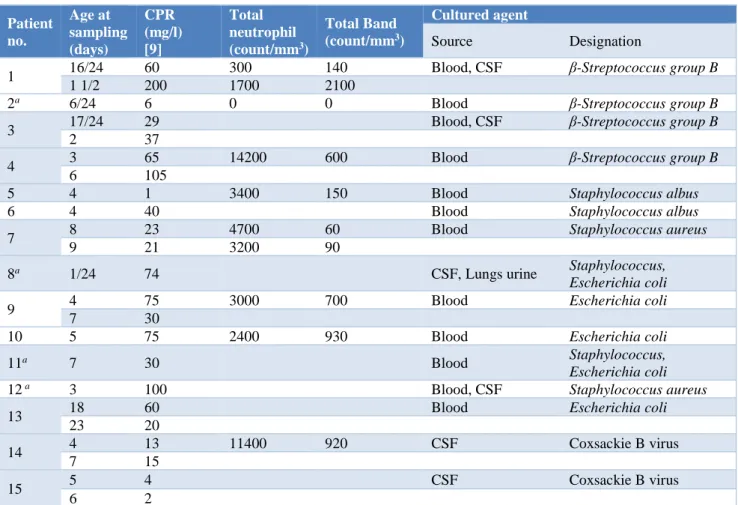
15 infected infants with septicemia or meningitis verified by positive cultures from the blood within the twelve of microorganism origin. The other 2 infants had positive viral cultures from the cerebrospinal fluid (CSF) (Table 1). Four babies had bacterial meningitis with positive cultures from the CSF.
Group II
9 infected infants with urinary tract infection verified by cultivation of Escherichia coli (>I 000 organism/ml) in urine obtained by bladder puncture, however different cultivations were negative (Table 2).
Group III
14 suspects infected infants wherever cultivations of blood, CSF and bladder urine were negative. These patients, like those in Groups I and II, had a clinical course suggesting general infection.
Group IV
72 non-infected infants who satisfied the aforementioned criteria for care in the Neonatal Unit however where the cultivations were negative. Furthermore the subsequent clinical course was not suggestive of infection and no antibiotic treatment was given.
Sampling techniques
Urine was obtained by suprapubic bladder puncture and CSF by lumbar puncture. Blood for aerobic and anaerobic cultivation was taken from peripheral veins. In about one-half of the cases capillary blood from free-flowing heel pricks was used for the total and differential white cell counts.5
CRP determinations
CRP determinations were performed with two methods on serum from capillary, venous or arterial blood, often as small a sample as 0.5 ml of blood.4
Lutex agglutination
Lutex agglutination was performed in the main consistent with the manufacturer's instructions (AG Behringwerke, Marburg, Germany) using 10 µl aliquots of reagents and patient's serum undiluted and diluted 1/5 and 1/20 with diethylbarbituric acid buffer (Veronal buffer), 0.15 mM CaCl2, 141 mM NaCl, 0.5 mM MgCl2, 0.1% gelatin, 1.8
mM sodium barbital and 3.1 mM barbituric acid, pH 7.3-7.4. After 5 min reaction time, the degree of agglutination was read at 12.5 x s magnification and registered as negative ±, + or ++. An arbitrary scale was established for each batch of latex particles using sera with known CRP content as determined by electroimmuno assay. Thus. a preliminary semiquantitative report of CRP level as negative, <10, 10-30, 20-40, 40-50, >50 mg/l could be received within 2 h of sampling.5
The electroimmunoassay (EIA)
originally presented by Laurell was employed for more exact quantitation as described by Wadsworth.6,7 Plates
were run 2-3 times per week with results reported the day after each run.
Statistical methods
RESULTS
CRP in infants with septicemia or meningitis (group I)
This group consisted of 15 infants with verified septicemia or meningitis. As is seen in Table (Table 1), nine out of eleven patients (82%) with bacterial septicemia or meningitis had increased CRP levels in the
initial CRP sample. Case no. 2 with a deadly congenital infection caused by β-Streptococcus Group B had a CRP within the normal range, but only one sample was obtained at 5 h of life. This patient also had total agranulocytosis. One patient (Number 5) with Staph. Albus sepsis also had a low CRP in his single sample. The two cases with viral meningitis had low CRP at 14 and 3 mg/l, respectively. The earliest sample was taken at I hour of age (case 8).
Table 1: Infants with verified septicemia or meningitis (group I).
Patient no.
Age at sampling (days)
CPR (mg/l) [9]
Total neutrophil (count/mm3)
Total Band (count/mm3)
Cultured agent
Source Designation
1 16/24 60 300 140 Blood, CSF β-Streptococcus group B
1 1/2 200 1700 2100
2a 6/24 6 0 0 Blood β-Streptococcus group B
3 17/24 29 Blood, CSF β-Streptococcus group B
2 37
4 3 65 14200 600 Blood β-Streptococcus group B
6 105
5 4 1 3400 150 Blood Staphylococcus albus
6 4 40 Blood Staphylococcus albus
7 8 23 4700 60 Blood Staphylococcus aureus
9 21 3200 90
8a 1/24 74 CSF, Lungs urine Staphylococcus,
Escherichia coli
9 4 75 3000 700 Blood Escherichia coli
7 30
10 5 75 2400 930 Blood Escherichia coli
11a 7 30 Blood Staphylococcus,
Escherichia coli
12 a 3 100 Blood, CSF Staphylococcus aureus
13 18 60 Blood Escherichia coli
23 20
14 4 13 11400 920 CSF Coxsackie B virus
7 15
15 5 4 CSF Coxsackie B virus
6 2
CRP=C-reactive protein; CSF=Cerebrospinal fluid; a Died
CRP in infants with bacteriuria (group II)
In the group of babies with bacteriuria 7 of 9 had initial CRP levels at intervals the traditional vary (Table 2).
One patient had a rather increased CRP of 12 mg/l and another, three weeks old, had an initial CRP of 170 mg/l. This patient (number 24) was the only one with symptoms of UTI of several days’ duration at the day of sampling and the only one with temperature over 38 0C.
The micro sedimentation rate was 40 mm/h. In succeeding samples from three of four patients with terribly slight symptoms a marked increase in CRP level was determined. In 2 of the 3 patients with increasing
CRP no treatment had been given for 3 days after bacteriuria had been ascertained.
The slight clinical symptoms remained unchanged, and the temperature was 37.5 0C at its highest.
CRP in suspect infected infants (group III)
Figure 1: Infants with suspected infection not verified by culture (group II) concentration of CRP in first sample related to age normal limit is indicated infants
not treated by antibiotic marked by.
Seven of the fourteen cases had pulmonary infiltrates suggestive of pneumonia, or aspirations with secondary pneumonia. Two cases, with initial CRP 60 and 90 mg/l, severally, had symptoms extremely implicative of septicemia, but cultures were negative.
Table 2: Infants with urinary tract infection verified by cultivation of Escherichia coli from urine taken by
bladder puncture group II.
Patient no Age at sampling (days) CRP (mg/l)
16
1 5
2* 100
3* 32
17 2 7
5 100
18 4 7
19 5 7
20 5 3
9* 1
21 6 1
22 11 12
23 2
23
14 4
17 60
20* 6
24
21 170
24* 80
28* 5
CRP=C-reactive protein, *After treatment had been initiated. CRP in non-infected infants (group IV)
The initial CRP values determined with EIA within the 72 non-infected infants throughout the primary month of life are shown (Figure 2). The initial sample was obtained at 0-3 days of age in 38, at 4-7 days in 20, and at 8-30 days in 14 patients. CRP values were squally distributed when values for each day were considered. At 0-3 days of age 92 % had d 16 mg/l and 80% <10 mg/l. At 4-7 days
of age 93% had less than 12 mg/l. using the non-parametric tolerance interval (95-50 TI) the upper limit was set at 15 mg/l at 0-3 days of age and 7 mg/l at 4-30 days of age for non-infected infants.
Figure 2: Non-infected infants (n=72) (group IV) concentration of CRP in first sample related to age of
the infant normal limit is indicated.
CRP in relation to gestational age
The initial CRP values taken throughout the primary week of life were grouped according to the gestational age of the infants. Three out of 5 infants with septicemia after 27-32 weeks of gestation produced moderate to high amounts of CRP. When comparing infected pre-term babies (27-36 weeks, n = 9) with full-term newborns with verified microorganism sepsis/ meningitis (n =5) no significant difference was found in CRP levels between the groups.9,10
CRP versus total neutrophil blood cell count
The results of total neutrophil counts in 71 patients at the time of initial CRP sample were compared with the data presented by Gregory and Hey.11
In the present study an early total neutrophil count fell within the region within which 90% of all normal neutrophil counts are found in 4 out of 8 tested cases of bacterial septicemia/ meningitis, in all 3 tested cases with UTI and in 5 of the 10 tested cases in Group III. Furthermore 20% of the non-infected tested babies (Group IV) were false positive.
CRP versus band neutrophil count
The distribution of early samples of non-segmented (band) polymorphonuclear leucocytes was investigated in 50 babies throughout the primary five 5 days of life. With one exception, they were all within the 95% range for normal full-term infants reported by Akenzua et al.12
out of the eight tested patients in the suspect infected group were within the normal range.
Utility of agglutination results
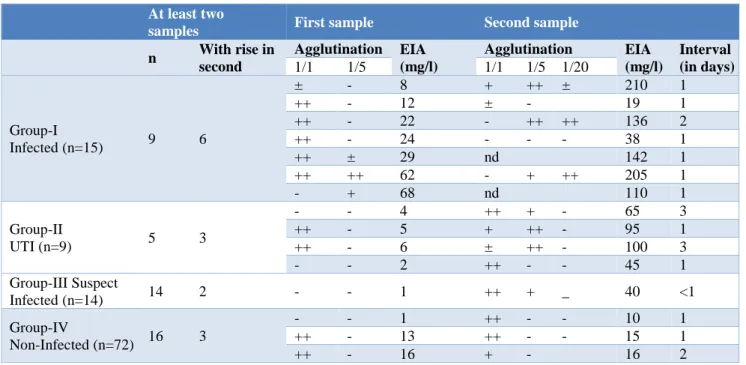
The agglutination results for the initial samples will be thought-about in respect to the patient groups. With the exception of Group II the distribution appears reasonable; 81 % of the non-infected infants had negative, ± or + agglutination results, whereas the infected I and suspect infected Group III had 9 or 12 % within this range. Agglutination findings were initially low in 7 out of 9
infants with verified bacteriuria. It should be noted, however, that of the 19 sera with initial ++ agglutination which were initially reported as 10-30 mg/l 12 were from infants later designated as non-infected. Nine of these proved to have EIA ratings in the normal range for age. Some of these ++ (10-30 mg/l) reports can be followed-up in (Table-3) where the detailed results are given for second samples with a higher CRP level than that found in the first. In most instances, the infected infants responded in the next sample taken within 1 or 2 days with high levels of CRP in distinction to the non-infected.13
Table 3: Consecutive samples showing a rise in c-reactive protein.
At least two
samples First sample Second sample
n With rise in
second
Agglutination EIA
(mg/l)
Agglutination EIA
(mg/l)
Interval (in days)
1/1 1/5 1/1 1/5 1/20
Group-I
Infected (n=15) 9 6
± - 8 + ++ ± 210 1
++ - 12 ± - 19 1
++ - 22 - ++ ++ 136 2
++ - 24 - - - 38 1
++ ± 29 nd 142 1
++ ++ 62 - + ++ 205 1
- + 68 nd 110 1
Group-II
UTI (n=9) 5 3
- - 4 ++ + - 65 3
++ - 5 + ++ - 95 1
++ - 6 ± ++ - 100 3
- - 2 ++ - - 45 1
Group-III Suspect
Infected (n=14) 14 2 - - 1 ++ + _ 40 <1
Group-IV
Non-Infected (n=72) 16 3
- - 1 ++ - - 10 1
++ - 13 ++ - - 15 1
++ - 16 + - 16 2
EIA=electroimmunoassay; UTI=urinary tract infection; nd = not-detected
DISCUSSION
The need is obvious for a quick and safe guide to direct the tough decision of treatment or no treatment of a neonate with vague symptoms, which could be due to sepsis. It is of greatest importance for the result to catch the earliest possible deviation from normal in any laboratory parameter used for this purpose. Throughout the previous few years many authors have reportable the utility total neutrophil count or total band neutrophi1 count in this respect. 10,14,15 In the present study neither
total neutrophil count nor band neutrophil count was comparable to CRP in the early detection of infection. Moreover, there have been massive numbers of positives with total neutrophil counts and of false-negatives with band neutrophil count.
In the present study on CRP we have a tendency to found, employing a changed standardized semi-quantitative
latex agglutination that routine results may be obtained inside two hours. From the practical point of view a latex agglutination of - or ±can be considered negative. Between 0-3 days of age however, some newborns without infection may have values of 15-20 mg/l or + agglutination. The range between 10-30 mg/l, that is ++ agglutination, isn't as clear cut. Furthermore, samples taken very early in the course of infection may be in this range. In uncertain cases, it is essential to repeat the sample after a few hours since the rise of CRP seems to be very rapid.
Cases with infant UTI had initial CRP in the normal range. In some cases, a pointy rise in CRP was seen. This may indicate that the infection was initial confined to the bladder but later advanced to the kidneys.17
Infection is most difficult to diagnose in very pre-term infants. The capability to make CRP is basal and occurs quite early. CRP determination in terribly pre-term infants may prove to be of great value in early detection of infection in these babies.
In the neonatal period, a CRP rise from causes nevertheless infection seems to be comparatively rare. In the present series, approximately 5 % will have false-positive values with a limit set at 15 mg/l at 0-3 days and at 10 mg/l from 4 days on.
Therefore, a high CRP, in combination with any symptoms indicating infection, is very implicative microorganism infection, should be treated with little risk of overtreatment. On the other hand, a newborn with symptoms indicating a severe bacterial infection, but with negative CRP should also be treated, since there are about 15% false-negatives in the present series. With additionally experience with the SIA method this figure may be reduced. In an exceedingly newborn with vague symptoms which may or may not indicate bacterial infection, CRP as well as the clinical condition ought to be followed. If the clinical condition is satisfactory, and the CRP not rising above normal limits, antibiotics usually can be withheld. In our experience, the use of CRP as a diagnostic aid has reduced administration of antibiotics within the nursery.
ACKNOWLEDGEMENTS
Authors would like to thank the department faculty and their patients; without their support, this study would not have been possible.
Funding: No funding sources Conflict of interest: None declared
Ethical approval: The study was approved by the Institutional Ethics Committee
REFERENCES
1. Gotoff SP, Behrman RE. Neonatal septicemia. The J Pediatr. 1970;76(1):142-53.
2. Crum NF. Update on Listeria monocytogenes infection. Current gastroenterology reports. 2002;4(4):287-96.
3. Sabel KG, Wadsworth CH. C‐Reactive Protein (CRP) in early diagnosis of neonatal septicemia. Acta Paediatr. 1979;68(6):825-31.
4. Chauhan SB, Vaghasia V, Chauhan BB. C-reactive protein (CRP) in early diagnosis of neonatal septicemia. National J Medic Res. 2012;2(3):276-8. 5. Lin DS, Huang SH, Lin CC, Tung YC, Huang TT,
Chiu NC, et al. Urinary tract infection in febrile infants younger than eight weeks of age. Pediatr. 2000;105(2):20.
6. Laurell CB. Quantitative estimation of proteins by electrophoresis in agarose gel containing antibodies. Analytical biochem. 1966;15(1):45-52.
7. Xanthou M. Leucocyte blood picture in ill newborn babies. Arch Dis childhood. 1972;47(255):741. 8. Reed AH, Henry RJ, Mason WB. Influence of
statistical method used on the resulting estimate of normal range. Clinic Chemist. 1971;17(4):275-84. 9. Jaye DL, Waites KB. Clinical applications of
C-reactive protein in pediatrics. Pediatr Infect Dis J. 1997;16(8):735-47.
10. Qiu C, Sorensen TK, Luthy DA, Williams MA. A prospective study of maternal serum C‐reactive protein (CRP) concentrations and risk of gestational diabetes mellitus. Paediatr Perinatal Epidemiol. 2004;18(5):377-84.
11. Gregory J, Hey E. Blood neutrophil response to bacterial infection in the first month of life. Arch Dis childhood. 1972;47(255):747-53.
12. Akenzua GI, Hui YT, Milner R, Zipursky A. Neutrophil and band counts in the diagnosis of neonatal infections. Pediatr. 1974;54(1):38-42. 13. Putta SD, Deshpande S, Bharadwaj R. Utility of
latex agglutination test in the diagnosis of acute pyogenic meningitis. Annal Pathol Lab Med. 2016;3(4):A269-275.
14. Haider SA. Polymorphonuclear leucocyte count in diagnosis of infection in the newborn. Arch Dis in childhood. 1972 ;47(253):394-5.
15. Zipursky A, Palko J, Milner R, Akenzua GI. The hematology of bacterial infections in premature infants. Pediatr. 1976;57(6):839-53.
16. Wadsworth C. A Rapid Spot Immunoprecipitate Assay Method Applied to Quantitating C‐Reactive Protein in Pediatr Sera. Scandinavian J Immunol. 1977;6(12):1263-73.
17. Jodal U, Lindberg U, Lincoln K. Level diagnosis of symptomatic urinary tract infections in childhood. Acta Pediatr. 1975;64(2):201-8.