Background
Temporomandibular disorders (TMD) are wide spread in the population: prevalence studies have reported that approximately 75% of the population has at least one sign of joint dysfunction (women ratio is 4:1), while approximately 33% experience at least one of its symptoms [1]. This means that TMD is, overwhelmingly, the most common chronic orofacial pain problem confronting dentistry. As a chronic disorder TMD, for many patients, is an enduring, recurrent condition, which may also resist treatment, [2,3]. Furthermore, as a chronic pain condition, TMD is no exception to this clinical picture and abundant evidence has established the presence of psychological distress and psychosocial disability as well as increased health care utilization in important segments of the TMD clinical population [4,5].
There are indications that many patients suffering from TMD may also show a reduced Oral Health Quality of Life (OHQoL) [6-8]. However, in the great majority of pertinent articles related to TMD patients, OHQoL was not specifically addressed;
instead aspects such as psychological impairment – i.e. depressive preoccupation, anxiety – were used as a surrogate parameters for OHQoL [9]. Reisine and Weber in 1989 used many aspecifical instruments as the McGill Pain Questionnaire and the State-Trait Anxiety Inventory [10]; moreover, other Authors [11-13] used not-validated instruments.
Short Form 36-item Health Survey (SF-36) is the most widely used questionnaire to evaluate the Health-related Quality of Life[14,15]; some authors have used it and its abbreviated version as SF-12 [16] and MOS-17 [17] in TMD patients, but none of them have valuated its sensitiveness and specificity for TMD.
To us, the use of SF-36 in TMD would allow for the comparison of TMD with other chronic diseases where SF-36 - HRQoL scores are already available. By comparing the impact of a specific disease to the level of impaired health, one would be able to derive the socio-psychosocial impact due to that disease (in our case to a specific TMD diagnosis)— a research goal which has so far not been targeted for oral disorders.
Measuring Quality of Life in TMD: use of SF-36
Deli Roberto
1, Macrì Ludovica Antonella
1, Mannocci Alice
2, La Torre Giuseppe
21Department of Orthodontics, Institute of Dentistry, Catholic University of the Sacred Heart, Rome; 2Epidemiology and Biostatistics Unit, Institute of Hygiene, Catholic University of the Sacred Heart , Rome
Correspondence to: Ludovica Antonella Macrì, via dei Gracchi, 39 00192, Roma. E-mail: [email protected]
Abstract
Aim:Temporomandibular disorders (TMD) occur frequently in the population and measuring health-related quality of life may prove to be a very useful complementary measure. The aim of our study was to evaluate both the correlation and the agreement between SF-36 and the Axis II of Research Diagnostic Criteria for TMD in the assessment of health-related quality of life in TMD patients.
Methods:This study was conducted on consecutives patients referred to our Department from 1 July 2007 to 31 January 2008. Each subject completed the Axis II and SF-36 questionnaires. Correlation of the SF-36 vs. the Axis II scales (graded chronic pain, depression, somatization with and without pain, jaw disability checklist) was calculated using non-parametric Spearmen coefficient.
Results:The examined sample was composed by 146 subjects (30 males, 116 females; mean age 35,2 ±14,38 years). There isn’t significant gender difference in age (p=0.083). All the considered Axis II scales are significantly inversely related with all the SF-36 domains.
Conclusion: Due to the good agreement with Axis II, SF-36 can be used for measuring Health-Related Quality of Life in TMD patients.
The aim of our study was to analyze the agreement and the correlation between Sf-36 and Axis II of Research Diagnostic Criteria for TMD [18] in the assessment of the health-related quality of life in TMD patients; and to seek out gender and age differences.
Materials and methods
Sample
This study was conducted with 146 consecutives patients referred to our Department from 1 July 2007 to 31 January 2008. The sample size was calculated based on a significance level of 95% and a power of 80% to detect differences in sensitivity of 10% between the two questionnaires (Axis II 95% versus SF36 85%). The power analysis showed that 141 subjects were required.
Each subject filled in the Axis II and SF-36 questionnaires. The questionnaires were administered in the waiting room before any contact with the physician (to avoid influence of the physician). Then all patients were seen by the physicians.
Outcomes Tool
Dworkin & LeResche in 1992 developed the Research Diagnostic Criteria for temporomandibular disorders (RDC/TMD) that includes, in the Axis II, the assessment of behavioral, psychological and psychosocial factors. The Axis II is composed by 31 questions covering informations devoted to demographics and psychosocial assessment [19]. Measures include the Graded Chronic Pain Scale, developed to provide a quantitative index for assessing the impact of chronic pain. Chronic pain severity is graded into hierarchical classes from 0 to IV reflecting the severity and impact of TMD on interference with usual functioning at home, work, or school and incorporating disability days (loss of work days) because of TMD pain [20, 21]. Grade 0 = no TMD pain and no-related disability; Grade I= low pain intensity and low pain-related disability; Grade II= high pain intensity and low pain-related disability; Grade III= moderately limiting disability; and Grade IV= severely limiting disability. Grades III and IV are typically associated with high pain intensity and TMD-related lost work days [19]. We used the Italian version of Axis II, previously validated [22].
The psychological status was assessed through depression and non-specific physical symptom (somatization) scores measured with subscales of the Revised Symptom Checkist-90 (SCL-90-R) [23]. There is also a jaw disability checklist, a composite
of 12 items concerning limitations in activities related to mandibular functioning, which measures the number of activities limited.
SF-36 is a self-administrated questionnaire composed of 36 questions relating to the patients’ health. It yields an 8-scale profile of functional health and well-being scores as well as psychometrically-based physical and mental health summary measures. Three scales - Physical Function (PF), Role Physical (RP) and Bodily Pain (BP) - correlate most highly with the physical component and contribute the greatest to the scoring of the Physical Component Summary (PCS) measure. The mental component correlates most highly with the Mental Health (MH), Role Emotional (RE) and Social Function (SF) scales, which also contribute most to the scoring of the Mental Component Summary (MCS) measure. Two of the scales - Vitality (VIT) and General Health (GH) - that evaluate the general health perception and the energie/fatigue, have noteworthy correlations with both components. We used the Italian version of SF-36, validated from Apolone et al in 1997[24].
A very low score of the scales is a sign of poor quality of life in the physical and/or in the socio-psycologic component.
Statistical analysis
The descriptive analysis used frequencies and percentiles for the qualitative variables; while we used mean and standard deviation (x ± SD) for
the quantitative variables.
Correlation of the SF-36 versus the Axis II scales (graded chronic pain, depression, somatization with and without pain, jaw disability) was calculated using non-parametric Spearmen coefficient (r).
To evaluate the possible gender differences for the means concerning Axis II and SF-36 scales, we used the Mann-Whitney test.
The normality of distribution of all SF-36 scales was tested using Kolmogorov-Smirnov Test.
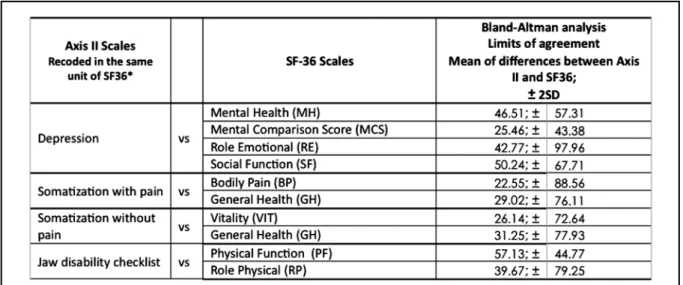
The Bland Altman’s analysis [25] was used for assessing the agreement between Axis II Scales and SF-36 Scales (Table 1).
Since the two questionnaires have a different range of values, we converted the Axis II values’ scales (graded chronic pain, depression, somatization with and without pain, jaw disability) in the same SF-36 range of value, dividing for 100 their range value.
The analysis was made by calculating the mean of differences in the questionnaires’ scores. We assert that SF-36 is in agreement with the Axis II when their scores are in the range of the values’ mean ± 2 SD.
The level of significance was set on p≤0.05. The statistical analysis was performed using SPSS 12.0 for Windows.
Results
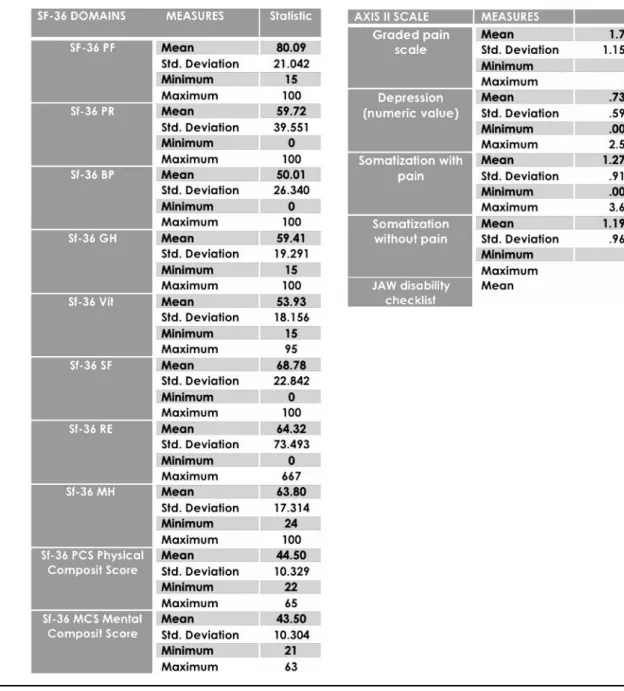
The examined sample was composed of 146 subjects - 30 males (20.5%), 116 females (79,5%); mean age was 35,2 ±14,38 years. There isn’t significative gender difference in age (p=0.083). Means score of the five Axis II scales and of the ten SF-36 fields are reported in Table2.
It is interesting to note that almost all the considered Axis II scales are significantly inversely related with all the 36 domains; only a few SF-36 domains are not related with the jaw disability (Table 3). In particular, the only item not significantly related is the jaw disability checklist when crossed with the mental scales of SF-36. All the others Axis II scales are very significantly related (p< 0,001) with all the SF-36 scales.
The presence of an inverse correlation demonstrate that the oral-health related quality of life, measured by SF-36, is always reduced in all its aspects when there is an enhancement in the value of chronic pain, depression and somatization with and without pain.
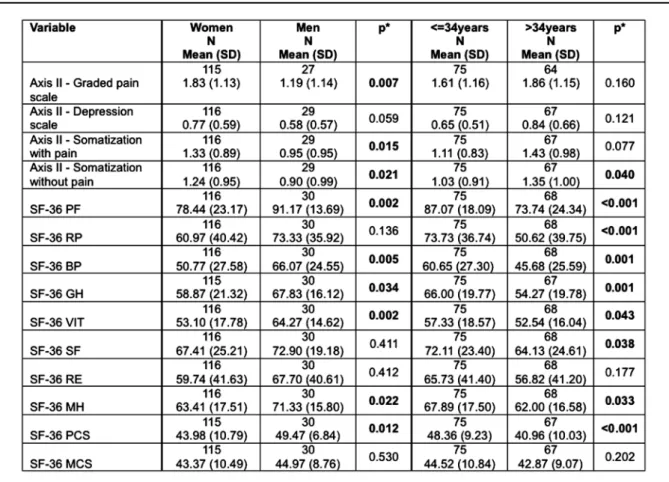
Gender comparison, see Table 4, showed significant differences in the means with respect to all Axis II scales except for depression: graded pain scale (p=0.007), somatisation with pain (p=0,015) and without pain (p=0,021) are lower
in men in respect to women; concerning SF-36 scales: Physical Function (p=0,002), Bodily Pain (p=0,005), General Health (p=0,034), Vitality (p=0,002), Mental Health (p=0,022), and Physical Composite Score(p=0,012) are greater in the male group.
The comparison between age groups is showed in Table 4. It’s possible to observe the significant differences in: somatization without pain (p=0.04) where the younger group is on average lower than older; PF, RP, BP, GH, VIT, SF, MH and PCS of the younger group are greater than older.
The Bland-Altman analysis (Table 1) highlighted a high agreement between these scales: depression versus MH, RE and SF; Somatization with pain versus BP e GH; Jaw disability versus PR. In fact, in these scales, 95% of observations are enclosed in the limits of agreement (mean differences ± 2 SD).
The scatter-plot of the most significant scales are shown in the figure 1.
Discussion
In the present study we analyzed the correlations and the agreement between the Axis II questionnaire, a TMD specific instrument, and the SF-36, that is the most widely used questionnaire to measure quality of life in medicine.
During recent decades, there has been a dramatic increase in literature relating to quality of life (QOL) and health-related quality of life (HRQOL); thus, a great deal of research has concentrated on developing standardized measures able to quantify HRQOL. Modes of administration of HRQOL instruments include
Table 1. Comparisons with Bland Altman’s method between Axis II Scales and SF-36 Scales.
Table 2. Descriptive statistics of Axis II and SF-36 scales in the sample study.
Table 3. Sperman’s correlation between SF-36 domains vs. Axis II scales.
direct interview, telephone interviews and self-completion questionnaires [25]. The most used instrument is the self-administered questionnaire, which avoids the physician’s (interviewer’s) influence on patients.
There are essentially two different approaches to evaluating health-related quality of life, both with their strengths and weaknesses, and there are advantages to using both instruments in a research study [27]: they are generic and specific assessments. The approaches are not mutually exclusive and may be suitable for different circumstances [26].
Oral diseases and conditions are highly prevalent and the consequences are not only physical, but also economic, social and psychological. They seriously impair quality of life in a large number of individuals and may affect various aspects of life including function, appearance and interpersonal relationship [28]; nevertheless, traditionally, oral disease has been assessed using purely clinical parameters. Greater attention to the social impact of oral disease began in 1988 with reports of substantial population-level effects of oral conditions on work loss and days lost from school [29]. But it
was only in 1989 that Reisine et al. [30] talked, for the first time, about oral health quality of life (OHRQoL). Since this early piece of work, the growing recognition of the importance of QoL in the field of dentistry has led to the development of a number of oral health-related quality of life instruments [31], so that now in literature, 13 instruments measuring OHQoL can be found; nevertheless, none of these questionnaires are specifically indicated for TMD. At the moment, the most frequently selected instrument for the assessment of OHQOL is the Oral Health Impact Profile (OHIP), which is probably more sensitive than other instruments for dental issues. It is widely used, and validated translations of the OHIP are available in German [32], Chinese [33], Swedish [34], Italian [35], Hungarian [36] and Japanese [37].
The OHIP was also used in TMD patients [32, 38, 39] but its questions are specifically directed to dental pain and prosthetics problems, so accordingly it may not be the best choice for TMD. Dworkin & LeResche in 1992 developed the research diagnostic criteria for temporomandibular disorders (RDC/TMD) that includes, in the Axis II, the assessment of
Table 4. Gender and age comparison respectively in the Axis II and SF-36 scales.
Figure 1. Scales with most agreement according to Bland Altman.
behavioral, psychological and psychosocial factors [40]. The Axis II questionnaire gathers clinically relevant self-report data covering: demographics; self-reported pain characteristics; parafunctional jaw behaviors and psychological status, including depression and somatization. Even if it is not a measure of OHRQoL, it is a really useful instrument in the patient-oriented diagnosis of TMD because of its sensitiveness and specificity to this disease.
The results of our study showed a high inverse relation between all the analyzed Axis II scales and all the SF-36 domains. This means that in subjects with worse levels of TMD pain, depression, somatization and jaw disability, HRQoL is decreased in all of its aspects. The few SF-36 domains that are not related with the jaw disability are the mental components (General Health, Social Function, Role Emotional and the Mental Composite Score), while all the physical components are highly related. This is reasonable because of the jaw disability checklist is a physical measure concerning limitations in activities related to mandibular functioning, which assesses the number of activities limited.
Regarding age, older TMD patients demonstrate a poorer quality of life, measured with SF-36, in almost all aspects, compared to those who are younger; on the other hand the age groups don’t show significant differences in Axis II scales, but somatization without pain.
Moreover, we investigated the gender differences in both questionnaires. As is commonly reported in TMD clinical studies, our sample was composed for the most part from females (79.5%).
Females seemed to be more likely to have impairment in HRQoL in almost all of its aspects (6/8), and have a higher level of pain and somatization which is in accordance with previous studies [3,41]. Nonetheless the SF-36 and Axis II are equally sensitive on gender differences, in fact the only aspects not related with sex are depression (Axis II) and for SF-36 almost all mental domains as social function, role emotional and mental composite score, and physical function too.
The Bland-Altman analysis confirmed the good agreement (95%) between those scales. In fact the depression value of Axis II is in agreement with Mental Health, Role Emotional and Social Function of SF-36; the somatization with pain is in agreement with Bodily Pain and General Health; the jaw disability checklist is in agreement with Role Physical.
So, we conclude that SF-36 can be used in the everyday approach to TMD patients, because of its good level of correlation and agreement with the Axis II and it could be considered a useful instrument to assess oral health-related quality of life in temporomandibular disorders.
References
1) Rugh JD, Soldberg WK. Oral health status in the United States: temporomandibular disorders. J Dent Educ 1985; 49: 398-406. 2) Rammelsberg P, LeResche L, Dworkin SF, Macl L. Longitudinal outcome of temporomandibular disorders: a 5-year epidemiologic study of muscle disorders defined by research diagnostic criteria for temporomandibular disorders. J Orofac Pain 2003; 17: 9-20.
3) Ohrbach R, Dworkin SF. Five-year outcomes in TMD: relationship of changes in pain to changes in physical and psychological variables. Pain 1998; 74: 315-26.
4) Kight M, Gatchel RJ, Wesley L. Temporomandibular disorders: evidence for significant overlap with psychopathology. Health Psychol 1999; 18: 177-82.
5) Dworkin SF, Suvinen T. Biobehavioral aspects of temporomandibular disorders: Behavioral, cognitive, and emotional factors related to etiology, assessment, diagnosis, and management: Review of the scientific literature, 1992- May, 1998. In: Millard H, Mason D, eds. Perspectives on 3rd World Workshop on Oral Medicine. Ann Arbor: University of Michigan School of Dentistry Office of Continuing Dental Education, 1998. 6) Truelove E, Huggins KH, Mancl L, Dworkin SF. The efficacy of traditional, low-cost and nonsplint therapies for temporomandibular disorder: a randomized controlled trial. J Am Dent Assoc 2006; 137: 1099-107.
7) Jedel E, Carlsson J, Stener-Victorin E. Health-related quality of
life in child patients with temporomandibular disorder pain. Eur J Pain 2007; 11: 557-63.
8) Naito M, Suzukamo Y, Nakayama T, Hamajima N, Fukuhara S. Linguistic adaptation and validation of the General Oral Health Assessment Index (GOHAI) in an elderly Japanese population. J Public Health Dent 2006; 66:273-5.
9) Turp JC, Motchall E, Schindler HJ, Heydecke G. In patients with temporomandibular disorders, do particular interventions influence oral health-related quality of life? A qualitative systematic review of the literature. Clin Oral Implants Res 2007; 18 Suppl 3: 127-37.
10) Reisine ST, Weber J. The effects of temporomandibular joint disorders on patients' quality of life. Community Dent Health 1989; 6: 257-70.
11) Dao T, Lavigne G, Charbonneau A, Feine J, Lund J. The efficacy of oral splint in the treatment of myofascial pain of the jaw muscles: A controlled clinical trial. Pain 1994; 56: 85-94. 12) Mauro G, Tagliaferro G, Montini M, Zanolla L. Diffusion model of pain language and quality of life in orofacial pain patients. J Orofac Pain 2001; 15: 36-46.
Maxillofac Surg. 2002; 60: 1389-99.
15) Ta LE, Dionne RA. Treatment of painful temporomandibular joints with a cyclooxygenase-2 inhibitor: a randomized placebo-controlled comparison of celecoxib to naproxen. Pain 2004; 111:13-21.
16) Bernhardt O, Gesch D, Schwahn C, et al. Risk factors for headache, including TMD signs and symptoms, and their impact on quality of life. Results of the Study of Health in Pomerania (SHIP). Quintessence Int 2005; 36: 55-64.
17) Di Fabio RP. Physical therapy for patients with TMD: a descriptive study of treatment, disability, and health status. J Orofac Pain 1998; 12: 124-35.
18) Dworkin SF, LeResche L. Research Diagnostic Criteria for Temporomandibular Disorders: review, criteria, examinations and specifications, critique. J Craniomandib Disord Facial Oral Pain 1992; 6: 301-55.
19) List T, Dworkin SF. Comparing TMD diagnoses and clinical findings at Swedish and US TMD centers using Research Diagnostic Criteria for Temporomandibular Disorders. J Orofac Pain 1996; 10: 240-53.
20) Von Korff M, Ormel J, Keefe FJ, Dworkin SF. Grading the severity of chronic pain. Pain 1992; 50:133-49.
21) Dworkin SF, Massoth DL. Temporomandibular disorders and chronic pain: disease or illness? J Prosthet Dent 1994; 72:29-38. 22) Macrì LA, Deli V, Deli R. Development of a reliable and clinically useful Italian version of the Axis II of the Research Diagnostic Criteria for Temporomandibular Disorders (RDC/TMD). It J Publ Health 2008; 5(2): In Press.
23) De Rogatis LR. SCL-90-R. Administration, scoring and procedures manual-II for the revised version. Towson, MD: Clinical Psychometric Research, 1983.
24) Apolone G, Mosconi P, Ware JE Jr. Questionario sullo stato di salute SF-36. Milano: Ed. Guerini ed Associati, 1997.
25) Bland JM, Altman DG. Statistical method for assessing agreement between two methods of clinical measurement. The Lancet 1986; 1: 307-10.
26) Guyatt GH. The philosophy of health-related quality of life translation. Qual Life Res 1993; 2: 461-5.
27) Ware JE. Measuring patients’ views: the optimum outcome measure. Br Med J 1993; 306: 1429-30.
28) Gift HC, Redford M. Oral health and the quality of life. Clin Geriatr Med 1992; 8: 673-83.
29) Spencer AJ, Lewis JM. The delivery of dental services: information, issues and directions. Comm Health Studies 1988; 12:16-30.
30) Reisine ST, Fertig J, Weber J, Leder S. Impact of dental conditions on patients' quality of life. Community Dent Oral Epidemiol 1989; 17: 7-10.
31) Corson MA, Boyd T, Kind P, Allen PF, Steel JC. Measuring oral health: does your treatment really make a difference. Br Dent J 1999; 187:481-4.
32) John MT, Patrick DL, Slade GD. The German version of the Oral Health Impact Profile--translation and psychometric properties. Eur J Oral Sci 2002; 110:425-33.
33) Wong MC, Lo EC, McMillan AS. Measuring oral health: does your treatment really make a difference. Br Dent J 1999; 187:481-4.
34) Larsson P, List T, Lundstrom I, Marcusson A, Ohrbach. Reliability and validity of a Swedish version of the Oral Health Impact Profile (OHIP-S). Acta Odontol Scandinav 2004; 62:147-52.
35) Segù M, Collesano V, Lobbia S, Rezzani C. Cross-cultural validation of a short form of the Oral Health Impact Profile for temporomandibular disorders. Community Dent Oral Epidemiol. 2005;33:125-30.
36) Szentpétery A, Szabò G, Marada G, Szantò I, John MT. The Hungarian version of the Oral Health Impact Profile. Eur J Oral Sci 2006; 114:197-203.
37) Yamazaki M, Inukai M, Baba K, John MT. Japanese version of the Oral Health Impact Profile (OHIP-J). J Oral Rehabil 2007; 34:159-68.
38) Murray H, Locker D, Mock D, Tenenbaum HC. Pain and the quality of life in patients referred to a craniofacial pain unit. Journal of Orofacial Pain 1996; 10: 316-23.
39) Reißmann DR, John MT, Schierz O, Wassell RW. Functional and psychosocial impact related to specific temporomandibular disorder diagnoses. J Dent 2007;35(8):643-50.
40) Dworkin SF, Huggins KH, Wilson L et al. A randomized clinical trial using research diagnostic criteria for temporomandibular disorders-Axis II to target clinic cases for a tailored self-care TMD treatment program. J Orofac Pain 2002; 16: 48-63.