Open Access
Research
Differences in service utilization and barriers among Blacks,
Hispanics, and Whites with drug use disorders
Brian E Perron*
1, Orion P Mowbray
1, Joseph E Glass
2, Jorge Delva
1,
Michael G Vaughn
3and Mathew Owen Howard
4Address: 1University of Michigan, School of Social Work, 1080 S. University Avenue, Ann Arbor, MI 48109, USA, 2VA Ann Arbor Healthcare System, Serious Mental Illness Treatment Research and Evaluation Center, 11H 2215 Fuller Rd, Ann Arbor, MI 48105, USA, 3St Louis University, School of Social Work, 3550 Lindell Boulevard, St Louis, MO 63130, USA and 4University of North Carolina, School of Social Work, Tate-Turner-Kuralt Building, 325 Pittsboro St, Chapel Hill, NC 27599, USA
Email: Brian E Perron* - [email protected]; Orion P Mowbray - [email protected]; Joseph E Glass - [email protected]; Jorge Delva - [email protected]; Michael G Vaughn - [email protected]; Mathew Owen Howard - [email protected] * Corresponding author
Abstract
Background: Treatment for drug use disorders (DUD) can be effective, but only a small proportion of people with DUD seek or receive treatment. Research on racial and ethnic treatment differences and disparities remains unclear. Understanding racial and ethnic differences and disparities in drug treatment is necessary in order to develop a more effective referral system and to improve the accessibility of treatment. The purpose of the current study was to explore the role of race and ethnicity in service utilization.
Methods: Using data from the National Epidemiologic Survey on Alcohol and Related Conditions (NESARC), this study examined racial and ethnic differences in use of 14 types of treatment services for DUD and 27 different treatment barriers among persons who met lifetime criteria for a DUD. Multivariate logistic regression analyses were used to examine service utilization and barriers among the racial and ethnic groups, while adjusting for other sociodemographic and clinical variables.
Results and discussion: Among Blacks, Hispanics and Whites in the overall NESARC sample, approximately 10.5% met criteria for at least one lifetime drug use disorder. Approximately 16.2% of persons with a lifetime DUD received at least one type of service. Overall, this study indicated that Whites were less likely to report receiving help for drug-related problems than Blacks, Blacks used a greater number of different types of services, and no racial and ethnic differences were observed with respect to perceived barriers to drug treatment. However, by examining types of services separately, a complex picture of racial and ethnic differences emerges. Most notably, Whites were most likely to use professional services, whereas Blacks were most likely to use 12-step and clergy. The service use pattern of Hispanics most resembled that of Whites.
Conclusion: While structural barriers to accessing treatment were observed, broad-based educational programs and interventions that are appropriately targeted to racial and ethnic groups remains an important area for prevention and treatment.
Published: 13 March 2009
Substance Abuse Treatment, Prevention, and Policy 2009, 4:3 doi:10.1186/1747-597X-4-3
Received: 1 December 2008 Accepted: 13 March 2009
This article is available from: http://www.substanceabusepolicy.com/content/4/1/3 © 2009 Perron et al; licensee BioMed Central Ltd.
Background
Treatment for drug use disorders (DUD) can be effective (Carr, 2008; Cunningham, 2005), but only a small pro-portion of people with DUD seek or receive treatment [1,2]. Research on racial and ethnic treatment differences and disparities remains unclear. While Blacks and Hispan-ics have similar rates of substance use disorders compared to non-Hispanic Whites [3,4], population-based studies show they are less likely to use specialty treatment services [3,5-7]. Other data from publicly-funded programs reveal that Blacks have higher rates of admissions, which can be attributed, in part, to referrals from the criminal justice system [8-10].
Understanding racial and ethnic differences and dispari-ties in drug treatment is necessary in order to develop a more effective referral system and to improve the accessi-bility of treatments [11]. Racial and ethnic minorities appear to have significantly higher rates of unmet needs for substance use disorders [4] and are less likely to seek or complete treatment [12]. Studying Black and Hispanic populations is particularly important given their antici-pated growth and that they make up the majority of the nation's urban population [13]. Considering that HIV/ AIDS disproportionately affect Blacks [14] and HIV/AIDS is often associated with and complicated by drug use [15], it is critical to understand the treatment needs of Blacks with DUDs. Studies also consistently find that minority populations experience more adverse health and social consequences related to substances misuse and therefore have more treatment needs [16,17]. This finding may be due to racial or ethnic discrimination, or to issues relating to acculturation stress and community responses to sub-stance use behaviors. Significant increases in subsub-stance use disorder treatment gaps between Hispanics and non-Hispanic Whites over the period between 1993 and 2003 were observed [18], a development warranting further monitoring and investigation of services for this popula-tion.
Several factors have been examined to help understand different patterns of service utilization among racial and ethnic minorities. Such factors include differential levels of service need [19], help-seeing behaviors [20], co-occur-rence of mental illness [21], socioeconomic status [22], and availability of culturally responsive services [23]. Alegria and colleagues [3] found that even when socioeco-nomic status and culture were taken into account, Blacks reported significantly lower levels of substance use disor-der service usage than Whites. Recent service utilization research has also been advanced by focusing on barriers to treatment. Family privacy, lack of knowledge regarding treatment, concerns about stigma, and concerns about medication have been reported as substantial barriers to accessing treatment [24,25]. Understanding how service
utilization and barriers vary across different at-risk popu-lations is necessary to develop targeted intervention strat-egies. To date, however, little information is available regarding the extent to which these barriers vary by race or ethnicity.
Current knowledge of racial or ethnic differences and dis-parities is limited, as prior research has typically com-bined mental health and substance abuse services, which masks differences in DUD service needs and factors asso-ciated with DUD service utilization [26]. A growing body of research on utilization of services for alcohol use disor-ders exists [17,27,28], but research on treatment utiliza-tion and barriers for DUD remains under-developed. Research focusing on racial and ethnic differences and dis-parities is necessary to improve service access and utiliza-tion for at-risk populautiliza-tions, and to help ensure effective use of limited resources [29]. Increased DUD service utili-zation is a public health priority as these services can potentially reduce the risk of HIV/AIDS and hepatitis [30], as well as involvement with the correctional system.
The purpose of the current study was to explore the role of race and ethnicity in service utilization. Specifically, this study examined racial and ethnic differences in service uti-lization rates across 14 types of treatment services for DUD and 27 perceived barriers to service utilization. This study builds on existing research by examining co-mor-bidity of mental illness and drug use disorder while using nationally representative data.
Methods
Subjects, Sampling, and Interviews
This study used data from the National Epidemiologic Survey on Alcohol and Related Conditions (NESARC), which is a nationally representative survey of 43,093 non-institutionalized U.S. residents aged 18 years and older [31]. The NESARC was based on a multistage sampling design, oversampling young adults, Hispanics, and Blacks to obtain reliable statistical estimation in these subpopu-lations, and to ensure appropriate representation of racial/ethnic groups. The overall response rate was 81%. Data were weighted at the individual and household lev-els and to adjust for oversampling and non-response on select demographic variables. Data were also adjusted to be representative of the U.S. population as assessed dur-ing the 2000 census.
substance use disorders and has evidenced good-to-excel-lent reliability for the assessment of substance use disor-ders [32,33]. Descriptions of the NESARC survey, sampling protocol, and related publications are described in detail in prior studies [31-33]
Measurement
Drug use disorders
Participants included those respondents who met DSM-IV lifetime criteria for any non-nicotine drug use disorder (DUD), including abuse or dependence. The specific sub-stances assessed were marijuana, cocaine or crack, tran-quilizers, stimulants, painkillers, other prescription drugs, heroin, inhalants or solvents, hallucinogens, and seda-tives.
Drug treatment utilization
Participants were asked to reply yes or no to the questions: "Have you ever gone anywhere or seen anyone for a rea-son that was related in any way to your use of medicines or drugs – a physician, counselor, Narcotics Anonymous, or any other community agency or professional?" Did you ever in your life talk to a medical doctor or other profes-sional about your use of drugs?" Participants who endorsed this question were then asked whether they used any of 14 different treatment services. The current study focused on lifetime use of these services.
Drug treatment barriers
Participants were asked: "Was there ever a time when you thought you should see a doctor, counselor, or other health professional or seek any other help for your drug use, but you didn't go?" Participants who endorsed this question were then asked about 27 possible barriers to getting help.
Sociodemographic variables
Several sociodemographic and clinical variables were assessed in this study: racial/ethnic groups including Whites (non-Hispanic), Blacks, and Hispanics, gender (male, female), living area (urban, rural), marital status (married, separated, never married), personal income (in dollars), age (in years), and employment status (employed, unemployed). Insurance status referred to currently private or public insurance (e.g., Medicare, Med-icaid, CHAMPUS, CHAMPVA, VA or other military healthcare). It should be noted that data regarding insur-ance status at time of diagnosis or when treatment was sought is not available in the NESARC data set.
Clinical variables
Five clinical variables were included in this study: lifetime history of a DSM-IV alcohol use disorder (i.e., abuse or dependence), lifetime history of an anxiety disorder (i.e., social phobia, panic disorder with or without
agorapho-bia, and generalized anxiety disorder), and lifetime his-tory of major depression, personality disorder (i.e., antisocial, avoidant, dependent, obsessive-compulsive, paranoid, schizoid, and histrionic), and polydrug use dis-order (i.e., having a lifetime history of more than three non-nicotine or non-caffeine DSM-IV DUD). Note that this definition of polydrug use disorder differs from that of polysubstance-related disorder as defined in DSM-IV (p. 293). Last, it is necessary to note that when assessed for anxiety disorder related symptoms, participants were not assessed for PTSD related symptoms.
Analytic plan
Analyses were computed using SUDAAN Version 9.0 [34]. This system implements a Taylor series linearization to adjust standard errors of estimates for complex survey sampling design effects including clustered data. Chi-square tests were used to make bivariate comparisons with the study variables. Multivariate logistic regression analy-ses were used to examine service utilization and barriers among the racial and ethnic groups, while adjusting for other sociodemographic and clinical variables.
Results
Overall Sample Characteristics
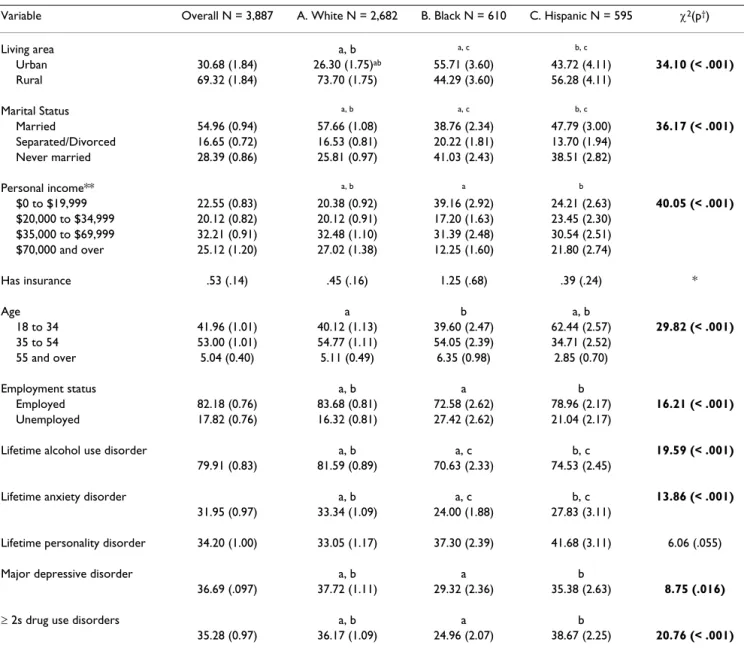
Among Blacks, Hispanics and Whites in the overall NESARC sample, approximately 10.5% met criteria for at least one lifetime drug use disorder. Whites exhibited the highest rate (11.3%, SE = .32), followed by Blacks (8.7%, SE = .45), and Hispanics (7.2%, SE = .60). These unad-justed results were statistically significant (χ2 [2] = 40.39,
p < .001). These persons constitute the current study sam-ple and are described in Table 1. Nearly half of the overall sample was currently unmarried, only a small percentage was 55 years of age or older, nearly 43% earned less than $35,000 annually, approximately 80% met lifetime alco-hol use disorder criteria, more than one-third evidenced lifetime anxiety, personality, major depressive and poly-drug use disorders and nearly one-in-five was currently unemployed. Regarding subsample characteristics, Blacks were more likely to live in urban areas, have lower incomes, and be unemployed compared to Whites and Hispanics and had the lowest rates of polydrug use disor-der. Hispanics tended to be younger than Blacks and Whites. Whites had highest rates of lifetime alcohol and anxiety disorders. Comparatively small differences in rates of major depression and personality disorder were observed across the groups. Few individuals with DUD reported having either private or public medical insur-ance; therefore, this variable was not included in the mul-tivariate analyses.
Differences in Types of Services Used
one type of service. Blacks were most likely to receive serv-ices (20.8%, SE = 2.05), followed by Hispanics (17.3%, SE = 2.25) and Whites (15.5%, SE = .81). Whites had signifi-cantly lower rates of treatment compared to Blacks and Hispanics, but rates between Blacks and Hispanics did not differ significantly.
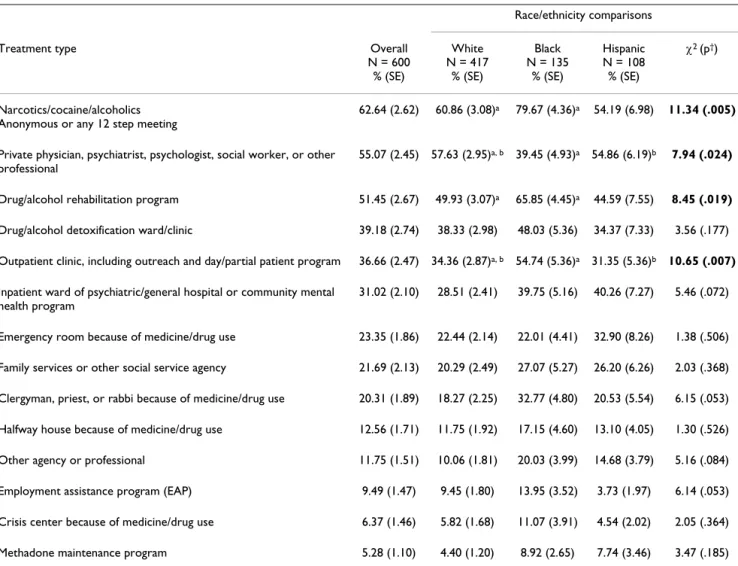
Table 2 provides a summary of treatment utilization for DUD by types of service. Overall, the most commonly uti-lized types of services used were 12-step programs (62.6%), private physician or professionals (55.1%), and drug/alcohol rehabilitation programs (51.5%). Chi-square tests were used to compare differences in rates
across each racial and ethnic group. Significant overall group differences were observed for 4 of the 14 service types, including use of 12-step meetings, private profes-sionals, drug/alcohol rehabilitation programs, and outpa-tient clinics. To better understand where specific racial and ethnic differences existed, pair-wise comparisons were conducted where overall group differences were observed. These analyses indicated that Blacks had signif-icantly higher rates of use of 12-step meetings, drug/alco-hol rehabilitation programs, outpatient clinics, inpatient wards, clergy services, and other types of services com-pared to Whites. Whites, on the other hand, exhibited sig-nificantly higher rates of professional service use.
Table 1: Sociodemographic and clinical characteristics of adults with a lifetime DSM-IV drug use disorder by racial/ethnic groups
Variable Overall N = 3,887 A. White N = 2,682 B. Black N = 610 C. Hispanic N = 595 χ2(p†)
Living area a, b a, c b, c
Urban 30.68 (1.84) 26.30 (1.75)ab 55.71 (3.60) 43.72 (4.11) 34.10 (< .001)
Rural 69.32 (1.84) 73.70 (1.75) 44.29 (3.60) 56.28 (4.11)
Marital Status a, b a, c b, c
Married 54.96 (0.94) 57.66 (1.08) 38.76 (2.34) 47.79 (3.00) 36.17 (< .001) Separated/Divorced 16.65 (0.72) 16.53 (0.81) 20.22 (1.81) 13.70 (1.94)
Never married 28.39 (0.86) 25.81 (0.97) 41.03 (2.43) 38.51 (2.82)
Personal income** a, b a b
$0 to $19,999 22.55 (0.83) 20.38 (0.92) 39.16 (2.92) 24.21 (2.63) 40.05 (< .001) $20,000 to $34,999 20.12 (0.82) 20.12 (0.91) 17.20 (1.63) 23.45 (2.30)
$35,000 to $69,999 32.21 (0.91) 32.48 (1.10) 31.39 (2.48) 30.54 (2.51) $70,000 and over 25.12 (1.20) 27.02 (1.38) 12.25 (1.60) 21.80 (2.74)
Has insurance .53 (.14) .45 (.16) 1.25 (.68) .39 (.24) *
Age a b a, b
18 to 34 41.96 (1.01) 40.12 (1.13) 39.60 (2.47) 62.44 (2.57) 29.82 (< .001) 35 to 54 53.00 (1.01) 54.77 (1.11) 54.05 (2.39) 34.71 (2.52)
55 and over 5.04 (0.40) 5.11 (0.49) 6.35 (0.98) 2.85 (0.70)
Employment status a, b a b
Employed 82.18 (0.76) 83.68 (0.81) 72.58 (2.62) 78.96 (2.17) 16.21 (< .001) Unemployed 17.82 (0.76) 16.32 (0.81) 27.42 (2.62) 21.04 (2.17)
Lifetime alcohol use disorder a, b a, c b, c 19.59 (< .001)
79.91 (0.83) 81.59 (0.89) 70.63 (2.33) 74.53 (2.45)
Lifetime anxiety disorder a, b a, c b, c 13.86 (< .001)
31.95 (0.97) 33.34 (1.09) 24.00 (1.88) 27.83 (3.11)
Lifetime personality disorder 34.20 (1.00) 33.05 (1.17) 37.30 (2.39) 41.68 (3.11) 6.06 (.055)
Major depressive disorder a, b a b
36.69 (.097) 37.72 (1.11) 29.32 (2.36) 35.38 (2.63) 8.75 (.016)
≥ 2s drug use disorders a, b a b
35.28 (0.97) 36.17 (1.09) 24.96 (2.07) 38.67 (2.25) 20.76 (< .001)
Compared to Whites, Hispanics used inpatient wards, clergy services, and other types of services at higher rates, and used private professionals and outpatient clinics at lower rates.
A series of multivariate logistic regression models were used to further examine the significant associations iden-tified in Table 2. Each service type was used as an outcome variable. Race and ethnicity were entered into the model as the primary independent variable, along with other potentially confounding sociodemographic (e.g., gender, rural vs. urban residence, marital status, personal income, age) and clinical characteristics (e.g., lifetime alcohol use disorder, polydrug use disorder, anxiety disorder, person-ality disorder, and major depressive disorder). For analy-sis pertaining to each type of service received, the reference group for race/ethnicity was changed to facilitate inter-group comparisons.
Adjusted odds ratios (OR) and 95% confidence intervals (CI) for race/ethnicity are provided in Table 3. For pur-poses of brevity, values for the control variables are not reported. Many significant race and ethnic associations with service utilization were observed in the multivariate analysis. The differential trends comparing Blacks and Whites were consistent with the bivariate analyses. Blacks were almost three times more likely to use 12-step pro-grams compared to Whites (OR = 2.96, 95% CI = 1.53 – 5.72). Also, Blacks were between two and three times more likely to use drug/alcohol rehabilitation programs, inpatient wards, clergy services, and other types of services compared to Whites. However, Whites were also almost twice as likely to use private professionals compared to Blacks (OR = 1.79, 95% CI = 1.08 – 2.96). No significant differences were observed comparing Hispanics and Whites. Compared to Hispanics, Blacks were significantly more likely to use 12-step meetings (OR = 3.31, 95% CI =
Table 2: Types of services used by adults with a DSM-IV lifetime drug use disorder who used at least one type of service
Race/ethnicity comparisons
Treatment type Overall
N = 600 % (SE)
White N = 417
% (SE)
Black N = 135
% (SE)
Hispanic N = 108 % (SE)
χ2 (p†)
Narcotics/cocaine/alcoholics Anonymous or any 12 step meeting
62.64 (2.62) 60.86 (3.08)a 79.67 (4.36)a 54.19 (6.98) 11.34 (.005)
Private physician, psychiatrist, psychologist, social worker, or other professional
55.07 (2.45) 57.63 (2.95)a, b 39.45 (4.93)a 54.86 (6.19)b 7.94 (.024)
Drug/alcohol rehabilitation program 51.45 (2.67) 49.93 (3.07)a 65.85 (4.45)a 44.59 (7.55) 8.45 (.019)
Drug/alcohol detoxification ward/clinic 39.18 (2.74) 38.33 (2.98) 48.03 (5.36) 34.37 (7.33) 3.56 (.177)
Outpatient clinic, including outreach and day/partial patient program 36.66 (2.47) 34.36 (2.87)a, b 54.74 (5.36)a 31.35 (5.36)b 10.65 (.007)
Inpatient ward of psychiatric/general hospital or community mental health program
31.02 (2.10) 28.51 (2.41) 39.75 (5.16) 40.26 (7.27) 5.46 (.072)
Emergency room because of medicine/drug use 23.35 (1.86) 22.44 (2.14) 22.01 (4.41) 32.90 (8.26) 1.38 (.506)
Family services or other social service agency 21.69 (2.13) 20.29 (2.49) 27.07 (5.27) 26.20 (6.26) 2.03 (.368)
Clergyman, priest, or rabbi because of medicine/drug use 20.31 (1.89) 18.27 (2.25) 32.77 (4.80) 20.53 (5.54) 6.15 (.053)
Halfway house because of medicine/drug use 12.56 (1.71) 11.75 (1.92) 17.15 (4.60) 13.10 (4.05) 1.30 (.526)
Other agency or professional 11.75 (1.51) 10.06 (1.81) 20.03 (3.99) 14.68 (3.79) 5.16 (.084)
Employment assistance program (EAP) 9.49 (1.47) 9.45 (1.80) 13.95 (3.52) 3.73 (1.97) 6.14 (.053)
Crisis center because of medicine/drug use 6.37 (1.46) 5.82 (1.68) 11.07 (3.91) 4.54 (2.02) 2.05 (.364)
Methadone maintenance program 5.28 (1.10) 4.40 (1.20) 8.92 (2.65) 7.74 (3.46) 3.47 (.185)
Note: All Ns in column headings are expressed as unweighted values. All table values are weighted column percentages (standard errors). Values in bold are statistically significant (p < .05). †Tests of differences based on chi-square. Cells with the same letters indicate group differences based on
1.50 – 7.31), rehabilitation programs (OR = 2.83, 95% CI = 1.42 – 5.65), and outpatient clinics (OR = 2.83, 95% CI = 1.42 – 5.65).
3.3 Differences in Number of Different Services Used
Among adults with a lifetime DUD who used services, the overall number of different types of services used ranged from one to eight (Mean = 2.8, SE = .09). Blacks used a larger number of different types of services (Mean = 3.5, SE = .23) compared to Whites (2.7, SE = .10) and ics (2.6, SE = .21) (F = 4.98, p = .010). Whites and Hispan-ics exhibited no differences.
Differences in Types of Treatment Barriers
Among persons with DUD, approximately 12.4% reported having a need for treatment but did not receive any services. Persons who felt they needed but did not receive treatment were queried about 27 different types of possible barriers encountered.
Table 4 summarizes rates of each barrier encountered among adults with a lifetime drug use disorder. The most frequently cited barriers included thinking that the lem should be handled alone (41.7%), thinking the prob-lem would get better by itself (37.2%), too embarrassed to discuss the problem (25.8%), and couldn't afford to pay
the bill (20.8%). Chi-square analyses did not reveal any significant racial or ethnic group difference.
Differences in Number of Treatment Barriers
The number of barriers reported ranged from 1 to 26, with an average of 3.4 (Whites, Mean = 3.3; Blacks, Mean = 3.5, Hispanic, Mean = 3.7). No significant differences in the number of barriers encountered were observed across the racial/ethnic groups (F = .16, p = .854).
Discussion
This study examined racial and ethnic differences in the utilization of drug treatment services and barriers to receiving treatment. Notable strengths of this study included using data from a nationally representative sur-vey that is among the largest and most current psychiatric epidemiologic studies. Using this same data source, other studies have examined factors associated with substance use disorder treatment utilization [35,36]. However, to date, no studies have provided a comprehensive examina-tion of differences across three major racial and ethnic groups, with a focus on differences in specific types of treatment services used and barriers to treatment.
Overall, this study indicated that Whites were less likely to report receiving help for drug-related problems than
Table 3: Multivariate associations between race/ethnicity and service utilization among adults with a lifetime drug use disorder who used at least one type of service (N = 600)
Treatment type Blacks
Hispanics (Whites as reference)
AOR (95% CI)
Whites Hispanics (Blacks as reference)
AOR (95% CI)
Whites Blacks (Hispanics as reference)
AOR (95% CI)
Adjusted Wald F (p)
Narcotics/cocaine/alcoholics Anonymous or any 12 step meeting
2.96 (1.53–5.72) .45 (0.18–1.15)
.34 (.17 – .65) .30 (.14 – .67)
1.21 (.62 – 2.03) 3.31 (1.50 – 7.31)
6.07 (.004)
Private physician, psychiatrist, psychologist, social worker, or other professional
.56 (.34 – .93) .85 (.49 – 1.48)
1.79 (1.08 – 2.96) 1.52 (.77 – 2.99)
1.18 (.68 – 2.04) .66 (.33 – 1.29)
2.74 (.072)
Drug/alcohol rehabilitation program 2.19 (1.34 – 3.57) .77 (.42 – 1.44)
.46 (.28 – .74) .35 (.18 – .71)
1.29 (.70 – 2.39) 2.83 (1.42 – 5.65)
6.79 (.002)
Outpatient clinic, including outreach and day/ partial patient program
2.23 (1.26 – 3.94) .76 (.41 – 1.39)
.45 (.25 – .79) .34 (.17 – .70)
1.32 (.72 – 2.41) 2.94 (1.44 – 6.00)
5.31 (.007)
Inpatient ward of psychiatric/general hospital or community mental health program
.56 (.34 – .93) .85 (.49 – 1.48)
1.79 (1.08 – 2.96) 1.52 (.77 – 2.99)
1.18 (.68 – 2.04) .66 (.33 – 1.29)
4.61 (.013)
Clergyman, priest, or rabbi because of medicine/ drug use
2.79 (1.52 – 5.14) 1.39 (.65 – 3.01)
.36 (.19 – .66) .50 (.21 – 1.19)
.72 (.33 – 1.55) 2.00 (.84 – 4.77)
5.55 (.006)
Other agency or professional 2.33 (1.13 – 4.77) 1.49 (.71 – 3.16)
.43 (.21 – .88) .64 (.27 – 1.55)
.67 (.32 – 1.41) 1.56 (.64 – 3.75)
2.70 (.075)
Employment assistance program (EAP) 1.68 (.72 – 3.91) .57 (.17 – 1.93)
.59 (.26 – 1.38) .34 (.09 – 1.25)
1.76 (.52 – 6.00) 2.97 (.80 – 11.01)
1.56 (.217)
Blacks, Blacks used a greater number of different types of services, and no racial and ethnic differences were observed with respect to perceived barriers to drug treat-ment. However, by examining types of services separately, a complex picture of racial and ethnic differences emerges. Provided below is a discussion of the major findings vis-à-vis the current study methodology and the broader liter-ature on treatment for substance-related problems.
Service utilization
Approximately one-in-six persons with a lifetime drug use disorder reported receiving some type of help for drug-related problems. Whites had lower rates of treatment compared to Blacks and Latinos. Although this finding contrasts with prior services research [3,5,6], it is impor-tant to consider the between group variation as it relates to type of treatment received. For example, Blacks were significantly less likely to rely on professional services
Table 4: Perceived barriers to treatment among adults with a lifetime DSM-IV drug use disorder and perceived unmet need for treatment
Drug Use Treatment Barrier Overall
(N = 511) % (SE)
White (N = 310)
% (SE)
Black (N = 107)
% (SE)
Hispanic (N = 94) % (SE)
χ2 (p)
Thought should be strong enough to handle alone 41.65 (2.69) 42.09 (3.25) 43.12 (5.76) 36.44 (7.63) .47 (.793)
Thought the problem would get better by itself 37.21 (2.82) 36.56 (3.43) 40.90 (5.79) 36.96 (7.91) .44 (.804)
Was too embarrassed to discuss it with anyone 25.80 (2.38) 24.79 (2.85) 32.66 (5.39) 23.81 (6.70) 1.65 (.444)
Couldn't afford to pay the bill 20.77 (2.31) 21.08 (2.68) 20.13 (5.57) 19.34 (5.67) .08 (.963) Didn't want to go 20.72 (2.07) 21.81 (2.58) 17.74 (4.53) 16.78 (5.48) .99 (.612)
Stopped using a drug or medicine on my own 18.46 (1.87) 19.49 (2.25) 15.63 (4.13) 14.79 (5.11) 1.21 (.549)
Afraid of what boss, family, friends or others might think 18.35 (2.36) 18.88 (2.94) 14.10 (4.35) 20.26 (6.18) 1.02 (.602)
Hated answering personal questions 17.35 (1.90) 16.20 (2.35) 22.94 (5.12) 18.18 (5.79) 1.42 (.495) Didn't think anything could help 16.71 (1.98) 17.56 (2.56) 13.94 (3.70) 14.25 (4.15) .96 (.620) Didn't think medicine or drug problem was serious enough 16.47 (2.11) 17.04 (2.55) 12.74 (3.74) 17.44 (5.02) .95 (.624)
Wanted to keep using medicine or drug 15.99 (1.83) 16.29 (2.32) 16.89 (4.51) 12.50 (3.84) .72 (.698)
Afraid they would put me into the hospital 13.77 (1.95) 13.94 (2.33) 13.86 (3.90) 12.36 (4.64) .10 (.953)
Wanted to go, but health insurance didn't cover 10.46 (1.61) 9.74 (1.91) 9.42 (3.57) 17.21 (5.25) 1.80 (.412)
Didn't have the time 9.92 (1.43) 8.29 (1.71) 12.62 (4.53) 18.21 (6.15) 3.10 (.220)
Didn't know any place to go for help 8.34 (1.45) 6.83 (1.63) 13.29 (3.98) 12.70 (4.70) 3.43 (.188) Afraid of the treatment they would give me 8.21 (1.30) 6.49 (1.47) 12.21 (4.13) 15.37 (5.75) 3.15 (.215) Family thought I should go, but didn't think it was necessary 7.00 (1.54) 6.72 (1.66) 4.68 (2.24) 12.20 (5.66) 1.5 (.478)
Tried getting help before and it didn't work 5.63 (1.09) 4.64 (1.18) 9.73 (3.35) 7.34 (3.80) .09 (.956) Afraid I would lose my job 4.83 (1.10)† 4.72 (1.27) 4.68 (2.04) 5.85 (3.57)
-Other reason 4.66 (1.36) 3.68 (1.02) 3.53 (1.29) 13.44 (10.06) .82 (.664)
Didn't have any way to get there 4.60 (1.10) 4.43 (1.31) 4.08 (1.98) 6.53 (3.99) .30 (.850) Friends or family helped me stop using a medicine or drug 4.27 (.89)† 4.47 (1.09) 1.69 (1.03) 6.34 (3.67)
-Hours were inconvenient 3.80 (1.17)† 3.69 (1.37) 4.11 (3.08) 4.20 (3.20)
-Had to wait too long to get into program 3.22 (.91)† 3.36 (1.14) 4.42 (1.99) .52 (.53)
-Couldn't arrange for child care 1.32 (.48)† 1.43 (.59) 1.12 (.84) .74 (.75)
-A member of my family objected .52 (.35)† .11 (.11) .00 (.00) 4.31 (3.25)
-Can't speak English very well .34 (.27)† .11 (.11) .00 (.00) 2.50 (2.49)
compared to Whites, but were significantly more likely to receive non-professional services, including 12-step meet-ings and church-related support. This finding underscores the importance of how services are measured, given the diversity in types of treatment and help that are available. Rates of drug/alcohol rehabilitation program utilization were also higher for Blacks compared to Whites. This sug-gests that Blacks may lack access to preventive resources to reduce the consequences of drug use problems, as sug-gested by prior researchers [23]. Moreover, using the same data source as the current study, Keyes et al. [35] found Blacks to have higher levels of drug use disorder symp-toms compared to Whites, showing a higher level of potential service need. Potentially, differences in the way that services are utilized may be based on geographic fac-tors. For example, a recent study by Velez and colleagues [37] found that cities with higher proportions of African Americans and Latinos have greater access to specialty services, such as services for people who are older, gay or lesbian, or who have HIV. While their study did not ana-lyze 12-step programs, it is possible that a similar trend exists, where 12-step programs are more prevalent in cities with a higher racial/ethnic diversity.
Latinos exhibited few significant differences in drug treat-ment utilization compared to Whites and Blacks. Although the sample size of Latinos is only slightly smaller than Blacks, it is important to note that the stand-ard errors are consistently larger for this group, which is due to a smaller sample size and possibly significant within group differences. Future research will consider additional subgroup analyses, focusing subgroups of dis-orders (e.g., separating disdis-orders of abuse from depend-ence) and other sociodemographic factors (e.g., income levels). Considering that Blacks overwhelmingly use 12-step programs as a source of treatment, this highlights issues of the potential lack of cultural relevance, availabil-ity, or accessibility of other types of services. At the same time, 12-step meetings and professional services were the most commonly used services among Latinos for drug use disorders, which was the pattern for Whites.
Overall, these differences in patterns of utilization show that all three racial and ethnic groups use 12-step meet-ings at a high rate, but these services are typically in con-junction with other types of help. Identifying differences across racial and ethnic groups also guides our under-standing regarding treatment preferences and accessibil-ity. Although the current data do not provide an opportunity to examine these concepts, the role of barri-ers to treatment described in this study does offer initial guidance.
Treatment Barriers
Overall, racial and ethnic groups showed no differences with respect to numbers or different types of barriers to
treatment encountered. One possibility is that there are minimal differences with respect to internal and external barriers to accessing drug treatment services. This is evi-denced by the small differences in rates across the racial and ethnic groups. The most common barriers to treat-ment across the groups were internal barriers, including thinking one should be strong enough to handle the prob-lem alone, thinking the probprob-lem would get better by itself, and being too embarrassed to discuss it with anyone. Thus, even if there are structural barriers preventing per-sons from accessing drug treatment, these data underscore the importance of greater public awareness across all eth-nic groups. This includes increased knowledge regarding the course of drug use disorders and education that will address stigma.
Although statistically significant differences were not observed, a few important trends in the data still need to be considered. For several barriers, Whites experienced rates that were approximately half those of Blacks and Lat-inos, including not having health insurance to cover expenses, not having the time, not knowing where to go for help, and fear of treatment. Furthermore, individuals with a perceived need for treatment but who have not used treatment are difficult to capture in general commu-nity samples, which increases the difficulty of studying treatment barriers from a population perspective. The problem of identifying significant differences across racial and ethnic groups is further compounded by the need for large samples. Therefore, it is important to consider issues of statistical power and, at the same time, be cautious of dismissing potentially important trends.
Limitations and Future Directions
It is important to consider these findings in the context of the study limitations. Foremost, regional variation is an important issue that we were not able to take into consid-eration in this paper. More specifically, [Perron BE et al, Mapping availability of outpatient substance abuse treat-ment programs in urban areas, submitted] used geo-graphic information systems to show significant regional differences in the availability of outpatient substance use disorder treatment programs in urban areas. The current study revealed that Blacks were more likely to use outpa-tient treatment programs. Overall trends in this study do not reveal important regional differences and within group differences. Additionally, legal coercion and other forms of social pressure are common place in treatment for substance use disorders and may differentially affect services use [38]. Coercion as it relates to service utiliza-tion was not assessed in the NESARC. Thus, the results of this study need to be considered cautiously.
mul-tiple service types that have strong community and net-work connections, it is also plausible that they relied on multiple options due to needing additional help. The extent to which respondents believed these services were helpful was not assessed. However, other data sources, such as the National Survey of American Life and NLAAS, may help answer these questions. Although they are not as large as the NESARC, they do provide the opportunity to examine issues of services and perceptions of helpfulness among comparably large samples of Blacks and Latinos.
Large-scale epidemiologic studies provide the opportunity to identify trends, which can help us hone in on problem areas and make subsequent research initiatives more effec-tive and efficiency. A greater understanding of racial and ethnic differences will require studies of service utilization addressing more region-specific areas, while also using more nuanced measures of services in order to strengthen the empirical picture on racial and ethnic differences. Finally, it is also important to consider the importance of ongoing surveillance of the problem, in light of a service system and funding mechanism that are continually changing.
Conclusion
This study found no differences in overall rates of drug treatment utilization across racial and ethnic groups. However, notable differences were observed in relation to types of services used. Blacks were more likely to use non-professional services, whereas Whites were more likely to use professional services. Latinos had similar patterns of utilization compared to Whites. No significant racial and ethnic differences were observed with respect to barriers to treatment. Over one-third of respondents who did not use treatment reported thinking they could handle the prob-lem alone or it would get better, and approximately one-fourth were embarrassed to discuss their problem with anyone.
Study results are also suggestive of treatment and policy initiatives. Increasing access to treatment options is an important issue, and strategically locating treatments in underserved communities is necessary but not sufficient. Professional services will have to be made affordable and culturally responsive to better serve Black communities. Such recommendations may be difficult to carry out dur-ing periods in which funddur-ing is severely limited due to an economic crisis. However, the potential long-term savings are significant when community based treatments reduce drug-related emergency room visits, health problems, and involvement with the criminal justice system. Addition-ally, while structural barriers to accessing treatment were observed, broad-based educational programs that are appropriately targeted to racial and ethnic groups remain an important area for prevention and treatment. This
would help address issues of stigma that were common treatment barriers observed among all racial and ethnic groups.
Competing interests
The authors declare that they have no competing interests.
Authors' contributions
The first two authors (BEP and OPM) conceptualized the study and solicited feedback from the other authors. The first two authors conducted the analyses and worked col-laboratively with the other members of the research team to interpret the results, and prepare and revise the manu-script.
Acknowledgements
This research was supported by the Curtis Center of the University of Michigan, School of Social Work, and the Department of Veterans Affairs, Veterans Health Administration, Health Services Research and Develop-ment Service and Office of Mental Health Services. The views expressed in this article are those of the authors and do not necessarily represent the views of the Curtis Center or Department of Veterans Affairs.
References
1. D'Onofrio G: Treatment for alcohol and other drug problems: Closing the gap. Ann Emerg Med 2003, 41:814-817.
2. Andrews G, Henderson S: Unmet Need in Psychiatry: Problems, Resources, Responses Cambridge University Press; 2000.
3. Alegria M, Canino G, Rios R, Vera M, Calderon J, Rusch D, Ortega
AN: Inequalities in use of specialty mental health services
among Latinos, African Americans, and non-Latino whites.
Psychiatr Serv 2002, 53:1547-1555.
4. Wells K, Klap R, Koike A, Sherbourne C: Ethnic disparities in unmet need for alcoholism, drug abuse, and mental health care. Am J Psychiatry 2001, 158:2027-2032.
5. Sue S, Fujino DC, Hu LT, Takeuchi DT, Zane NW: Community mental health services for ethnic minority groups: a test of the cultural responsiveness hypothesis. J Consult Clin Psychol
1991, 59:533-540.
6. Wang PS, Demler O, Kessler RC: Adequacy of treatment for serious mental illness in the United States. Am J Public Health
2002, 92:92-98.
7. Wang PS, Berglund PA, Olfson M, Kessler RC: Delays in initial treatment contact after first onset of a mental disorder.
Health Serv Res 2004, 39:393-415.
8. MacMaster SA: Experiences with and perceptions of, barriers to substance abuse and HIV services among African
Ameri-can women who use crack cocaine. J Ethn Subst Abuse 2005,
4:53-75.
9. Department of Health and Human Services: Treatment Data Epi-sode Set (TEDS). (Author ed. Washington, DC;) 2004.
10. Department of Health and Human Services: Drug and Alcohol Service Information System (DASIS): Black Admissions to
Substance Abuse Treatment: 1999. (Author ed. Washington, DC)
2002.
11. Saunders SM, Zygowicz KM, D'Angelo BR: Person-related and treatment-related barriers to alcohol treatment. J Subst Abuse Treat 2006, 30:261-270.
12. Campbell CI, Weisner C, Sterling S: Adolescents entering chem-ical dependency treatment in private managed care: ethnic differences in treatment initiation and retention. J Adolesc Health 2006, 38:343-350.
13. Turner WL, Wallace B: African American Substance Use:
Epi-demiology, Prevention, and Treatment. Violence Against
Women 2003, 9:576-589.
14. Kang SY, Goldstein MF, Deren S: Health care utilization and risk
behaviors among HIV positive minority drug users. J Health
Publish with BioMed Central and every scientist can read your work free of charge "BioMed Central will be the most significant development for disseminating the results of biomedical researc h in our lifetime."
Sir Paul Nurse, Cancer Research UK
Your research papers will be:
available free of charge to the entire biomedical community
peer reviewed and published immediately upon acceptance
cited in PubMed and archived on PubMed Central
yours — you keep the copyright
Submit your manuscript here:
http://www.biomedcentral.com/info/publishing_adv.asp
BioMedcentral
15. Ward JW, Duchin JS: The epidemiology of HIV and AIDS in the United States. AIDS Clin Rev 1997:1-45.
16. Boyd CJ, Blow F, Orgain LS: Gender differences among
African-American substance abusers. J Psychoactive Drugs 1993,
25:301-305.
17. Schmidt L, Greenfield T, Mulia N: Unequal treatment: racial and ethnic disparities in alcoholism treatment services. Alcohol Res Health 2006, 29:49-54.
18. Blanco C, Patel SR, Liu L, Jiang H, Lewis-Fernandez R, Schmidt AB, Lie-bowitz MR, Olfson M: National trends in ethnic disparities in mental health care. Med Care 2007, 45:1012-1019.
19. Wagstaff A, van Doorslaer E: Income inequality and health: what
does the literature tell us? Annu Rev Public Health 2000,
21:543-567.
20. Abe-Kim J, Takeuchi DT, Hong S, Zane N, Sue S, Spencer MS, Appel H, Nicdao E, Alegria M: Use of mental health-related services among immigrant and US-born Asian Americans: results
from the National Latino and Asian American Study. Am J
Public Health 2007, 97:91-98.
21. Harris KM, Edlund MJ: Use of mental health care and substance abuse treatment among adults with co-occurring disorders.
Psychiatr Serv 2005, 56:954-959.
22. Williams DR, Rucker TD: Understanding and addressing racial disparities in health care. Health Care Financ Rev 2000, 21:75-90. 23. US Surgeon General: Mental health: A report of the Surgeon
General. 1999.
24. Ayalon L, Alvidrez J: The experience of Black consumers in the mental health system – identifying barriers to and facilita-tors of mental health treatment using the consumers' per-spective. Issues Ment Health Nurs 2007, 28:1323-1340.
25. Neale J, Tompkins C, Sheard L: Barriers to accessing generic health and social care services: a qualitative study of inject-ing drug users. Health Soc Care Community 2008, 16:147-154. 26. Mojtabai R: Use of specialty substance abuse and mental
health services in adults with substance use disorders in the community. Drug Alcohol Depend 2005, 78:345-354.
27. Schmidt LA, Ye Y, Greenfield TK, Bond J: Ethnic disparities in clin-ical severity and services for alcohol problems: results from the National Alcohol Survey. Alcohol Clin Exp Res 2007, 31:48-56. 28. Cohen E, Feinn R, Arias A, Kranzler HR: Alcohol treatment utili-zation: findings from the National Epidemiologic Survey on
Alcohol and Related Conditions. Drug Alcohol Depend 2007,
86:214-221.
29. Breton AR, Taira DA, Burns E, O'Leary J, Chung RS: Follow-up services after an emergency department visit for substance abuse. Am J Manag Care 2007, 13:497-505.
30. Tucker JA, Foushee HR, Simpson CA: Increasing the appeal and utilization of services for alcohol and drug problems: What consumers and their social networks prefer. Int J Drug Policy
2007, 20:76-84.
31. Grant BF, Stinson FS, Dawson DA, Chou SP, Ruan WJ, Pickering RP:
Co-occurrence of 12-month alcohol and drug use disorders and personality disorders in the United States: results from the National Epidemiologic Survey on Alcohol and Related Conditions. Arch Gen Psychiatry 2004, 61:361-368.
32. Grant BF, Dawson DA, Stinson FS, Chou PS, Kay W, Pickering R: The Alcohol Use Disorder and Associated Disabilities Interview Schedule-IV (AUDADIS-IV): reliability of alcohol consump-tion, tobacco use, family history of depression and
psychiat-ric diagnostic modules in a general population sample. Drug
Alcohol Depend 2003, 71:7-16.
33. Grant BF, Harford TC, Dawson DA, Chou PS, Pickering RP: The Alcohol Use Disorder and Associated Disabilities Interview schedule (AUDADIS): reliability of alcohol and drug mod-ules in a general population sample. Drug Alcohol Depend 1995,
39:37-44.
34. Institute RT: SUDAAN Language Manual, Release 9.0 Research Triangle Park, NC: Research Triangle Institute; 2004.
35. Hatzenbuehler ML, Keyes KM, Narrow WE, Grant BF, Hasin DS:
Racial/ethnic disparities in service utilization for individuals with co-occurring mental health and substance use disorders in the general population: results from the national epidemi-ologic survey on alcohol and related conditions. The journal of clinical psychiatry 2008, 69:1112-1121.
36. Keyes KM, Hatzenbuehler ML, Alberti P, Narrow WE, Grant BF, Hasin DS: Service utilization differences for Axis I psychiatric
and substance use disorders between white and black adults.
Psychiatr Serv 2008, 59:893-901.
37. Velez MB, Campos-Holland AL, Arndt S: City's racial composition
shapes treatment center characteristics and services. J Ethn
Subst Abuse 2008, 7:188-199.