© 2016
www.fisheriessciences.com
ORIGINAL ARTICLEResearch Article
*Correspondence to: N. A. Panichev, Department of Chemistry, Tshwane University of Technology, P.O. Box 56208, Arcadia 0007, Pretoria, South Africa, Tel: +27-12-382-6233; Mob: +27 73 661 6061; Fax: +27 12 382 6286 E-mail: [email protected]
Influence of Different Cooking Procedure on the Hg Concentration
in Fish
N. A. Panichev
*, S. E. Panicheva
1Department of Chemistry, Tshwane University of Technology, P.O. Box 56208, Arcadia 0007, Pretoria, South Africa
Received: 20.11.2015 / Accepted: 06.01.2016 / Published online: 12.01.2016
Abstract: The effect of culinary treatment on reducing mercury (Hg) concentration in fish was studied with 35 samples of 14 the most common fish species from the South African market. An analytical determination of Hg was carried out by direct thermal decomposition (DTD) of fish samples using a Model RA-915+ Zeeman Mercury analyzer. The Hg concentration in fish had been determined before and after traditional ways of cooking (boiling, poaching, simmering, deep frying and grilling on coal fire) on a dry basis to avoid uncertainty of different water content in cooked and uncooked fish. It was found that the Hg concentration in most cooked fishes (60%) was not changed in comparison with uncooked samples. The cooking procedure, which could reduce Hg concentration by 10-26.3%, is the fish treatment with vegetable brines or lemon juice, possibly, due to formation of soluble complexes of Hg2+ ions with citric acid. The other cooking procedure, which allows lowering the amount of Hg up to 26.5% is the thermal treatment of fish by grilling. The removal of Hg can be explained by a process, which is called “steam distillation”, when fish oil is evaporated at a temperature of boiling water together with methylmercury (MeHg).
Introduction
Mercury (Hg) is one of the most hazardous pollutants in the
environment that affects human health (ATSDR). This element is counted as a global pollutant, because when Hg is released into atmospheric air from local sources of emission, it settles down
thousands kilometers away on surface of ocean (Pacyna et al. 2010; Pirrone et al. 201). In aqueous media, elemental Hgo and inorganic species of Hg+2 are converted by microorganisms into methylmercury MeHg, the most toxic form of mercury (Mergler
et al. 2007, Grandjean et al. 2010). Since the level of MeHg accumulation in fish is cumulative and normally increases at each level of the food chain, older top-predatory fish generally have the
highest Hg concentration (Focardi S. 2012; Storelly et al. 2007).
Mercury in fish exists in the form of inorganic Hg 2+ and organic form as MeHg (May et al. 1987). To protect general population against hazardous exposure through the fish consumption,
national agencies have set limits for Hg concentration in wet
weight (raw) fish. Thus the U.S. Food and Drug Administration and World Health Organization (FDA/WHO, 2004) have set a
level of 0.5 µg g-1 of Hg and 1.0 µg g-1 for predatory fish. Although in most cases a cooked fish is consumed, the majority of studies has been related to levels of Hg in raw fish products (US. FDA). The information concerning Hg concentration in cooked fish and the effects of cooking methods on Hg content in fish is more limited. The influence of cooking procedures (boiling for different time periods, frying and roasting) on Hg content in fish have
been studied by several groups of researchers (Burger et al.2003; Perello et al. 2008; Farias et al. 2010; Ouedraogo et al.2011; Maulvault et al. 2012; Kalogeropoulos et al. 2012; Schmidt et al. 2015). Most of them draw the conclusion that while the relative
concentration of Hg in cooked fish is increasing, due to the fat and water loss during cooking procedure, thetotal mass of Hg in fish remains unchanged. This conclusion indicates that cooking does not influence on the amount of Hg in fish.
Therefore, it was a reassurance to see an article, in which
decrease of Hg, from 15 to 70%, after the roasting of some omnivorous and herbivorous fish species of Amazon region in Brazil on coal fire has been described (Farias et al. 2010). In more
recent publication (Schmidt et al. 2015) it was also found that up
to 33% of Hg can be removed from fish by frying. The results of
these investigations are in contradiction with previously published data, but at the same time create some hope that reducing the
amount of Hg in fish by cooking is possible.
The aim of this study was to test and evaluate some cooking methods for reducing Hg concentration in fish. This could be
done by the removal of Hg in the form of soluble or volatile
compounds before or in the process of main cooking procedure. The concentration of Hg in fish was planned to determine before and after traditional ways of cooking on a dry weight basis to avoid uncertainty of different water content in cooked and uncooked fish.
Materials and Methods
Instrumentation
A Model RA-915+ Zeeman atomic absorption mercury analyser
(Lumex, St. Petersburg, Russia) was used for Hg determination (Sholupov et al. 2004; ). The application of the instrument for Hg determination in fish is based on the direct thermal decomposition (DTD) of wet or dry fish samples with the following detection
of Hg vapours by atomic absorption spectrometer (Panichev
& Panicheva, 2015). Fish or fish products were analysed with RA-915+ Zeeman Mercury Analyser without any chemical pre-treatment, minimizing the risk of sample contamination.
Analytical balance (Radwag), model AS 220/C/2, 220g x 0.1
mg, were used for weighing of fish samples, pH-meter (Hanna Instruments), model HI 8519N- for pH measurements and type K
chromel-alumel thermocouple, with temperature range from -270 oC. to 1372oC for the measurement of internal temperature of fish. Unsweetened 100% lemon juice, (Brookers) and sunflower
oil (Excella), products of South Africa, home fermented and
commercial sauerkraut, product of Germany, as well as cucumbers in brine, Buei Darom, product of Israel, were used for fish culinary
treatment.
Fish samples
Fish samples, represented 14 the most common sea fish species on the South African market (Cawthorn et al. 2011) were collected at local Tshwane market in Pretoria. They include: Kingklip (Genypterus capensis), Norwegian salmon (Salmo salar), Hake and Cape Hake (Merluccius paradoxus/Merluccius capensis), Kabeljou (Argyosomus spp.), Sole large (Bothidae), Yellowtail (Seriola lalandi), Snoek (Thyrsites atun), Soldierfish
(Myripristinae), Red snapper (Lutjanus spp.), Mackerel
(Scomber japonicus), Cape salmon (Atractoscion aequidens),
Slinger (Chrysoblephus puniceus), Calamari (Loliginidae). All
fish samples were fresh, except of Snoek, some Mackerel and Calamari, which were obtained frozen.The fishes were cleaned, washed and fileted with skin-on for different cooking procedures. All studies were performed with individual specimen of fish.
Culinary treatment
A filet of fish was cooked using the main domestic cooking
procedures such as boiling, poaching, simmering, deep frying and
grilling on coal fire. Cooked and uncooked fish were taken for analysis without skin. Fish cooked in oil was taken out on a filter paper to eliminate oil excess. Fish cooked in aqueous medium was taken out at the end of cooking. For the evaluation of possible influence of cooking procedures on Hg content in fish, the initial and cooked samples of each fish have been analysed after 7 days
of open air-drying.
Certified Reference Materials
Certified Reference Materials (CRM) were used in present work for two reasons. One - to calibrate the RA-915+ Zeeman Mercury analyzer, which has been done with CRM DC 73308 (Stream Sediments), of China National Analysis Center, certified
Technology, US. Department of commerce, certified value 44 ± 4
ng g-1 and CRM TORT-2 (Lobster hepatopancreas) of the National Research Council of Canada, certified value 270 ± 60 ng g-1 have been used for validation of analytical results.
Analytical procedure of Hg determination in fish
Each fish sample, taken for the analysis was weighed on an analytical balance in milligrams units and placed into a quartz
boat of the instrument. After it was inserted into an evaporation
tube, preheated to 350–400
°C, vapours of Hg, together with smoke, formed due to
combustion of organic matter, were transported into an analytical cell, constantly heated to 800oC, for the measurements of Hg by atomic absorption method. Background absorption was eliminated by the high-frequency Zeeman correction system. The calibration
curve for Hg determination plotted as absolute mass of Hg (ng) versus value of integrated analytical signal (arbitrary units) using
different masses of CRM with known concentration of Hg. The concentration of Hg in fish (ng g-1) was determined from the data on absolute mass of Hg (ng) and mass of the fish sample (g).
The mass of samples ranges between 50 and 300 mg. The exact
weight of the sample was set to the software of RA-915+Mercury Analyser. In the process of analysis, the software displays a curve
of Hg evaporation, and at the end of measurements, it shows the
maximum absorption value, the area of the peak and calculated
concentration of Hg in the sample.
Direct thermal decomposition (DTD) analysis of fish samples affords many benefits. Eliminating wet chemistry greatly reduces chemical waste generation during acid digestion of fish samples,
prevents Hg losses and sample contamination at the stage of sample preparation. The limit of detection (3s criteria) and limit
of quantification (10 s criteria) for the determination of Hg in fish samples with mass of 250 mg was found to be 0.6 ng g-1 and 2.0 ng g-1, respectively (Panichev & Panicheva, 2015). Time taken for the analysis of one sample (three replicates) is about
10 min. Validation of results were carried out by analysis of
CRM TORT-2, lobster hepatopancreas (NRC Canada) with good correspondence of certified (270 ±60 ng g-1) and found values (283 ± 45 ng g-1). The SRM 1515, apple leaves (US department
of commerce) was used to control the stability of calibration curve
position in time. Analyses of certified reference materials (CRMs)
at the beginning and end of each set of samples (typically 12-16)
verified that the instrument remained calibrated. The mean value of Hg concentration was found to be 45 ± 6 ng g-1(n=35) with certified value 44 ± 4 ng g-1.
Results
Hg concentration in cooked and uncooked fish
The data on Hg concentration in dry samples of uncooked
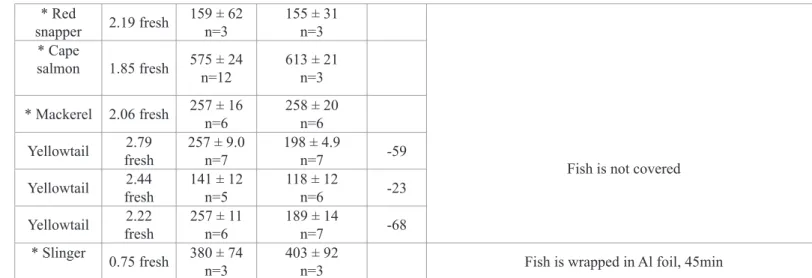
(X1) and cooked (X2) fish, prepared with traditional methods of fish cooking (boiling, poaching, frying and grilling over coal) and concentration change (ΔC) presented in Table 1. From the results of measurements follows that in most analyzed fish samples of
different species the Hg concentration remains unchanged. This
conclusion is confirmed by statistical treatment of analytical results, using null-hypothesis test (Miller J.N. & Miller J.C., 2005).
Most of the obtained results are in an agreement with conclusions
that Hg amount in fish does not changed by cooking (Burger
et al.2003; Domingo J.L., 2011). The statistically meaningful decrease in Hg concentration have been observed for a limited
number of fish species. They are Sole (ΔC=25 ng g-1 or 15.6%), Yellowtail (ΔC=49 ng g-1 or 19.1%), after simmering in vegetable oil and three samples of Yellowtail fishes, separately grilled over coal fire. All samples of Yellowtail show relatively high values of Hg degrease (ΔC=59 ng g-1 or 23.0%; ΔC=23 ng g-1 or 16.3% and ΔC=68 ng g-1 or 26.5%). Significance test for each sample reveal that the calculated value of t exp exceeds a critical value of t,
taken from table of t-distribution (Miller J.N. & Miller J.C., 2005). As a result, the null hypotheses for those samples was rejected.
Decrease in Hg concentration is statistically meaningful. The difference in Hg concentration can be explained by removal of Hg
in the volatile form (possibly as MeHg) together with fish fat by a “steam distillation” (Atkins, 2006). The fundamental principle of
“steam distillation” is that it enables some heat-sensitive, water-insoluble organic compound to be distilled with water vapors at a lower temperature than their normal boiling point. During grilling,
the fish internal temperature, according to our measurement was 96°C. This value corresponds to the temperature of boiling
water in Pretoria, because the city is located at the height 1265 m above the sea level. At these conditions, some amount of Hg was
removed as MeHg together with fish fat. This phenomenon could be observed only for fish species enriched in fat. There were no noticeable changes of Hg concentration in fish species with low fat, like Red snapper, Cape salmon or Slinger, grilled under the same conditions over coal fire. It appears to be that the possibility to remove Hg depend not only on a cooking procedure, but also on fish species.
Hg concentration in fish with and without
preliminary treatment before cooking
The possibility of Hg removal from fish before main cooking
procedure is based on chemical properties of some organic acids to form soluble complexes with Hg 2+ ions. This process could be performed by preliminary treatment of fish in vegetable brines or lemon juice. For example, sauerkraut brine contains large number
of organic acids and sulfur containing compounds (Trail et al.
1996), formed during fermentation. Experimental results on Hg concentration in fish, preliminary treated with brines, lemon juice
or directly boiled in them, presented in Table 2. From the results
of studies follow that soaking of Slinger fish in diluted lemon juice (pH=2.7-2.9) followed by simmering for 40 min does not affect the Hg content. Soaking in sauerkraut brine (pH=3.5 -3.8) followed by simmering for 40 min has no effect on Hg content in
Yellowtail tuna. The same negative result has been observed after
boiling of Snoek or poaching of Cape Hake in cucumber brine (pH=4.2).
Fish name
Fish weight, kg, and it’s state at
purchase
Concentration, C, ng g-1,
C ± Δ, P=0.95 changeConc.
ΔC=
X2-X1,
ng/g Some remarks
Uncooked Cooked
X1 X2
Boiling in water 20 min.
* Cape hake 0.76
fresh 229 ± 14n=6 215 ± 9.4n=7
Stainless steel kitchenware
with a lid
* Cape hake 0.78 fresh 598 ± 6.4
n=7 595 ± 8.6n=6
*Yellowtail 1.74 fresh 461 ± 57n=3 480 ± 36n=3
Poaching in water for 30-40 min.
* Hake 1.25 fresh 353 ± 46
n=3 364 ± 34n=3
Stainless steel kitchenware with a lid * Kabeljou 0.58 fresh 291 ± 28
n=3 302 ± 30n=3 * Red
snapper 2.19 fresh 159 ± 62n=3 161 ± 9.4n=3
* Norwegian
Salmon 3.1 fresh 39.7 ± 3.8n=3 43.8 ± 8.3n=4
* Snoek 1.21
frozen 240 ± 24n=3 255 ± 4.0n=3
Poaching in a plastic bag at 1900C with a small amount of water
* Kingklip
large 1.99 fresh 464 ± 21n=3 445 ± 77n=3
Roasting bag
* Mackerel 0.32
frozen 283 ± 75n=3 284 ± 20n=3
* Mackerel 0.33 frozen 447 ± 103n=3 468 ± 53
n=3
Simmering in a small amount of water with addition of sunflower oil for 20 min.
* Calamari frozensteak 244 ± 22n=3 233 ± 9.4n=3 Stainless steel kitchenware
Simmering in a small amount of sunflower oil for 30 min.
* Sole large 0.5
fresh 210 ± 26n=3 196 ± 8.7n=3
Stainless steel kitchenware
with a lid Sole large <0.5 fresh 160 ± 18
n=3 135 ± 16n=4 -25
Yellowtail 2.79 257 ± 9.0n=7 208 ± 7.2n=6 -49
Boiling in a sunflower oil for 3 min.
Cape Hake 0.82 fresh 708 ± 17
n=6 666 ± 26n=6 -42 Kitchenware with a ceramic covering
Baking over an open fire 30 min.
* Red
snapper 2.19 fresh 159 ± 62n=3 155 ± 31n=3
Fish is not covered * Cape
salmon 1.85 fresh 575 ± 24n=12 613 ± 21n=3
* Mackerel 2.06 fresh 257 ± 16n=6 258 ± 20n=6
Yellowtail fresh2.79 257 ± 9.0n=7 198 ± 4.9n=7 -59
Yellowtail fresh2.44 141 ± 12n=5 118 ± 12n=6 -23
Yellowtail fresh2.22 257 ± 11n=6 189 ± 14n=7 -68 * Slinger 0.75 fresh 380 ± 74
n=3 403 ± 92n=3 Fish is wrapped in Al foil, 45min
*Cooked and uncooked samples with the same mercury results confirmed by null-hypothesis t-test, P=0.95. Fruit and vegetable brines and juices used: sauerkraut, cucumber, lemon.
Content of Hg in sunflower oil was ≤ 0.6 ng g-1
Fish name and methods of
cooking
Fish weight, kg, and it’s state at
purchase
Concentration, C, ng g-1
C ± Δ, P = 0.95 changeConc.
ΔC=
X2-X1, ng/g
Some remarks
Uncooked Cooked
X1 X2
Soaking in a diluted lemon juice for 2 hours followed by simmering in a fresh portion of juice 40 min, pH=2.7-2.9
* Slinger 0.73 fresh 323 ± 20
n=6 335 ± 14n=6 Kitchenware with a ceramic covering
* Slinger 0.45
fresh 209 ± 12n=4 207 ± 7.9n=5
Boiling in a diluted lemon juice 20 min, pH=2.7-2.9
Cape Hake 0.76
fresh 229 ± 14n=6 193 ± 10n=5 -36
Kitchenware with a ceramic covering
Soldier fish 0.69 fresh 483 ± 16n=5 356 ± 6.7n=6 -127
Soaking in a vegetable brine( sauerkraut, pH=3.5-3.8) for 2h followed by simmering 40 min
* Sashimi tuna stake frozen 1784 ± 17
n=5 1772 ± 69n=5 Kitchenware with a ceramic covering
Boiling in sauerkraut brine, pH=3.5-3.8
Snoek 2.24
frozen 607 ± 34n=3 536 ± 16n=4 -71 30 min
Slinger fresh0.58 704 ± 25
n=6 663 ± 15n=6 -41 20 min
*Slinger 0.57
fresh 430 ± 28n=8 400 ± 16n=6 20 min
Cape Hake 0.76
fresh 229 ± 14n=6 206 ± 5.0n=5 -23 20 min
Poaching in vegetable brine(cucumber, pH=4.2) 30min
The boiling of Cape Hake in lemon juice (pH=2.7- 2.9) reduced Hg concentration on ΔC=36 ng g-1 or 15.7% and Soldier fish on ΔC=127 ng g-1 or 26.3%. Poaching of Cape hake in a plastic bag for 20 minutes after been marinating for two hours decreased Hg
concentration in Cape hake on ΔC=45 ng/g or 7.5% and in Slinger fish on ΔC=31 ng/g or 4.4%
Such changes of Hg concentration are statistically significant what was confirmed by t-test based on null hypothesis assumption.
The loss of mercury can be explained by the formation of water-soluble mercury complex with citric acid, stability constant of
which is pK=10.9 (Martell et al. 1998), and other compounds.
Discussion
It should be noticed that Hg concentration in fish used for cooking experiments have been in the range of 12-180 ng g-1 on a wet weight basis and the only one fish, related to predators (Yellowfin tuna), contained 540 ng g-1 of Hg. That is, all fish samples obtained at the local fish market, have the Hg concentrations in the
range of permissible level (Panichev & Panicheva, 2015). From general consideration it follows that to reduce Hg concentration
in fish is possible either by formation of soluble complexes of
Hg 2+ions with organic acids by cooking with vegetable brines or lemon juice or by thermal removal of volatile MeHg. Due to the fact that from 73 to 99% of total Hg in fish is present in the form of MeHg
(May et al. 1987), the treatment of fish with brines or lemon juice
can remove only limited amount of Hg in the form of Hg 2+ions. This conclusion can be confirmed by the decrease of Hg concentration in Snoek, Slinger, Cape hake and Soldier fish in the range of 5.8-26.3% after their treatment in sauerkraut brine and lemon juice (Table 2).
The other way of Hg removal from fish connected with cooking that could release Hg in the form of MeHg. The efficiency of Hg thermal removal by grilling was in the range of 16.3-26.5%. Simmering in sunflower oil could be the other example of thermal removal of Hg from the fat fishes. We observed 19.1% loss of Hg for rich in fat Yellowtail and only 5.9% for lean Cape hake fish. Therefore, the major part of Hg remains in fish, possibly connected to protein.
Boiling and poaching in water do not change Hg concentration in
fish.
Some researchers observed fish Hg increase after cooking procedures as a sequence of moisture and fat losses if the
measurements were conducted on a wet weight samples (Burger et al.2003; Perello et al.2008; Kalogeropoulos et al. 2012).
According to the literature data frying and roasting fish processing
shows that the Hg content decrease on a dry weight basis (Farias et al. 2010; Ouedraogo et al. 2011; Schmidt et al. 2015). So, Schmidt
L. shows 33% decrease of Hg concentration by frying. Moisture loss during cooking may cause fish Hg concentration increase in several times and therefore the 33% decrease of Hg concentration on a dry weight basis would be masked if the results are presented
on a wet weight basis.
From our previous study (Panichev & Panicheva, 2015)
follows that Hg concentration in fish could change within the ratio of wet weight/dry weight of the fish. The mean value of that ratio was found to be 4.29 for sea fishes used in the present study. It
appears to be that the choice of results presentation depends on a solving problem.
Conclusion
The results of this study, based on the analysis of 35 samples
of 14 the most common fish species obtained at the local fish market, prepared with traditional methods of cooking (boiling,
poaching, simmering, frying and grilling over coal) show that
Hg concentration in most the of cooked fish samples remains
unchanged.
To diminish Hg concentration in fish was possible by
complexation of Hg 2+ ions with organic acids of vegetable brines or lemon juice. Direct boiling of Snoek, Slinger and Cape Hake in sauerkraut brine (pH=3.5-3.8) for 20-30 min reduced Hg concentration in these lean fishes up to 11.7%. The boiling of Cape hake and Soldier fish in lemon juice (pH=2.7-2.9) reduced Hg concentration on 15.7 and 26.3% respectively. Such changes of Hg concentration were found to be statistically significant.
Some noticeable changes of Hg concentration have been
observed for Sole (15.6%) and Yellowtail (19.1%), after simmering in oil, and for Yellowtail fishes (23.0, 16.3 and 26.5%), grilled over a coal fire. Such a change of Hg concentration has been observed only for fish species rich with fat.
* Cape Hake
1.1
fresh 231 ± 12n=3 231 ± 2.9n=3
Kitchenware with a ceramic covering
* Snoek 2.24 frozen 607 ± 34n=3 566 ± 45n=4
Poaching in a plastic bag for 20 min at 1900C after been marinated Δ for two hours, pH=2.6
Cape hake fresh0.78 598 ± 6n=7 554 ± 12n=6 -44
Roasting bag Slinger fresh0.58 704 ± 25 n=6 673 ± 3 n=6 -31
*Cooked and uncooked samples with the same mercury results confirmed by null-hypothesis t-test, P=0.95. Fruit and vegetable brines and juices used: sauerkraut, cucumber, lemon.
From the results of this studies follows, that some domestic
cooking procedures could be applied for the moderate reducing of Hg in fish.
Acknowledgements
The authors are grateful to the National Research Foundation of South Africa for financial support of this work, Grant Number 81298 for the Rated Researcher.
References
Atkins, P & de Paula, J. (2006). Atkins’ Physical Chemistry, (Eighth Ed.), Oxford University Press.
ATSDR (Agency for Toxic Substances & Disease Registry),
Priority List of Hazardous Substances.
Burger, J., Dixon, C., Boring, S., & Gochfeld, M. (2003). Effect
of deep-frying on risk from mercury. Journal of Toxicology and Environmental Health, Part A, 66 (9), 817-828.
Cawthorn, D.M., Steinman, H.A. & Witthuhn, R.C. (2011).
Evaluating the availability of fish species on the South African market and the factors undermining sustainability
and consumer choice.Food control, 22, 1748-1759.
Domingo, J.L. (2011). Influence of cooking processes on
the concentrations of toxic metals and various organic environmental pollutants in food. A Review of the published literature. Critical Reviews in Food Science and Nutrition,
51(1), 29-37.
Farias L.A., Favaro, D. I., Santos, J.O., Vasconcellos, M.B., Pessoa, A et al. (2010). Cooking process evaluation on mercury content in fish. Acta Amaqzonica,40, 741-748.
FAO/WHO. (2011). Report on joint expert consultation on the risks and benefits of fish consumption, Rome: FAO fishery and Aquaculture report.
Focardi S. (2012). Levels of mercury and polychlorobiphenyls in
commercial food in Siena Province (Tuscany, Italy) in the
period 2001-2010. Michrochemical Journal, 105, 60-64. Grandjean, P., Satoh, H., Murata, K. & Eto, K. (2010). Adverse
effects of methylmercury: environmental health research implications. Environ. Health Perspect,118, 1137-1145. JECFA.(2004). Safety evaluation of certain food additives and
contaminants. Joint FAO/WHO Expert Committee on Food Additives, (pp.132-139), Geneva, WHO.
Kalogeropoulos, N., Karavoltos, S., Sakellari, A., Avramidou, S., Dassenakis, M et al. (2012). Heavy metals in raw, fried and grilles Mediterranean finfish and shellfish. Food Chemistry Toxicology, 50, 3702-3708.
Martel, A.E., Smith R.M. Critical stability constants, Plenum
Press, New York, vols.1-6, 1998
Maulvault A.L., Anacleto P., Lourenco H.M., Carvalho
M.L.,Nunes M.L.,& Marques A. (2012). Nutritional quality
and safety of cooked edible crab (Cancer pagurus). Food Chemistry, 133, 277-283.
May, K., Stoeppler, M., & Reisinger, K. (1987). Studies in the ratio total mercury/methylmercury in the aquatic food chain.
Toxicological & Environmental Chemistry, 13, 153-159.
Mergler, D., Anderson, H. A., Chan, L. H. M., Mahaffey, K. R., Murray, M et al. (2007). Methylmercury exposure and health effects in humans: A worldwide concern. Ambio, 36(1), 3-11.
Miller J.N., & Miller J.C. (2005). Statistics and Chemometrics for Analytical Chemistry (5th ed.). England: Pearson Education Limited.
Pacyna, E. G., Pacyna, J. M., Sundseth, K., Munthe, J., Kindbom, K et al. (2010). Global emission of the atmosphere from
anthropogenic sources in 2005 and projection to 2010.
Atmospheric Environment, 44, 2487-2499.
Panichev, N. A., & Panicheva, S. E. (2015). Determination of total mercury in fish and sea products by direct thermal
decomposition atomic absorption spectrometry. Food chemistry, 166, 432-441.
Perelló, G., Martί-Cid, R., Llobet, J. M., & Domingo, J. L. (2008). Effect of various cooking process on the concentrations of
Arsenic, Cadmium, Mercury and Lead in foods. Journal of Agricultural Food Chemistry, 56(23), 11262-11269.
Pirrone, N., Cinnirella, S., Feng, X., Finkelman, R. B., Friedli, H.
R et al. (2010). Global mercury emissions to the atmosphere from anthropogenic and natural sources. Atmospheric Chemistry and Physics, 10, 5951-5964.
Quedraogo, O., & Amyot, M. (2011). Effects of various cooking
methods and food components on bioaccessibility of mercury
from fish. Environmental Research, 111, 1064-1069. Schmidt, L., Bizzi C. A., Duarte, F. A., Muller, E. I., Krupp, E et
al. (2015). Evaluation of Hg species after culinary treatment
of fish. Food Control, 47, 413-419.
Sholopov, S., Pogarev, S., Ryzhov, V., Mashyanov, N., & Stroganov, A. (2004). Zeeman atomic absorption spectrometer RA 915+ for direct determination of mercury in air and complex matrix samples. Fuel Process Technology, 84, 473-485.
Storelli, D. G., Barone, G., Piscitelli, G., & Marcotrigano,
G.O. (2007). Mercury in fish: Concentration vs fish size and estimates of mercury intake. Food additives and Contaminants, 24, 1353-1357.
Trail, A. C., Fleming, H. P., Yong, C. T., & McFeeters, R. F. (1996). Chemical and sensory characterization of commercial sauerkraut. Journal of Food Quality, 19, 15-30.
US EPA, 2001. Methylmercury (MeHg) (CASRN 22967-92-6).
US FDA (U.S. Food and Drug Administration), Mercury Levels in