80 Bothalia 43,1 (2013)
CHENOPODIACEAE
CHENOLEA CONVALLIS, A NEW SPECIES FROM WESTERN CAPE PROVINCE, SOUTH AFRICA
Generic circumscriptions in Chenopodiaceae have still to be fully resolved but modern treatments recog-nize four subfamilies, with subfamily Chenopodioideae segregated into six tribes (Kuhn et al. 1993). Keys to the genera of tribe Camphorosmeae in current use (Scott 1978; Kühn et al. 1993) rely heavily on fruit and seed characters to distinguish taxa, but the limited value of these characters for generic delimitation within the tribe has become increasingly apparent (Kadereit & Freitag 2011). This applies particularly to the form of append-ages on the fruits that are likely to experience strong and variable selection for dispersal (Chu & Sanderson 2008). The most recent taxonomic conclusions of Kadereit & Freitag (2011) indicate that several genera, particularly
Bassia All. and Kochia Roth, are highly polyphyletic
and that the taxa fall within three clades correspond-ing with three informal groups, the Chenolea Thunb.,
Sclerolaena R.Br. and Bassia All./Camphorosma L.
groups. The Chenolea group comprises fi ve species of dwarf shrubs, perennial and annual plants placed in four widely disjunct genera, spread between Eurasia, west-ern North America, southwest-ern Italy, and southwest-ern Africa. The Sclerolaena group, the largest of the three, incor-porates a strictly perennial Australian group plus three annual species from Central Asia. The Bassia/Campho-rosma group has a predominantly Eurasian geographic range but includes B. dinteri and B. salsoloides within southern Africa. The formal subtribal classifi cation and supporting morphological data of these groups have not yet been published. Nevertheless, Kadereit & Freitag (2011) stress the importance of the internal morphol-ogy of leaves in providing phylogenetically informative characters. The Bassia/Camphorosma group has various types of Kranz anatomy indicative of C4-photosynthetic pathways, whereas the Chenolea and Sclerolaena groups have non-Kranz anatomy, refl ecting C3-photosynthesis.
Plants of the monotypic Chenolea and the moder-ately sized genus Bassia, with which it has previously been combined (Scott 1978), are subshrubs or herbs with small bisexual, sometimes pistillate fl owers, and slightly accrescent fruiting perianths. In common with other members of tribe Camphorosmeae, the seeds contain an annular or horseshoe-shaped embryo and moderately developed perisperm, the fl owers lack bracteoles, and the stigmas are entirely papillose (Kadereit & Freitag 2011). Scott (1978) circumscribed Bassia to encompass both Kochia Roth and Chenolea, each with one species
in southern Africa, as well as the monotypic, Eurasian Londesia Fisch. & C.A.Mey. In contrast, the most recent molecular-based classifi cation of Kadereit & Freitag (2011) treats Bassia as a strictly Afro-Eurasian genus of ± 20 species that includes Londesia and the major part of Kochia. Chenolea, which resolved separately in their analysis, was reinstated as a genus endemic to southern Africa’s coast.
Recent plant checklists for southern African Chenopodiaceae (Makgakga 2003; Klopper et al. 2006) list four species of Bassia in the region, including B. dif-fusa (Thunb.) Kuntze, which is now treated in Chenolea
as C. diffusa Thunb. Only two of the remaining three
species are native to southern Africa: B. dinteri (Bot-sch.) A.J.Scott, a local endemic in the southern Namib of Namibia, and B. salsoloides (Fenzl) A.J.Scott, wide-spread in South Africa’s Nama Karoo, extending from northern Bushmanland eastwards to the southern Free State and southwards through the Great Karoo. The third species, B. indica (Wight) A.J.Scott, appears to have been introduced from an area between North Africa and India (Scott 1978; Kadereit & Freitag 2011).
In 2011, Mrs A. le Roux, an ecologist undertaking a long-term study of the vegetation in the valley and hills surrounding the Greater Brandvlei Dam near Worces-ter, Western Cape, encountered several unusual plants of Chenopodiaceae in the area. Based on a study of the leaf anatomy in particular, notably the non-Kranz anat-omy, we recognize them as representing an undescribed species belonging to the Chenolea group of Campho-rosmeae with a fruiting perianth quite unlike any other species in the group. We discuss our interim decision to place this new species in the genus Chenolea with the name C. convallis, in reference to the secluded Brand-vlei Valley where the plants are found.
For anatomical investigation, fresh material was fi xed in FAA and then embedded in wax before sectioning and double-staining with alcian blue and safranin following Rudall (1995).
TAXONOMY AND CONSERVATION STATUS
Chenolea convallis Snijman & J.C.Manning, sp. nov.
non-Kranz anatomy of the C3 Neokochioid or Eoko-chioid type, but differing by the combination of a woody habit and the fruiting perianth with a prominent, suc-culent, rugose, pale brown, glistening dorsal tubercle below the apex of each lobe.
TYPE.—South Africa, Western Cape, 3319
(Worces-ter): Worcester District, Greater Brandvlei Dam area, slopes on E side of Dam, 212 m, (–CD), 23 February 2012, D. Snijman & A. le Roux 2368 (NBG, holo.; KAS-SEL, MO, PRE, iso).
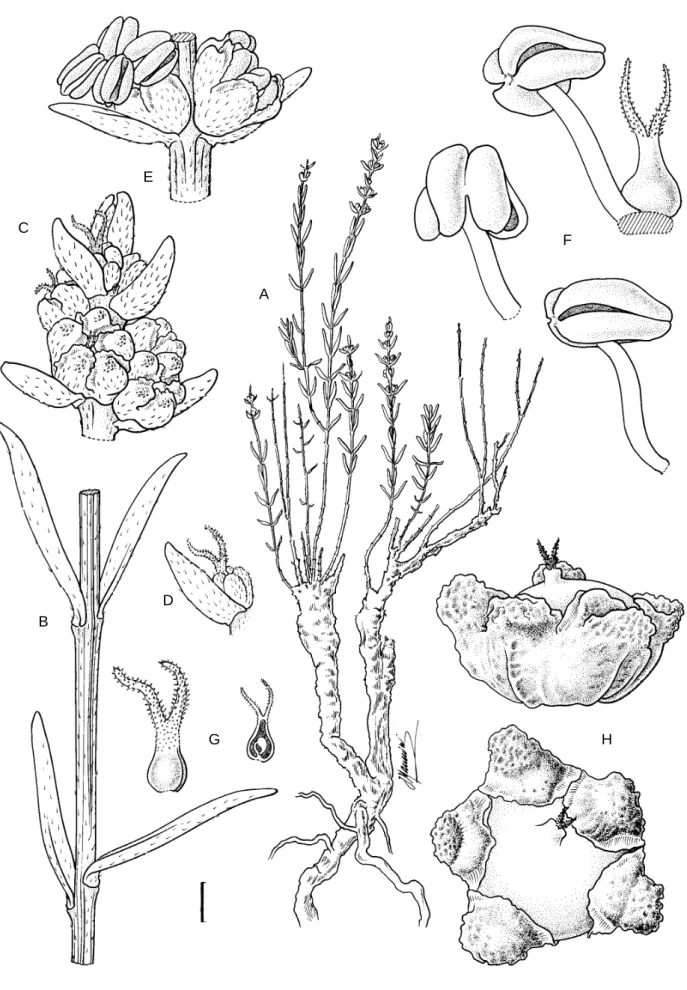
Succulent-leaved, branching subshrub, up to 300 mm tall, resprouting from a deeply rooted, woody base. Branches mostly erect, slender, striate, young shoots sparsely villose. Leaves subopposite, sometimes appear-ing opposite, distantly spaced throughout, sometimes deciduous below, sessile, linear to narrowly lanceolate, 5–8 × 1.5–2.0 mm, almost semiterete, adaxially fl at-tened, pale glaucous green, insertion on stem marked by a narrow brownish band, young leaves lightly pubes-cent with fi liform, 1-seriate hairs on both surfaces, older leaves glabrescent, minutely granular from remnants of hair bases under a 10 × lens, each comprising a swol-len basal cell and narrowly tubular distal cell directed towards apex, anatomy non-Kranz. Infl orescence resem-bling a terminal spike, up to 70 mm long, of up to 15 subopposite, axillary fl ower clusters. Flowers bisex-ual, 2 per axil (rarely with additional, aborted acces-sory fl ower), sessile, without bracteoles, protogynous; perianth campanulate, mostly 5-lobed, lobes ± ovate, ± 2.0–2.5 × 1 mm, connate for up to ± 1 mm, succulent, thinly villose, pale glaucous green, each with small, glabrous, dorsal tubercle below apex, margins mem-branous in distal third; stamens mostly 5, perigynous, shortly exserted, fi laments slender, ± sigmoid, anthers dorsifi xed, spreading horizontally at anthesis, broadly oblong-sagittate, 1.25 × 1.25 mm, apex ± smooth, dehis-cence latrorse, pale yellow, pollen yellow; ovary ovoid, ± 0.5 × 0.5 mm, unilocular; ovule 1, basal; style short, stigmas 2, fi liform, ± 0.75 mm long, entirely covered with papillae, reddish, well exserted prior to anthesis, ± withering thereafter. Fruiting perianth accrescent, free from pericarp, ± 4 mm diam., depressed-spherical, lobes dark and ± leathery, each ornamented distally with an enlarged, dorsal tubercle, tubercles succulent, rugose, 1.5 mm diam., pale brown and glistening, lobes below the tubercle shortly keeled, margins of lobes remaining narrowly membranous in distal third. Fruit an achene, with a membranous pericarp; mature seeds unknown. Flowering period: Feb. to Mar. Figure 1.
Distribution and habitat: Chenolea convallis is cur-rently known from just one population near the foot of the west-facing slopes of the low hills on the eastern banks of the Greater Brandvlei Dam near Worcester, Western Cape (Figure 2). The plants, numbering no more than about 50 individuals, grow in stony loam, at approximately 212 m above sea level. The area lies on bedrock of the Witteberg Series, the youngest deposits of the Cape Supergroup and these are tilted towards the Breede River, which runs along the Worcester fault line. The soils of the hills are derived from shales and sand-stones of the oldest formations of the Witteberg Series (Gresse &Theron 1992).
The surrounding vegetation, classifi ed as Breede Shale Renosterveld (Rebelo et al. 2006), includes succulent and asteraceous shrubs such as Crassula
tetragona L. (Crassulaceae), Elytropappus
rhinocero-tis (L.f.) Less., Eriocephalus africanus L., Helichrysum rutilans (L.) D.Don, Oedera genistifolia (L.) Anderb. & K.Bremer, and Pteronia ovalifolia DC. (all Aster-aceae). Some rare species found at the site are Aspal-athus muraltioides Eckl. & Zeyh. (Fabcaeae), Phyllobo-lus caudatus (L.BoPhyllobo-lus) Gerbaulet (Aizoaceae) and two Iridaceae, Moraea vuvuzela Goldblatt & J.C.Manning
and Sparaxis maculosa Goldblatt. An average rainfall
of ± 300 mm per annum falls mainly between May and August. Chenolea convallis is one of the few species in the Greater Brandvlei Dam area that fl owers during the late summer drought, between February and March.
Conservation status: the current water level of the Greater Brandvlei Dam was reached in 1985 after suc-cessive enlargements to the dam in 1950 and 1972 (Le Roux et al. 2010), resulting in the inundation of the renosterveld, which now barely fringes the dam to the north and east. In effect, the rising water levels may already have been destroyed other suitable local habitats
of Chenolea convallis. New proposals by the
Depart-ment of Water Affairs to raise the water level of the Brandvlei Dam once again are further cause for concern about the future survival of C. convallis, given its close proximity to the present water’s edge. According to the South African Red List categories and criteria (Rai-mondo et al. 2009) we suggest that C. convallis should be classifi ed as Critically Endangered. It is noteworthy that prior to the collections made by Mrs. A. le Roux, C. convallis was not known in any of the major herbaria of South Africa (BOL, NBG, PRE, SAM) (acronyms after Holmgren et al. 1990).
DISCUSSION Leaf anatomy
82 Bothalia 43,1 (2013)
FIGURE 1.—Chenolea convallis, Snijman & le Roux 2368 (NBG). A, part of plant showing resprouting habit; B, detail of striate stem showing
subopposite leaves; C, part of infl orescence showing protogynous fl owers: female phase; D, solitary fl ower at female phase; E, fl owers: male phase; F, solitary stamen and gynoecium showing attachment, plus details of stamen showing dorsifi xed anther; G, gynoecium (plus longi-tudinal section at lower magnifi cation showing solitary, basal ovule); H, persistent fruiting perianth and achene, side view and from above. Scale bar: A, 10 mm; B–E, H, 1.5 mm; F, G, 0.5 mm. Artist: John Manning.
F
G H
A C
B
Eokochia Freitag & G.Kadereit, but not yet illustrated (Kadereit & Freitag 2011). Both genera fall within the Chenolea group sensu Kadereit & Freitag (2011) of Camphorosmeae.
Leaf trichomes
Young leaves of Chenolea convallis are sparsely pubescent with appresssed, three-celled, uniseriate, fi li-form hairs. The terminal cell of each hair is shed in the older, more succulent leaves, leaving only the swollen, thick-cuticled basal cell and narrow, tubular intermediate cell (Figure 4). Under a 10 × lens, these appear as small granules on the leaf surface. Similar trichomes have been described for many species of Camphorosmeae (Carolin 1983) and illustrated for Neokochia americana (S.Watson) G.L.Chu & S.C.Sand. (Chu & Sanderson 2008, Figure 2B) from North America and Bassia muri-cata (L.) Asch., distributed from Morocco to southern Iran (Metcalfe & Chalk 1965, Figure 262A). Chenolea diffusa, in contrast, has more specialized, T-shaped hairs with a pluricellular stalk (Carolin 1983).
Fruiting perianth
Chenolea convallis is distinguished from other Afri-can species of Camphorosmeae by the unusual fruiting perianth, which develops prominent, wart-like, dorsal outgrowths below the apex of each lobe. Contrasting with the mostly dark-coloured, somewhat leathery fruit-ing lobes, the dorsal outgrowths are pale brown, glis-tening and irregularly sculptured. This morphology is also unique amongst taxa of the Chenolea group sensu Kadereit & Freitag (2011). Chenolea diffusa has smooth, fl eshy, somewhat cowl-shaped fruiting perianth lobes, Spirobassia Freitag & G.Kadereit has three, obtuse perianth appendages, Neokochia (Ulbrich) G.L.Chu & S.C.Sand. has fi ve, free, wing-like appendages from the base of the lobe and Eokochia has a fi ve-winged peri-anth.
Harvester termites, Microhodotermes viator, have been seen gathering and carrying fallen twigs and leaves of C. convallis into holes at the base of several plants and it may be that the fruits are dispersed in this way, although probably not exclusively so.
Classifi cation
This new species is easily identifi ed by opposite to subopposite leaves and the distinctive fruiting perianth, which develops a large wart-like, dorsal outgrowth below the apex of each lobe. Based on the non-Kranz leaf morphology it shows a strong alliance with taxa in the Chenolea group (sensu Kadereit & Freitag 2011), in which only Neokochia is not monotypic. According to the classifi cation proposed by Kadereit & Freitag (2011) and which is based heavily on molecular data and leaf anatomy, this new taxon may eventually warrant recog-nition as a new genus in the Chenolea group, but this requires further molecular investigation throughout the tribe. Since some of the relationships among the mono-typic genera in this group are still unclear and because intercontinental disjunctions have been invoked to sup-port their separation, our interim decision is to place this FIGURE 2.—Distribution of Chenolea convallis,●.
FIGURE 3.—Chenolea convallis, Snijman & le Roux 2368 (NBG). Transverse section of isobilateral leaf showing scattered, persist-ent, swollen, basal cells of partially shed trichomes on abaxial surface and vascular bundles arranged in the same median plane within water storing tissue in the middle of the leaf. Scale bar = 200 μm.
FIGURE 4.—Chenolea convallis, Snijman & le Roux 2368 (NBG).
Detail of abaxial leaf surface showing sunken stomata and per-sistent swollen bases of uniseriate trichomes. Scale bar = 100
84 Bothalia 43,1 (2013) new species in the southern African genus Chenolea,
a name which takes precedence over all others in this group.
The addition of C. convallis to the previously mono-typic Chenolea requires expansion of the generic description only to the extent of adding the subshrubby habit to the otherwise low, decumbent, straggling, near perennial habit of the plants, increasing the number of fl owers per axil from one to two, extending the fruiting perianth morphology to include the presence of warty dorsal outgrowths on the lobes and adding the presence of simple, uniseriate hairs to the trichome types. In other genera of the tribe, such as Bassia (sensu Kadereit & Freitag 2011), characters such as growth form and peri-anth appendages also vary among species.
Apart from major leaf anatomical differences between Chenolea sensu lato and Bassia (non-Kranz vs. Kranz), Chenolea can be distinguished from the native species of Bassia in southern Africa by subtle differ-ences in leaf arrangement, subopposite, sometimes dis-tant leaves in Chenolea and alternate, often tightly clus-tered leaves in Bassia.
Additional specimens examined
WESTERN CAPE.—3319 (Worcester): Worcester, Greater Brand-vlei Dam, 217 m, (–CB), 21 February 2011, A. le Roux 910 (NBG), 2 June 2011, A. le Roux 910a (NBG).
ACKNOWLEDGEMENTS
We thank Anso le Roux for fi rst documenting this new species; P.D. le Roux and the staff of Pokkraal for assistance in the fi eld; ABEERU (Applied Behavioural Ecology & Ecosystem Research Unit), UNISA for shar-ing data from the study site; Western Cape Nature Con-servation Board for a permit to gather plants; Michelle Smith for preparing the map; Hamish Robertson for identifying the species of termite; Miranda Waldron for the electron microscope scans; and Colin Paterson-Jones for help with photography. Helmut Freitag contributed many helpful comments on the manuscript.
REFERENCES
CAROLIN, R.C. 1983. The trichomes of the Chenopodiaceae and the Amaranthaceae. Botanische Jahrbücher für Systematik
103:451–466.
CAROLIN, R.C., JACOBS, S.W.L. & VESK, M. 1975. Leaf structure in Chenopodiaceae. Botanische Jahrbücher für Systematik 95: 226–255.
CHU, G.-L. & SANDERSON, S.C.2008. The genus Kochia
(Chenopo-diaceae) in North America. Madroño 55: 251–256.
GRESSE, P.G. & THERON, J.N. 1992. The geology of the Worcester area. Government Printer, Pretoria.
HOLMGREN, P.K., HOLMGREN, N.H. & BARNETT, L.C. 1990.
Index Herbariorum. Part. 1: The Herbaria of theWorld. New
York Botanical Garden, New York.
KADEREIT, G. & FREITAG, H. 2011. Molecular phylogeny of Cam-phorosmeae (Camphorosmoideae, Chenopodiaceae): Implica-tions for biogeography, evolution of C4-photosynthesis and tax-onomy. Taxon 60: 51–78.
KADEREIT, G., BORSCH, T., WEISING, K, & FREITAG, H. 2003. Phylogeny of Amaranthaceae and Chenopodiaceae and the evo-lution of C4-photosynthesis. International Journal of Plant Sci-ence 164: 959–986.
KLOPPER, R.R., CHATELAIN, C., BÄNNINGER, V., HABASHI, C., STEYN, H.M., DE WET, B.C., ARNOLD, T.H., GAUTHIER, L., SMITH, G.F. & SPICHIGER, R. 2006. Checklist of the fl ow-ering plants of sub-Saharan Africa. An index of accepted names and synonyms. South African Botanical Diversity Network Report No. 42. SABONET, Pretoria.
KÜHN, U., BITTRICH, V., CAROLIN, R.C., FREITAG, H., HEDGE, H., UOTILA, P. & WILSON, P.G. 1993. Chenopodiaceae. In K. Kubitzki, J.G. Rohwer & V. Bittrich, The families and genera of vascular plants II: 253–281. Springer-Verlag, Berlin.
LE ROUX, A., VAN JAARSVELD, E.J. & BUYS, M.H. 2010. Mopkop vygies in the Breede River Valley: the thin end of the wedge.
Veld & Flora 96:32, 33.
MAKGAKGA, M.C. 2003. Chenopodiaceae. In G. Germishuizen & N.L. Meyer, Plants of southern Africa: an annotated checklist. Strelitzia 14. National Botanical Institute, Pretoria.
METCALFE, C.R. & CHALK, 1965. Anatomy of the dicotyledons, leaves, stem, and wood in relation to taxonomy with notes on economic uses. Clarendon Press, Oxford.
RAIMONDO, D., VON STADEN, L., FODEN, W., VICTOR, J.E., HELME, N.A., TURNER, R.C., KAMUNDI, D.A. & MANYA-MA, P.A. (eds). 2009. Red List of South African Plants. Strelitzia
25. South African National Biodiversity Institute, Pretoria. REBELO, A.G., BOUCHER, C., HELME, N., MUCINA, L. &
RUTHERFORD, M.C. 2006. Fynbos Biome. In L. Mucina, & M.C. Rutherford, The vegetation of South Africa, Lesotho and Swaziland. Strelitzia 19. South African National Biodiversity Institute, Pretoria.
RUDALL, P. 1995. VIII. Iridaceae. In D.F. Cutler & M. Gregory, Anat-omy of the monocotyledons. Clarendon Press, Oxford. SCOTT, A.J. 1978. A revision of the Camphorosmioideae. Feddes
Rep-ertorium 89: 101–119.
D.A. SNIJMAN* and J.C. MANNING**
* Compton Herbarium, South African National Biodiversity Institute, Private Bag X7, Claremont 7735, Cape Town, South Africa. Email: [email protected].