Journal of Applied Linguistics and Language Research Volume 5, Issue 3, 2018, pp. 113-130
Available online at www.jallr.com ISSN: 2376-760X
* Correspondence:Awwad Othman Abdelaziz Ahmed, Email: drawwd.ahmed gmail.com © 2018 Journal of Applied Linguistics and Language Research
Test Preparation: Reducing EFL Test-
takers’ Stressful Barriers
Awwad Othman Abdelaziz Ahmed *
Associate Professor of Applied Linguistics, Taif University, Taif, KSA
Abstract
This study tried to verify whether EFL teachers provide their students with test taking strategies and prepare them well in advance in order to reduce the stressful barriers that face them when taking tests. The theoretical framework of this study covered relevant material on the subject matter in order to shorten the gap between tests and test takers in this regard. The instrument used was a questionnaire based on material close to test preparation and test stress. It includes (20) items, each one on was based on a 5-point Likert Scale. It was given to (100) Sudanese students majoring in English. A questionnaire to collect the data needed to make the statistical analyses check them against the hypotheses of the study has been used. The data obtained analyzed by using (SPSS) program. Descriptive analysis was presented to calculate the means and the standard deviations for each item of the questionnaire. The findings proved that stress did not promote students to study well in advance of the examinations. Furthermore, students did not familiarize themselves with the type of questions that will be given before taking the test. Interestingly, students found their test stress reduced when they started to study more regularly. Based on these findings, it has been recommended that teachers should encourage their students to form study groups. Their aim is to exchange knowledge and provide support and encouragement for one another. Students should not have frantic review just before the test time; it will be more confusing methods than helpful ones. Finally, no meaningful correlation was found due to gender and test stress.
Keywords: barriers, Test stress, EFL students, test taking strategies
INTRODUCTION
learners, were then exposed to a one-hour class on education. Their performance was then contrasted to that of their counterparts in the control group—comprises of 29 students—whose score was null. The results display that the experimental group respondents excelled their counterparts in the control group.
Sweetnam (2000) also traces the association between the teaching of test-taking procedures and their impact on enhancing classroom test grades. The study includes (22) fourth level students (10 males and 12 females) who were given particular tasks on weekly and semesterly-based-workshops concerning test-taking strategies. Test techniques, used during this period, were motivation and recreation techniques. Students were promoted to implement such strategies in every school test for each level. The use of such techniques provided positive results towards effective test strategies.
Gallagher (1992) conducts a study on test-taking strategies from another dimension. He involves the variable of sex difference in test-taking strategies. Moreover, Gallagher investigates the hypothesis of the discrepancies in math test practice among boys and girls. The results of this study show that there are differences in students’ strategies used for resolving math difficulties. The participants, he adds that they were high-scoring testees in the SAT-mathematics. The results show noteworthy variances in tactics used by boys and girls in math test.
Vattanapath and Jaiprayoon (1999) trace the efficiency of the teaching of the test strategies used in multiple-choice tests in order to obtain higher marks on English tests. Their sample involved a number of 60 freshmen-nursing students who took part in this study. They divided their sample into experimental and control groups. The experimental group was trained on test-taking tactics twenty minutes per week for a period of ten weeks. The groups’ performance was compared to that of the control group using a forty items of multiple-choice test. It was concluded that the study experimental group got better results compared to those of the control group. Furthermore, it showed that the students who took part in this study acquired constructive perspectives towards the trend of the learning of the test-taking strategies and that they set out to implement such strategies in actual testing cases. Carraway (1987) tried to trace the impact of teaching a test-taking sessions on lessening test stress and increasing the test marks. The level of test anxiety was assessed using the Test Anxiety Inventory (TAI) designed by Spielberger (1980) which involves two groups: the experimental and the control ones selected from thirty nursing learners who joined up a Community Faculty. The study concluded that the students, who took part in the session, displayed remarkably less levels of test stress and notably obtained higher test marks compared to those who did not take the test previously.
While many of the strategies in these areas fall within the language teacher's domain, others remain the students' responsibility. A number of test preparation strategies, however, are the responsibility of both teachers and students working together.
tests. It is observed that some learners are effective participants in the classroom, do their classwork and homework properly. They usually prepare themselves perfectly for taking the test, but when the time of the test approaches, they feel frightened and anxious. They assume that they cannot get good marks or even pass the test. While they are taking the test, they cannot respond correctly to the questions, to the extent that even if they know the answers. This obviously personifies the picture of test stress. This is the nervous feeling that learners experience when they take a test in general. Some test takers confirm that this stress becomes more intense whenever they take a test. This kind of tenseness they feel when taking a test, can affect their concentration and performance negatively.
The researcher intends to trace the causes of this stress among the students of the Department of English, College of Education at Gezira University, Sudan. He intends to investigate the stressful barriers encounter EFL students when taking tests and to provide students with some specific test preparation strategies to overcome these barriers.
Generally speaking, any demanding situations need people to be psychologically and physically prepared. Test stress can be a positive on the other hand an overdose of it can create problems. If someone feels stressful before taking a test, he will be having the feeling the he does not know nothing about the test, and accordingly he will forget the answers that he absolutely knows. Therefore, in this case he is in need for the strategies which help him minimize the degree of this stressfulness. His teacher can suggest helpful resources to talk to if he always gets extreme test stress (Sweetnam, 2002). Stress can happen if someone has expectations that hope come true. If a student assumes that he either will perform poorly on the test, or is not well prepared for the test, or may seem imprudent, he then may develop an emotional response that may be in harmony with one's own anticipations regarding what is expected to occur. Such anticipations could be best represented in a written form, visual images or body gestures. The student's mind produces then an analogous emotional reaction. Some students may pass a test without having studied well, while some others feel stressed as they sit in for a test. Test stress is just the students' emotional reactions to the structure of a test. Such a reaction is natural since students are concerned with their scores on a particular test.
As mentioned above, test preparation and test-taking strategies have received an increasing research attention in the field of language assessment for their importance in narrowing the gap between tests and test takers. Test stress has become one of the current challenges in the teaching of foreign language to provide students with a low-stressful classroom environment. Thus, this study investigates the barriers encounter EFL students when taking tests; mainly the problems which arouse their test stress. This study assumes that teaching test-taking strategies will result in increasing students' overall scores in their tests. It is also assumed that having such strategies will reduce the level of test stress, and improve students' overall attitudes toward tests. Many useful strategies teachers can inform their students about them in order to perform well in their examinations. Some of them can be presented as follows:
Students should maintain a soundly systematic plan of revising, sleeping, taking rest and having their meals. They should revise once or preferably twice a week prior to their tests.
Students should not overburden themselves in studies. If they find themselves able to study with a full concentration for about 10-20 minutes, then they should only study for such a time and then have a break (Casbarro, 2005).
Test stress can be devastating to test results. Students must reduce their stress to a manageable level. The following tips can be pursued in order to minimize test stress: Students should allow themselves sufficient time to get to class; they should not feel that they have to rush.
Students should first scan the test and then answer questions they know. This helps develop self-confidence (Casbarro, 2005).
Furthermore, (Budd, 2002: 3) recommends some helpful suggestions to overcome any test- anxiety, such as:
No textbooks needed: Students should not only ensure that they comprehend the facts of a given task but also remember the exam material to pass the test as desired.
Strain: Test-taking adds more strain. Students' efficiency inclines lessens due to test strain. Therefore, they have to grasp the material properly and remember even if they feel stressed.
Time strain: Having studied numerous related materials, perceived numerous actualities, notions, procedures and resolutions, students need to recall all the given facts and tests' components easily during a forty-five-minutes test.
particular topic in a single session, rather they should have breaks between each session.
It is mentioned earlier that a full preparation prior to the test day is a better way of overcoming test anxiety. Students should avoid cramming; rather they should try other ways of recalling and learning specific material. Instructors can inform their students that when studying for a test, they may ask themselves some questions and try to find out their answers by integrating ideas from different sources such as handout notes, text materials and additional readings. Furthermore, if students fail to cover the whole given material during the semester, they, then, select a specific section of the textbook that they can easily comprehend. Therefore, students confidently present their comprehension of any given material on the day of the test.
Liu (2004: 1) suggests a stress control procedure as follows: First, learners overturn their question sheets and shut their eyes for a while. They think deeply with positive expectations towards the test. They open their eyes then they start first with the questions that they know their answers.
To overcome this phenomenon; parents, students as well as teachers should play a crucial and effective role to reduce these stressful barriers. For example, parents prepare their children for the test, students have confidence, and teachers reduce the stress by facilitating the items of the test.
Attending class regularly is a key to test preparation. The information on a test is usually presented, analyzed and reviewed in class. Students need to be in class when the teacher gives hints about what the test will mainly be on, so they can concentrate their studying and limit the amount of time it takes them. Reviewing class notes is another essential step towards successful studying habits. Students should review these notes on a regular basis, not in the last minutes. Letting the notes sink in over time will expand their knowledge on the subject and giving them more of a complete understanding of the material (Brodsky, 2004).
Furthermore, students do whatever works best for their learning habits. While studying need to keep a positive attitude. If they say they cannot do something, they cannot. However, if they say they can, and they deserve to, then they will achieve so much more. They actually need to refresh themselves on the subjects at hand, by reading headings and subheading, concentrating on any bold words, reading any summary sections, reviewing their notes and reading these things aloud. The three types of reading that they can use when studying are: comprehensive reading, which is reading it all word for word and making note cards. Skimming is just reading for the main ideas; it normally does not give them many details. The last way is newspaper reading, also referred to as the magazine style, which is ideal for a final reading.
Instructors commonly give essay tests to reveal a student’s capability to generate their ideas properly with selected vocabulary in use and argumentative point of views. Thus, the students make sure that they know the information and to write guided words that enable them to demonstrate their ideas more effectively.
Many students think that an essay test question can be one of the most difficult to study. They can identify this type of question on the test by looking for key words such as list, name, define or identify. Krivoshik (2003: 1) lists some of the needed techniques and tips to do well on an essay test. They are as follows:
Read all directions before beginning.
Have a comprehensive over view of all questions, underscore main words and encircle directive words.
Brainstorm and note down clues as one reads and/or answers questions. Ensure that all answers are systematized and thorough.
Outlines can help organize thoughts.
Do not leave any answers that could be illusive to the instructor. Do not use a long general introduction.
Emphasize new ideas through using new clauses and indicative words. Attempt to substantiate your answers to the open-end essay questions.
Write clearly using ink on one side of the answer sheet, usually well-ordered work scores higher grades.
Attempt as possible to support arguments using more examples that are real.
Test-takers should check their work for spelling and grammatical errors and illegible handwriting. In reading through the exam, they check that the conclusion is well supported and that the introduction corresponds with the conclusion.
Milnamow (2001: 1-2) has also listed seven brief and essential steps in answering an essay test:
Prepare a schedule. (Manage time properly). Have a first reading of all questions.
Have an overview of all questions and pay head to all instructions (the directions on how to answer).
Set an outline for answers prior to writing down the answers. Allocate some time to writing an introduction and conclusion. Revise what has been written.
can create a summery sheet for each major topic that they generate from their course material. This seems to be an efficient way to highlight the significant themes of a unit. It is important in preparing for an essay test to determine relationships between ideas and assessing how these connections can be used as essay questions. Before writing, the students can jot ideas down and thinking through the questions, budgeting time and to allow time for proofreading, understanding what is being asked, starting with the easy questions, determining the general answer, and separating the issues that they choose to use as support for their argument. While writing, the students make sure that the answer proves a direct point (Milnamow, 2001).
In general, when students prepare for an essay test, they should have a wide knowledge about the topic and should be very organized. This will help them to be well-prepared for taking the test.
Students most probably prefer multiple choice questions because the correct answer is right in front of them and all one has to do is determine what is right and what is wrong. Chargar (2002: 4) discusses why multiple-choice tests are easier than essay tests, and why it can also be more difficult. He says
Multiple-choice tests are easier for three reasons: 1) it is guaranteed that the correct answer is given so you would not have to produce and answer, 2) comparisons and definitions are emphasized so no analyses are involved, and 3) there are a lot of questions so each question has a low point value.
Multiple choice tests are more difficult in that they cover a greater range of information, they force students to be familiar with minute details, and because they are so difficult to write, an instructor may have two very similar given answers and the student could easily choose the wrong one (Stevenson, 2002).
The rules when the students take this type of test are that they should read all of the possible choices, sometimes there might be a better choice. To manage their time, they answer the questions that they are confident about and mark the ones that they are not. They should not leave any blank unless points are taken off. The students try to answer the question without looking at the options. They eliminate obviously wrong answers. They should be careful when they read "the all of the above" or "none of the above". One of them could be a distractor, but it could also be the right choice. The students should watch out for key words such as negatives or superlatives, or even words that might identify a true statement. They must not overanalyze questions. Fieber (2001: 1-2) has listed numerous techniques and strategies which will increase one’s ability to do well on a multiple-choice question test. He suggests to break the question into the stem and the alternatives.
highlight significant indicative components of all questions that help finding the correct answers.
read the question a few times in order to ensure that they understand what the question is asking about.
think of a correct answer before looking at the answer choices, then see if any of the answer choices are the same or similar to what they thought.
apply elimination process as it helps eliminate incorrect answers/choices, comparing the answer choices, eliminating the ones you know are incorrect, choices such as "all of the above," "none of the above," "A and B," etc. as to be treated as true or false questions.
mark questions you do not know their answers so that you may come over before the test ends.
review all answers on the answer sheet at the end of the test to make sure that they didn’t leave any question blank unintentionally. Never leave a question blank unless there is a penalty for guessing.
check that their answers correspond to the correct question.
stick with their initial answer since, more often than not their changed answer is wrong more often than their first choice.
Young (2003: 1) also presents four additional useful tips for taking multiple-choice tests. They are as follows:
Eliminate words, such as always, no, and never. Longer statements are usually true, because it takes longer and more words to make a true statement true.
Choose options that directly match the stem, identifying key words in the stem identifies the question being asked.
Choose options that make sense based on logical reasoning and their background information.
Choose options that make a true statement when combined with the stem.
These guidelines give a practice to test out students' new skill by using these types of questions.
The techniques of reviewing the material and preparing a list of questions could also be used in any class discussion. Krivoshik (2003: 2) mentions a basic definition of an oral test. She says that orals exams give test takers opportunity to show their formal or informal skills of understanding, demonstrating and communication related materials." However, this strongly emphasizes the idea of making a good impression of performing well on the oral tests.
A student in a normal group discussion will be more able to participate and contribute to the class by reviewing the material and thinking of questions that may be presented during the discussion. Similarly, practicing in front of a mirror will aid a test-taker in an oral test as much as a student who is shy and afraid to speak in class. Avoiding rambling, answering concisely, using good eye contact, and supporting one’s answers also contribute highly to the impression a student makes on the instructor during a class discussion as well as in an oral test Krivoshik (2003).
Parents should make sure their sons and daughters have already had slept well, had their healthy breakfast and gone to school punctually.
Parents should also ensure that their sons and daughters have already had their school supplies (notebooks, pencils, and so on).
Performing well on a test will be easier if students have been constantly completing their school home works.
It is recommended that parents should encourage their sons and daughters to have their homework completed daily.
They should provoke their sons and daughters to test taking by enhancing the efforts they have exerted in studying and doing their home works, rather than scoring high grades on a test.
Parents should help their sons and daughters diminish their feeling of being afraid or stressed. They should also encourage them by spreading the spirit of enthusiasm, praising and rewarding their efforts.
Concerned sons and daughters incline to display many discouraging ideas. Parents can teach their sons and daughters how to challenge such ideas by considering each proof of each destructive idea. They can also help them develop more positive ideas.
It is the teacher's responsibility to help students make what is known as an exam plan. This plan is a "test-attack strategies" that students can employ at the start of, or during, the test. According to (Al-Hamly and Coombe, 2003), the six recommended areas to cover in an exam plan are:
Have an overview of the test paper before answering questions. Such a practice helps student think well of answers. Point values for each question and exam section should be noted so that students can effectively budget their time. It is recommended that students distribute time to each question and spare some time to revise their answers. Read test direction carefully. Students often think that reading direction carefully takes time away from the exam. This is not true as reading directions carefully actually saves time rather than wastes it. It is crucial that students are trained to read and listen to all direction carefully. One of the most important test-taking skills students can have is the ability to follow direction. Some students are so anxious to get started on the test that they skip the directions altogether, which is often a costly mistake (Lane, 2001; Coombe and Hubley, 1998).
Make educated guesses. One of the areas where teacher/student collaboration can be especially useful is that of guessing strategies. When uncertain of the correct answer to a test item, it is important to encourage students to make reasonable guesses. If done intelligently, guessing is a good strategy.
Implement relevant strategies to skills domain. Instructors should train students on how to use effective strategies for dealing with various language skills covered in a test (Coombe and Hubley, 1998). If the test includes short answer, essay and multiple-choice questions, encourage students to complete the multiple-multiple-choice part first. Students should be trained to read all options carefully and eliminate those that are clearly wrong. Students should move on to short answer questions before attempting essay-type questions. By answering objective questions first, students can easily recall the information and connect concepts together. Some questions may indicate to how to answer subjective type of questions.
A common phenomenon during a test is that students become stressed if they feel they are working more slowly than others are. Seeing that other students are farther along on the test should not cause students to change their strategies or exam plan (Gall and Gall, 1993).
Each test should be a learning experience for both the teacher and the students. Teachers should go over test results with students in a timely manner highlighting students' areas of strength and weakness. The feedback instructors receive helps them giving students the necessary remediation they need for future exams. Students need to use the feedback they get from test results to master the material that they did not do well on.
It is expected from this study to provide the students with a low-stressful classroom environment. In addition to reduce students' test stress through study habits and test taking strategies.
METHOD Participants
The population of this study involves EFL students from Gezira University in Sudan. This population includes a considerable number of students at the Department of English, College of Arts. The selection of the framework sample was chosen from the total group of students who represent the community of students in the Department of English. The sample involves (50) female students and (50) male students. Their ages range from (20) to (24) years old.
Materials
The instrument concerns the field study is carried out by using a questionnaire intended for the sample of students participated in this study. The items of this questionnaire are grouped into two parts. Part one is to generate personal data and part two includes statements based on review of literature related to the causes of test stress. Multiple-type of questions are chosen because they are easier to answer and can also be analyzed easily.
The responses of (100) students for the questionnaire items are tabulated and calculated using the mean (x) and the standard deviation (SD) for each of the questionnaire items to test the hypotheses concerning the mean using the paired-sample (t) test at (.05) level of significance. The paired-paired-sample (t) test process is applied to draw a comparison between the means of the two variables. It also estimates the differences among the values of both variables of each case and assess if the means differ from each other.
Measures
Alpha is designed as a measuring tool to measure the internal average-based-consistency concerning the inter-item correlation.
The following formula determines alpha:
Where: (K = number of items) (r = average correlation) N of Cases = 562.0 N of items = 20
Table 1. Inter-item
Correlations Mean Minimum Maximum Range Max/Min Variance
1296 -.0455 .4087 .4542 -8.9765 --- --- (K = number of items = 20) (r = inter-item correlation mean = 0.1296)
a= 20 x 0.1296 1+(20 - 1) 0.1296
Table 2. Reliability Statistics
Cronbach's Alpha N of Items
.720 20
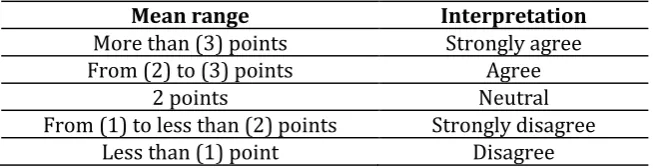
Cronbach's Alpha is (0.72) and this indicates the questionnaire items are highly reliable. The statistical method needed for the questionnaire analysis was carried out through the Statistical Package for Social Sciences (SPSS) program. The researcher used the paired-samples (t) test procedure to analyze students' responses. A table of norms on which the respondents' decision made, is as follows:
Table 3. Five-point Likert Scale range
Mean range Interpretation
More than (3) points Strongly agree From (2) to (3) points Agree
2 points Neutral From (1) to less than (2) points Strongly disagree
Less than (1) point Disagree
RESULTS
the differences among the values of the two variables in each case and tests whether the averages differ from each other. This helps in giving judgments on each response separately.
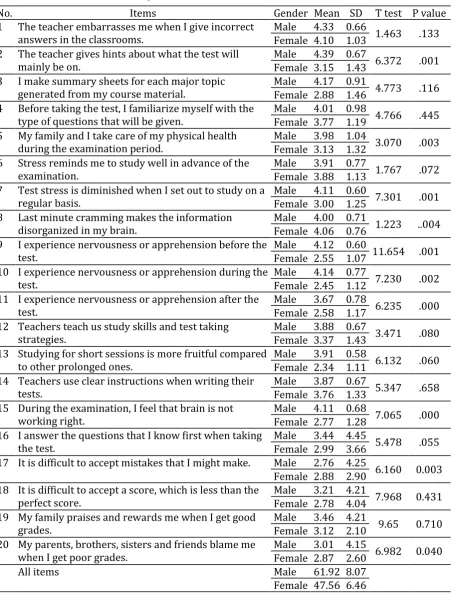
Table 4. Descriptive Statistics of the Students Questionnaire
No. Items Gender Mean SD T test P value 1 The teacher embarrasses me when I give incorrect
answers in the classrooms.
Male 4.33 0.66
1.463 .133 Female 4.10 1.03
2 The teacher gives hints about what the test will mainly be on.
Male 4.39 0.67 6.372 .001 Female 3.15 1.43
3 I make summary sheets for each major topic
generated from my course material. Male Female 2.88 1.46 4.17 0.91 4.773 .116 4 Before taking the test, I familiarize myself with the
type of questions that will be given.
Male 4.01 0.98 4.766 .445 Female 3.77 1.19
5 My family and I take care of my physical health
during the examination period. Male Female 3.13 1.32 3.98 1.04 3.070 .003 6 Stress reminds me to study well in advance of the
examination. Male Female 3.88 1.13 3.91 0.77 1.767 .072 7 Test stress is diminished when I set out to study on a
regular basis. Male Female 3.00 1.25 4.11 0.60 7.301 .001 8 Last minute cramming makes the information
disorganized in my brain. Male Female 4.06 0.76 4.00 0.71 1.223 ..004 9 I experience nervousness or apprehension before the
test. Male Female 2.55 1.07 4.12 0.60 11.654 .001 10 I experience nervousness or apprehension during the
test. Male Female 2.45 1.12 4.14 0.77 7.230 .002 11 I experience nervousness or apprehension after the
test. Male Female 2.58 1.17 3.67 0.78 6.235 .000 12 Teachers teach us study skills and test taking
strategies. Male Female 3.37 1.43 3.88 0.67 3.471 .080 13 Studying for short sessions is more fruitful compared
to other prolonged ones. Male Female 2.34 1.11 3.91 0.58 6.132 .060 14 Teachers use clear instructions when writing their
tests. Male Female 3.76 1.33 3.87 0.67 5.347 .658 15 During the examination, I feel that brain is not
working right. Male Female 2.77 1.28 4.11 0.68 7.065 .000 16 I answer the questions that I know first when taking
the test.
Male 3.44 4.45
5.478 .055 Female 2.99 3.66
17 It is difficult to accept mistakes that I might make. Male 2.76 4.25
6.160 0.003 Female 2.88 2.90
18 It is difficult to accept a score, which is less than the perfect score.
Male 3.21 4.21
7.968 0.431 Female 2.78 4.04
19 My family praises and rewards me when I get good grades.
Male 3.46 4.21
9.65 0.710 Female 3.12 2.10
20 My parents, brothers, sisters and friends blame me when I get poor grades.
Male 3.01 4.15 6.982 0.040 Female 2.87 2.60
All items Male 61.92 8.07
Female 47.56 6.46
less or more than (0.05). The questionnaire statements are analyzed statistically as follows:
In statement (1), the means are (4.33) and (4.10) for males and females correspondingly, and the p-value is (0.133) which is greater than (0.05). This indicates that instructors do not embarrass the students when they give incorrect answers. In the second statement, the means are (4.39) and (3.15) and the p-value is (0.001) which is a lesser amount of (0.05). This emphasizes that tutors give some hints about what the test will mainly be on.
The third statement has a mean of (4.17) for the male students and (2.88) for the females. Furthermore, it has the p-value of (0.116) which is more than (0.05). This indicates that students do not make summary sheets for major topics generated from their course material.
In the fourth statement, the means of males is (4.01) and of females is (2.88). The p-value is (0.445) which is greater than (0.05). This explains that students do not familiarize themselves with the type of questions that will be given before taking the test.
In statement (5), the means are (3.98) and (3.13) for males and females correspondingly and the p-value is (0.003) which is as less as (0.05). This emphasizes that families take care of their sons and daughters' physical health during the examinations period.
Statement (6) has mean of (3.91) male students and (3.88) for female students. The p-value is (0.072) which is more than (0.05). This reflects that stress does not promote students to study well in advance of the examinations.
In statement (7), the mean of male students is (4.01) and of female students is (3.00). The p-value is (0.001) which is fewer than (0.05). This explains that students have less test stress when they set out to study on a regular basis.
The two means in statement (8) are (4.00) and (4.06) for males and females respectively. The p-value is (, 004) which is less than (, 05). This indicates that last minute cramming makes the information disorganized in their brains.
In statement (9), the mean of male students is (4.12) and of female pupils is (2.55). The p-value is (0.001) which is less than (0.05). This reflects that students experience nervousness or apprehension before the test.
Statement (10) includes two means, the male students mean is (4.14) and the female students is (2.45). The p-value is (0.002) which is less than (0.05). This explains that students experience nervousness or apprehension during the test.
Statement (11) presents two means: one of them is the male students mean that is (3.67) and the other is of the female students, which is (2.58). The p-value is (0.000) which is less than (0.05). This explains that students experience nervousness or apprehension after the test.
The mean of male students in statement (13) is (3.91) and of the female students is (2.34). The p-value is (0.060) which is greater than (0.05). This means that students consider periods of short study are more productive than the lengthy one.
Statement (14) shows two close means. The males mean is (3.87) and the females’ one is (3.76). The p-value is (0.658) which is greater than (0.05). This emphasizes that teachers do not use clear instructions when they write tests.
In statement (15), the mean of the male students mean is (4.11) and of the female students is (2.77). The p-value is (0.000) which is less than (0.05). This indicates that during the examination students feel their brains are not working right.
Statement (16) has males mean of (3.44) and females mean of (2.99). The p-value is (0.155) which is greater than (0.05). This emphasizes that students do not answer the questions that they know first when they take tests.
Statement (17) recorded a mean of (2.76) for males and (2.88) for females. The p-value is (0.003) which is less than (0.05). This indicates that it is difficult for students to accept the mistakes they make when taking tests.
Having analyzed the data provided in statement (18), it could be noticed that male students have mean of (3.21) and of female students of (2.78). The p-value is (0.431) which is greater than (0.05). Due to these statistics, it seems that students do not accept a score that is less than the perfect score.
According to the statistics of statement (19), the male students have mean of (3.46) and the female students have mean of (3.12). The p-value is (0.710) which is greater than (0.05). This emphasizes that families do not praise and reward their sons and daughters when they get good grades.
Based on the descriptive statistics of statement (20), the male students have mean of (3.01) and the female students have mean of (2.87). The p-value is (0.040) which is less than (0.05). This implies that students' parents, brothers, sisters and friends blame them when they get poor grades.
Testing the Hypotheses
The hypotheses of this study were tested by using the paired-sample (t) (test) method. The level of significance was at (0.05). If the P-value was a smaller amount of (0.05), then there was a substantial difference, and if the P-value was greater than (0.05), then there was no substantial difference. This procedure is to reject or accept the hypotheses.
1- Students' test reduced when they studied earlier and more regularly.
In table (4.1) statement (7) shows that the mean of male students is (4.01) and of female students is (3.00). The p-value is (0.001) which is less than (0.05). This explains that students have less test stress particularly when they set out to study on a regular basis. These results indicate the acceptance of this hypothesis.
2- Teachers taught their students study skills and strategies of test taking.
than (0.05). This indicates that teachers do not teach their students study skills and strategies of test taking. Based on the p-value, this hypothesis is rejected.
3- Families took care of their sons and daughters during their examinations.
Reviewing the information in table (4.1), in particular statement (5) the means are (3.98) and (3.13) for males and females correspondingly and the p-value is (0.003) which is less than (0.05). This emphasizes that families take care of their sons and daughters' physical health during the examinations period. According to these results, this hypothesis is accepted.
4- Last minute cramming made the students more stressful.
The two means in statement (8), table (4.1) are (4.00) and (4.06) for males and females respectively. The p-value is (.004) which is less than (.05). This indicates that last minute cramming makes the information disorganized in their brains. These results reflect the correctness of this hypothesis.
CONCLUSION
This study investigates the causes of test stress. The main reason for conducting this study is the practical need for such a research in this field. The results of the students' questionnaires reveal that teachers familiarize their students with the format of the test that they will take. Although the findings of the current study indicated that the male and female participants do not demonstrate the proper test-taking skills required to guarantee satisfying achievement levels. It seems that families rarely praise and reward their sons and daughters when they get good grades. In addition to students do not make summary sheets for major topics generated from their course material in order to prepare themselves well for the test. In fact, students who are obsessed by the test-taking stress do not essentially have test-stress, rather they have the feeling of being stressed because of being afraid of not being well-prepared for a test. It is noticed that students ascribe their test-taking stress to the low scores they score on tests. Moreover, it could be said that these students do not possess the appropriate study skills. On the contrary, students who are well-prepared and comprehend any test related material will not suffer of test stress. It is also noted that last minute studying does not only increase students' stress but also prevents them recalling information they just learned. Moreover, it is observed that one of the most persistent difficulties students come across while attempting subjective tests is that they often do not have enough time to answer all of the questions, thus leaving some questions unattempted. It could be concluded that there are no significant differences in test stress according to the learners’ gender variable. Students may score low grades on a test because of the fact that they have not thoroughly read the instructions of a test.
Based on the results the study obtained, the researcher adds and recommends the following:
Preparation for test requires knowing how many and what types of tests will be administered, when they will take place, and the criteria that will be used to assess their performance. This will help them reduce their test stress.
Teachers need to encourage students to plan ahead, scheduling review periods well in advance, keeping them short and doing them often. If students set a semesterly-based study plan and follow it regularly, they need only to review for exams rather than study the whole exam material.
Another way that teachers can help empower students in test-taking skills is to help them form study groups. One of the major advantages of study groups is that members share academic goal and provide support and encouragement for one another, When forming study groups, it is recommended that 5-6 dedicated students get together initially to discuss common goals and procedures, (Coombe, C. and N. Hubley, 1998). The material to be reviewed should be decided upon in advance so that group members can come prepared.
Teachers can work with their students to develop appropriate review tools such as outlines, flashcards and summaries that the latter would use in their out-of-class study sessions. This, therefore, helps students sort out, summarize and recall information and exam material properly and reasonably. A study checklist—of the most significant and related information students need to know about the exam—is one of most useful tools. As students begin reviewing, they can cross off items they have covered as they review them. An added advantage is that teachers can use this document as a reminder of the materials they need to include on a test. Thus, it is recommended that students should develop the habit of reviewing the lecture materials on a daily basis to be fully aware of the materials and avoid spending more time on studying new materials from the scratch.
The idea of "studying" from past exams is a controversial area in test preparation. In some cultures, students see this as an opportunity to memorize past exam content for use on later exams. Some teachers are not in favour of this because many of them want to reuse exams verbatim year after year. However, if teachers are doing their jobs, past exams are revised and improved upon after administration, so this practice tests, students will conceive what is to be done on the day of the exam. Besides, students will also realize the grade value for each of the test section. This information can help students plan their study time effectively. An additional advantage of this practice is that by becoming familiar with what the test 'look like', stress surrounding the test will decrease. Providing students with sample questions from past exam is beneficial to them.
Teachers need to be proactive in certain areas as to better prepare their students for tests. A combination of content knowledge plus the use of appropriate test-taking skills is effective combination for successful test taking.
noteworthy entries or ideas in questions and eliminating wrong choices (Dodeen & Abdelmabood, 2005). Nevertheless, it does not mean that such strategies could be a good substitute of knowing the whole materials or preparing for the test, rather it means that maintaining such strategies and implementing such skills help students do well on tests, score high grades on a test. More significantly, one of the most remarkable test-taking tactics is that one knows how to prepare and study well for a test. They also help students score high grades on tests using test conditions, time and effort effectively. The fact that using such tactics and competencies reduces test stress and improves students' attitudes toward tests, which result in increased scores.
The findings of this study imply that instructors and educators tend to help their students develop a better understanding of the importance of test-taking strategies. Furthermore, teacher’s orientation programs on exams’ preparation should highly consider various teaching methods that senior instructors can use to not only boost students’ testing competencies but also reduce their stress in the process of assessment.
REFERENCES
Albanomey, A. (2002). The effects of texts' authenticity on reading comprehension authenticity on reading-comprehension test- taking strategies used by adult Saudi learners of English as a foreign language (Unpublished doctoral dissertation), Arizona State University, Arizona, USA.
Al Fraidan, A., & Al-Khalaf, K. (2012). Test-taking strategies of Arab EFL learners on multiple choice tests. International Education Studies, 5(4), 80-85.
Brodsky, M. (2004). Preparing for tests. Retrieved from www.mth.msu.edu/mccarthy/ student.information/testprep.html
Budd, B. (2002). Reducing Exam Anxiety and Improving Concentration. Retrieved from http:// www. Yorku. Ca/cdc//lSp/ep/exam6.htm
Carraway, C. (1987). Determining the relationship of nursing test scores and test-anxiety levels before and after a test-taking strategies seminar. Retrieved from https://eric.ed.gov/?id=ED318498
Casbarro, J. (2005). Test anxiety & what you can do about it. In A Practical Guide for Teachers, Parents, and Kids. U.S.A: National Professional Resources.
Chargar, E. (2002). Test anxiety. Retrieved from http:// www.umr.edu/~cousel/test. Chen, Y. (2005). Barriers to acquiring listening strategies for EFL learners and their
Pedagogical implications. TESL-EJ,8(4), 125.
Cohen, A. D. (2000). Exploring strategies in test-taking: Fine tuning verbal reports from respondents. In G. Ekbatani & H. Pierson (Eds.), Learner- directed assessment in ELSL (pp. 127-150). Mahurah, NJ: Lawrence Erlbaum.
Coombe, C., & N. Hubley. (1988). Empowering students in test-taking strategies. Paper
presented at TESOL Arabia Conference, Alin, UAE.
Dodeen H & Abdelmabood H (2005). The effect of teaching test-taking strategies on university students' performance, test anxiety, and attitudes towards tests. In P Davidson, C. Coombe, & W Jones (eds). Assessment in the Arab World. Dubai, UAE: TESOL Arabia.
Evans, L. (1995). Helping your child manage test anxiety. NYU Child Studies, 1 (17). Fieber, S. (2001). Test anxiety. Retrieved from http:// www. Counseling. Uci.
Edu/counsel/testanx.html
Gall, M., & J. Gall (1993). Making the Grade. Rockin, CA: Prime Publishing.
Gallagher, A. (1992). Sex differences in problem-solving strategies used by
high-scoring examinees on SAT. Retrieved from
http://journals.sagepub.com/doi/abs/10.1177/001698620104500405
Krivoshik, L. (2003). Taking Essays Tests. Retrieved from http://www.uncc.edu/univlern/webmodules/esaytst 2b.html
Lane, P. (2001, August 31). How to take tests? A three-step approach. Khaleej Times
Weekend, p.6.
Liu, O. (2004a). Investigating the relationship between test preparation and TOEFL iBT performance. Retrieved from Educational Testing Service: http://onlinelibrary.wiley.com/doi/10.1002/ets2.12016/epdf.
Liu, O. (2004b). Test Anxiety: Overcoming test anxiety. Retrieved from http:// www.uic.edu/depts/counseletr/ace/testanxiety.htm
Loulou, D. (1995). Making the A: How to study for tests. ERIC / AE Digest Series. Retrieved from http://www.campus.cua.edu/www/eric_ae/digests/tm9510.htm Ma, J. (2003). Test preparation for high-stakes English language tests in China.
Retrieved from
http://educ.queensu.ca/sites/webpublish.queensu.ca.educwww/files/files/Rese arch/Test%20Preparation%20Newsletter%20Volume%205.pdf
Militana, E. (2003). Coping with test anxiety. Retrieved from http://www.iss.stthomas.edu/studyguides/tstprp8.htm
Milnamow, K. (2001). Relieving Test Anxiety. Retrieved from http://www.mxctc.commnet.edu/clc/testanxy.htm
Nolting, P.D. (2000). Your Guide to Reducing Test Anxiety and Improving Study Strategies.Boston: USA. Houghton Mifflin Company.
Peng, Y. 2005. Test preparation strategies and test taking strategies use in Chinese high school students (Unpublished doctoral dissertation), University of Nevada, Las Vegas, USA.
Perney, J., & Ravid, R. (1990). The relationship between attitudes towards statistics, math self-concept, test anxiety, and graduate students achievement in an introductory statistics course. Retrieved from http://eric.ed.gov/?id=ED318607. Sweetnam, K. R. (2000). Test taking strategies and students achievement. Retrieved
from http//www.cloquet.k12.us/chu/class/fourth/ks/strategies.htm
Sweetnam, K.R. (2002). Test taking strategies and student achievement. Cloquet, Minnesota, USA: Running Head.
Vattanapath, R. & Jaiprayoon, K. (1999). An assessment of the effectiveness of teaching test-taking strategies for multiple-choice English reading comprehension tests.
Occasional Papers, 8: 57-71.