Vol. 2, N 2, 2014, pp. 181194
UDC 811.111‟276.6:379.85
DEVELOPING TEXTS FOR AN ENGLISH FOR TOURISM
COURSE: THE EFFECT OF USING TASK-CYCLING, SPACED
RETRIEVAL AND HIGH-FREQUENCY WORDS ON STUDENTS’
SELF-PERCEPTIONS OF ABILITY AND LEVELS OF
CONFIDENCE
James Bury
Shumei University, Department of Tourism and Business Management, Japan E-Mail: [email protected]
Abstract. Texts used in traditional reading courses often contain complicated grammatical structures and academic lexical items. Exposing students to high level texts can aid language acquisition, but if the text is too complex, students can become overwhelmed and demotivated. To address this, texts and activities used in an undergraduate English for Tourism course were developed based on frequency lists and applying the principles of the modified natural approach (Byrnes 2006), task-cycling (Skehan 1998; Levy and Kennedy 2004) and spaced retrieval (Karpicke and Roediger 2007). This article reports on enrolled students’ perceptions of ability and levels of confidence.
Key words: course development, English for Tourism, students’ perceptions of ability, student confidence
1.INTRODUCTION
When teaching reading courses, instructors often use texts rich in complex grammatical structures and context-specific lexical items. This is especially true in English for specific purposes courses as teachers regularly use authentic materials. Exposing students to texts that are too complex and challenging can be overwhelming and demotivating (Huang and Liou 2007; Murphy 2007). A common classroom response is for students to translate texts word by word, which is time consuming, can lead to misinterpretation and does not develop other important reading skills, such as reading for general meaning and gist.
To address this, a new English for Tourism course was developed, designed, tested and taught to students enrolled in the Tourism and Business Management Faculty at a university in the Kanto region of Japan. The course had no pre-requisites and was opened as an elective to students from all four year groups. While the course aimed to develop students‟ overall English abilities, large parts of each lesson were dedicated to reading texts that supplied learners with information on various aspects of the tourism industry.
In developing the course, there were a number of considerations that needed to be taken into account:
1. How can students be helped to cope with the large amount of new structures and lexical items in a text that is written in another language?
2. How can texts and activities best be used to improve students‟ short-term and long-term retention of context-specific lexical items?
3. How can texts be used in a course to help develop communicative competence?
This article reports on research undertaken in response to the above considerations. Data gathered from questionnaires conducted before and after the course was delivered is reported on and discussed, addressing the following research questions:
1. Will completion of the course help improve students‟ perceptions of their reading abilities and levels of confidence in reading English?
2. Will completion of the course help improve students‟ perceptions of their speaking abilities and levels of confidence in speaking English?
3. Will completion of the course help improve students‟ perceptions of their knowledge of tourism specific vocabulary and levels of confidence in using these lexical items?
4. Will completion of the course help improve students‟ perceptions of their communicative competence and levels of confidence in communicating in English?
2.LITERATURE REVIEW
Texts used in traditional reading courses often contain complicated grammatical structures and some uncommon, academic lexical items. As a result, students are exposed to new, more advanced language and this can aid language acquisition, as in Krashen‟s (1981) theory of comprehensible input. However, a learner with no previous knowledge of the target language can quickly get lost and, therefore, lose motivation, raising their affective filters (ibid.). Research on reading courses (Huang and Liou 2007; Murphy 2007) has shown that students often become overwhelmed with the difficulty of the texts they encounter in class, which can be detrimental to the learning process (Fulcher 1997).
English for specific purposes classes focus on one particular context, and because of this, there is often a lack of accessible material. Consequently, teachers frequently employ authentic materials. However, the complexity of these materials can accentuate and intensify the challenges students face. To address this, materials need to be altered and modified, described as the streamlined natural approach (Byrnes 2006).
When reading complex tests, a large number of students translate passages word by word using their dictionaries (Schuetze 2010) and translation, especially when conducted on mobile phones, which is accessible and engaging for students (Corris et al. 2004). However, Schuetze (2010) states that developing students‟ reading strategies and their approaches to deciphering a text by introducing and expanding their techniques other than translation can help to consolidate meaning and avoid misinterpretation. Over-reliance on any one reading strategy should be avoided.
different pedagogical goals. In asynchronous, pre-planned communicative activities students have more time to focus on accuracy and this can significantly affect the language produced (Skehan and Foster 2001). In synchronous activities students focus more on meaning, developing communication strategies (Skehan 1998).
Huang and Liou (2007) state that targeted vocabulary instruction is essential in improving students‟ retention of lexical items. When reading, students must comprehend and interpret words and sentences with multiple possible meanings. Focusing on lexical items that have been chosen from high-frequency word lists is likely to help students‟ comprehension as they commonly appear in different contexts, allowing multiple meanings to be conveyed. Ensuring that the target language is context specific and relevant to students‟ interests and needs is also of particular importance (McAdams 1993), as relating words to students‟ own contexts and experiences strengthens their associations (Sökmen 1997) and can improve short and long term language retention.
Giving students the chance to review and use newly encountered lexical items in varying contexts is also of great importance as it increases the likelihood of the items being recalled at a later point (Schmitt 2000). Furthermore, if lexical items are successfully employed and then reviewed, the retrieval routes that students employ when encountering them again are reinforced (Baddeley 1997). As a result, the increased exposure to the lexical items gained through reviewing vocabulary allows students to consolidate meaning (Schmitt and Carter 2000). Additionally, using basic grammatical structures as entry points into a text before moving on to more complex structures helping students develop the building blocks needed to deal with longer reading passages.
When teaching English for Tourism, the focus on communicative competence (Canale and Swain 1980) and intercultural communication (Alred et al. 2003) is especially pertinent. Learners face many challenges when dealing with the processes of communication, interpreting differences in cultures and constructing meaningful messages in the target language, and developing students‟ abilities in these areas must be emphasized (Byram and Buttjes 1991). Students are constantly being challenged in relation to their comprehension of and beliefs about the target language and culture (Risager 2006) as well as their perceptions of their own abilities and levels of confidence, and courses should reflect this.
Self-perceptions are the impressions a person has relating to their own abilities in different domains or contexts (Harter 1999). As such, they are a critical component of self-esteem (Bong and Skaalvik 2003) and play an important role in the development of self-regulation, reading ability (Harter and Whitesell 2003) and the way people approach communication (Nezlek et al. 2008), with self-esteem affecting willingness to engage in communication (Pearson et al. 2011).
3.COURSE DEVELOPMENT
and a focus on meaning to occur. Tasks that encouraged students to use reading strategies other than translation were also employed.
In order to aid the development of communicative competence, activities described by Ribé and Vidal (1993) as second and third generation tasks were employed. These aimed to develop communication skills in conjunction with general cognitive strategies, use the target language in a context specific to the students that has real value to them and their language learning goals, and to develop awareness and interpersonal skills in the tourism sector.
Unlike traditional reading courses, which have been regarded as non-communicative (Zhang 2009), this course was developed to expose readers to lexical items that could be used communicatively in extension activities, breaking from the more traditional reading teaching techniques that dominate university classes (Rustipa 2010). It was decided that the target lexis should be drawn from high-frequency word lists to give students the opportunity to consolidate their comprehension of sector specific lexical items, in turn developing their communicative competence in the context of the tourism industry. Exigent grammatical structures and low-frequency lexical items were avoided in order to present a balance of recycled words and structures, and newly introduced items that built on the previously covered material. This allowed the complexity of the texts to increase in a planned progression throughout the course. By developing the reading texts in this way and providing the students with positive and encouraging feedback, the course aimed to improve students‟ self-belief and perceptions of ability, which would in turn help to improve communicative competence.
The texts covered a wide range of popular tourist destinations from around the world (see Appendix A), activities that can be done there and a profile of a worker in the industry at that destination. Learners had the opportunity to read and identify the main points of the texts by applying the strategies that were presented in the activities and tasks. As a result, learners were not forced to use a dictionary as soon as they read the first sentence of a text as they had been given the necessary strategies and building blocks. This design aimed to assist learners immerse themselves in the texts and identify the main points and ideas without extensive translation, thus developing a wide range of reading strategies.
4.METHODOLOGY
To investigate students‟ perceptions of their reading abilities, speaking abilities, knowledge of tourism specific vocabulary and communicative competence, and their levels of confidence in reading English, speaking English, using tourism specific vocabulary and communicating in English, the participants completed a ten-item pre-course questionnaire at the start of the first lesson and a 19-item post-course questionnaire in the final lesson. As the cohort was fairly small, every student received a questionnaire to ensure that all opinions could be voiced, making the data more representative. Twenty one students enrolled on the course and completed the first questionnaire. One student was absent from the final lesson and one student had dropped out, giving a return of 19 post-course questionnaires.
All the data collected was anonymous, the purpose of the research was explained to the students and it was clearly stated that their participation was voluntary. Class averages will be presented as analysis of the individual participants‟ results could not be conducted due to anonymity. Once the research was completed a short, translated report was made available to all of the participants.
5.RESULTS
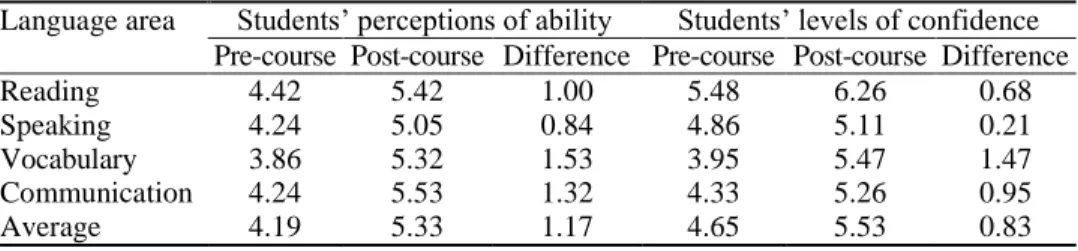
Table 1 Students‟ perceptions of their abilities and levels of confidence in various language areas
Language area Students‟ perceptions of ability Students‟ levels of confidence Pre-course Post-course Difference Pre-course Post-course Difference
Reading 4.42 5.42 1.00 5.48 6.26 0.68
Speaking 4.24 5.05 0.84 4.86 5.11 0.21
Vocabulary 3.86 5.32 1.53 3.95 5.47 1.47 Communication 4.24 5.53 1.32 4.33 5.26 0.95
Average 4.19 5.33 1.17 4.65 5.53 0.83
Table 1 shows that all of the language areas in both students‟ perceptions of their abilities and levels of confidence in the various language areas improved by overall averages of 1.17 and 0.83. It can also be seen that the lowest post-course average score is greater than the highest pre-course score, with the exception of the data relating to students‟ levels of confidence in Reading, which had a relatively high pre-course average.
The data also indicates that, in both perceptions of ability and levels of confidence, the language area with the biggest improvement was Vocabulary, followed by Communication, Reading and Speaking. Students‟ levels of confidence were higher than their perceptions of ability in all language areas, except for post-course Communication, which had an average of 5.53 in perceptions of ability and 5.26 in levels of confidence. Overall, students‟ perceptions of ability improved more than their levels of confidence and this is true in all of the language areas except Vocabulary.
Table 2 Ranking of language areas by students‟ perceptions of ability and levels of confidence
Students‟ perceptions of ability Tableheading Students‟ levels of confidence Pre-course Post-course Pre-course Post-course 1. Reading (4.42) 1. Communication
(5.53)
1. Reading (5.48) 1. Reading (6.26)
2. Speaking and communication (4.24)
2. Reading (5.42) 2. Speaking (4.86) 2. Vocabulary (5.47) 3. Vocabulary (5.33) 3. Communication
(4.33)
3. Communication (5.26)
4. Vocabulary (3.86) 4. Speaking (5.05) 4. Vocabulary (3.95) 4. Speaking (5.11)
pre-course and post-pre-course questionnaires. Both pre-pre-course rankings were very similar, but the post-course rankings differed, especially for students‟ perceptions of ability.
In regards to students‟ perceptions of ability, the pre-course data shows the ranking to be Reading, Speaking and Communication, and Vocabulary. The post-course data identifies the ranking as Communication, Reading, Vocabulary and Speaking. Therefore, even though Vocabulary showed the greatest improvement in terms of students‟ perceptions of ability, it still ranked third, behind Communication and Reading.
In terms of students‟ levels of confidence, the rankings of language areas in the pre-course and post-pre-course questionnaires were Reading, Speaking, Communication and Vocabulary, and Reading, Vocabulary, Communication and Speaking respectively. The rise to second for the vocabulary category and the drop to fourth for the speaking category reflect the differences in improvement highlighted in Table 1.
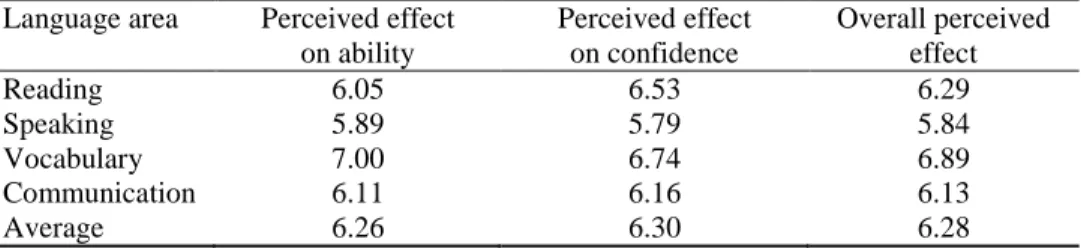
Table 3 Perceived effect of the course on ability and confidence
Language area Perceived effect on ability
Perceived effect on confidence
Overall perceived effect
Reading 6.05 6.53 6.29
Speaking 5.89 5.79 5.84
Vocabulary 7.00 6.74 6.89
Communication 6.11 6.16 6.13
Average 6.26 6.30 6.28
Table 3 shows that the students believed the course had a positive effect on all of the language areas, both in terms of their perceived levels of ability and levels of confidence. It can be seen that there was a slightly more positive perceived effect on confidence (6.30) than ability (6.26). In regards to perceived effect on ability, the data shows that the language area with the greatest perceived improvement was Vocabulary, followed by Communication, Reading and Speaking. This is the same ranking as the students‟ perceptions of improvement in ability and levels of confidence. In relation to perceived effect on confidence, the ranking differs slightly, with the greatest perceived improvement being in Vocabulary, then Reading, Communication and Speaking. In all of the language areas the students‟ perceived effect of the course on confidence was greater than its effect on ability, with the exception of Vocabulary. This supports the finding that students‟ perceptions of ability improved more than their levels of confidence.
Table 4 Perceived effect of the course on ability and levels of confidence vs. students‟ post-course evaluations of ability and levels of confidence
Language area Perceptions of ability Levels of confidence Post-course
evaluation
Perceived affect
Difference Post-course evaluation
Perceived affect
Difference
Reading 5.48 6.05 0.57 6.19 6.53 0.34
Speaking 5.10 5.89 0.79 5.14 5.79 0.65
Vocabulary 5.33 7.00 1.67 5.48 6.74 1.26 Communication 5.52 6.11 0.59 5.28 6.16 1.17
Table 4 shows that, in terms of both perceptions of ability and levels of confidence, the effect the students believed the course to have was greater than the results relating to students‟ perceived ability and levels of confidence gained from the post-course evaluation. In regards to ability, the average difference was 0.90 and in terms of levels of confidence the average difference was 0.78.
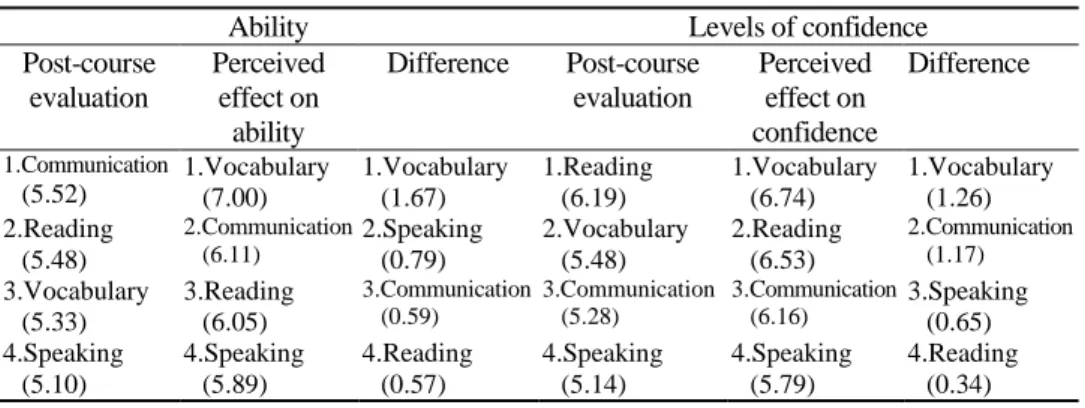
Table 5 Ranking of language areas by students‟ post-course perceptions of ability and levels of confidence vs. perceived effect of the course
Ability Levels of confidence
Post-course evaluation
Perceived effect on
ability
Difference Post-course evaluation Perceived effect on confidence Difference 1.Communication (5.52) 1.Vocabulary (7.00) 1.Vocabulary (1.67) 1.Reading
(6.19) 1.Vocabulary (6.74)
1.Vocabulary (1.26) 2.Reading (5.48) 2.Communication (6.11) 2.Speaking (0.79) 2.Vocabulary
(5.48) 2.Reading (6.53)
2.Communication (1.17) 3.Vocabulary (5.33) 3.Reading (6.05) 3.Communication (0.59) 3.Communication
(5.28) 3.Communication (6.16)
3.Speaking (0.65) 4.Speaking (5.10) 4.Speaking (5.89) 4.Reading (0.57) 4.Speaking
(5.14) 4.Speaking (5.79)
4.Reading (0.34)
Table 5 shows that while students ranked the language areas most positively affected by the course as Vocabulary, Communication, Reading and Speaking for perceptions of ability and Vocabulary, Reading, Communication and Speaking for levels of confidence, the greatest differences between their post-course self-evaluations and their perceived effect of the course were in Vocabulary, Speaking, Communication and Reading for ability and Vocabulary, Communication, Speaking and Reading for confidence.
Responses to Item 2 on the post-course questionnaire „„How much do you agree with the statement - I would recommend joining the course to my friends?‟‟ produced an overall positive response of 6.79, with a mode of 7. In relation to this item, six comments were made. Two said the course was good for helping them attain their future employment goals, one said that it was good to study about tourism, one said the course was interesting, one said that the topics were good and one said that the course was too difficult. That half of the comments made in response to this item were related to tourism and future employment reflects the reasons given for joining the course in Item 1 on the post-course questionnaire as 68.42% of the responses to Item 1 mentioned future employment goals in the tourism industry. Other reasons given in response to Item 1 were, „English is important in society‟, „Passing Eiken grade 2‟ and „I wanted to speak English‟.
6. CONCLUSION
The language area that was most improved was the category relating to tourism specific vocabulary. This implies that the implementation of spaced retrieval, task-cycling and the modifying of texts to include target lexis drawn from high-frequency word lists was successful in helping improve students‟ perceptions of ability and levels of confidence in using specialized lexis in this context.
The language area that showed the second highest improvement was Communication. This suggests that the decision to depart from a traditional, non-communicative reading course to one that exposes students to high-frequency lexical items that can be used in extension activities to develop communicative competence had positive results. This is supported by the improvement in students‟ perceptions of ability and levels of confidence in Speaking. This finding also suggests that the planned development in the complexity of the texts helped to improve students‟ self-perceptions, which had a constructive effect on the way they felt about and approached communicating in English.
The improvement in students‟ perceptions of ability and levels of confidence in Reading implies that modifying authentic texts so that they were more accessible and relevant, and encouraging students to develop different reading strategies through task-cycling and reviewing lexical items through spaced retrieval was a success. The decision to avoid complicated grammatical structures and low-frequency lexical items when designing the course may also have contributed to these results.
The findings of this research show an improvement in students‟ perceptions of ability and confidence in four language areas, and the English for Tourism course introduced in this article had a direct impact on these results, indicating positive results in relation to the four research questions outlined. However, the course was not studied in isolation and other external factors that the students were exposed to, including both formal and informal learning, may have affected the findings outlined above (Erstad et al. 2009; Furlong and Davies 2012). Consequently, while the materials studied throughout this course impacted on students‟ perceptions of ability and confidence, the level of its bearing on the outcomes presented is difficult to calculate.
To address this, the effect the students‟ believed the course to have had on their perceptions of ability and levels of confidence was investigated. The results show that students believe this English for Tourism course had a positive effect on all of the language areas investigated in both terms of ability and confidence. This supports the findings that the course was successful and positively contributed to developing students‟ abilities and levels of confidence in reading, speaking, using tourism specific vocabulary and communicative competence.
The students‟ perceived effect of the course was greater than their perceptions of improvements in ability and levels of confidence in the post-course self-evaluations in all language areas, both in perceptions of ability and levels of confidence. This further strengthens the claim that this course helped the students‟ development in the four language areas investigated. The positive perceived effect of the course is also corroborated by the positive feedback and the constructive comments that students made in relation to item 2 on the post-course questionnaire.
that exposing students to high-frequency lexical items and reviewing them in a communicative way in extension activities had positive results.
REFERENCES
Alred, G., Byram, M., and Fleming, M. Intercultural experience and education. Clevedon: Multilingual Matters, 2003.
Baddeley, A. Human Memory: Theory and Practice (Revised edition). Hove: Psychology Press, 1997.
Bong, M. and Skaalvik, E. M. “Academic Self-Concept and Self-Efficacy: How Different Are They Really?” Educational Psychology Review 15 (1):1-40. 2003.
Byram, M., and Buttjes, D. Mediating languages and cultures: Towards an intercultural theory of foreign language education. Clevedon: Multilingual Matters eds. 1991. Byrnes, H. Advanced language learning. London: Continuum, 2006.
Canale, M. and Swain, M. “Theoretical bases of communicative approaches to second language teaching and testing.” Applied Linguistics 1:1-47. 1980.
Corris, M., Manning, C., Poetsch, S. and Simpson, J. “How Useful And Usable Are Dictionaries For Speakers of Australian Indigenous Languages?” International Journal of Lexicography 17:33-68. 2004.
Erstad, O., Gilje, Ø., Sefton-Green, J. and Vasbo, K. “Exploring „learning lives‟: community, identity, literacy and meaning.” Literacy 43 (2):100-116. 2009.
Furlong, J. and Davies, C. “Young people, new technologies and learning at home: taking context seriously.” Oxford Review of Education 38 (1):45-62. 2012.
Fulcher, G. “Text difficulty and accessibility: Reading formulae and expert judgement.” System 25 (4):497-513. 1997.
Harter, S. The construction of the self: A developmental perspective. New York: Guilford Press. 1999.
Harter, S. and Whitesell, N. R. “Beyond the debate: Why some adolescents report stable selfworth over time and situation, whereas others report changes in self-worth.” Journal of Personality 71:1027-1058. 2003.
Huang, H-T. and Liou, H-C. “Vocabulary learning in an automated graded reading program.” Language Learning & Technology 11 (3):64-82. 2007.
Karpicke, J. and Roediger, H. “Expanding retrieval practice promotes short-term retention, but equally spaced retrieval enhances long-term retention.” Journal of Experimental Psychology. Learning, Memory, and Cognition 33 (4):704-719. 2007. Krashen, S. Second language acquisition and second language learning. Oxford:
Pergamon. 1981.
Levy, M., & Kennedy, C. “A Task-cycling pedagogy using stimulated reflection and audio-conferencing in foreign language learning.” Language Learning & Technology 8 (2):50-68. 2004.
McAdams, K. C. “Readability reconsidered: a study of reader reaction to fog indexes.”
Newspaper Research Journal 14:50-59. 1993.
Murphy, P. “Reading comprehension exercises online: The effects of feedback, proficiency and interaction.” Language Learning & Technology 11 (3):107-29. 2007.
Pearson, J. C., Nelson, P. E., Titsworth, S. and Harter, L. Human Communication. New York: McGraw-Hill, 2011.
Ribé, R. and Vidal, N. Project Work Step by Step. Oxford: Heinemann International, 1993. Risager, K. Language and culture. Clevedon: Multilingual Matters, 2006.
Rustipa, K. “Teaching Communicative Reading.” Ragam Jurnal Pengembangan
Humaniora 10 (3):125-130. 2010.
Scheutze, U. “Spiral Learning: An Introductory Course on Reading Lote Online.” Journal of Language Design 4 (1):24-31. 2010.
Schmitt, N. Vocabulary in Language Teaching. Cambridge: Cambridge University Press, 2000.
Skehan, P. The cognitive approach to language learning. Oxford: Oxford University Press, 1998.
Skehan, P. and Foster, P. “Cognition and tasks”. In Cognition and Second Language Instruction edited by P. Robinson, 183–205. Cambridge: Cambridge University Press. 2001.
Sökmen, A. “Current trends in teaching second language vocabulary”. Vocabulary:
Description, acquisition and pedagogy, edited by N. Schmitt and M. Michael,
237-257. Cambridge: Cambridge University Press. 1997.
Sotillo, S. M. “Discourse functions and syntactic complexity in synchronous and asynchronous communication.” Language Learning & Technology 4 (1):82-119. 2000.
www.wordfrequency.info www.wordandphrase.info
Zhang, Y. “Reading to Speak: Integrating Oral Communication Skills.” English Teaching Forum 47 (1):32-34. 2009.
Appendix A: English for Tourism Course Contents
Tourism English I (1) Lesson themes
Lesson 1: Asia and the Pacific I – Guam, Scuba diving and the diving instructor. Lesson 2: Europe I – Finland, visiting Santa and the dog-sled driver.
Lesson 3: Africa I – Botswana, safari and the safari guide.
Lesson 4: North and Central America I – San Francisco, visiting Alkatraz and the tour guide.
Lesson 5: South America I – Peru, visiting Machu Piccu and the photographer Lesson 6: Review I
Lesson 7: Assessment I
Lesson 8: Asia and the Pacific II – India, visiting the Taj Mahal and the Bollywood director.
Lesson 9: Europe II – Italy, visiting Mount Vesuvius and the fashion buyer.
Lesson 10: Africa II – South Africa, The Cradle of Humankind and the hotel manager. Lesson 11: North and Central America II – Panama, visiting the jungle and the cruise rep. Lesson 12: South America II – Brazil, capoeira and the river boat navigator.
Appendix B: English for Tourism Course - Pre-course Questionnaire (Japanese)
1. なぜあなたは観光英語の授業を履習に参加したのですか?
_______________________________________________________________________ _______________________________________________________________________ 2. 今までに観光英語の授業を履習した事はありますか?
はい。 いいえ。 はいの人はどの授業を履習しましたか?
_______________________________________________________________________
1 - 10のスケールで (1 = 非常に悪い, 10 = 非常によい), どのように、あなたの英語力を評価しますか?
3. 英語のリーディング 1 2 3 4 5 6 7 8 9 10 4. 英語のスピーキング
1 2 3 4 5 6 7 8 9 10 5. 観光語彙についての知識
1 2 3 4 5 6 7 8 9 10
6. 英語でコミュニケーションすること 1 2 3 4 5 6 7 8 9 10
1 - 10のスケールで (1 = 非常に悪い, 10 = 非常によい), 次のカテゴリーに、どれくらい自信がありますか?
7. 英語のリーディング 1 2 3 4 5 6 7 8 9 10 8. 英語のスピーキング
1 2 3 4 5 6 7 8 9 10 9. 観光語彙を使用して
1 2 3 4 5 6 7 8 9 10
10. 英語でコミュニケーションすること 1 2 3 4 5 6 7 8 9 10
English for Tourism Course - Pre-course Questionnaire (English) 1. Why did you join this English for Tourism course?
________________________________________________________________________ ______________________________________________________________________
2. Have you studied an English for Tourism course before? Yes No
If Yes, which course?
__________________________________________
On a scale of 1 – 10 (1 = very low, 10 = very high), how would you rate your abilities in the following categories?
3. English reading.
1 2 3 4 5 6 7 8 9 10 4. English speaking.
5. Knowledge of tourism specific vocabulary. 1 2 3 4 5 6 7 8 9 10
6. Communicating in English. 1 2 3 4 5 6 7 8 9 10
On a scale of 1 – 10 (1 = very low, 10 = very high), how confident are you in the following categories?
7. Reading English
1 2 3 4 5 6 7 8 9 10 8. Speaking English.
1 2 3 4 5 6 7 8 9 10
9. Using tourism specific vocabulary. 1 2 3 4 5 6 7 8 9 10
10. Communicating in English. 1 2 3 4 5 6 7 8 9 10
Appendix C: English for Tourism Course - Post-course Questionnaire (Japanese)
1. 今までに観光英語の授業を履習した事はありますか? はい。 いいえ。 はいの人はどの授業を履習しましたか?
_______________________________________________________________________ 2.
「私は友達にこのプログラムに参加することを勧める。」にどのくらい同意しま すか?
(1= 完全に反対, 10= 完全に賛成) 1 2 3 4 5 6 7 8 9 10 説明
________________________________________________________________________ ______________________________________________________________________
1 - 10のスケールで (1 = 非常に悪い, 10 = 非常によい), どのように、あなたの英語力を評価しますか?
3. 英語のリーディング 1 2 3 4 5 6 7 8 9 10 4. 英語のスピーキング
1 2 3 4 5 6 7 8 9 10 5. 観光語彙についての知識
1 2 3 4 5 6 7 8 9 10
6. 英語でコミュニケーションすること 1 2 3 4 5 6 7 8 9 10
1 - 10のスケールで (1 = 非常に悪い, 10 = 非常によい), 次のカテゴリーに、どれくらい自信がありますか?
7. 英語のリーディング 1 2 3 4 5 6 7 8 9 10 8. 英語のスピーキング
9. 観光語彙を使用して 1 2 3 4 5 6 7 8 9 10
10. 英語でコミュニケーションすること 1 2 3 4 5 6 7 8 9 10
1 - 10のスケールで(1=完全に反対、10=完全に賛成),
このコースに加わることが次のカテゴリーの能力をどのくらい向上させ たと、思いますか?
11. 英語のリーディング 1 2 3 4 5 6 7 8 9 10 12. 英語のスピーキング
1 2 3 4 5 6 7 8 9 10 13. 観光語彙についての知識
1 2 3 4 5 6 7 8 9 10
14. 英語でコミュニケーションすること 1 2 3 4 5 6 7 8 9 10
1 - 10のスケールで(1=完全に反対、10=完全に賛成),
このコースに加わることで、あなたはどのくらい自信がもてたと思いま すか?
15. 英語のリーディング 1 2 3 4 5 6 7 8 9 10 16. 英語のスピーキング
1 2 3 4 5 6 7 8 9 10 17. 観光語彙を使用して
1 2 3 4 5 6 7 8 9 10
18. 英語でコミュニケーションすること 1 2 3 4 5 6 7 8 9 10
19. 観光英語の授業を履習改善/高める方法はありますか?
________________________________________________________________________ ________________________________________________________________________ ________________________________________________________________________ ____________________________________________________________________
English for Tourism Course - Post-course Questionnaire (English)
1. Have you studied an English for Tourism course before? Yes No
If Yes, which course?
__________________________________________
2. How much do you agree with the statement „I would recommend joining the course to my friends‟ ? (1 = disagree completely, 10 = agree completely.)
1 2 3 4 5 6 7 8 9 10 Please explain.
3. English reading.
1 2 3 4 5 6 7 8 9 10 4. English speaking.
1 2 3 4 5 6 7 8 9 10
5. Knowledge of tourism specific vocabulary. 1 2 3 4 5 6 7 8 9 10
6. Communicating in English. 1 2 3 4 5 6 7 8 9 10
On a scale of 1 – 10 (1 = very low, 10 = very high), how confident are you in the following categories?
7. Reading English
1 2 3 4 5 6 7 8 9 10 8. Speaking English.
1 2 3 4 5 6 7 8 9 10
9. Using tourism specific vocabulary. 1 2 3 4 5 6 7 8 9 10
10. Communicating in English. 1 2 3 4 5 6 7 8 9 10
On a scale of 1 – 10 (1 = Not at all, 10 = A great deal), how much do you think joining this course has improved your abilities in the following categories?
11. English reading. 1 2 3 4 5 6 7 8 9 10 12. English speaking.
1 2 3 4 5 6 7 8 9 10
13. Knowledge of tourism specific vocabulary. 1 2 3 4 5 6 7 8 9 10
14. Communicating in English. 1 2 3 4 5 6 7 8 9 10
On a scale of 1 – 10 (1 = Not at all, 10 = A great deal), how much do you think joining this course has improved your confidence in the following categories?
15. Reading English 1 2 3 4 5 6 7 8 9 10 16. Speaking English.
1 2 3 4 5 6 7 8 9 10
17. Using tourism specific vocabulary. 1 2 3 4 5 6 7 8 9 10
18. Communicating in English. 1 2 3 4 5 6 7 8 9 10