TECHNICAL UNIVERSITY OF CLUJ-NAPOCA
ACTA TECHNICA NAPOCENSIS
Series: Applied Mathematics, Mechanics, and Engineering Vol. 62, Issue I, March, 2019
ANALYSIS OF THE DYNAMIC REGIME OF FORCED VIBRATIONS
IN THE DYNAMIC COMPACTING PROCESS
WITH VIBRATING ROLLERS
Cornelia Florentina DOBRESCU
Abstract: In order to increase efficiency and work speed, in the process of dynamic compaction, mixed
compactors are used. The adjustment of the vibrations regime of the compactor roller with the travel speed, is made based on the real-time monitoring of the dynamic response. Thus, the instantaneous movement of the vibrations of the compactor rollers is captured in the form of an analog signal and then converted to digital system until the occurrence of some supra-harmonics specific to the transition of the field into the plastic field.
This article presents the dynamic scheme of a mixed self-propelled vibratory compactor. Thus, based on the dynamic analysis, it is presented the variation of machine and of technological amplitude with compactor rollers, including the force transmitted in the compaction field.
Key words: dynamic compaction, mixed self-propelled vibratory compactor
1. INTRODUCTION
For the dynamic study, there was adopted the construction and functional scheme of a 20t self-propelled mixed compactor and the maximum disturbance force of 800 kN at the frequency of 50 Hz with the amplitude of the 2 mm vibratory roller. The dynamic system can be schematized as a linear-elastic model with three degrees of freedom. The flat roto-translation movement of the chassis with all the equipment has been transformed into inertially coupled translational movements to two equivalent mass concentrations m2 and m3 placed above the leaning points of the chassis to the roller, respectively to the axles of the wheels with tires.
Based on the mass data, of rigidity and dynamic excitation, there were determined the calculation relations for amplitude and their representation in relation to the continuous variation of the excitation pulse ω in order to identify the dynamic regimes.
Compaction is a process to increase density of soil bymechanical means, which usually involves rolling, vibrating,tamping or
combination of these processes. In this process particles are rearranged by application of external force and air in the voids is expelled out. This external force is applied in the form of rolling, vibrating, tamping or combination of these processes.
In the study of the compaction process the following three categories of variables have to be considered: - parameters regarding the compacted material: initial density, granularity, material humidity etc.; machine parameters: the mass of the machine, the frequency and the amplitude of the vibrations that are generated and transmitted to the compacted material; compaction method (machine type, number of passes, speed of the vibratory compactor etc.).
2. DYNAMIC ANALYSIS
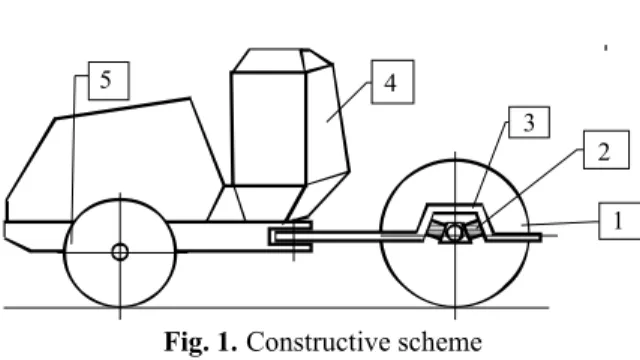
5 are located behind the machine serving only for traction. 5 4 3 2 1
Fig. 1.Constructive scheme
The dynamic scheme shapes the dynamic behavior of the compactor by mass elements m1 for the vibratory roller; m, J for the chassis of the machine with all the equipment (motor-pump group, cab, accessories) and mp for the pair of tire wheels, as well as for the k1 and k3 rigidities for the land subject to compaction and k2 for the elastic system of isolation of the vibration transmitted from the roll to the chassis.
Figure 2 shows the dynamic model of the self-propelled mixed compactor with one vibratory roller, with the following notations:
• x1 (A1) is the instantaneous movement (elongation) of the technological vibration of the vibratory roller and A1 is the amplitude of the vibrations;
• x2 (A2) - the instantaneous movement (elongation) of the vibrations transmitted to the chassis at the connection point A, and A2 is the amplitude;
• x3 (A3) - the instantaneous movement (elongation) of the vibrations transmitted to the chassis in the connection point B, which is
located on the axis of the tire wheel pairs;
• P = P(t) = m0rω2 - the vertical disruptive
force of the vibrator placed inside the roller, and m0r is the static momentum of the dynamic unbalance masses, ω is the pulse of the disruptive force;
• C - the mass center of the chassis assembly fully equipped with a hydraulic pumping group,
thermal engine, control cabin, accessories; • a, b the distances between mass center C
and points A and respectively B.
Fig. 2.Scheme of the dynamic model
The differential movement equations for the model in image 2, in the linear-elastic domain, may be written as:
0 0 sin 3 3 2 23 3 3 2 2 1 2 3 23 2 2 2 0 2 2 1 2 1 1 1 x k x m x m x k x k x m x m t r m x k x k k x m (1)The reduced masses m2, m3 and m23, conformed only to the vertical translational instantaneous displacements corresponding to "material points" with displacements x1, x2 and x3 are given by the relations:
J mab l m m J ma l m J mb l m p 2 23 2 2 3 2 2 2 1 1 1 (2)where l = a+b
The function of own pulse for the linear-elastic system with three degrees of freedom is as
D(ω) = a6ω6 + a4ω4 + a2ω2 + a0 (3)
whose coefficients a2j , j =0, 1, 2, 3 are
a0 = k1 k2 k3
a2 = k2 (k2 m3 - k3 m1)-(k1 +k2) (k3 m2 +k2 m3)
a4 = (k1 +k2) (m2 m3 - m223) + (k2 m3+k3 m2)m1
a6 = m1 (m2 23 – m2 m3) (4)
The amplitudes of the vibrations for system (1) emerge as follows:
232 4
2 3 3 2 2 2 2 01
k m k m mD r m
A (5)
L
b a
B A
P
mp m1
x3(A3)
x1(A1)
x2(A2)
k3 k1
2 2 3 3 2 02 D k m k
r m
A
(6)
2 23 2 03 k m
D r m A
(7)
3. PARAMETRIC ANALYSIS
For the dynamic scheme in Figure 2, the parametric constructive (mass and dimensional) values as well as the values of the rigidities for the soil and the elastic dynamic isolation step were determined.
Thus, for the constructive model in Figure 1, we have the following parameters:
m0 r = 8 kg.m a = 2,4 m b = 1,1 m k1 = 5 107 N/m k2 = 106 N/m k3 = 1,5 107 N/m m1 = 4000 Kg m = 14000 Kg mp = 2000 Kg
Jc = J = 16200 Kg m2
On the basis of the previous data, there were established the values of the masses in vibratory movement, as follows:
m1 = 4000 Kg m2 = 2700 Kg m3 = 9900 Kg m23 = 1690 Kg
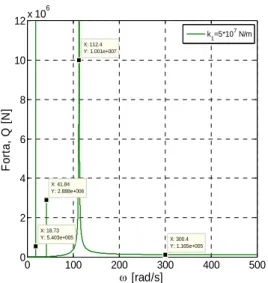
In order to assess the efficiency of the vibrations transmitted in the soil to be compacted, the maximum force transmitted in the field shall be established Qmax = k1 A1, and the T12 =k(/A2/-/A1/)/(m0 r ω2) transmissibility for the degree of isolation of vibrations.
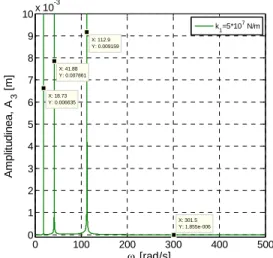
Based on the initial data and the calculated values, the variation curves of parameters A1, A2, A3, Qmax, T12, may be represented as in Images 3…7.
Fig. 3.Variation of amplitude A1 according to pulse
Fig. 4.Variation of amplitude A2 according to pulse
Fig. 5.Variation of amplitude A3 according to pulse
0 100 200 300 400 500 -0.02
0 0.02 0.04 0.06 0.08 0.1
X: 114.2 Y: 0.09008
[rad/s]
A
m
pl
it
ud
in
ea,
A
1
[m
]
X: 18.73 Y: 0.01081
X: 41.84 Y: 0.05775
X: 298.6 Y: 0.002334
k1=5*107 N/m
0 100 200 300 400 500 0
0.01 0.02 0.03 0.04 0.05 0.06 0.07 0.08 0.09 0.1
X: 113 Y: 0.09089
[rad/s]
A
m
pl
it
ud
in
ea
, A
2
[m
] X: 41.85Y: 0.06833 X: 18.74 Y: 0.05217
X: 301.5 Y: 1.066e-005
k1=5*107 N/m
0 100 200 300 400 500 0
1 2 3 4 5 6 7 8 9 10x 10
-3
X: 112.9 Y: 0.009159
[rad/s]
A
m
plit
ud
inea,
A
3
[m
]
X: 301.5 Y: 1.855e-006 X: 41.88
Y: 0.007861 X: 18.73 Y: 0.006635
k1=5*10 7
Fig. 6.Variation of maximum compaction force Qmax
according to pulse
Fig. 7.Variation transmissibility of vibration T12 with
pulse
It is found that the system has three critical zones at resonance, and in the post-resonance amplitude A1of the technological vibrations is maintained constant and stable. Amplitudes A1 in the resonance areas have high values with negative effects on the cab comfort and the durability of the motor-pump group.
In post-resonance, they have low values which make the degree of isolation high.
4. CONCLUSIONS
The compaction of natural and stabilized soil with mixed self-propelled compacting (vibrating roller and tire wheels) can be
achieved through an effective approach to real-time monitoring of the compaction process. Thus, in a first stage, the initiation parametric sizes of the technological compaction process must be evaluated. For this purpose, there are necessary the values of the vibratory roller amplitude are required in various dynamic regimes, delimited by intervals of the disturbing pulse variation with avoidance of the critical resonance areas.
This stage is the feasible variant preceding the adjustments required for "real-time control" of the dynamic compacting process.
In essence, the following conclusions are drawn from this study:
a) the dynamic calculation model can be used to initiate and complete the initial dynamic analysis data;
b) the mass, rigidity and dimensional parameters are in direct correlation with the functional regime of the vibratory compactor;
c) the Dynamic response performance can be assessed based on the calculation relations given in the work which have been verified and validated on a large number of machines and categories of land;
d) the dynamic compaction efficiency can be determined by assessing the maximum force transmitted to the compaction field;
e) the curve families are plotted on the basis of the discrete variation of the rigidity of soil, which after each pass the plastic-field pressing up is made until completion;
f) the land rigidity values, consisting of poorly cohesive soils or sandy clay soils stabilized with ecological substances, are experimentally determined on bathes and specially designed test polygons.
In essence, the data contained in this paper provides the possibility of a dynamic analysis of the vibratory roll-compacting soil system. Thus, in the initial phase it is possible to complete the compaction technology by vibration of oil, in "total monitoring" regime with decisions imposed by parametric values thresholds.
5. REFERENCES
[1] Adam, D., Kopf, F., Theoretical
analysis of dynamically loaded soils,
0 100 200 300 400 500 0
2 4 6 8 10 12x 10
6
X: 18.73 Y: 5.403e+005
[rad/s]
X: 41.84 Y: 2.888e+006
X: 112.4 Y: 1.001e+007
X: 300.4 Y: 1.165e+005
Fo
rt
a
, Q [
N
]
k1=5*107 N/m
0 100 200 300 400 500 0
0.2 0.4 0.6 0.8 1 1.2 1.4 1.6 1.8 2
X: 302.5 Y: 0.003188
[rad/s]
X: 18.6 Y: 1.401
X: 41.85 Y: 1.587
X: 113.6 Y: 1.806
T
ran
s
m
is
ibili
ta
te
a
, T
12
European Workshop: Compaction of soils and granular materials, ETC11 of ISSMGE, Paris, France, 2000;
[2] Adam, D., Kopf, F., Operational
Devices for Compaction Optimization and Quality Control (Continuous Compaction Control & Light Falling
Weight Device), Proceedings of the
International Seminar on Geotechnics in Pavement and Railway Design and Construction, Athens, Greece, pp. 97– 106, 2004;
[3] Bejan, S., Analiza performanței
procesului de compactare dinamică prin
vibrații pentru structuri rutiere, PhD
thesis, “Dunarea de Jos’’ University of Galati, 2015;
[4] Bratu, P., Mecanică teoretică, Ed. Impuls, Bucharest, 2006;
[5] Bratu, P., Sisteme elastice de rezemare
pentru mașini și utilaje, Editura
Tehnică, Bucharest, 1990;
[6] Bratu, P., Vibrațiile sistemelor elastice, Ed. Tehnică, Bucharest, 2000;
[7] Bratu, P., The behavior of nonlinear viscoelastic systems subjected to
harmonic dynamic excitation, The 9th
International Congress on Sound and Vibration, University of Central Florida Orlando, Florida, 8 – 11 July, 2002;
[8] Bratu, P., Dynamic response of
nonlinear systems under stationary harmonic excitation, Non-linear
acoustics and vibration, 11-th
International Congress on Sound and Vibration, 2767-2770, St. Petersburg, 5 - 8 Iuly, 2004;
[9] Bratu, P., Dynamic analysis in case of compaction vibrating rollers intended
for road works, The 17tg International
Congress on Sound& Vibration, ICSV, Cairo, 18-22 July, 2010;
[10] Bratu, P., Debeleac, C., The analysis of
vibratory roller motion, Proceedings of
the VII International Triennial Conference Heavy Machinery – HM 2011, Session Earth-moving and transportation machinery, Vrnjačka Banja, Serbia, 29 June -2 July, pp.23-26, ISBN 978-86-82631-58-3, 2011;
[11] Dobrescu C. F., Braguța E., -
Optimization of Vibro-Compaction Technological Process Considering
Rheological Properties, Acoustics and
Vibration of Mechanical Structures AVMS-2017, Proceedings of the 14th
AVMS Conference, Timișoara,
Romania, ISBN 978-3-319-69822-9, ISSN 0930-8989;
[12] Dobrescu C. F., Braguța E., ”Dynamic modeling of vibro-compaction process
on cohesionless granular soils”
Acoustics and Vibration of Mechanical Structures“ May 25- 26, 2017 - Timișoara, Romania;
[13] Leopa, A., Debeleac, C., Năstac, S., Simulation of Vibration Effects on Ground Produced by Technological
Equipments, 12th International
Multidisciplinary Scientific
GeoConference SGEM2012,
Conference Proceedings, Vol. 5, Vol. 5, pp. 743-750, ISSN 1314-2704, 2012; [14] Leopa, A., Năstac, S., Debeleac, C.,
Căpățână, G.F., Potirniche, A., Identification of parameters characterizing the nonlinear behavior of viscous-elastic systems on dynamic
loadings, The 8th International
DAAAM Baltic Conference "Industrial Engineering “, April 19-21, Tallinn, Estonia, 2012;
[15] Mihăilescu Șt., Bratu P., Goran V., Vlădeanu Al.- Mașini de construcții.
Calculul, construcția și încercarea
mașinilor pentru lucrări de pământ.
Vol.II, Editura Tehnică, Bucharest, 1985, Coordinators: Șt. Mihăilescu, P. Bratu
[16] Mooney, M.A., Rinehart, R.V. Field Monitoring of Roller Vibration During
Compaction of Subgrade Soil, Journal
of Geotechnical and Geoenvironmental Engineering, ASCE, Vol. 133, No. 3, pp. 257–265, 2007;
[17] Mooney, M.A., Rinehart, R.V., In-Situ Soil Response to Vibratory Loading and
ItsRelationship to Roller-Measured Soil
Geoenvironmental Engineering, ASCE, Vol. 135, No. 8, pp. 1022–1031, 2009;
[18] Morariu –Gligor R., Study of the
influence of plate compactor weight on
its functioning ACTA TECHNICA
NAPOCENSIS, Series: Applied Mathematics, Mechanics and Engineering, Vol. 57, Issue II, June, 2014
[19] Morariu –Gligor R.,Factors influencing
the degree of soil compaction, ACTA
TECHNICA NAPOCENSIS, Series: Applied Mathematics, Mechanics and Engineering, Vol. 60, Issue I, March, 2017
[20] Pințoi R., Bordos R., Braguța E., - Vibration Effects in the Process of Dynamic Compaction of Fresh Concrete
and Stabilized Earth, Journal of
Vibration Engineering & Technologies –Volume 5, December 2017, ISSN 2321-3558;
[21] Polidor Bratu, Adriana Stuparu, Adrian
Leopa, Sorin Popa, The dynamic
analyse of a construction with the base insulation consisting
in anti-seismic devices modelled as a Hooke-Voigt-Kelvin linear rheological system, ACTA TECHNICA NAPOCENSIS, Series: Applied Mathematics, Mechanics and Engineering, Vol. 60, Issue IV, November, 2017
[22] Polidor Bratu, Adriana Stuparu, Sorin Popa, Ovidiu Voicu, Nicolae Iacob, The assessment of the dynamic response to seismic excitation for constructions equipped with base isolation systems according to the newton-voigt-kelvin
model, ACTA TECHNICA
NAPOCENSIS, Series: Applied Mathematics, Mechanics and Engineering, Vol. 60, Issue IV, November, 2017
[23] Polidor Bratu, Adriana Stuparu, Sorin Popa, Ovidiu Voicu, Nicolae Iacob, Gianina Spânu, The dynamic isolation performances analysis of the vibrating equipment with elastic links to a fixed
base, ACTA TECHNICA
NAPOCENSIS, Series: Applied Mathematics, Mechanics and Engineering, Vol. 61, Issue I, March, 2018
ANALIZA REGIMULUI DINAMIC AL VIBRATIILOR FORTATE IN PROCESUL DE COMPACTARE
DINAMICĂ CU RULOURI VIBRATOARE
Rezumat: Pentru a crește eficiența și viteza de lucru, în procesul compactării dinamice se utilizează
compactoare mixte. Reglarea regimului de vibrații al tamburului compactorului, cu viteza de deplasare, se face pe baza monitorizării în timp real a răspunsului dinamic. Astfel, mișcarea instantanee a vibrațiilor tamburului compactorului este captată sub forma unui semnal analogic și apoi convertită în sistemul digital până la apariția unor supra-armonici specifice tranziției în domeniul plastic. Acest articol prezintă schema dinamică a unui compactor mixt cu vibrații autopropulsate. Astfel, pe baza analizei dinamice, se prezintă variația mașinii și a amplitudinii tehnologice cu rolele de compactor, inclusiv forța transmisă în suprafața de compactare.